
COMPSCI 220 Programming Methodology FirstClass Functions We introduce
![Nested Functions // map<S, T>(f: (x : S) => T, a: S[]): T[] function](https://slidetodoc.com/presentation_image/255a7da660db6fae00763b84d97b3b90/image-5.jpg "Nested Functions // map<S, T>(f: (x : S) => T, a: S[]): T[] function")

![Abstraction: Take 2 // scale. By(n: number): // (a: number[][]) => number[][] function scale.](https://slidetodoc.com/presentation_image/255a7da660db6fae00763b84d97b3b90/image-18.jpg "Abstraction: Take 2 // scale. By(n: number): // (a: number[][]) => number[][] function scale.")
- Slides: 24
COMPSCI 220 Programming Methodology
First-Class Functions We introduce the idea that functions are values, code is data, etc. Some of the concepts in this section are very hard, and won’t really make sense until we get to the next section, where we introduce the idea of closures. We recommend revisiting the examples in this section after you learn about closures.
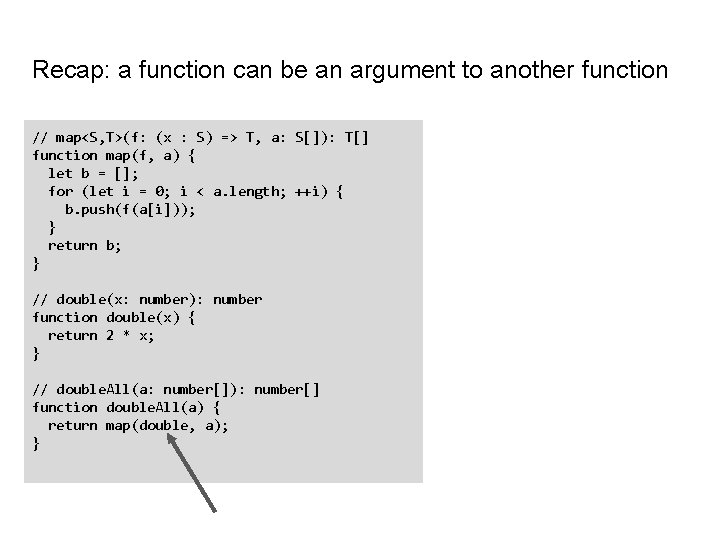
Recap: a function can be an argument to another function // map<S, T>(f: (x : S) => T, a: S[]): T[] function map(f, a) { let b = []; for (let i = 0; i < a. length; ++i) { b. push(f(a[i])); } return b; } // double(x: number): number function double(x) { return 2 * x; } // double. All(a: number[]): number[] function double. All(a) { return map(double, a); }
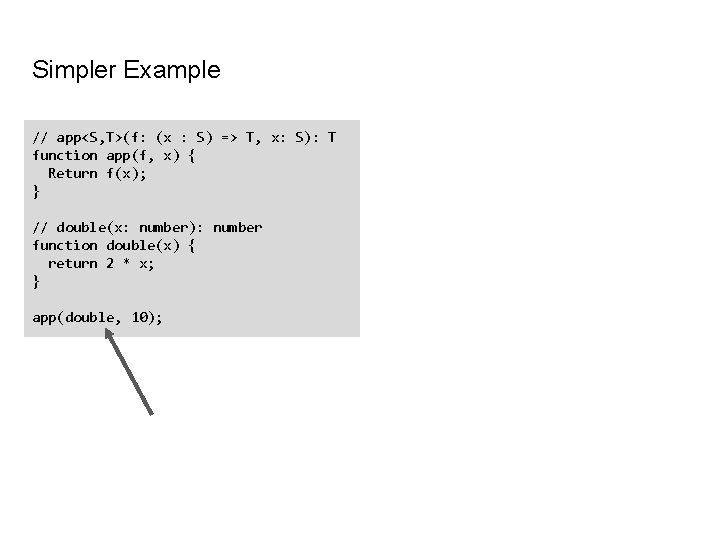
Simpler Example // app<S, T>(f: (x : S) => T, x: S): T function app(f, x) { Return f(x); } // double(x: number): number function double(x) { return 2 * x; } app(double, 10);
Nested Functions // map<S, T>(f: (x : S) => T, a: S[]): T[] function map(f, a) { let b = []; for (let i = 0; i < a. length; ++i) { b. push(f(a[i])); } return b; } // double. All(a: number[]): number[] function double. All(a) { // double(x: number): number function double(x) { return 2 * x; } return map(double, a); } The double function is a helper. Nesting it inside double. All makes that clear. We cannot call double from double. All.
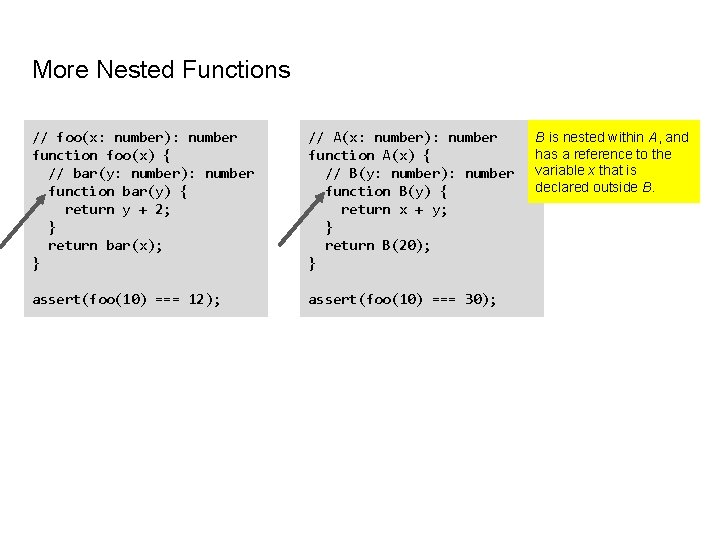
More Nested Functions // foo(x: number): number function foo(x) { // bar(y: number): number function bar(y) { return y + 2; } return bar(x); } // A(x: number): number function A(x) { // B(y: number): number function B(y) { return x + y; } return B(20); } assert(foo(10) === 12); assert(foo(10) === 30); B is nested within A, and has a reference to the variable x that is declared outside B.
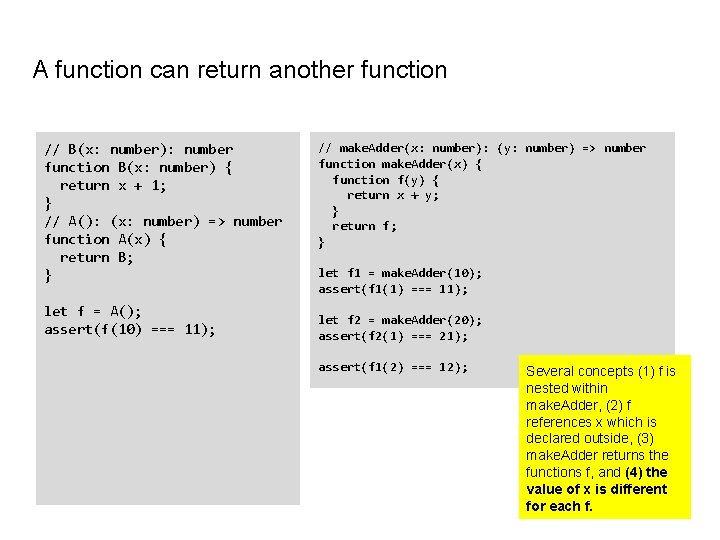
A function can return another function // B(x: number): number function B(x: number) { return x + 1; } // A(): (x: number) => number function A(x) { return B; } let f = A(); assert(f(10) === 11); // make. Adder(x: number): (y: number) => number function make. Adder(x) { function f(y) { return x + y; } return f; } let f 1 = make. Adder(10); assert(f 1(1) === 11); let f 2 = make. Adder(20); assert(f 2(1) === 21); assert(f 1(2) === 12); Several concepts (1) f is nested within make. Adder, (2) f references x which is declared outside, (3) make. Adder returns the functions f, and (4) the value of x is different for each f.
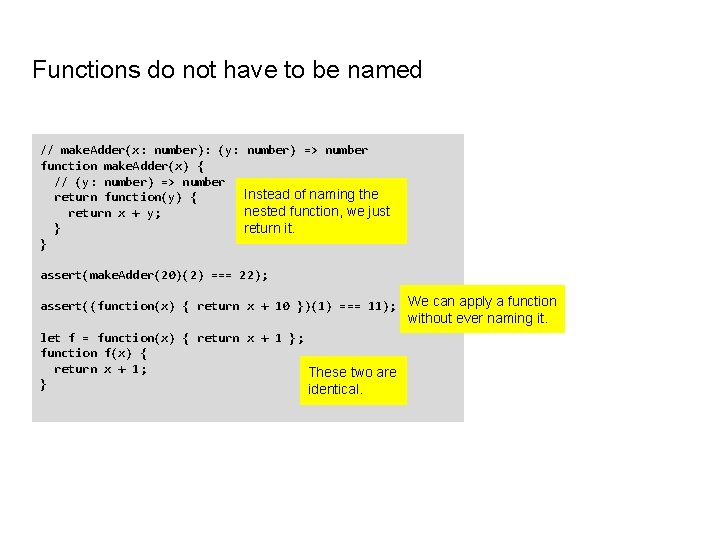
Functions do not have to be named // make. Adder(x: number): (y: function make. Adder(x) { // (y: number) => number return function(y) { return x + y; } } number) => number Instead of naming the nested function, we just return it. assert(make. Adder(20)(2) === 22); assert((function(x) { return x + 10 })(1) === 11); We can apply a function without ever naming it. let f = function(x) { return x + 1 }; function f(x) { return x + 1; These two are } identical.
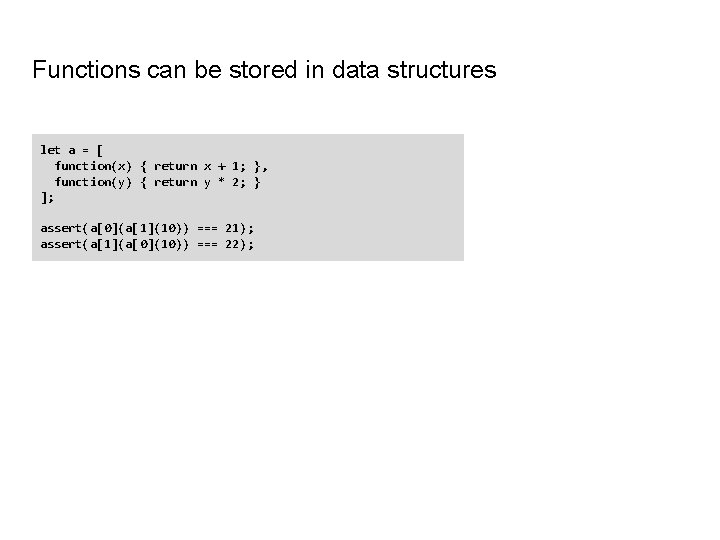
Functions can be stored in data structures let a = [ function(x) { return x + 1; }, function(y) { return y * 2; } ]; assert(a[0](a[1](10)) === 21); assert(a[1](a[0](10)) === 22);
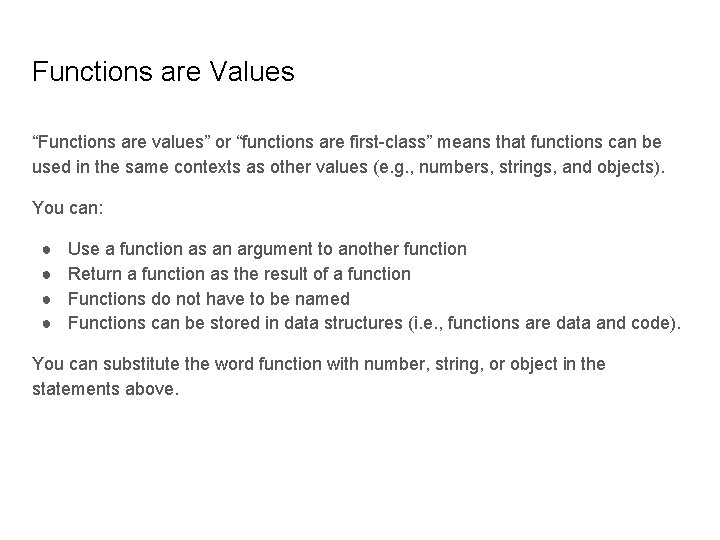
Functions are Values “Functions are values” or “functions are first-class” means that functions can be used in the same contexts as other values (e. g. , numbers, strings, and objects). You can: ● ● Use a function as an argument to another function Return a function as the result of a function Functions do not have to be named Functions can be stored in data structures (i. e. , functions are data and code). You can substitute the word function with number, string, or object in the statements above.
Function calls vs declarations The following examples should be straightforward. The only wrinkle is that we are going to return functions and nest functions.
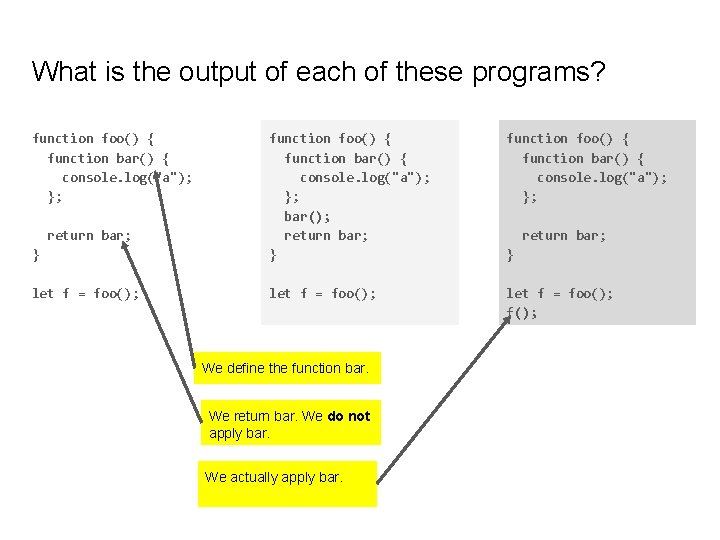
What is the output of each of these programs? function foo() { function bar() { console. log("a"); }; } function foo() { function bar() { console. log("a"); }; bar(); return bar; } let f = foo(); f(); return bar; We define the function bar. We return bar. We do not apply bar. We actually apply bar. return bar; }
Scope and Closures
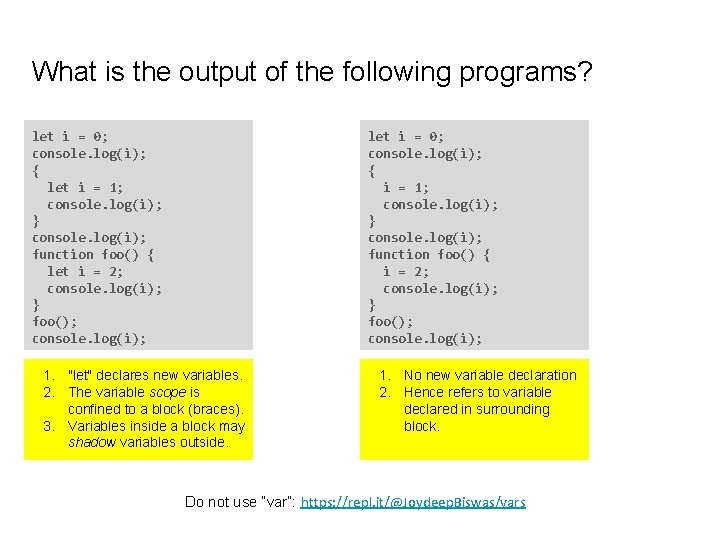
What is the output of the following programs? let i = 0; console. log(i); { let i = 1; console. log(i); } console. log(i); function foo() { let i = 2; console. log(i); } foo(); console. log(i); let i = 0; console. log(i); { i = 1; console. log(i); } console. log(i); function foo() { i = 2; console. log(i); } foo(); console. log(i); 1. "let" declares new variables. 2. The variable scope is confined to a block (braces). 3. Variables inside a block may shadow variables outside. 1. No new variable declaration 2. Hence refers to variable declared in surrounding block. Do not use “var”: https: //repl. it/@Joydeep. Biswas/vars
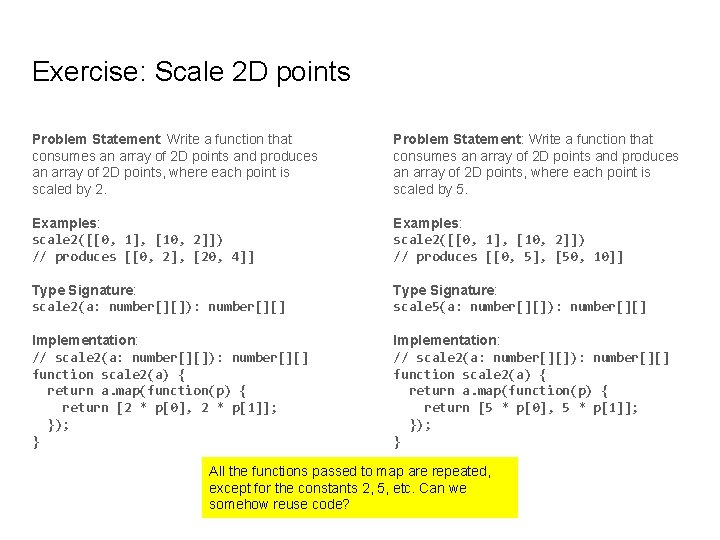
Exercise: Scale 2 D points Problem Statement: Write a function that consumes an array of 2 D points and produces an array of 2 D points, where each point is scaled by 2. Problem Statement: Write a function that consumes an array of 2 D points and produces an array of 2 D points, where each point is scaled by 5. Examples: scale 2([[0, 1], [10, 2]]) // produces [[0, 2], [20, 4]] Examples: scale 2([[0, 1], [10, 2]]) // produces [[0, 5], [50, 10]] Type Signature: scale 2(a: number[][]): number[][] Type Signature: scale 5(a: number[][]): number[][] Implementation: // scale 2(a: number[][]): number[][] function scale 2(a) { return a. map(function(p) { return [2 * p[0], 2 * p[1]]; }); } Implementation: // scale 2(a: number[][]): number[][] function scale 2(a) { return a. map(function(p) { return [5 * p[0], 5 * p[1]]; }); } All the functions passed to map are repeated, except for the constants 2, 5, etc. Can we somehow reuse code?
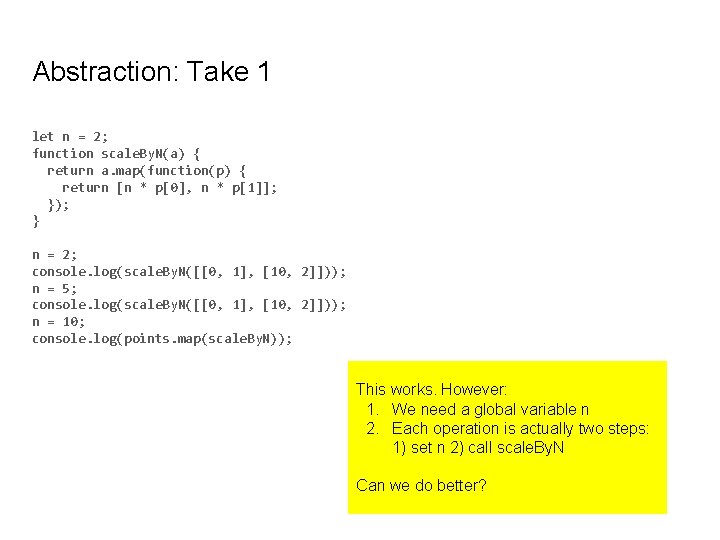
Abstraction: Take 1 let n = 2; function scale. By. N(a) { return a. map(function(p) { return [n * p[0], n * p[1]]; }); } n = 2; console. log(scale. By. N([[0, 1], [10, 2]])); n = 5; console. log(scale. By. N([[0, 1], [10, 2]])); n = 10; console. log(points. map(scale. By. N)); This works. However: 1. We need a global variable n 2. Each operation is actually two steps: 1) set n 2) call scale. By. N Can we do better?
Abstraction: Take 2 // scale. By(n: number): // (a: number[][]) => number[][] function scale. By(n) { // f(a: number[][]): number[][] function f(a) { return a. map(function(p) { return [n * p[0], n * p[1]]; }); }; return f; } let scale 2 = scale. By. N(2); let scale 5 = scale. By. N(5); This raises several questions: 1. What is the value of p in scale. By? The variable p is not in scope in scale. By. Trick question! 2. scale. By returns a function. When is that function executed? In the code on the left, it is never executed. 3. How does the returned function “remember” the value of n? scale. By does not return the function f. scale. By returns a closure. A closure is a function with values for its free variables. You cannot directly write a closure. So, we will invent our own notation to talk about them. ● The value of scale 2 is f [n → 2 ] ● The value of scale 5 is f [n → 5 ]
CLOSURES
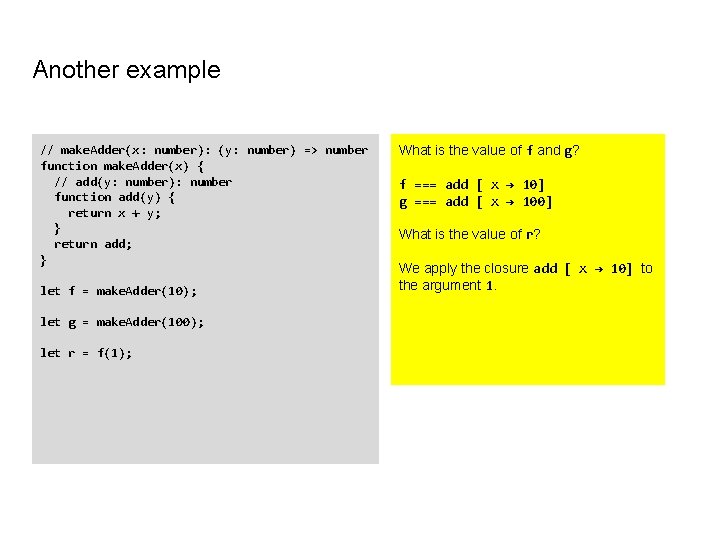
Another example // make. Adder(x: number): (y: number) => number function make. Adder(x) { // add(y: number): number function add(y) { return x + y; } return add; } let f = make. Adder(10); let g = make. Adder(100); let r = f(1); What is the value of f and g? f === add [ x → 10] g === add [ x → 100] What is the value of r? We apply the closure add [ x → 10] to the argument 1.
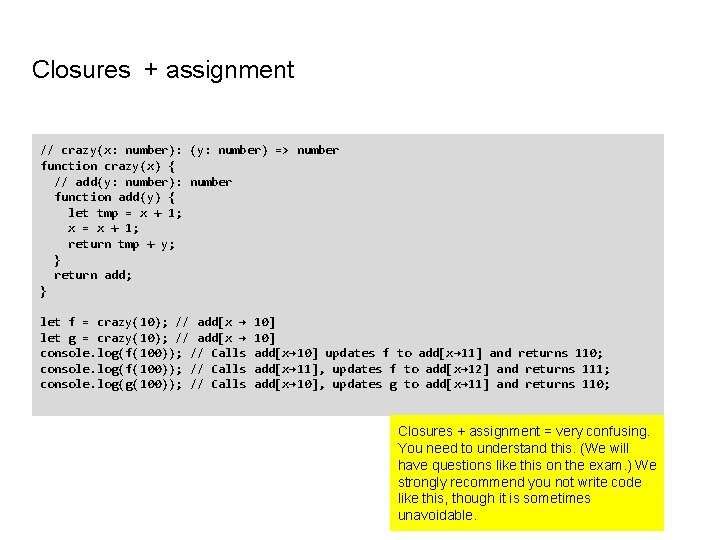
Closures + assignment // crazy(x: number): (y: number) => number function crazy(x) { // add(y: number): number function add(y) { let tmp = x + 1; x = x + 1; return tmp + y; } return add; } let f = crazy(10); // add[x → let g = crazy(10); // add[x → console. log(f(100)); // Calls console. log(g(100)); // Calls 10] add[x→ 10] updates f to add[x→ 11] and returns 110; add[x→ 11], updates f to add[x→ 12] and returns 111; add[x→ 10], updates g to add[x→ 11] and returns 110; Closures + assignment = very confusing. You need to understand this. (We will have questions like this on the exam. ) We strongly recommend you not write code like this, though it is sometimes unavoidable.
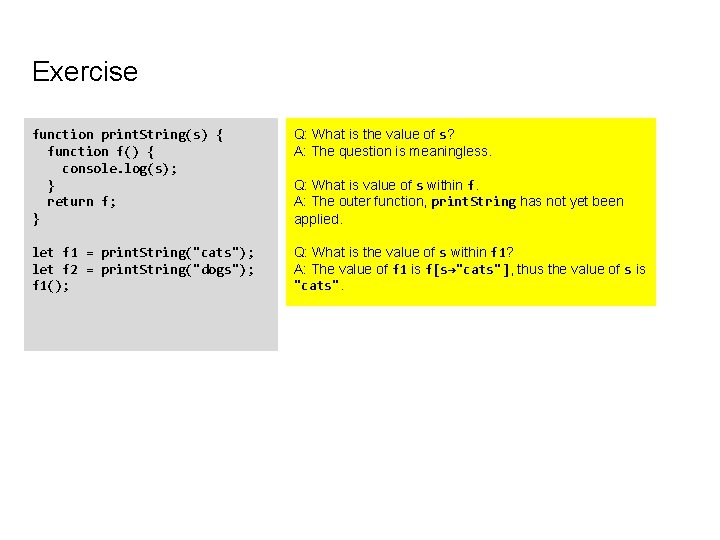
Exercise function print. String(s) { function f() { console. log(s); } return f; } Q: What is the value of s? A: The question is meaningless. let f 1 = print. String("cats"); let f 2 = print. String("dogs"); f 1(); Q: What is the value of s within f 1? A: The value of f 1 is f[s→"cats"], thus the value of s is "cats". Q: What is value of s within f. A: The outer function, print. String has not yet been applied.
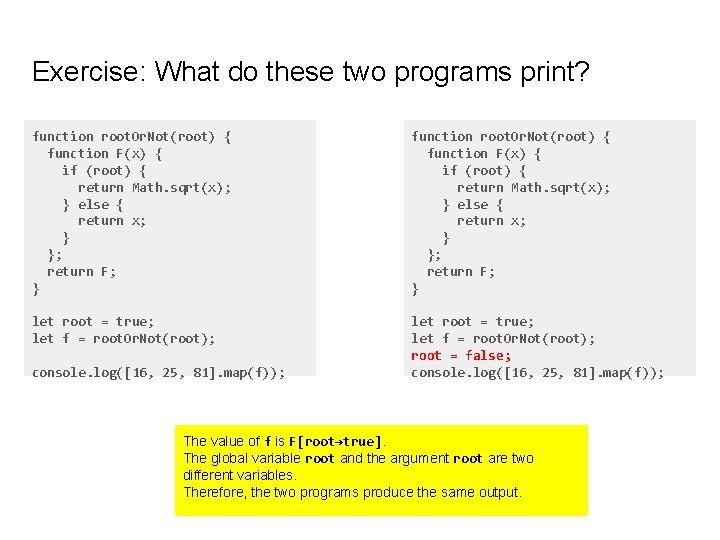
Exercise: What do these two programs print? function root. Or. Not(root) { function F(x) { if (root) { return Math. sqrt(x); } else { return x; } }; return F; } let root = true; let f = root. Or. Not(root); root = false; console. log([16, 25, 81]. map(f)); The value of f is F[root→true]. The global variable root and the argument root are two different variables. Therefore, the two programs produce the same output.
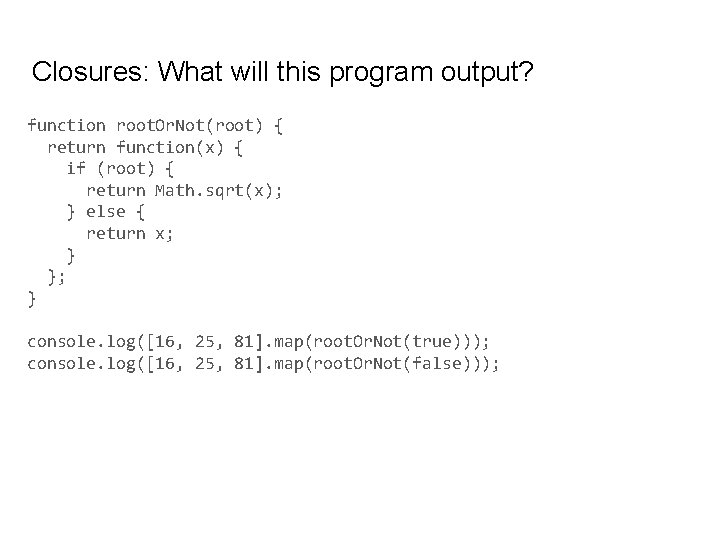
Closures: What will this program output? function root. Or. Not(root) { return function(x) { if (root) { return Math. sqrt(x); } else { return x; } }; } console. log([16, 25, 81]. map(root. Or. Not(true))); console. log([16, 25, 81]. map(root. Or. Not(false)));