
Compsci 201 Recursion DNALink preview Owen Astrachan olacs
- Slides: 39
Compsci 201, Recursion, DNA-Link preview Owen Astrachan ola@cs. duke. edu http: //bit. ly/201 spring 19 March 1, 2019 3/1/2019 Compsci 201, Spring 2019, Linked Lists Recursion 1
N is for … • new • Allocating memory from the heap • null • Value when nothing has been allocated 3/1/2019 Compsci 201, Spring 2019, Linked Lists Recursion 2
Plan for Today • Introduction to Recursion • Canonical problem-solving/programming tool • Useful for lists, trees, and when structure is self-referential (algorithmic too, not today) • Review linked lists in context of DNA-link • You can work with a partner, choose next week, run code, finish after break 3/1/2019 Compsci 201, Spring 2019, Linked Lists Recursion 3
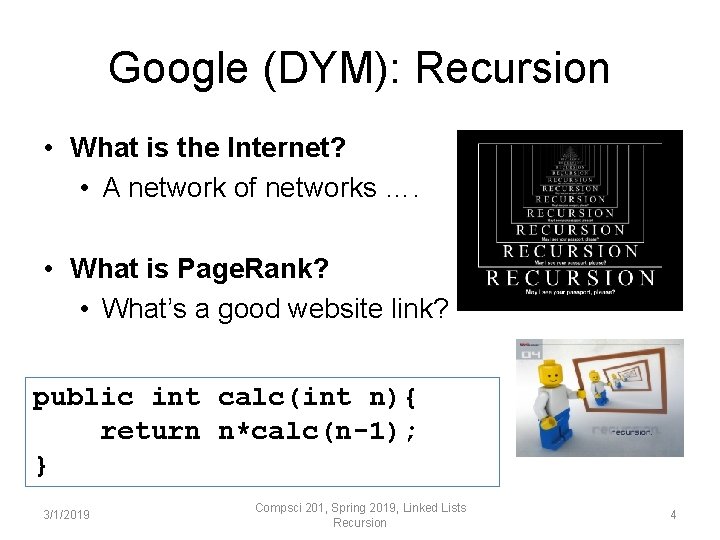
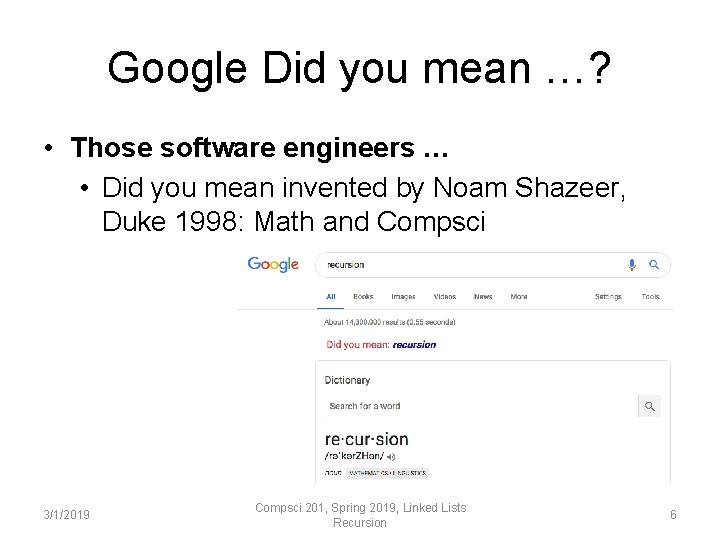
Google (DYM): Recursion • What is the Internet? • A network of networks …. • What is Page. Rank? • What’s a good website link? public int calc(int n){ return n*calc(n-1); } 3/1/2019 Compsci 201, Spring 2019, Linked Lists Recursion 4
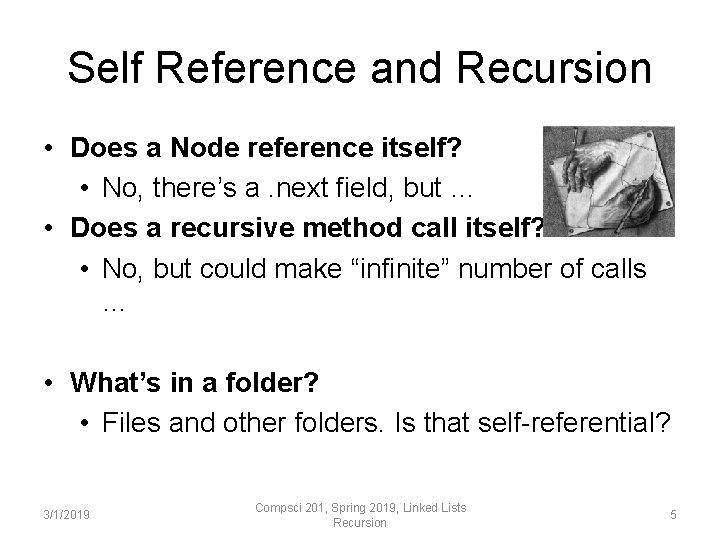
Self Reference and Recursion • Does a Node reference itself? • No, there’s a. next field, but … • Does a recursive method call itself? • No, but could make “infinite” number of calls … • What’s in a folder? • Files and other folders. Is that self-referential? 3/1/2019 Compsci 201, Spring 2019, Linked Lists Recursion 5
Google Did you mean …? • Those software engineers … • Did you mean invented by Noam Shazeer, Duke 1998: Math and Compsci 3/1/2019 Compsci 201, Spring 2019, Linked Lists Recursion 6
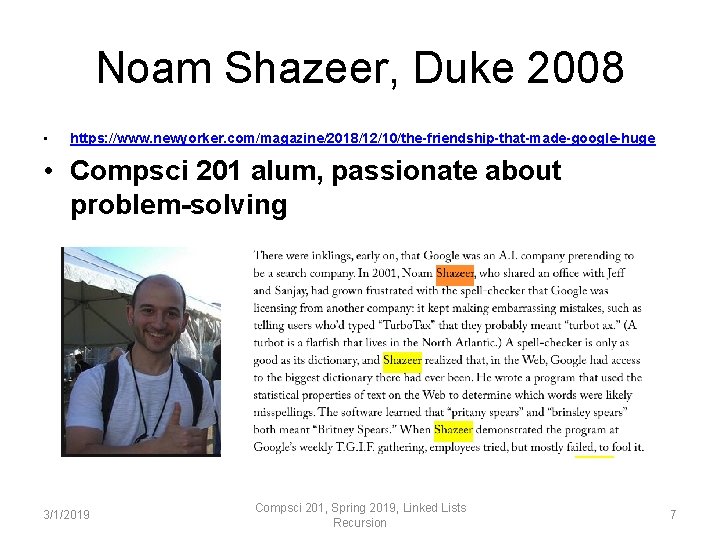
Noam Shazeer, Duke 2008 • https: //www. newyorker. com/magazine/2018/12/10/the-friendship-that-made-google-huge • Compsci 201 alum, passionate about problem-solving 3/1/2019 Compsci 201, Spring 2019, Linked Lists Recursion 7
When to use recursion • The structure of the problem lends itself … • Folders/Directories contain … • Nodes in a linked list contain … • The algorithmic structure lends itself … • Sorting algorithms as we’ll see … • Factorial? Just say no … 3/1/2019 Compsci 201, Spring 2019, Linked Lists Recursion 8
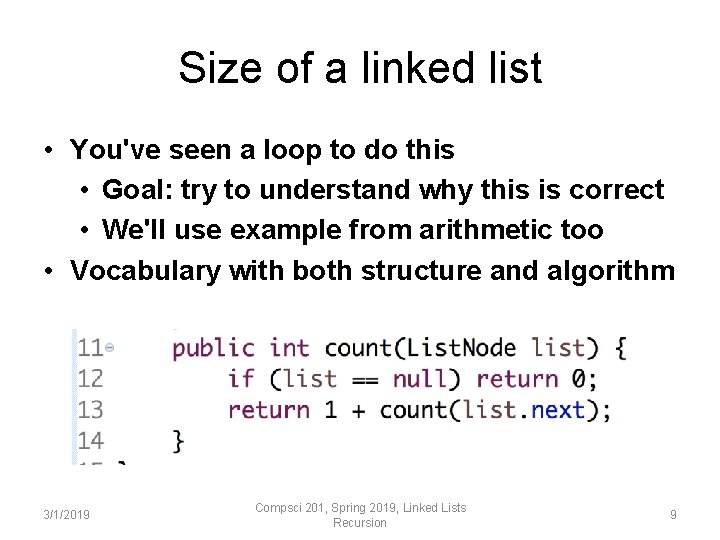
Size of a linked list • You've seen a loop to do this • Goal: try to understand why this is correct • We'll use example from arithmetic too • Vocabulary with both structure and algorithm 3/1/2019 Compsci 201, Spring 2019, Linked Lists Recursion 9
Vocabulary • All recursive code has a base case • A simple case where no recursion necessary • Example in linked list? null, no recursion • sometimes one node case too • Base case always identified with an if statement. 3/1/2019 Compsci 201, Spring 2019, Linked Lists Recursion 10
Understanding Recursion • Visualize: https: //goo. gl/Qd 9 Lqa • The base case anchors the recursion • There's no loop! Why? • Sequence of recursive calls • Stacked up until base returns • The recursive call "decreases" • Must get toward base case 3/1/2019 Compsci 201, Spring 2019, Linked Lists Recursion 11
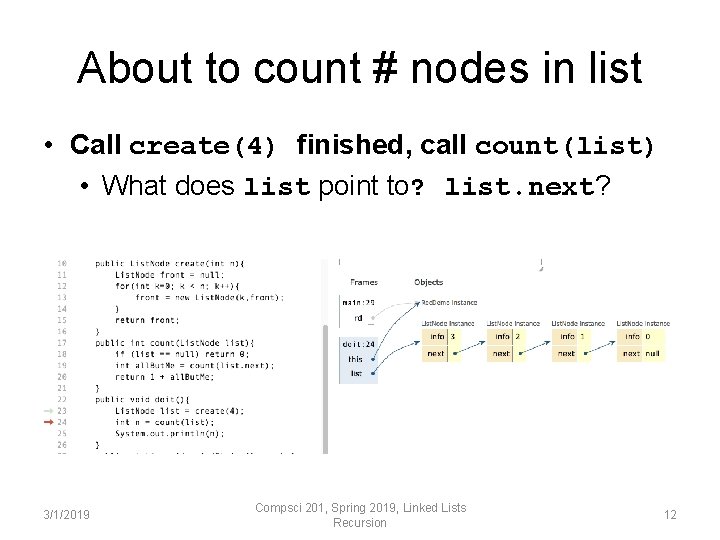
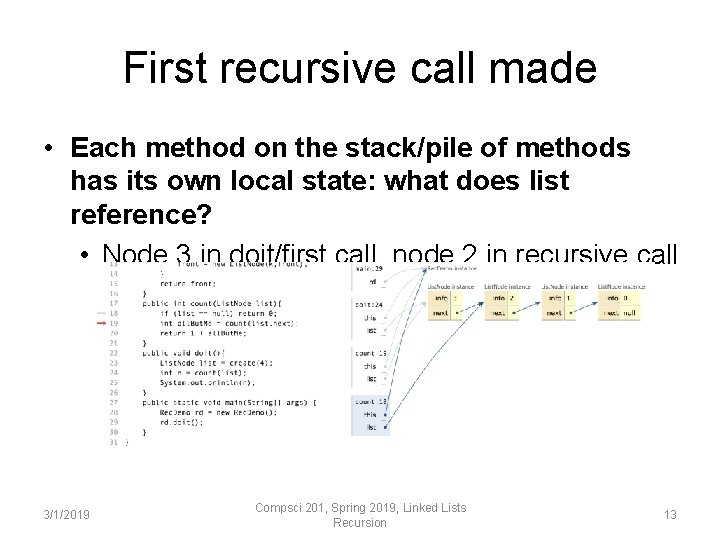
About to count # nodes in list • Call create(4) finished, call count(list) • What does list point to? list. next? 3/1/2019 Compsci 201, Spring 2019, Linked Lists Recursion 12
First recursive call made • Each method on the stack/pile of methods has its own local state: what does list reference? • Node 3 in doit/first call, node 2 in recursive call 3/1/2019 Compsci 201, Spring 2019, Linked Lists Recursion 13
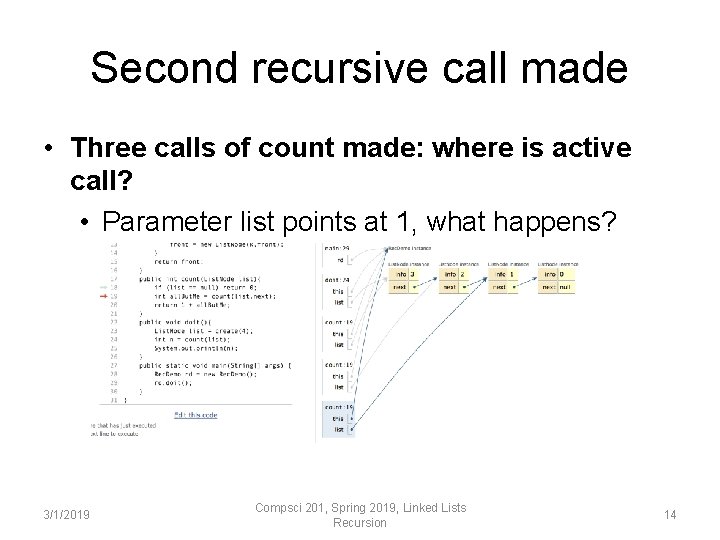
Second recursive call made • Three calls of count made: where is active call? • Parameter list points at 1, what happens? 3/1/2019 Compsci 201, Spring 2019, Linked Lists Recursion 14
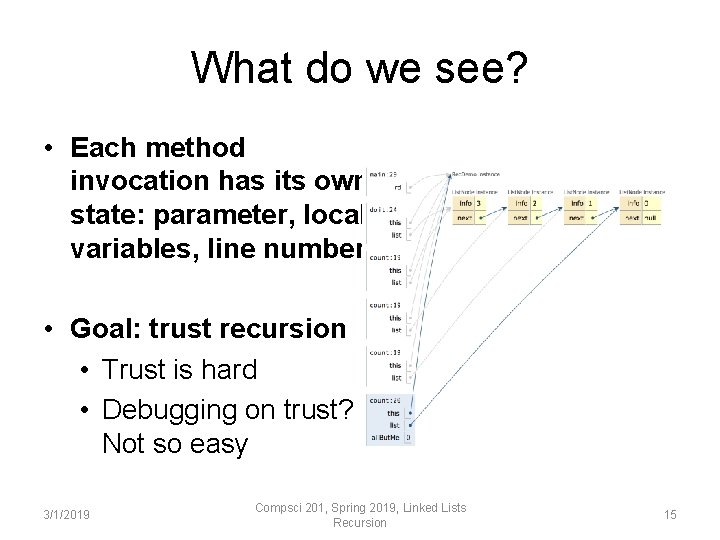
What do we see? • Each method invocation has its own state: parameter, local variables, line number • Goal: trust recursion • Trust is hard • Debugging on trust? Not so easy 3/1/2019 Compsci 201, Spring 2019, Linked Lists Recursion 15
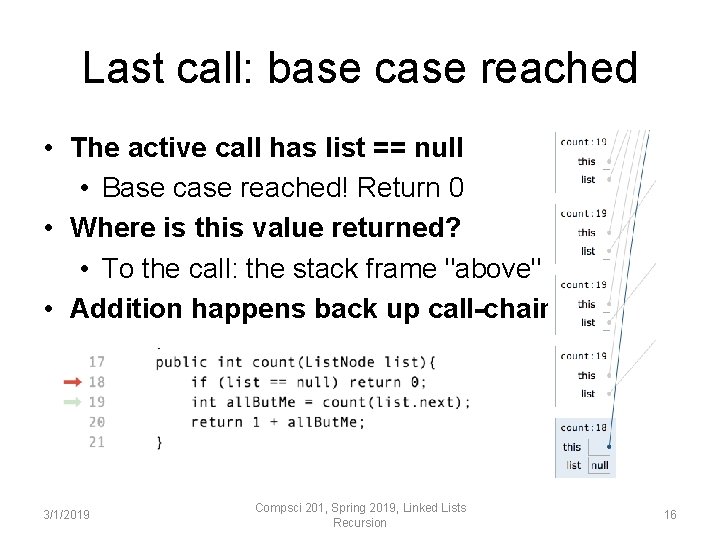
Last call: base case reached • The active call has list == null • Base case reached! Return 0 • Where is this value returned? • To the call: the stack frame "above" • Addition happens back up call-chain 3/1/2019 Compsci 201, Spring 2019, Linked Lists Recursion 16
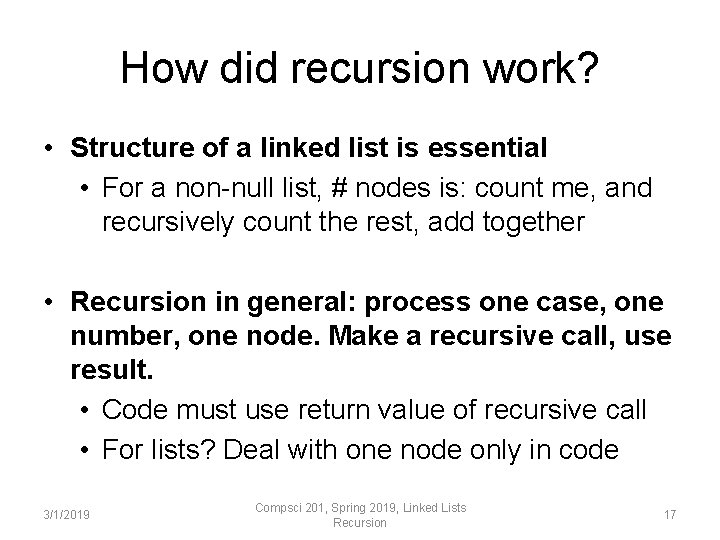
How did recursion work? • Structure of a linked list is essential • For a non-null list, # nodes is: count me, and recursively count the rest, add together • Recursion in general: process one case, one number, one node. Make a recursive call, use result. • Code must use return value of recursive call • For lists? Deal with one node only in code 3/1/2019 Compsci 201, Spring 2019, Linked Lists Recursion 17
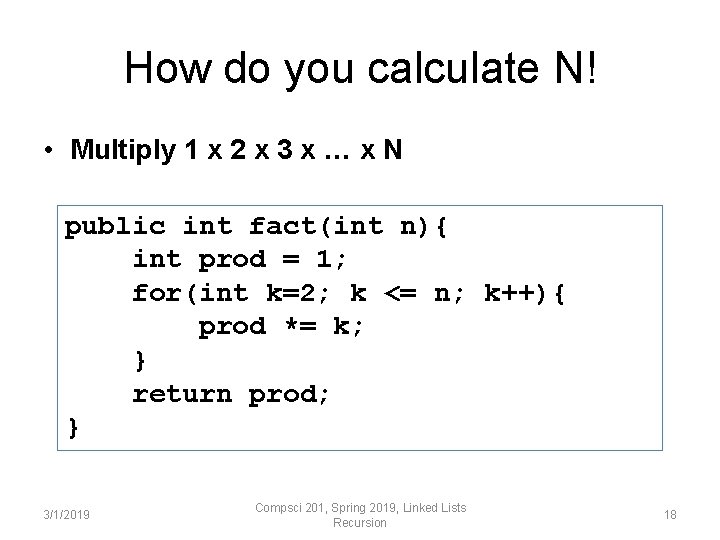
How do you calculate N! • Multiply 1 x 2 x 3 x … x N public int fact(int n){ int prod = 1; for(int k=2; k <= n; k++){ prod *= k; } return prod; } 3/1/2019 Compsci 201, Spring 2019, Linked Lists Recursion 18
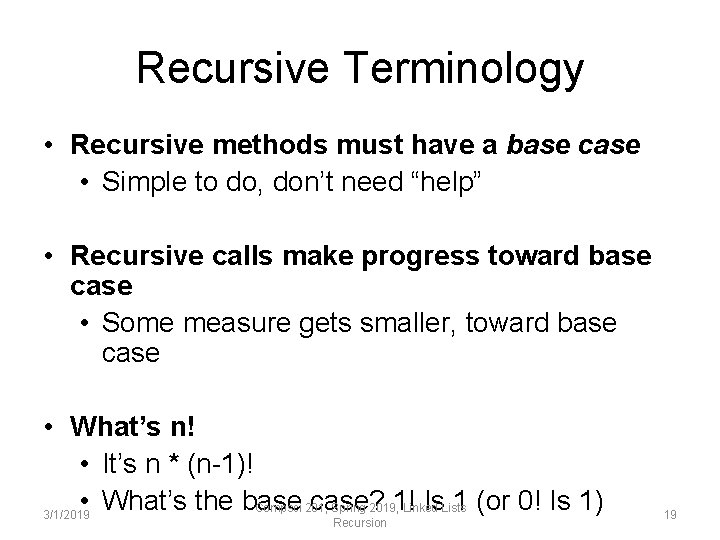
Recursive Terminology • Recursive methods must have a base case • Simple to do, don’t need “help” • Recursive calls make progress toward base case • Some measure gets smaller, toward base case • What’s n! • It’s n * (n-1)! • What’s the base case? 1!Linked Is. Lists 1 (or 0! Is 1) Compsci 201, Spring 2019, 3/1/2019 Recursion 19
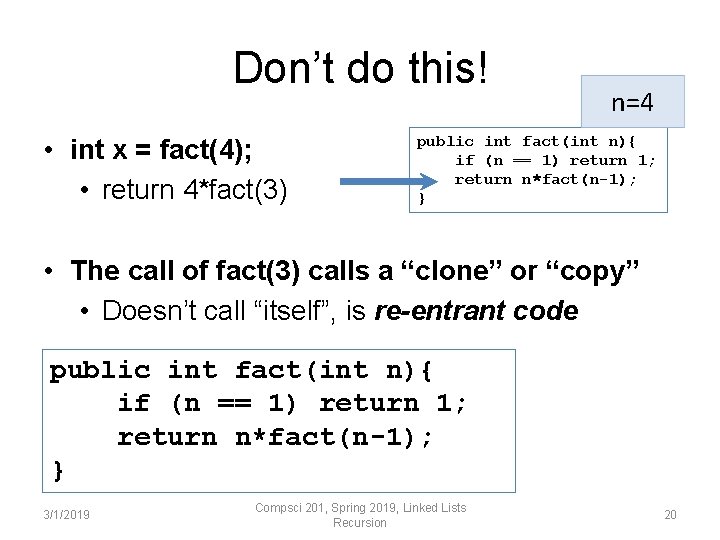
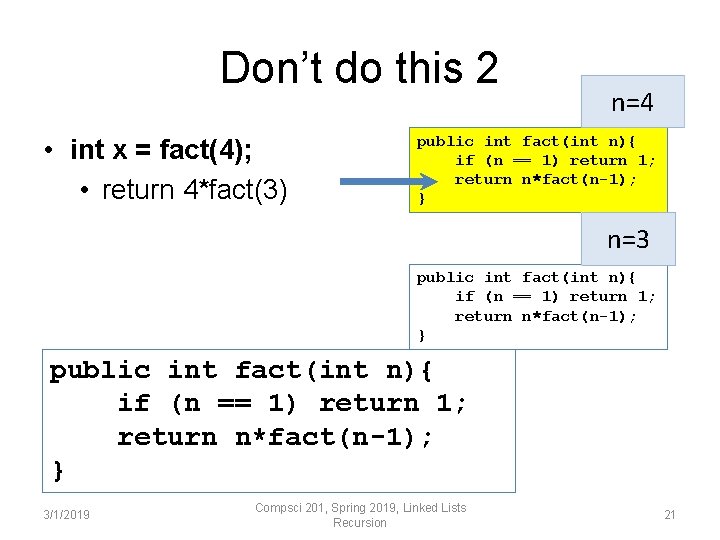
Don’t do this! • int x = fact(4); • return 4*fact(3) n=4 public int fact(int n){ if (n == 1) return 1; return n*fact(n-1); } • The call of fact(3) calls a “clone” or “copy” • Doesn’t call “itself”, is re-entrant code public int fact(int n){ if (n == 1) return 1; return n*fact(n-1); } 3/1/2019 Compsci 201, Spring 2019, Linked Lists Recursion 20
Don’t do this 2 • int x = fact(4); • return 4*fact(3) n=4 public int fact(int n){ if (n == 1) return 1; return n*fact(n-1); } n=3 public int fact(int n){ if (n == 1) return 1; return n*fact(n-1); } 3/1/2019 Compsci 201, Spring 2019, Linked Lists Recursion 21
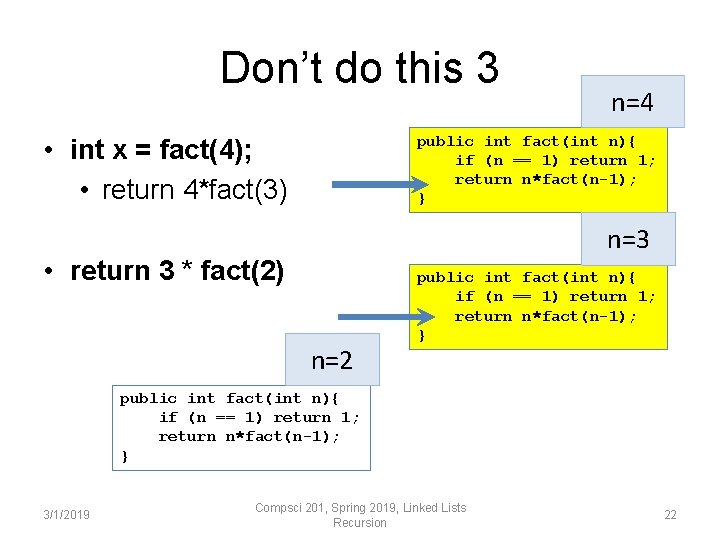
Don’t do this 3 n=4 public int fact(int n){ if (n == 1) return 1; return n*fact(n-1); } • int x = fact(4); • return 4*fact(3) n=3 • return 3 * fact(2) n=2 public int fact(int n){ if (n == 1) return 1; return n*fact(n-1); } 3/1/2019 Compsci 201, Spring 2019, Linked Lists Recursion 22
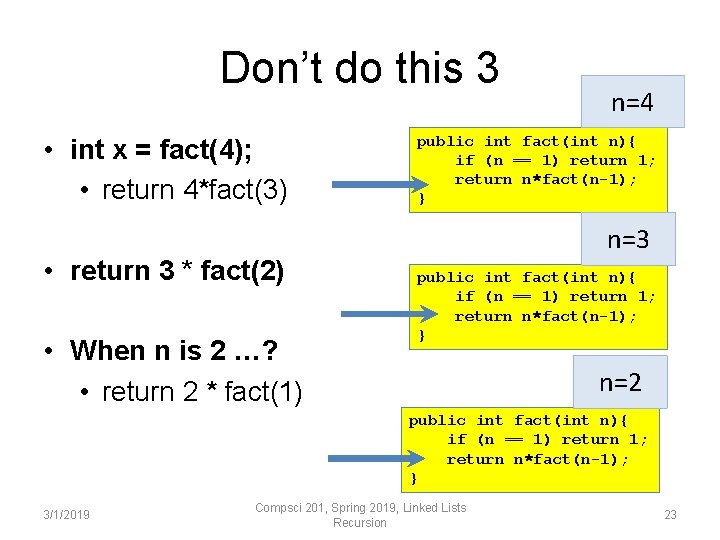
Don’t do this 3 • int x = fact(4); • return 4*fact(3) • return 3 * fact(2) • When n is 2 …? • return 2 * fact(1) n=4 public int fact(int n){ if (n == 1) return 1; return n*fact(n-1); } n=3 public int fact(int n){ if (n == 1) return 1; return n*fact(n-1); } n=2 public int fact(int n){ if (n == 1) return 1; return n*fact(n-1); } 3/1/2019 Compsci 201, Spring 2019, Linked Lists Recursion 23
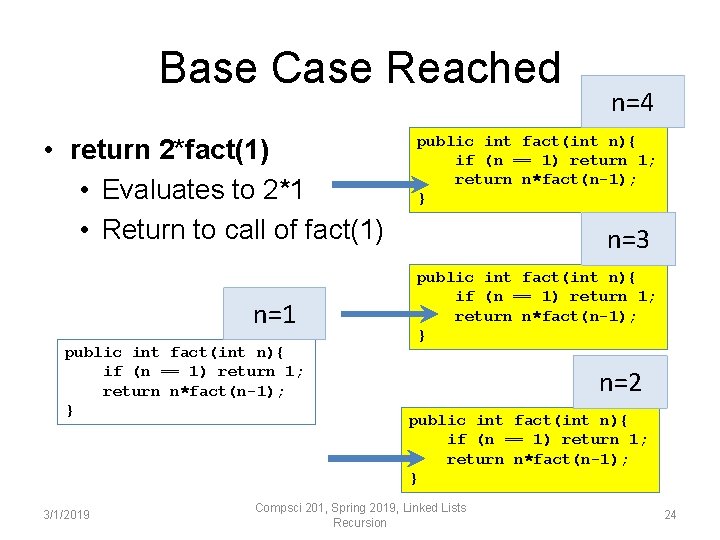
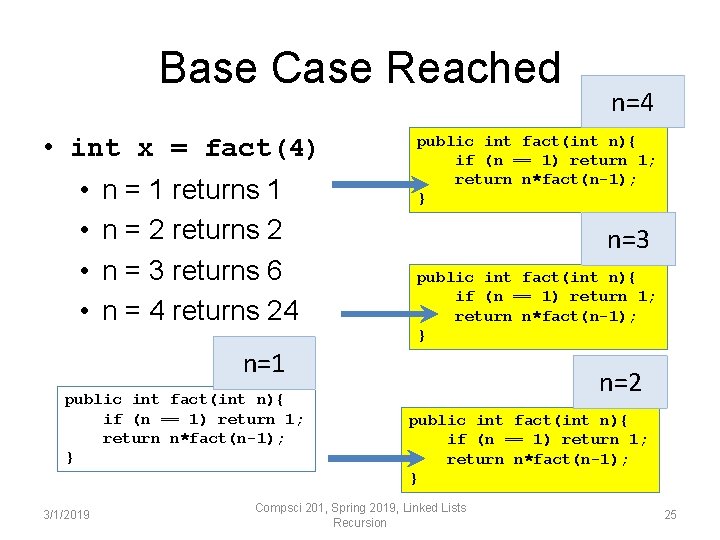
Base Case Reached • return 2*fact(1) • Evaluates to 2*1 • Return to call of fact(1) n=1 public int fact(int n){ if (n == 1) return 1; return n*fact(n-1); } 3/1/2019 n=4 public int fact(int n){ if (n == 1) return 1; return n*fact(n-1); } n=3 public int fact(int n){ if (n == 1) return 1; return n*fact(n-1); } n=2 public int fact(int n){ if (n == 1) return 1; return n*fact(n-1); } Compsci 201, Spring 2019, Linked Lists Recursion 24
Base Case Reached • int x = fact(4) • • n = 1 returns 1 n = 2 returns 2 n = 3 returns 6 n = 4 returns 24 public int fact(int n){ if (n == 1) return 1; return n*fact(n-1); } n=3 public int fact(int n){ if (n == 1) return 1; return n*fact(n-1); } n=1 public int fact(int n){ if (n == 1) return 1; return n*fact(n-1); } 3/1/2019 n=4 n=2 public int fact(int n){ if (n == 1) return 1; return n*fact(n-1); } Compsci 201, Spring 2019, Linked Lists Recursion 25
WOTO http: //bit. ly/201 spring 19 -march 11 3/1/2019 Compsci 201, Spring 2019, Linked Lists Recursion 26
From Links to … • What is the DNA/Link. Strand assignment about? • Why do we study linked lists • How do you work in a group? 3/1/2019 Compsci 201, Spring 2019, Linked Lists Recursion 27
From PCR to linked lists • Polymerase Chain Reaction • Make copies of a specific DNA segment • Recombinant DNA • Insert DNA using restriction enzymes • Loosely forms basis for DNA/Linked assignment • Big gains in efficiency using Linked Lists • Compare to array of chars, e. g. Strings 3/1/2019 Compsci 201, Spring 2019, Linked Lists Recursion 28
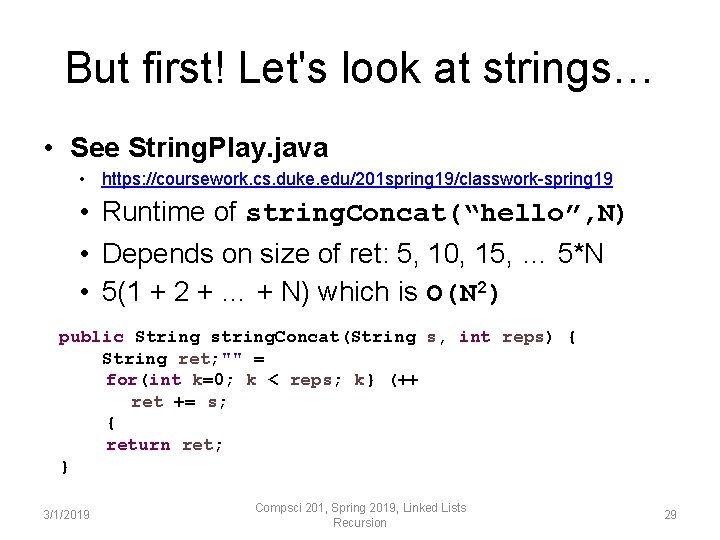
But first! Let's look at strings… • See String. Play. java • https: //coursework. cs. duke. edu/201 spring 19/classwork-spring 19 • Runtime of string. Concat(“hello”, N) • Depends on size of ret: 5, 10, 15, … 5*N • 5(1 + 2 + … + N) which is O(N 2) public String string. Concat(String s, int reps) { String ret; "" = for(int k=0; k < reps; k} (++ ret += s; { return ret; } 3/1/2019 Compsci 201, Spring 2019, Linked Lists Recursion 29
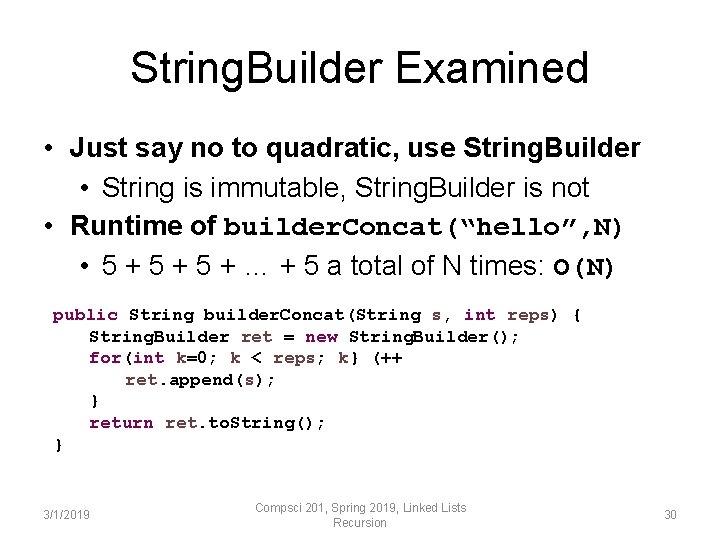
String. Builder Examined • Just say no to quadratic, use String. Builder • String is immutable, String. Builder is not • Runtime of builder. Concat(“hello”, N) • 5 + 5 + … + 5 a total of N times: O(N) public String builder. Concat(String s, int reps) { String. Builder ret = new String. Builder(); for(int k=0; k < reps; k} (++ ret. append(s); } return ret. to. String(); } 3/1/2019 Compsci 201, Spring 2019, Linked Lists Recursion 30
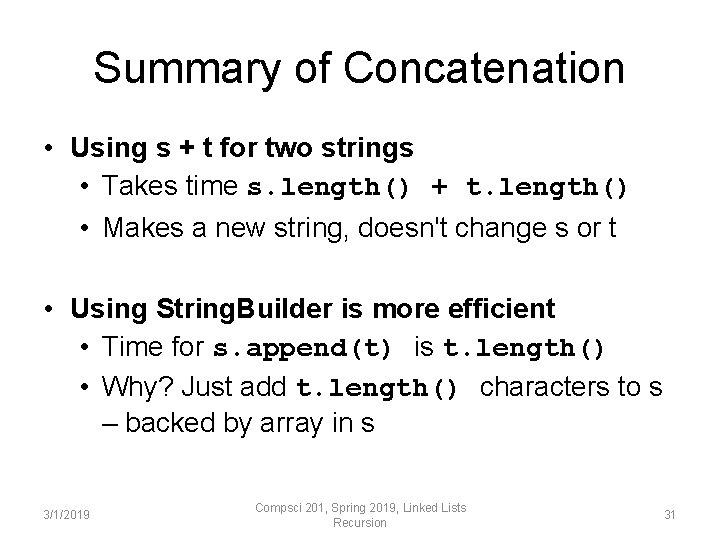
Summary of Concatenation • Using s + t for two strings • Takes time s. length() + t. length() • Makes a new string, doesn't change s or t • Using String. Builder is more efficient • Time for s. append(t) is t. length() • Why? Just add t. length() characters to s – backed by array in s 3/1/2019 Compsci 201, Spring 2019, Linked Lists Recursion 31
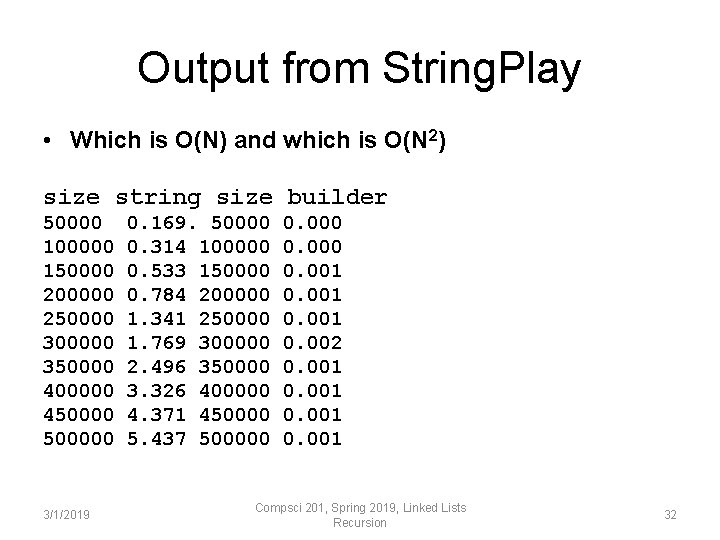
Output from String. Play • Which is O(N) and which is O(N 2) size string size builder 50000 100000 150000 200000 250000 300000 350000 400000 4500000 3/1/2019 0. 169. 50000 0. 314 100000 0. 533 150000 0. 784 200000 1. 341 250000 1. 769 300000 2. 496 350000 3. 326 400000 4. 371 450000 5. 437 500000 0. 001 0. 002 0. 001 Compsci 201, Spring 2019, Linked Lists Recursion 32
WOTO http: //bit. ly/201 spring 19 -march 12 3/1/2019 Compsci 201, Spring 2019, Linked Lists Recursion 33
danah boyd Dr. danah boyd is a Senior Researcher at Microsoft Research, … a Visiting Professor at NYU, …Her work examines everyday practices involving social media, with specific attention to youth engagement, privacy, and risky behaviors. She recently wrote Engaging the Ethics of Data Science in Practice; coauthored Isomorphism through algorithms: Institutional Dependencies in the case ofconnections Facebook is a critical part of building a new "Building new economy. The American education system, as flawed as it is, is great for the creative class because of the way it mixes up networks. " 3/1/2019 Compsci 201, Spring 2019, Linked Lists Recursion 34
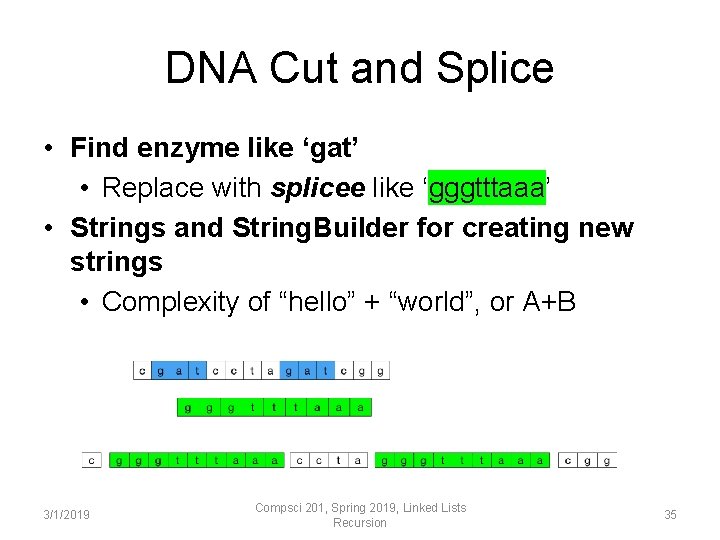
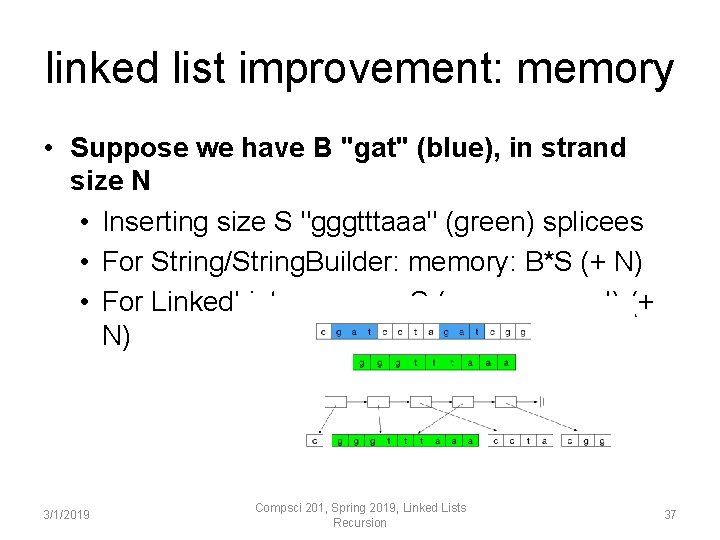
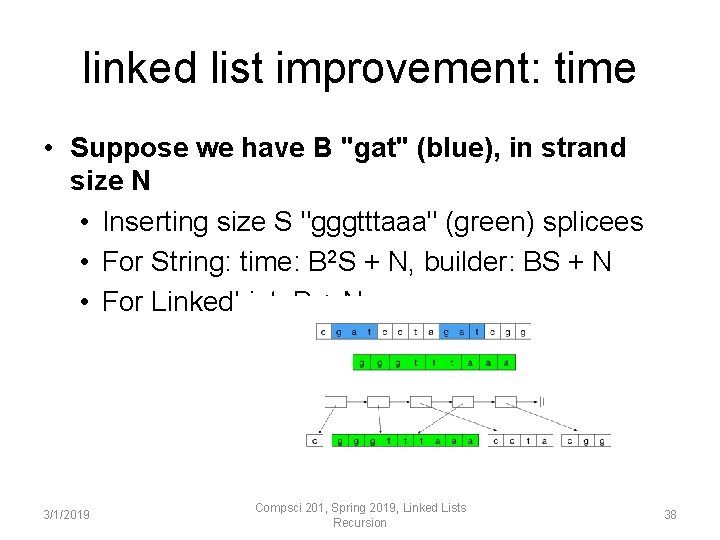
DNA Cut and Splice • Find enzyme like ‘gat’ • Replace with splicee like ‘gggtttaaa’ • Strings and String. Builder for creating new strings • Complexity of “hello” + “world”, or A+B • String: A + B, String. Builder: B 3/1/2019 Compsci 201, Spring 2019, Linked Lists Recursion 35
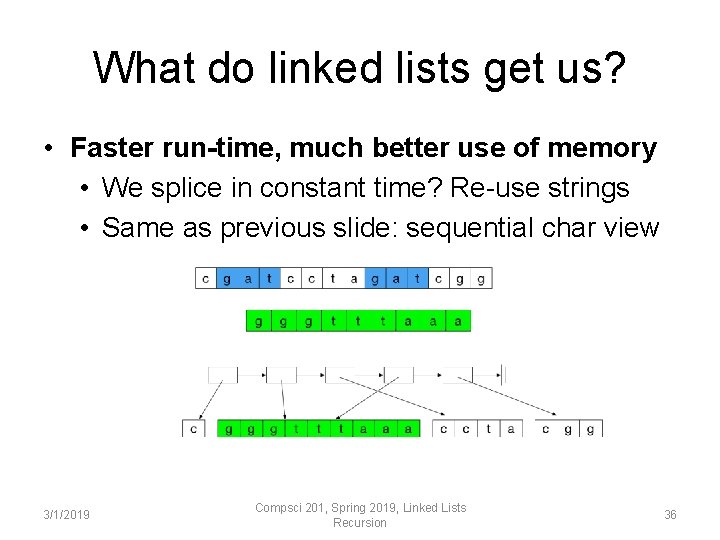
What do linked lists get us? • Faster run-time, much better use of memory • We splice in constant time? Re-use strings • Same as previous slide: sequential char view 3/1/2019 Compsci 201, Spring 2019, Linked Lists Recursion 36
linked list improvement: memory • Suppose we have B "gat" (blue), in strand size N • Inserting size S "gggtttaaa" (green) splicees • For String/String. Builder: memory: B*S (+ N) • For Linked. List: memory: S (re-use green!) (+ N) 3/1/2019 Compsci 201, Spring 2019, Linked Lists Recursion 37
linked list improvement: time • Suppose we have B "gat" (blue), in strand size N • Inserting size S "gggtttaaa" (green) splicees • For String: time: B 2 S + N, builder: BS + N • For Linked. List: B + N 3/1/2019 Compsci 201, Spring 2019, Linked Lists Recursion 38
Theory and Practice • The JVM can sometimes optimize your code • Don’t optimize what you don’t have to … • http: //www. pellegrino. link/2015/08/22/stringconcatenation-with-java-8. html • Timings with System. nano. Time() are suspect • Other things going on in computer • JVM can go into garbage-collection mode • Other considerations 3/1/2019 Compsci 201, Spring 2019, Linked Lists Recursion 39