
COMPSCI 105 S 1 2017 Principles of Computer
- Slides: 28
COMPSCI 105 S 1 2017 Principles of Computer Science 18 Linked List(3)
Agenda & Readings Agenda Variations of Linked Lists Singly Linked Lists with Head and Tail Doubly Linked Lists with Dummy head node Reference: Textbook: Problem Solving with Algorithms and Data Structures Extra Reading: 2 Chapter 3 – Lists Chapter 3 – The Unordered. List Abstract Data Type http: //en. literateprograms. org/Singly_linked_list_(Python) COMPSCI 105 Lecture 18
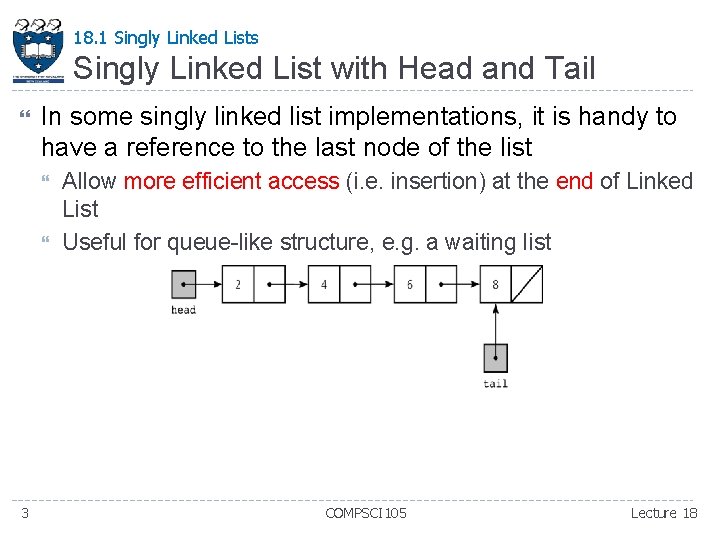
18. 1 Singly Linked Lists Singly Linked List with Head and Tail In some singly linked list implementations, it is handy to have a reference to the last node of the list 3 Allow more efficient access (i. e. insertion) at the end of Linked List Useful for queue-like structure, e. g. a waiting list COMPSCI 105 Lecture 18
18. 1 Singly Linked Lists Singly Linked List with Head and Tail Cases: Insertion General case: An empty list: 4 Insert a new node to the beginning of a list Insert a new node to the end of a list Insert a new node to the middle of a list Insert a new node to an empty list COMPSCI 105 Lecture 18
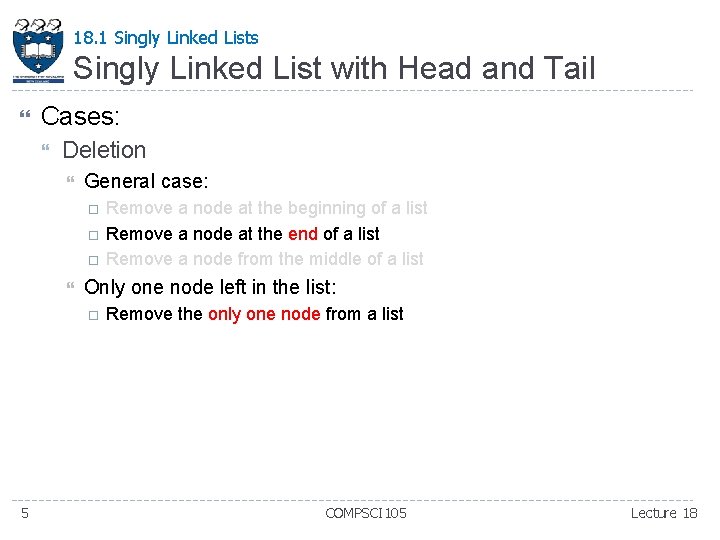
18. 1 Singly Linked Lists Singly Linked List with Head and Tail Cases: Deletion General case: Only one node left in the list: 5 Remove a node at the beginning of a list Remove a node at the end of a list Remove a node from the middle of a list Remove the only one node from a list COMPSCI 105 Lecture 18
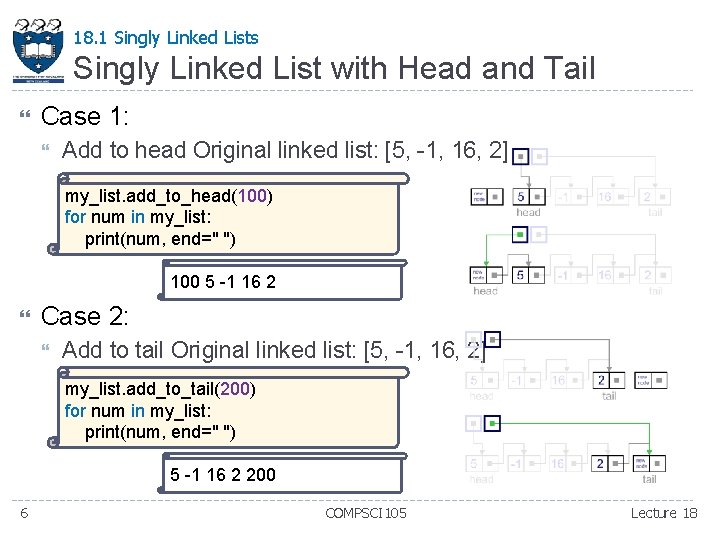
18. 1 Singly Linked Lists Singly Linked List with Head and Tail Case 1: Add to head Original linked list: [5, -1, 16, 2] my_list. add_to_head(100) for num in my_list: print(num, end=" ") 100 5 -1 16 2 Case 2: Add to tail Original linked list: [5, -1, 16, 2] my_list. add_to_tail(200) for num in my_list: print(num, end=" ") 5 -1 16 2 200 6 COMPSCI 105 Lecture 18
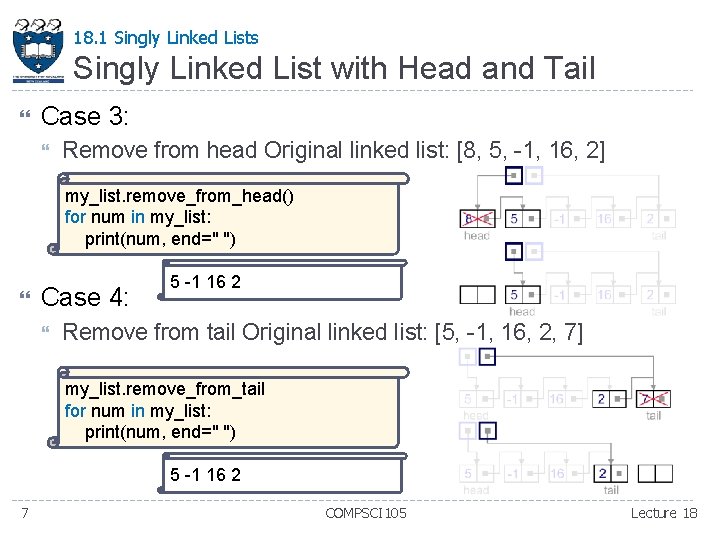
18. 1 Singly Linked Lists Singly Linked List with Head and Tail Case 3: Remove from head Original linked list: [8, 5, -1, 16, 2] my_list. remove_from_head() for num in my_list: print(num, end=" ") Case 4: 5 -1 16 2 Remove from tail Original linked list: [5, -1, 16, 2, 7] my_list. remove_from_tail for num in my_list: print(num, end=" ") 5 -1 16 2 7 COMPSCI 105 Lecture 18
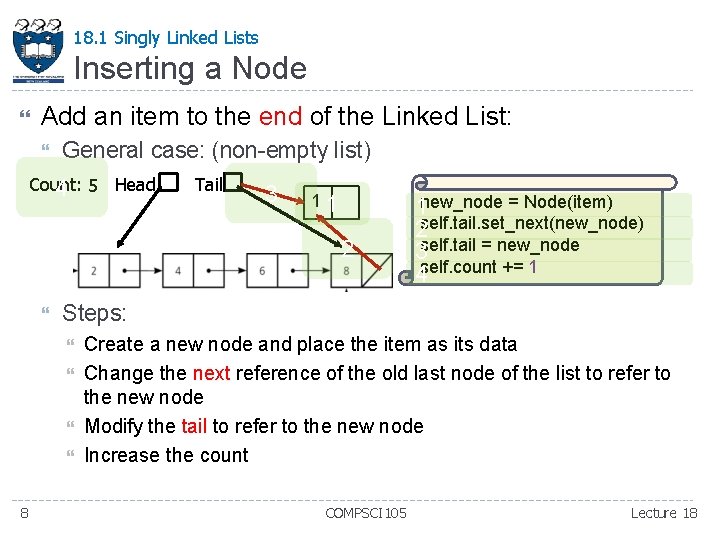
18. 1 Singly Linked Lists Inserting a Node Add an item to the end of the Linked List: General case: (non-empty list) Count: 4 54 Head Tail 3 11 2 Steps: 8 1 new_node = Node(item) 2 self. tail. set_next(new_node) 3 self. tail = new_node 4 self. count += 1 Create a new node and place the item as its data Change the next reference of the old last node of the list to refer to the new node Modify the tail to refer to the new node Increase the count COMPSCI 105 Lecture 18
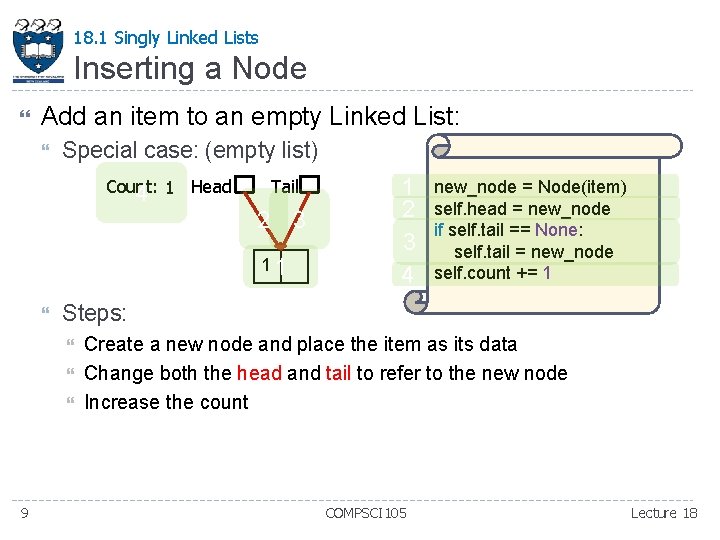
18. 1 Singly Linked Lists Inserting a Node Add an item to an empty Linked List: Special case: (empty list) Count: 4 01 Head Tail 2 3 11 new_node = Node(item) self. head = new_node if self. tail == None: self. tail = new_node self. count += 1 Steps: 9 1 2 3 4 Create a new node and place the item as its data Change both the head and tail to refer to the new node Increase the count COMPSCI 105 Lecture 18
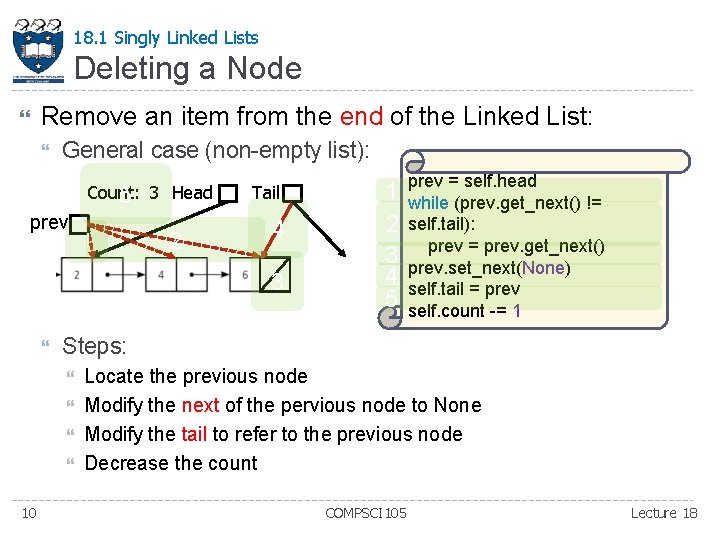
18. 1 Singly Linked Lists Deleting a Node Remove an item from the end of the Linked List: General case (non-empty list): Count: 5 43 Head prev 1 2 Tail 4 3 prev = self. head while (prev. get_next() != self. tail): prev = prev. get_next() prev. set_next(None) self. tail = prev self. count -= 1 Steps: 10 1 2 3 4 5 Locate the previous node Modify the next of the pervious node to None Modify the tail to refer to the previous node Decrease the count COMPSCI 105 Lecture 18
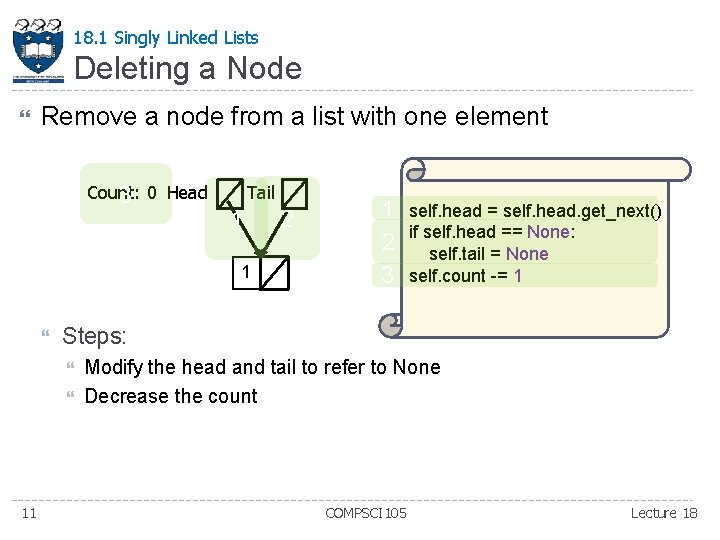
18. 1 Singly Linked Lists Deleting a Node Remove a node from a list with one element Count: 3 10 Head Tail 1 1 1 2 3 self. head = self. head. get_next() if self. head == None: self. tail = None self. count -= 1 Steps: 11 2 Modify the head and tail to refer to None Decrease the count COMPSCI 105 Lecture 18
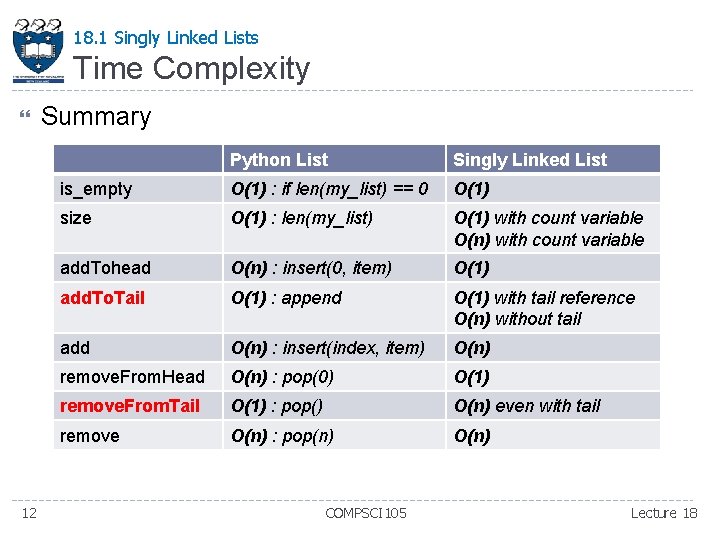
18. 1 Singly Linked Lists Time Complexity 12 Summary Python List Singly Linked List is_empty O(1) : if len(my_list) == 0 O(1) size O(1) : len(my_list) O(1) with count variable O(n) with count variable add. Tohead O(n) : insert(0, item) O(1) add. To. Tail O(1) : append O(1) with tail reference O(n) without tail add O(n) : insert(index, item) O(n) remove. From. Head O(n) : pop(0) O(1) remove. From. Tail O(1) : pop() O(n) even with tail remove O(n) : pop(n) O(n) COMPSCI 105 Lecture 18
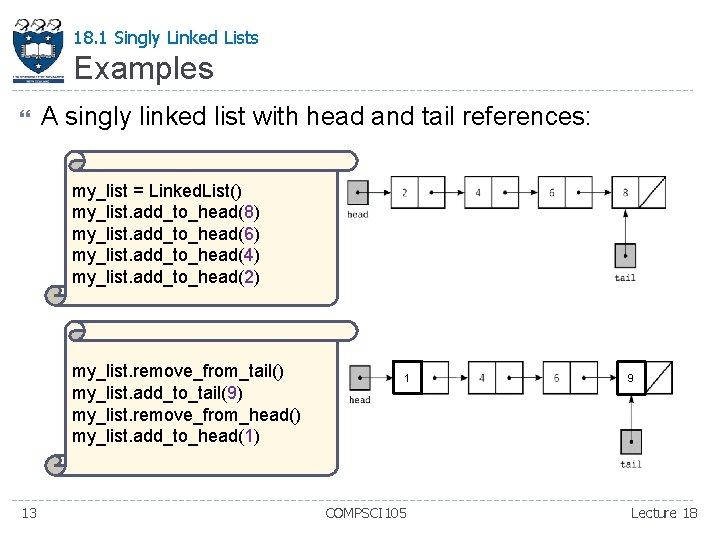
18. 1 Singly Linked Lists Examples A singly linked list with head and tail references: my_list = Linked. List() my_list. add_to_head(8) my_list. add_to_head(6) my_list. add_to_head(4) my_list. add_to_head(2) my_list. remove_from_tail() my_list. add_to_tail(9) my_list. remove_from_head() my_list. add_to_head(1) 13 1 COMPSCI 105 9 Lecture 18
18. 1 Singly Linked Lists Exercise 18. 1 Q 1. What is the output of the following program? my_list = Linked. List() for x in [9, 2, 40]: my_list. add_to_head(x) my_list. remove_from_tail() my_list. add_to_tail(32) my_list. remove_from_head() my_list. add_to_head(100) for num in my_list: print(num, end=" ") print() 14 COMPSCI 105 Lecture 18
18. 1 Singly Linked Lists Exercise 18. 1 Q 2. What is the output of the following program? my_list = Linked. List() for x in [9, 2, 22, 40]: my_list. add_to_head(x) my_list. remove_from_tail() my_list. add_to_tail(32) my_list. remove_from_head() my_list. add_to_head(100) for num in my_list: print(num, end=" ") 15 COMPSCI 105 Lecture 18
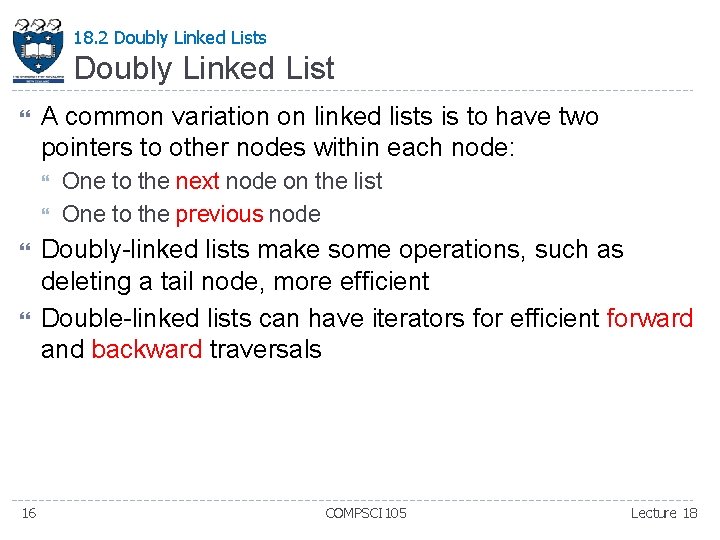
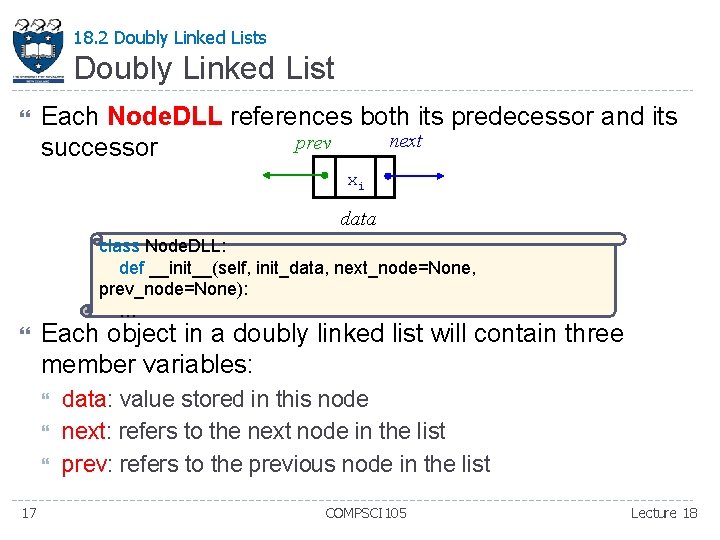
18. 2 Doubly Linked Lists Doubly Linked List A common variation on linked lists is to have two pointers to other nodes within each node: 16 One to the next node on the list One to the previous node Doubly-linked lists make some operations, such as deleting a tail node, more efficient Double-linked lists can have iterators for efficient forward and backward traversals COMPSCI 105 Lecture 18
18. 2 Doubly Linked Lists Doubly Linked List Each Node. DLL references both its predecessor and its next prev successor xi data class Node. DLL: def __init__(self, init_data, next_node=None, prev_node=None): … Each object in a doubly linked list will contain three member variables: 17 data: value stored in this node next: refers to the next node in the list prev: refers to the previous node in the list COMPSCI 105 Lecture 18
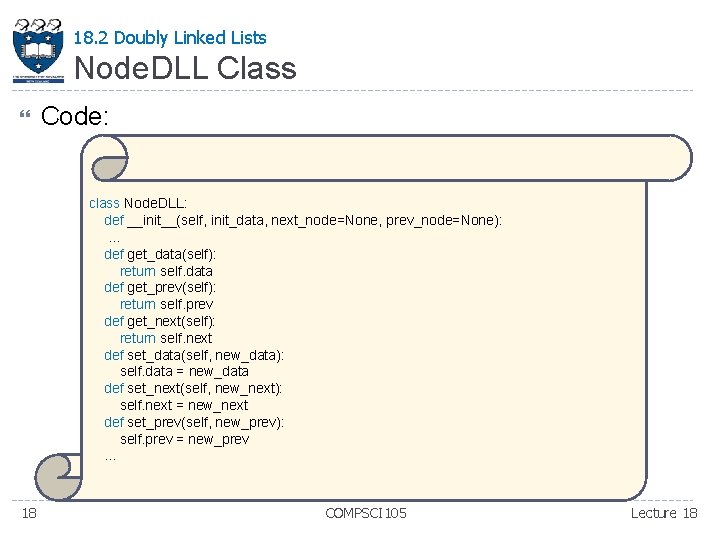
18. 2 Doubly Linked Lists Node. DLL Class Code: class Node. DLL: def __init__(self, init_data, next_node=None, prev_node=None): … def get_data(self): return self. data def get_prev(self): return self. prev def get_next(self): return self. next def set_data(self, new_data): self. data = new_data def set_next(self, new_next): self. next = new_next def set_prev(self, new_prev): self. prev = new_prev … 18 COMPSCI 105 Lecture 18
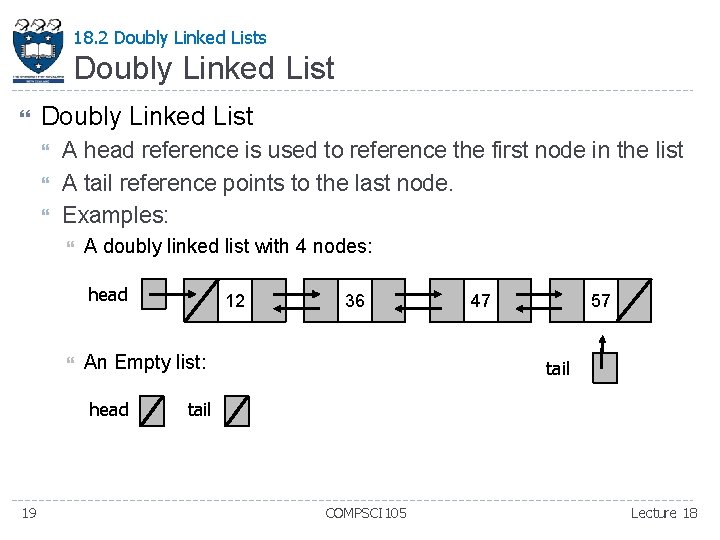
18. 2 Doubly Linked Lists Doubly Linked List A head reference is used to reference the first node in the list A tail reference points to the last node. Examples: A doubly linked list with 4 nodes: head 36 An Empty list: head 19 12 47 57 tail COMPSCI 105 Lecture 18
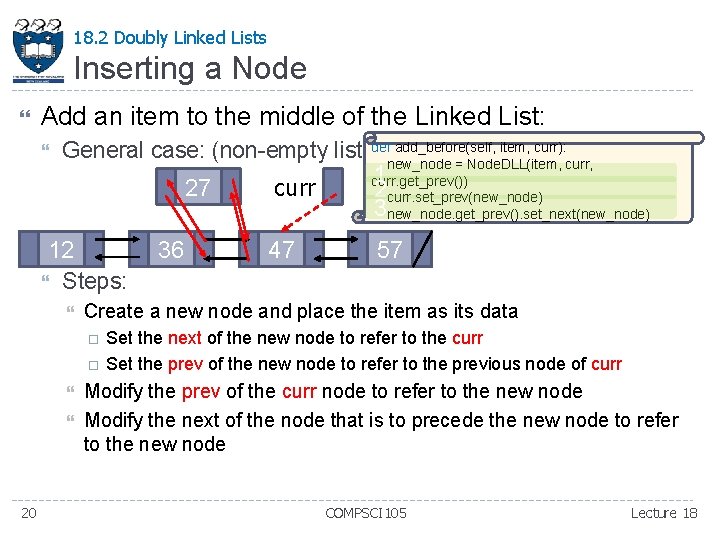
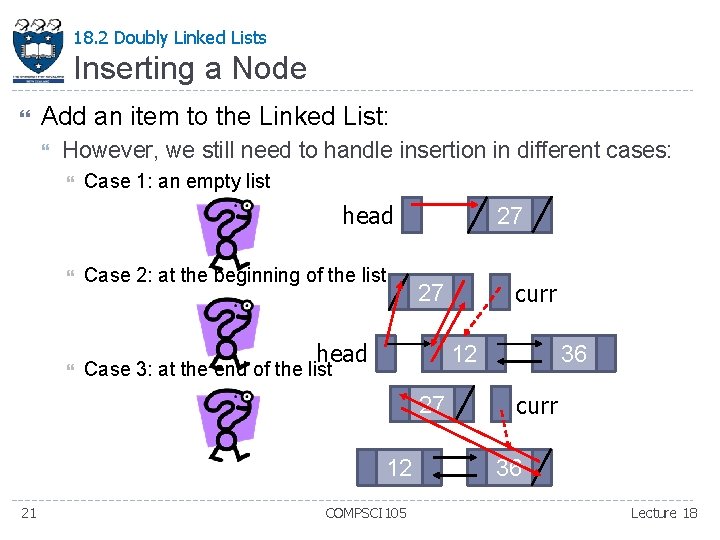
18. 2 Doubly Linked Lists Inserting a Node Add an item to the middle of the Linked List: add_before(self, item, curr): General case: (non-empty list) defnew_node = Node. DLL(item, curr, 1 curr. get_prev()) 27 curr 2 curr. set_prev(new_node) 3 new_node. get_prev(). set_next(new_node) 12 Steps: 20 47 57 Create a new node and place the item as its data 36 Set the next of the new node to refer to the curr Set the prev of the new node to refer to the previous node of curr Modify the prev of the curr node to refer to the new node Modify the next of the node that is to precede the new node to refer to the new node COMPSCI 105 Lecture 18
18. 2 Doubly Linked Lists Inserting a Node Add an item to the Linked List: However, we still need to handle insertion in different cases: Case 1: an empty list head Case 2: at the beginning of the list 27 head 12 Case 3: at the end of the list 27 12 21 curr 27 COMPSCI 105 36 curr 36 Lecture 18
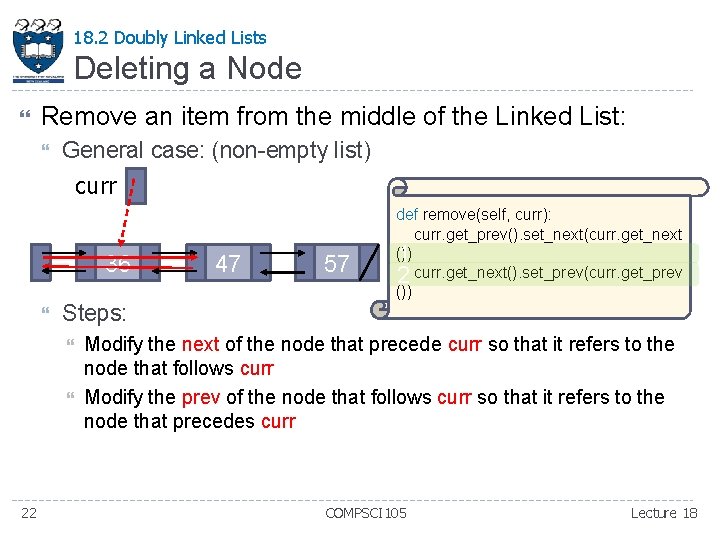
18. 2 Doubly Linked Lists Deleting a Node Remove an item from the middle of the Linked List: General case: (non-empty list) curr 36 Steps: 22 47 57 def remove(self, curr): curr. get_prev(). set_next(curr. get_next ()) 1 2 curr. get_next(). set_prev(curr. get_prev ()) Modify the next of the node that precede curr so that it refers to the node that follows curr Modify the prev of the node that follows curr so that it refers to the node that precedes curr COMPSCI 105 Lecture 18
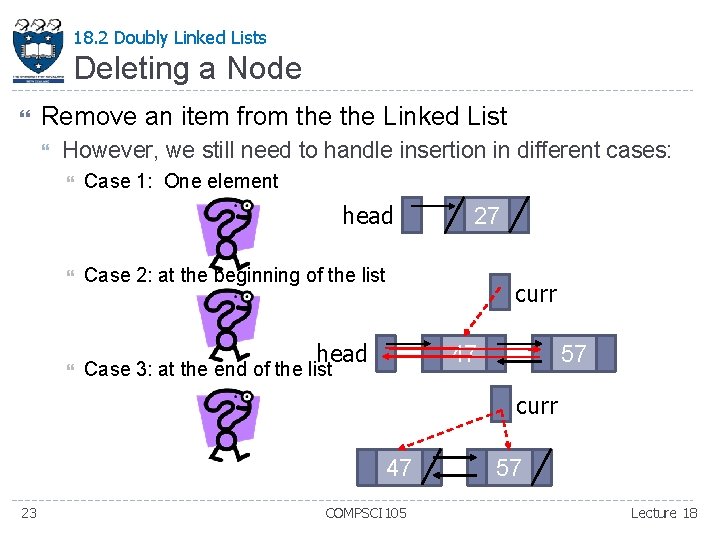
18. 2 Doubly Linked Lists Deleting a Node Remove an item from the Linked List However, we still need to handle insertion in different cases: Case 1: One element head 27 Case 2: at the beginning of the list head curr 47 Case 3: at the end of the list 57 curr 47 23 COMPSCI 105 57 Lecture 18
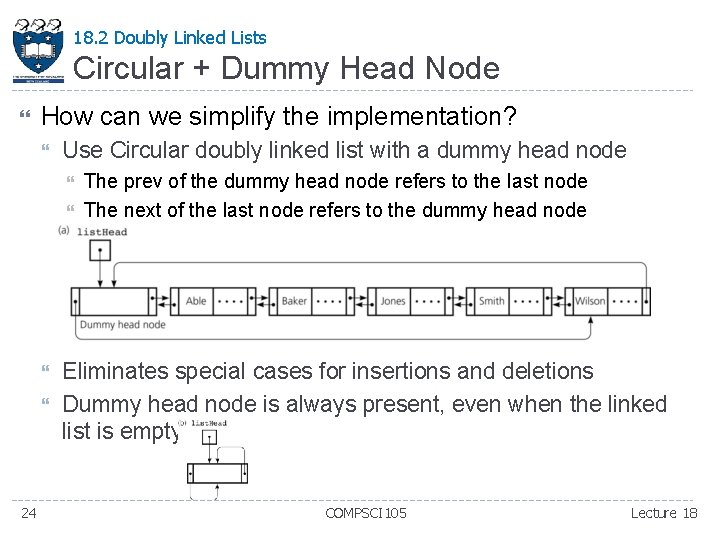
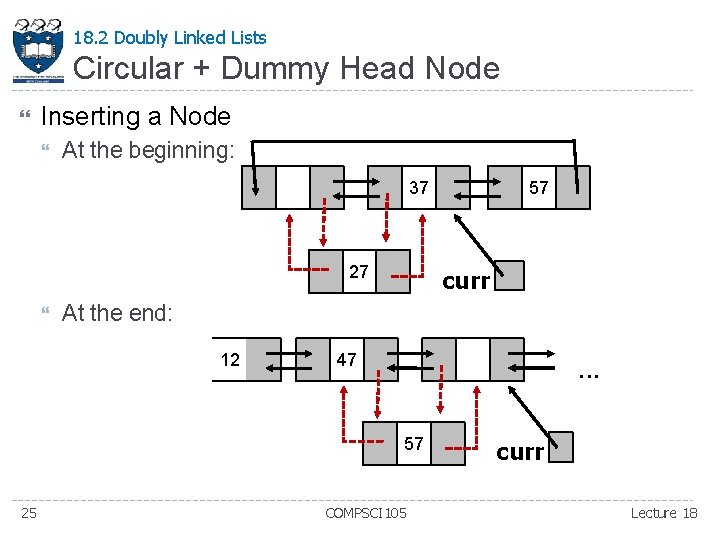
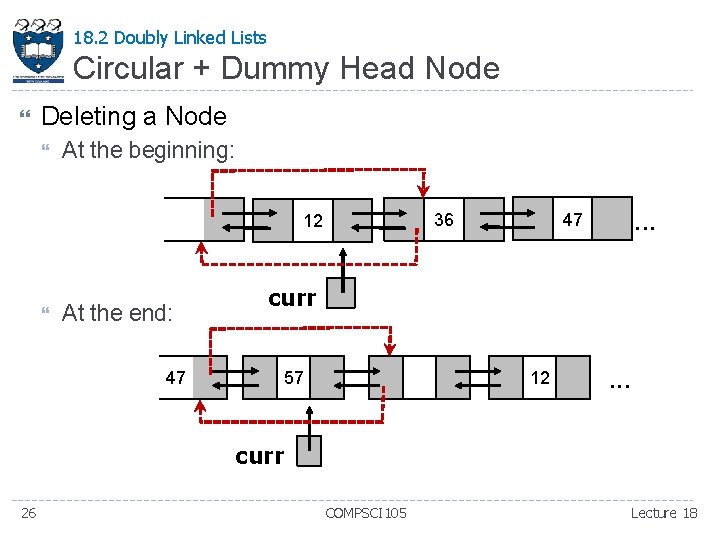
18. 2 Doubly Linked Lists Circular + Dummy Head Node How can we simplify the implementation? Use Circular doubly linked list with a dummy head node 24 The prev of the dummy head node refers to the last node The next of the last node refers to the dummy head node Eliminates special cases for insertions and deletions Dummy head node is always present, even when the linked list is empty COMPSCI 105 Lecture 18
18. 2 Doubly Linked Lists Circular + Dummy Head Node Inserting a Node At the beginning: 37 27 curr At the end: 12 47 . . . 57 25 57 COMPSCI 105 curr Lecture 18
18. 2 Doubly Linked Lists Circular + Dummy Head Node Deleting a Node At the beginning: At the end: 47 . . . 47 36 12 curr 57 12 . . . curr 26 COMPSCI 105 Lecture 18
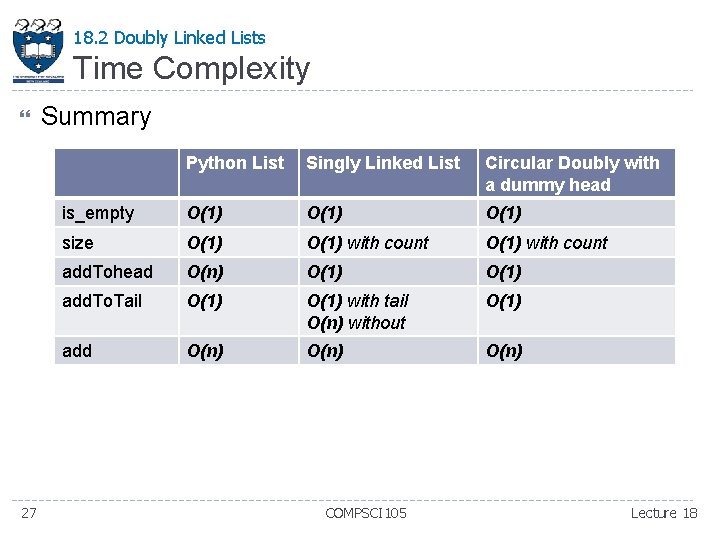
18. 2 Doubly Linked Lists Time Complexity 27 Summary Python List Singly Linked List Circular Doubly with a dummy head is_empty O(1) size O(1) with count add. Tohead O(n) O(1) add. To. Tail O(1) with tail O(n) without O(1) add O(n) COMPSCI 105 Lecture 18
Summary On completion of this class, you are able to 28 Understand learn how to implement the singly linked-list Understand learn how to implement the doubly linked-list COMPSCI 105 Lecture 18