
COMPSCI 101 Spring 2012 Introduction to Computer Science
![Anatomy of a search [query] l l http: //www. google. com/images? q=programming& biw=1370&bih=1081 What](https://slidetodoc.com/presentation_image_h2/9c466bd9fbaceda45aa7af055c65a13b/image-5.jpg "Anatomy of a search [query] l l http: //www. google. com/images? q=programming& biw=1370&bih=1081 What")






- Slides: 24
COMPSCI 101, Spring 2012 Introduction to Computer Science Owen Astrachan http: //www. cs. duke. edu/courses/spring 12/compsci 1 01 http: //www. cs. duke. edu/~ola Compsci 101, Spring 2012 1. 1
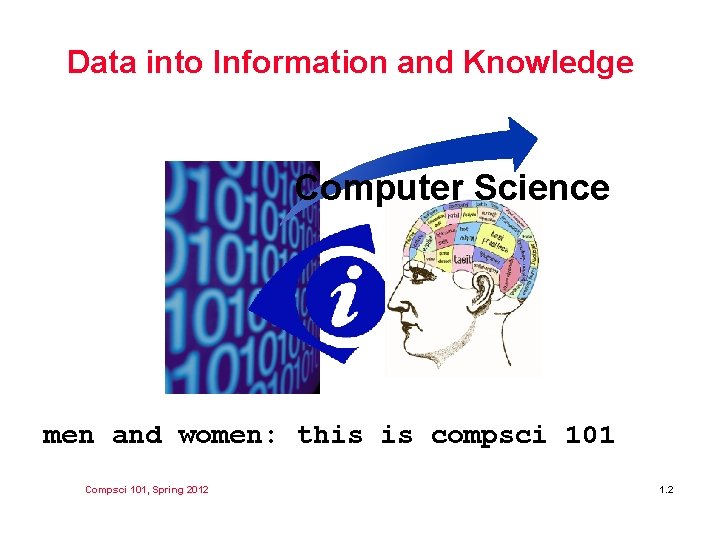
Data into Information and Knowledge Computer Science men and women: this is compsci 101 Compsci 101, Spring 2012 1. 2
Prerequisites for Compsci 101, Spring 2012 1. 3
Is a picture worth a thousand words? l http: //www. google. com/images? q=world%20 wide %20 web&biw=1238&bih=969 l http: //www. google. com/images? q=computer%20 s cience&biw=1370&bih=1081 l http: //www. google. com/images? q=internet&biw=1 370&bih=1081 l http: //www. google. com/images? q=programming& biw=1370&bih=1081 Compsci 101, Spring 2012 1. 4
Anatomy of a search [query] l l http: //www. google. com/images? q=programming& biw=1370&bih=1081 What comes after the question-mark in the URL? Ø Ø Ø l What is the query string? What are the browser dimensions? What is constant in the search query, what changes? How is the query parameterized? How are multiple-word queries handled? What does this have to do with Computer Science and programming? Compsci 101, Spring 2012 1. 5
Questions about Computer Science What is it that distinguishes it from the separate subjects with which it is related? What is the linking thread which gathers these disparate branches into a single discipline? My answer to these questions is simple --- it is the art of programming a computer. It is the art of designing efficient and elegant methods of getting a computer to solve problems, theoretical or practical, small or large, simple or complex. (Tony)Hoare Compsci 101, Spring 2012 C. A. R. 1. 6
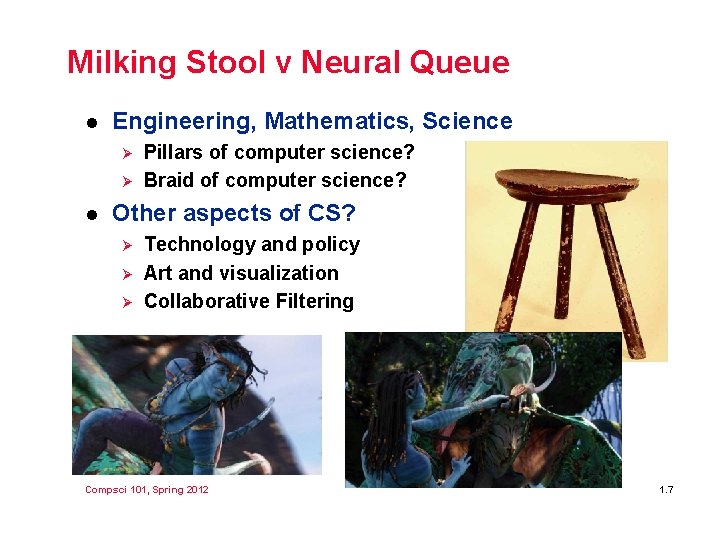
Milking Stool v Neural Queue l Engineering, Mathematics, Science Ø Ø l Pillars of computer science? Braid of computer science? Other aspects of CS? Ø Ø Ø Technology and policy Art and visualization Collaborative Filtering Compsci 101, Spring 2012 1. 7
It's not all programming at all, but … l What is the nature of intelligence? How can one predict the performance of a complex system? What is the nature of human cognition? Does the natural world 'compute'? l It is the interplay between such fundamental challenges and the human condition that makes computer science so interesting. The results from even the most esoteric computer science research programs often have widespread practical impact. Computer security depends upon the innovations in mathematics. Your Google search for a friend depends on state-of-the-art distributed computing systems, algorithms, and artificial intelligence. Compsci 101, Spring 2012 http: //www. post-gazette. com/pg/pp/04186/341012. stm 1. 8
Understanding Information/Data l Does understanding computer science help you when you want a new smart phone? l Does knowledge of programming help you get your laptop connected to a wireless access point? l Does experience with algorithms and algorithmic approaches help physicians and attorneys? l Are these important to society, to you? Compsci 101, Spring 2012 1. 9
How will you learn to 'speak'? l http: //www. rosettastone. com/personal/demo Compsci 101, Spring 2012 1. 10
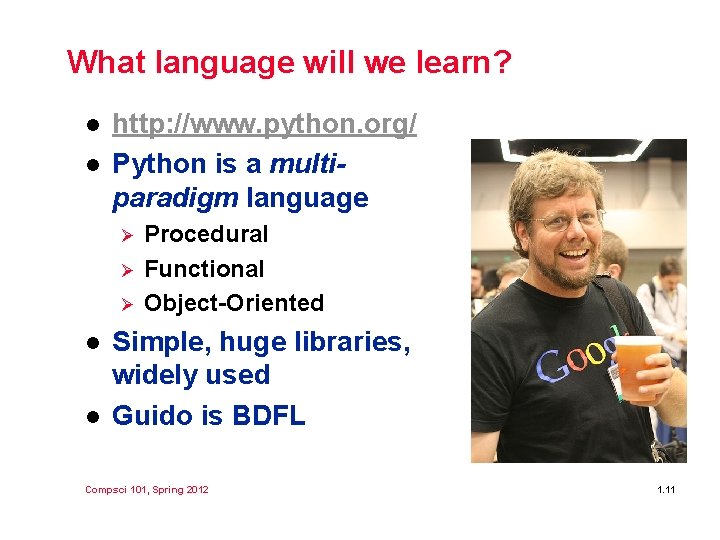
What language will we learn? l l http: //www. python. org/ Python is a multiparadigm language Ø Ø Ø l l Procedural Functional Object-Oriented Simple, huge libraries, widely used Guido is BDFL Compsci 101, Spring 2012 1. 11
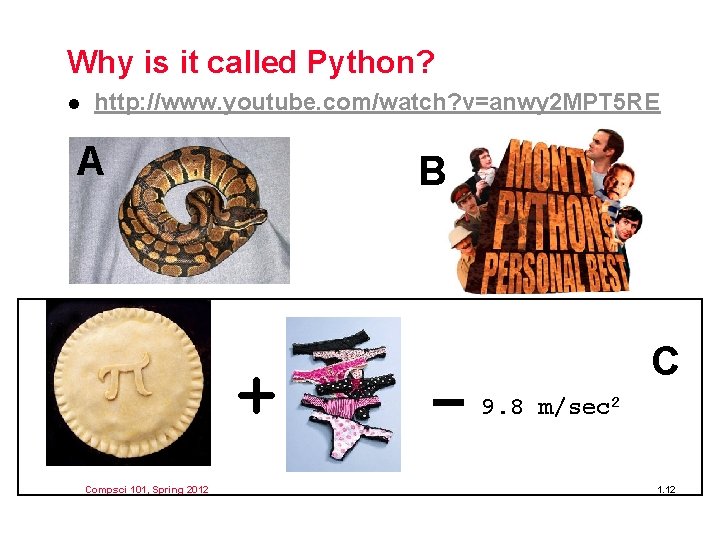
Why is it called Python? l http: //www. youtube. com/watch? v=anwy 2 MPT 5 RE A B + Compsci 101, Spring 2012 - C 9. 8 m/sec 2 1. 12
Course Overview: Is this the right one? l There are details, see the course web page Ø Ø Midterms and final are open book, what does that mean? APTs: Algorithmic Problem-solving and Testing • Weekly small programming assignments, tested online Ø Ø l Why should you come to class? Ø Ø l Programming assignments: solo, group, … Lab/recitation: group and individual work Meet people, learn things, participate in a community Provide help, get help, wonder, dance, think Why is this course so great? Ø Because you’re in it Compsci 101, Spring 2012 1. 13
What's in Compsci 101? l Learning about computing, computer science, and programming Ø Ø l Vocabulary of Python and programming languages Crafting programs from the vocabulary Power of automation, repetition, scale Understanding and changing the world Programming using Python Tools: Eclipse, EPD, Libraries, … Ø Engineering and analyzing designs and programs Ø Using mathematical and scientific techniques Ø Appreciating and learning art and science of programming Ø Moving toward scaling solutions (continued later Compsci 101, Spring 2012 courses) Ø 1. 14
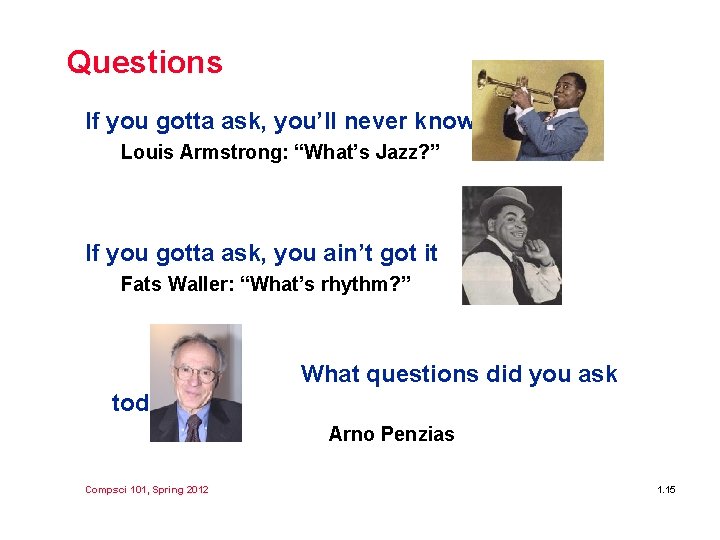
Questions If you gotta ask, you’ll never know Louis Armstrong: “What’s Jazz? ” If you gotta ask, you ain’t got it Fats Waller: “What’s rhythm? ” What questions did you ask today? Arno Penzias Compsci 101, Spring 2012 1. 15
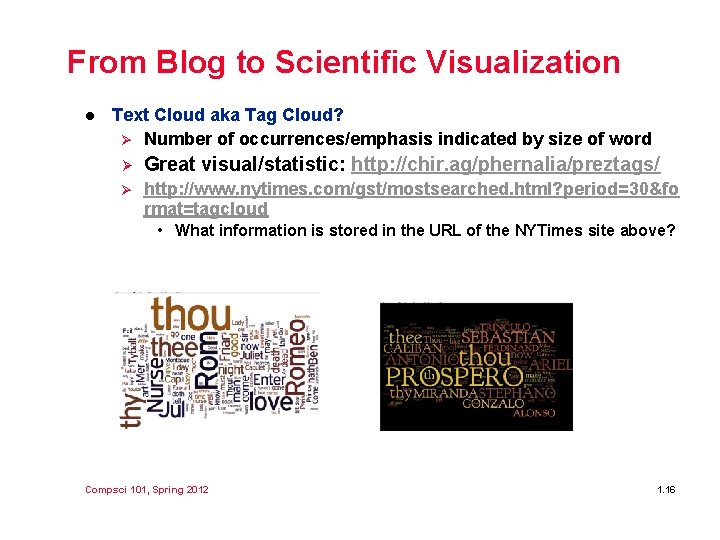
From Blog to Scientific Visualization l Text Cloud aka Tag Cloud? Ø Number of occurrences/emphasis indicated by size of word Ø Great visual/statistic: http: //chir. ag/phernalia/preztags/ Ø http: //www. nytimes. com/gst/mostsearched. html? period=30&fo rmat=tagcloud • What information is stored in the URL of the NYTimes site above? Compsci 101, Spring 2012 1. 16
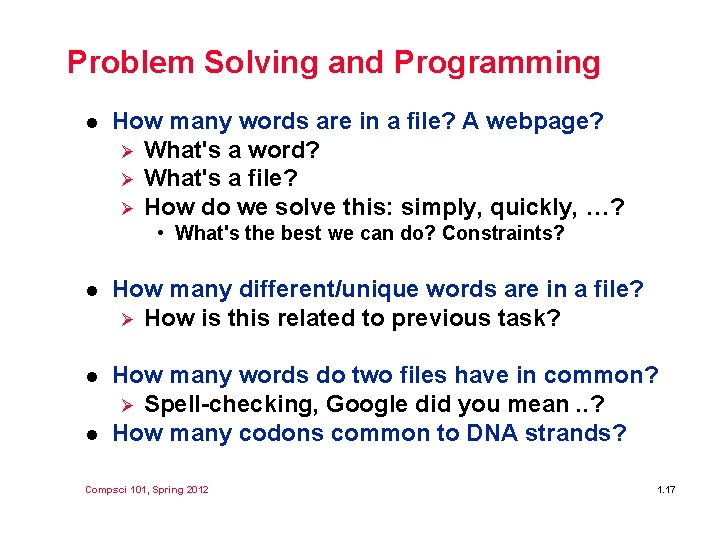
Problem Solving and Programming l How many words are in a file? A webpage? Ø What's a word? Ø What's a file? Ø How do we solve this: simply, quickly, …? • What's the best we can do? Constraints? l How many different/unique words are in a file? Ø How is this related to previous task? l How many words do two files have in common? Ø Spell-checking, Google did you mean. . ? How many codons common to DNA strands? l Compsci 101, Spring 2012 1. 17
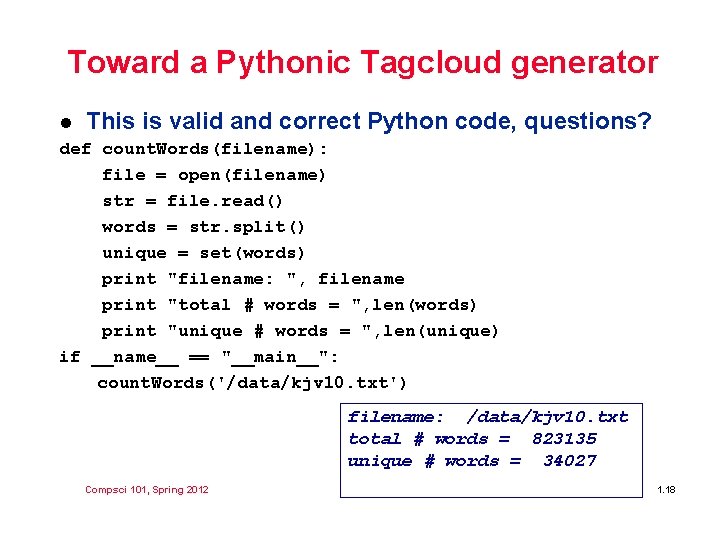
Toward a Pythonic Tagcloud generator l This is valid and correct Python code, def count. Words(filename): file = open(filename) str = file. read() words = str. split() unique = set(words) print "filename: ", filename print "total # words = ", len(words) print "unique # words = ", len(unique) if __name__ == "__main__": count. Words('/data/kjv 10. txt') questions? filename: /data/kjv 10. txt total # words = 823135 unique # words = 34027 Compsci 101, Spring 2012 1. 18
Python vocabulary l Python has a large standard library Ø Ø Ø l Python users often use third-party libraries too Ø Ø l Organized in modules: sys, io, math, os, … http: //docs. python. org/library/index. html API browseable online, but Eclipse IDE helps a lot Scientific, visual, plotting, … We will use EPD: Enthought Python Distribution Python is a multi-paradigm language, though this won't matter so much in the beginning Ø Very useful later! Compsci 101, Spring 2012 1. 19
Python and Programming Concepts l Names are important, abstractions Ø Ø l Types are important, facilitate operations Ø Ø l What is http: //152. 3. 140. 1 What is http: //www. amazon. com What is foo. pdf, foo. mp 4, foo. jpg, foo. wav Do the file extensions guarantee file type? Thinking in terms of names and types can help Ø Ø Python has types, inferred dynamically Python uses types differently from Java and C++ • Static v Dynamic Compsci 101, Spring 2012 1. 20
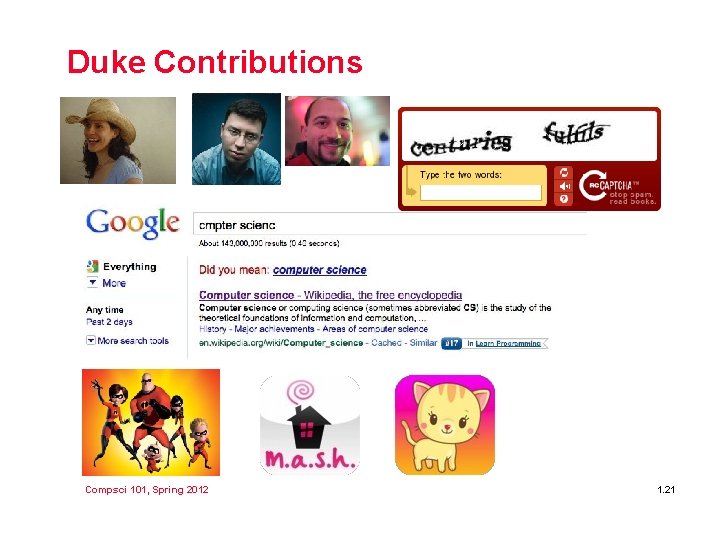
Duke Contributions Compsci 101, Spring 2012 1. 21
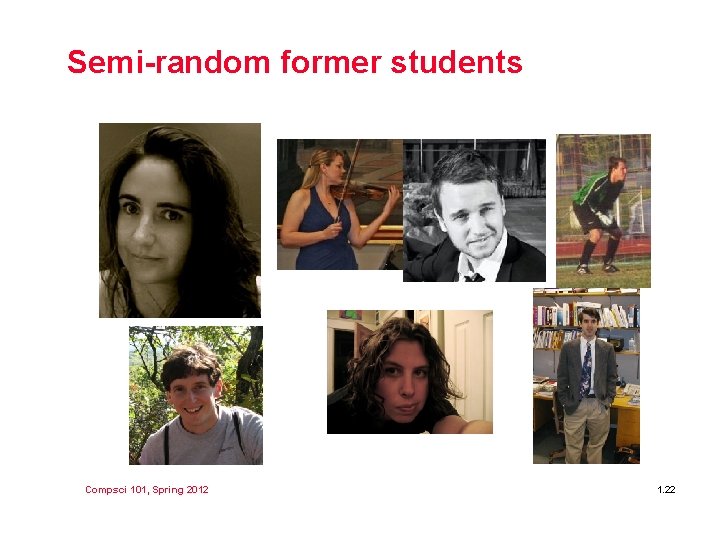
Semi-random former students Compsci 101, Spring 2012 1. 22
From Idea to Algorithm to Program l Finding minimal crossing count Ø Ø l Input: Ø Ø l Applications? Puzzle-solving? Given (xi, yi, ri) and P 1, P 2 --- determine minimal number of circles to cross to get from P 1 to P 2 [-3, 2, 2, 0, -4, 12, 12] [-1, 2, 3, 1, 5, 1, 1, 1] [1, 3, 1, 7, 1, 1, 2, 3] (2, 3) (13, 2) Output: Ø 5 Compsci 101, Spring 2012 1. 23
Why is programming fun? l Fred Brooks First is the sheer joy of making things Second is the pleasure of making things that are useful l Third is the fascination of fashioning complex puzzle-like objects of interlocking moving parts l l Fourth is the joy of always learning Finally, there is the delight of working in such a tractable medium. The programmer, like the poet, works only slightly removed from pure thought-stuff. l Compsci 101, Spring 2012 1. 24