
Comprehensiveness A Vital Principle in Emergency Management Comprehensiveness
- Slides: 31
Comprehensiveness A Vital Principle in Emergency Management
Comprehensiveness What does this principle mean to you? l “of large scope; covering or involving much; inclusive” (Dictionary. com) l Is broad, expansive and in-depth. l Implies a holistic approach or view. l
Why Comprehensiveness? We can be affected by many hazards and vulnerability l Disasters have diverse causes and consequences l There are many phases and functions in emergency management l A variety of actors participate in disasters l
Assumptions We will be affected by many different hazards l There are more causes than poor land-use planning and more consequences than physical damages l We can reduce disasters and react to them l Emergency managers do not act alone l
The All-Hazards Perspective Is important to comprehensiveness l Meanings l l Including all types of hazards that may affect us l Acknowledging functions that are common to most hazards
Group Project l Discuss types of hazards
Points to Consider There are many different types of hazards l Hazards may be natural, technological, or man-made l Each area is affected by unique hazards l There are no hazard-free areas l Source of hazard can be hard to distinguish l You must understand hazards l
Functions Common to Hazards l l l l Land-use planning Construction Planning, training and exercises Warnings Evacuation Sheltering Medical Care Special populations l l l Public information Donations management Volunteer management Damage assessment Debris removal Disaster assistance
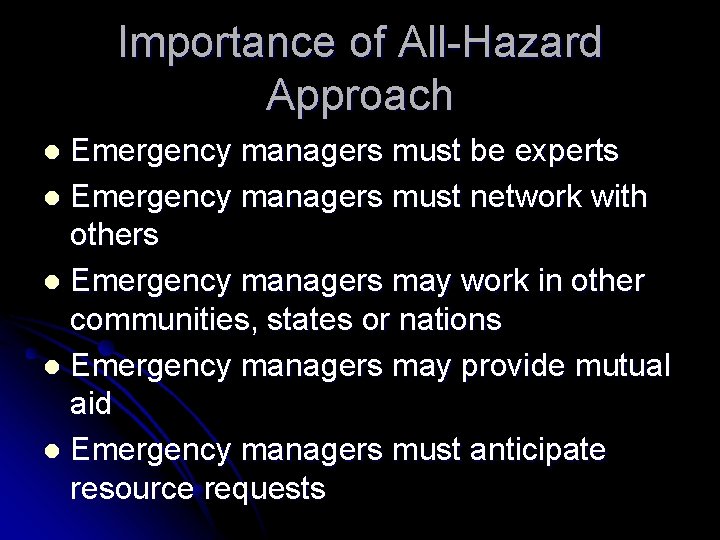
Importance of All-Hazard Approach Emergency managers must be experts l Emergency managers must network with others l Emergency managers may work in other communities, states or nations l Emergency managers may provide mutual aid l Emergency managers must anticipate resource requests l
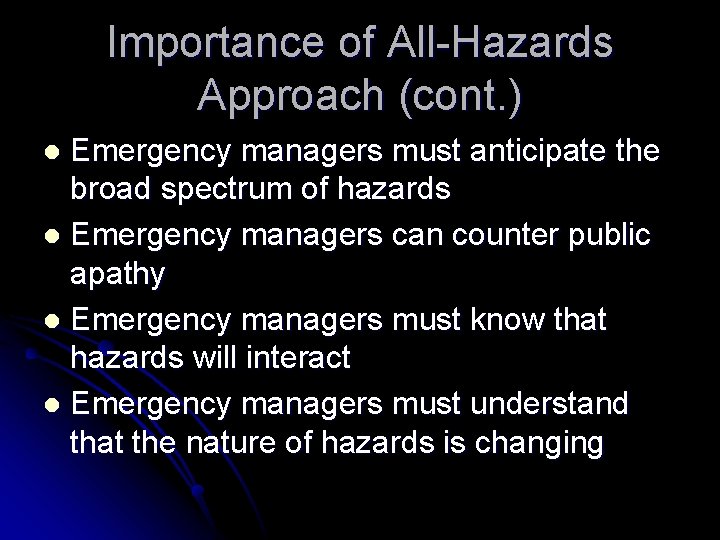
Importance of All-Hazards Approach (cont. ) Emergency managers must anticipate the broad spectrum of hazards l Emergency managers can counter public apathy l Emergency managers must know that hazards will interact l Emergency managers must understand that the nature of hazards is changing l
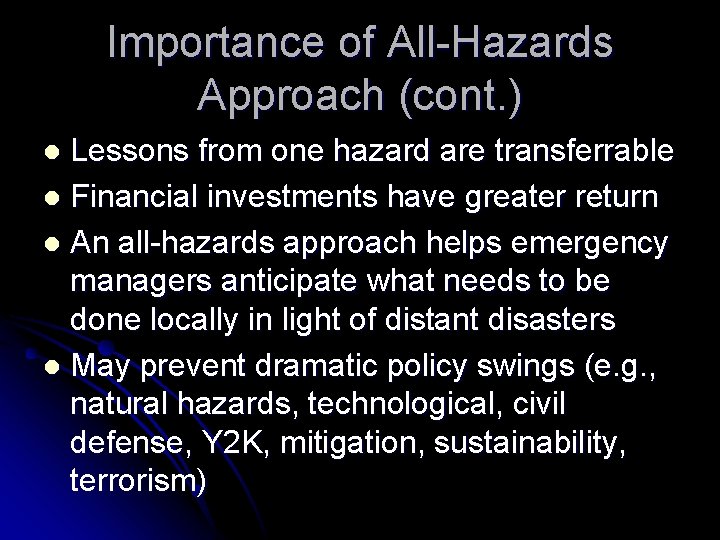
Importance of All-Hazards Approach (cont. ) Lessons from one hazard are transferrable l Financial investments have greater return l An all-hazards approach helps emergency managers anticipate what needs to be done locally in light of distant disasters l May prevent dramatic policy swings (e. g. , natural hazards, technological, civil defense, Y 2 K, mitigation, sustainability, terrorism) l
Assignment l Reflection paper
Vulnerability Is important for comprehensiveness l We need to focus on vulnerability, and not just hazards l Vulnerability relates to structural and cultural causes of disasters l
Examples of Vulnerability l l l Minorities Disabled Environmental degradation Construction of buildings Unplanned urbanization Carelessness in industry l l Neglect of emergency management Poor decision making Deteriorating health Foreign policy decisions and cultural misunderstandings
Examples Peru l Dominican Republic l Case Studies in Emergency Management l
Impacts Is important for comprehensiveness l Disasters produce deaths and injuries l Disasters damage and destroy buildings and the infrastructure l Disasters cause harm to animals, farmland the environment l Disasters generate direct and indirect economic losses l Disasters lead to political changes l
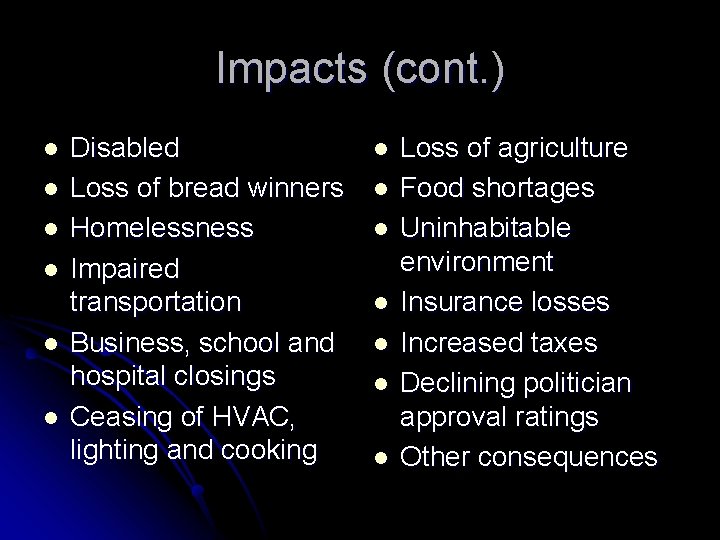
Impacts (cont. ) l l l Disabled Loss of bread winners Homelessness Impaired transportation Business, school and hospital closings Ceasing of HVAC, lighting and cooking l l l l Loss of agriculture Food shortages Uninhabitable environment Insurance losses Increased taxes Declining politician approval ratings Other consequences
Power Point Presentations l The impacts of disasters
Disaster Phases Is important for comprehensiveness l Emergency management includes mitigation, preparedness, response and recovery l
Mitigation l Efforts to reverse the rising trend of disasters or minimize impact
Preparedness l Activities to increase the readiness of a community for disasters
Response l Implementation of life saving measures
Recovery l Steps to overcome impacts and minimize future vulnerability
Points to Consider l l l What has emergency management traditionally focused on? Are there problems with this approach? If so, what are they? Should emergency management focus more on mitigation and recovery? If so, why? Should we give complete attention to mitigation and recovery? What are the consequences (both positive and negative) of doing so? What does this imply for the importance of each phase of disaster?
Functions Are important for comprehensiveness l Are relevant to each phase of disasters l
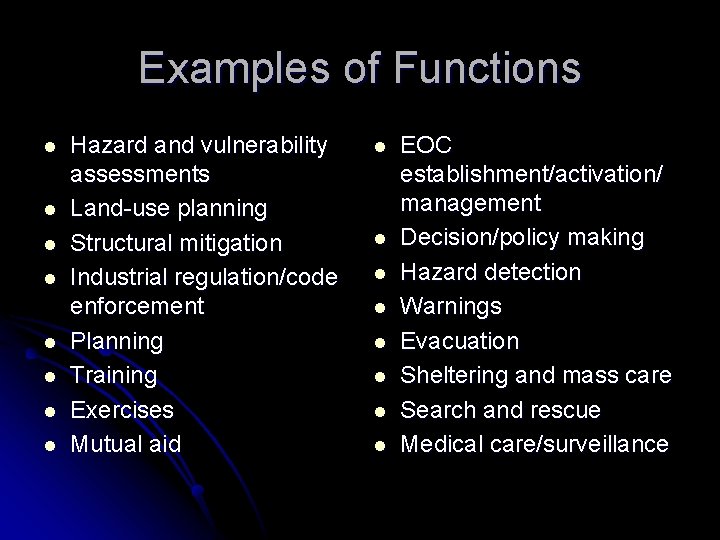
Examples of Functions l l l l Hazard and vulnerability assessments Land-use planning Structural mitigation Industrial regulation/code enforcement Planning Training Exercises Mutual aid l l l l EOC establishment/activation/ management Decision/policy making Hazard detection Warnings Evacuation Sheltering and mass care Search and rescue Medical care/surveillance
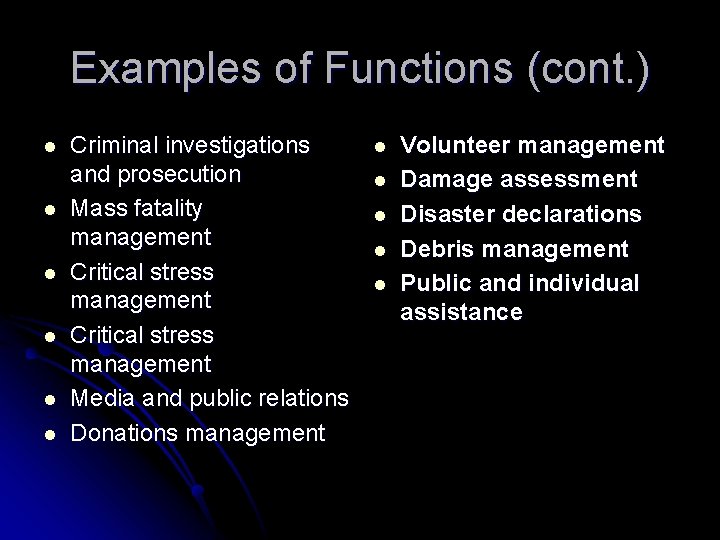
Examples of Functions (cont. ) l l l Criminal investigations and prosecution Mass fatality management Critical stress management Media and public relations Donations management l l l Volunteer management Damage assessment Disaster declarations Debris management Public and individual assistance
Stakeholders/Participants Is important for comprehensiveness l The emergency manager needs to get others involved l Examples from the Round Table discussants l
Other Stakeholders/Participants Public l Private l Non-profit l Citizens l
Working with Others l See http: //www. youtube. com/watch? v=R 6 ilz 3 tl 5 Vw.
Conclusion Emergency management is a comprehensive profession l It includes all types of: l l Hazards l Vulnerability l Impacts l Phases l Functions l Participants