
Comprehensive System of Personnel Development CSPD Workgroup Orientation
- Slides: 47
Comprehensive System of Personnel Development (CSPD) Workgroup Orientation www. ecpcta. org
Agenda Introductions Comprehensive System of Personnel Development (CSPD) Overview Review CSPD Work CSPD Subcomponent Workgroups Develop Action Plans for Each CSPD Subcomponent Workgroup Sharing Wrap Up/Evaluations/Next Steps
State Vision Statement State Mission Statement
Early Childhood Personnel Center Purpose: to facilitate the implementation of comprehensive systems of personnel development (CSPD) for all disciplines serving infants and young children with disabilities and their families
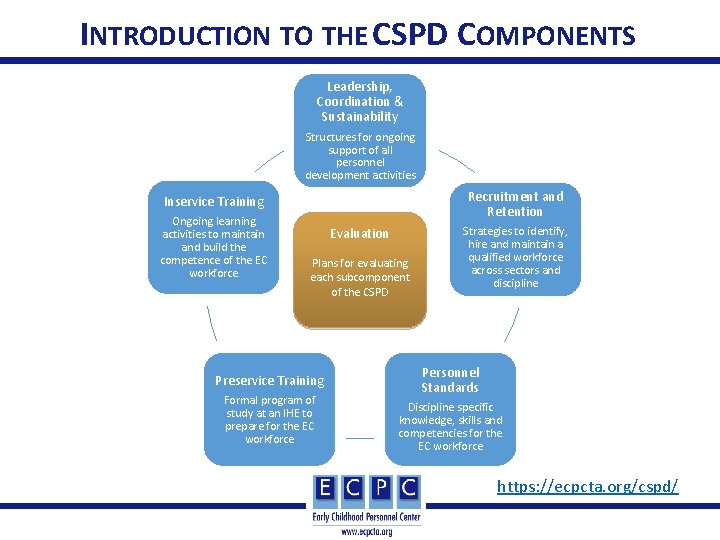
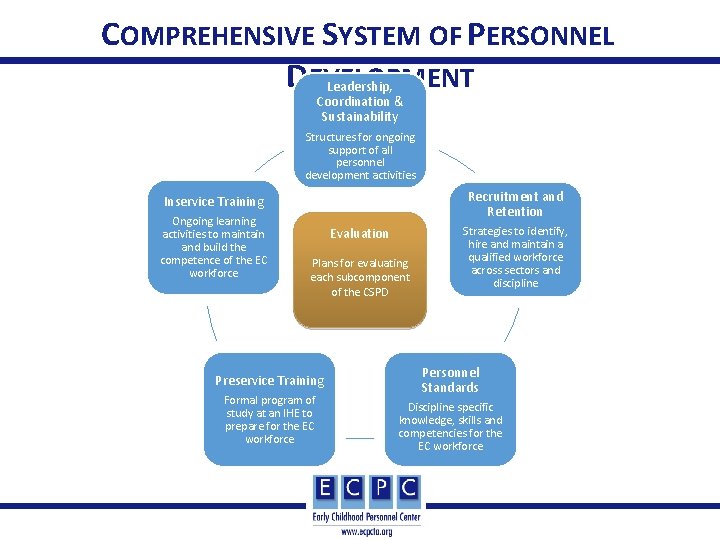
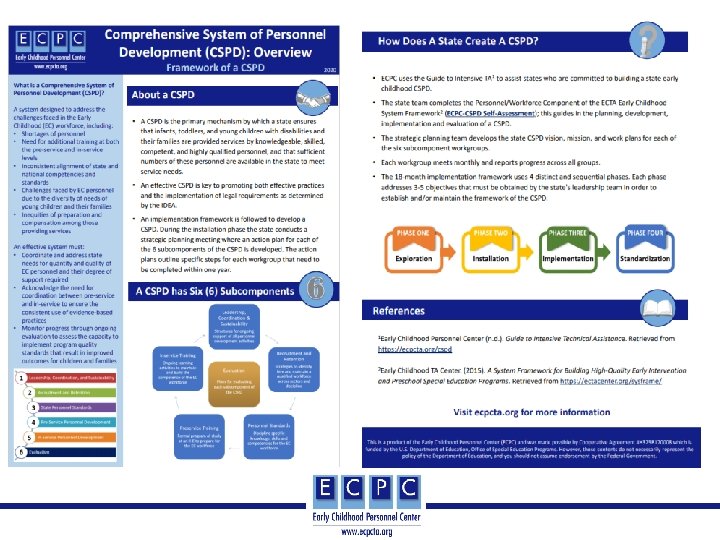
INTRODUCTION TO THE CSPD COMPONENTS Leadership, Coordination & Sustainability Structures for ongoing support of all personnel development activities Recruitment and Retention Inservice Training Ongoing learning activities to maintain and build the competence of the EC workforce Evaluation Plans for evaluating each subcomponent of the CSPD Preservice Training Formal program of study at an IHE to prepare for the EC workforce Strategies to identify, hire and maintain a qualified workforce across sectors and discipline Personnel Standards Discipline specific knowledge, skills and competencies for the EC workforce https: //ecpcta. org/cspd/
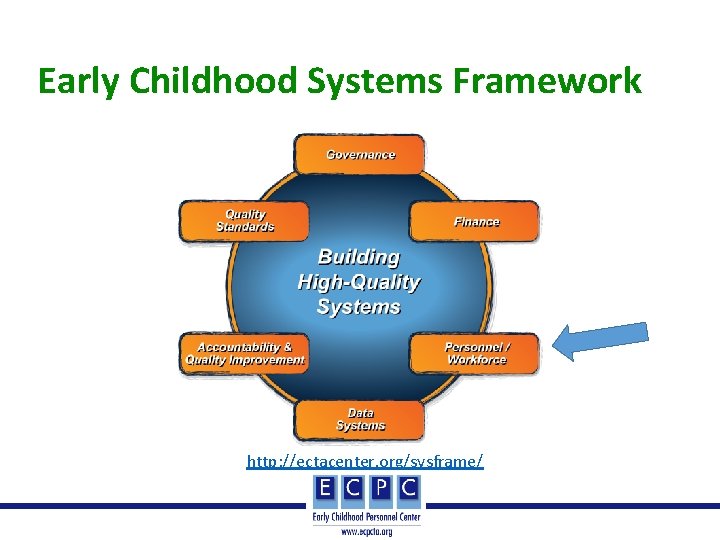
Early Childhood Systems Framework http: //ectacenter. org/sysframe/
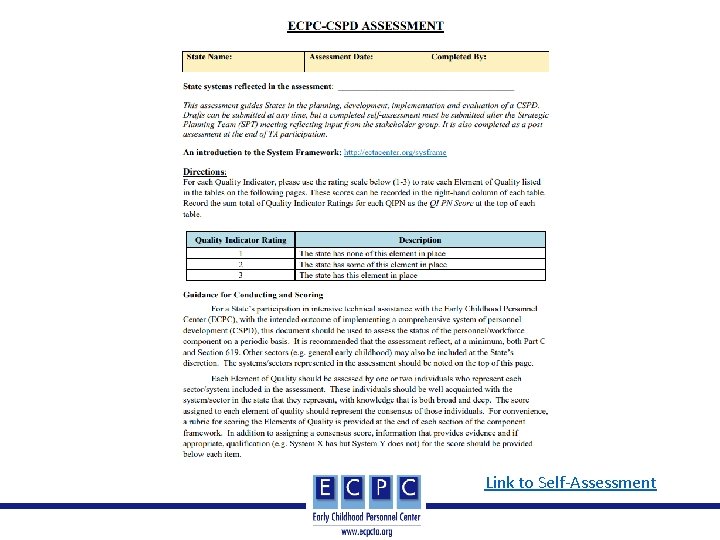
Link to Self-Assessment
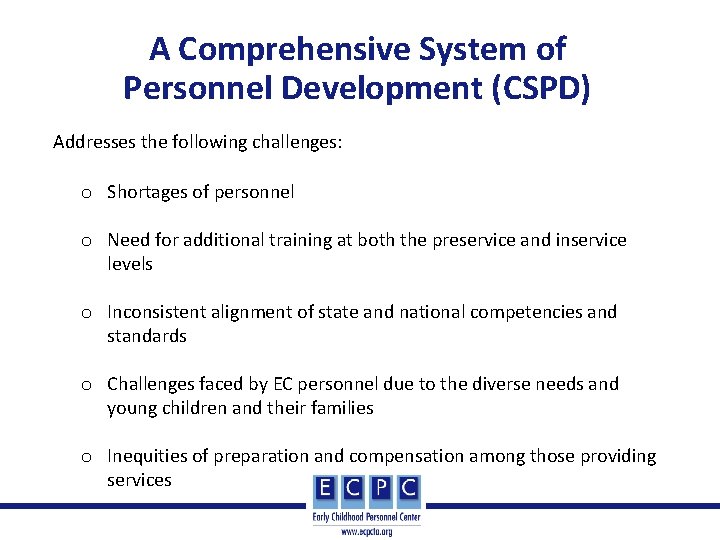
A Comprehensive System of Personnel Development (CSPD) Addresses the following challenges: o Shortages of personnel o Need for additional training at both the preservice and inservice levels o Inconsistent alignment of state and national competencies and standards o Challenges faced by EC personnel due to the diverse needs and young children and their families o Inequities of preparation and compensation among those providing services
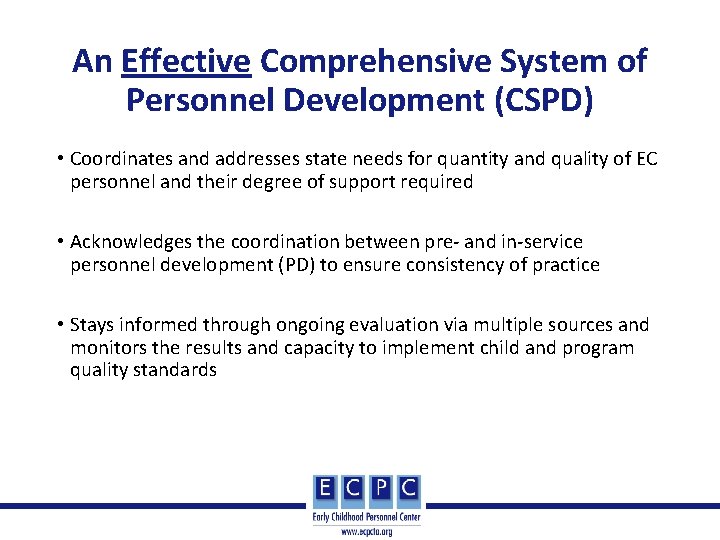
An Effective Comprehensive System of Personnel Development (CSPD) • Coordinates and addresses state needs for quantity and quality of EC personnel and their degree of support required • Acknowledges the coordination between pre- and in-service personnel development (PD) to ensure consistency of practice • Stays informed through ongoing evaluation via multiple sources and monitors the results and capacity to implement child and program quality standards
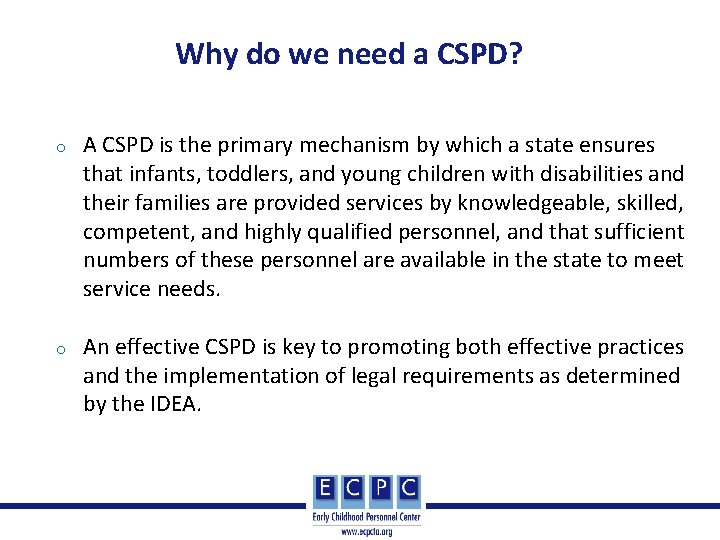
Why do we need a CSPD? o A CSPD is the primary mechanism by which a state ensures that infants, toddlers, and young children with disabilities and their families are provided services by knowledgeable, skilled, competent, and highly qualified personnel, and that sufficient numbers of these personnel are available in the state to meet service needs. o An effective CSPD is key to promoting both effective practices and the implementation of legal requirements as determined by the IDEA.
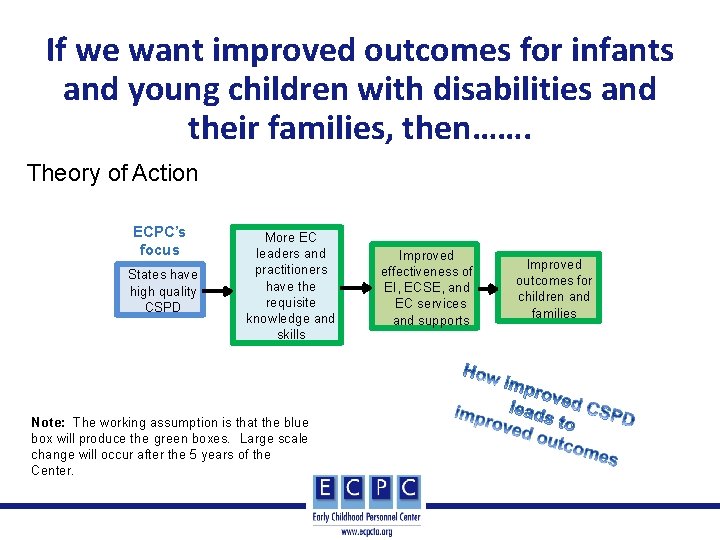
If we want improved outcomes for infants and young children with disabilities and their families, then……. Theory of Action ECPC’s focus States have high quality CSPD More EC leaders and practitioners have the requisite knowledge and skills Note: The working assumption is that the blue box will produce the green boxes. Large scale change will occur after the 5 years of the Center. Improved effectiveness of EI, ECSE, and EC services and supports Improved outcomes for children and families
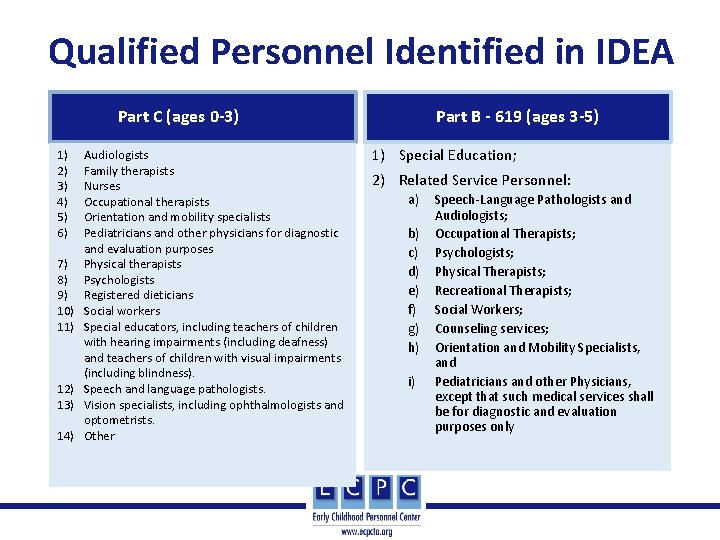
Qualified Personnel Identified in IDEA Part C (ages 0 -3) 1) 2) 3) 4) 5) 6) 7) 8) 9) 10) 11) 12) 13) 14) Audiologists Family therapists Nurses Occupational therapists Orientation and mobility specialists Pediatricians and other physicians for diagnostic and evaluation purposes Physical therapists Psychologists Registered dieticians Social workers Special educators, including teachers of children with hearing impairments (including deafness) and teachers of children with visual impairments (including blindness). Speech and language pathologists. Vision specialists, including ophthalmologists and optometrists. Other Part B - 619 (ages 3 -5) 1) Special Education; 2) Related Service Personnel: a) b) c) d) e) f) g) h) i) Speech-Language Pathologists and Audiologists; Occupational Therapists; Psychologists; Physical Therapists; Recreational Therapists; Social Workers; Counseling services; Orientation and Mobility Specialists, and Pediatricians and other Physicians, except that such medical services shall be for diagnostic and evaluation purposes only
COMPREHENSIVE SYSTEM OF PERSONNEL DEVELOPMENT Leadership, Coordination & Sustainability Structures for ongoing support of all personnel development activities Recruitment and Retention Inservice Training Ongoing learning activities to maintain and build the competence of the EC workforce Evaluation Plans for evaluating each subcomponent of the CSPD Preservice Training Formal program of study at an IHE to prepare for the EC workforce Strategies to identify, hire and maintain a qualified workforce across sectors and discipline Personnel Standards Discipline specific knowledge, skills and competencies for the EC workforce
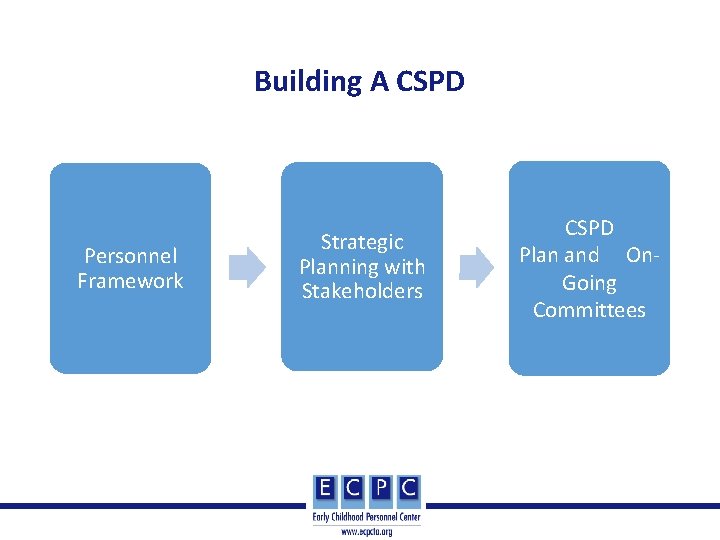
Building A CSPD Personnel Framework Strategic Planning with Stakeholders CSPD Plan and On. Going Committees
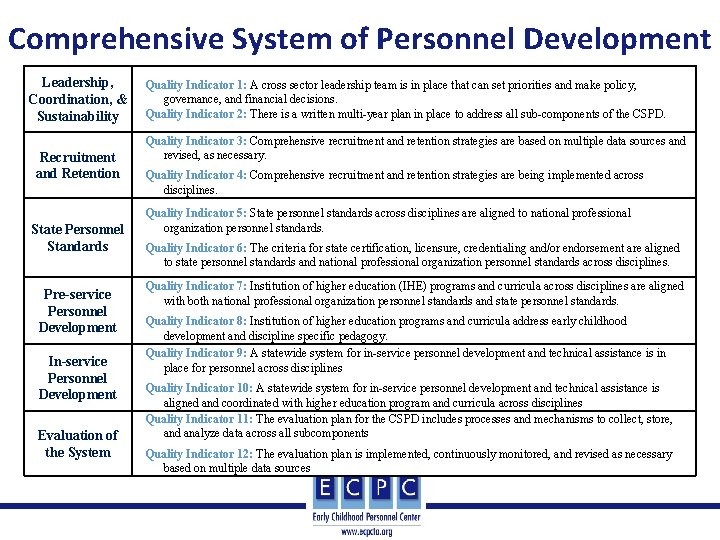
Comprehensive System of Personnel Development Leadership, Coordination, & Sustainability Recruitment and Retention State Personnel Standards Pre-service Personnel Development In-service Personnel Development Evaluation of the System Quality Indicator 1: A cross sector leadership team is in place that can set priorities and make policy, governance, and financial decisions. Quality Indicator 2: There is a written multi-year plan in place to address all sub-components of the CSPD. Quality Indicator 3: Comprehensive recruitment and retention strategies are based on multiple data sources and revised, as necessary. Quality Indicator 4: Comprehensive recruitment and retention strategies are being implemented across disciplines. Quality Indicator 5: State personnel standards across disciplines are aligned to national professional organization personnel standards. Quality Indicator 6: The criteria for state certification, licensure, credentialing and/or endorsement are aligned to state personnel standards and national professional organization personnel standards across disciplines. Quality Indicator 7: Institution of higher education (IHE) programs and curricula across disciplines are aligned with both national professional organization personnel standards and state personnel standards. Quality Indicator 8: Institution of higher education programs and curricula address early childhood development and discipline specific pedagogy. Quality Indicator 9: A statewide system for in-service personnel development and technical assistance is in place for personnel across disciplines Quality Indicator 10: A statewide system for in-service personnel development and technical assistance is aligned and coordinated with higher education program and curricula across disciplines Quality Indicator 11: The evaluation plan for the CSPD includes processes and mechanisms to collect, store, and analyze data across all subcomponents Quality Indicator 12: The evaluation plan is implemented, continuously monitored, and revised as necessary based on multiple data sources
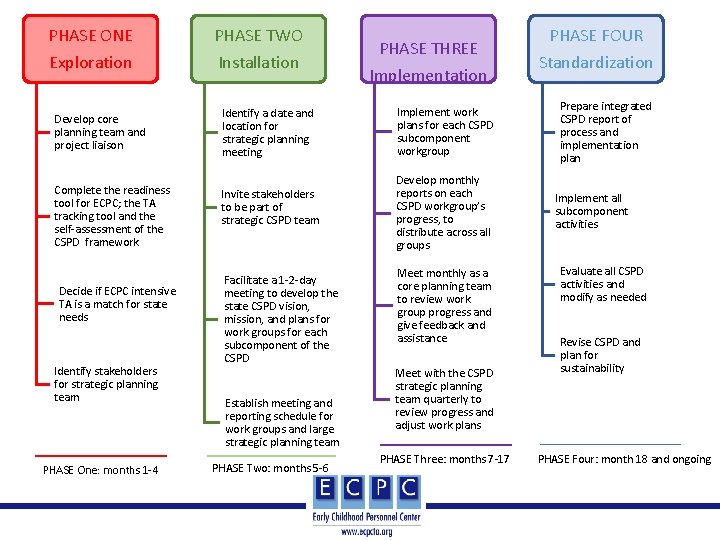
PHASE ONE PHASE TWO Exploration Installation Develop core planning team and project liaison Complete the readiness tool for ECPC; the TA tracking tool and the self-assessment of the CSPD framework Decide if ECPC intensive TA is a match for state needs Identify stakeholders for strategic planning team PHASE One: months 1 -4 PHASE THREE Implementation Identify a date and location for strategic planning meeting Implement work plans for each CSPD subcomponent workgroup Invite stakeholders to be part of strategic CSPD team Develop monthly reports on each CSPD workgroup’s progress, to distribute across all groups Facilitate a 1 -2 -day meeting to develop the state CSPD vision, mission, and plans for work groups for each subcomponent of the CSPD Establish meeting and reporting schedule for work groups and large strategic planning team PHASE Two: months 5 -6 Meet monthly as a core planning team to review work group progress and give feedback and assistance Meet with the CSPD strategic planning team quarterly to review progress and adjust work plans PHASE Three: months 7 -17 PHASE FOUR Standardization Prepare integrated CSPD report of process and implementation plan Implement all subcomponent activities Evaluate all CSPD activities and modify as needed Revise CSPD and plan for sustainability PHASE Four: month 18 and ongoing
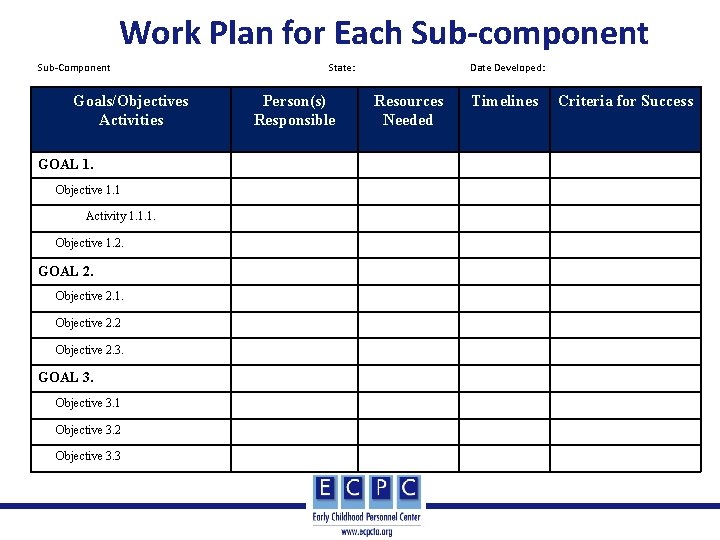
Work Plan for Each Sub-component Sub-Component Goals/Objectives Activities GOAL 1. Objective 1. 1 Activity 1. 1. 1. Objective 1. 2. GOAL 2. Objective 2. 1. Objective 2. 2 Objective 2. 3. GOAL 3. Objective 3. 1 Objective 3. 2 Objective 3. 3 State: Person(s) Responsible Date Developed: Resources Needed Timelines Criteria for Success
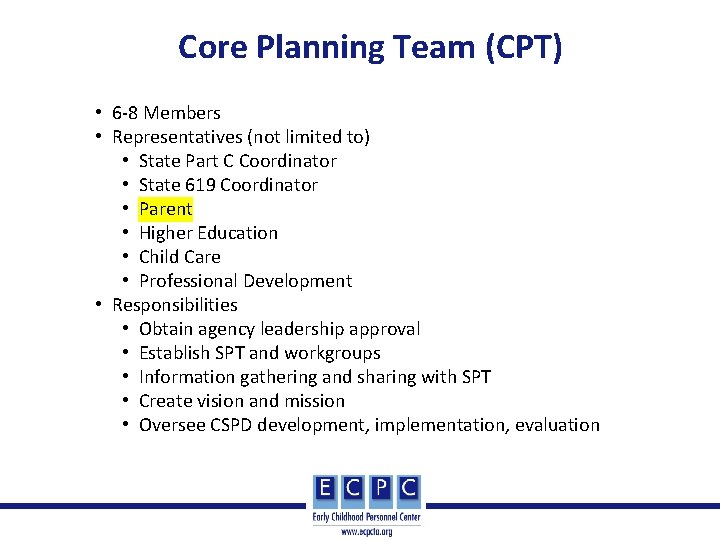
Core Planning Team (CPT) • 6 -8 Members • Representatives (not limited to) • State Part C Coordinator • State 619 Coordinator • Parent • Higher Education • Child Care • Professional Development • Responsibilities • Obtain agency leadership approval • Establish SPT and workgroups • Information gathering and sharing with SPT • Create vision and mission • Oversee CSPD development, implementation, evaluation
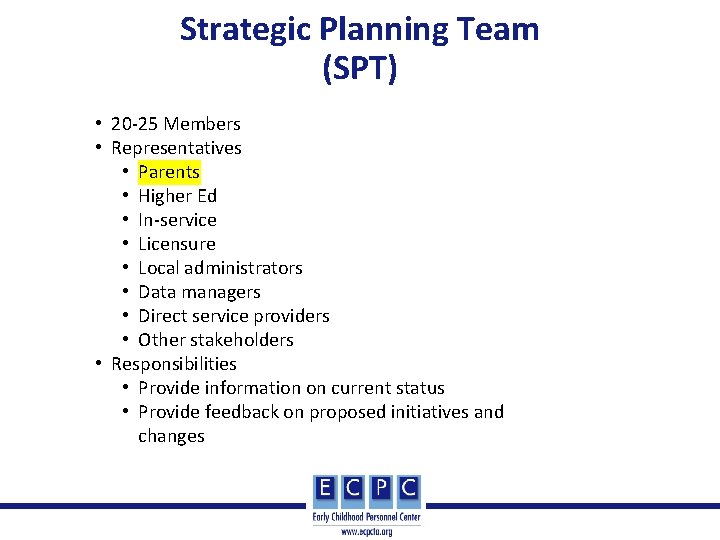
Strategic Planning Team (SPT) • 20 -25 Members • Representatives • Parents • Higher Ed • In-service • Licensure • Local administrators • Data managers • Direct service providers • Other stakeholders • Responsibilities • Provide information on current status • Provide feedback on proposed initiatives and changes
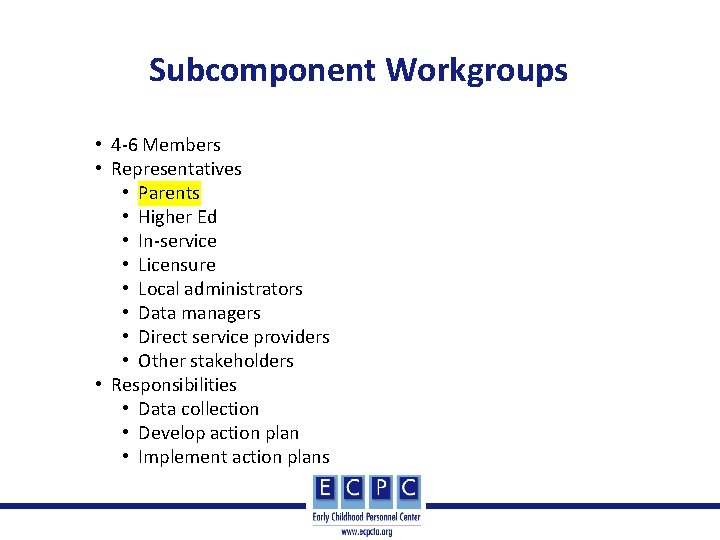
Subcomponent Workgroups • 4 -6 Members • Representatives • Parents • Higher Ed • In-service • Licensure • Local administrators • Data managers • Direct service providers • Other stakeholders • Responsibilities • Data collection • Develop action plan • Implement action plans
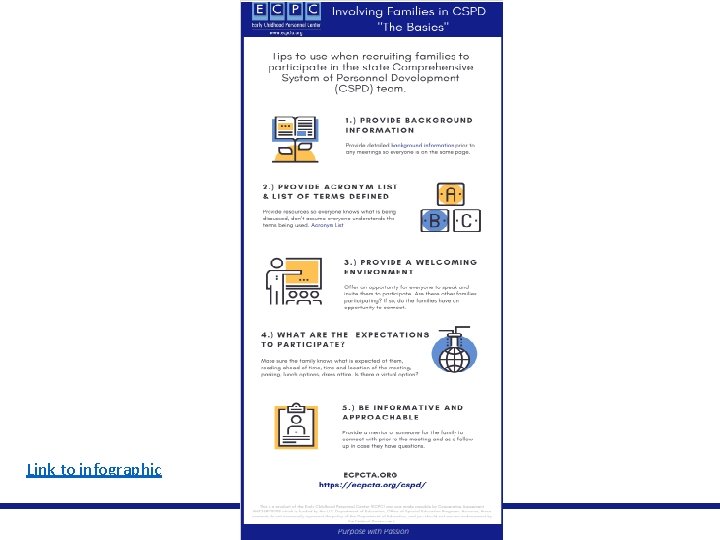
Link to infographic
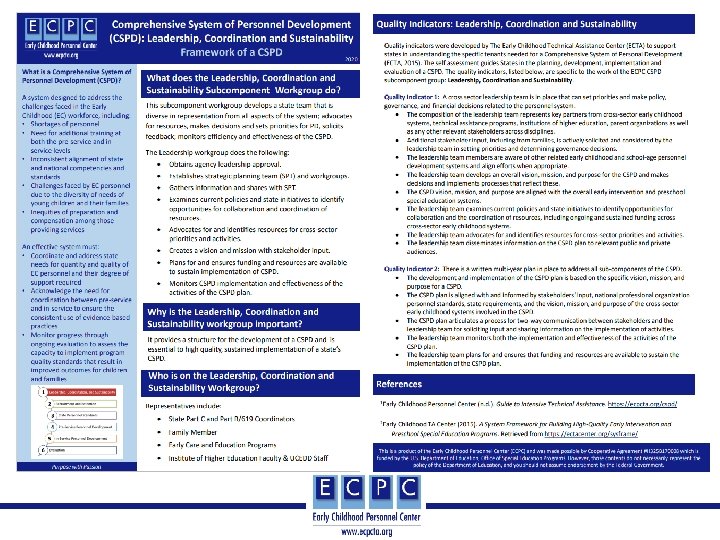
CSPD Subcomponent Leadership, Coordination, and Sustainability • Addresses the membership and responsibilities of a leadership team and the required elements of a written plan for the CSPD sustainability. • Includes: • representatives with in-depth knowledge, authority, and influence for each of the service sectors (e. g. , early childhood education, Part C, and Section 619) represented in the system • important stakeholders, including families whose children receive services, direct service program administrators, educators and trainers who prepare personnel, • personnel who provide services • Functions of the leadership team include advocating for resources; making decisions and setting priorities for personnel development; keeping stakeholders informed; soliciting feedback from stakeholders; being aware of related and tangential state initiatives in early childhood; and monitoring the functionality, effectiveness, and efficiency of the CSPD. • The written plan delineates responsibilities, procedures, and processes for all subcomponents of the CSPD.
Leadership, Coordination, and Sustainability • Quality Indicator 1: A cross sector leadership team is in place that can set priorities and make policy, governance, and financial decisions. • Quality Indicator 2: There is a written multi-year plan in place to address all sub-components of the CSPD.
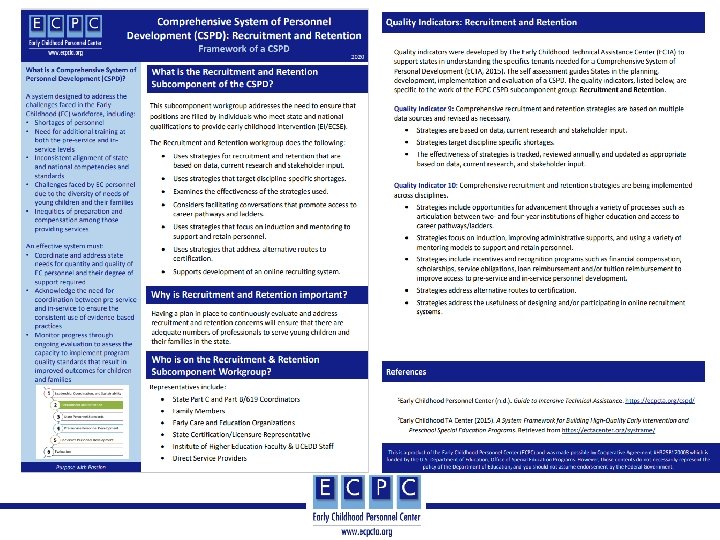
CSPD Subcomponent Recruitment and Retention • Addresses the need to ensure that positions are filled by individuals who meet state and national qualifications to provide early childhood intervention (EI/ECSE). • Information related to anticipated vacancies or a need for increased personnel is necessary to meet the needs of IDEA eligible infants and young children.
Recruitment and Retention • Quality Indicator 9: Comprehensive recruitment and retention strategies are based on multiple data sources and revised as necessary. • Quality Indicator 10: Comprehensive recruitment and retention strategies are being implemented across disciplines.
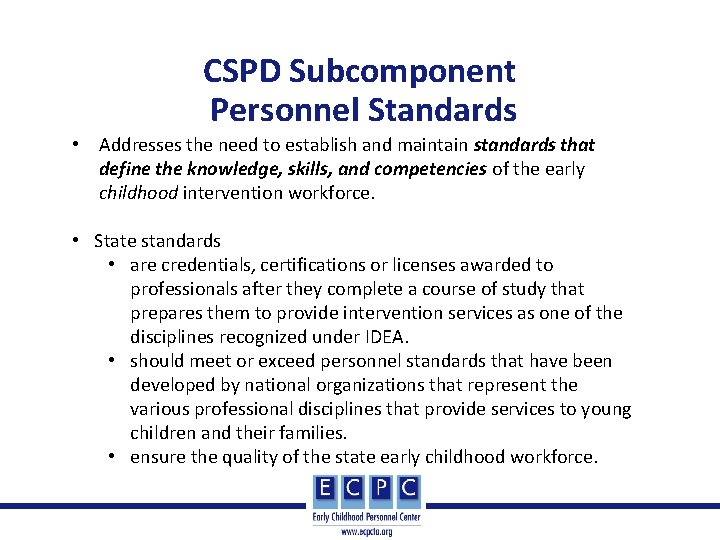
CSPD Subcomponent Personnel Standards • Addresses the need to establish and maintain standards that define the knowledge, skills, and competencies of the early childhood intervention workforce. • State standards • are credentials, certifications or licenses awarded to professionals after they complete a course of study that prepares them to provide intervention services as one of the disciplines recognized under IDEA. • should meet or exceed personnel standards that have been developed by national organizations that represent the various professional disciplines that provide services to young children and their families. • ensure the quality of the state early childhood workforce.
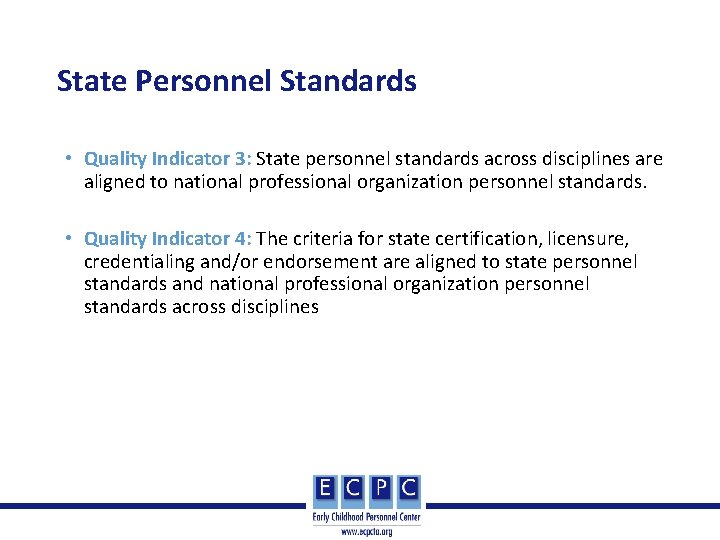
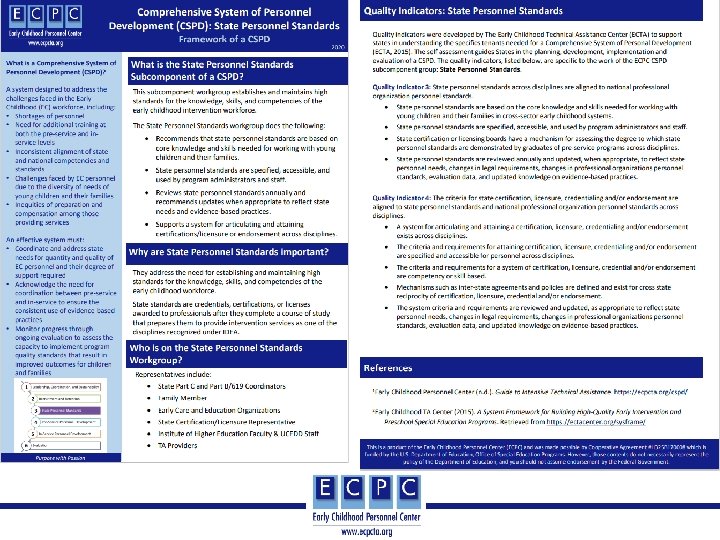
State Personnel Standards • Quality Indicator 3: State personnel standards across disciplines are aligned to national professional organization personnel standards. • Quality Indicator 4: The criteria for state certification, licensure, credentialing and/or endorsement are aligned to state personnel standards and national professional organization personnel standards across disciplines
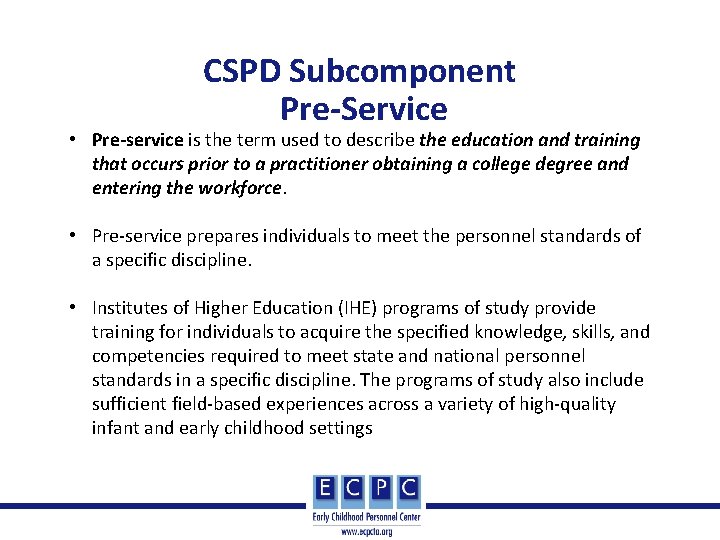
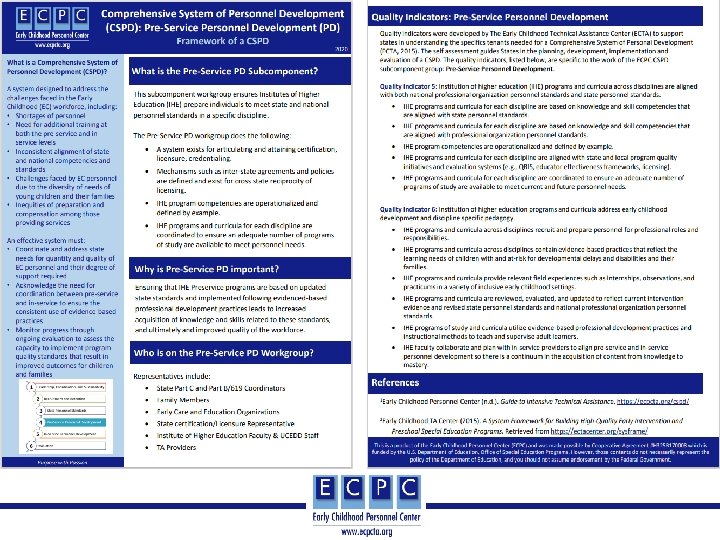
CSPD Subcomponent Pre-Service • Pre-service is the term used to describe the education and training that occurs prior to a practitioner obtaining a college degree and entering the workforce. • Pre-service prepares individuals to meet the personnel standards of a specific discipline. • Institutes of Higher Education (IHE) programs of study provide training for individuals to acquire the specified knowledge, skills, and competencies required to meet state and national personnel standards in a specific discipline. The programs of study also include sufficient field-based experiences across a variety of high-quality infant and early childhood settings
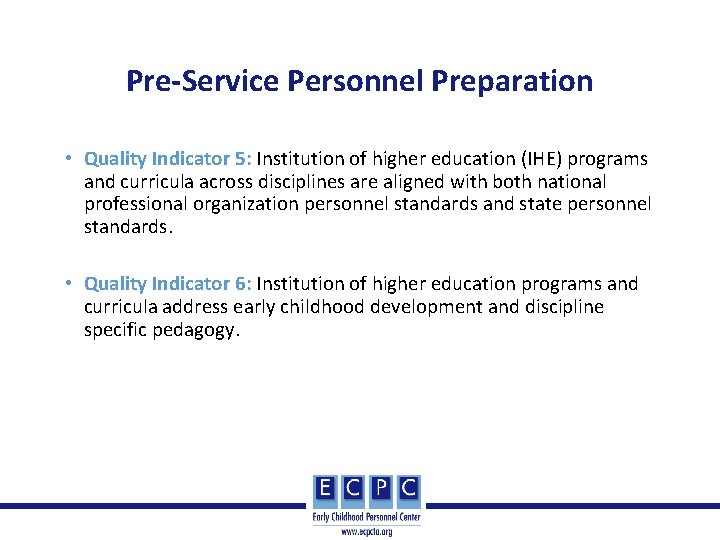
Pre-Service Personnel Preparation • Quality Indicator 5: Institution of higher education (IHE) programs and curricula across disciplines are aligned with both national professional organization personnel standards and state personnel standards. • Quality Indicator 6: Institution of higher education programs and curricula address early childhood development and discipline specific pedagogy.
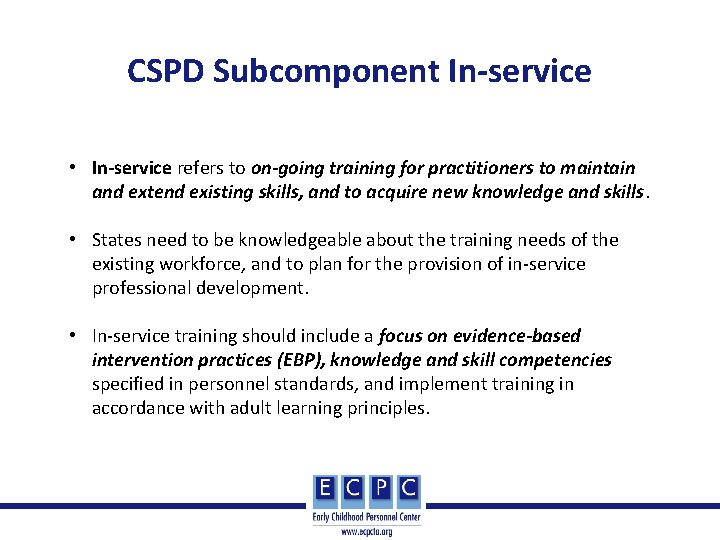
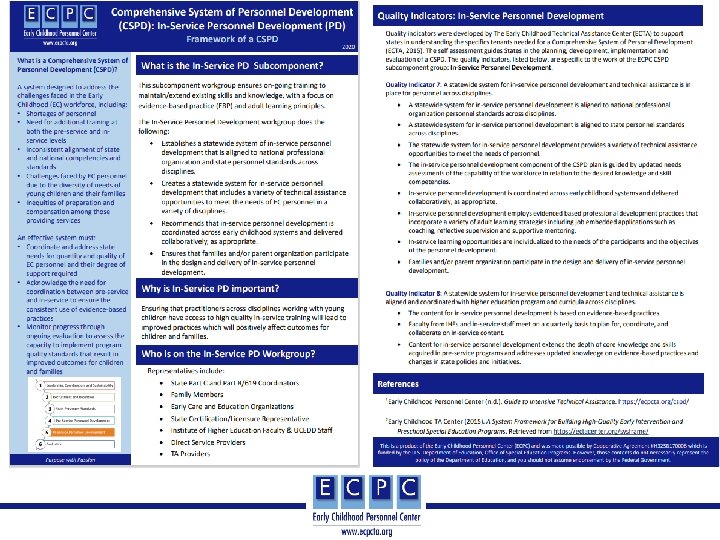
CSPD Subcomponent In-service • In-service refers to on-going training for practitioners to maintain and extend existing skills, and to acquire new knowledge and skills. • States need to be knowledgeable about the training needs of the existing workforce, and to plan for the provision of in-service professional development. • In-service training should include a focus on evidence-based intervention practices (EBP), knowledge and skill competencies specified in personnel standards, and implement training in accordance with adult learning principles.
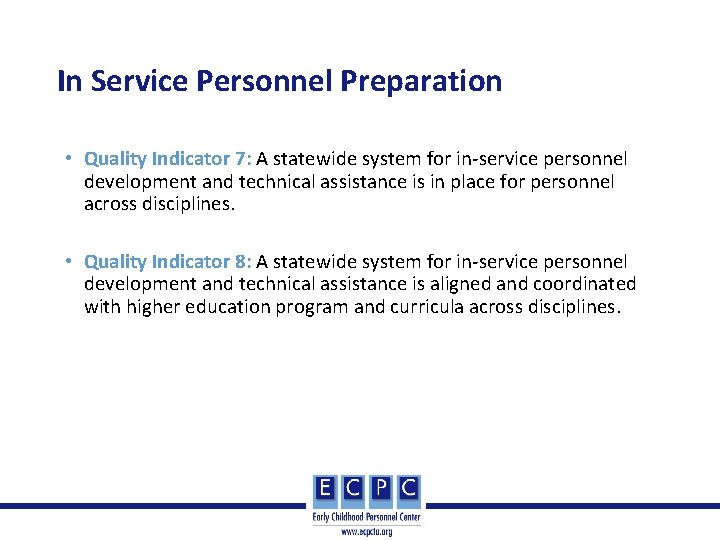
In Service Personnel Preparation • Quality Indicator 7: A statewide system for in-service personnel development and technical assistance is in place for personnel across disciplines. • Quality Indicator 8: A statewide system for in-service personnel development and technical assistance is aligned and coordinated with higher education program and curricula across disciplines.
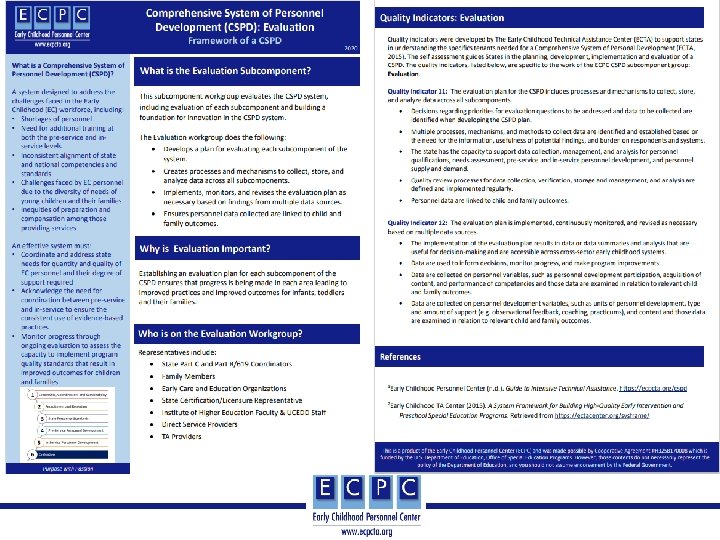
CSPD Subcomponent Evaluation of the System (Evaluation Plan) • Addresses each subcomponent of the CSPD and, initially, address the most critical features of each. • Evaluation should be viewed as cyclical in nature. That is, evaluation questions are generated, data are collected, data are analyzed and used to make decisions about the system, changes to the system are made based on the data, system changes are evaluated, and new evaluation questions are generated.
Evaluation of the System • Quality Indicator 11: The evaluation plan for the CSPD includes processes and mechanisms to collect, store, and analyze data across all subcomponents. • Quality Indicator 12: The evaluation plan is implemented, continuously monitored, and revised as necessary based on multiple data sources.
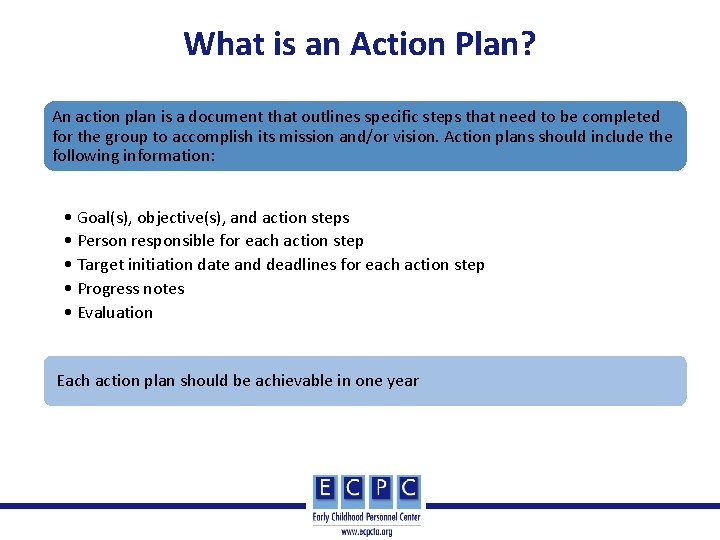
What is an Action Plan? An action plan is a document that outlines specific steps that need to be completed for the group to accomplish its mission and/or vision. Action plans should include the following information: • Goal(s), objective(s), and action steps • Person responsible for each action step • Target initiation date and deadlines for each action step • Progress notes • Evaluation Each action plan should be achievable in one year .
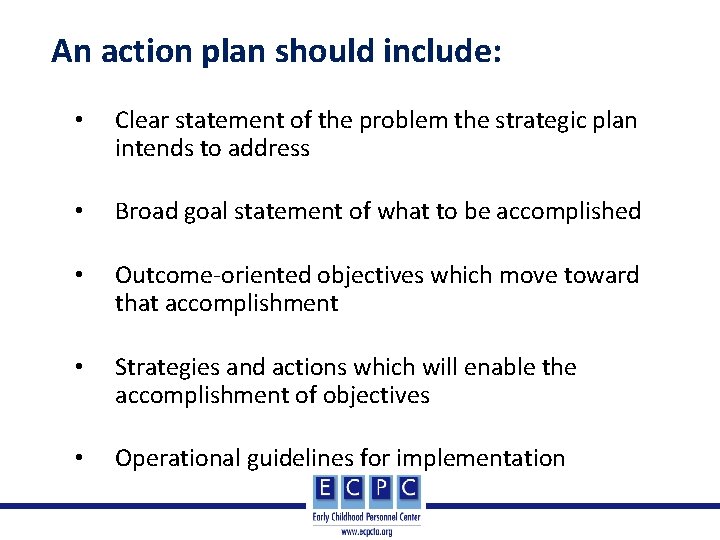
An action plan should include: • Clear statement of the problem the strategic plan intends to address • Broad goal statement of what to be accomplished • Outcome-oriented objectives which move toward that accomplishment • Strategies and actions which will enable the accomplishment of objectives • Operational guidelines for implementation
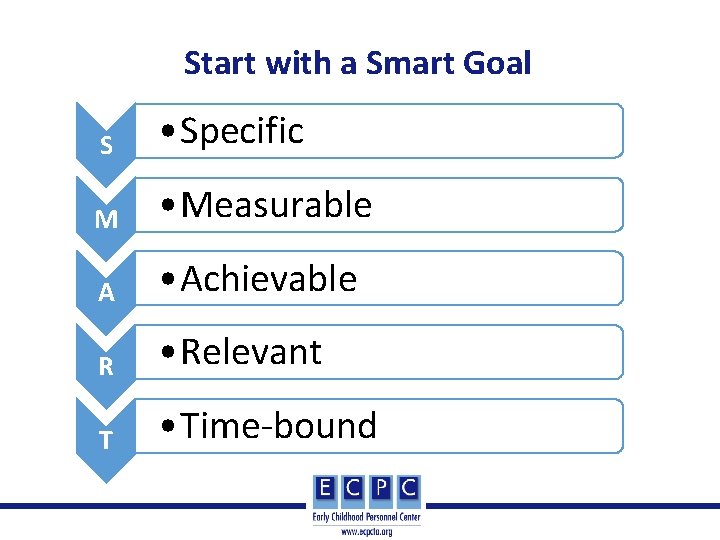
Start with a Smart Goal S • Specific M • Measurable A • Achievable R • Relevant T • Time-bound
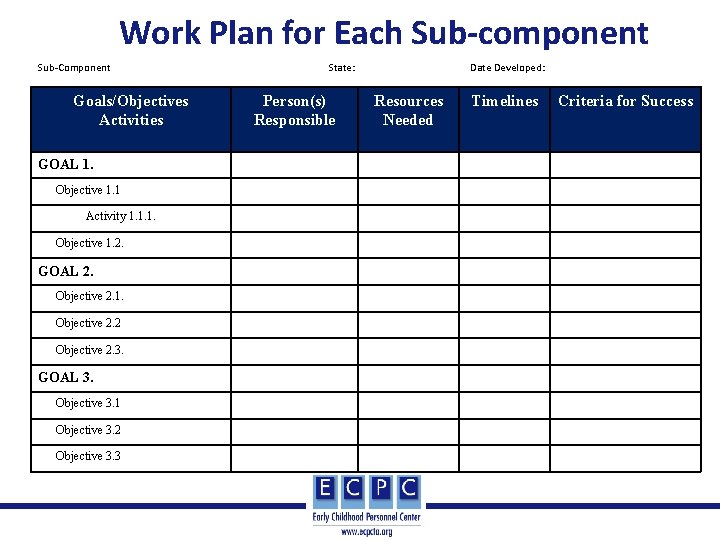
Work Plan for Each Sub-component Sub-Component Goals/Objectives Activities GOAL 1. Objective 1. 1 Activity 1. 1. 1. Objective 1. 2. GOAL 2. Objective 2. 1. Objective 2. 2 Objective 2. 3. GOAL 3. Objective 3. 1 Objective 3. 2 Objective 3. 3 State: Person(s) Responsible Date Developed: Resources Needed Timelines Criteria for Success
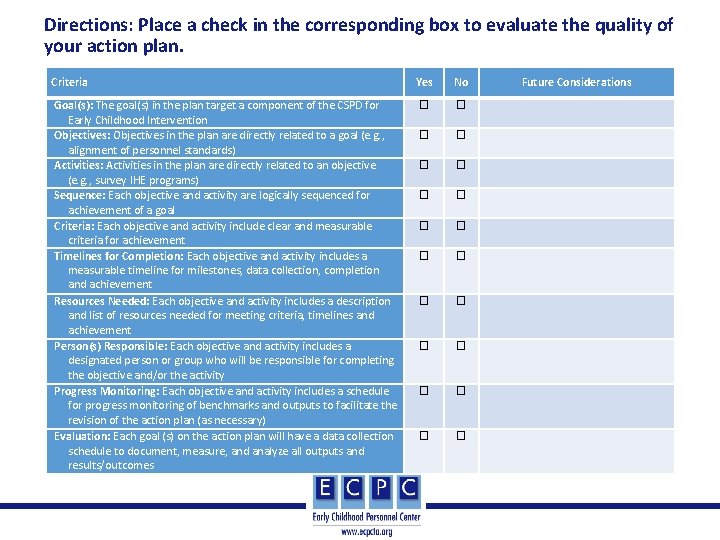
Directions: Place a check in the corresponding box to evaluate the quality of your action plan. Criteria Yes No Goal(s): The goal(s) in the plan target a component of the CSPD for Early Childhood Intervention Objectives: Objectives in the plan are directly related to a goal (e. g. , alignment of personnel standards) Activities: Activities in the plan are directly related to an objective (e. g. , survey IHE programs) Sequence: Each objective and activity are logically sequenced for achievement of a goal Criteria: Each objective and activity include clear and measurable criteria for achievement Timelines for Completion: Each objective and activity includes a measurable timeline for milestones, data collection, completion and achievement Resources Needed: Each objective and activity includes a description and list of resources needed for meeting criteria, timelines and achievement Person(s) Responsible: Each objective and activity includes a designated person or group who will be responsible for completing the objective and/or the activity Progress Monitoring: Each objective and activity includes a schedule for progress monitoring of benchmarks and outputs to facilitate the revision of the action plan (as necessary) Evaluation: Each goal (s) on the action plan will have a data collection schedule to document, measure, and analyze all outputs and results/outcomes ☐ ☐ ☐ ☐ ☐ Future Considerations
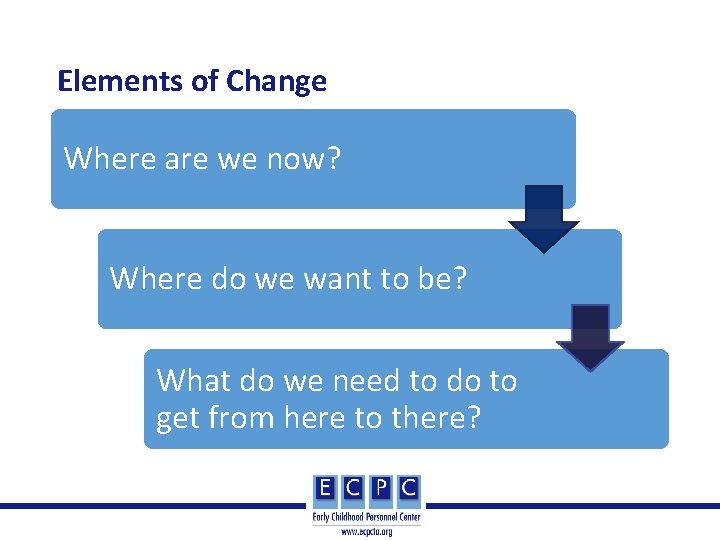
Elements of Change Where are we now? Where do we want to be? What do we need to do to get from here to there?
Next Steps