
Comprehensive Study of Plasma Wall Sheath Transport Phenomena
- Slides: 10
Comprehensive Study of Plasma. Wall Sheath Transport Phenomena Mitchell Walker - PI Associate Professor Georgia Institute of Technology Jud Ready Principal Research Engineer & Adjunct Prof. Georgia Tech Research Institute Michael Keidar Associate Professor George Washington University Gregory Thompson Professor The University of Alabama Julian Rimoli Assistant Professor Georgia Institute of Technology August 24, 2012 1
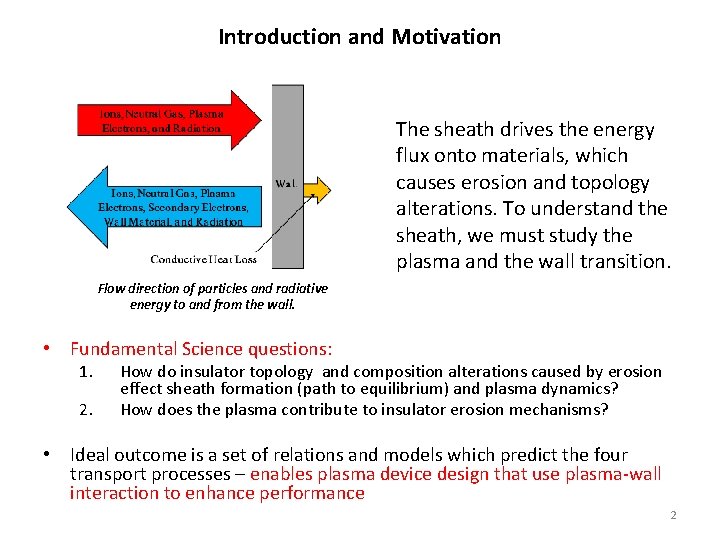
Introduction and Motivation The sheath drives the energy flux onto materials, which causes erosion and topology alterations. To understand the sheath, we must study the plasma and the wall transition. Flow direction of particles and radiative energy to and from the wall. • Fundamental Science questions: 1. 2. How do insulator topology and composition alterations caused by erosion effect sheath formation (path to equilibrium) and plasma dynamics? How does the plasma contribute to insulator erosion mechanisms? • Ideal outcome is a set of relations and models which predict the four transport processes – enables plasma device design that use plasma-wall interaction to enhance performance 2
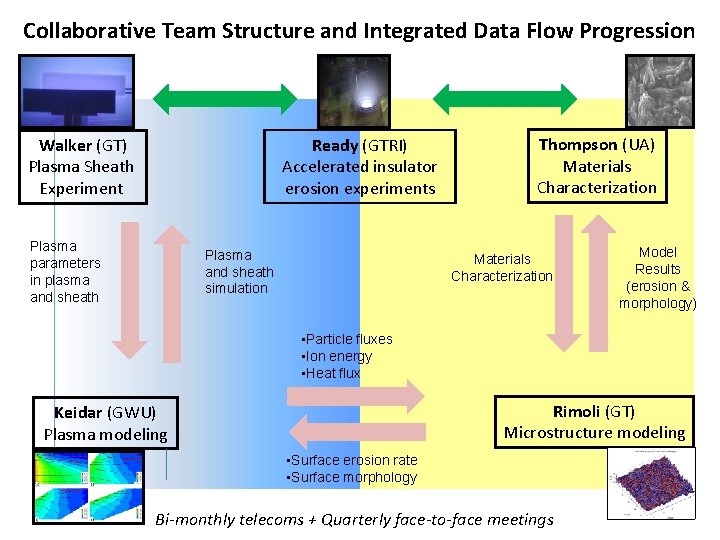
Collaborative Team Structure and Integrated Data Flow Progression Walker (GT) Plasma Sheath Experiment Ready (GTRI) Accelerated insulator erosion experiments Plasma parameters in plasma and sheath Plasma and sheath simulation Thompson (UA) Materials Characterization Model Results (erosion & morphology) • Particle fluxes • Ion energy • Heat flux Rimoli (GT) Microstructure modeling Keidar (GWU) Plasma modeling • Surface erosion rate • Surface morphology Bi-monthly telecoms + Quarterly face-to-face meetings 3
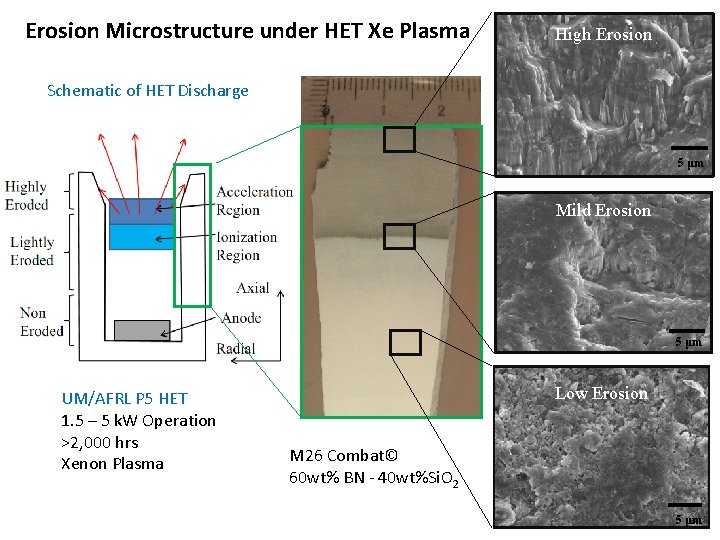
Erosion Microstructure under HET Xe Plasma High Erosion Schematic of HET Discharge 5 μm Mild Erosion 5 μm UM/AFRL P 5 HET 1. 5 – 5 k. W Operation >2, 000 hrs Xenon Plasma Low Erosion M 26 Combat© 60 wt% BN - 40 wt%Si. O 2 5 μm
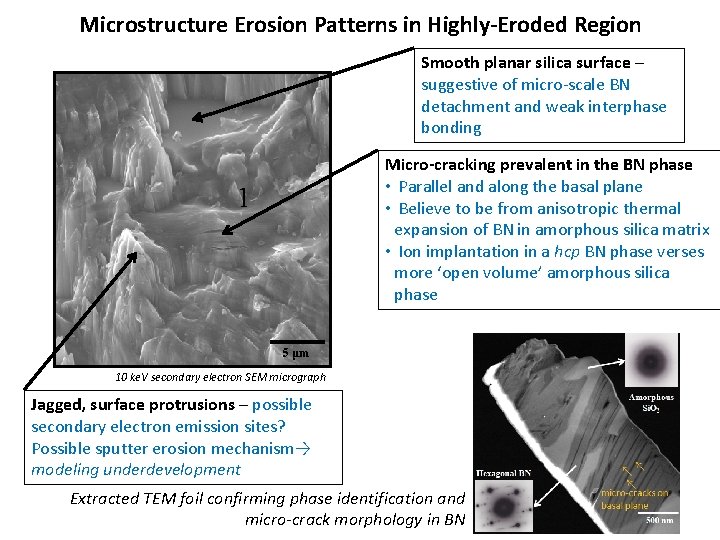
Microstructure Erosion Patterns in Highly-Eroded Region Smooth planar silica surface – suggestive of micro-scale BN detachment and weak interphase bonding D Micro-cracking prevalent in the BN phase • Parallel and along the basal plane • Believe to be from anisotropic thermal expansion of BN in amorphous silica matrix • Ion implantation in a hcp BN phase verses more ‘open volume’ amorphous silica phase 1 5 μm 10 ke. V secondary electron SEM micrograph Jagged, surface protrusions – possible secondary electron emission sites? Possible sputter erosion mechanism→ modeling underdevelopment Extracted TEM foil confirming phase identification and micro-crack morphology in BN
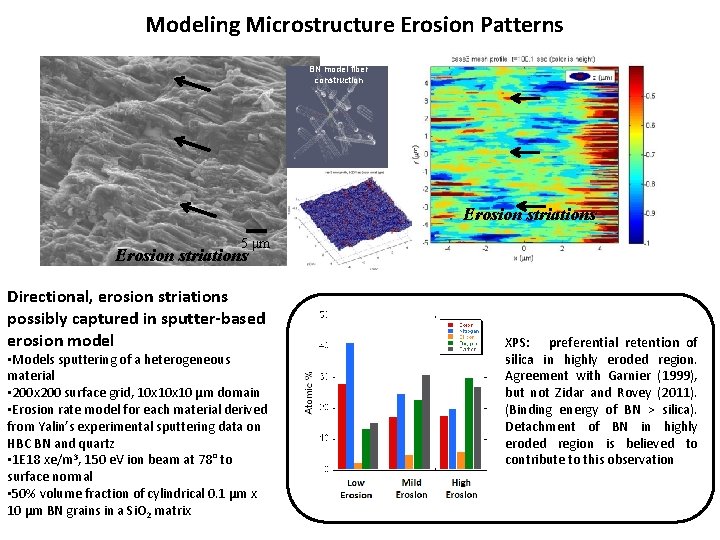
Modeling Microstructure Erosion Patterns BN model fiber construction Erosion striations 5 μm Erosion striations Directional, erosion striations possibly captured in sputter-based erosion model • Models sputtering of a heterogeneous material • 200 x 200 surface grid, 10 x 10 µm domain • Erosion rate model for each material derived from Yalin’s experimental sputtering data on HBC BN and quartz • 1 E 18 xe/m 3, 150 e. V ion beam at 78° to surface normal • 50% volume fraction of cylindrical 0. 1 µm x 10 µm BN grains in a Si. O 2 matrix XPS: preferential retention of silica in highly eroded region. Agreement with Garnier (1999), but not Zidar and Rovey (2011). (Binding energy of BN > silica). Detachment of BN in highly eroded region is believed to contribute to this observation
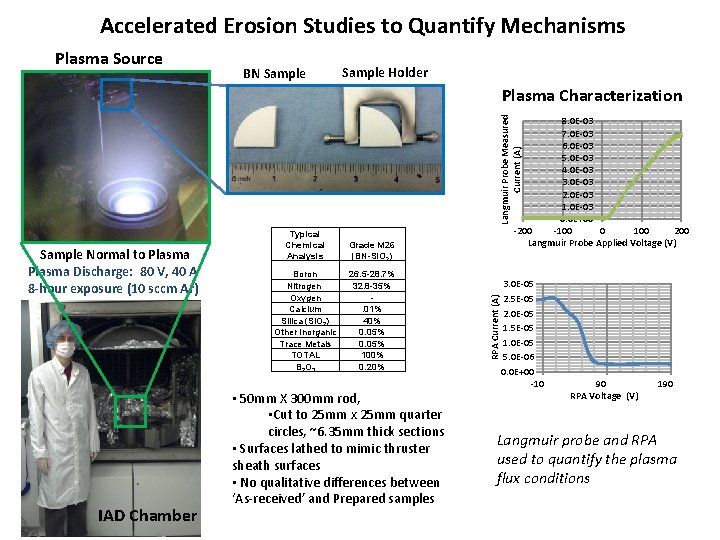
Accelerated Erosion Studies to Quantify Mechanisms Plasma Source BN Sample Holder Langmuir Probe Measured Current (A) Plasma Characterization IAD Chamber Grade M 26 (BN-Si. O 2) Boron Nitrogen Oxygen Calcium Silica (Si. O 2) Other Inorganic Trace Metals TOTAL B 2 O 3 26. 5 -28. 7% 32. 8 -35%. 01% 40% 0. 05% 100% 0. 20% • 50 mm X 300 mm rod, • Cut to 25 mm x 25 mm quarter circles, ~6. 35 mm thick sections • Surfaces lathed to mimic thruster sheath surfaces • No qualitative differences between ‘As-received’ and Prepared samples RPA Current (A) Sample Normal to Plasma Discharge: 80 V, 40 A 8 -hour exposure (10 sccm Ar) Typical Chemical Analysis 8. 0 E-03 7. 0 E-03 6. 0 E-03 5. 0 E-03 4. 0 E-03 3. 0 E-03 2. 0 E-03 1. 0 E-03 0. 0 E+00 -200 -100 0 100 200 Langmuir Probe Applied Voltage (V) 3. 0 E-05 2. 5 E-05 2. 0 E-05 1. 5 E-05 1. 0 E-05 5. 0 E-06 0. 0 E+00 -10 90 RPA Voltage (V) 190 Langmuir probe and RPA used to quantify the plasma flux conditions
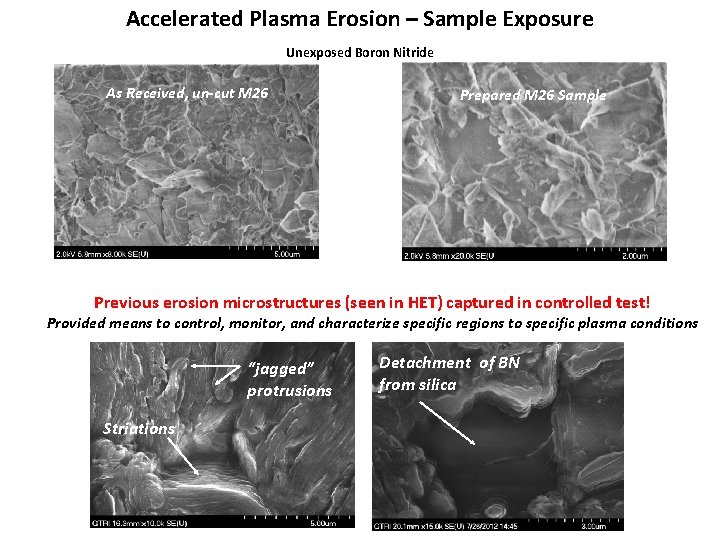
Accelerated Plasma Erosion – Sample Exposure Unexposed Boron Nitride As Received, un-cut M 26 Prepared M 26 Sample Previous erosion microstructures (seen in HET) captured in controlled test! Provided means to control, monitor, and characterize specific regions to specific plasma conditions “jagged” protrusions Striations Detachment of BN from silica
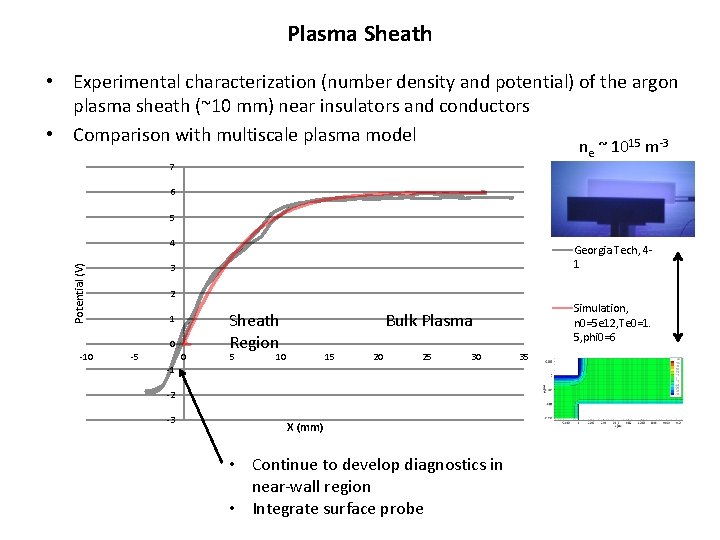
Plasma Sheath • Experimental characterization (number density and potential) of the argon plasma sheath (~10 mm) near insulators and conductors • Comparison with multiscale plasma model 15 -3 ne ~ 10 m 7 6 5 4 Georgia Tech, 41 Potential (V) 3 2 1 0 -10 -5 0 Sheath Region 5 10 15 20 25 30 -1 -2 -3 Simulation, n 0=5 e 12, Te 0=1. 5, phi 0=6 Bulk Plasma X (mm) • Continue to develop diagnostics in near-wall region • Integrate surface probe 35
Accomplishments – Year 1 1. Material characterization of HET eroded microstructure initiated • Microcracking prevalent in BN along basal plane • Erosion into jagged protrusions occur – implication to secondary electron emission unclear • Detachment of BN from silica yielding preferential retention of silica during erosion 2. Controlled erosion chamber for accelerated studies set-up and functioning 3. Material Modeling • MD simulation of erosion • Effects of material mesostructural heterogeneity on the development of the surface profile 4. Plasma • Multiscale model of bulk plasma and sheath • Experimental characterization of plasma properties in thick sheath near insulators and conductors 5. Publications • Joint Publication: "Plasma induced microstructure erosion in BN-silica composite" - In Progress • Keidar – L. Brieda and M. Keidar, Sheath formation in an oblique magnetic field, J. Appl. Phys. , vol. 111, 123302, 2012 • Keidar – L. Brieda and M. Keidar, Multiscale simulation of Hall thrusters, AIAA Joint Propulsion Conference, Atlanta GA, Aug. , 2012.