
COMPREHENSIVE SCHOOL PHYSICAL ACTIVITY PROGRAM CSPAP COMMUNICATING SUCCESS
- Slides: 26
COMPREHENSIVE SCHOOL PHYSICAL ACTIVITY PROGRAM (CSPAP) COMMUNICATING SUCCESS 10/1/2020
OUR MISSION: To promote, protect, and improve the health and safety of all Hoosiers. OUR VISION: Every Hoosier reaches optimal health regardless of where they live, learn, work, or play.
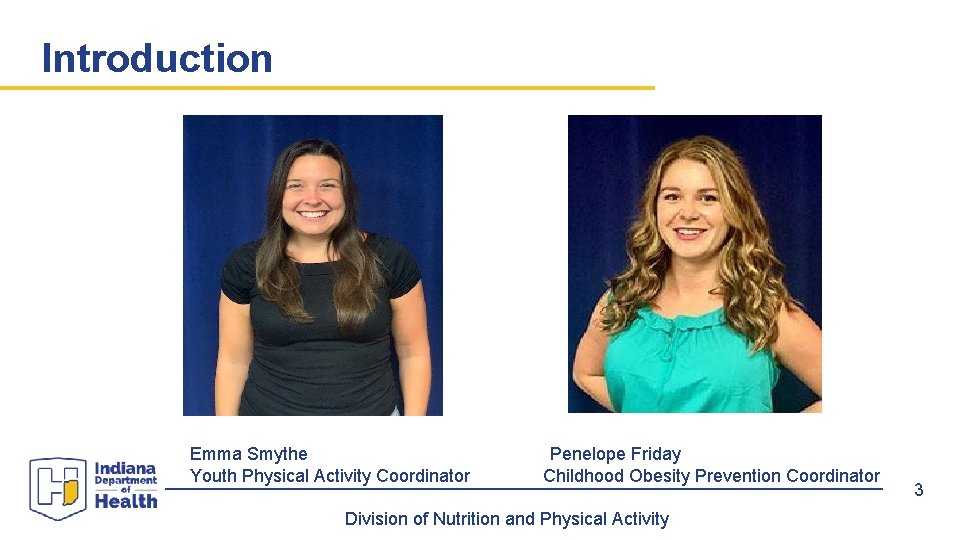
Introduction Emma Smythe Youth Physical Activity Coordinator Penelope Friday Childhood Obesity Prevention Coordinator Division of Nutrition and Physical Activity 3
Comprehensive School Physical Activity Program ● ● Action item planning for the strengths and weaknesses around movement during the school day Learning forum about best practice implementation for physical activities Key stakeholder engagement session designed to self-assess current gaps in activity levels Opportunity to utilize movement as a complement to learning by constructing a sustainability proposal 4
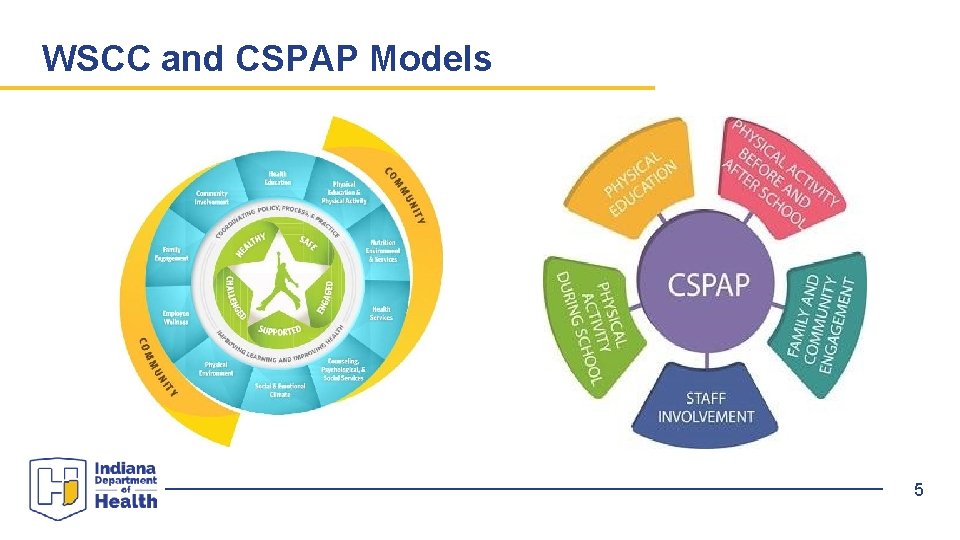
WSCC and CSPAP Models 5
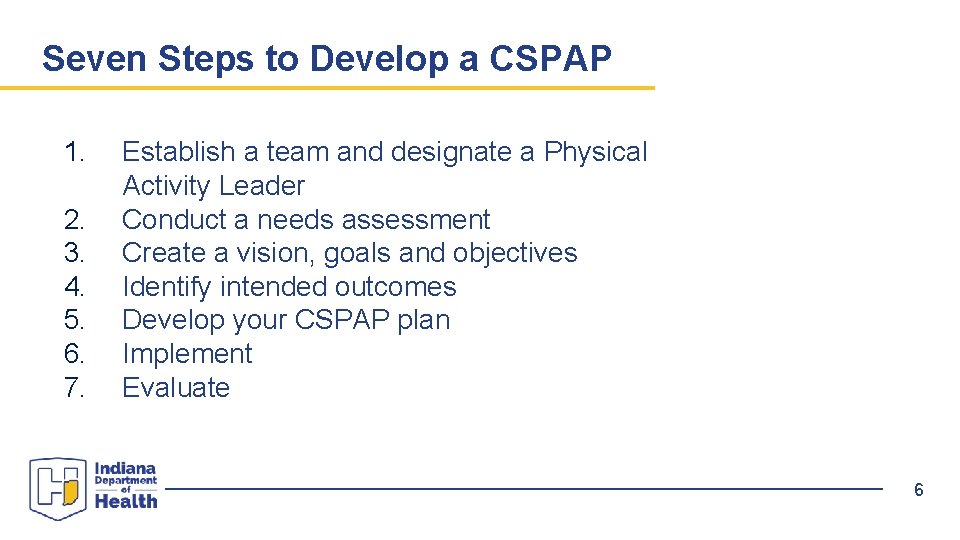
Seven Steps to Develop a CSPAP 1. 2. 3. 4. 5. 6. 7. Establish a team and designate a Physical Activity Leader Conduct a needs assessment Create a vision, goals and objectives Identify intended outcomes Develop your CSPAP plan Implement Evaluate 6
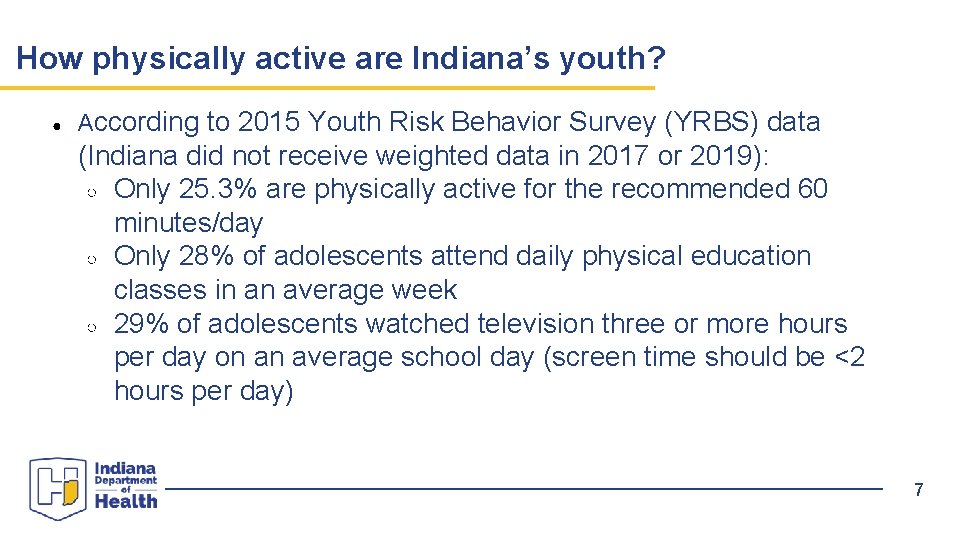
How physically active are Indiana’s youth? ● According to 2015 Youth Risk Behavior Survey (YRBS) data (Indiana did not receive weighted data in 2017 or 2019): ○ Only 25. 3% are physically active for the recommended 60 minutes/day ○ Only 28% of adolescents attend daily physical education classes in an average week ○ 29% of adolescents watched television three or more hours per day on an average school day (screen time should be <2 hours per day) 7
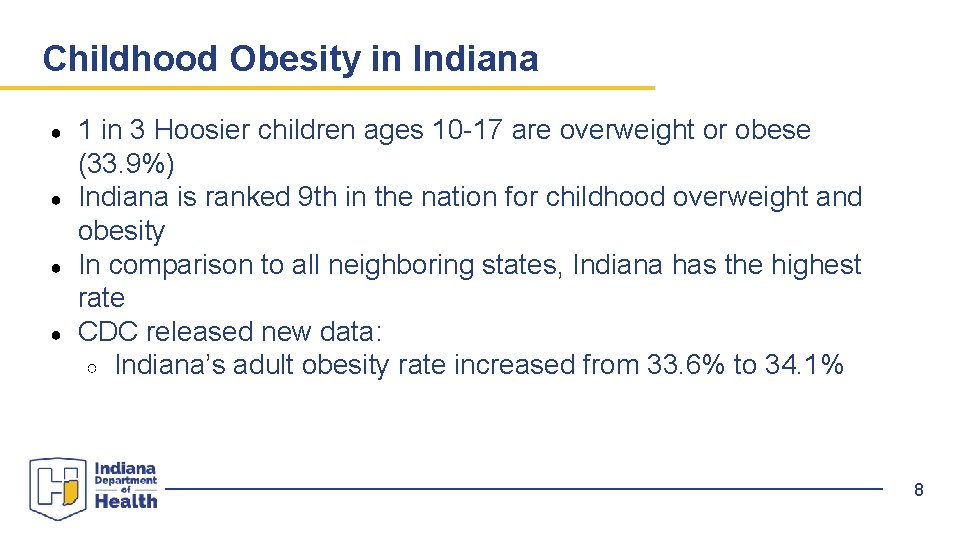
Childhood Obesity in Indiana ● ● 1 in 3 Hoosier children ages 10 -17 are overweight or obese (33. 9%) Indiana is ranked 9 th in the nation for childhood overweight and obesity In comparison to all neighboring states, Indiana has the highest rate CDC released new data: ○ Indiana’s adult obesity rate increased from 33. 6% to 34. 1% 8
Benefits of Quality Physical Education During School ● Gives students the knowledge and skills to participate in a lifetime of PA ○ Teach, mentor, and support youth to become physically active at an early age ● Teaches skill development - needed for safe and fun play/movement ● Provides a wide range of developmentally appropriate activities ● Supports other school subject areas - learning retention ● Provides a foundation to help children socialize successfully and the opportunity to learn positive people skills ● Develops a sense of self-worth, confidence, and independence ● Gives the opportunity to set and reach goals 9
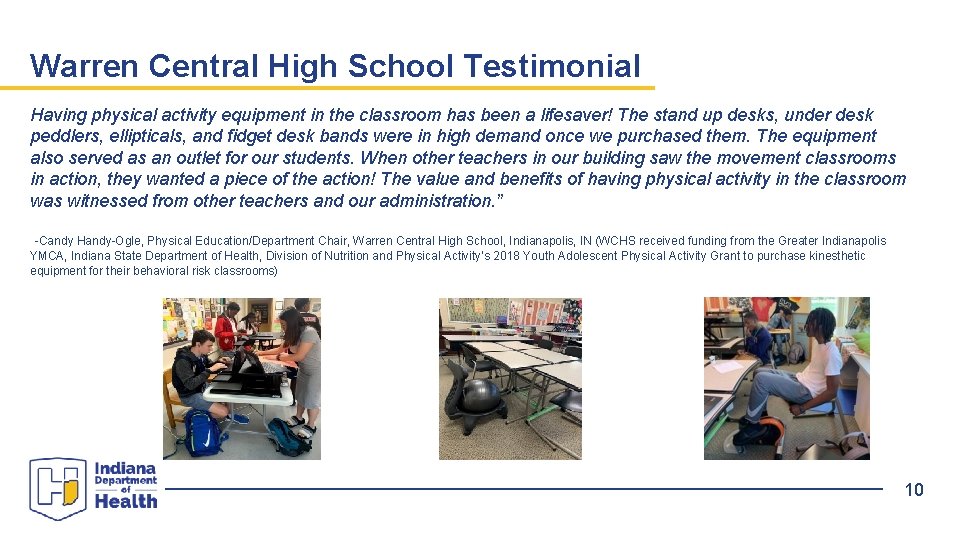
Warren Central High School Testimonial Having physical activity equipment in the classroom has been a lifesaver! The stand up desks, under desk peddlers, ellipticals, and fidget desk bands were in high demand once we purchased them. The equipment also served as an outlet for our students. When other teachers in our building saw the movement classrooms in action, they wanted a piece of the action! The value and benefits of having physical activity in the classroom was witnessed from other teachers and our administration. ” -Candy Handy-Ogle, Physical Education/Department Chair, Warren Central High School, Indianapolis, IN (WCHS received funding from the Greater Indianapolis YMCA, Indiana State Department of Health, Division of Nutrition and Physical Activity’s 2018 Youth Adolescent Physical Activity Grant to purchase kinesthetic equipment for their behavioral risk classrooms) 10
Stages of Play Unoccupied Play (Birth-3 Months): At this stage baby is just making a lot of movements with their arms, legs, hands, feet, etc. They are learning about and discovering how their body moves. Solitary Play (Birth-2 Years): This is the stage when a child plays alone. They are not interested in playing with others quite yet. Spectator/Onlooker Behavior (2 Years): During this stage a child begins to watch other children playing but does not play with them. Parallel Play (2+ Years) When a child plays alongside or near others but does not play with them this stage is referred to as parallel play. 11
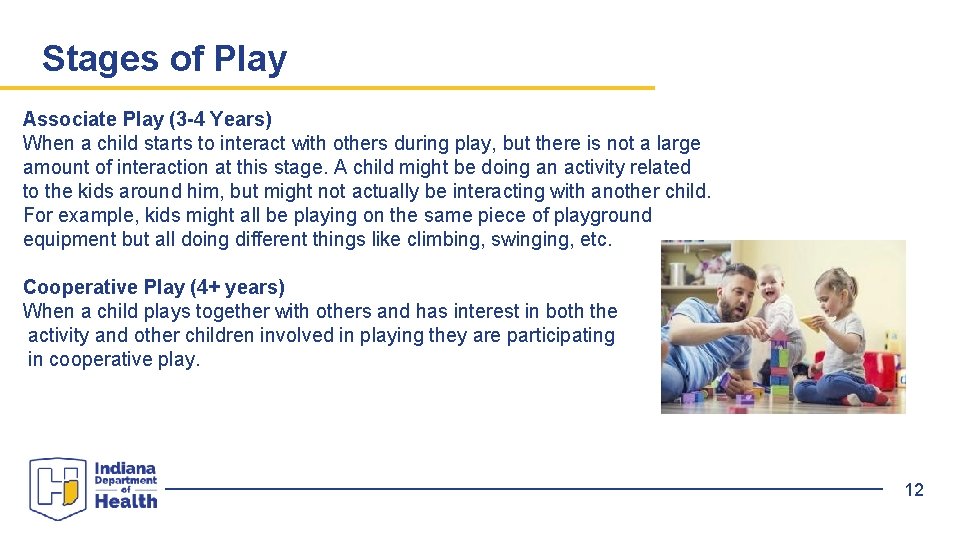
Stages of Play Associate Play (3 -4 Years) When a child starts to interact with others during play, but there is not a large amount of interaction at this stage. A child might be doing an activity related to the kids around him, but might not actually be interacting with another child. For example, kids might all be playing on the same piece of playground equipment but all doing different things like climbing, swinging, etc. Cooperative Play (4+ years) When a child plays together with others and has interest in both the activity and other children involved in playing they are participating in cooperative play. 12
Recess Guidance • Provide all students in kindergarten through 12 th grade with at least 20 minutes of recess daily (or a similar daily period of physical activity). • Prohibit the replacement of physical education with recess or the use of recess to meet time requirements for physical education policies. • Provide schools and students with adequate spaces, facilities, equipment, and supplies for recess. • Ensure that spaces and facilities for recess meet or exceed recommended safety standards. 13
Recess Guidance Cont… • Prohibit the exclusion of students from recess for disciplinary reasons or academic performance in the classroom. • Prohibit the use of physical activity during recess as punishment. • Provide recess before lunch. • Provide staff members who lead or supervise recess with ongoing professional development. 14
Building a School Recess Plan ● ● ● A school recess plan identifies the strategies a school will use to organize and implement recess at a school. Helps with accountability, tracking physical activity during recess, and documenting the impact of recess Can be shared with all school staff, students, and parents. For more information, visit: https: //www. cdc. gov/healthyschools/physicalactivity/pdf/2016_12_16_ Customizable. Recess. Planning. Template. docx 15
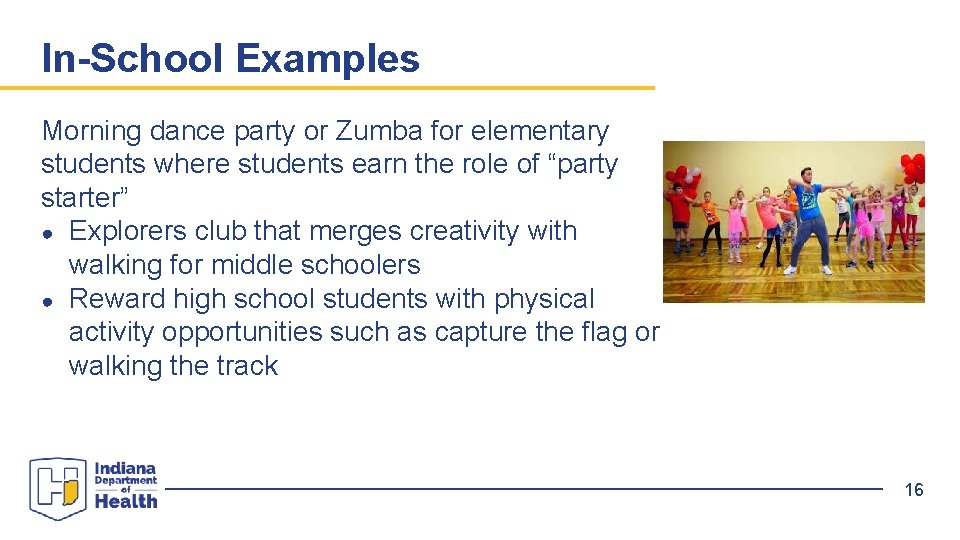
In-School Examples Morning dance party or Zumba for elementary students where students earn the role of “party starter” ● Explorers club that merges creativity with walking for middle schoolers ● Reward high school students with physical activity opportunities such as capture the flag or walking the track 16
Physical Activity Before and After School ● The hours leading up to the start of the school day and after school are an opportune time to get kids moving and showcases the importance of living a healthy lifestyle in different ways other than participating in sports (all ages and grades) ○ Examples: ■ Walking laps in the gymnasium or school hallways ■ Instructor-led group movement activities - yoga and mindfulness, Zumba; encourage walking/biking to school - safe routes to school ■ Free play in the school gymnasium or on the playground 17
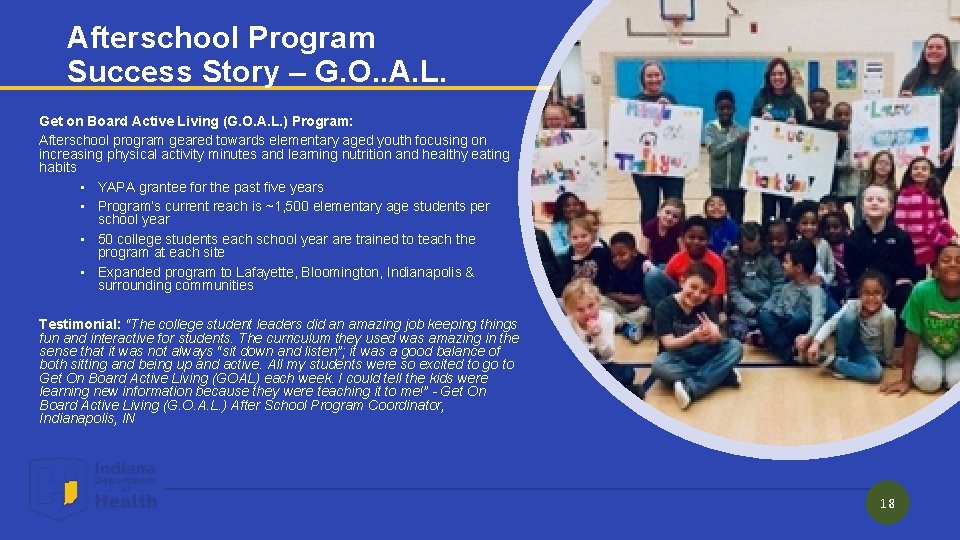
Afterschool Program Success Story – G. O. . A. L. Get on Board Active Living (G. O. A. L. ) Program: Afterschool program geared towards elementary aged youth focusing on increasing physical activity minutes and learning nutrition and healthy eating habits • YAPA grantee for the past five years • Program’s current reach is ~1, 500 elementary age students per school year • 50 college students each school year are trained to teach the program at each site • Expanded program to Lafayette, Bloomington, Indianapolis & surrounding communities Testimonial: “The college student leaders did an amazing job keeping things fun and interactive for students. The curriculum they used was amazing in the sense that it was not always “sit down and listen”; it was a good balance of both sitting and being up and active. All my students were so excited to go to Get On Board Active Living (GOAL) each week. I could tell the kids were learning new information because they were teaching it to me!” - Get On Board Active Living (G. O. A. L. ) After School Program Coordinator, Indianapolis, IN 18
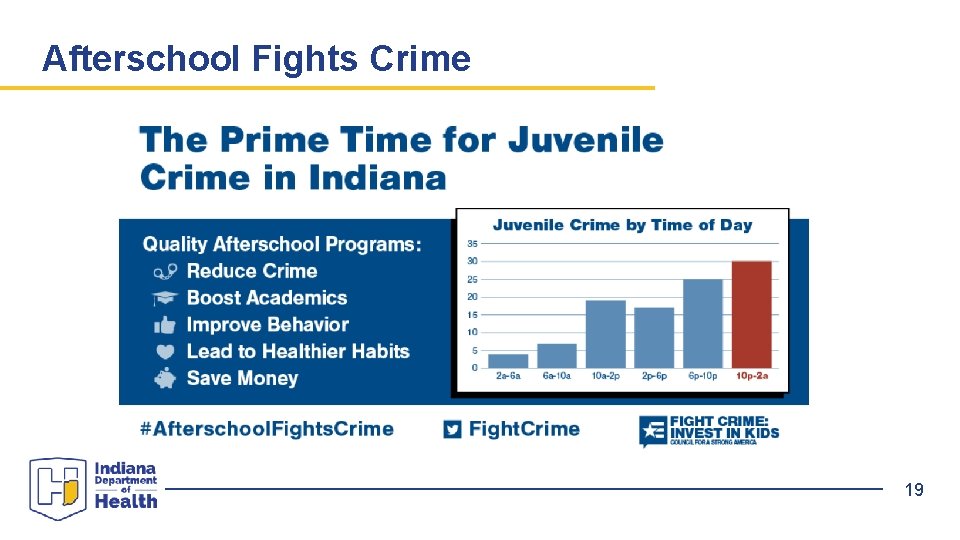
Afterschool Fights Crime 19
Brainstorm Session ● ● Are you maximizing partnerships? What does this look like with physical activity? How are you encouraging families to incorporate physical activity at home? What are the challenges? What has been successful for you - personally and professionally? 20
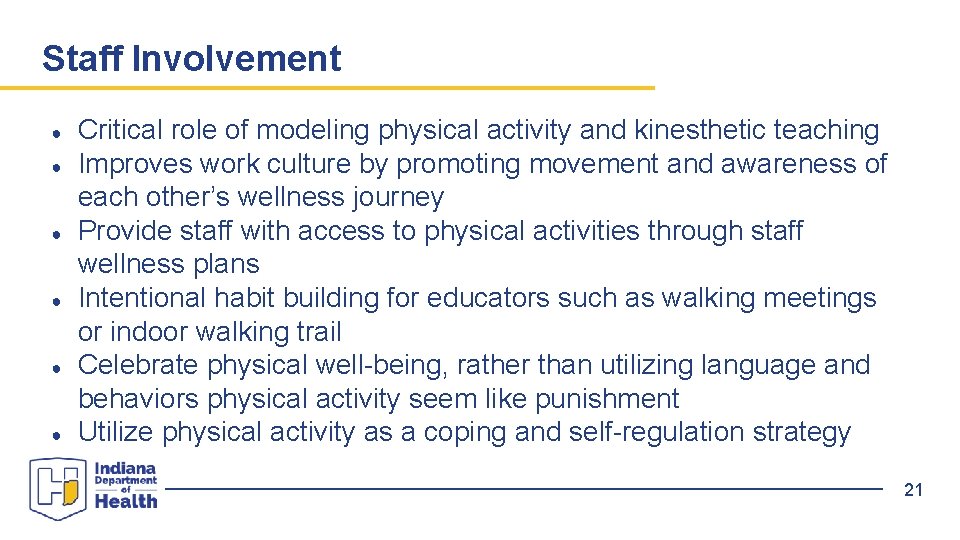
Staff Involvement ● ● ● Critical role of modeling physical activity and kinesthetic teaching Improves work culture by promoting movement and awareness of each other’s wellness journey Provide staff with access to physical activities through staff wellness plans Intentional habit building for educators such as walking meetings or indoor walking trail Celebrate physical well-being, rather than utilizing language and behaviors physical activity seem like punishment Utilize physical activity as a coping and self-regulation strategy 21
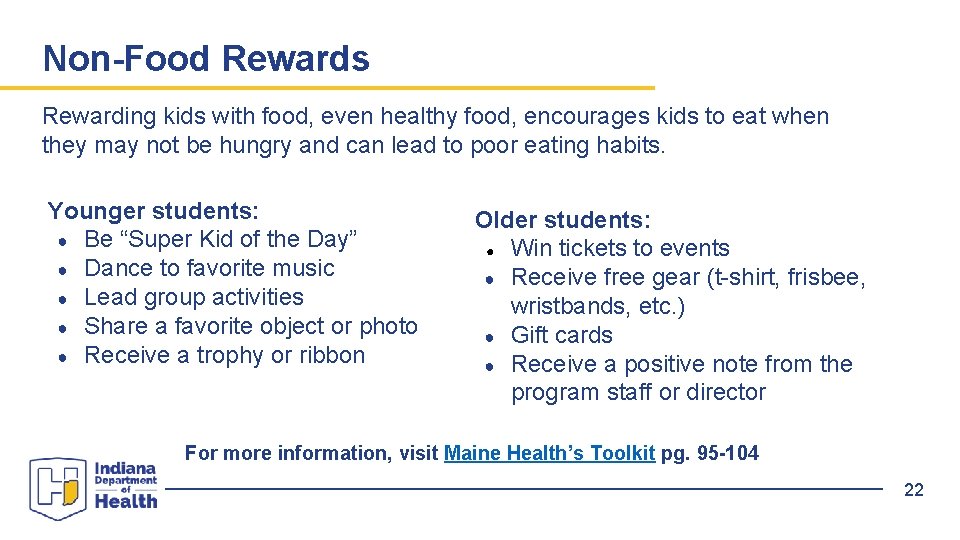
Non-Food Rewards Rewarding kids with food, even healthy food, encourages kids to eat when they may not be hungry and can lead to poor eating habits. Younger students: ● Be “Super Kid of the Day” ● Dance to favorite music ● Lead group activities ● Share a favorite object or photo ● Receive a trophy or ribbon Older students: ● Win tickets to events ● Receive free gear (t-shirt, frisbee, wristbands, etc. ) ● Gift cards ● Receive a positive note from the program staff or director For more information, visit Maine Health’s Toolkit pg. 95 -104 22
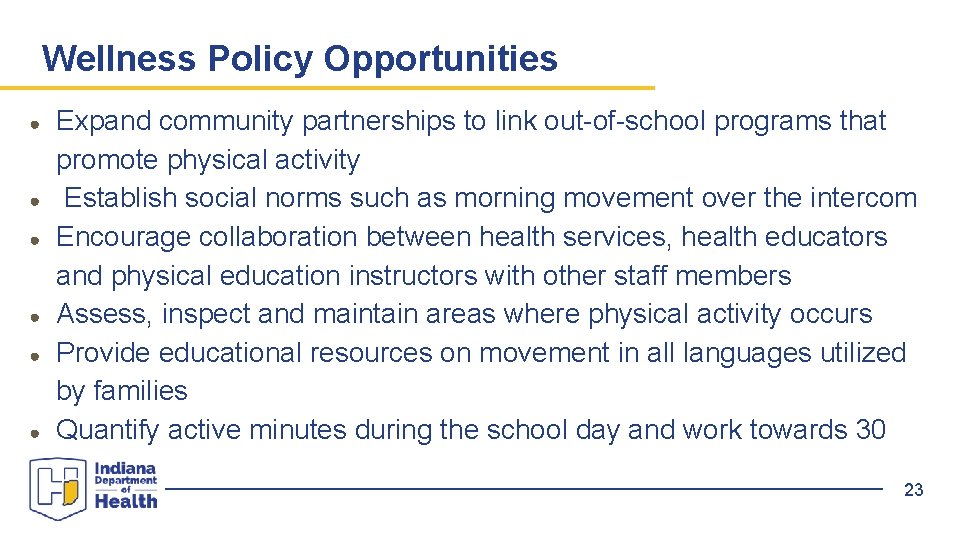
Wellness Policy Opportunities ● ● ● Expand community partnerships to link out-of-school programs that promote physical activity Establish social norms such as morning movement over the intercom Encourage collaboration between health services, health educators and physical education instructors with other staff members Assess, inspect and maintain areas where physical activity occurs Provide educational resources on movement in all languages utilized by families Quantify active minutes during the school day and work towards 30 23
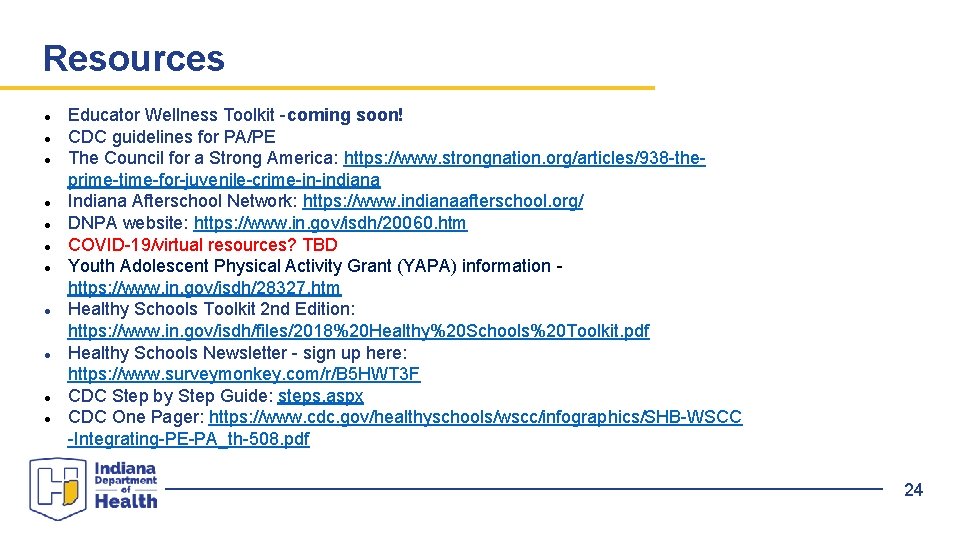
Resources ● ● ● Educator Wellness Toolkit -coming soon! CDC guidelines for PA/PE The Council for a Strong America: https: //www. strongnation. org/articles/938 -theprime-time-for-juvenile-crime-in-indiana Indiana Afterschool Network: https: //www. indianaafterschool. org/ DNPA website: https: //www. in. gov/isdh/20060. htm COVID-19/virtual resources? TBD Youth Adolescent Physical Activity Grant (YAPA) information https: //www. in. gov/isdh/28327. htm Healthy Schools Toolkit 2 nd Edition: https: //www. in. gov/isdh/files/2018%20 Healthy%20 Schools%20 Toolkit. pdf Healthy Schools Newsletter - sign up here: https: //www. surveymonkey. com/r/B 5 HWT 3 F CDC Step by Step Guide: steps. aspx CDC One Pager: https: //www. cdc. gov/healthyschools/wscc/infographics/SHB-WSCC -Integrating-PE-PA_th-508. pdf 24
Big 5 Takeaways: ● ● ● PA is not just “one more thing” to do. It is proven to be an asset to the learning environment. Altering systems in place around movement will take time. Utilize your community partners, health and physical educators to formulate what increasing active minutes would look like each building PA is a component of the WSCC Model and is an all-encompassing practice for social-emotional learning Wellness policies are an opportunity to rebuild the language to align with health and wellness priorities, and hold schools accountable for progress Schools are in a position to impact the health behaviors of children that transcend into their adult lives 25
Completion Survey Please confirm your attendance by completing this 5 -minute survey! Thanks for joining us! https: //www. surveymonkey. com/r/F 2 TP 8 N 3 Contact Information: Penelope Friday at Pfriday@isdh. in. gov Emma Smythe at ESmythe@isdh. in. gov 26