
Comprehensive Safety Analysis CSA 2010 Listening Session Overview

- Slides: 45
Comprehensive Safety Analysis (CSA) 2010 Listening Session Overview December 3, 2009 U. S. Department of Transportation Federal Motor Carrier Safety Administration Listening Session #1 12/3/2009
Listening Session Agendas Today’s agenda: Next session’s agenda • Welcome and opening remarks • Overview presentation on CSA 2010 • Responses to your comments and questions (12/10): • How CSA 2010 will affect carriers and drivers • What carriers and drivers can do to prepare for CSA 2010 • Supplemental Agency programs: – Roadside Data Uniformity – Data Quality U. S. Department of Transportation Federal Motor Carrier Safety Administration Listening Session #1 12/3/2009 2
Welcome • Over 1800 locations participating • Over 300 advance comments and questions – From carriers, agencies, associations, and individuals – Covering about 20 major topics • Submit more comments and questions throughout the webcast – Type them in on the lower right of your computer screen and hit “send” • Technical difficulties? Call 1 -866 -260 -4631 for live aid. U. S. Department of Transportation Federal Motor Carrier Safety Administration Listening Session #1 12/3/2009 3
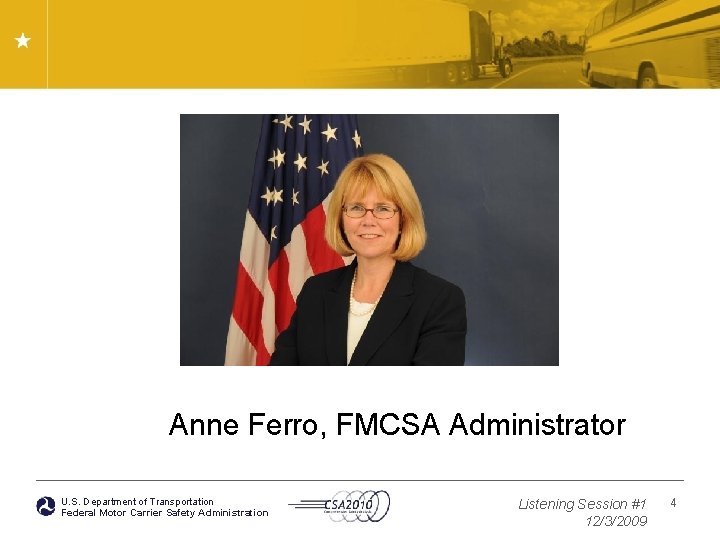
Anne Ferro, FMCSA Administrator U. S. Department of Transportation Federal Motor Carrier Safety Administration Listening Session #1 12/3/2009 4
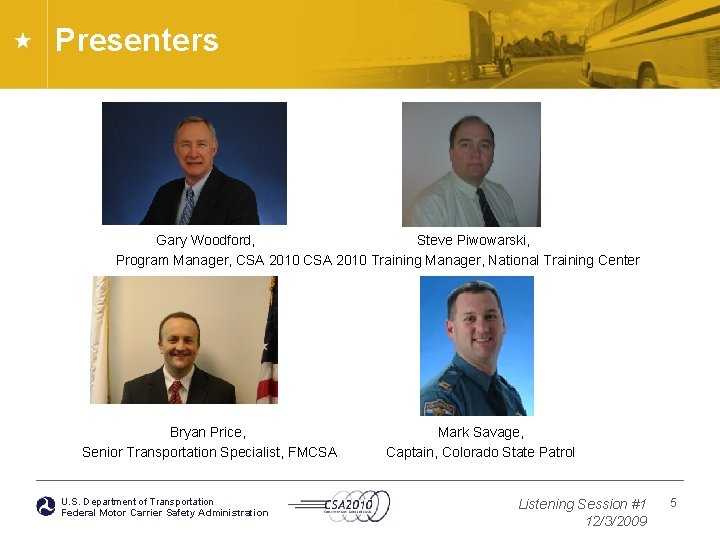
Presenters Gary Woodford, Steve Piwowarski, Program Manager, CSA 2010 Training Manager, National Training Center Bryan Price, Senior Transportation Specialist, FMCSA U. S. Department of Transportation Federal Motor Carrier Safety Administration Mark Savage, Captain, Colorado State Patrol Listening Session #1 12/3/2009 5
Presentation Agenda • CSA 2010: Defined and Described • Measurement System Methodology and Examples • Test and Implementation • Summary Technical difficulties? Call 1 -866 -260 -4631 for live aid U. S. Department of Transportation Federal Motor Carrier Safety Administration Listening Session #1 12/3/2009 6
CSA 2010 Defined and Described Technical difficulties? Call 1 -866 -260 -4631 for live aid U. S. Department of Transportation Federal Motor Carrier Safety Administration Listening Session #1 12/3/2009
Comprehensive Safety Analysis 2010 What is CSA 2010? CSA 2010 is an important initiative to improve the efficiency and effectiveness of FMCSA’s enforcement and compliance program to achieve the Agency’s mission to reduce commercial motor vehicle (CMV) crashes, fatalities, and injuries. Technical difficulties? Call 1 -866 -260 -4631 for live aid U. S. Department of Transportation Federal Motor Carrier Safety Administration Listening Session #1 12/3/2009 8
CSA 2010 Goals and Benefits • Reach a greater segment of the industry earlier through: – A more comprehensive measurement system – A broader array of interventions – Safety rating decoupled from Compliance Review (CR) • Improve FMCSA and state partner compliance and enforcement efficiency and effectiveness • Achieve a greater reduction in large truck and bus crashes Technical difficulties? Call 1 -866 -260 -4631 for live aid U. S. Department of Transportation Federal Motor Carrier Safety Administration Listening Session #1 12/3/2009 9
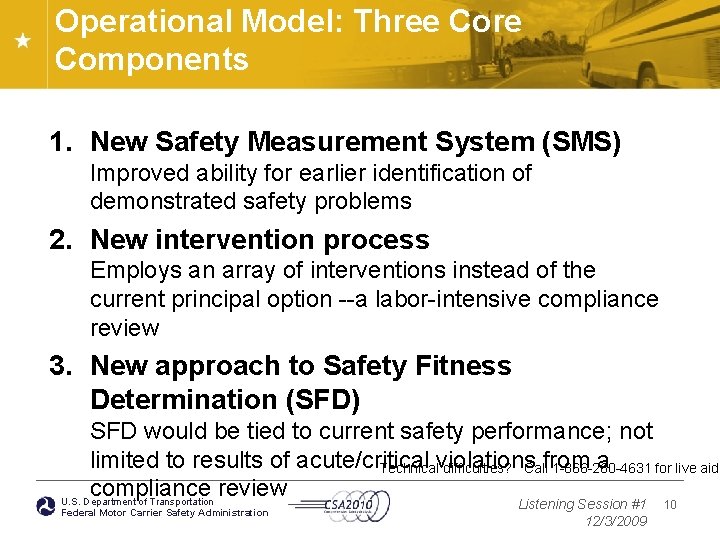
Operational Model: Three Core Components 1. New Safety Measurement System (SMS) Improved ability for earlier identification of demonstrated safety problems 2. New intervention process Employs an array of interventions instead of the current principal option --a labor-intensive compliance review 3. New approach to Safety Fitness Determination (SFD) SFD would be tied to current safety performance; not limited to results of acute/critical a Technicalviolations difficulties? Callfrom 1 -866 -260 -4631 for live aid compliance review U. S. Department of Transportation Federal Motor Carrier Safety Administration Listening Session #1 12/3/2009 10
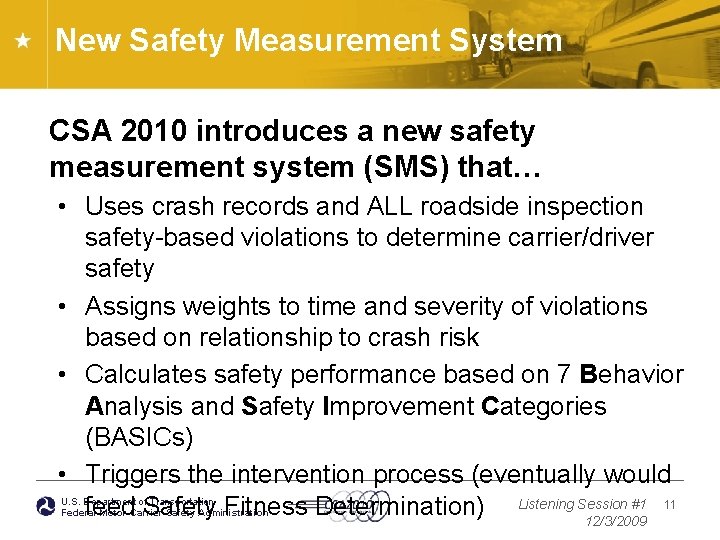
New Safety Measurement System CSA 2010 introduces a new safety measurement system (SMS) that… • Uses crash records and ALL roadside inspection safety-based violations to determine carrier/driver safety • Assigns weights to time and severity of violations based on relationship to crash risk • Calculates safety performance based on 7 Behavior Analysis and Safety Improvement Categories (BASICs) • Triggers the intervention process (eventually would #1 11 feed Safety Fitness Determination) Listening Session 12/3/2009 U. S. Department of Transportation Federal Motor Carrier Safety Administration
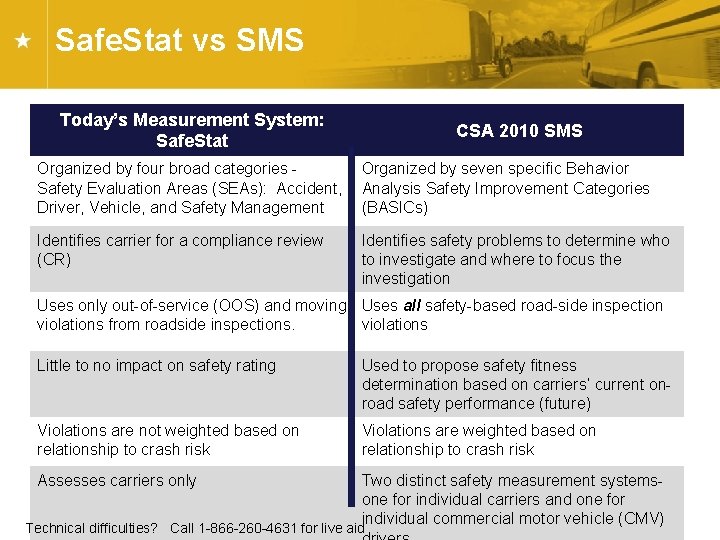
Safe. Stat vs SMS Today’s Measurement System: Safe. Stat CSA 2010 SMS Organized by four broad categories Safety Evaluation Areas (SEAs): Accident, Driver, Vehicle, and Safety Management Organized by seven specific Behavior Analysis Safety Improvement Categories (BASICs) Identifies carrier for a compliance review (CR) Identifies safety problems to determine who to investigate and where to focus the investigation Uses only out-of-service (OOS) and moving Uses all safety-based road-side inspection violations from roadside inspections. violations Little to no impact on safety rating Used to propose safety fitness determination based on carriers’ current onroad safety performance (future) Violations are not weighted based on relationship to crash risk Violations are weighted based on relationship to crash risk Assesses carriers only Two distinct safety measurement systemsone for individual carriers and one for #1 Listening Session individual commercial motor vehicle (CMV) 12/3/2009 U. S. Department of Transportation Federal Motor Carrier Safety Administration Technical difficulties? Call 1 -866 -260 -4631 for live aid
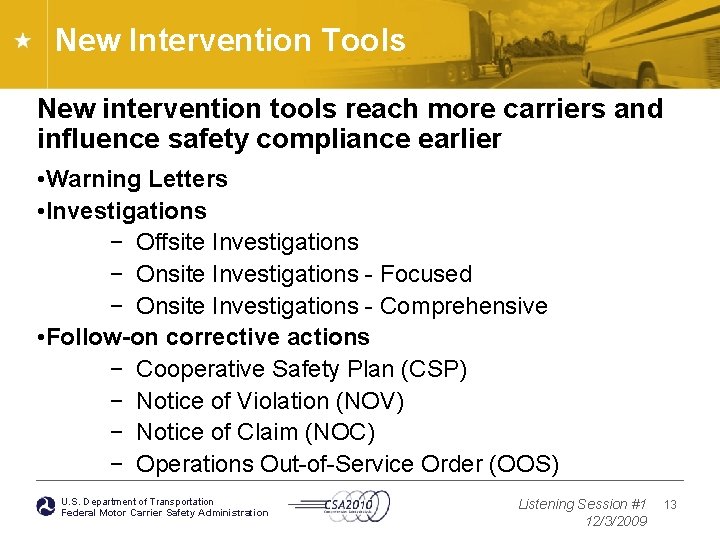
New Intervention Tools New intervention tools reach more carriers and influence safety compliance earlier • Warning Letters • Investigations − Offsite Investigations − Onsite Investigations - Focused − Onsite Investigations - Comprehensive • Follow-on corrective actions − Cooperative Safety Plan (CSP) − Notice of Violation (NOV) − Notice of Claim (NOC) − Operations Out-of-Service Order (OOS) U. S. Department of Transportation Federal Motor Carrier Safety Administration Listening Session #1 12/3/2009 13
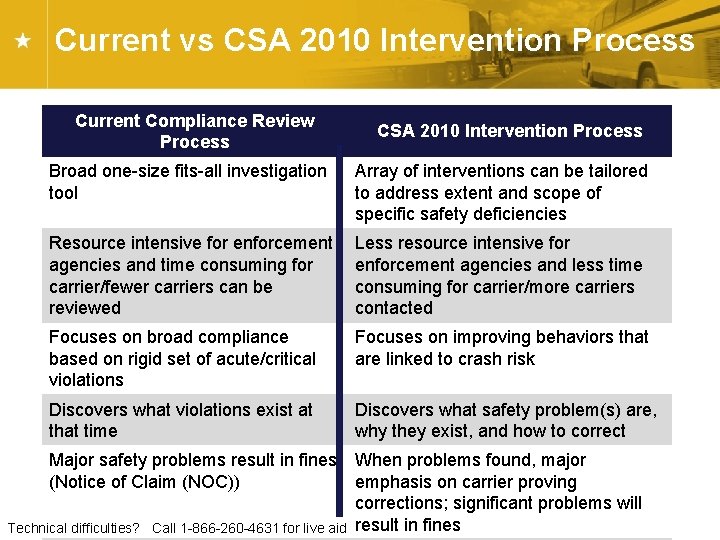
Current vs CSA 2010 Intervention Process Current Compliance Review Process CSA 2010 Intervention Process Broad one-size fits-all investigation tool Array of interventions can be tailored to address extent and scope of specific safety deficiencies Resource intensive for enforcement agencies and time consuming for carrier/fewer carriers can be reviewed Less resource intensive for enforcement agencies and less time consuming for carrier/more carriers contacted Focuses on broad compliance based on rigid set of acute/critical violations Focuses on improving behaviors that are linked to crash risk Discovers what violations exist at that time Discovers what safety problem(s) are, why they exist, and how to correct Major safety problems result in fines (Notice of Claim (NOC)) When problems found, major emphasis on carrier proving Listening Session #1 corrections; significant problems will 12/3/2009 result in fines U. S. Department of Transportation Federal Motor Carrier Safety Administration Technical difficulties? Call 1 -866 -260 -4631 for live aid
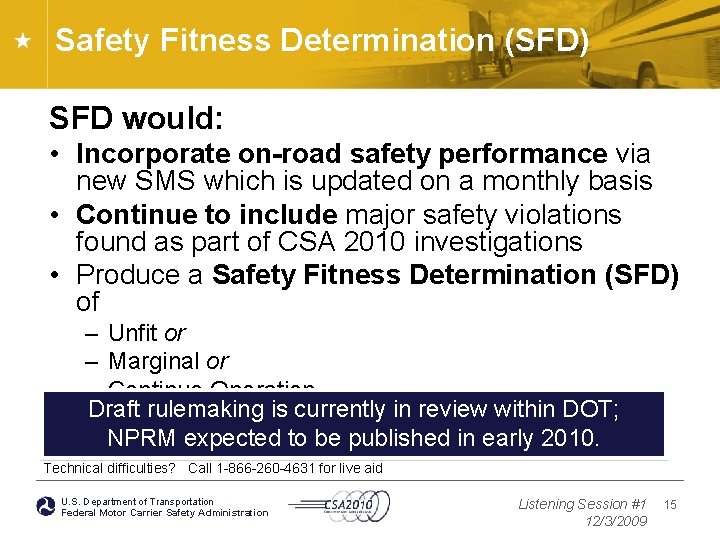
Safety Fitness Determination (SFD) SFD would: • Incorporate on-road safety performance via new SMS which is updated on a monthly basis • Continue to include major safety violations found as part of CSA 2010 investigations • Produce a Safety Fitness Determination (SFD) of – Unfit or – Marginal or – Continue Operation Draft rulemaking is currently in review within DOT; NPRM expected to be published in early 2010. Technical difficulties? Call 1 -866 -260 -4631 for live aid U. S. Department of Transportation Federal Motor Carrier Safety Administration Listening Session #1 12/3/2009 15
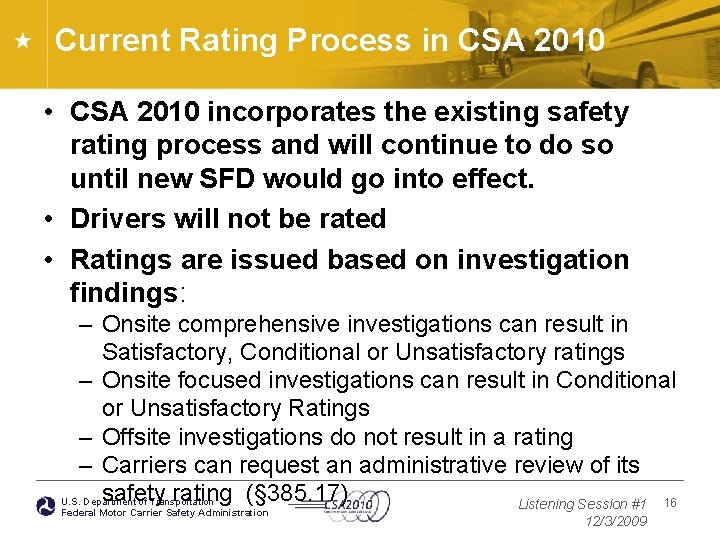
Current Rating Process in CSA 2010 • CSA 2010 incorporates the existing safety rating process and will continue to do so until new SFD would go into effect. • Drivers will not be rated • Ratings are issued based on investigation findings: – Onsite comprehensive investigations can result in Satisfactory, Conditional or Unsatisfactory ratings – Onsite focused investigations can result in Conditional or Unsatisfactory Ratings – Offsite investigations do not result in a rating – Carriers can request an administrative review of its safety rating (§ 385. 17) U. S. Department of Transportation Listening Session #1 16 Federal Motor Carrier Safety Administration 12/3/2009
CSA 2010 Measurement System Methodology and Examples Technical difficulties? Call 1 -866 -260 -4631 for live aid U. S. Department of Transportation Federal Motor Carrier Safety Administration Listening Session #1 12/3/2009
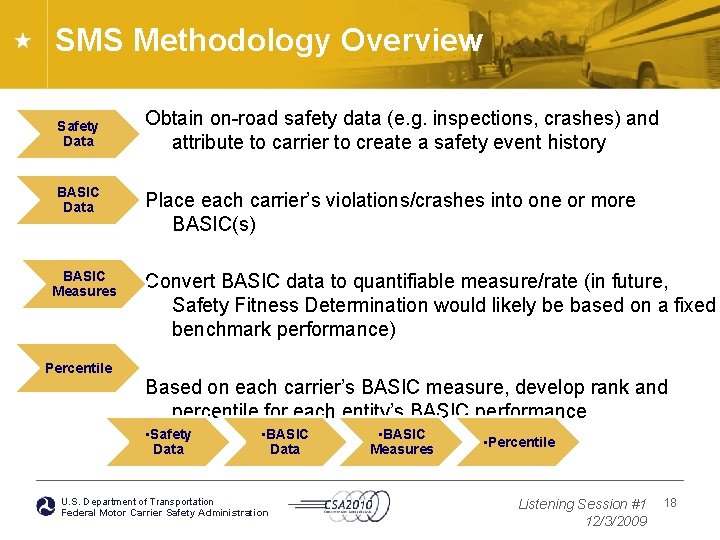
SMS Methodology Overview Safety Data BASIC Measures Obtain on-road safety data (e. g. inspections, crashes) and attribute to carrier to create a safety event history Place each carrier’s violations/crashes into one or more BASIC(s) Convert BASIC data to quantifiable measure/rate (in future, Safety Fitness Determination would likely be based on a fixed benchmark performance) Percentile Based on each carrier’s BASIC measure, develop rank and percentile for each entity’s BASIC performance • Safety Data • BASIC Data U. S. Department of Transportation Federal Motor Carrier Safety Administration • BASIC Measures • Percentile Listening Session #1 12/3/2009 18
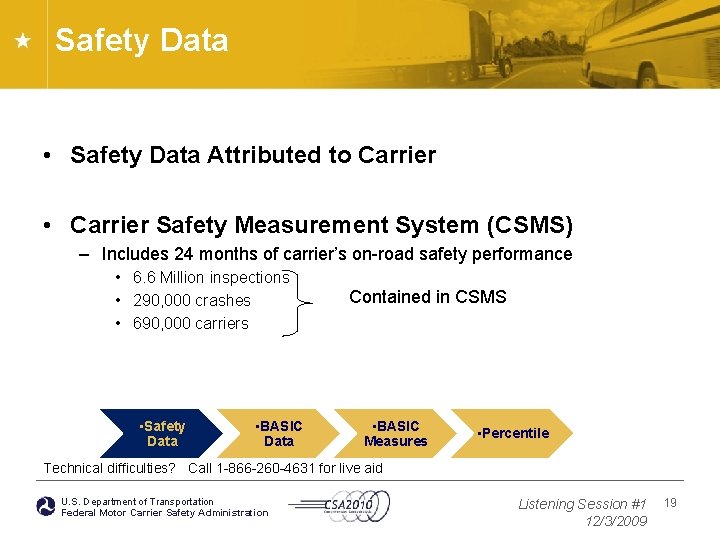
Safety Data • Safety Data Attributed to Carrier • Carrier Safety Measurement System (CSMS) – Includes 24 months of carrier’s on-road safety performance • 6. 6 Million inspections • 290, 000 crashes • 690, 000 carriers • Safety Data • BASIC Data Contained in CSMS • BASIC Measures • Percentile Technical difficulties? Call 1 -866 -260 -4631 for live aid U. S. Department of Transportation Federal Motor Carrier Safety Administration Listening Session #1 12/3/2009 19
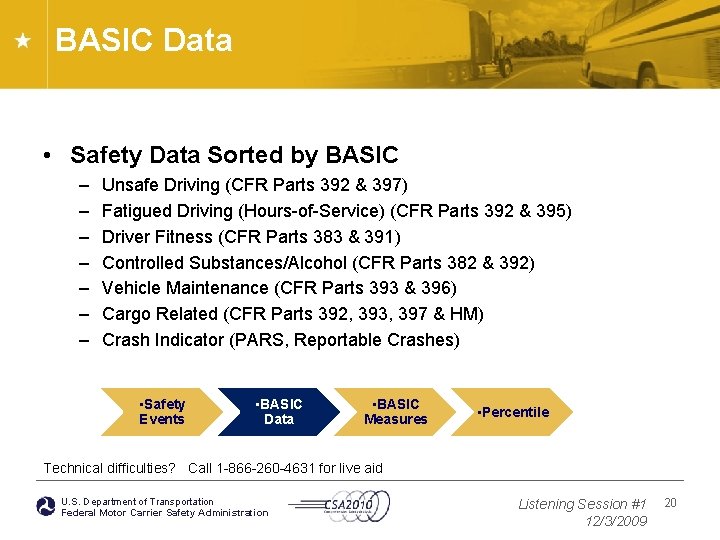
BASIC Data • Safety Data Sorted by BASIC – – – – Unsafe Driving (CFR Parts 392 & 397) Fatigued Driving (Hours-of-Service) (CFR Parts 392 & 395) Driver Fitness (CFR Parts 383 & 391) Controlled Substances/Alcohol (CFR Parts 382 & 392) Vehicle Maintenance (CFR Parts 393 & 396) Cargo Related (CFR Parts 392, 393, 397 & HM) Crash Indicator (PARS, Reportable Crashes) • Safety Events • BASIC Data • BASIC Measures • Percentile Technical difficulties? Call 1 -866 -260 -4631 for live aid U. S. Department of Transportation Federal Motor Carrier Safety Administration Listening Session #1 12/3/2009 20
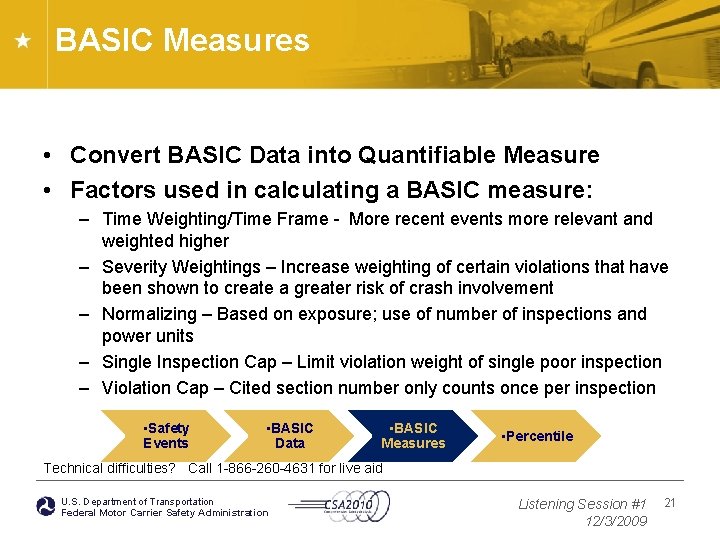
BASIC Measures • Convert BASIC Data into Quantifiable Measure • Factors used in calculating a BASIC measure: – Time Weighting/Time Frame - More recent events more relevant and weighted higher – Severity Weightings – Increase weighting of certain violations that have been shown to create a greater risk of crash involvement – Normalizing – Based on exposure; use of number of inspections and power units – Single Inspection Cap – Limit violation weight of single poor inspection – Violation Cap – Cited section number only counts once per inspection • Safety Events • BASIC Data • BASIC Measures • Percentile Technical difficulties? Call 1 -866 -260 -4631 for live aid U. S. Department of Transportation Federal Motor Carrier Safety Administration Listening Session #1 12/3/2009 21
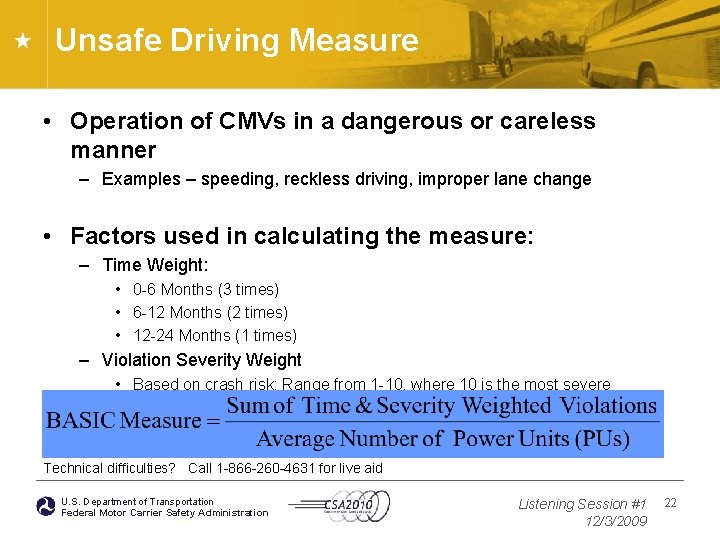
Unsafe Driving Measure • Operation of CMVs in a dangerous or careless manner – Examples – speeding, reckless driving, improper lane change • Factors used in calculating the measure: – Time Weight: • 0 -6 Months (3 times) • 6 -12 Months (2 times) • 12 -24 Months (1 times) – Violation Severity Weight • Based on crash risk: Range from 1 -10, where 10 is the most severe – Normalized by Average Power Units Technical difficulties? Call 1 -866 -260 -4631 for live aid U. S. Department of Transportation Federal Motor Carrier Safety Administration Listening Session #1 12/3/2009 22
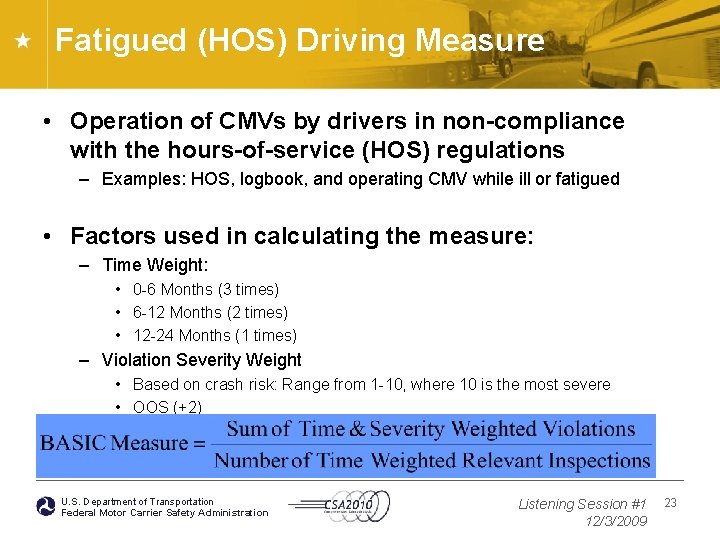
Fatigued (HOS) Driving Measure • Operation of CMVs by drivers in non-compliance with the hours-of-service (HOS) regulations – Examples: HOS, logbook, and operating CMV while ill or fatigued • Factors used in calculating the measure: – Time Weight: • 0 -6 Months (3 times) • 6 -12 Months (2 times) • 12 -24 Months (1 times) – Violation Severity Weight • Based on crash risk: Range from 1 -10, where 10 is the most severe • OOS (+2) – Normalized by Relevant Inspections – Levels 1, 2, 3, 6 and any other inspections resulting in related violations U. S. Department of Transportation Federal Motor Carrier Safety Administration Listening Session #1 12/3/2009 23
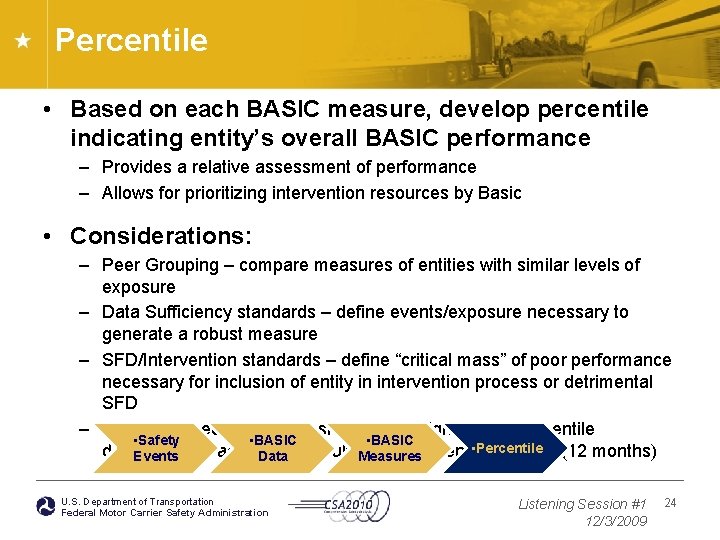
Percentile • Based on each BASIC measure, develop percentile indicating entity’s overall BASIC performance – Provides a relative assessment of performance – Allows for prioritizing intervention resources by Basic • Considerations: – Peer Grouping – compare measures of entities with similar levels of exposure – Data Sufficiency standards – define events/exposure necessary to generate a robust measure – SFD/Intervention standards – define “critical mass” of poor performance necessary for inclusion of entity in intervention process or detrimental SFD – Current Inspection and Crash Data – assignment of percentile • Safety • BASIC Percentile (12 months) dependent on age of and result of most recent • inspection Events Data Measures U. S. Department of Transportation Federal Motor Carrier Safety Administration Listening Session #1 12/3/2009 24
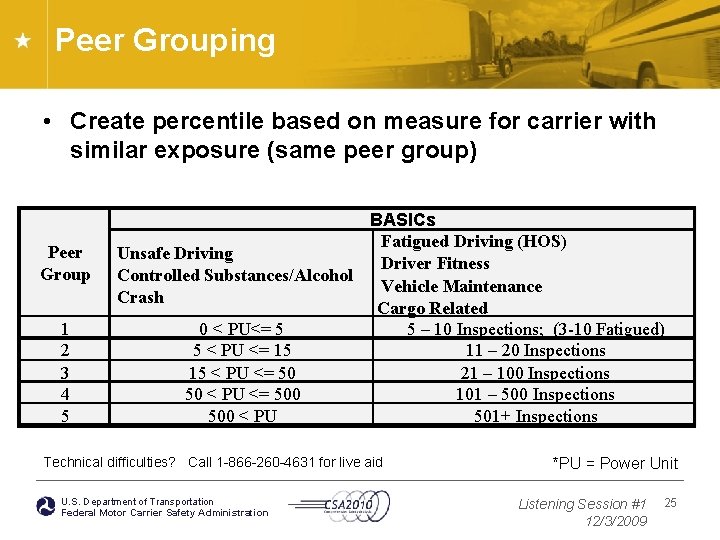
Peer Grouping • Create percentile based on measure for carrier with similar exposure (same peer group) Peer Group 1 2 3 4 5 BASICs Fatigued Driving (HOS) Unsafe Driving Driver Fitness Controlled Substances/Alcohol Vehicle Maintenance Crash Cargo Related 0 < PU<= 5 5 – 10 Inspections; (3 -10 Fatigued) 5 < PU <= 15 11 – 20 Inspections 15 < PU <= 50 21 – 100 Inspections 50 < PU <= 500 101 – 500 Inspections 500 < PU 501+ Inspections Technical difficulties? Call 1 -866 -260 -4631 for live aid U. S. Department of Transportation Federal Motor Carrier Safety Administration *PU = Power Unit Listening Session #1 12/3/2009 25
Example of Safe. Stat vs SMS The following slides provide examples of key differences between Safe. Stat and the new Safety Measurement System Technical difficulties? Call 1 -866 -260 -4631 for live aid U. S. Department of Transportation Federal Motor Carrier Safety Administration Listening Session #1 12/3/2009 26
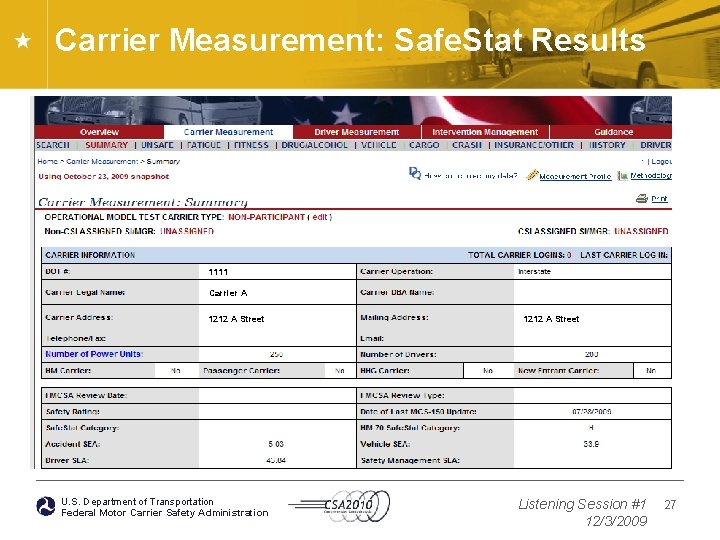
Carrier Measurement: Safe. Stat Results 1111 Carrier A 1212 A Street U. S. Department of Transportation Federal Motor Carrier Safety Administration 1212 A Street Listening Session #1 12/3/2009 27
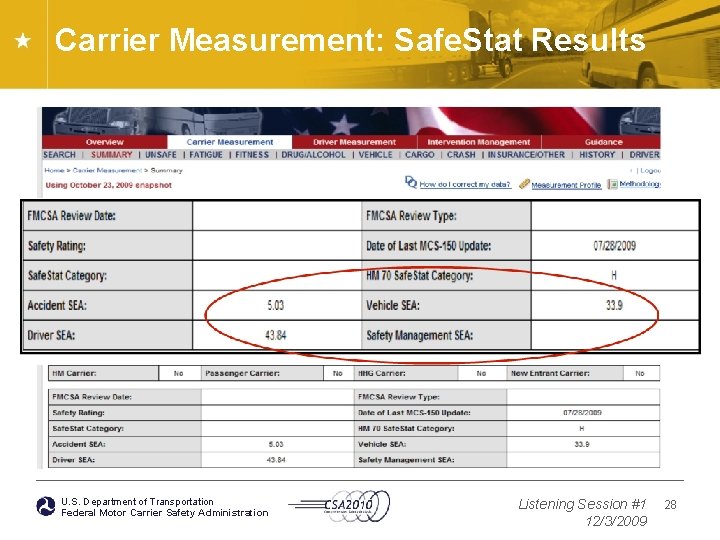
Carrier Measurement: Safe. Stat Results U. S. Department of Transportation Federal Motor Carrier Safety Administration Listening Session #1 12/3/2009 28
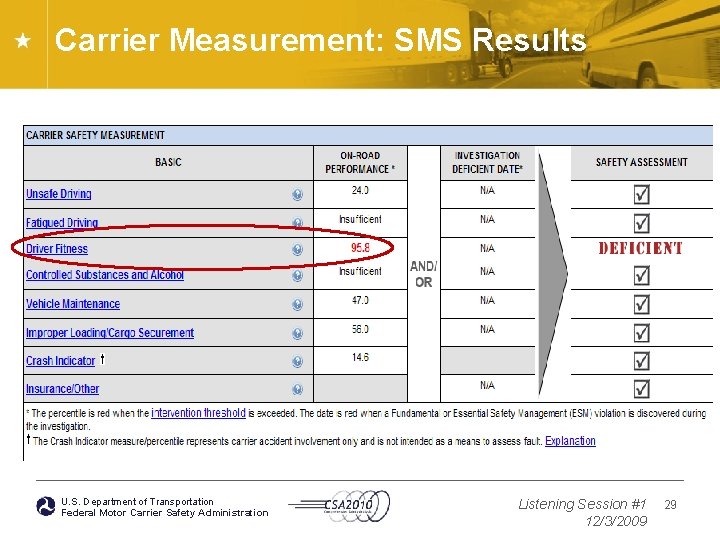
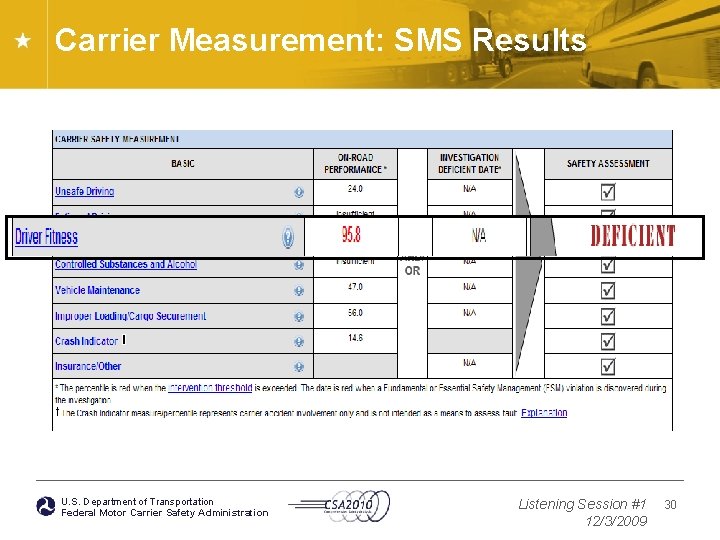
Carrier Measurement: SMS Results U. S. Department of Transportation Federal Motor Carrier Safety Administration Listening Session #1 12/3/2009 29
Carrier Measurement: SMS Results U. S. Department of Transportation Federal Motor Carrier Safety Administration Listening Session #1 12/3/2009 30
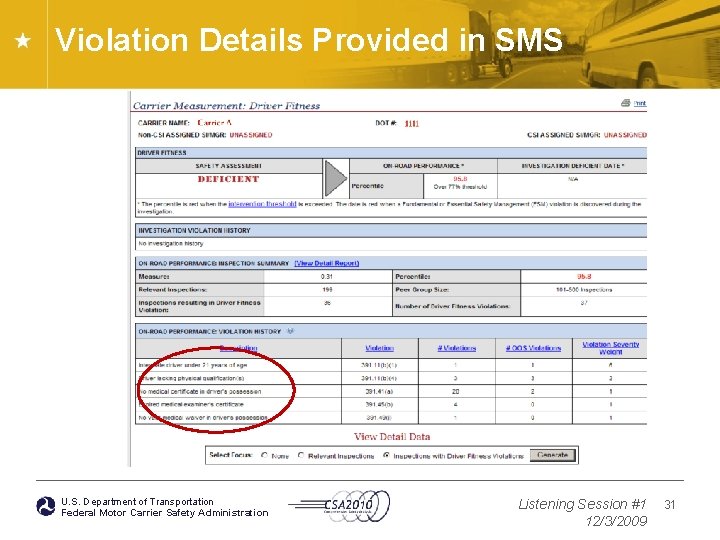
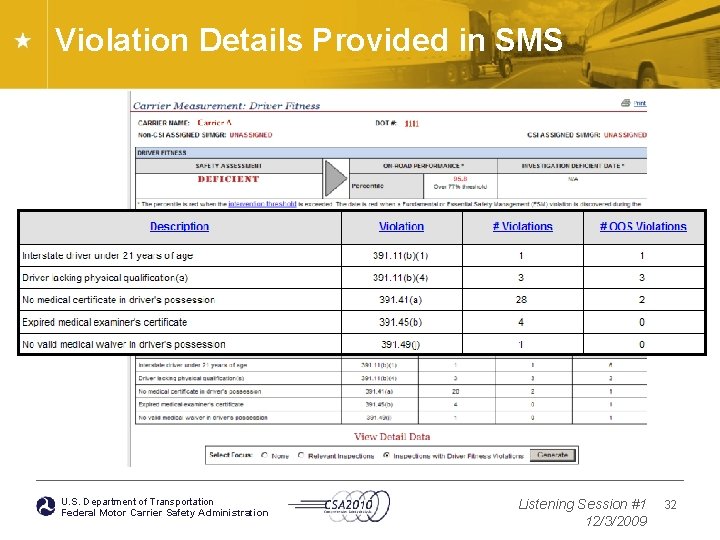
Violation Details Provided in SMS U. S. Department of Transportation Federal Motor Carrier Safety Administration Listening Session #1 12/3/2009 31
Violation Details Provided in SMS U. S. Department of Transportation Federal Motor Carrier Safety Administration Listening Session #1 12/3/2009 32
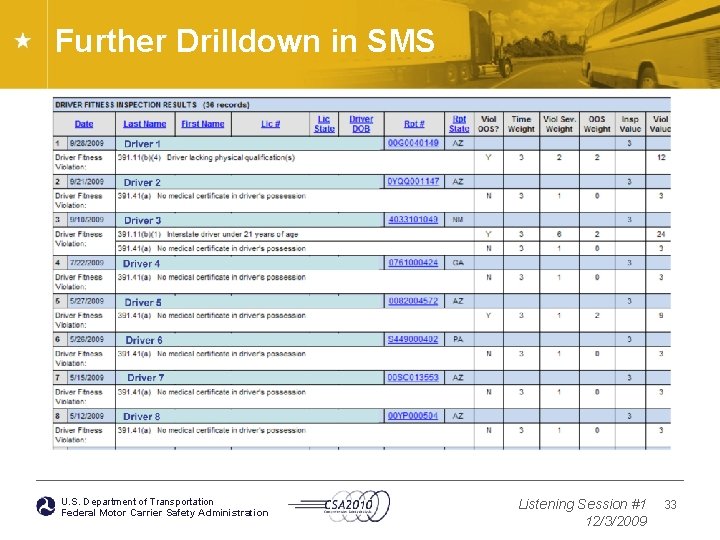
Further Drilldown in SMS U. S. Department of Transportation Federal Motor Carrier Safety Administration Listening Session #1 12/3/2009 33
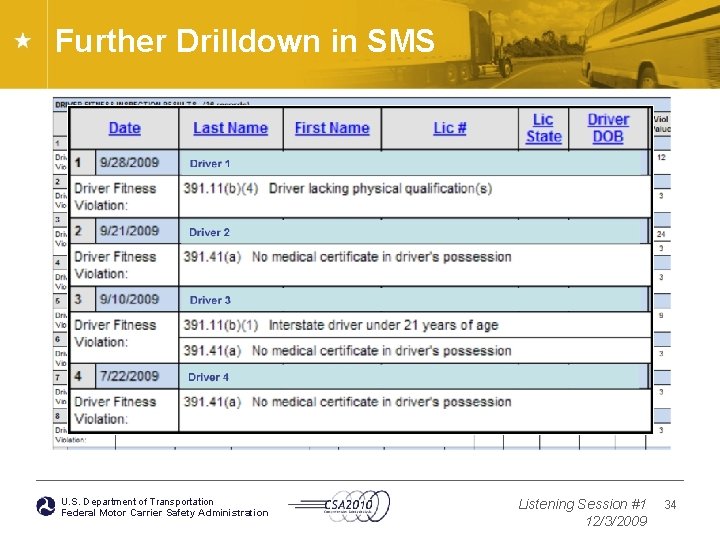
Further Drilldown in SMS U. S. Department of Transportation Federal Motor Carrier Safety Administration Listening Session #1 12/3/2009 34
CSA 2010 Test and Implementation and Preliminary Findings Technical difficulties? Call 1 -866 -260 -4631 for live aid U. S. Department of Transportation Federal Motor Carrier Safety Administration Listening Session #1 12/3/2009
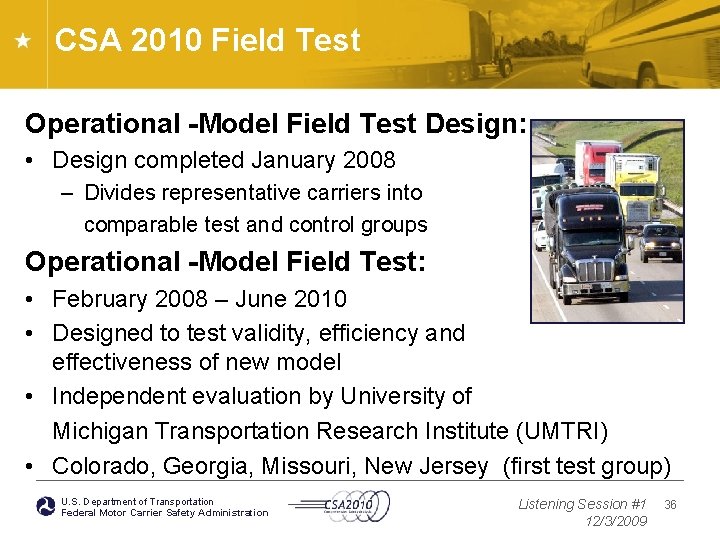
CSA 2010 Field Test Operational -Model Field Test Design: • Design completed January 2008 – Divides representative carriers into comparable test and control groups Operational -Model Field Test: • February 2008 – June 2010 • Designed to test validity, efficiency and effectiveness of new model • Independent evaluation by University of Michigan Transportation Research Institute (UMTRI) • Colorado, Georgia, Missouri, New Jersey (first test group) U. S. Department of Transportation Federal Motor Carrier Safety Administration Listening Session #1 12/3/2009 36
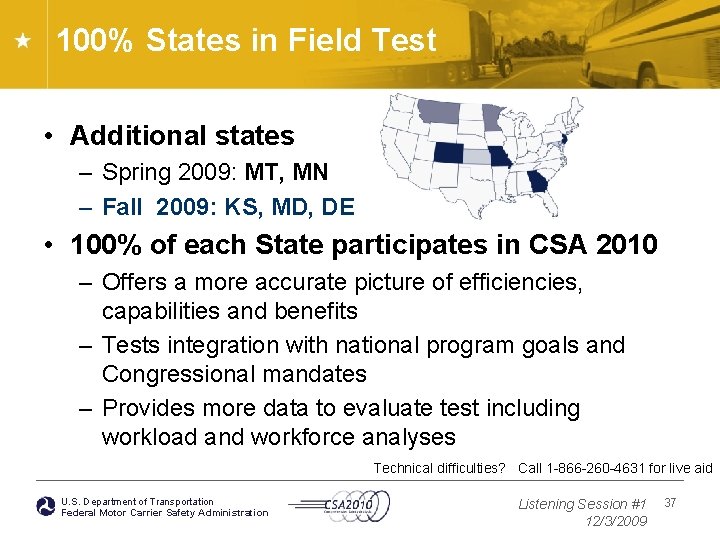
100% States in Field Test • Additional states – Spring 2009: MT, MN – Fall 2009: KS, MD, DE • 100% of each State participates in CSA 2010 – Offers a more accurate picture of efficiencies, capabilities and benefits – Tests integration with national program goals and Congressional mandates – Provides more data to evaluate test including workload and workforce analyses Technical difficulties? Call 1 -866 -260 -4631 for live aid U. S. Department of Transportation Federal Motor Carrier Safety Administration Listening Session #1 12/3/2009 37
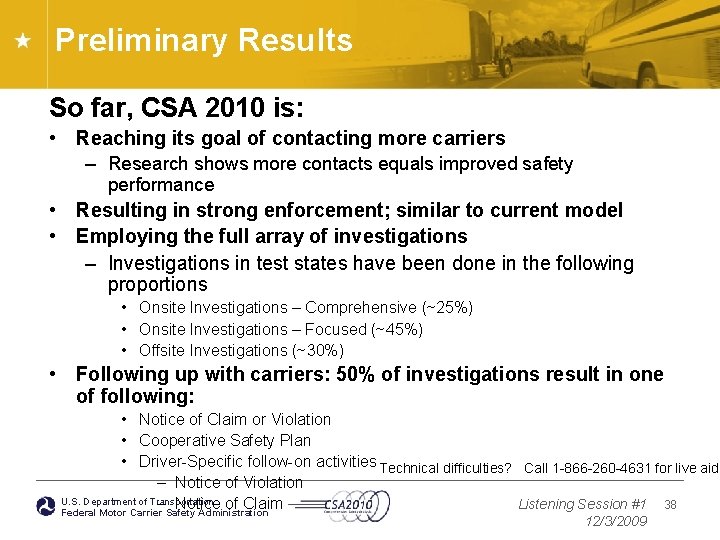
Preliminary Results So far, CSA 2010 is: • Reaching its goal of contacting more carriers – Research shows more contacts equals improved safety performance • Resulting in strong enforcement; similar to current model • Employing the full array of investigations – Investigations in test states have been done in the following proportions • Onsite Investigations – Comprehensive (~25%) • Onsite Investigations – Focused (~45%) • Offsite Investigations (~30%) • Following up with carriers: 50% of investigations result in one of following: • Notice of Claim or Violation • Cooperative Safety Plan • Driver-Specific follow-on activities Technical difficulties? Call 1 -866 -260 -4631 for live aid – Notice of Violation U. S. Department of Transportation Listening Session #1 38 – Notice of Claim Federal Motor Carrier Safety Administration 12/3/2009
Preliminary Results Warning letters are having a positive impact: • 4, 487 letters sent from Feb 2008 (Inception of Operational Model Test) to Oct. 2009 • 2, 168 (~48%) of recipients logged into website to view their data and safety assessment • Feedback from test states indicate that some carriers appreciate the early alert Technical difficulties? Call 1 -866 -260 -4631 for live aid U. S. Department of Transportation Federal Motor Carrier Safety Administration Listening Session #1 12/3/2009 39
National Implementation Elements and Timeline Summer 2010 • Replace Safe. Stat with SMS • Send SMS results (BASICs scores) to Roadside Inspectors July through December 2010 • Roll out training to enforcement agencies on new interventions • Send warning letters nationwide Outreach to Stakeholders Throughout U. S. Department of Transportation Federal Motor Carrier Safety Administration Listening Session #1 12/3/2009 40
Summary Technical difficulties? Call 1 -866 -260 -4631 for live aid U. S. Department of Transportation Federal Motor Carrier Safety Administration Listening Session #1 12/3/2009
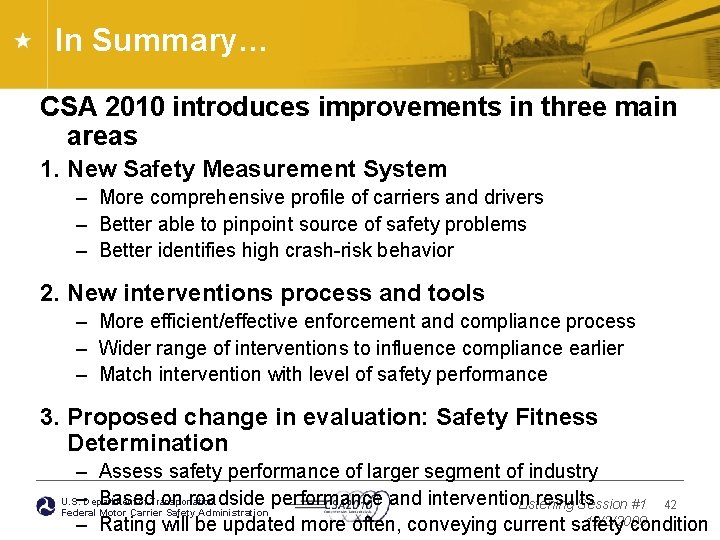
In Summary… CSA 2010 introduces improvements in three main areas 1. New Safety Measurement System – More comprehensive profile of carriers and drivers – Better able to pinpoint source of safety problems – Better identifies high crash-risk behavior 2. New interventions process and tools – More efficient/effective enforcement and compliance process – Wider range of interventions to influence compliance earlier – Match intervention with level of safety performance 3. Proposed change in evaluation: Safety Fitness Determination – Assess safety performance of larger segment of industry Based on roadside performance and intervention results U. S. –Department of Transportation Listening Session #1 42 Federal Motor Carrier Safety Administration 12/3/2009 – Rating will be updated more often, conveying current safety condition
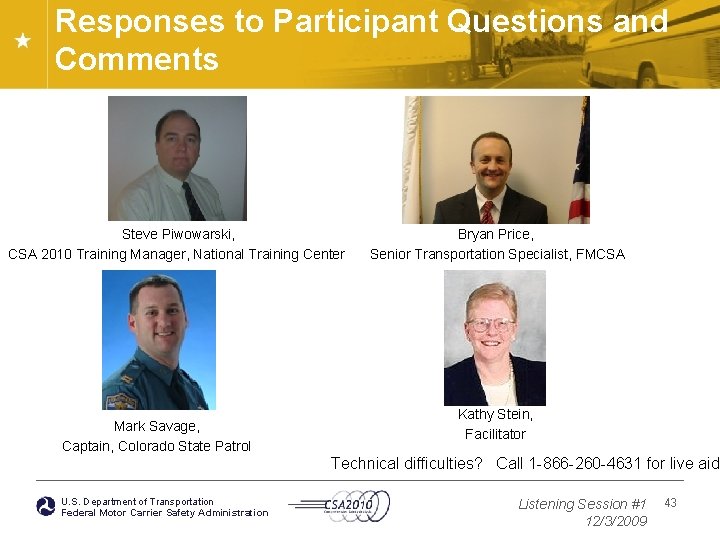
Responses to Participant Questions and Comments Steve Piwowarski, CSA 2010 Training Manager, National Training Center Mark Savage, Captain, Colorado State Patrol Bryan Price, Senior Transportation Specialist, FMCSA Kathy Stein, Facilitator Technical difficulties? Call 1 -866 -260 -4631 for live aid U. S. Department of Transportation Federal Motor Carrier Safety Administration Listening Session #1 12/3/2009 43
Next Webcast Join us next week for FMCSA’s second Listening Session: – Thursday, December 10, 2009 at 3: 30 p. m. – Topics to include: • How CSA 2010 will impact carriers and drivers • How carriers and drivers can prepare for CSA 2010 • Supplementary Agency programs – Data Quality – Roadside Uniformity U. S. Department of Transportation Federal Motor Carrier Safety Administration Listening Session #1 12/3/2009 44
For more information, see csa 2010. fmcsa. dot. gov U. S. Department of Transportation Federal Motor Carrier Safety Administration Listening Session #1 12/3/2009