
Comprehensive Needs Assessment CNA Overview What is the
- Slides: 19
Comprehensive Needs Assessment (CNA) Overview
What is the Comprehensive Needs Assessment? • A collaborative step in NCDPI’s program for district/school improvement • An evidence-based and objective assessment based on a rubric that integrates effective practices with NC professional standards • A third party external review that validates a school’s work and qualities
The CNA Provides: • Schools: An objective, clear view of strengths, areas for development, challenges, and successes. • District: A clear picture of the quality of education in schools and the needs, in order to support them in their work. • Stakeholders: Developmental tool for change and continuous improvement.
Who receives CNAs? • Race to the Top Districts • Race to the Top Schools • School Improvement Grant Schools • Low-Performing Schools • Schools not responding to interventions • Schools/districts by district request
The CNA process • ensures a quality framework which operates consistently in each school; • provides a third-party, evidence-based, objective validation of the school’s work and qualities; and • is built upon a clear, transparent, shared set of criteria and supporting rubric integrating effective practices with NC professional standards.
The CNA helps schools • recognize strengths and determine needs; • examine the causes and nature of those needs; and • set priorities for future actions.
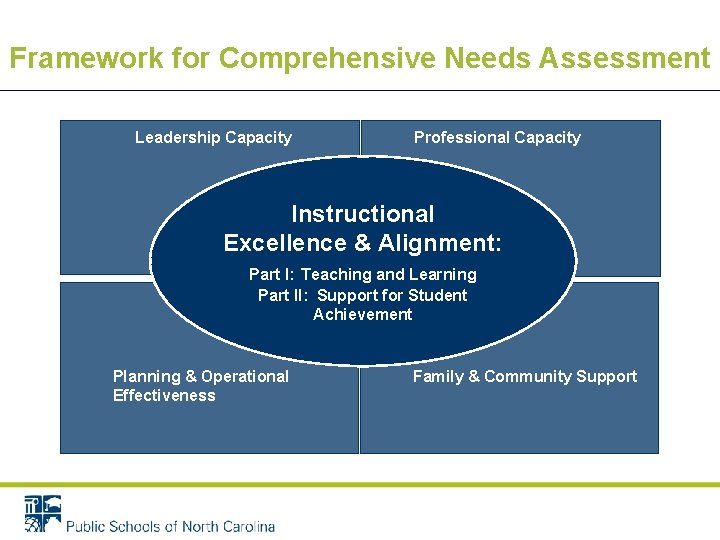
Framework for Comprehensive Needs Assessment Leadership Capacity Professional Capacity Instructional Excellence & Alignment: Part I: Teaching and Learning Part II: Support for Student Achievement Planning & Operational Effectiveness Family & Community Support
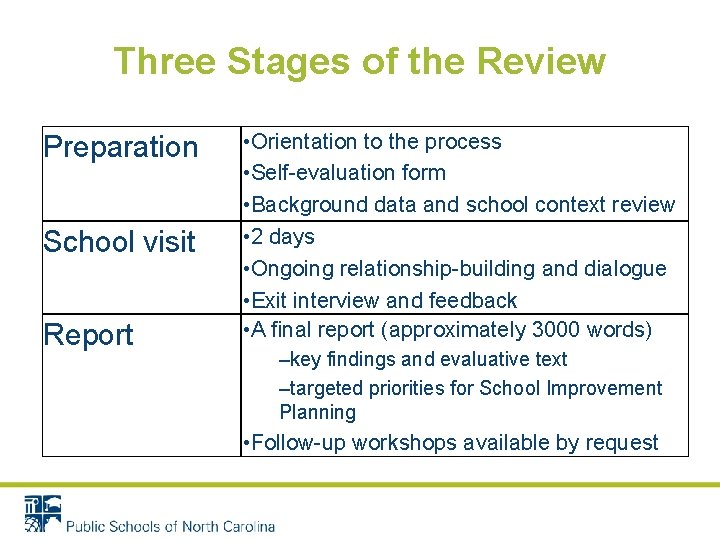
Three Stages of the Review Preparation School visit Report • Orientation to the process • Self-evaluation form • Background data and school context review • 2 days • Ongoing relationship-building and dialogue • Exit interview and feedback • A final report (approximately 3000 words) –key findings and evaluative text –targeted priorities for School Improvement Planning • Follow-up workshops available by request
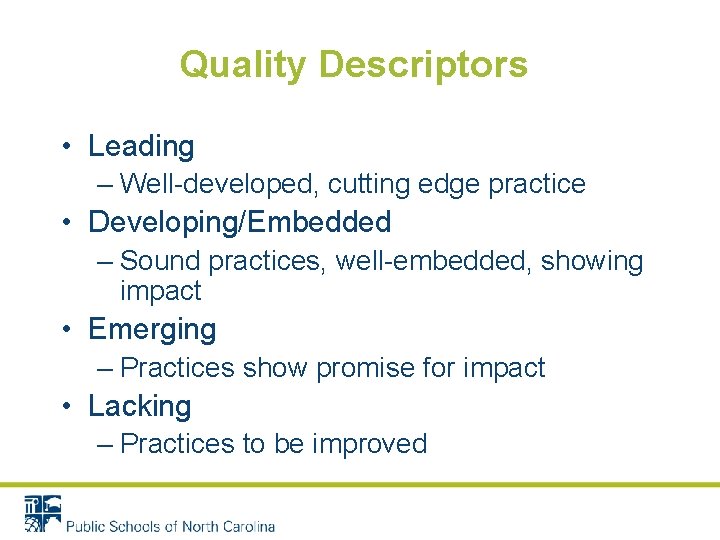
Quality Descriptors • Leading – Well-developed, cutting edge practice • Developing/Embedded – Sound practices, well-embedded, showing impact • Emerging – Practices show promise for impact • Lacking – Practices to be improved
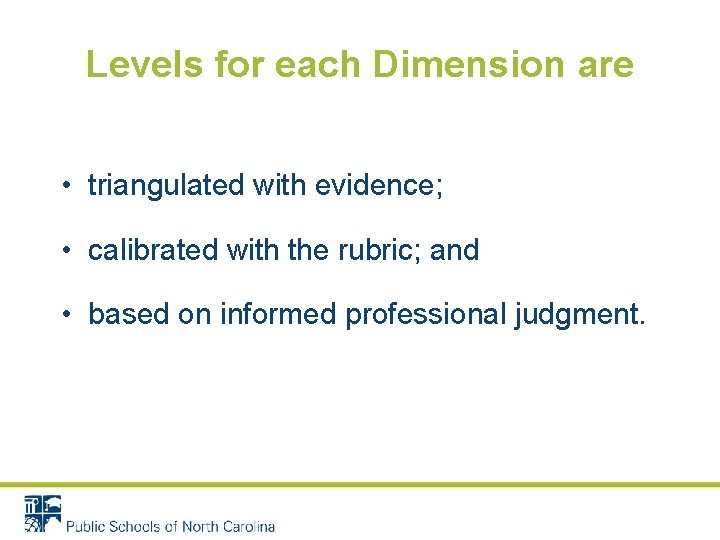
Levels for each Dimension are • triangulated with evidence; • calibrated with the rubric; and • based on informed professional judgment.
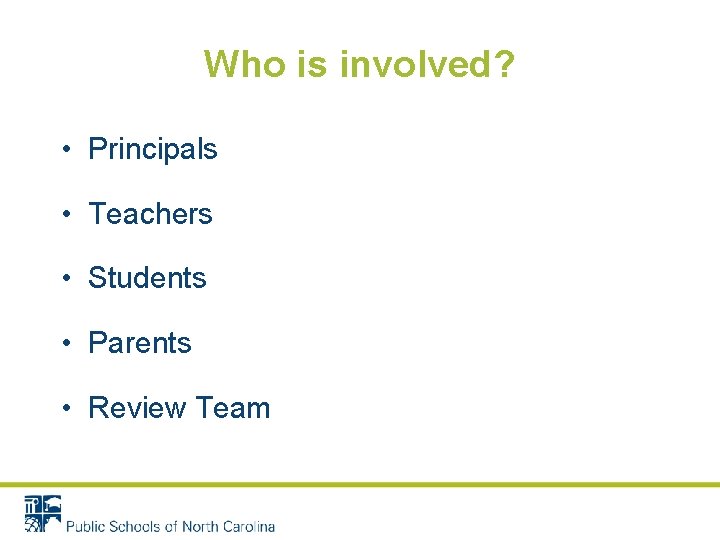
Who is involved? • Principals • Teachers • Students • Parents • Review Team
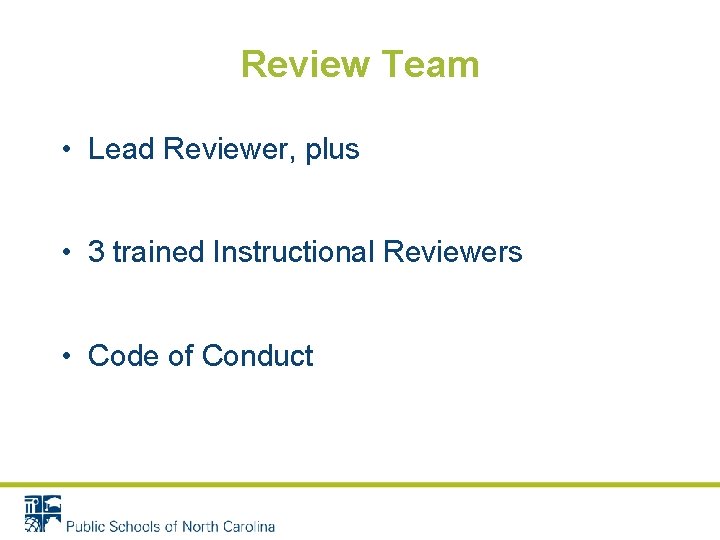
Review Team • Lead Reviewer, plus • 3 trained Instructional Reviewers • Code of Conduct
How to Prepare Before the visit: • Attend an orientation and ask questions • Read the Notes of Guidance and understand the CNA criteria • Raise staff awareness and understanding about the CNA process • Decide how your school will prepare the Self-Evaluation Form (SEF) • Talk with your Lead Reviewer by phone
Self Evaluation Form • Guides self-directed reflection on each dimension of the Framework • Prepared by the school prior to the visit • Triangulates the evidence gathered through interviews, observations and focus groups
Arrangements for the Visit • Private place for the review team to work • Schedule Groups (first day and half of visit) – – Focus Group of Teachers Focus Group of Students Focus Group of Parents Collaborative Meeting • Copy of School Improvement Plan, school map, master class schedule, and groups schedule • List of 5 classes you’d like the team to visit
During the Visit • Be available to talk with the team • Make a class visit with the Lead Reviewer • Attend the exit conference to hear the major findings from the visit
After the Visit • Review the draft report for factual inaccuracies • Plan for work based on the report
Response from a Principal “Thank you for the report. It is very clear on areas we need to enhance. . and captures underlying issues and barriers to success. . The expectations are there, the systems are there, the resources are there, the item missing is clearly defined in this report. . Our SIT met today. . . to strengthen plans for the next school year. ”
Questions Lindsey L. Beam, MA Instructional Review Coach Lindsey. Beam@dpi. nc. gov 919. 835. 6121 Susan Silver, Ed. D. Instructional Review Coach Support Administrator Susan. Silver@dpi. nc. gov (919) 835 -6131