
Comprehensive modeling Digital Battlespace Management Division Program Overview
Comprehensive modeling Digital Battlespace Management Division Program Overview Scale assessment Dr. John Hannan, Ph. D. Division Chief Chemical and Biological Technologies Department Defense Threat Reduction Agency UNCLASSIFIED Threat Agent Assessment Data

Digital Battlespace Management Division Mission Provide the warfighter with comprehensive CB data fusion and analysis capabilities to support situational awareness, decision making and threat management UNCLASSIFIED
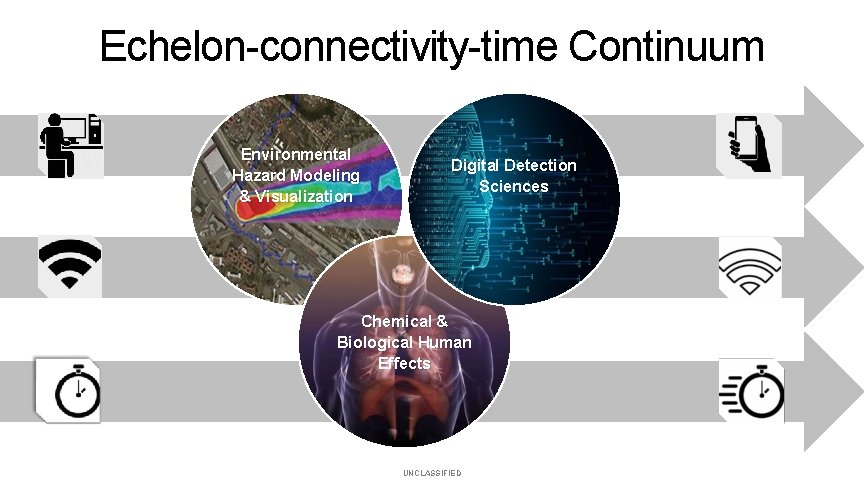
Echelon-connectivity-time Continuum Environmental Hazard Modeling & Visualization Digital Detection Sciences Chemical & Biological Human Effects UNCLASSIFIED
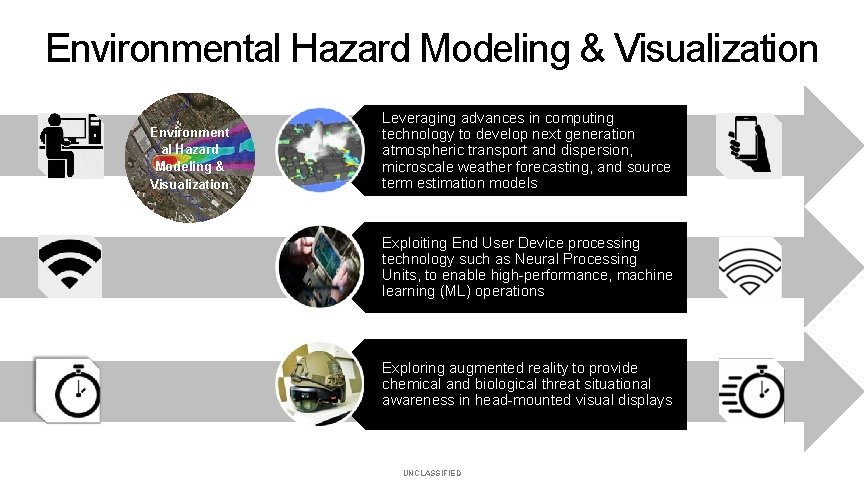
Environmental Hazard Modeling & Visualization Environment al Hazard Modeling & Visualization Leveraging advances in computing technology to develop next generation atmospheric transport and dispersion, microscale weather forecasting, and source term estimation models Exploiting End User Device processing technology such as Neural Processing Units, to enable high-performance, machine learning (ML) operations Exploring augmented reality to provide chemical and biological threat situational awareness in head-mounted visual displays UNCLASSIFIED
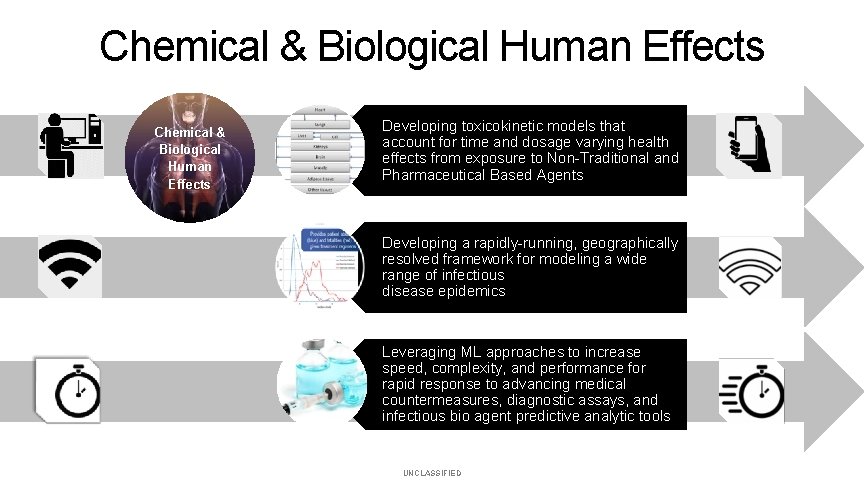
Chemical & Biological Human Effects Developing toxicokinetic models that account for time and dosage varying health effects from exposure to Non-Traditional and Pharmaceutical Based Agents Developing a rapidly-running, geographically resolved framework for modeling a wide range of infectious disease epidemics Leveraging ML approaches to increase speed, complexity, and performance for rapid response to advancing medical countermeasures, diagnostic assays, and infectious bio agent predictive analytic tools UNCLASSIFIED
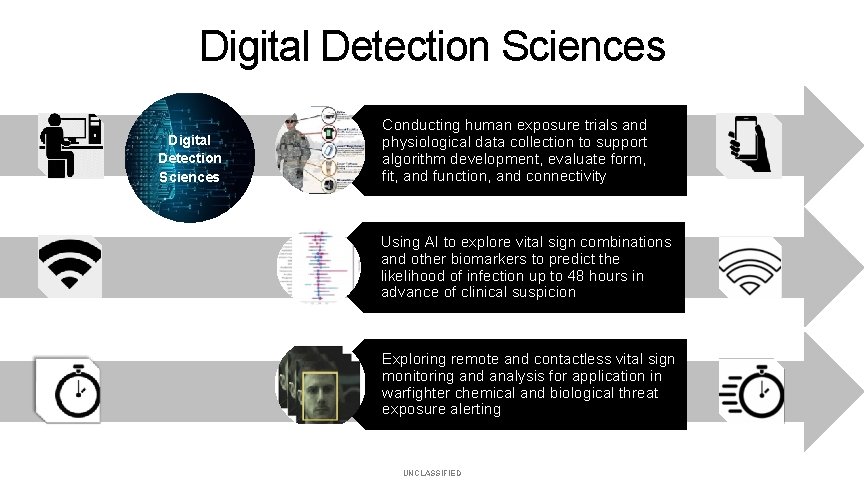
Digital Detection Sciences Conducting human exposure trials and physiological data collection to support algorithm development, evaluate form, fit, and function, and connectivity Using AI to explore vital sign combinations and other biomarkers to predict the likelihood of infection up to 48 hours in advance of clinical suspicion Exploring remote and contactless vital sign monitoring and analysis for application in warfighter chemical and biological threat exposure alerting UNCLASSIFIED

Artificial Intelligence in the Battlespace Early Warning Optimal Drug Development Solving Complex, Physics-based Problems in Milliseconds Automated Decision Aids UNCLASSIFIED
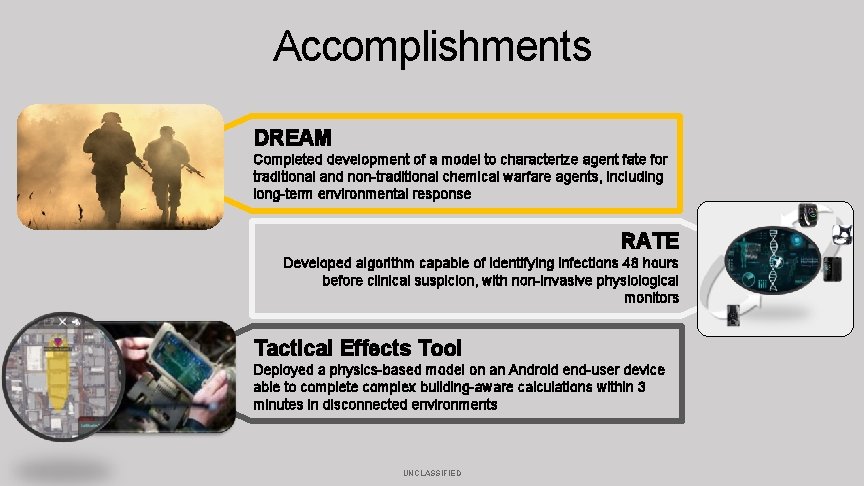
Accomplishments DREAM Completed development of a model to characterize agent fate for traditional and non-traditional chemical warfare agents, including long-term environmental response RATE Developed algorithm capable of identifying infections 48 hours before clinical suspicion, with non-invasive physiological monitors Tactical Effects Tool Deployed a physics-based model on an Android end-user device able to complete complex building-aware calculations within 3 minutes in disconnected environments UNCLASSIFIED
Conference Sessions • Monday • • 1630 - 1730 Junior Ballroom A – Power Hour Session 1: Digital Battlespace Management Tuesday • 0930 - 1130 Junior Ballroom B – Session 2: Advanced Topics in Hazard Prediction • • Wednesday • 0930 - 1130 Junior Ballroom B – Session 2: Supporting the Warfighter at the Tactical Edge • • DTRA Session Chair: Dr. Chris Kiley 1330 - 1530 Junior Ballroom A – Session 1: Artificial Intelligence for Early Drug Discovery • • DTRA Session Chair: Mr. Rick Fry DTRA Session Chair: Dr. Kensey Amaya and Dr. Sweta Batni Thursday • 0930 - 1130 Junior Ballroom B – Session 2: Advanced Topics in Medical Modeling • • DTRA Session Chair: Dr. Sweta Batni 1330 - 1530 Junior Ballroom B – Session 2: Advancements in Computational Analytics and Host-Based Data Storage for Chem/Bio Threats • DTRA Session Chair: Ed Argenta UNCLASSIFIED
- Slides: 9