
Comprehensive Mine and Sensor Simulation Functional Overview Mid
- Slides: 42
Comprehensive Mine and Sensor Simulation Functional Overview Mid Self Deputy Director, Modeling & Simulation CECOM RDEC Night Vision & Electronic Sensors Directorate mid. self@nvl. army. mil 703 -704 -1285
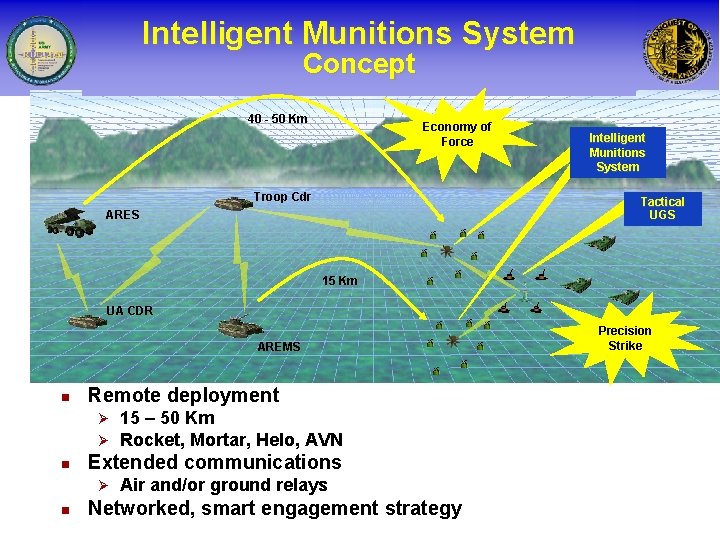
Intelligent Munitions System Concept 40 - 50 Km Economy of Force Troop Cdr Intelligent Munitions System Tactical UGS ARES 15 Km UA CDR AREMS n Remote deployment Ø Ø n Extended communications Ø n 15 – 50 Km Rocket, Mortar, Helo, AVN Air and/or ground relays Networked, smart engagement strategy Precision Strike
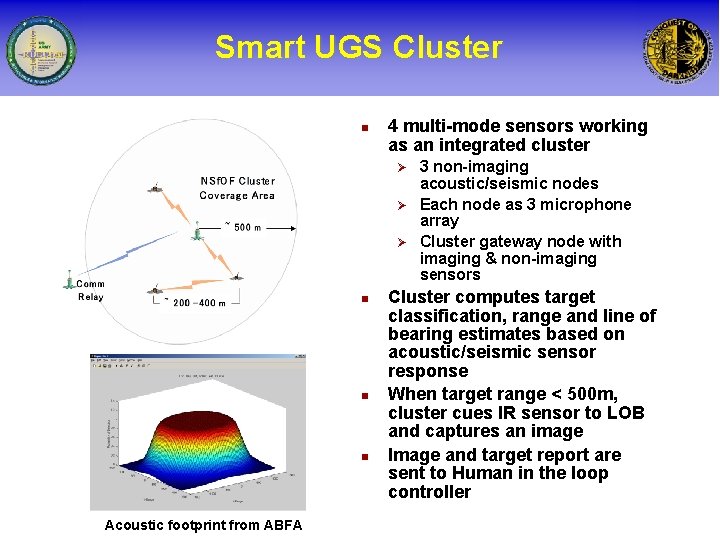
Smart UGS Cluster n 4 multi-mode sensors working as an integrated cluster 3 non-imaging acoustic/seismic nodes Ø Each node as 3 microphone array Ø Cluster gateway node with imaging & non-imaging sensors Ø n n n Acoustic footprint from ABFA Cluster computes target classification, range and line of bearing estimates based on acoustic/seismic sensor response When target range < 500 m, cluster cues IR sensor to LOB and captures an image Image and target report are sent to Human in the loop controller
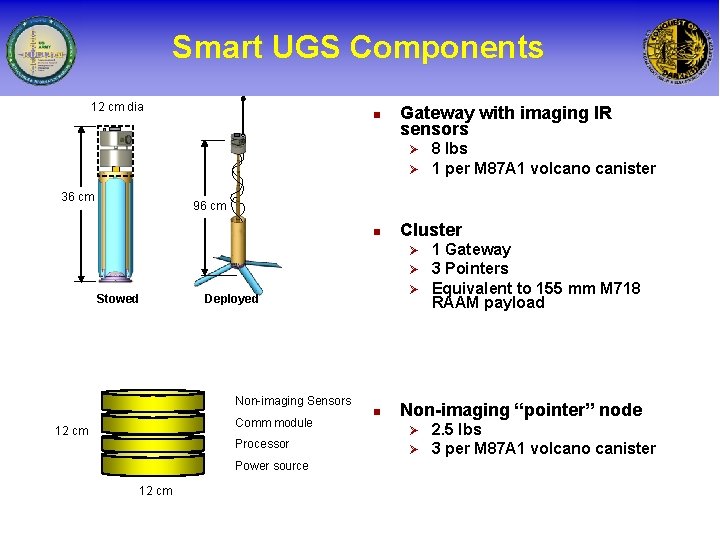
Smart UGS Components 12 cm dia n Gateway with imaging IR sensors Ø Ø 36 cm 8 lbs 1 per M 87 A 1 volcano canister 96 cm n Stowed Comm module 12 cm Processor Power source 12 cm Ø Ø Ø Deployed Non-imaging Sensors Cluster n 1 Gateway 3 Pointers Equivalent to 155 mm M 718 RAAM payload Non-imaging “pointer” node Ø Ø 2. 5 lbs 3 per M 87 A 1 volcano canister
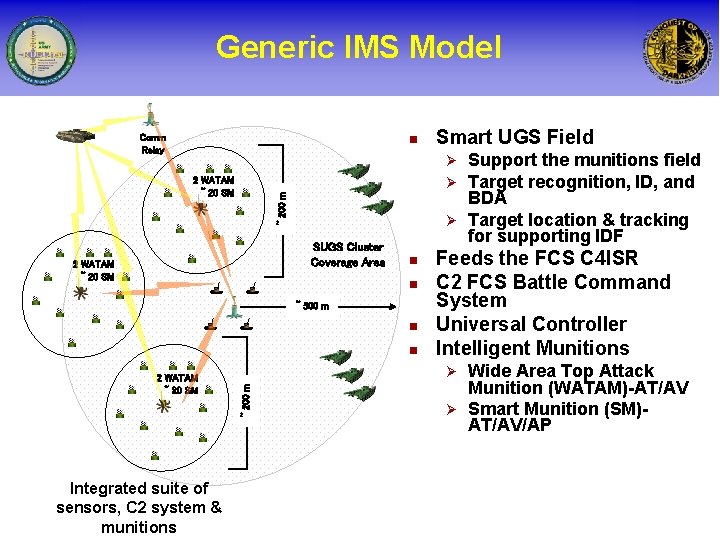
Generic IMS Model Comm Relay n Support the munitions field Target recognition, ID, and BDA Ø Target location & tracking for supporting IDF Ø Ø ~ 200 m 2 WATAM ~ 20 SM SUGS Cluster Coverage Area 2 WATAM ~ 20 SM n n ~ 500 m n n Integrated suite of sensors, C 2 system & munitions Feeds the FCS C 4 ISR C 2 FCS Battle Command System Universal Controller Intelligent Munitions Wide Area Top Attack Munition (WATAM)-AT/AV Ø Smart Munition (SM)AT/AV/AP Ø ~ 200 m 2 WATAM ~ 20 SM Smart UGS Field
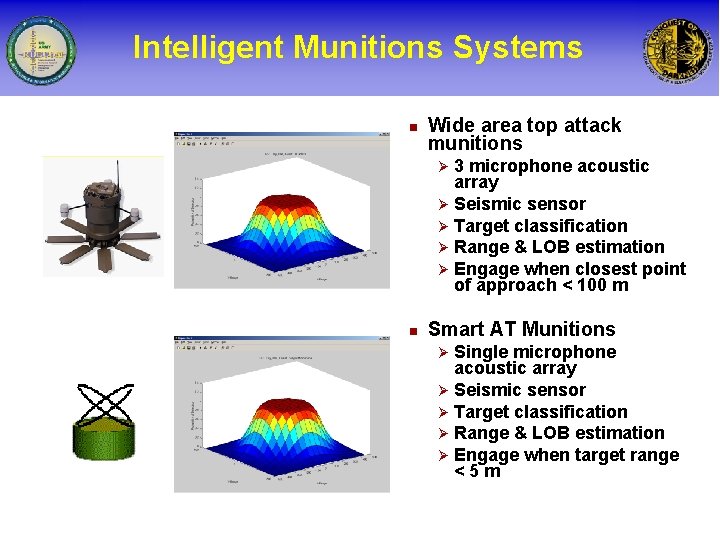
Intelligent Munitions Systems n Wide area top attack munitions Ø Ø Ø n 3 microphone acoustic array Seismic sensor Target classification Range & LOB estimation Engage when closest point of approach < 100 m Smart AT Munitions Ø Ø Ø Single microphone acoustic array Seismic sensor Target classification Range & LOB estimation Engage when target range <5 m
UGS/IMS Control n n All FCS vehicles have common C 2 system UGS/IMS share common sensor architecture and communications UGS/IMS controller is a SW module that runs on the common C 2 system UGS/IMS gateway module communicates via standard FCS combat net radio Ø n UGS/IMS communicate using a standard message and data structure Ø n n LOS range approx 8 km Sensor Interface and Access Management System Any controller can initialize and assume control of an UGS/IMS cluster Control can be passed from one controller to another
UGS Reporting to the Network n n n UGS cluster generates target reports each time they detect a target Gateway node in the field filters these reports before sending them to a controller to prevent the field from constantly chattering (and to reduce simulation network load) Gateway node uses three criteria: Target reports are re-transmitted after a configurable timeout (default timeout is 1 minute) Ø Reports are transmitted once the target moves a configurable distance (default distance is 500 m) Ø Report is sent immediately if the acquisition level is upgraded Ø
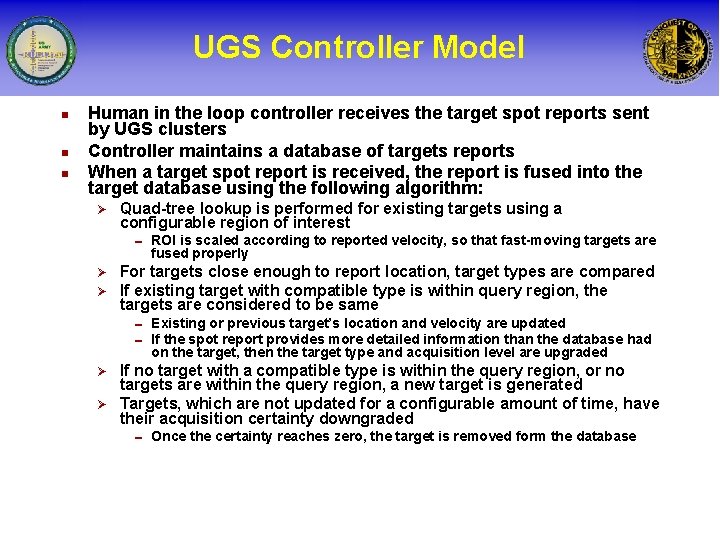
UGS Controller Model n n n Human in the loop controller receives the target spot reports sent by UGS clusters Controller maintains a database of targets reports When a target spot report is received, the report is fused into the target database using the following algorithm: Ø Quad-tree lookup is performed for existing targets using a configurable region of interest 0 ROI is scaled according to reported velocity, so that fast-moving targets are fused properly Ø Ø For targets close enough to report location, target types are compared If existing target with compatible type is within query region, the targets are considered to be same 0 Existing or previous target’s location and velocity are updated 0 If the spot report provides more detailed information than the database had on the target, then the target type and acquisition level are upgraded If no target with a compatible type is within the query region, or no targets are within the query region, a new target is generated Ø Targets, which are not updated for a configurable amount of time, have their acquisition certainty downgraded Ø 0 Once the certainty reaches zero, the target is removed form the database
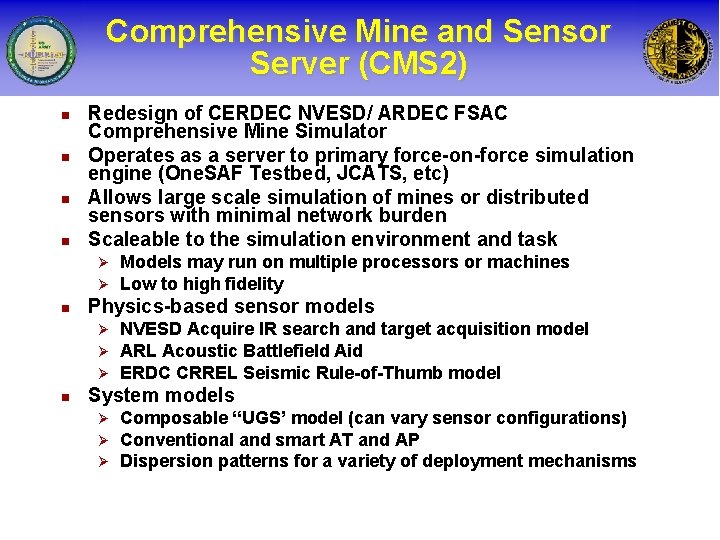
Comprehensive Mine and Sensor Server (CMS 2) n n Redesign of CERDEC NVESD/ ARDEC FSAC Comprehensive Mine Simulator Operates as a server to primary force-on-force simulation engine (One. SAF Testbed, JCATS, etc) Allows large scale simulation of mines or distributed sensors with minimal network burden Scaleable to the simulation environment and task Ø Ø n Physics-based sensor models Ø Ø Ø n Models may run on multiple processors or machines Low to high fidelity NVESD Acquire IR search and target acquisition model ARL Acoustic Battlefield Aid ERDC CRREL Seismic Rule-of-Thumb model System models Ø Ø Ø Composable “UGS’ model (can vary sensor configurations) Conventional and smart AT and AP Dispersion patterns for a variety of deployment mechanisms
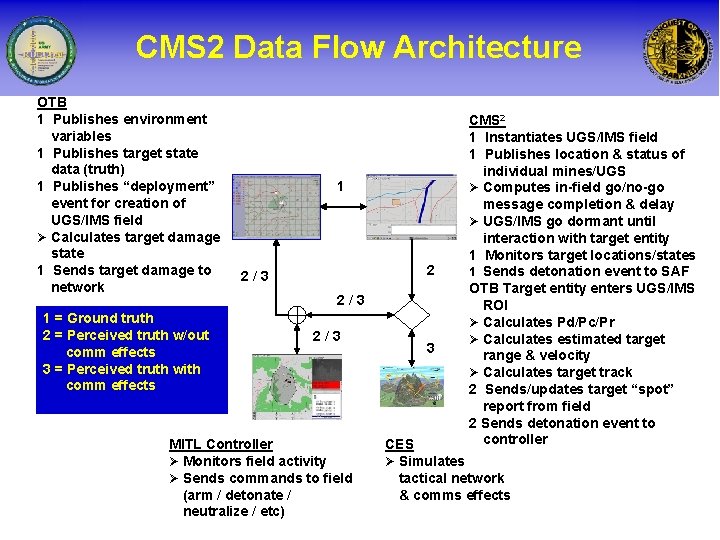
CMS 2 Data Flow Architecture OTB 1 Publishes environment variables 1 Publishes target state data (truth) 1 Publishes “deployment” event for creation of UGS/IMS field Ø Calculates target damage state 1 Sends target damage to network 1 = Ground truth 2 = Perceived truth w/out comm effects 3 = Perceived truth with comm effects 1 2 2/3 2/3 MITL Controller Ø Monitors field activity Ø Sends commands to field (arm / detonate / neutralize / etc) 3 CMS 2 1 Instantiates UGS/IMS field 1 Publishes location & status of individual mines/UGS Ø Computes in-field go/no-go message completion & delay Ø UGS/IMS go dormant until interaction with target entity 1 Monitors target locations/states 1 Sends detonation event to SAF OTB Target entity enters UGS/IMS ROI Ø Calculates Pd/Pc/Pr Ø Calculates estimated target range & velocity Ø Calculates target track 2 Sends/updates target “spot” report from field 2 Sends detonation event to controller CES Ø Simulates tactical network & comms effects
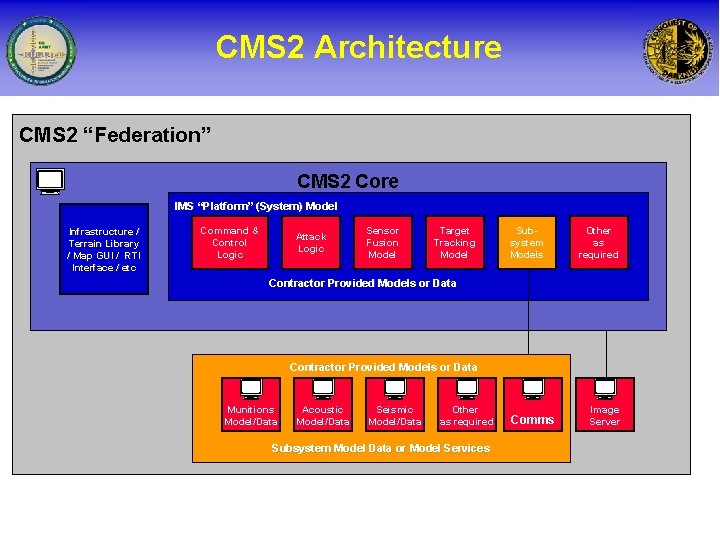
CMS 2 Architecture CMS 2 “Federation” CMS 2 Core IMS “Platform” (System) Model Infrastructure / Terrain Library / Map GUI / RTI Interface / etc Command & Control Logic Attack Logic Sensor Fusion Model Target Tracking Model Subsystem Models Other as required Contractor Provided Models or Data Munitions Model/Data Acoustic Model/Data Seismic Model/Data Other as required Subsystem Model Data or Model Services Comms Image Server
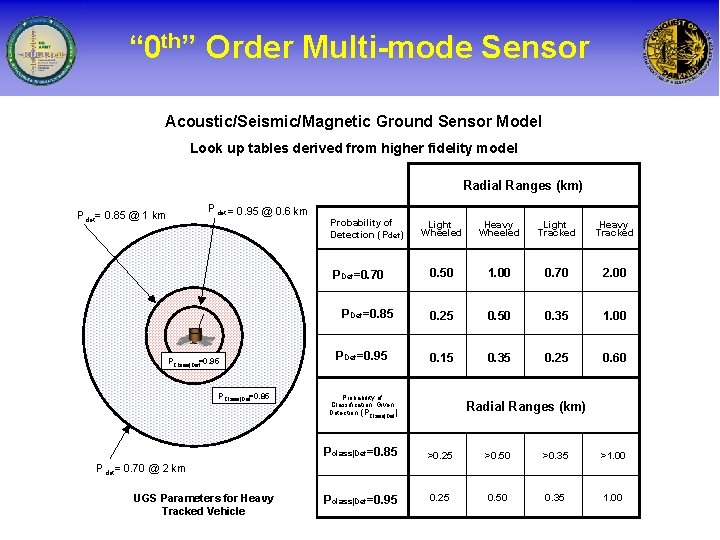
“ 0 th” Order Multi-mode Sensor Acoustic/Seismic/Magnetic Ground Sensor Model Look up tables derived from higher fidelity model Radial Ranges (km) Pdet = 0. 95 @ 0. 6 km Pdet= 0. 85 @ 1 km Probability of Detection (Pdet) PDet=0. 70 PDet=0. 85 PClass|Det=0. 95 PClass|Det=0. 85 PDet=0. 95 Light Wheeled Heavy Wheeled Light Tracked Heavy Tracked 0. 50 1. 00 0. 70 2. 00 0. 25 0. 50 0. 35 1. 00 0. 15 0. 35 0. 25 0. 60 Probability of Classification Given Detection (PClass|Det) Radial Ranges (km) Pclass|Det=0. 85 >0. 25 >0. 50 >0. 35 >1. 00 Pclass|Det=0. 95 0. 25 0. 50 0. 35 1. 00 Pdet = 0. 70 @ 2 km UGS Parameters for Heavy Tracked Vehicle
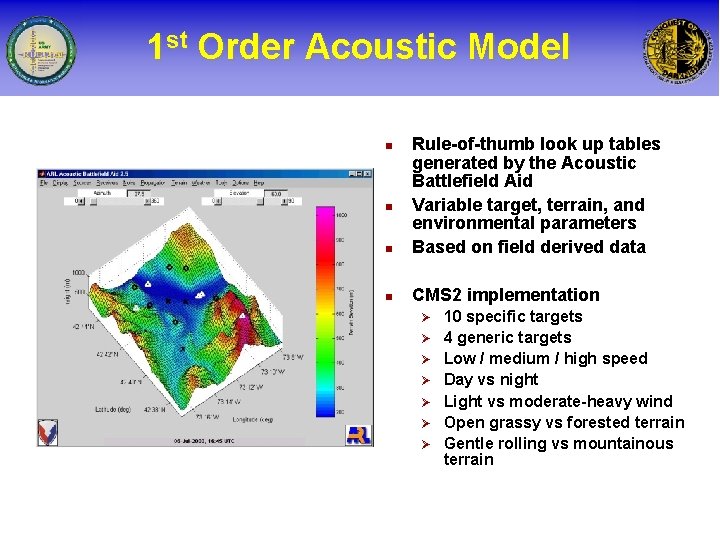
1 st Order Acoustic Model n Rule-of-thumb look up tables generated by the Acoustic Battlefield Aid Variable target, terrain, and environmental parameters Based on field derived data n CMS 2 implementation n n Ø Ø Ø Ø 10 specific targets 4 generic targets Low / medium / high speed Day vs night Light vs moderate-heavy wind Open grassy vs forested terrain Gentle rolling vs mountainous terrain
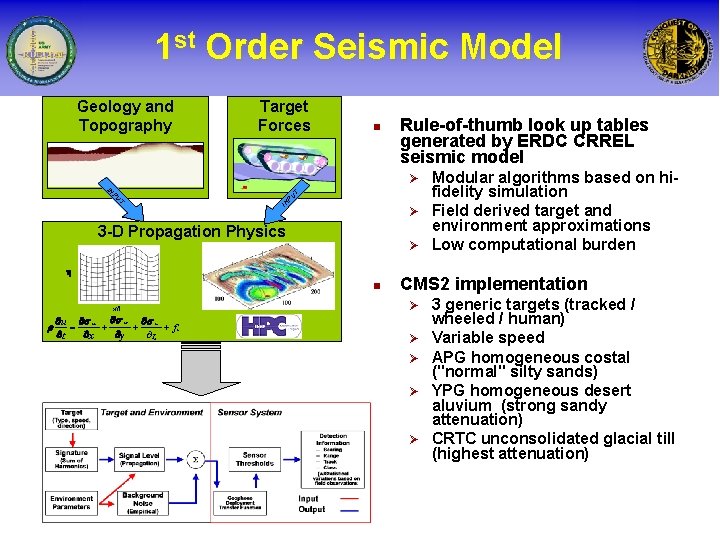
1 st Order Seismic Model Geology and Topography Target Forces n Rule-of-thumb look up tables generated by ERDC CRREL seismic model Modular algorithms based on hifidelity simulation Ø Field derived target and environment approximations Ø Low computational burden Ø IN T PU PU IN T 3 -D Propagation Physics h n Ø x/t ¶s ¶s r u= + + + f ¶x ¶y ¶z ¶t xx xy CMS 2 implementation xz x Ø Ø 3 generic targets (tracked / wheeled / human) Variable speed APG homogeneous costal ("normal" silty sands) YPG homogeneous desert aluvium (strong sandy attenuation) CRTC unconsolidated glacial till (highest attenuation)
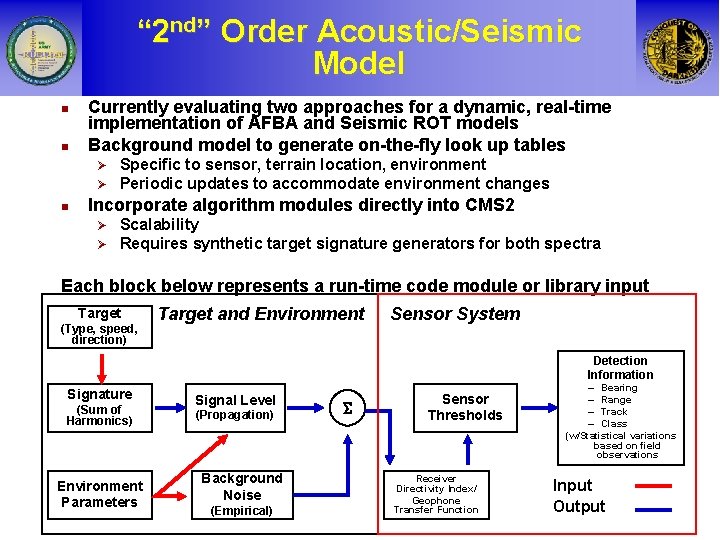
“ 2 nd” Order Acoustic/Seismic Model n n Currently evaluating two approaches for a dynamic, real-time implementation of AFBA and Seismic ROT models Background model to generate on-the-fly look up tables Ø Ø n Specific to sensor, terrain location, environment Periodic updates to accommodate environment changes Incorporate algorithm modules directly into CMS 2 Ø Ø Scalability Requires synthetic target signature generators for both spectra Each block below represents a run-time code module or library input Target (Type, speed, direction) Target and Environment Sensor System Detection Information Signature (Sum of Harmonics) Environment Parameters Signal Level (Propagation) Background Noise (Empirical) S Sensor Thresholds Receiver Directivity Index/ Geophone Transfer Function – Bearing – Range – Track – Class (w/Statistical variations based on field observations Input Output
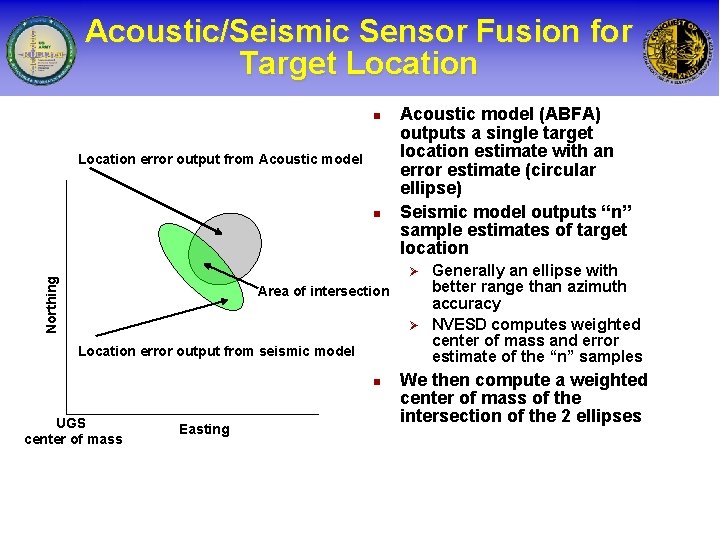
Acoustic/Seismic Sensor Fusion for Target Location n Location error output from Acoustic model n Acoustic model (ABFA) outputs a single target location estimate with an error estimate (circular ellipse) Seismic model outputs “n” sample estimates of target location Generally an ellipse with better range than azimuth accuracy Ø NVESD computes weighted center of mass and error estimate of the “n” samples Northing Ø Area of intersection Location error output from seismic model n UGS center of mass Easting We then compute a weighted center of mass of the intersection of the 2 ellipses
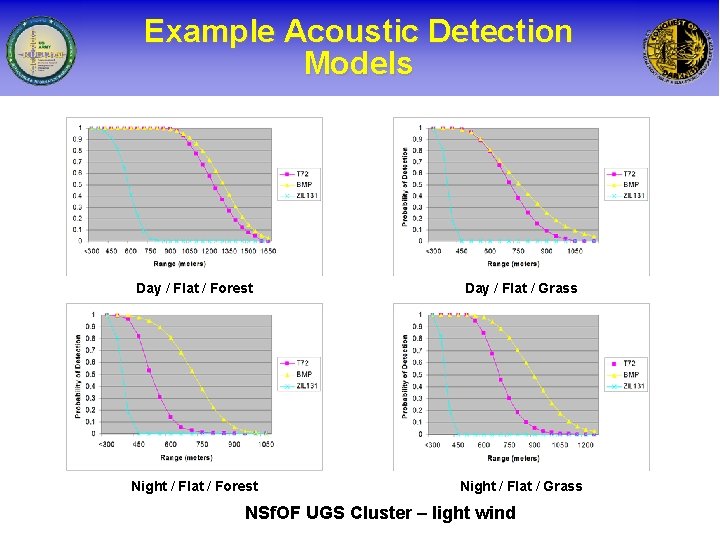
Example Acoustic Detection Models Day / Flat / Forest Day / Flat / Grass Night / Flat / Forest Night / Flat / Grass NSf. OF UGS Cluster – light wind
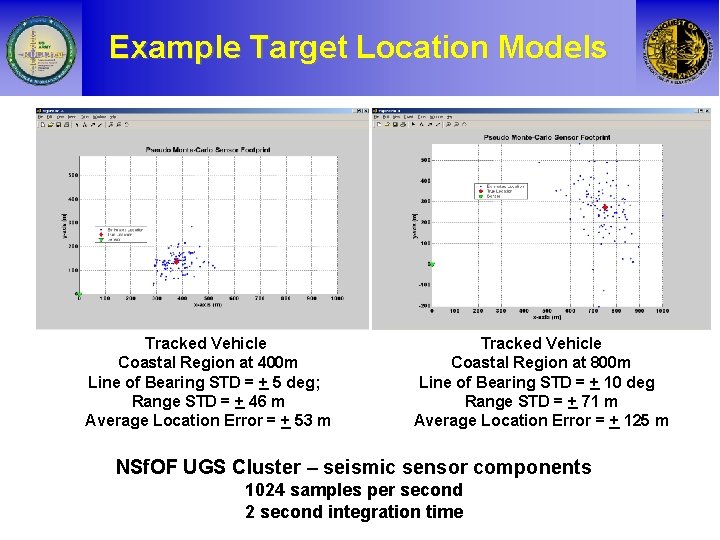
Example Target Location Models Tracked Vehicle Coastal Region at 400 m Line of Bearing STD = + 5 deg; Range STD = + 46 m Average Location Error = + 53 m Tracked Vehicle Coastal Region at 800 m Line of Bearing STD = + 10 deg Range STD = + 71 m Average Location Error = + 125 m NSf. OF UGS Cluster – seismic sensor components 1024 samples per second 2 second integration time
Traditional Software Design Approaches n Top-Down Design Advantages: Cohesive system architecture due to higher-level abstractions Ø Disadvantages: Minimal code reuse, potentially poor performance Ø n Bottom-Up Design Advantages: Efficient, reusable code Ø Disadvantages: Hard to foresee how low-level pieces will serve overall architecture Ø
Software Development Approach n Bi-Directional ('Sandwich') Design Top-Down: Application-level components based on Architectural Design Patterns Ø Bottom-Up: Simulation Libraries, each written to satisfy a domain-specific requirement Ø n n Top-Down portion is relatively simple because well-known solutions Most of our time is spent developing domainspecific libraries
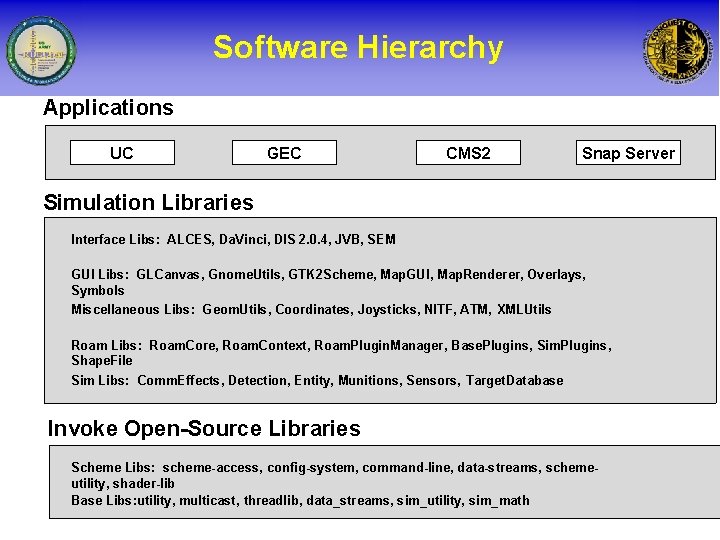
Software Hierarchy Applications UC GEC CMS 2 Snap Server Simulation Libraries Interface Libs: ALCES, Da. Vinci, DIS 2. 0. 4, JVB, SEM GUI Libs: GLCanvas, Gnome. Utils, GTK 2 Scheme, Map. GUI, Map. Renderer, Overlays, Symbols Miscellaneous Libs: Geom. Utils, Coordinates, Joysticks, NITF, ATM, XMLUtils Roam Libs: Roam. Core, Roam. Context, Roam. Plugin. Manager, Base. Plugins, Sim. Plugins, Shape. File Sim Libs: Comm. Effects, Detection, Entity, Munitions, Sensors, Target. Database Invoke Open-Source Libraries Scheme Libs: scheme-access, config-system, command-line, data-streams, schemeutility, shader-lib Base Libs: utility, multicast, threadlib, data_streams, sim_utility, sim_math
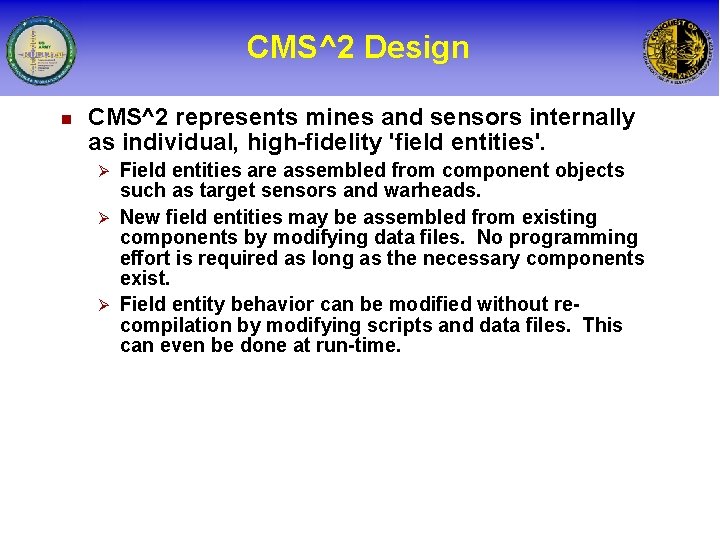
CMS^2 Design n CMS^2 represents mines and sensors internally as individual, high-fidelity 'field entities'. Field entities are assembled from component objects such as target sensors and warheads. Ø New field entities may be assembled from existing components by modifying data files. No programming effort is required as long as the necessary components exist. Ø Field entity behavior can be modified without recompilation by modifying scripts and data files. This can even be done at run-time. Ø
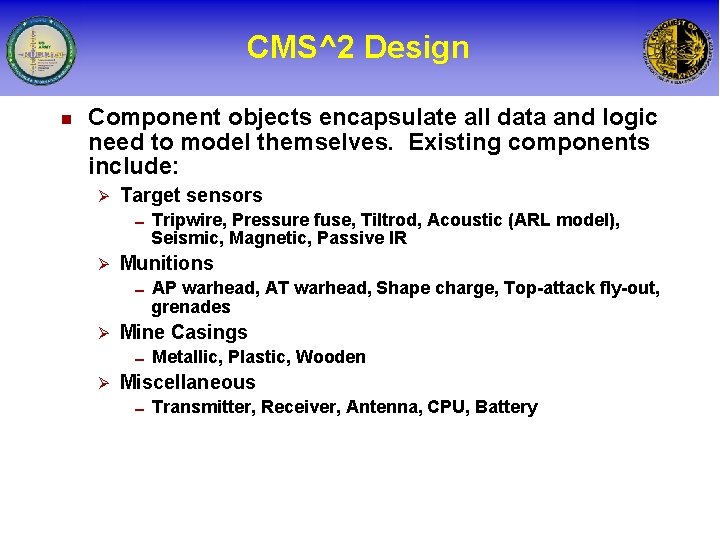
CMS^2 Design n Component objects encapsulate all data and logic need to model themselves. Existing components include: Ø Target sensors 0 Tripwire, Pressure fuse, Tiltrod, Acoustic (ARL model), Seismic, Magnetic, Passive IR Ø Munitions 0 AP warhead, AT warhead, Shape charge, Top-attack fly-out, grenades Ø Mine Casings 0 Metallic, Plastic, Wooden Ø Miscellaneous 0 Transmitter, Receiver, Antenna, CPU, Battery
CMS^2 Design n Field entities are grouped into fields. Fields are a convenient, familiar concept that allow the user to manipulate large numbers of entities as a whole. Ø Fields reduce network load. CMS^2 publishes one message that describes an entire field instead of a separate message for each entity within that field. Ø
CMS^2 Design n Scalability Ø CMS^2 can represent very large numbers of field entities without reducing modeling fidelity. 0 Geometric algorithms are used to eliminate all out-of-range target-sensor pairings. 0 Performance data is pre-calculated whenever possible. Example: ARL statistical detection tables. 0 Efficient coding practices streamline the target detection process. Ø A single CMS^2 workstation has modeled 140, 000 mines while tracking 25, 000 target entities.
CMS^2 Design n Current work Extract the CMS^2 simulation module into a separate back-end process. Ø Implement a controller process which manages multiple back-ends running on separate processors or workstations. Ø Modify the CMS^2 GUI to communicate with the controller process. Ø When complete, a user will be able to create and simulate millions of mines and sensors through a single CMS^2 GUI at the existing level of fidelity. Ø
Simulation Libraries n n Define domain-specific vocabularies ('interfaces') Usable (and reusable) at the binary level Encapsulate and establish resource management policies Encapsulate algorithms
Library Advantages n Flexibility/Adaptability Ø Can be used in the native environment of any experiment or system 0 Examples: UACEP (DIS), LSI Capstone (JVB), C 4 ISR OTM (Da. Vinci) Can be composed in different ways, depending on requirements (scalability, simplicity, reliability) Ø Doesn't require us to predict future environments Ø n Reusability Approximately 85% of the code written for CMS^2, UC, Snap Server, and other applications is in the simulation libraries Ø Changes to a library are reflected in all applications that use it Ø n Scalability Not limited by the scalability of communication infrastructure Programs that use libraries are as scalable as the libraries themselves Ø Libraries scale up and down Ø Ø
Implementation Details n Algorithms are encapsulated for easy upgrading Ø n Each library sets resource management policies Ø n Examples: GLCanvas, Symbol. Renderer Examples: Lib. Detection Libraries make no assumptions about the process environment Ø Examples: Lib. DIS
IMS “Platform/System” Simulation n Utilize CMS 2 -Armament Server Federation as the “system” simulation of IMS UA / FCS warfighter-in-the-loop simulations (Generic IMS) LSI So. SIL integration and interoperability testing (contractor specific designs) Ø IMS PAT support and augmentation (contractor specific designs) Ø Ø n Utilize CMS 2 as surrogate T-UGS to provide Layer 1 sensor information to IMS Ø n PM-RUS is funding use of CMS 2 to support FCS T-UGS development Utilize Government-LSI defined data/messaging interface (Sensor Data Link) between the IMS field and the FCS network Sensor Data Link (SDL) data and message framework under development by PM-NV/RSTA and NVESD Ø SDL will be the “standard” interface from T-UGS to FCS C 2 network Ø CMS 2 readily supports implementation of tactical messaging interface to support IMS in the So. SIL Ø n Migrate to MATREX simulation architecture when that environment becomes mature and available Armament server is core component of MATREX PM-FCS has previously funded integration of CMS 2 into JVB CMS 2 architecture readily supports “decoupling” of embedded sensor services IAW the proposed MATREX architecture Ø NVESD is tracking the migration of JVB to MATREX Ø Ø Ø
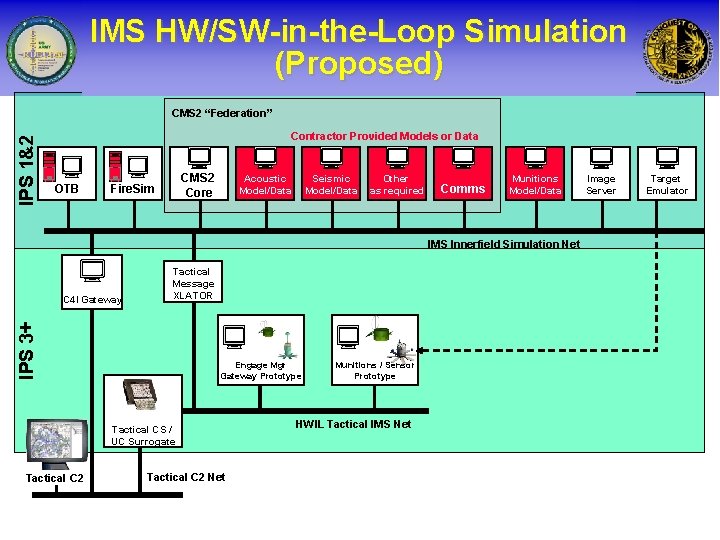
IMS HW/SW-in-the-Loop Simulation (Proposed) IPS 1&2 CMS 2 “Federation” Contractor Provided Models or Data OTB CMS 2 Core Fire. Sim Acoustic Model/Data Seismic Model/Data Other as required Comms Munitions Model/Data IMS Innerfield Simulation Net IPS 3+ C 4 I Gateway Tactical Message XLATOR Engage Mgr Gateway Prototype Tactical CS / UC Surrogate Tactical C 2 Net Munitions / Sensor Prototype HWIL Tactical IMS Net Image Server Target Emulator
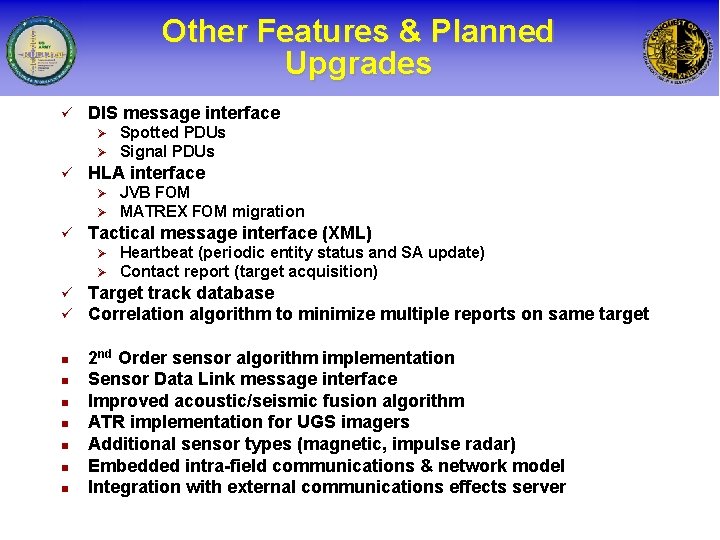
Other Features & Planned Upgrades ü DIS message interface Ø Ø ü HLA interface Ø Ø ü n n n n JVB FOM MATREX FOM migration Tactical message interface (XML) Ø Ø ü ü Spotted PDUs Signal PDUs Heartbeat (periodic entity status and SA update) Contact report (target acquisition) Target track database Correlation algorithm to minimize multiple reports on same target 2 nd Order sensor algorithm implementation Sensor Data Link message interface Improved acoustic/seismic fusion algorithm ATR implementation for UGS imagers Additional sensor types (magnetic, impulse radar) Embedded intra-field communications & network model Integration with external communications effects server
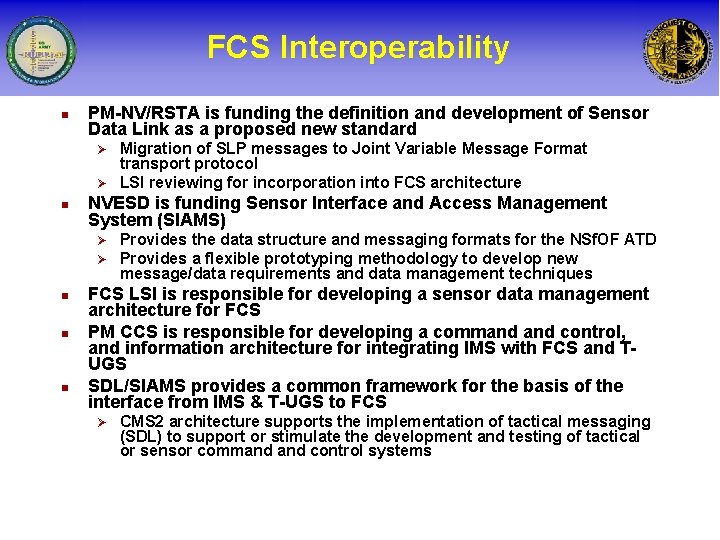
FCS Interoperability n PM-NV/RSTA is funding the definition and development of Sensor Data Link as a proposed new standard Migration of SLP messages to Joint Variable Message Format transport protocol Ø LSI reviewing for incorporation into FCS architecture Ø n NVESD is funding Sensor Interface and Access Management System (SIAMS) Ø Ø n n n Provides the data structure and messaging formats for the NSf. OF ATD Provides a flexible prototyping methodology to develop new message/data requirements and data management techniques FCS LSI is responsible for developing a sensor data management architecture for FCS PM CCS is responsible for developing a command control, and information architecture for integrating IMS with FCS and TUGS SDL/SIAMS provides a common framework for the basis of the interface from IMS & T-UGS to FCS Ø CMS 2 architecture supports the implementation of tactical messaging (SDL) to support or stimulate the development and testing of tactical or sensor command control systems
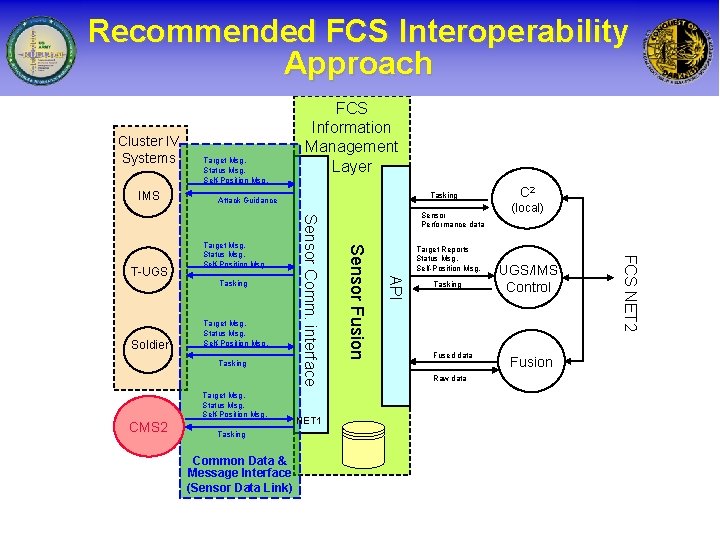
Recommended FCS Interoperability Approach Cluster IV Systems IMS Target Msg. Status Msg. Self-Position Msg. CMS 2 Tasking Common Data & Message Interface (Sensor Data Link) NET 1 Tasking Fused data Raw data C 2 (local) UGS/IMS Control Fusion FCS NET 2 Tasking Target Reports Status Msg. Self-Position Msg. API Target Msg. Status Msg. Self-Position Msg. Sensor Performance data Sensor Fusion Target Msg. Status Msg. Self-Position Msg. Tasking Soldier Tasking Attack Guidance Sensor Comm. interface T-UGS Target Msg. Status Msg. Self-Position Msg. FCS Information Management Layer
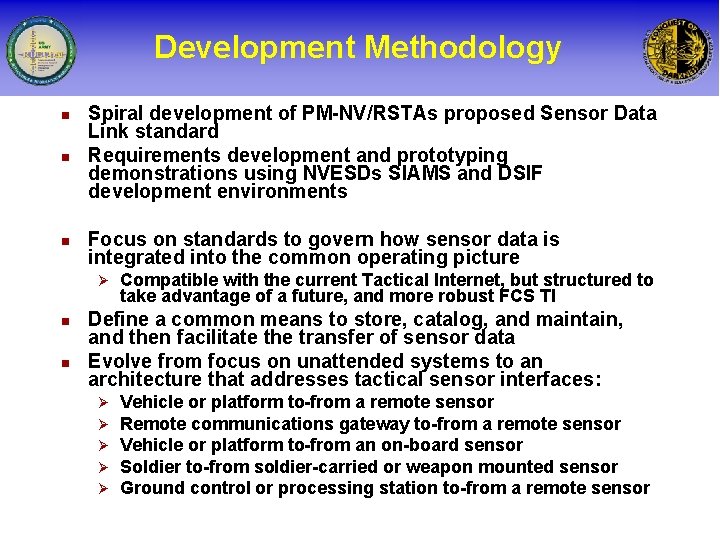
Development Methodology n n n Spiral development of PM-NV/RSTAs proposed Sensor Data Link standard Requirements development and prototyping demonstrations using NVESDs SIAMS and DSIF development environments Focus on standards to govern how sensor data is integrated into the common operating picture Ø n n Compatible with the current Tactical Internet, but structured to take advantage of a future, and more robust FCS TI Define a common means to store, catalog, and maintain, and then facilitate the transfer of sensor data Evolve from focus on unattended systems to an architecture that addresses tactical sensor interfaces: Ø Ø Ø Vehicle or platform to-from a remote sensor Remote communications gateway to-from a remote sensor Vehicle or platform to-from an on-board sensor Soldier to-from soldier-carried or weapon mounted sensor Ground control or processing station to-from a remote sensor
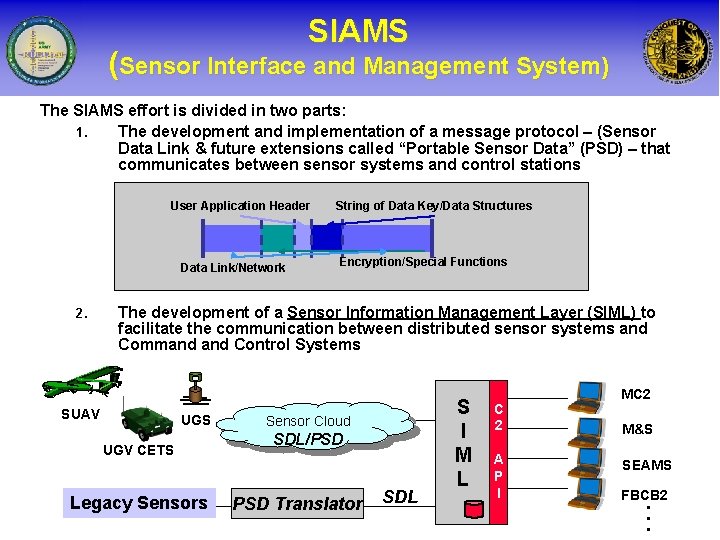
SIAMS (Sensor Interface and Management System) The SIAMS effort is divided in two parts: 1. The development and implementation of a message protocol – (Sensor Data Link & future extensions called “Portable Sensor Data” (PSD) – that communicates between sensor systems and control stations User Application Header Data Link/Network 2. String of Data Key/Data Structures Encryption/Special Functions The development of a Sensor Information Management Layer (SIML) to facilitate the communication between distributed sensor systems and Command Control Systems SUAV UGS UGV CETS Legacy Sensors Sensor Cloud SDL/PSD Translator SDL S I M L C 2 A P I MC 2 M&S SEAMS FBCB 2 . . .
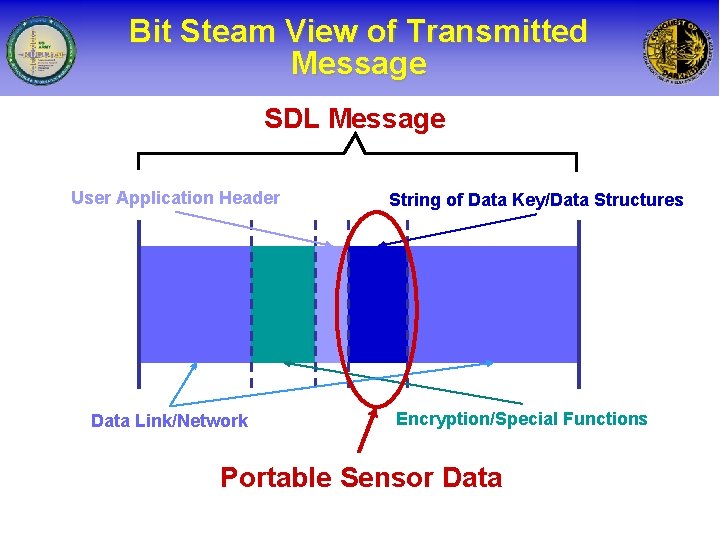
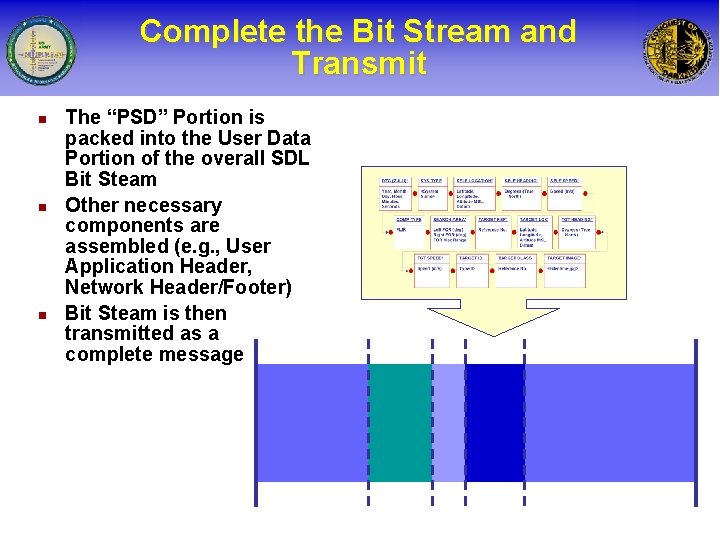
Bit Steam View of Transmitted Message SDL Message User Application Header Data Link/Network String of Data Key/Data Structures Encryption/Special Functions Portable Sensor Data
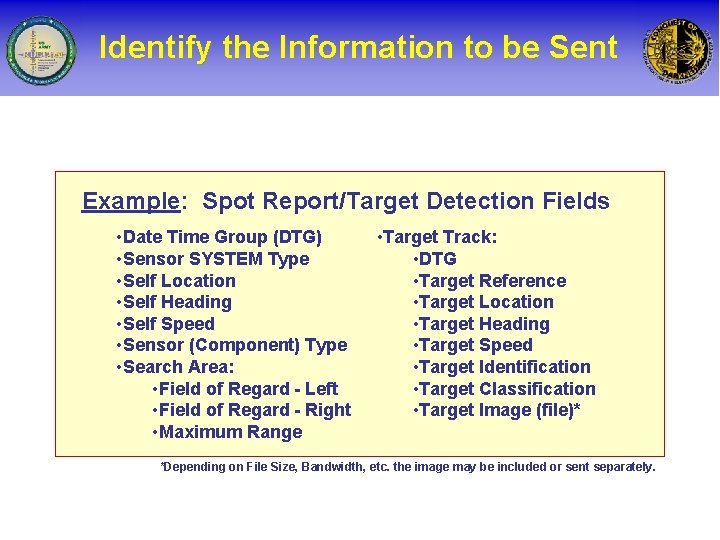
Identify the Information to be Sent Example: Spot Report/Target Detection Fields • Date Time Group (DTG) • Sensor SYSTEM Type • Self Location • Self Heading • Self Speed • Sensor (Component) Type • Search Area: • Field of Regard - Left • Field of Regard - Right • Maximum Range • Target Track: • DTG • Target Reference • Target Location • Target Heading • Target Speed • Target Identification • Target Classification • Target Image (file)* *Depending on File Size, Bandwidth, etc. the image may be included or sent separately.
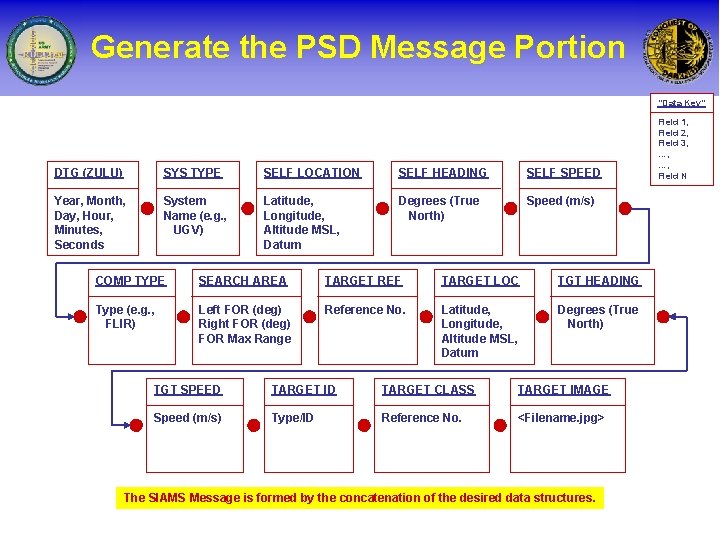
Generate the PSD Message Portion “Data Key” DTG (ZULU) SYS TYPE SELF LOCATION SELF HEADING SELF SPEED Year, Month, Day, Hour, Minutes, Seconds System Name (e. g. , UGV) Latitude, Longitude, Altitude MSL, Datum Degrees (True North) Speed (m/s) COMP TYPE SEARCH AREA TARGET REF TARGET LOC TGT HEADING Type (e. g. , FLIR) Left FOR (deg) Right FOR (deg) FOR Max Range Reference No. Latitude, Longitude, Altitude MSL, Datum Degrees (True North) TGT SPEED TARGET ID TARGET CLASS TARGET IMAGE Speed (m/s) Type/ID Reference No. <Filename. jpg> The SIAMS Message is formed by the concatenation of the desired data structures. Field 1, Field 2, Field 3, …, …, Field N
Complete the Bit Stream and Transmit n n n The “PSD” Portion is packed into the User Data Portion of the overall SDL Bit Steam Other necessary components are assembled (e. g. , User Application Header, Network Header/Footer) Bit Steam is then transmitted as a complete message
Summary n CMS 2 provides a proven and affordable platform to support such simulation and experiment events Government owned software Ø 2 -4 PC servers can support simulation with 10, 000’s of entities Ø n CMS 2 is now the primary simulation tool being used to represent and support development and evaluation of UGS and IMS Ø Ø Ø Networked Sensors for the Objective Force ATD Spider APLA Intelligent Munitions Systems for FCS Tactical UGS UA MBL