
Comprehensive Integration of Advanced Manufacturing Competencies throughout Associates
- Slides: 25
Comprehensive Integration of Advanced Manufacturing Competencies throughout Associates degree and Stackable Certificate Curricula Dr. David Spang, Rowan College at Burlington County Dr. Edem Tetteh, Rowan College at Burlington County Dr. Ratan Jha, Rowan University
National Science Foundation Grant Awarded Sept. 2016 - $768, 272 Award ID 1601487 DUE-Division of Undergraduate Education ATE-Advanced Technological Education In partnership with Rowan University
Personnel • • • Dr. David Spang - Principal Investigator Dr. Edem Tetteh - Co-Principal Investigator Dr. Ratneshwar Jha - Co-Principal Investigator Mr. Dan Sullivan - STEM-NSF Grant Project Manager Ms. Elaine Young - NSF Grant Coordinator • Ms. Eileen Swiatkowski - Sr. Grants Specialist • Dr. Nicole Scott - Manager of Program Development • Ms. Kathryn Strang - Director of Compliance, Assessment, & Research • Workforce Development Colleagues • RCBC Support Personnel
Goal #1 • To strengthen an Engineering Technology program serving the southern New Jersey region. – Objective 1. 1: Highlight technical and non-technical (soft) skills across the curriculum; align with industry needs, including student work-based learning opportunities such as undergraduate research projects and internships. – Objective 1. 2: Develop an applications library (real examples of STEM principles for instructional practices) as a resource for faculty to support relevant curriculum by presenting industry-relevant competencies, techniques and images that meet predetermined learning outcomes. – Objective 1. 3: Strengthen career pathways throughout, and partnerships between, regional higher education institutions, secondary schools, and industry partners. Activities will include the creation of advisory committees, student work-based learning activities, and job placement support. Focus will be on job placement and recruitment support for graduates and industry partners. Additional emphasis will be on successful job placement for underrepresented student populations.
Goal #2 • To serve as a conduit for the creation of programs and educational pathways that address unmet training needs and the needs of emergent high growth industries. – Objective 2. 1: Create a new academic program in Advanced Manufacturing (Associates Degree and a stackable certificate) by developing new curriculum through the adaptation of relevant models from national and regional NSF ATE programs, to support the Engineering Technology (ET) educational needs in the region. – Objective 2. 2: Establish an Advanced Manufacturing training facility with input from industry leaders and educators to collaborate and produce skilled competent workers for industry.
Activities and Achievements
Activities • (4) National Conference Presentations and Publications: 2017, 2018, 2019, 2020 • (4) NSF-ATE Principal Investigator Conference Presentations: 2016, 2017, 2018, 2019 • (3) NSF Annual Reports, with External Evaluation Reports • Meetings, Conferences, and Workshops – – Advanced Manufacturing Forum - June 2017 Technology Conference – July 2017 Engineer’s Week Activities MET Advisory Board Meetings – since January 2018 • Development of Marketing Materials
Achievements • Close collaboration between Rowan College at Burlington County (RCBC) and Rowan University (RU) • Close collaboration with Industry Partners • Development of Mechanical Engineering Technology (MET) curriculum – – – AAS degree BS degree “ 3+1” program Stackable Certificate Applications Database Development • Outfitting of RCBC laboratory in support of the AAS degree (years 1 & 2)
Curriculum • Curriculum – The most critical and timely technical and nontechnical skills have been identified by working closely with industry partners and have been incorporated into the curriculum. • Applications Database – An applications database and library has been developed and will serve as a resource for faculty to support the relevant curriculum, and to present industry-relevant competencies within courses that meet predetermined learning outcomes.
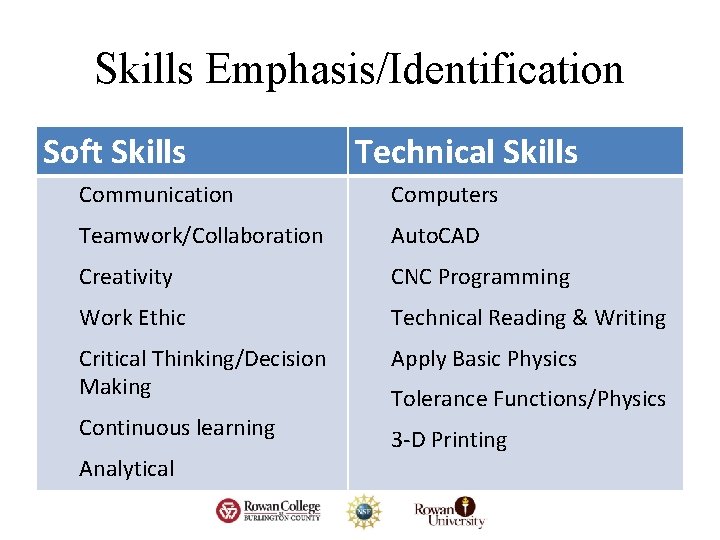
Skills Emphasis/Identification Soft Skills Technical Skills Communication Computers Teamwork/Collaboration Auto. CAD Creativity CNC Programming Work Ethic Technical Reading & Writing Critical Thinking/Decision Making Apply Basic Physics Continuous learning 3 -D Printing Analytical Tolerance Functions/Physics
Impact
Impacts • New MET Associates degree program at RCBC • New MET Baccalaureate degree program at RU – New department of Engineering Technology at RU • New “ 3+1” degree program pathway in MET (and also including Electrical Engineering Technology, EET) • Strengthened College-Industry partnership and collaboration
Novel “ 3+1” Program Delivery • Background – The need for the proposed “ 3+1” program model stems from the rising affordability and debt crisis affecting many students who pursue higher education to improve the quality of their lives. – RCBC will deliver the third year (of four) in the MET program, providing an affordable and accessible pathway toward the baccalaureate degree. – The fourth year of the degree program will be delivered by Rowan University, as RU courses in the RU degree programs, on the RCBC campus.
Novel “ 3+1” Program Delivery • Operational Model – Rowan University will determine the content and the learning outcomes for the courses, ensuring that the learning outcomes will be the same. – Rowan University will specify the credentials required for the professors chosen to teach the courses, and have the ability to review and comment on the curricula vitae of the professors who are being considered to teach the courses, but RCBC will be solely responsible for making the appointment. – RCBC will be solely responsible for hiring the faculty and delivering the courses for freshman to junior-level courses. – Faculty at both institutions will periodically review the operation and success of the program.
Associate Degree-Granting Institution • • Sharing of course syllabi and outcomes. Highly qualified faculty members. Create analogs of junior-level courses. Close relationship between the assessment offices. • Earn up to 90 credits to transfer to the baccalaureate degree-granting institution.
Applications Approach • Thoughtful design of how the material supporting requisite skills and competencies are delivered to students, in a learning environment • Common Elements of an Applications Approach – The application must have readily identifiable significance in terms of functionality and economic benefit – The underlying and reliant principles must be summarized in plain language and communicated with a simple figure or table – The application and principles must have significance to future academic courses as well as in likely career experiences – The introduction and development of the application must follow a sound pedagogical approach
Applications Categories • Writing, creativity, critical thinking, practical problem solving skills, and effect of culture – Dr. Brandon Chapman, Sociology and Anthropology • Safety and Personal Protective Equipment – Ms. Angelo Foy – STEM Laboratory • Effective Communication and Language – Dr. Erica Osmond, Public Speaking – Prof. Chris Gazzara, English • Professional Work Ethic – Prof. Brina Sedar, Human Services • Responsible Design – Ms. Lisa Steinberg, Fashion Design • Newton’s Law of Cooling and Conduction in Thermodynamics – Prof. Jonathan Weisbrod, Mathematics • Ideal Gas Law, Ohm’s Law, Snell’s Law – Prof. Greg Perugini, Physics
Sustainability Plan
Sustainability Plan • Projected increased enrollment due to new program offerings will generate student fees and revenues needed to sustain the program. • The program will leverage existing resources, including equipment, facilities, and personnel as well as contribute to the development and planning of a new state-of-the-art facility. • The cost of additional faculty and operating personnel will be absorbed by the operating budget. • Outreach, recruitment, and job placement will be supported by industry partners. • An online tutorial for the applications library will be created for sustained and continued use.
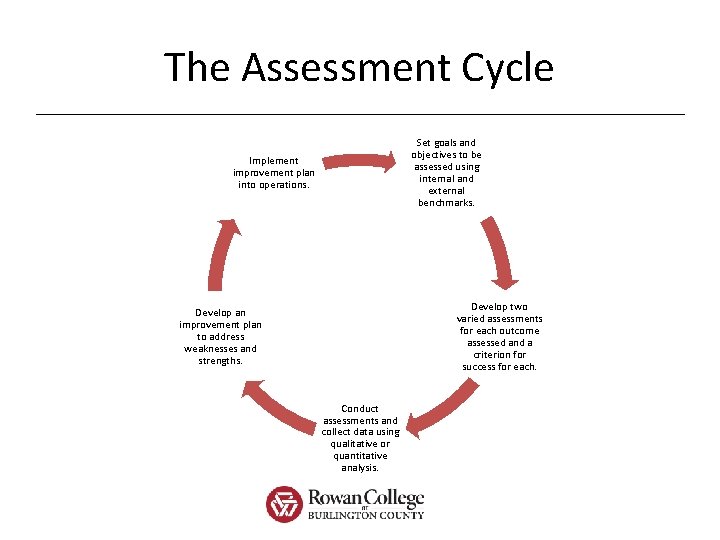
The Assessment Cycle Set goals and objectives to be assessed using internal and external benchmarks. Implement improvement plan into operations. Develop two varied assessments for each outcome assessed and a criterion for success for each. Develop an improvement plan to address weaknesses and strengths. Conduct assessments and collect data using qualitative or quantitative analysis.
Outcomes Assessments • Pre-defined learning outcomes – In order to actively measure the degree of attainment of learning outcomes – Example: ABET Course Learning Outcomes assessment, with supported Student Outcomes • Represent learning outcomes for very specific criteria • Sharing outcomes assessment – Can give an industry partner confidence that the proper material is being emphasized and that students have the required degree of skills and competency
Future Work
Future and Continued Work • Strengthen continuous pathways between secondary schools, higher education institutions, and industry partners. • Maintain Relevance of the Curriculum – Advisory Committee Input – Formalized Program Review • Undergraduate Research – To develop critical thinking, problem solving, and communication skills • Student Employment Opportunities – Real-world employment opportunities – Internships and Co-ops • Applications Approach – Enable students to see the relevance of the subjects they are expected to learn • Future NSF grant applications, building off of the current work
Acknowledgements • The authors wish to gratefully acknowledge the support of the National Science Foundation (NSF), through the Division of Undergraduate Education, DUE 1601487 which made this effort possible. Any opinions, findings, and conclusions or recommendations expressed in this material are those of the authors and do not necessarily reflect the views of the National Science Foundation. • The authors also wish to acknowledge Rowan College at Burlington County (RCBC) and Rowan University (RU) for the extensive support in the development and alignment of the mechanical engineering technology curricula.
Contact Information Dr. David Spang, Sr. Vice President & Provost, RCBC dspang@rcbc. edu Dr. Edem Tetteh, Dean of STEM, RCBC etetteh@rcbc. edu Dr. Ratneshwar Jha, Dept. Head and Professor, Mechanical Engineering, Rowan University jhar@rowan. edu