
Comprehensive Early Childhood Systems in States Desired Results
- Slides: 22
Comprehensive Early Childhood Systems in States: Desired Results and Key Functions Revised System Graphics The Early Childhood Systems Working Group
Background on the Early Childhood Systems Working Group (ECSWG) • Began in 2006 • Meet voluntarily on an as needed basis • The ECSWG: – Includes organizations and individuals who provide technical assistance to state leaders – Is a peer learning community – Develops resources for the early childhood field Early Childhood Systems Working Group 2
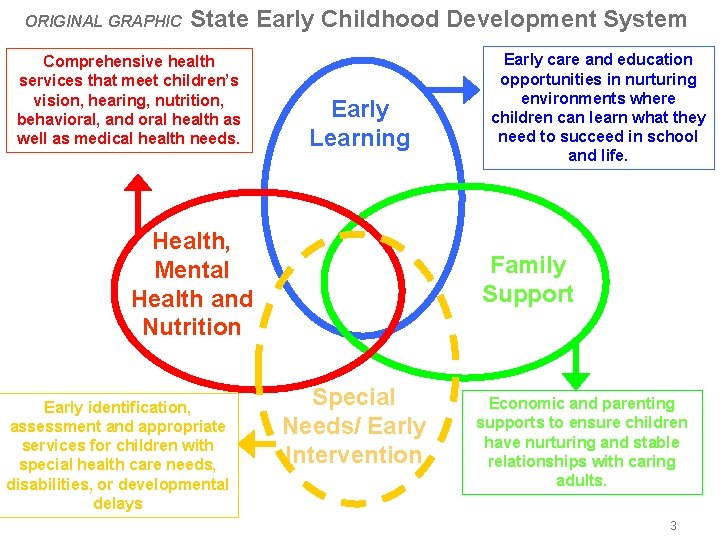
ORIGINAL GRAPHIC State Early Childhood Development System Comprehensive health services that meet children’s vision, hearing, nutrition, behavioral, and oral health as well as medical health needs. Early Learning Health, Mental Health and Nutrition Early identification, assessment and appropriate services for children with special health care needs, disabilities, or developmental delays Early care and education opportunities in nurturing environments where children can learn what they need to succeed in school and life. Family Support Special Needs/ Early Intervention Economic and parenting supports to ensure children have nurturing and stable relationships with caring adults. 3
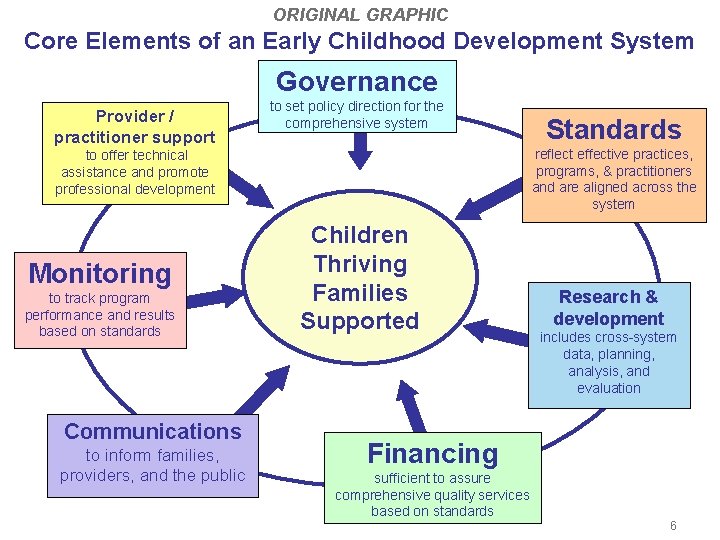
ORIGINAL GRAPHIC Core Elements of an Early Childhood Development System Governance Provider / practitioner support to set policy direction for the comprehensive system reflect effective practices, programs, & practitioners and are aligned across the system to offer technical assistance and promote professional development Monitoring to track program performance and results based on standards Communications to inform families, providers, and the public Standards Children Thriving Families Supported Research & development includes cross-system data, planning, analysis, and evaluation Financing sufficient to assure comprehensive quality services based on standards 6
Why Revise Now? • The ECSWG members felt it was time to: – Clarify some of the concepts or terms – Incorporate lessons learned – Reflect the evolving understanding of system-building in states Early Childhood Systems Working Group 7
What Changed? • ECSWG expanded – Recruited more members from the health and family leadership and support fields • Developed guiding values and principles • Revised ovals graphic • Updated the key functions of a comprehensive early childhood system Early Childhood Systems Working Group 8
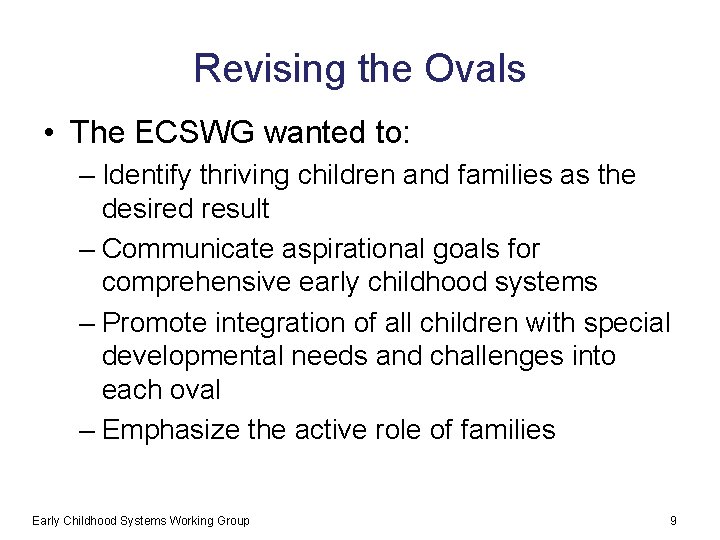
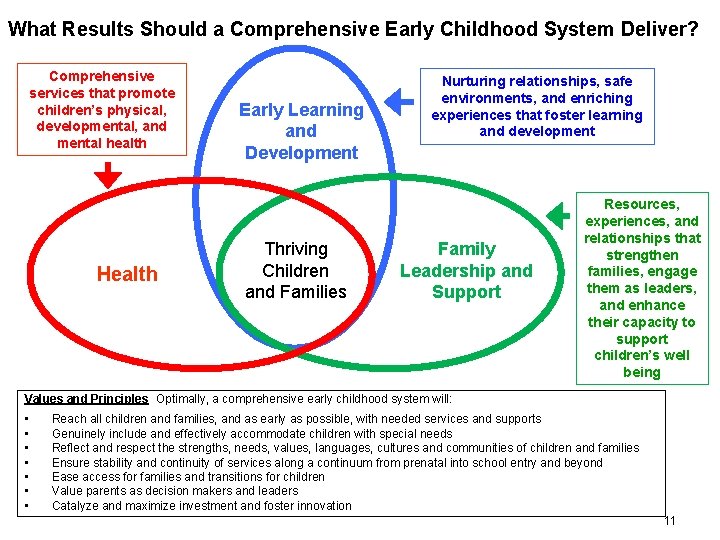
Revising the Ovals • The ECSWG wanted to: – Identify thriving children and families as the desired result – Communicate aspirational goals for comprehensive early childhood systems – Promote integration of all children with special developmental needs and challenges into each oval – Emphasize the active role of families Early Childhood Systems Working Group 9
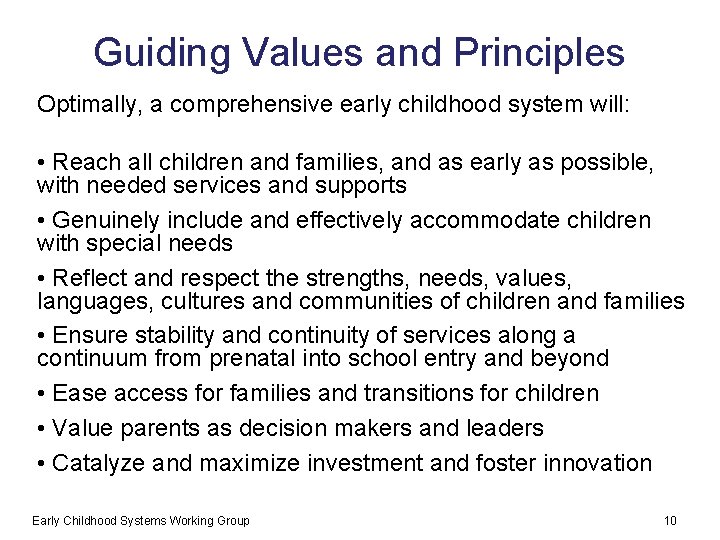
Guiding Values and Principles Optimally, a comprehensive early childhood system will: • Reach all children and families, and as early as possible, with needed services and supports • Genuinely include and effectively accommodate children with special needs • Reflect and respect the strengths, needs, values, languages, cultures and communities of children and families • Ensure stability and continuity of services along a continuum from prenatal into school entry and beyond • Ease access for families and transitions for children • Value parents as decision makers and leaders • Catalyze and maximize investment and foster innovation Early Childhood Systems Working Group 10
What Results Should a Comprehensive Early Childhood System Deliver? Comprehensive services that promote children’s physical, developmental, and mental health Health Early Learning and Development Thriving Children and Families Nurturing relationships, safe environments, and enriching experiences that foster learning and development Family Leadership and Support Resources, experiences, and relationships that strengthen families, engage them as leaders, and enhance their capacity to support children’s well being Values and Principles Optimally, a comprehensive early childhood system will: • • Reach all children and families, and as early as possible, with needed services and supports Genuinely include and effectively accommodate children with special needs Reflect and respect the strengths, needs, values, languages, cultures and communities of children and families Ensure stability and continuity of services along a continuum from prenatal into school entry and beyond Ease access for families and transitions for children Value parents as decision makers and leaders Catalyze and maximize investment and foster innovation 11
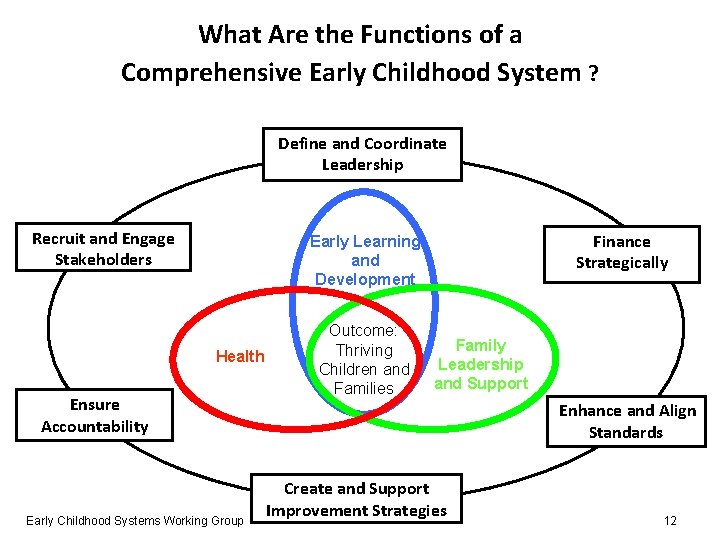
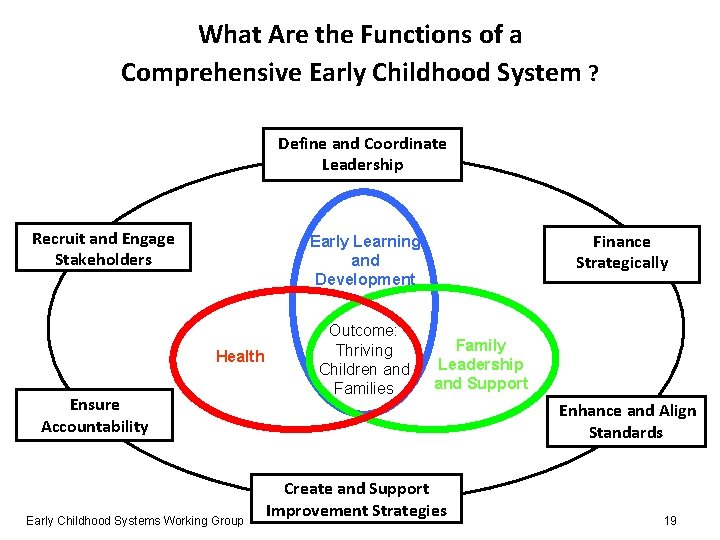
What Are the Functions of a Comprehensive Early Childhood System ? Define and Coordinate Leadership Recruit and Engage Stakeholders Finance Strategically Early Learning and Development Health Ensure Accountability Early Childhood Systems Working Group Outcome: Thriving Children and Families Family Leadership and Support Enhance and Align Standards Create and Support Improvement Strategies 12
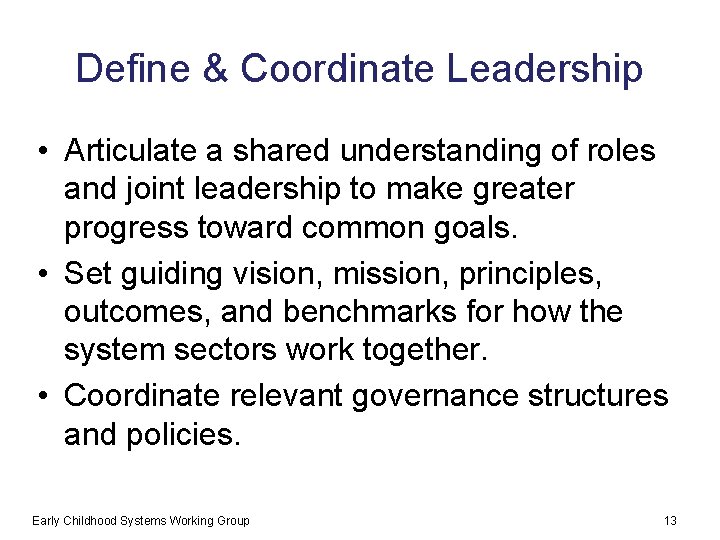
Define & Coordinate Leadership • Articulate a shared understanding of roles and joint leadership to make greater progress toward common goals. • Set guiding vision, mission, principles, outcomes, and benchmarks for how the system sectors work together. • Coordinate relevant governance structures and policies. Early Childhood Systems Working Group 13
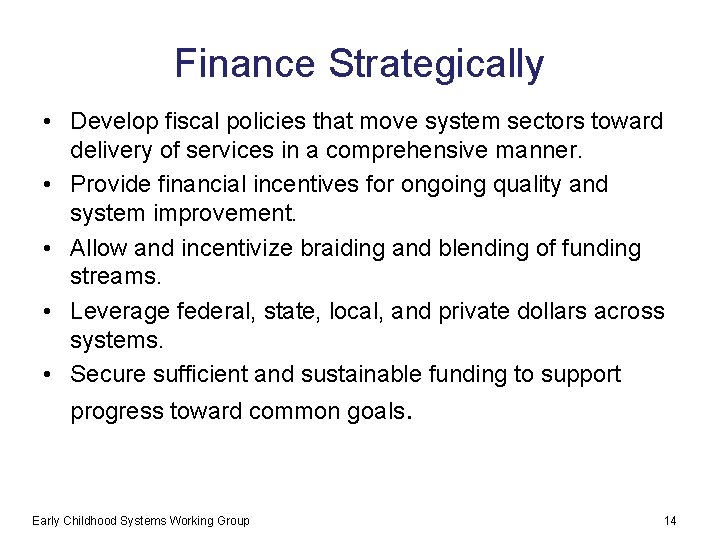
Finance Strategically • Develop fiscal policies that move system sectors toward delivery of services in a comprehensive manner. • Provide financial incentives for ongoing quality and system improvement. • Allow and incentivize braiding and blending of funding streams. • Leverage federal, state, local, and private dollars across systems. • Secure sufficient and sustainable funding to support progress toward common goals. Early Childhood Systems Working Group 14
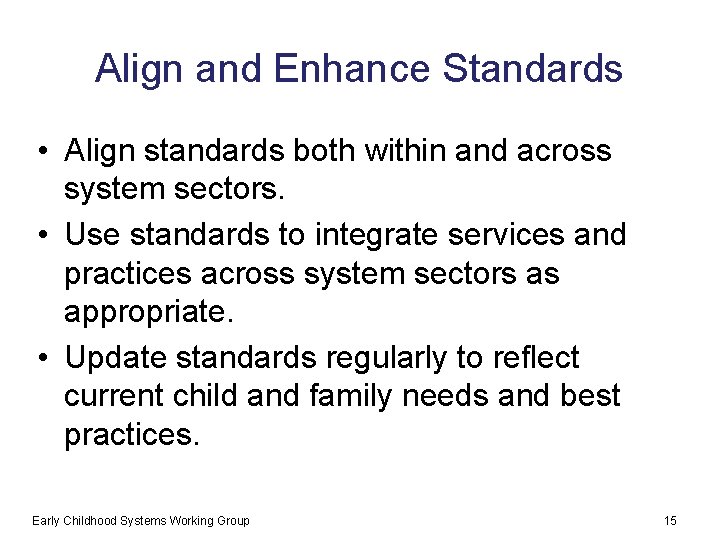
Align and Enhance Standards • Align standards both within and across system sectors. • Use standards to integrate services and practices across system sectors as appropriate. • Update standards regularly to reflect current child and family needs and best practices. Early Childhood Systems Working Group 15
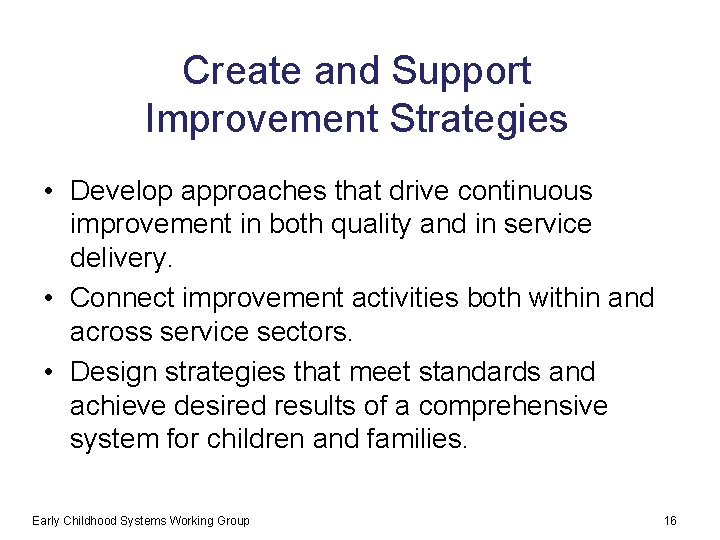
Create and Support Improvement Strategies • Develop approaches that drive continuous improvement in both quality and in service delivery. • Connect improvement activities both within and across service sectors. • Design strategies that meet standards and achieve desired results of a comprehensive system for children and families. Early Childhood Systems Working Group 16
Ensure Accountability • Design data systems that track progress on outcomes and benchmarks. • Regularly review and use data to guide continuous improvement and inform planning, policy, practice and operations. • Connect data across the comprehensive early childhood system to answer critical policy questions. Early Childhood Systems Working Group 17
Recruit and Engage Stakeholders • Use strategic communication to increase understanding of requirements and benefits of a comprehensive early childhood system. • Build a broad constituency to support investment in a comprehensive early childhood system. • Partner with families as leaders in building a comprehensive early childhood system. Early Childhood Systems Working Group 18
What Are the Functions of a Comprehensive Early Childhood System ? Define and Coordinate Leadership Recruit and Engage Stakeholders Finance Strategically Early Learning and Development Health Ensure Accountability Early Childhood Systems Working Group Outcome: Thriving Children and Families Family Leadership and Support Enhance and Align Standards Create and Support Improvement Strategies 19
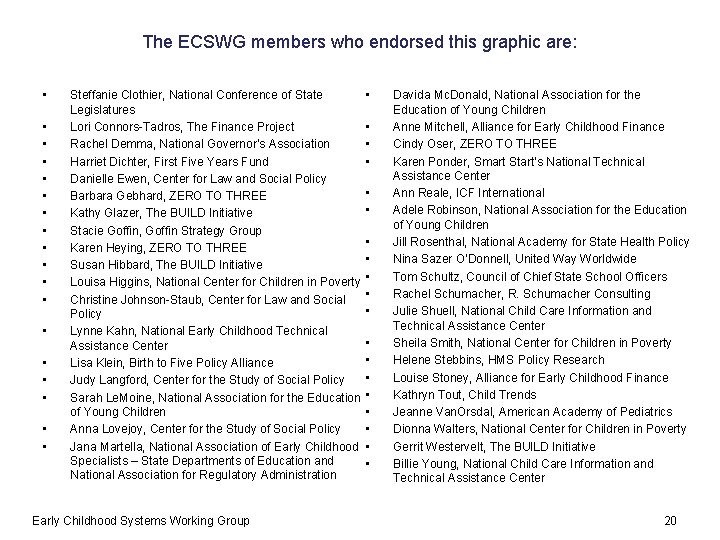
The ECSWG members who endorsed this graphic are: • • • • • Steffanie Clothier, National Conference of State Legislatures Lori Connors-Tadros, The Finance Project Rachel Demma, National Governor’s Association Harriet Dichter, First Five Years Fund Danielle Ewen, Center for Law and Social Policy Barbara Gebhard, ZERO TO THREE Kathy Glazer, The BUILD Initiative Stacie Goffin, Goffin Strategy Group Karen Heying, ZERO TO THREE Susan Hibbard, The BUILD Initiative Louisa Higgins, National Center for Children in Poverty Christine Johnson-Staub, Center for Law and Social Policy Lynne Kahn, National Early Childhood Technical Assistance Center Lisa Klein, Birth to Five Policy Alliance Judy Langford, Center for the Study of Social Policy Sarah Le. Moine, National Association for the Education of Young Children Anna Lovejoy, Center for the Study of Social Policy Jana Martella, National Association of Early Childhood Specialists – State Departments of Education and National Association for Regulatory Administration Early Childhood Systems Working Group • • • • • Davida Mc. Donald, National Association for the Education of Young Children Anne Mitchell, Alliance for Early Childhood Finance Cindy Oser, ZERO TO THREE Karen Ponder, Smart Start’s National Technical Assistance Center Ann Reale, ICF International Adele Robinson, National Association for the Education of Young Children Jill Rosenthal, National Academy for State Health Policy Nina Sazer O’Donnell, United Way Worldwide Tom Schultz, Council of Chief State School Officers Rachel Schumacher, R. Schumacher Consulting Julie Shuell, National Child Care Information and Technical Assistance Center Sheila Smith, National Center for Children in Poverty Helene Stebbins, HMS Policy Research Louise Stoney, Alliance for Early Childhood Finance Kathryn Tout, Child Trends Jeanne Van. Orsdal, American Academy of Pediatrics Dionna Walters, National Center for Children in Poverty Gerrit Westervelt, The BUILD Initiative Billie Young, National Child Care Information and Technical Assistance Center 20
Next Steps for ECSWG • Develop additional tools using new graphic as basis for states to: – Frame state system development – Conduct a self-assessment – Learn about other state system building and make peer-to-peer connections Early Childhood Systems Working Group 21
Thank You! • For more information on the ECSWG see http: //www. buildinitiative. org/content/earlychildhood-systems-working-group-ecswg • To provide feedback on your state experience with ECSWG resources, please contact Kathy Glazer, BUILD, kathyglazer@gmail. com. Early Childhood Systems Working Group 22