
Comprehensive CD Uniformity Control in Lithography and Etch


- Slides: 34
Comprehensive CD Uniformity Control in Lithography and Etch Process Qiaolin Zhanga, Cherry Tangb, Tony Hsiehb, Nick Maccraeb, Bhanwar Singhb, Kameshwar Poollaa, Costas Spanosa a. Dept of EECS, UC Berkeley b. SDC, Advanced Micro Devices March 3, 2005 1 FLCC
Motivation • Importance of across-wafer (AW) CD (gate-length) uniformity – Impacts IC performance spread and yield – Large AW CDV large die-to-die performance variation low yield • How to cope with increasing AW CD variation? – Employ design tricks, ex. adaptive body biasing • Has limitations – Reduce AW CD variation during manufacturing • The most effective approach 2 FLCC
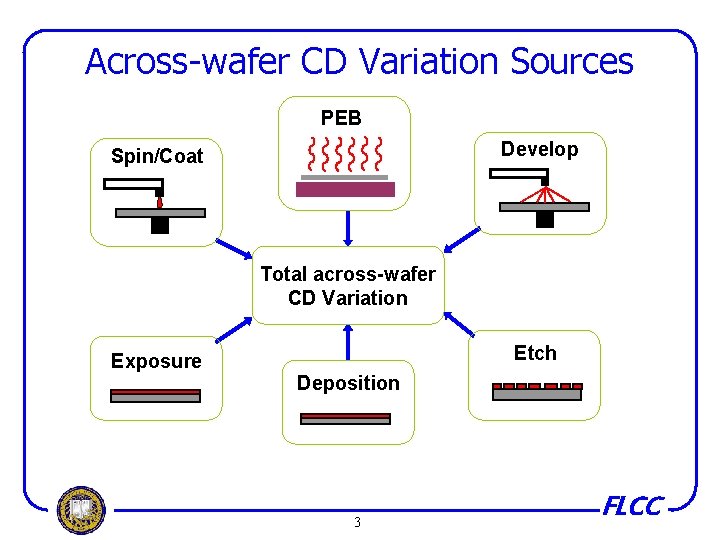
Across-wafer CD Variation Sources PEB Develop Spin/Coat Total across-wafer CD Variation Exposure Etch Deposition 3 FLCC
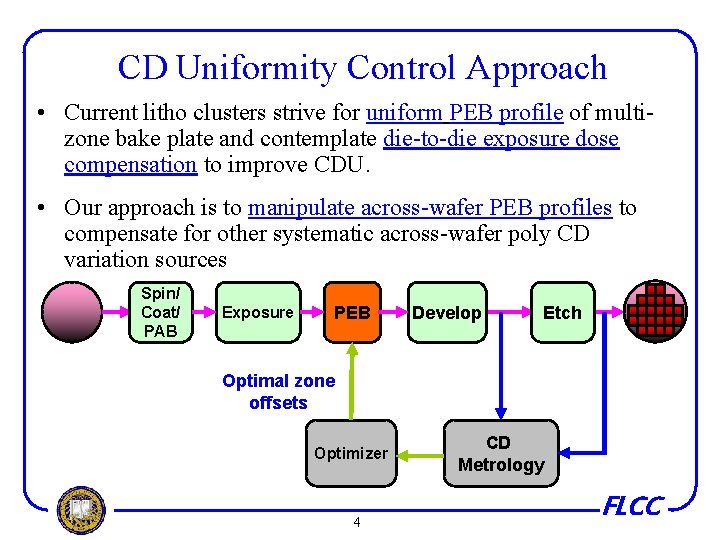
CD Uniformity Control Approach • Current litho clusters strive for uniform PEB profile of multizone bake plate and contemplate die-to-die exposure dose compensation to improve CDU. • Our approach is to manipulate across-wafer PEB profiles to compensate for other systematic across-wafer poly CD variation sources Spin/ Coat/ PAB Exposure PEB Develop Etch Optimal zone offsets Optimizer 4 CD Metrology FLCC
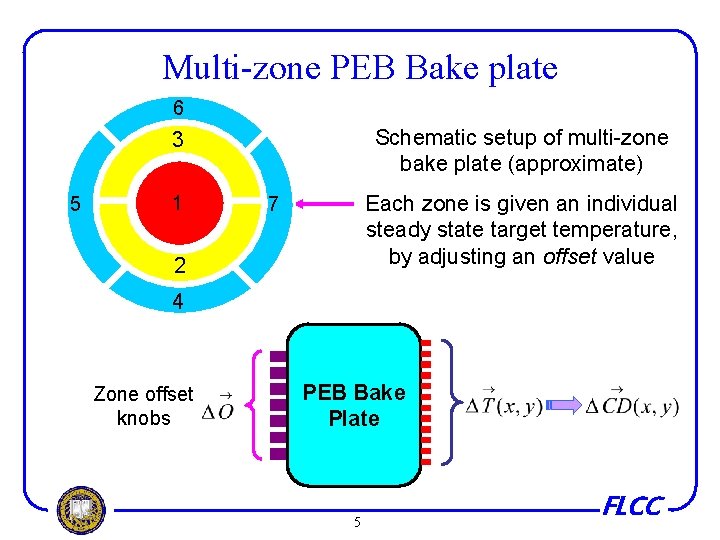
Multi-zone PEB Bake plate 6 Schematic setup of multi-zone bake plate (approximate) 3 5 1 Each zone is given an individual steady state target temperature, by adjusting an offset value 7 2 4 Zone offset knobs PEB Bake Plate 5 FLCC
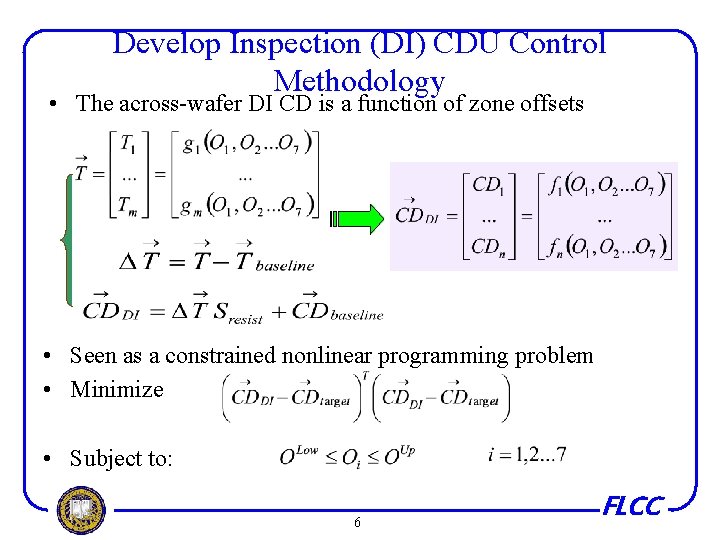
Develop Inspection (DI) CDU Control Methodology • The across-wafer DI CD is a function of zone offsets • Seen as a constrained nonlinear programming problem • Minimize • Subject to: 6 FLCC
Snapshot of Derived CD-to-Offset Model • Empirically derived CD-to-offset model based on temperature -to-offset model and resist PEB sensitivity Zone 1 Zone 2 Zone 3 Zone 4 Zone 5 Zone 6 Zone 7 nm/offset unit 7 FLCC
Simulation Results of DI CDU Control Dense Line Semi-isolated Line Isolated Line Experimentally extracted baseline CDU Simulated optimal CDU after applying DI CDU control CDU Improvement Dense Line Semi-isolated Line Isolated Line 72% 61% 69% 8 FLCC
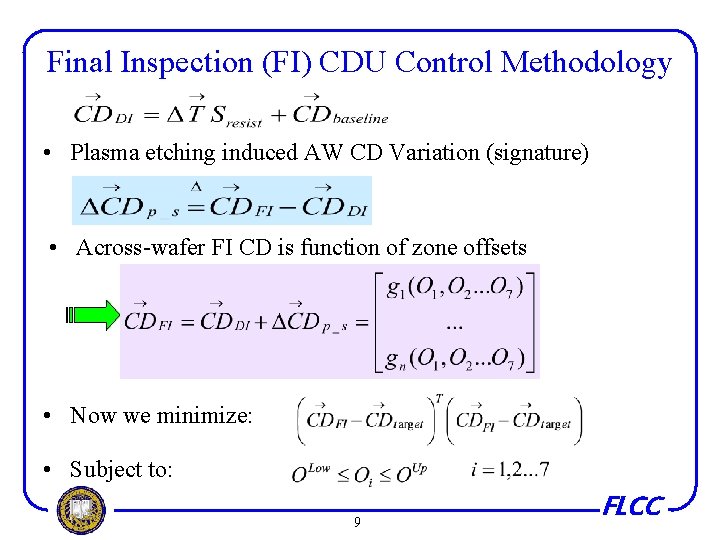
Final Inspection (FI) CDU Control Methodology • Plasma etching induced AW CD Variation (signature) • Across-wafer FI CD is function of zone offsets • Now we minimize: • Subject to: 9 FLCC
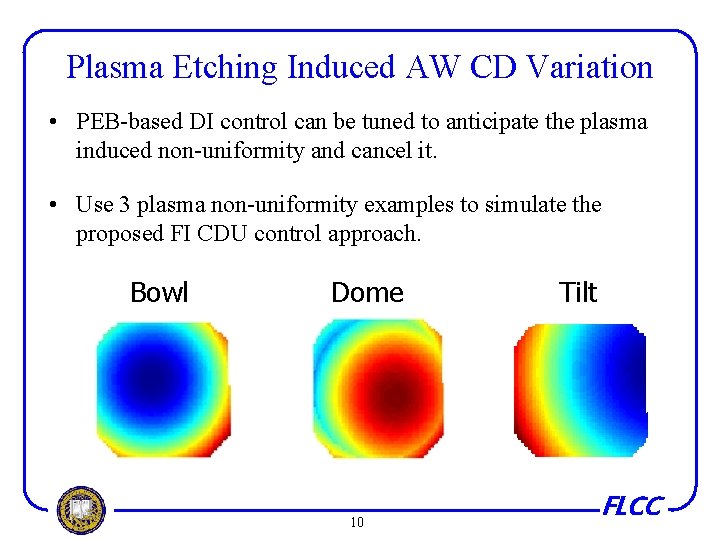
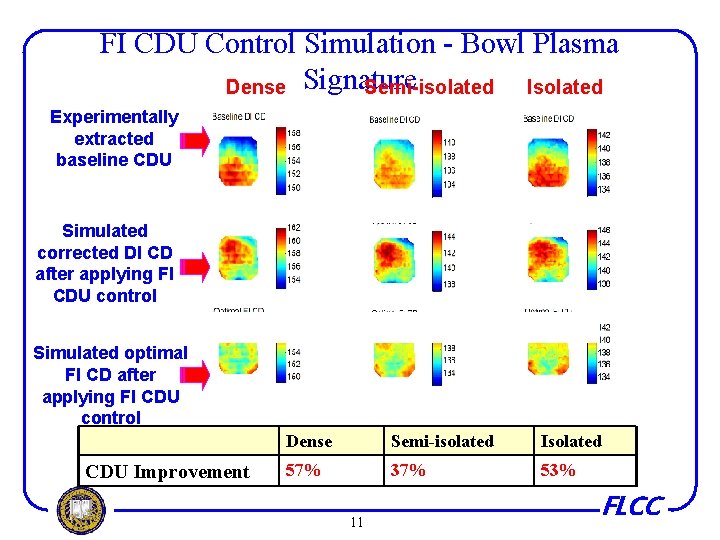
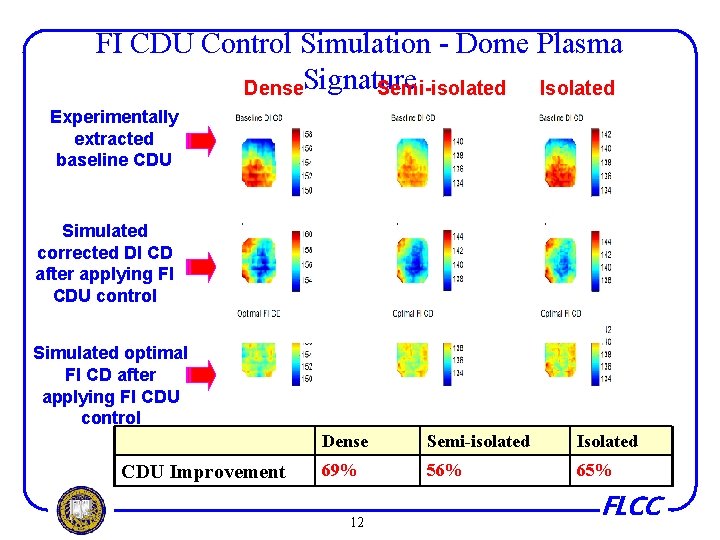
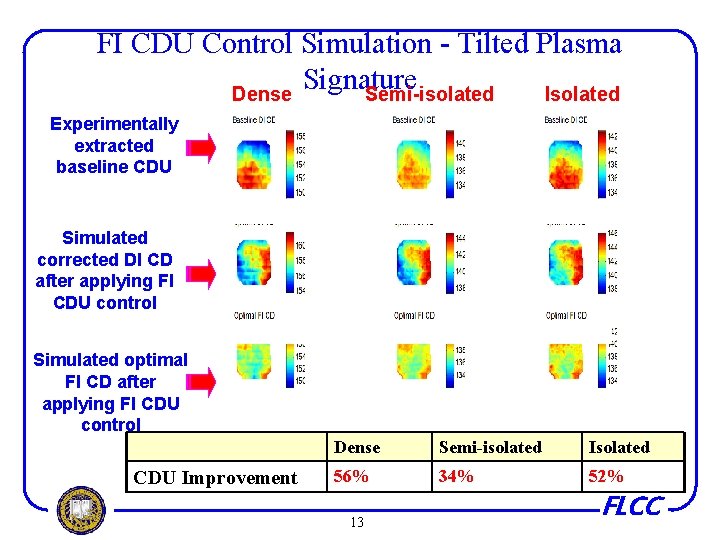
Plasma Etching Induced AW CD Variation • PEB-based DI control can be tuned to anticipate the plasma induced non-uniformity and cancel it. • Use 3 plasma non-uniformity examples to simulate the proposed FI CDU control approach. Bowl Dome 10 Tilt FLCC
FI CDU Control Simulation - Bowl Plasma Dense Signature Semi-isolated Isolated Experimentally extracted baseline CDU Simulated corrected DI CD after applying FI CDU control Simulated optimal FI CD after applying FI CDU control CDU Improvement Dense Semi-isolated Isolated 57% 37% 53% 11 FLCC
FI CDU Control Simulation - Dome Plasma Dense. Signature Semi-isolated Isolated Experimentally extracted baseline CDU Simulated corrected DI CD after applying FI CDU control Simulated optimal FI CD after applying FI CDU control CDU Improvement Dense Semi-isolated Isolated 69% 56% 65% 12 FLCC
FI CDU Control Simulation - Tilted Plasma Signature Dense Semi-isolated Isolated Experimentally extracted baseline CDU Simulated corrected DI CD after applying FI CDU control Simulated optimal FI CD after applying FI CDU control CDU Improvement Dense Semi-isolated Isolated 56% 34% 52% 13 FLCC
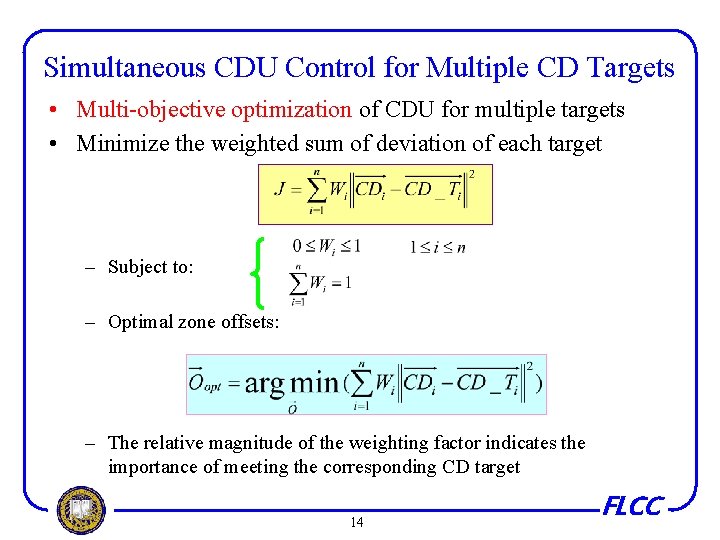
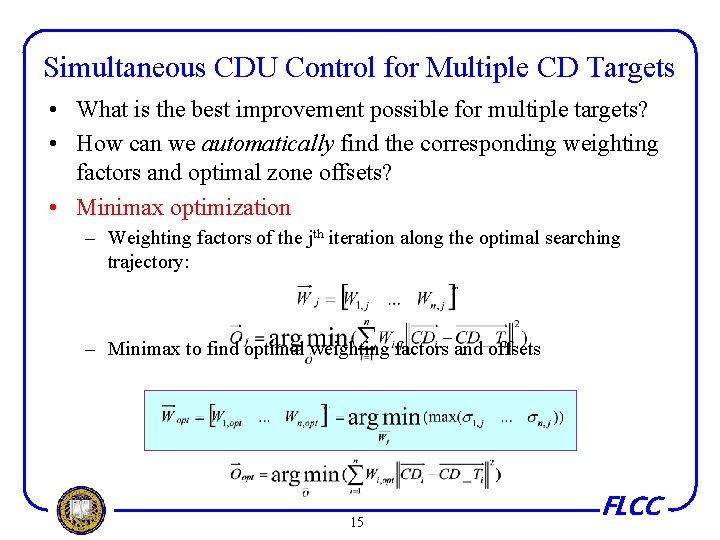
Simultaneous CDU Control for Multiple CD Targets • Multi-objective optimization of CDU for multiple targets • Minimize the weighted sum of deviation of each target – Subject to: – Optimal zone offsets: – The relative magnitude of the weighting factor indicates the importance of meeting the corresponding CD target 14 FLCC
Simultaneous CDU Control for Multiple CD Targets • What is the best improvement possible for multiple targets? • How can we automatically find the corresponding weighting factors and optimal zone offsets? • Minimax optimization – Weighting factors of the jth iteration along the optimal searching trajectory: – Minimax to find optimal weighting factors and offsets 15 FLCC
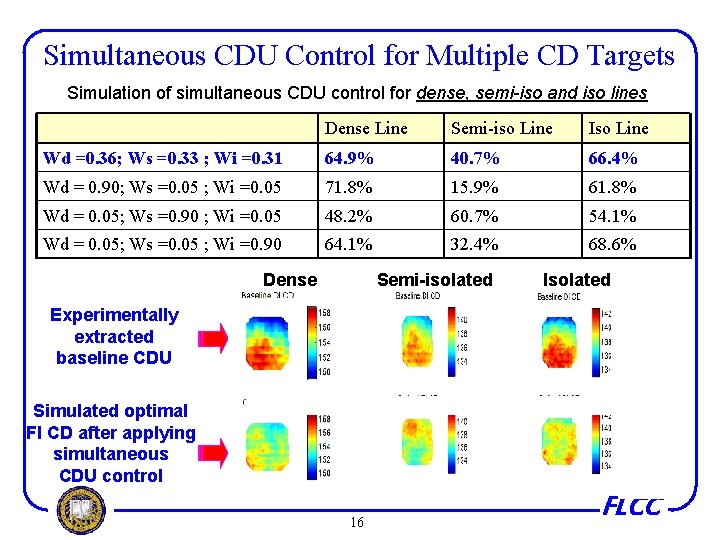
Simultaneous CDU Control for Multiple CD Targets Simulation of simultaneous CDU control for dense, semi-iso and iso lines Dense Line Semi-iso Line Iso Line Wd =0. 36; Ws =0. 33 ; Wi =0. 31 64. 9% 40. 7% 66. 4% Wd = 0. 90; Ws =0. 05 ; Wi =0. 05 71. 8% 15. 9% 61. 8% Wd = 0. 05; Ws =0. 90 ; Wi =0. 05 48. 2% 60. 7% 54. 1% Wd = 0. 05; Ws =0. 05 ; Wi =0. 90 64. 1% 32. 4% 68. 6% Dense Semi-isolated Isolated Experimentally extracted baseline CDU Simulated optimal FI CD after applying simultaneous CDU control 16 FLCC
Summary and Conclusions • Extracted CDU signatures of dense, iso and semi-iso • CD-to-offset model enables DI & FI CDU control – The derived CD-to-offset model is based on temperature-to-offset model and resist PEB sensitivity – Offers better fidelity than the old CD-to-offset model purely based on CD measurement – Simulation indicates promise of DI & FI CDU control • Multi-objective & minimax optimization schemes enable simultaneous CDU control for multiple CD targets • Work in SDC at AMD are under way to validate this approach experimentally 17 FLCC
Technology/Circuit Co-Design: Impact of Spatial Correlation Paul Friedberg Department of Electrical Engineering and Computer Sciences University of California, Berkeley Feb. 14, 2005 18 FLCC
Outline • • • Motivation Spatial Correlation Extraction Impact of Spatial Correlation on Circuit Performance How does process control impact spatial correlation? Conclusions/Future Plans 19 FLCC
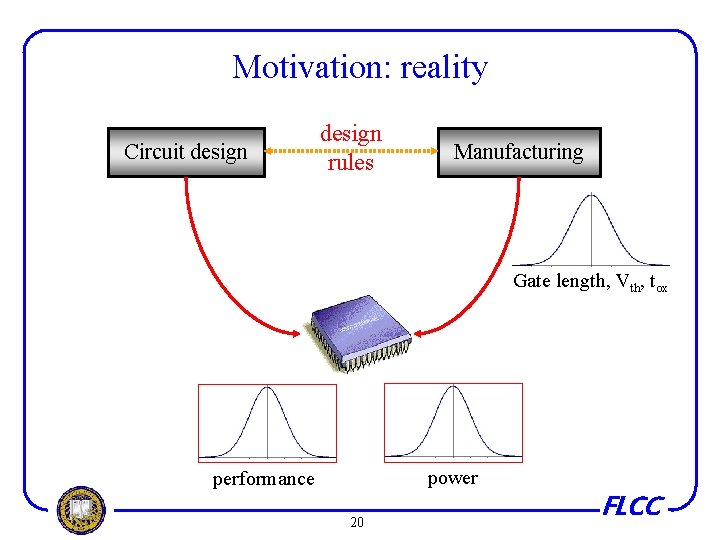
Motivation: reality Circuit design rules Manufacturing Gate length, Vth, tox power performance 20 FLCC
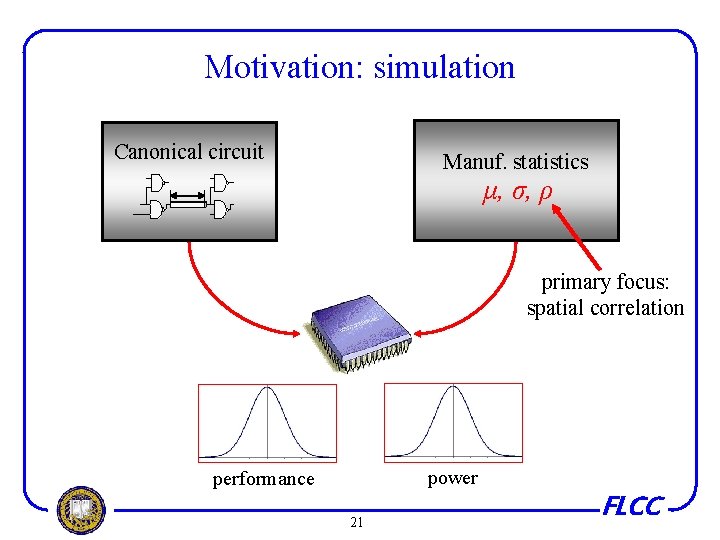
Motivation: simulation Canonical circuit Manuf. statistics μ, σ, ρ primary focus: spatial correlation power performance 21 FLCC
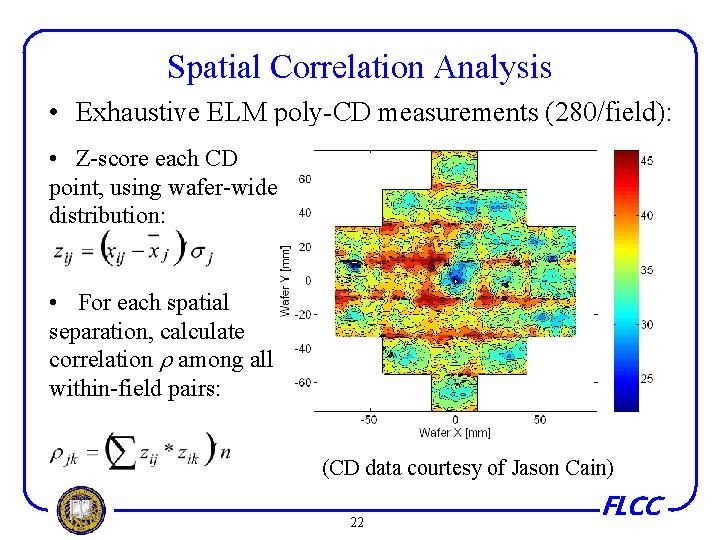
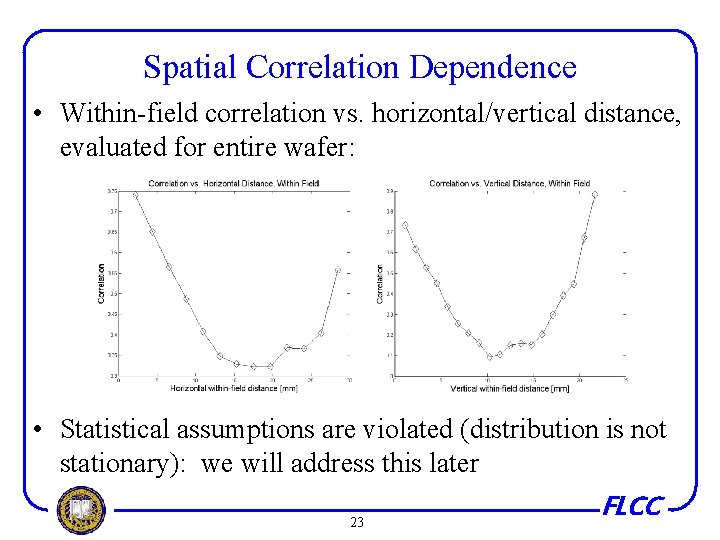
Spatial Correlation Analysis • Exhaustive ELM poly-CD measurements (280/field): • Z-score each CD point, using wafer-wide distribution: • For each spatial separation, calculate correlation among all within-field pairs: (CD data courtesy of Jason Cain) 22 FLCC
Spatial Correlation Dependence • Within-field correlation vs. horizontal/vertical distance, evaluated for entire wafer: • Statistical assumptions are violated (distribution is not stationary): we will address this later 23 FLCC
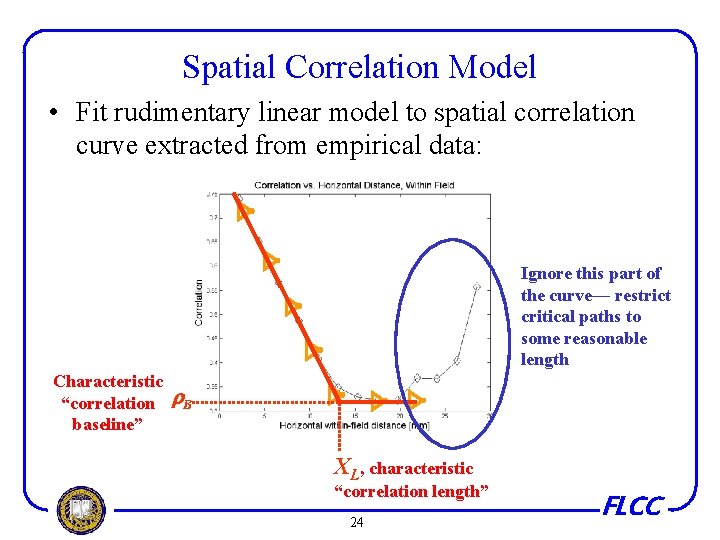
Spatial Correlation Model • Fit rudimentary linear model to spatial correlation curve extracted from empirical data: Ignore this part of the curve— restrict critical paths to some reasonable length Characteristic “correlation r. B baseline” XL, characteristic “correlation length” 24 FLCC
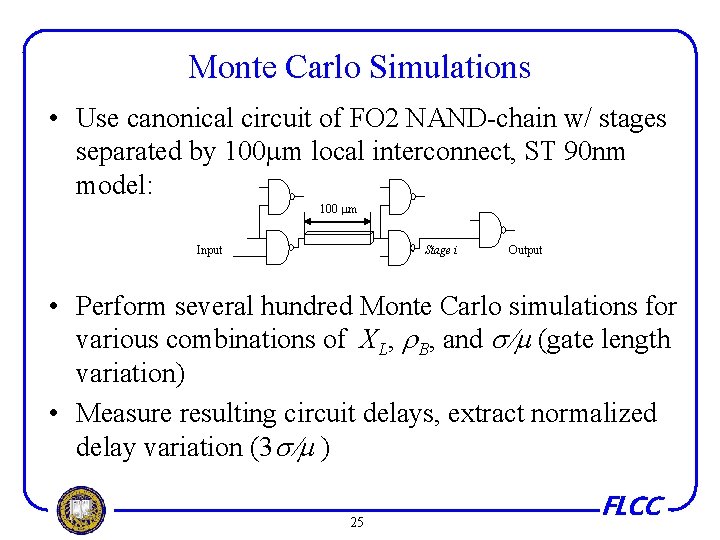
Monte Carlo Simulations • Use canonical circuit of FO 2 NAND-chain w/ stages separated by 100 m local interconnect, ST 90 nm model: 100 m Input Stage i Output • Perform several hundred Monte Carlo simulations for various combinations of XL, B, and / (gate length variation) • Measure resulting circuit delays, extract normalized delay variation (3 / ) 25 FLCC
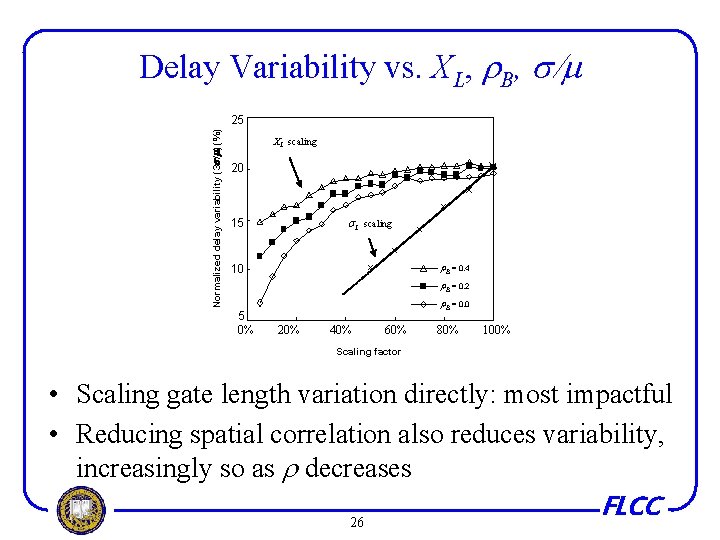
Delay Variability vs. XL, B, / Normalized delay variability (3 / ) (%) 25 XL scaling 20 L 15 scaling B = 0. 4 10 B = 0. 2 5 0% B = 0. 0 20% 40% 60% 80% 100% Scaling factor • Scaling gate length variation directly: most impactful • Reducing spatial correlation also reduces variability, increasingly so as decreases FLCC 26
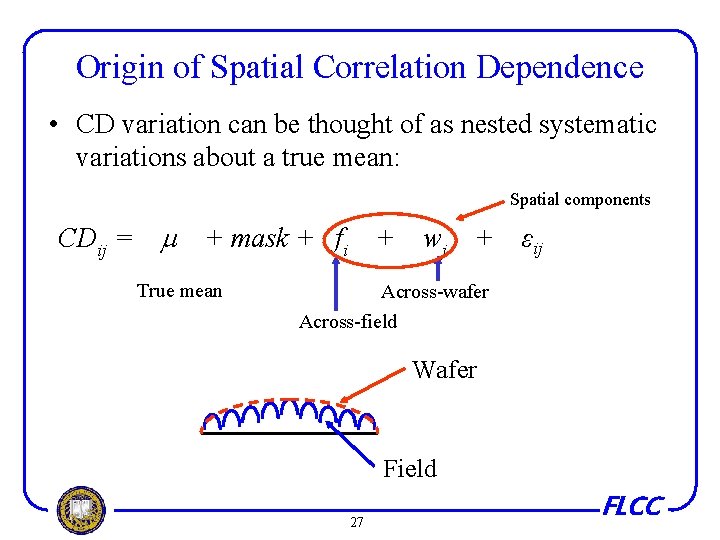
Origin of Spatial Correlation Dependence • CD variation can be thought of as nested systematic variations about a true mean: Spatial components CDij = + mask + fi + wj + εij True mean Across-wafer Across-field Wafer Field 27 FLCC
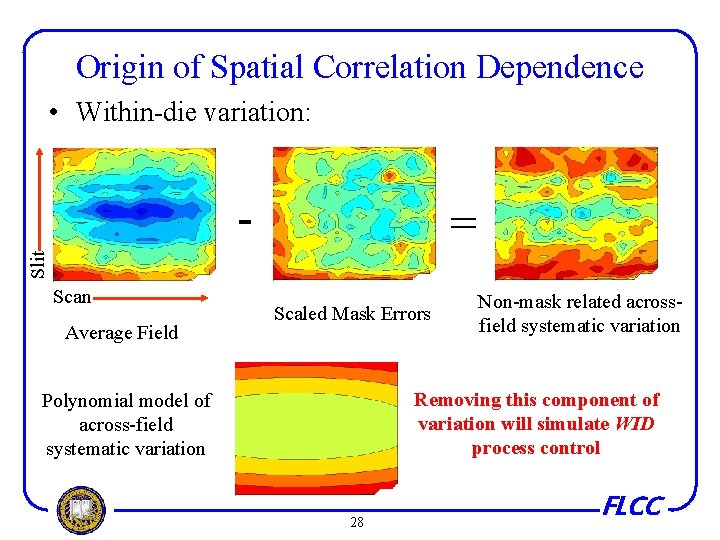
Origin of Spatial Correlation Dependence • Within-die variation: Slit = Scan Average Field Scaled Mask Errors Non-mask related acrossfield systematic variation Removing this component of variation will simulate WID process control Polynomial model of across-field systematic variation 28 FLCC
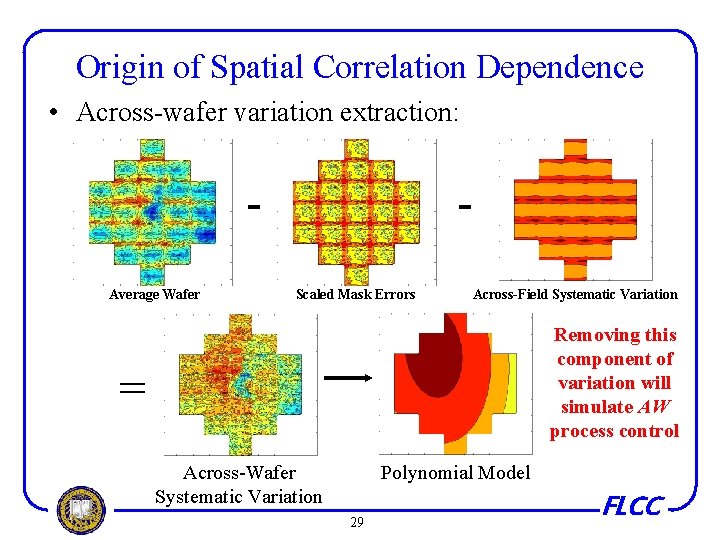
Origin of Spatial Correlation Dependence • Across-wafer variation extraction: Average Wafer Scaled Mask Errors Across-Field Systematic Variation Removing this component of variation will simulate AW process control = Across-Wafer Systematic Variation Polynomial Model 29 FLCC
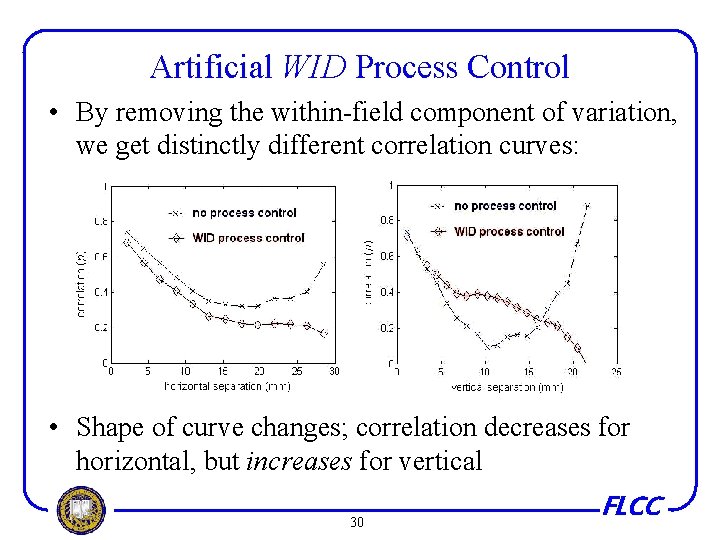
Artificial WID Process Control • By removing the within-field component of variation, we get distinctly different correlation curves: • Shape of curve changes; correlation decreases for horizontal, but increases for vertical 30 FLCC
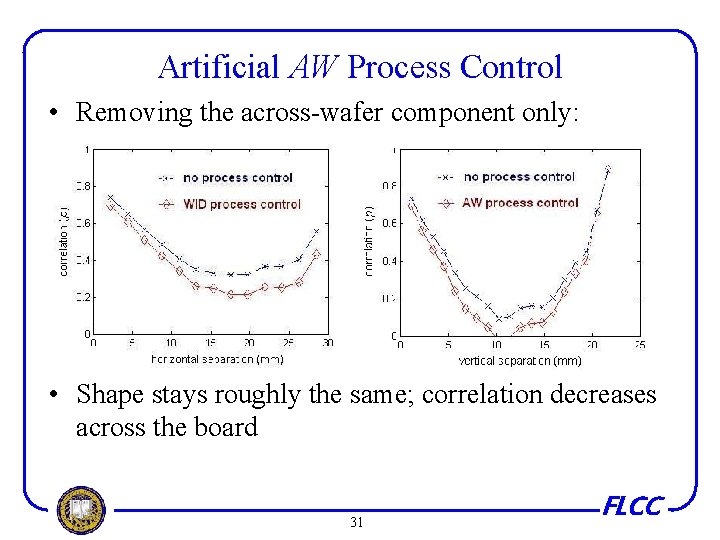
Artificial AW Process Control • Removing the across-wafer component only: • Shape stays roughly the same; correlation decreases across the board 31 FLCC
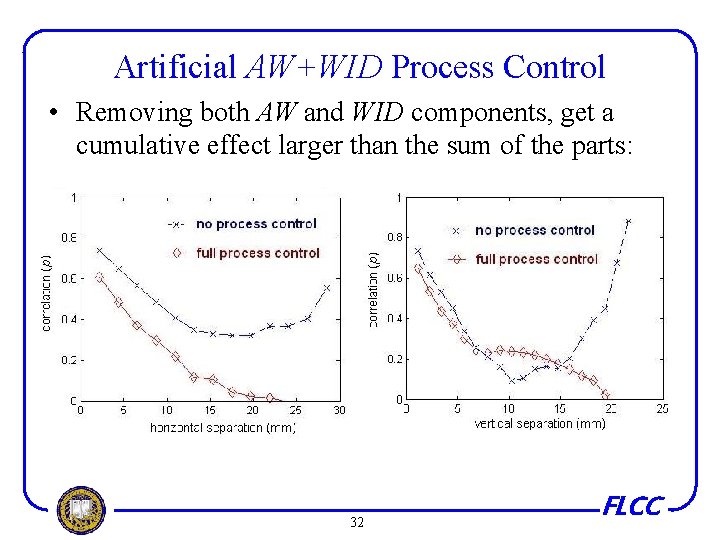
Artificial AW+WID Process Control • Removing both AW and WID components, get a cumulative effect larger than the sum of the parts: 32 FLCC
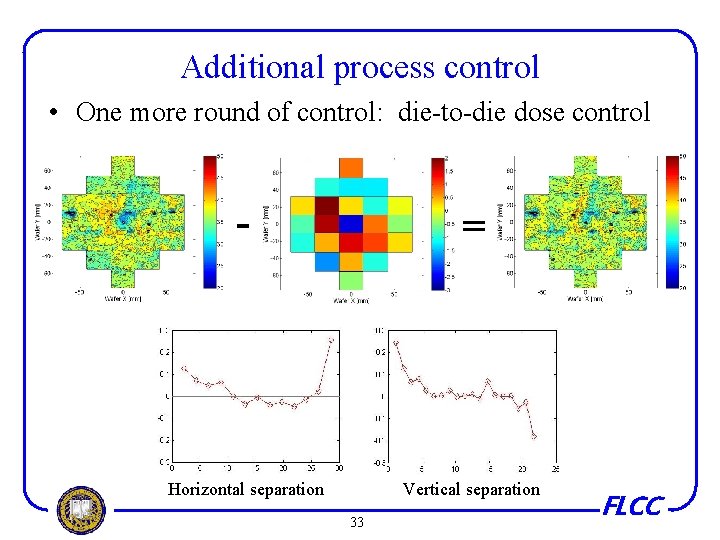
Additional process control • One more round of control: die-to-die dose control - = Horizontal separation Vertical separation 33 FLCC
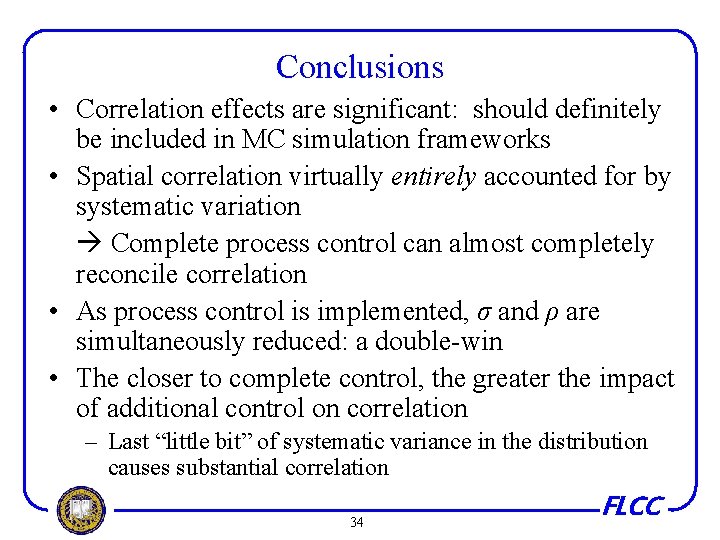
Conclusions • Correlation effects are significant: should definitely be included in MC simulation frameworks • Spatial correlation virtually entirely accounted for by systematic variation Complete process control can almost completely reconcile correlation • As process control is implemented, σ and ρ are simultaneously reduced: a double-win • The closer to complete control, the greater the impact of additional control on correlation – Last “little bit” of systematic variance in the distribution causes substantial correlation 34 FLCC