
Comprehensive Antibiogram Toolkit Using Nursing Home Antibiograms To
Comprehensive Antibiogram Toolkit Using Nursing Home Antibiograms To Improve Antibiotic Prescribing and Delivery Training Slides for Prescribing Clinicians www. ahrq. gov/NH-ASPGuide ● May 2014 AHRQ Pub. No. 14 -0023 -5 -EF
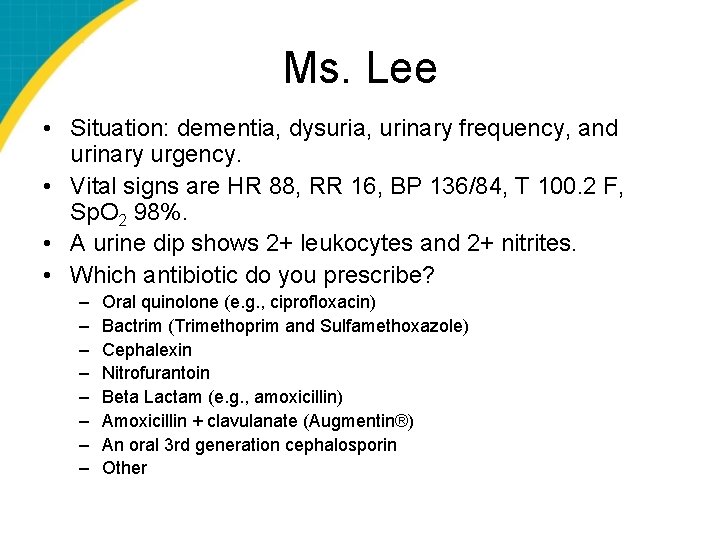
Ms. Lee • Situation: dementia, dysuria, urinary frequency, and urinary urgency. • Vital signs are HR 88, RR 16, BP 136/84, T 100. 2 F, Sp. O 2 98%. • A urine dip shows 2+ leukocytes and 2+ nitrites. • Which antibiotic do you prescribe? – – – – Oral quinolone (e. g. , ciprofloxacin) Bactrim (Trimethoprim and Sulfamethoxazole) Cephalexin Nitrofurantoin Beta Lactam (e. g. , amoxicillin) Amoxicillin + clavulanate (Augmentin®) An oral 3 rd generation cephalosporin Other
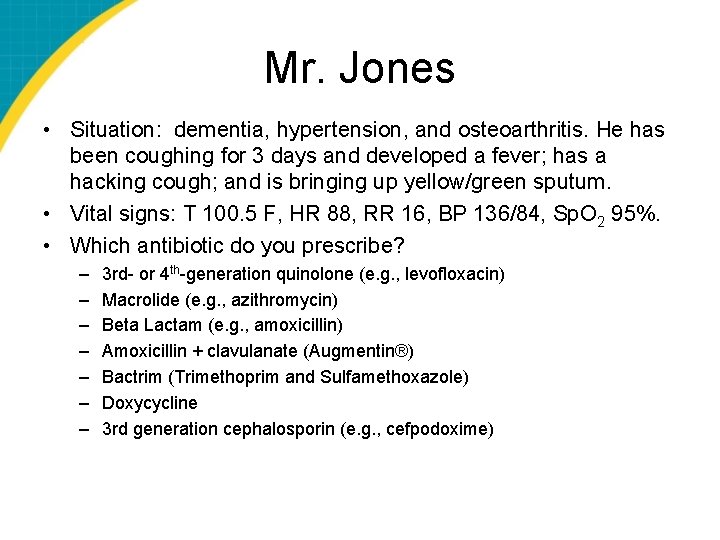
Mr. Jones • Situation: dementia, hypertension, and osteoarthritis. He has been coughing for 3 days and developed a fever; has a hacking cough; and is bringing up yellow/green sputum. • Vital signs: T 100. 5 F, HR 88, RR 16, BP 136/84, Sp. O 2 95%. • Which antibiotic do you prescribe? – – – – 3 rd- or 4 th-generation quinolone (e. g. , levofloxacin) Macrolide (e. g. , azithromycin) Beta Lactam (e. g. , amoxicillin) Amoxicillin + clavulanate (Augmentin®) Bactrim (Trimethoprim and Sulfamethoxazole) Doxycycline 3 rd generation cephalosporin (e. g. , cefpodoxime)
Objectives • Implement an antibiogram at this nursing home • Set a goal of improving initial (empiric) prescribing of antibiotics • Follow the impact of the antibiogram on nursing home prescribing
Background: Antibiotic Prescribing • Antibiotics are frequently prescribed in nursing homes. – Broad-spectrum antibiotics are frequently prescribed. • Initial antibiotic decisions are empiric; clinician’s judgment is based on: – Patient factors (e. g. , age, symptoms) – Nursing home factors (type, historical experience, formulary) – Preference/knowledge
Background: Antibiograms • An antibiogram is a tool to provide clinicians with local microbiologic sensitivity data to assist in their empiric prescribing. • Hospitals have used antibiograms to: – Identify important local resistance patterns. – Increase recommended antibiotic prescribing for acute infections.
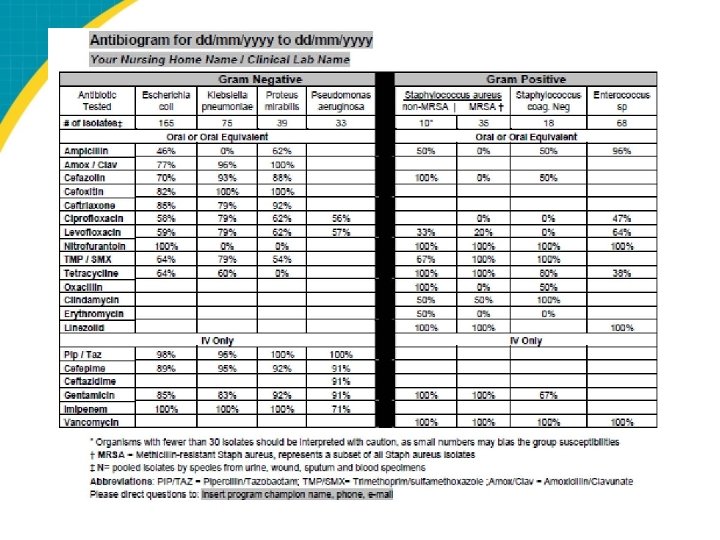
Key Findings From Antibiogram • Most data come from urine cultures: – Of XX cultures used to make the antibiograms, • XX % were urine cultures. • XX % were wound cultures. • XX % were sputum cultures. – The antibiograms will be most applicable when selecting antibiotics to treat urine infections and systemic infections that may have come from the urine. – The leading organisms for positive urine cultures were: • E. coli: XX % of urine cultures • Enterococcus species: XX % • Klebsiella pneumoniae: XX % • Proteus mirabilis: XX %
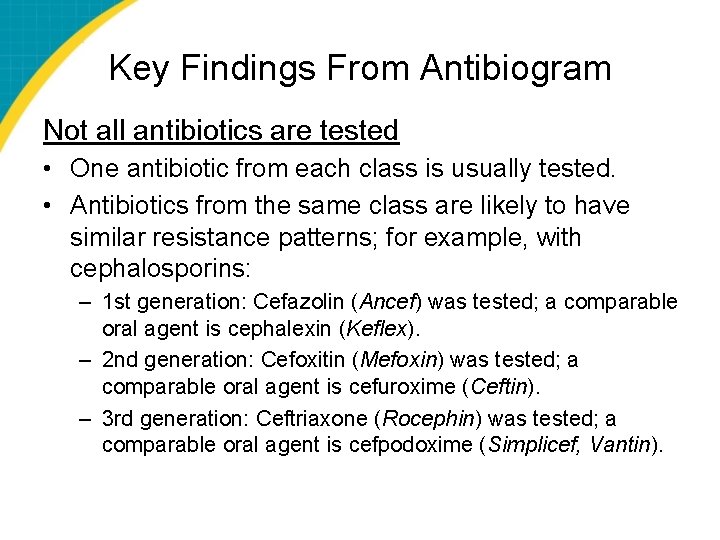
Key Findings From Antibiogram Not all antibiotics are tested • One antibiotic from each class is usually tested. • Antibiotics from the same class are likely to have similar resistance patterns; for example, with cephalosporins: – 1 st generation: Cefazolin (Ancef) was tested; a comparable oral agent is cephalexin (Keflex). – 2 nd generation: Cefoxitin (Mefoxin) was tested; a comparable oral agent is cefuroxime (Ceftin). – 3 rd generation: Ceftriaxone (Rocephin) was tested; a comparable oral agent is cefpodoxime (Simplicef, Vantin).
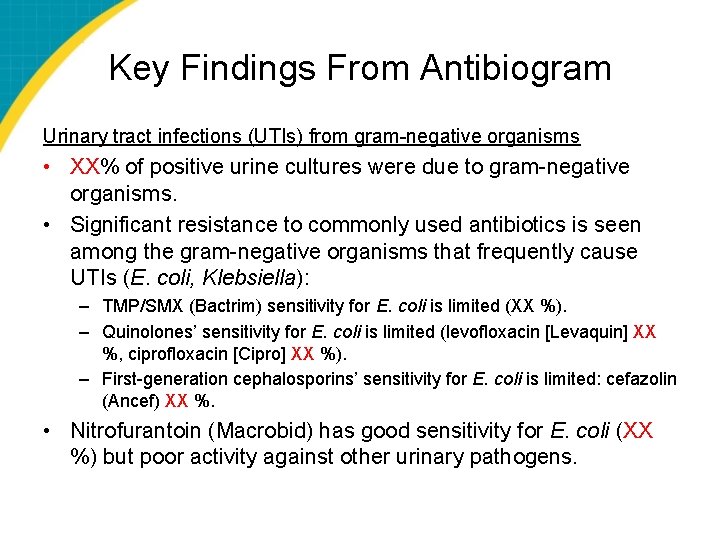
Key Findings From Antibiogram Urinary tract infections (UTIs) from gram-negative organisms • XX% of positive urine cultures were due to gram-negative organisms. • Significant resistance to commonly used antibiotics is seen among the gram-negative organisms that frequently cause UTIs (E. coli, Klebsiella): – TMP/SMX (Bactrim) sensitivity for E. coli is limited (XX %). – Quinolones’ sensitivity for E. coli is limited (levofloxacin [Levaquin] XX %, ciprofloxacin [Cipro] XX %). – First-generation cephalosporins’ sensitivity for E. coli is limited: cefazolin (Ancef) XX %. • Nitrofurantoin (Macrobid) has good sensitivity for E. coli (XX %) but poor activity against other urinary pathogens.
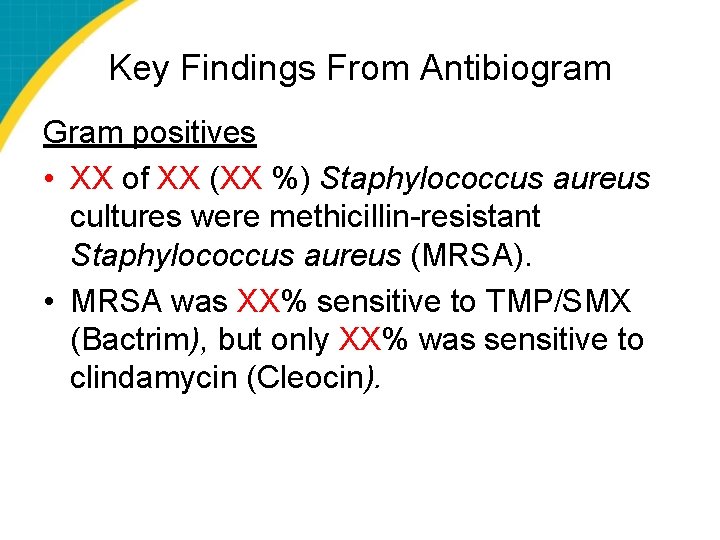
Key Findings From Antibiogram Gram positives • XX of XX (XX %) Staphylococcus aureus cultures were methicillin-resistant Staphylococcus aureus (MRSA). • MRSA was XX% sensitive to TMP/SMX (Bactrim), but only XX% was sensitive to clindamycin (Cleocin).
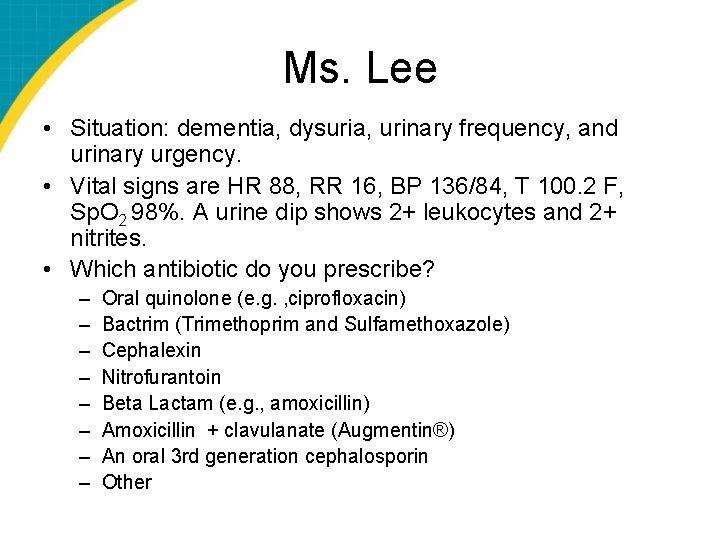
Ms. Lee • Situation: dementia, dysuria, urinary frequency, and urinary urgency. • Vital signs are HR 88, RR 16, BP 136/84, T 100. 2 F, Sp. O 2 98%. A urine dip shows 2+ leukocytes and 2+ nitrites. • Which antibiotic do you prescribe? – – – – Oral quinolone (e. g. , ciprofloxacin) Bactrim (Trimethoprim and Sulfamethoxazole) Cephalexin Nitrofurantoin Beta Lactam (e. g. , amoxicillin) Amoxicillin + clavulanate (Augmentin®) An oral 3 rd generation cephalosporin Other
Mr. Jones • Situation: dementia, hypertension, and osteoarthritis. He has had a hacking cough for 3 days, developed a fever, and is bringing up yellow/green sputum. • Vital signs: T 100. 5 F, HR 88, RR 16, BP 136/84, Sp. O 2 95%. • Which antibiotic do you prescribe? – – – – 3 rd or 4 th generation quinolone (e. g. , levofloxacin) Macrolide (e. g. , azithromycin) Beta Lactam (e. g. , amoxicillin) Amoxicillin + clavulanate (Augmentin®) Bactrim (Trimethoprim and Sulfamethoxazole) Doxycycline 3 rd generation cephalosporin (e. g. , cefpodoxime)
Limitations • Source of infection – “Hospital-acquired”: so nursing home microbiology and antibiogram are less applicable. – “Facility-acquired”: acquired while at nursing home; therefore, antibiogram is more applicable. • Sample size: – Organisms with fewer than 30 isolates should be interpreted with caution, as small numbers may bias the group susceptibilities.

Questions?
- Slides: 15