
COMPREHENSION SKILLS Communication Skills Introduction In our academic
- Slides: 6
COMPREHENSION SKILLS Communication Skills
Introduction ■ In our academic life , questions are asked frequently whether they are in the form of daily test or in exams’ paper. It seems that we “ STUDENTS” are meant for answering the questions. Definition ■ Here it is word ; Comprehension , derived from Latin word “Comprehension” that means “seizing or capturing”. ■ In Oxford dictionary; “It consists of a passage upon which questions are set to test the students’ ability to understand the content of the given text and to infer information and meanings from it. ”
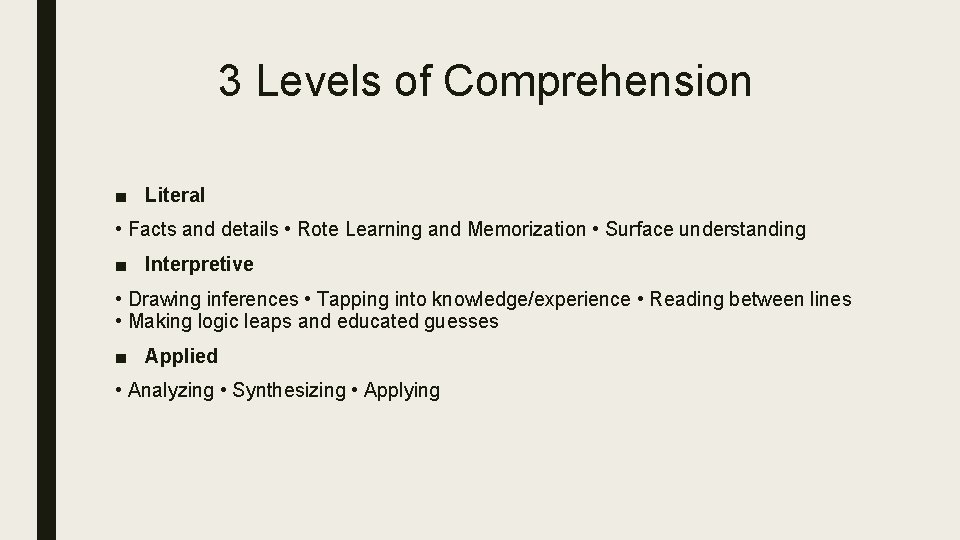
3 Levels of Comprehension ■ Literal • Facts and details • Rote Learning and Memorization • Surface understanding ■ Interpretive • Drawing inferences • Tapping into knowledge/experience • Reading between lines • Making logic leaps and educated guesses ■ Applied • Analyzing • Synthesizing • Applying
Importance of Comprehension ■ Increase effectiveness of reading and helps not only academically but professionally also. ■ Comprehension construct meaning form the text. ■ Students cannot master complex scientific concepts without it. ■ Skilled readers don’t just read the text, they interact with the text ■ Comprehension increase Reading Speed ■ Helps students to Ace the standardized state test ■ This ability help to accurately interpret and analyze written information ■ It make us extract main idea and draw conclusion from text.
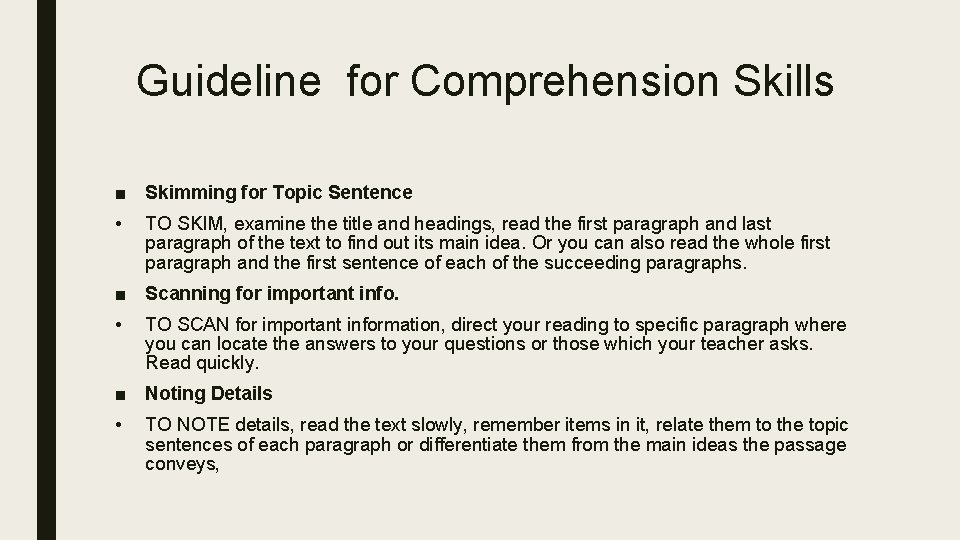
Guideline for Comprehension Skills ■ Skimming for Topic Sentence • TO SKIM, examine the title and headings, read the first paragraph and last paragraph of the text to find out its main idea. Or you can also read the whole first paragraph and the first sentence of each of the succeeding paragraphs. ■ Scanning for important info. • TO SCAN for important information, direct your reading to specific paragraph where you can locate the answers to your questions or those which your teacher asks. Read quickly. ■ Noting Details • TO NOTE details, read the text slowly, remember items in it, relate them to the topic sentences of each paragraph or differentiate them from the main ideas the passage conveys,
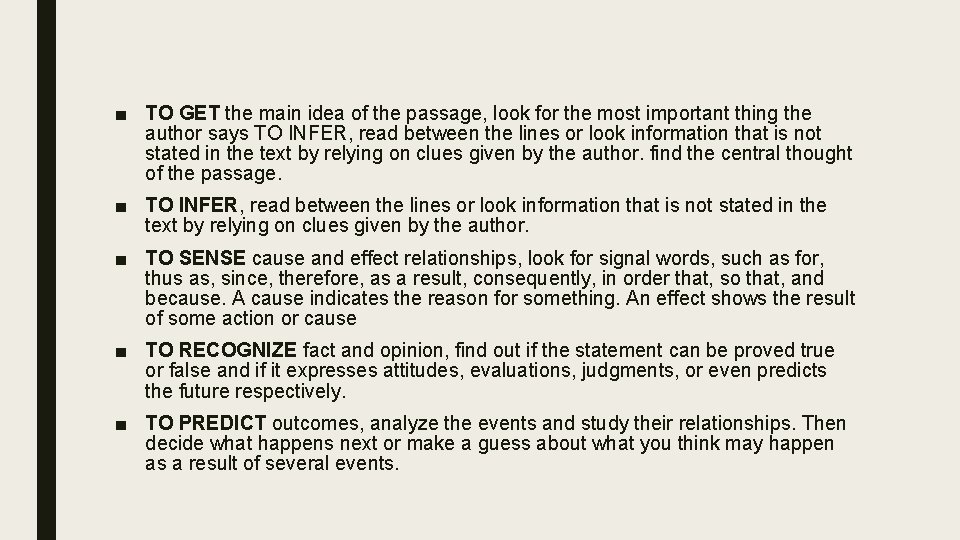
, ■ TO GET the main idea of the passage, look for the most important thing the author says TO INFER, read between the lines or look information that is not stated in the text by relying on clues given by the author. find the central thought of the passage. ■ TO INFER, read between the lines or look information that is not stated in the text by relying on clues given by the author. ■ TO SENSE cause and effect relationships, look for signal words, such as for, thus as, since, therefore, as a result, consequently, in order that, so that, and because. A cause indicates the reason for something. An effect shows the result of some action or cause ■ TO RECOGNIZE fact and opinion, find out if the statement can be proved true or false and if it expresses attitudes, evaluations, judgments, or even predicts the future respectively. ■ TO PREDICT outcomes, analyze the events and study their relationships. Then decide what happens next or make a guess about what you think may happen as a result of several events.