
COMPREHEND COPE CONNECT AN UPDATE AND SURVEY ISABEL
COMPREHEND, COPE & CONNECT AN UPDATE AND SURVEY ISABEL CLARKE CONSULTANT CLINICAL PSYCHOLOGIST
COMPREHEND, COPE & CONNECT THIS APPROACH GETS AWAY FROM LABELS AND STIGMA BY: Meeting people where they are – hearing their distress Understanding what they do to manage it – for example: §Self harm §Attempting suicide §Withdrawing from life etc. And offers different ways to manage distress
COMPREHEND, COPE & CONNECT TRANSFORMING ACUTE AND COMMUNITY MH. SERVICES A practical way of introducing whole team psychological working A formulation – way of understanding their problems worked out with the individual Shared with the team Informing psychological approaches that the whole team can deliver
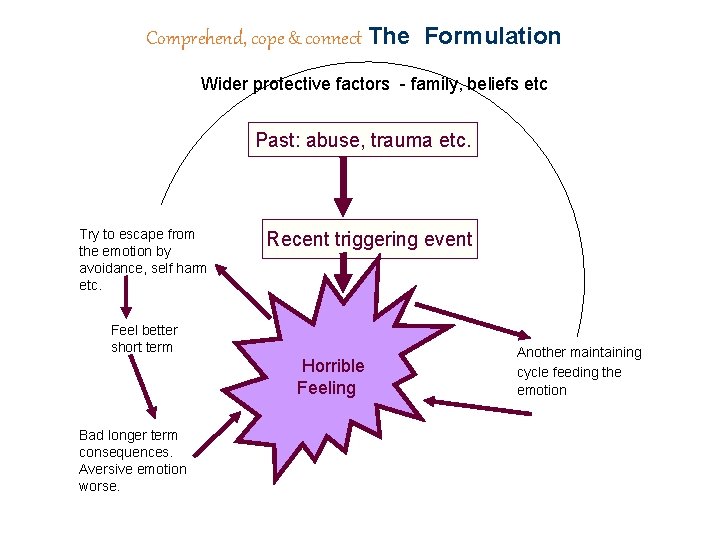
Comprehend, cope & connect The Formulation Wider protective factors - family, beliefs etc Past: abuse, trauma etc. Try to escape from the emotion by avoidance, self harm etc. Feel better short term Bad longer term consequences. Aversive emotion worse. Recent triggering event Horrible Feeling Another maintaining cycle feeding the emotion
COMPREHEND, COPE & CONNECT THERAPEUTIC APPROACHES Mindfulness Grounding in the body and the present – where the individual can be in control Arousal management Emotion regulation skills to face the emotion Psychosis: Unshared reality as an escape from emotion
COMPREHEND, COPE & CONNECT THERAPEUTIC APPROACHES CONTINUED The Compassionate Friend Programme Treat yourself as you would a good friend Emotional Coping Skills Accepting and managing emotions Encouraging behavioural change Behaviours to increase Behaviours to decrease
COMPREHEND, COPE & CONNECT PSYCHOLOGICAL SKILLS DEVELOPMENT = THE TREATMENT Whole staff team involved in teaching, coaching or supporting these skills §Skills groups – eg. Emotional Coping Skills §Psychotic Symptom Management Daily Mindfulness on the ward Staff offer skills coaching where needed
COMPREHEND, COPE & CONNECT WORKING ACROSS THE CARE PATHWAY AND BEYOND. Skills groups can be accessed by inpatients or in the community Formulation informs care across the pathway Where acute sevices have introduced the approach, community services often follow.
T E H T C E N E P CO N O &C D IN C , D H N E E H B E R Y H P M C R O O OA E TH PR AP T E H
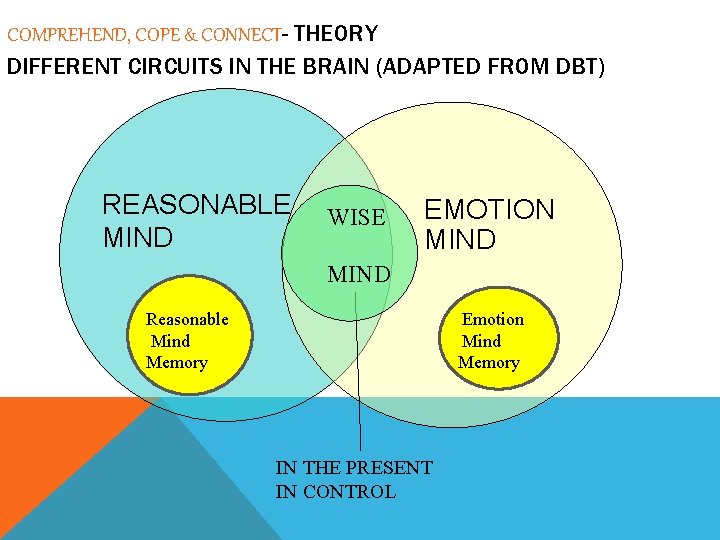
COMPREHEND, COPE & CONNECT- THEORY DIFFERENT CIRCUITS IN THE BRAIN (ADAPTED FROM DBT) REASONABLE MIND Reasonable Mind Memory EMOTION MIND WISE IN THE PRESENT IN CONTROL Emotion Mind Memory
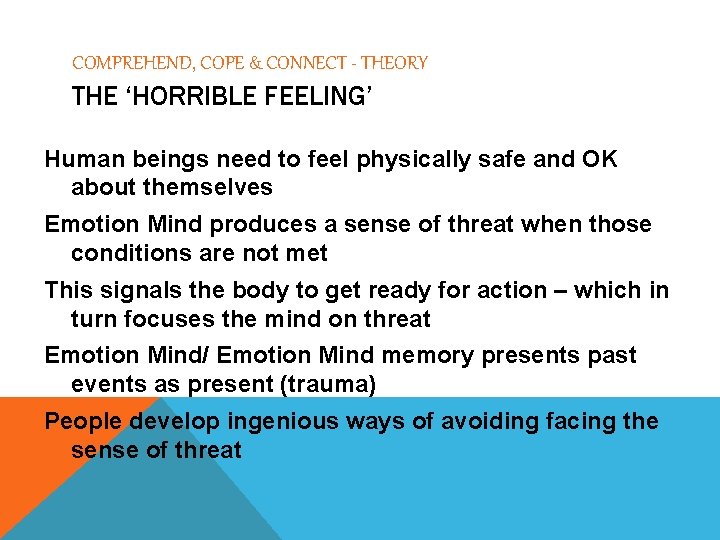
COMPREHEND, COPE & CONNECT - THEORY THE ‘HORRIBLE FEELING’ Human beings need to feel physically safe and OK about themselves Emotion Mind produces a sense of threat when those conditions are not met This signals the body to get ready for action – which in turn focuses the mind on threat Emotion Mind/ Emotion Mind memory presents past events as present (trauma) People develop ingenious ways of avoiding facing the sense of threat
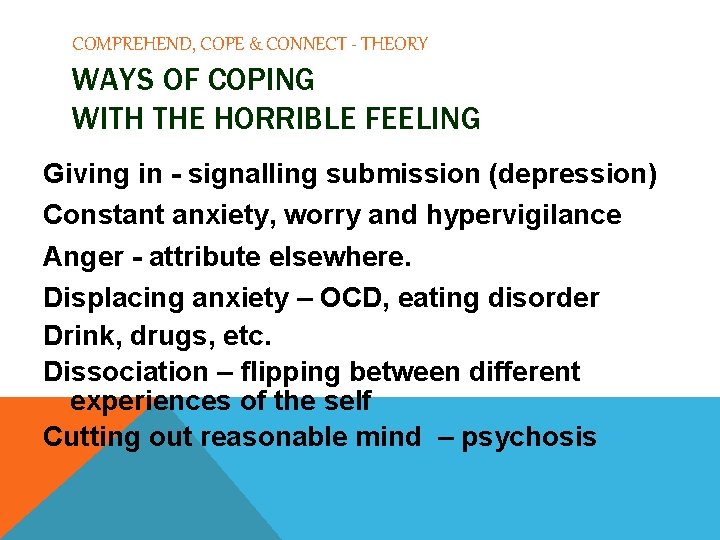
COMPREHEND, COPE & CONNECT - THEORY WAYS OF COPING WITH THE HORRIBLE FEELING Giving in - signalling submission (depression) Constant anxiety, worry and hypervigilance Anger - attribute elsewhere. Displacing anxiety – OCD, eating disorder Drink, drugs, etc. Dissociation – flipping between different experiences of the self Cutting out reasonable mind – psychosis
COMPREHEND, COPE & CONNECT - THEORY THESE ARE COMMON WAYS OF COPING EARLY TRAUMA/ADVERSITY ADDS TO CURRENT DISTRESS – MAKING COPING MORE DIFFICULT THERE IS NO “THEM AND US” – “ONLY US”
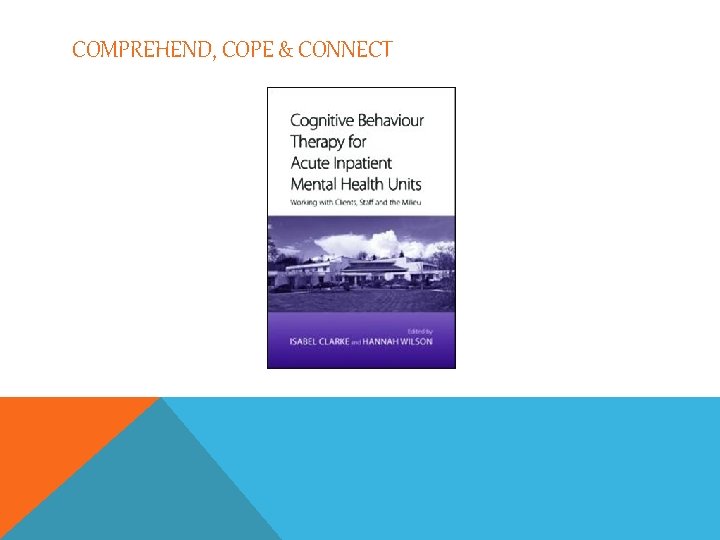
COMPREHEND, COPE & CONNECT THE PROGRAMME IN ACTION Piloted in one hospital in Hampshire: 2004 – 2012 (featured in the book: CBT for Inpatient Units – see next slide) Extended to all 4 Acute Services under the Southern Health Trust. in 2012. Some Southern Health community services. Surrey & Borders Partnership NHS Foundation Trust Sheffield Health and Social Care Foundation Trust NHS Lothian (Edinburgh) – all Acute. Huddersfield, Harrogate & Dewsbury Community and Acute. .
COMPREHEND, COPE & CONNECT
Comprehend, cope & connect Evaluating the Programme: Southern Health NHS Foundation Trust 3 papers • Quantitative – pre and post measures Published as Araci & Clarke 2016 • Qualitative – Staff perceptions of impact on individual, team work and milieu – in submission • Qualitative 2 – Service user experiences of the programme - In preparation.
COMPREHEND, COPE & CONNECT THE COMPREHEND, COPE AND CONNECT APPROACH IN IAPT has a ca. 50% Recovery rate – what about the other 50%? Southern Health’s italk audited this group and identified that they chracteristically present with: Past issues complicating current coping Long therapy history Relationship/attachment issues. This trans-diagnostic, formulation led, approach is being piloted in italk for those identified with these characteristics.
COMPREHEND, COPE & CONNECT IN ITALK 4 Sessions : Listening: formulation: goal setting 6 groups covering skills to break vicious circles identified in the formulation , on managing • arousal – up as well as down • attention – i. e. mindfulness • emotions – expression as part of management • Facing the past (without revisiting it) – building a healthy relationship with it • Positive anger work
COMPREHEND, COPE & CONNECT IN ITALK 6 groups on relationship • Relationship with self - self compassion • Developing the internal good friend – both the encouraging friend and the honest friend • Relationship s with others. • Balancing priorities • Putting self in others shoes while avoiding getting sucked in • Managing intimacy • Internal relationship with different parts of the self • Recognizing the value and downside of each • Developing a mindful centre
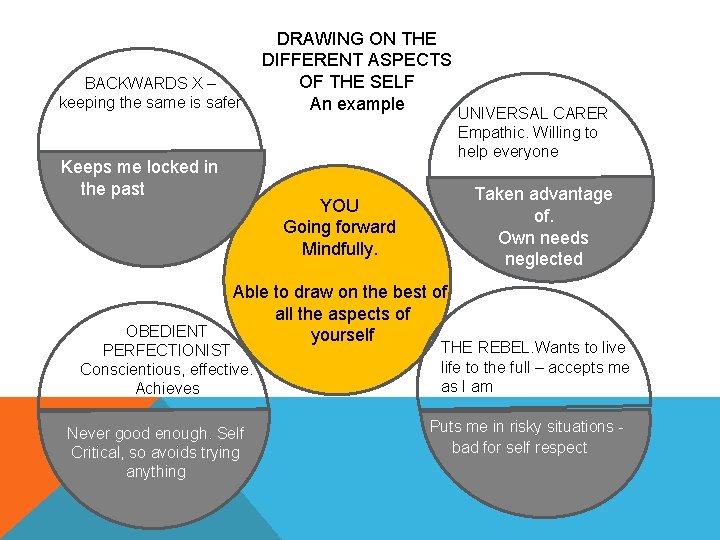
BACKWARDS X – keeping the same is safer DRAWING ON THE DIFFERENT ASPECTS OF THE SELF An example Keeps me locked in the past UNIVERSAL CARER Empathic. Willing to help everyone Taken advantage of. Own needs neglected YOU Going forward Mindfully. Able to draw on the best of all the aspects of yourself OBEDIENT PERFECTIONIST Conscientious, effective. Achieves Never good enough. Self Critical, so avoids trying anything THE REBEL. Wants to live life to the full – accepts me as I am Puts me in risky situations - bad for self respect
COMPREHEND, COPE & CONNECT IN ITALK Use of Mindfulness is used throughout as a tool to work on change. Important mindfulnesses: Of emotion – deconstructed as a physical event Of self compassion Of your strong centre Work in progress: 7 full programmes completed in 3 areas of Hampshire. 4 further programmes in preparation. 4 th area about to come on stream
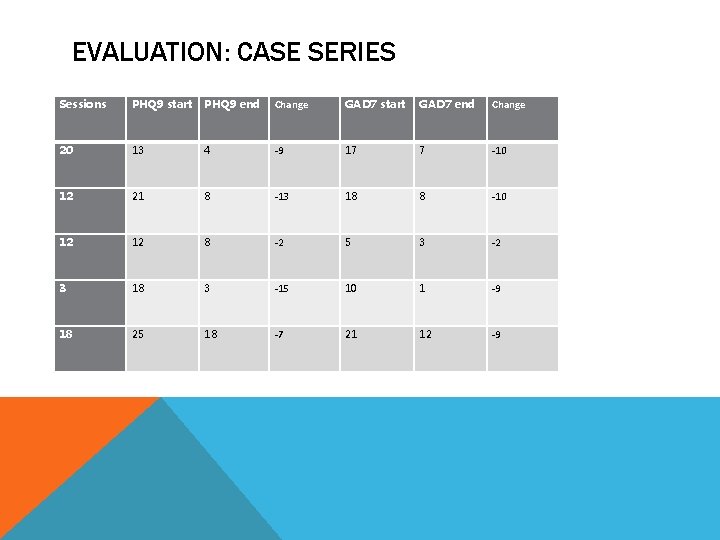
EVALUATION: CASE SERIES Sessions PHQ 9 start PHQ 9 end Change GAD 7 start GAD 7 end Change 20 13 4 -9 17 7 -10 12 21 8 -13 18 8 -10 12 12 8 -2 5 3 -2 3 18 3 -15 10 1 -9 18 25 18 -7 21 12 -9
COMPREHEND, COPE & CONNECT AND CULTURE FREE THERAPY A new initiative in the planning stages.
COMPREHEND, COPE & CONNECT CONTACT DETAILS, REFERENCES AND WEB ADDRESS Isabel. Clarke@southernhealth. nhs. uk David Araci & Isabel Clarke (2016): Investigating the efficacy of a whole team, psychologically informed, acute mental health service approach, Journal of Mental. Health, DOI: 10. 3109/09638237. 2016. 1139065 Clarke, I. & Wilson, H. Eds. (2008) Cognitive Behaviour Therapy for Acute Inpatient Mental Health Units; working with clients, staff and the milieu. London: Routledge. Durrant, C. , Clarke, I. , Tolland, A. & Wilson, H. (2007) Designing a CBT Service for an Acute In-patient Setting: A pilot evaluation study. Clinical Psychology and Psychotherapy. 14, 117 -125. www. isabelclarke. org
- Slides: 24