
Comprehend Cope and Connect engaging the individual from



- Slides: 18
Comprehend, Cope and Connect; engaging the individual from where they are – across diagnostic boundaries and cultures. Isabel Clarke Consultant Clinical Psychologist
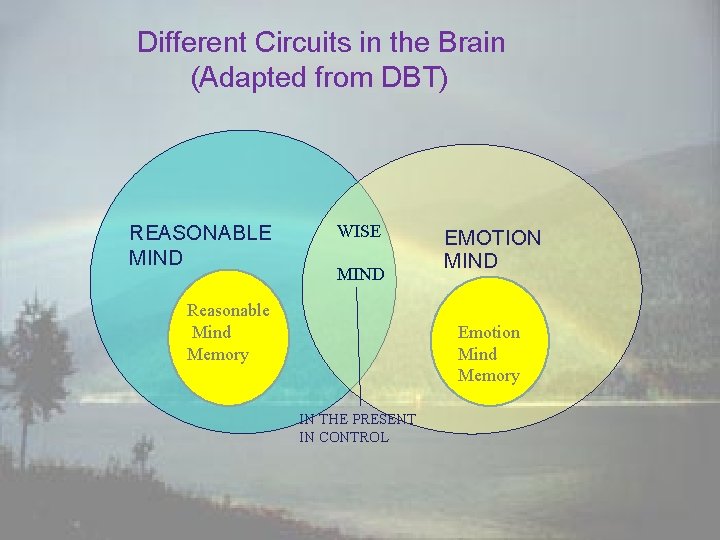
Different Circuits in the Brain (Adapted from DBT) REASONABLE MIND WISE MIND Reasonable Mind Memory EMOTION MIND Emotion Mind Memory IN THE PRESENT IN CONTROL
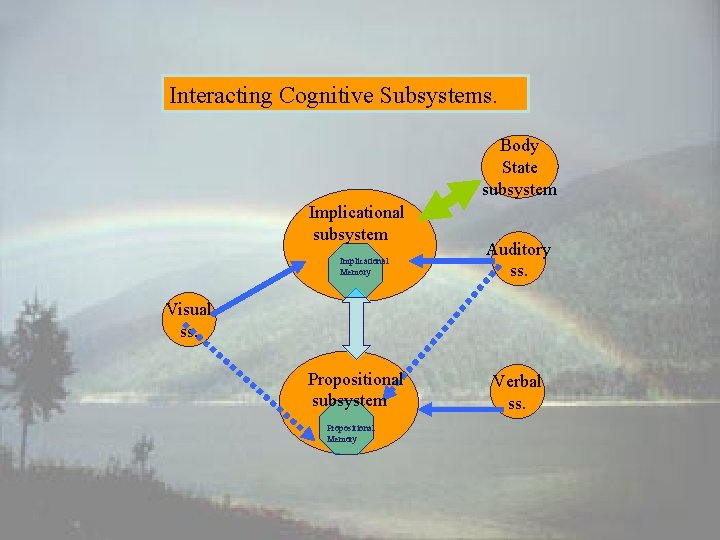
Interacting Cognitive Subsystems. Body State subsystem Implicational Memory Auditory ss. Visual ss. Propositional subsystem Propositional Memory Verbal ss.
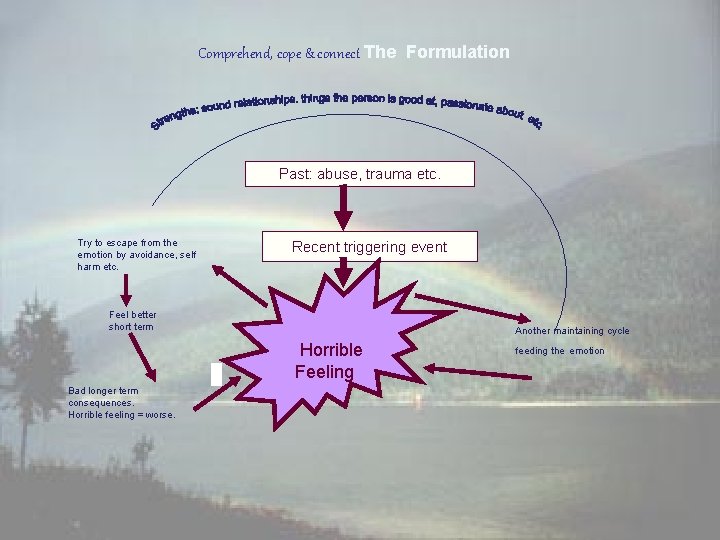
Comprehend, cope & connect The Formulation Past: abuse, trauma etc. Try to escape from the emotion by avoidance, self harm etc. Recent triggering event Feel better short term Another maintaining cycle Horrible Feeling Bad longer term consequences. Horrible feeling = worse. feeding the emotion
A Challenging Model of the Mind • The human being is a balancing act as the two organising systems pass control back and forth: there is no boss. • The mind is simultaneously individual, and reaches beyond the individual, when the implicational ss. is dominant. • This constant switch between logic and emotion gives us human fallibility and 2 distinct ways of knowing • The self sufficient, billiard ball, mind is an illusion • In our implicational/relational mode we are a part of the whole – and the nature of our experience changes.
THE RATIONALITY ASSUMPTION
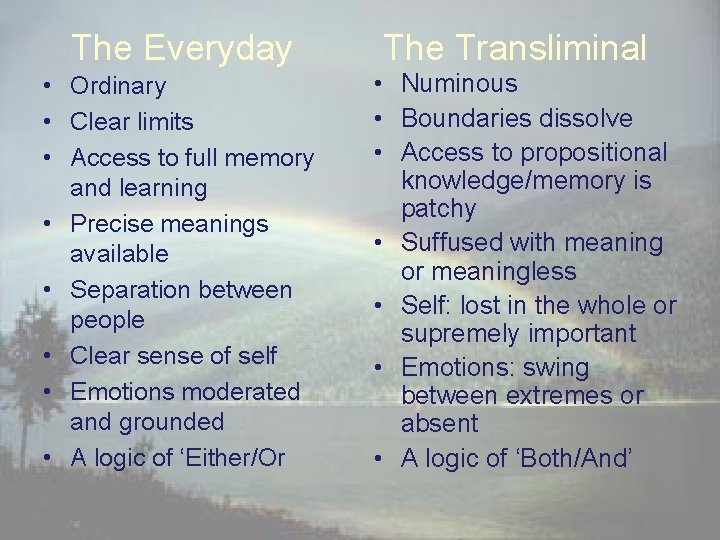
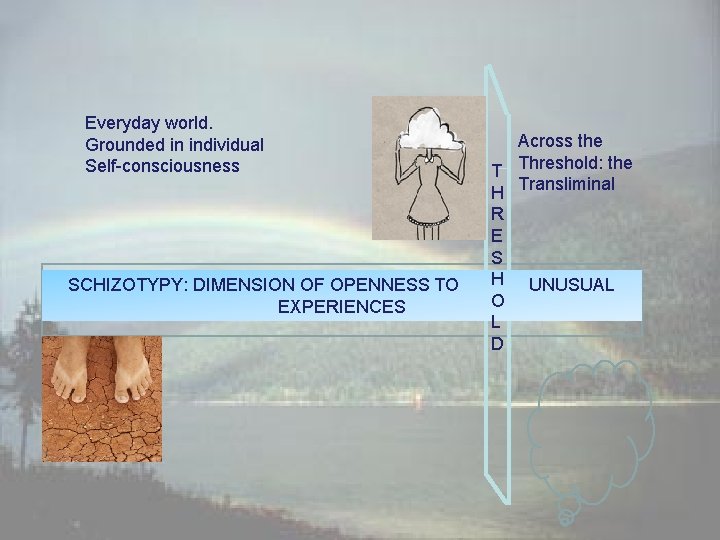
Two Ways of Knowing • Good everyday functioning = good communication between implicational/relational and propositional • At high and at low arousal, the implicational ss becomes dominant • This gives us the different quality of experience – the transliminal • More often, the two are working together, adding something to ordinary experience – e. g. where we get that sense of the sacred, the supernatural.
Two Ways of Knowing – Introducing the Transliminal The breeze at dawn has secrets to tell you. Don’t go back to sleep. You must ask for what you really want. Don’t go back to sleep. People are going back and forth across the doorsill Where the two worlds touch. The door is round and open. Don’t go back to sleep. Rumi, translated by John Moyne & Coleman Barks in ‘Open Secret’ (Threshold books).
THE BILLIARD BALL MIND ASSUMPTION
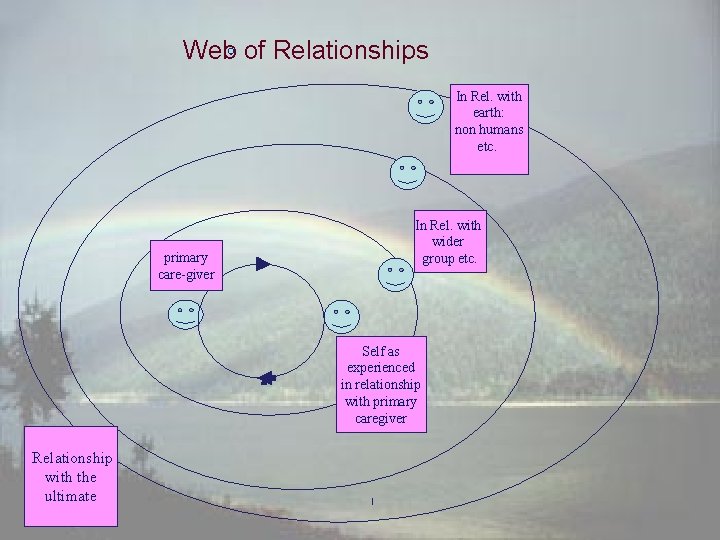
Web of Relationships In Rel. with earth: non humans etc. primary care-giver In Rel. with wider group etc. Self as experienced in relationship with primary caregiver Relationship with the ultimate
The Everyday • Ordinary • Clear limits • Access to full memory and learning • Precise meanings available • Separation between people • Clear sense of self • Emotions moderated and grounded • A logic of ‘Either/Or The Transliminal • Numinous • Boundaries dissolve • Access to propositional knowledge/memory is patchy • Suffused with meaning or meaningless • Self: lost in the whole or supremely important • Emotions: swing between extremes or absent • A logic of ‘Both/And’
Everyday world. Grounded in individual Self-consciousness SCHIZOTYPY: DIMENSION OF OPENNESS TO EXPERIENCES Across the T Threshold: the H Transliminal R E S H UNUSUAL O L D
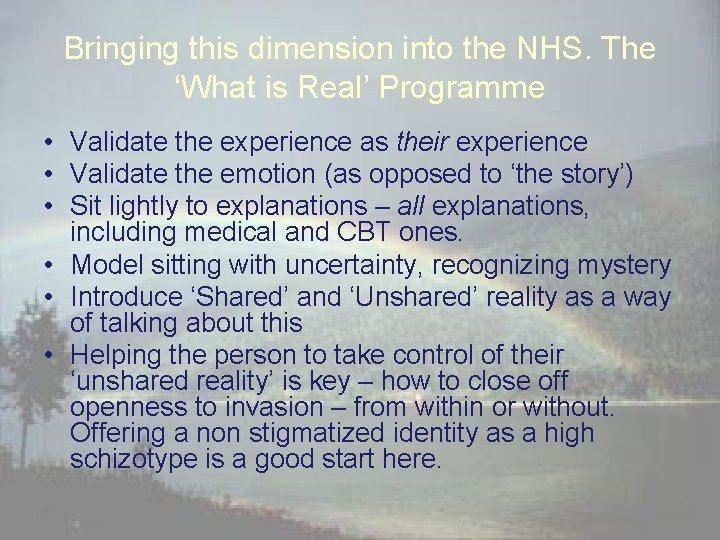
Bringing this dimension into the NHS. The ‘What is Real’ Programme • Validate the experience as their experience • Validate the emotion (as opposed to ‘the story’) • Sit lightly to explanations – all explanations, including medical and CBT ones. • Model sitting with uncertainty, recognizing mystery • Introduce ‘Shared’ and ‘Unshared’ reality as a way of talking about this • Helping the person to take control of their ‘unshared reality’ is key – how to close off openness to invasion – from within or without. Offering a non stigmatized identity as a high schizotype is a good start here.
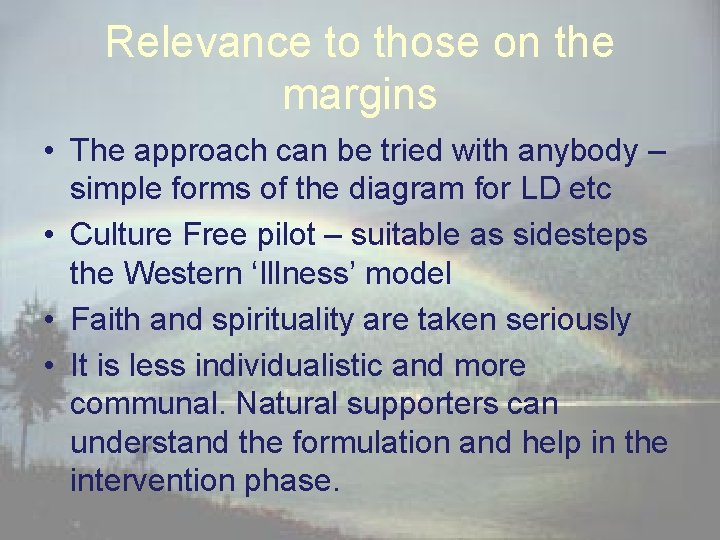
Relevance to those on the margins • The approach can be tried with anybody – simple forms of the diagram for LD etc • Culture Free pilot – suitable as sidesteps the Western ‘Illness’ model • Faith and spirituality are taken seriously • It is less individualistic and more communal. Natural supporters can understand the formulation and help in the intervention phase.
The Spiritual Crisis Network – offering an alternative • 2005 Founded at the second of the Revisioning Mental Health conferences organized by Catherine Lucas. • Legal framework set up: Moving from Company limited by guarantee towards Charity status. • Website and email response system – with training. • Spreading awareness of an alternative viewpoint
CCC • Embedded and evaluated widely in Acute services and some CMHTs. See Araci & Clarke 2017. • Complexity in IAPT – programme designed for those failing to recover with the prescribed therapies. • 4 sessions of individual formulation, 12 week skills group and individual review. • Evaluation paper in preparation, showing that individuals who failed to make progress with previous CBT responded to CCC. • Culture Free version. Taken up by the Culturally Adapted CBT group. Paper in prep. • Pilot to test the manual. 2 therapists, 32 cases. • Promising results. Over 90% retention. • Both studies presented on posters at BABCP
Contact details, References and Web addresses • isabel@scispirit. com • Isabel. Clarke@southernhealth. nhs. uk • Araci, D. & Clarke, I. (2017): Investigating the efficacy of a whole team, psychologically informed, acute mental health service approach, Journal of Mental Health Journal. 26, 307 -311. • Clarke, I. & Nicholls, H. (2018) Third Wave CBT Integration for Individuals and Teams: Comprehend, Cope and Connect. Routledge. • Clarke, I. (2016) How to deal with anger. A 5 -step, CBT-based plan for managing anger and overcoming frustration. John Murray Learning • Clarke, I. (Ed. ) (2010) Psychosis and Spirituality: consolidating the new paradigm. Chichester: Wiley • Clarke, I. ( 2008) Madness, Mystery and the Survival of God. Winchester: 'O'Books. • Clarke, I. & Wilson, H. Eds. (2008) Cognitive Behaviour Therapy for Acute Inpatient Mental Health Units; working with clients, staff and the milieu. London: Routledge. www. isabelclarke. org