
Compounds Unit 2 Topic 2 Chemical Formula l
- Slides: 11
Compounds Unit 2 Topic 2
Chemical Formula l A chemical formula represents the number of each type of element bonded together in a compound. l The number of capital letters indicates how many types of elements are present (each element has only one capital letter).
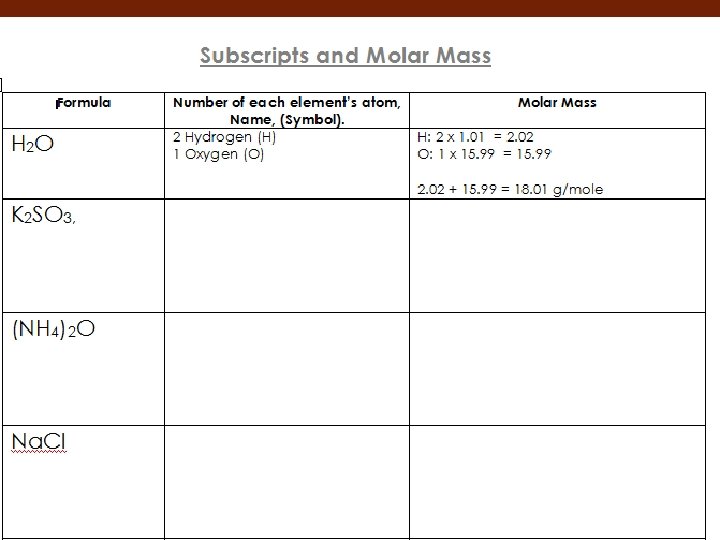
Subscripts l A subscript directly after an element’s symbol indicates how many of that element there is in the compound (if there is no subscript then there is only one of that element). • H 2 O Subscript indicates 2 Hydrogen atoms
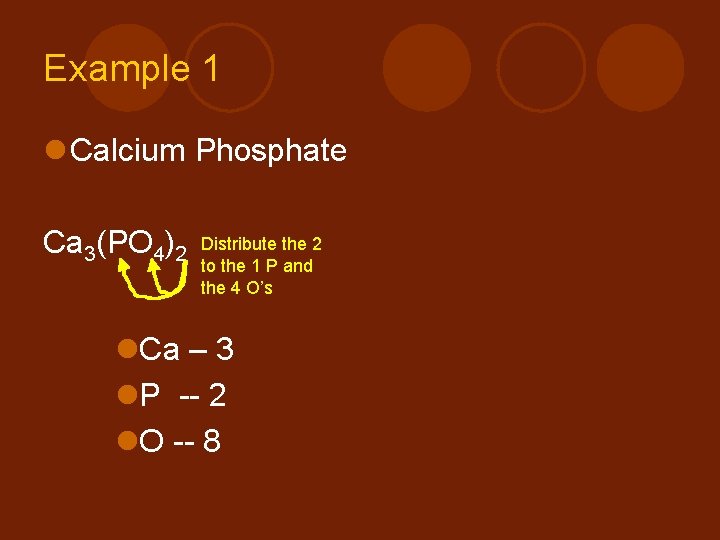
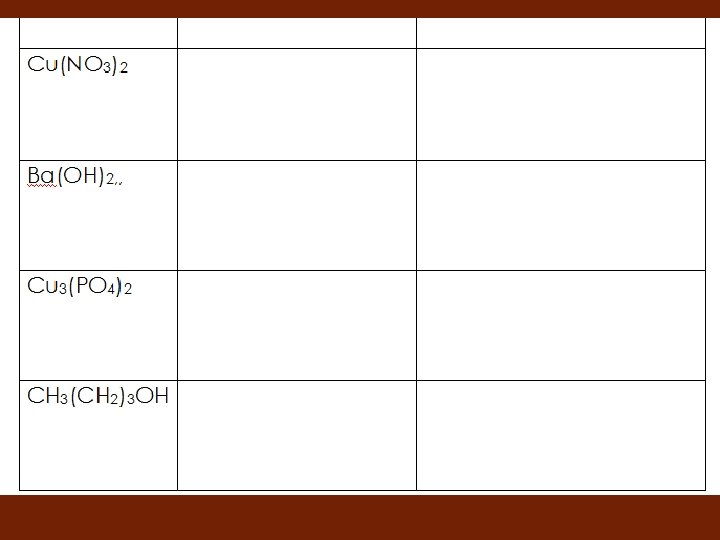
Symbol l If the symbol of a compound contains parentheses, then the subscript outside the parentheses is multiplied by each element inside the parentheses. l This information is used to determine the number of each type of element in the compound. You will need to be able to do this proficiently before you learn how to add up molecular masses.
Example 1 l Calcium Phosphate Ca 3(PO 4)2 Distribute the 2 to the 1 P and the 4 O’s l. Ca – 3 l. P -- 2 l. O -- 8
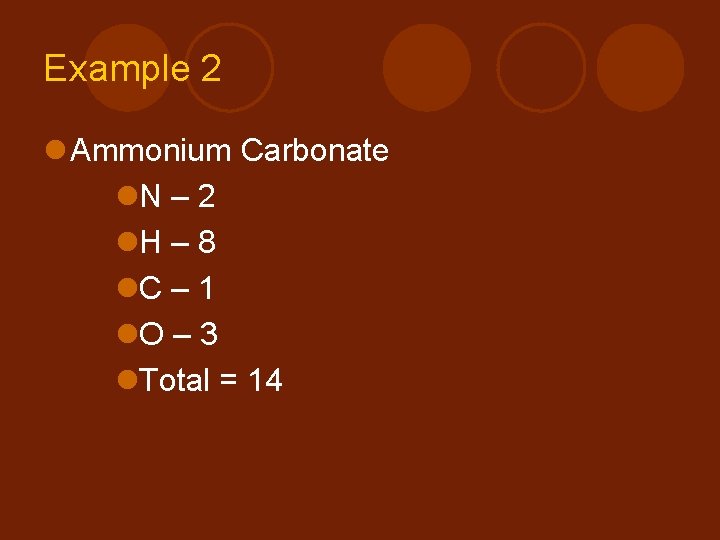
Example 2 l Ammonium Carbonate l. N – 2 l. H – 8 l. C – 1 l. O – 3 l. Total = 14
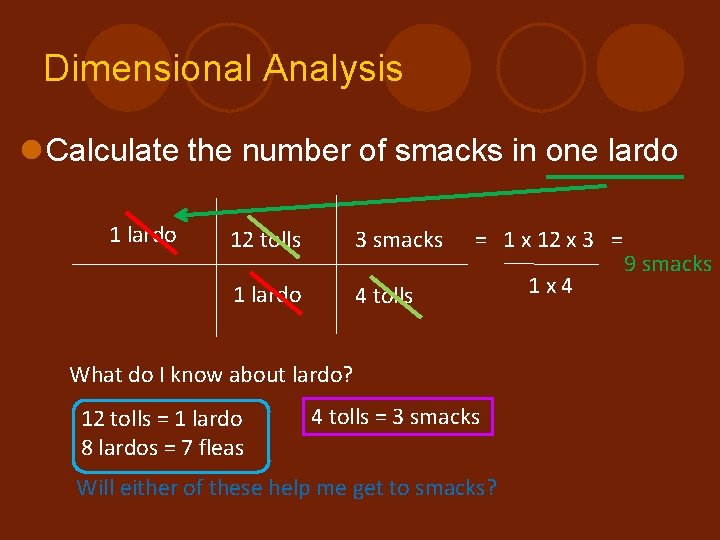
Dimensional Analysis l Calculate the number of smacks in one lardo 12 tolls 3 smacks 1 lardo 4 tolls = 1 x 12 x 3 = What do I know about lardo? 12 tolls = 1 lardo 8 lardos = 7 fleas 4 tolls = 3 smacks Will either of these help me get to smacks? 1 x 4 9 smacks
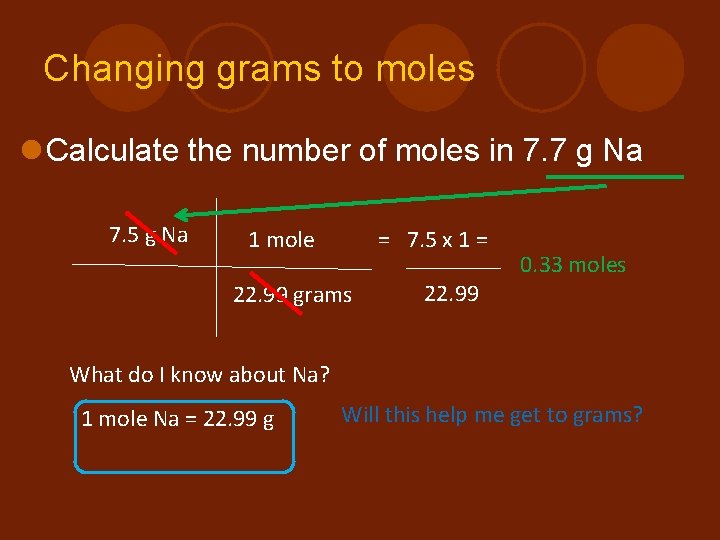
Changing grams to moles l Calculate the number of moles in 7. 7 g Na 7. 5 g Na 1 mole = 7. 5 x 1 = 22. 99 grams 22. 99 0. 33 moles What do I know about Na? 1 mole Na = 22. 99 g Will this help me get to grams?