
Compounds are two or more elements that are
- Slides: 33
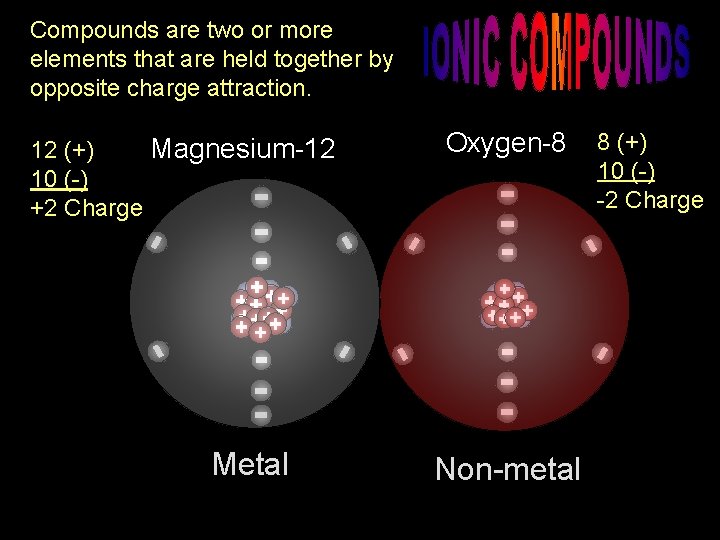
Compounds are two or more elements that are held together by opposite charge attraction. Magnesium-12 12 (+) 10 (-) +2 Charge Metal Oxygen-8 Non-metal 8 (+) 10 (-) -2 Charge
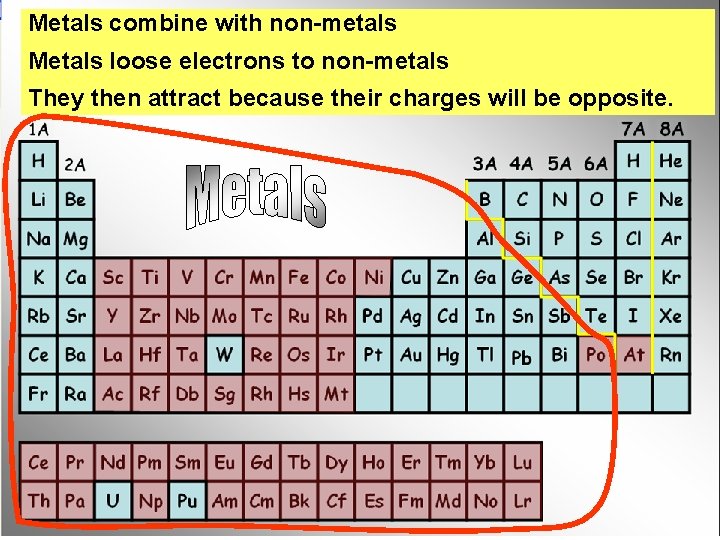
Metals combine with non-metals Metals loose electrons to non-metals They then attract because their charges will be opposite.
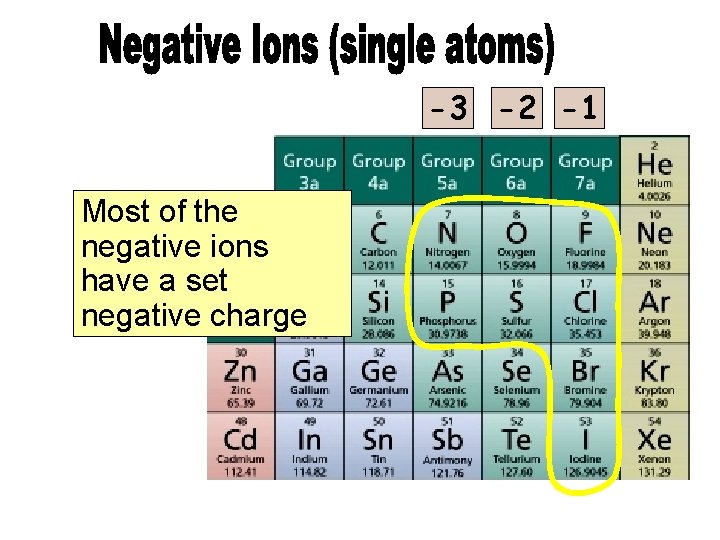
-3 -2 -1 Most of the negative ions have a set negative charge
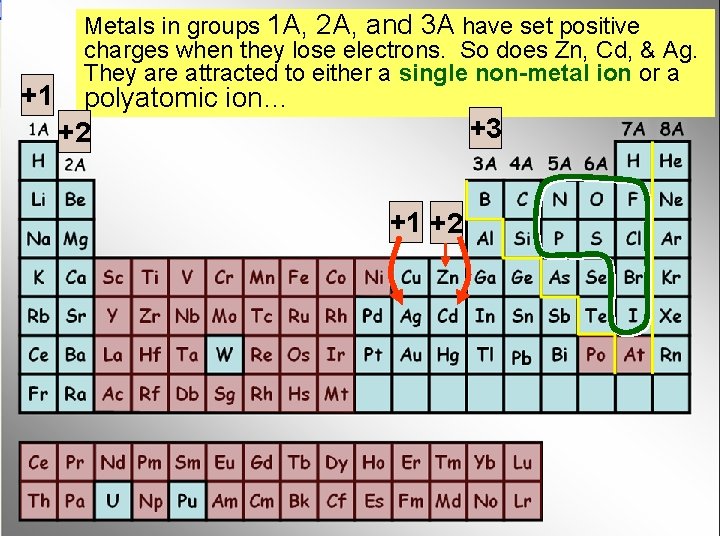
+1 Metals in groups 1 A, 2 A, and 3 A have set positive charges when they lose electrons. So does Zn, Cd, & Ag. They are attracted to either a single non-metal ion or a polyatomic ion… +2 +3 +1 +2
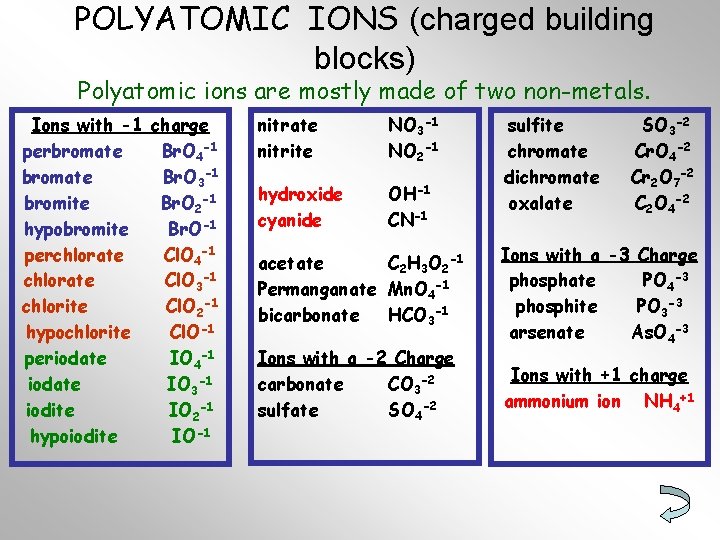
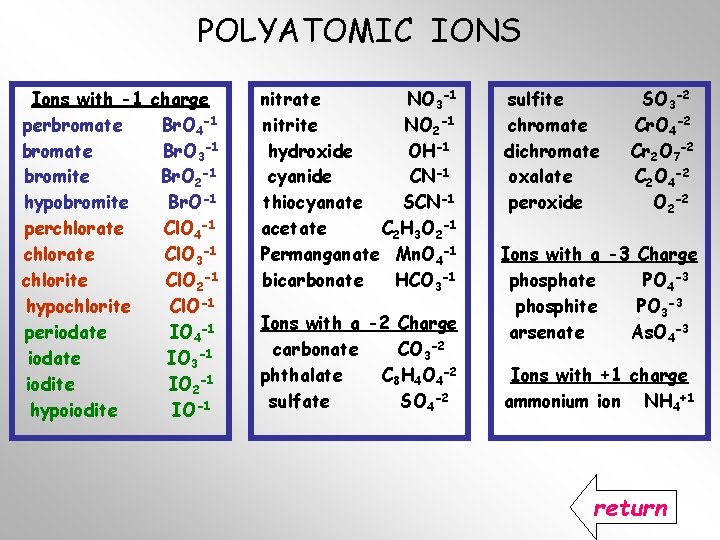
POLYATOMIC IONS (charged building blocks) Polyatomic ions are mostly made of two non-metals. Ions with -1 charge perbromate Br. O 4 -1 bromate Br. O 3 -1 bromite Br. O 2 -1 hypobromite Br. O-1 perchlorate Cl. O 4 -1 chlorate Cl. O 3 -1 chlorite Cl. O 2 -1 hypochlorite Cl. O-1 periodate IO 4 -1 iodate IO 3 -1 iodite IO 2 -1 hypoiodite IO-1 nitrate nitrite NO 3 -1 NO 2 -1 hydroxide cyanide OH-1 CN-1 acetate C 2 H 3 O 2 -1 Permanganate Mn. O 4 -1 bicarbonate HCO 3 -1 Ions with a -2 Charge carbonate CO 3 -2 sulfate SO 4 -2 sulfite chromate dichromate oxalate SO 3 -2 Cr. O 4 -2 Cr 2 O 7 -2 C 2 O 4 -2 Ions with a -3 Charge phosphate PO 4 -3 phosphite PO 3 -3 arsenate As. O 4 -3 Ions with +1 charge ammonium ion NH 4+1
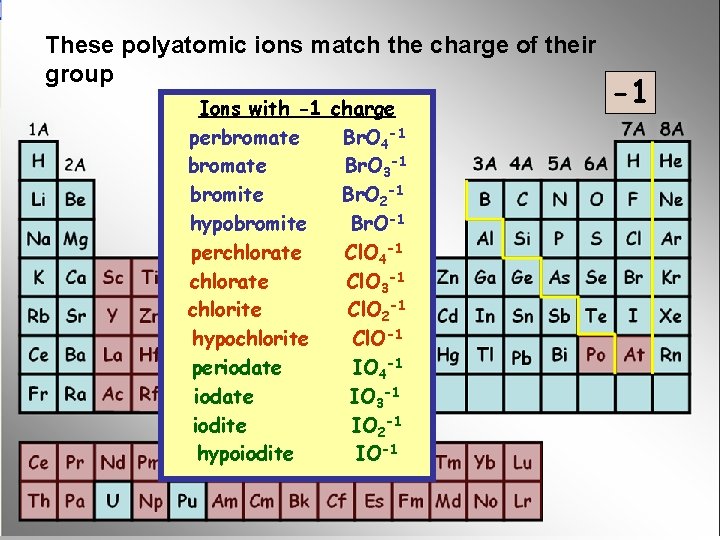
These polyatomic ions match the charge of their group Ions with -1 charge perbromate Br. O 4 -1 bromate Br. O 3 -1 bromite Br. O 2 -1 hypobromite Br. O-1 perchlorate Cl. O 4 -1 chlorate Cl. O 3 -1 chlorite Cl. O 2 -1 hypochlorite Cl. O-1 periodate IO 4 -1 iodate IO 3 -1 iodite IO 2 -1 hypoiodite IO-1 -1
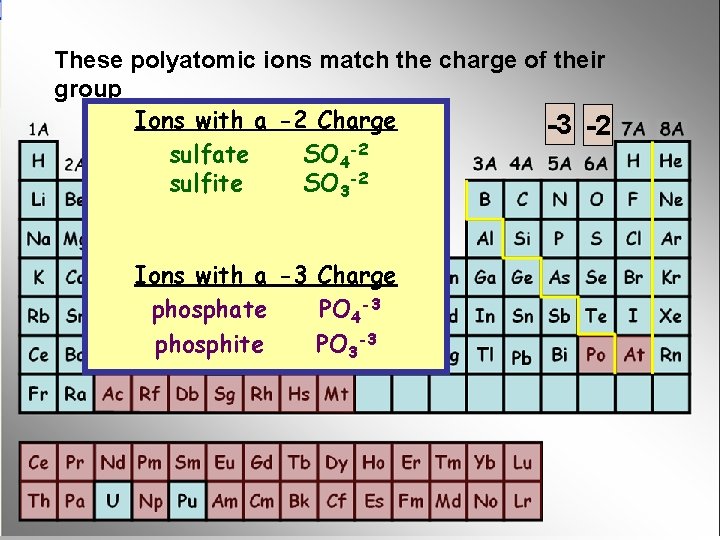
These polyatomic ions match the charge of their group Ions with a -2 Charge -3 -2 sulfate SO 4 -2 sulfite SO 3 -2 Ions with a -3 Charge phosphate PO 4 -3 phosphite PO 3 -3
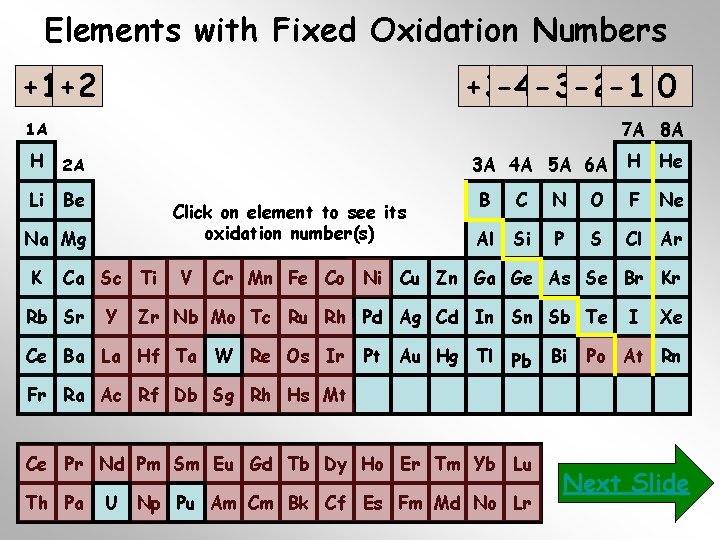
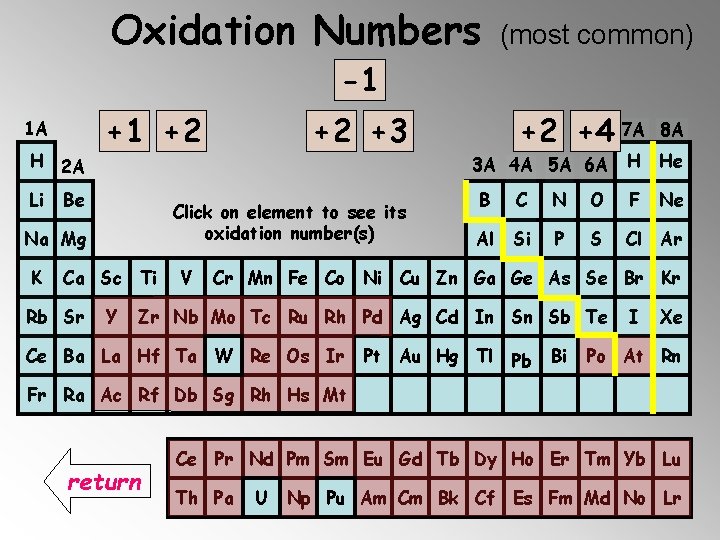
It is also important to memorize the oxidation of the ions that have fixed oxidation numbers (positive or negative). In particular, those from groups 1 A, 2 A, 3 A, 4 A, 5 A, 6 A, 7 A, 8 A and the elements: Zn, Cd and Ag. Use the following periodic chart to determine their oxidation numbers. Just click on the element symbol…
Elements with Fixed Oxidation Numbers +1+2 +3 -4 -3 -2 -1 0 7 A 8 A 1 A H 2 A Li Be 3 A 4 A 5 A 6 A Click on element to see its oxidation number(s) Na Mg K Ca Sc Ti Rb Sr Y V H He B C N O F Ne Al Si P S Cl Ar Cr Mn Fe Co Ni Cu Zn Ga Ge As Se Br Kr Zr Nb Mo Tc Ru Rh Pd Ag Cd In Sn Sb Te Ce Ba La Hf Ta W Re Os Ir Pt Au Hg Tl Pb Bi I Xe Po At Rn Fr Ra Ac Rf Db Sg Rh Hs Mt Ce Pr Nd Pm Sm Eu Gd Tb Dy Ho Er Tm Yb Lu Th Pa U Np Pu Am Cm Bk Cf Es Fm Md No Lr Next Slide
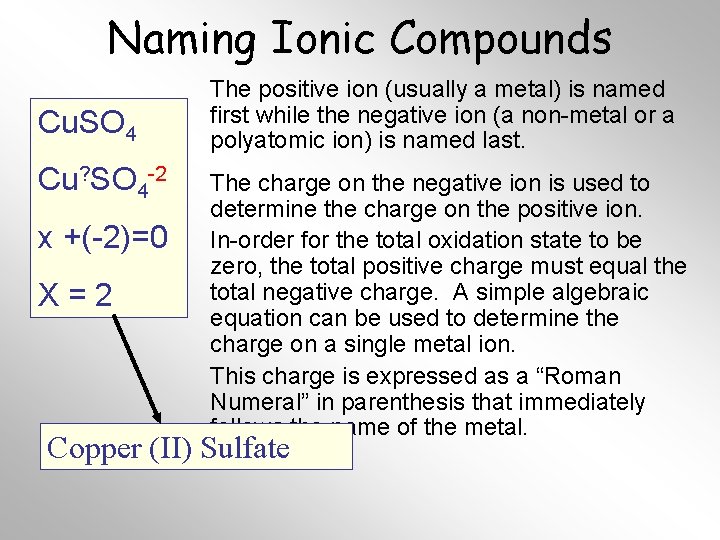
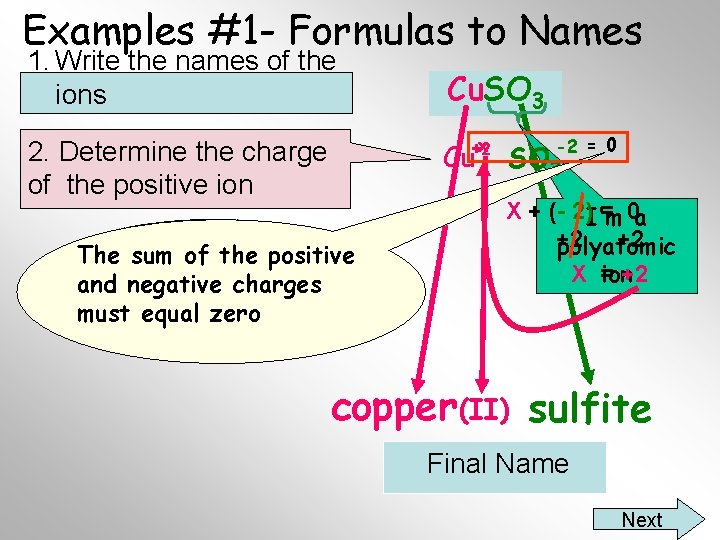
Naming Ionic Compounds Cu. SO 4 Cu? SO 4 -2 x +(-2)=0 X=2 The positive ion (usually a metal) is named first while the negative ion (a non-metal or a polyatomic ion) is named last. The charge on the negative ion is used to determine the charge on the positive ion. In-order for the total oxidation state to be zero, the total positive charge must equal the total negative charge. A simple algebraic equation can be used to determine the charge on a single metal ion. This charge is expressed as a “Roman Numeral” in parenthesis that immediately follows the name of the metal. Copper (II) Sulfate
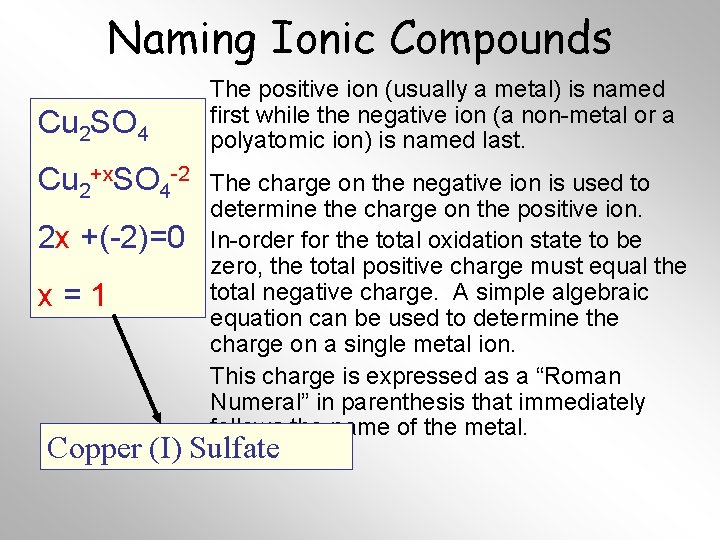
Naming Ionic Compounds Cu 2 SO 4 Cu 2+x. SO 4 -2 2 x +(-2)=0 x=1 The positive ion (usually a metal) is named first while the negative ion (a non-metal or a polyatomic ion) is named last. The charge on the negative ion is used to determine the charge on the positive ion. In-order for the total oxidation state to be zero, the total positive charge must equal the total negative charge. A simple algebraic equation can be used to determine the charge on a single metal ion. This charge is expressed as a “Roman Numeral” in parenthesis that immediately follows the name of the metal. Copper (I) Sulfate
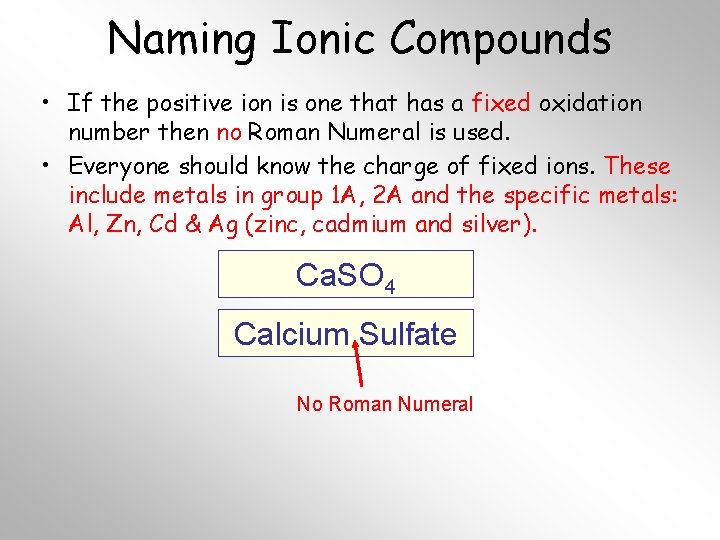
Naming Ionic Compounds • If the positive ion is one that has a fixed oxidation number then no Roman Numeral is used. • Everyone should know the charge of fixed ions. These include metals in group 1 A, 2 A and the specific metals: Al, Zn, Cd & Ag (zinc, cadmium and silver). Ca. SO 4 Calcium Sulfate No Roman Numeral
Examples #1 - Formulas to Names 1. Write the names of the ions Cu. SO 3 x +2 2. Determine the charge of the positive ion Cu The the positive You sum mustofknow the and negative charges charge on the sulfite must ion isequal -2 zero -2 = 0 SO 3 X + (- 2)I’m = 0 a +2 +2 polyatomic X = +2 ion copper (II) sulfite Final Name Next
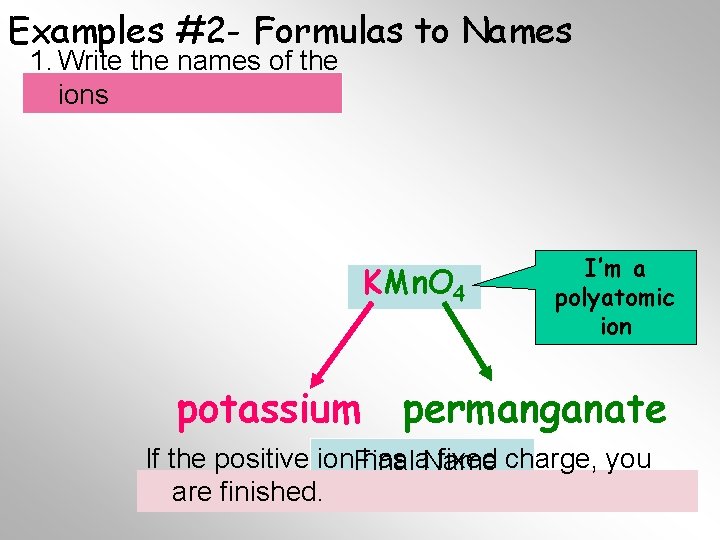
Examples #2 - Formulas to Names 1. Write the names of the ions KMn. O 4 potassium I’m a polyatomic ion permanganate If the positive ion. Final has a. Name fixed charge, you are finished.
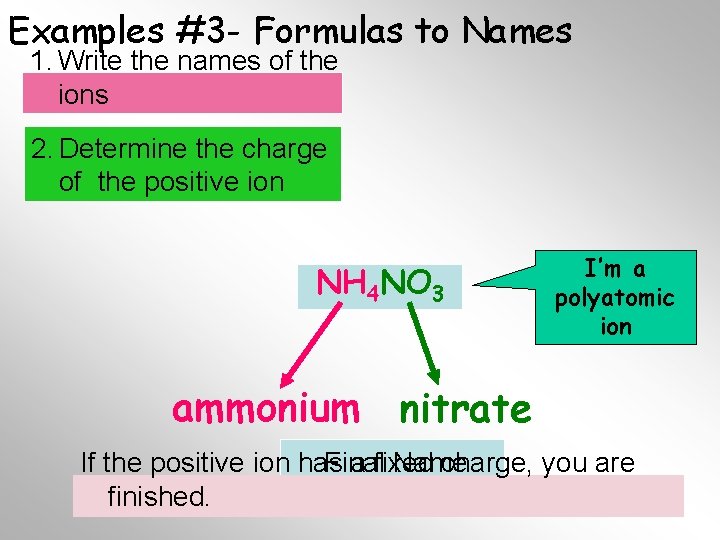
Examples #3 - Formulas to Names 1. Write the names of the ions 2. Determine the charge of the positive ion NH 4 NO 3 I’m a polyatomic ion ammonium nitrate Final Name If the positive ion has a fixed charge, you are finished.
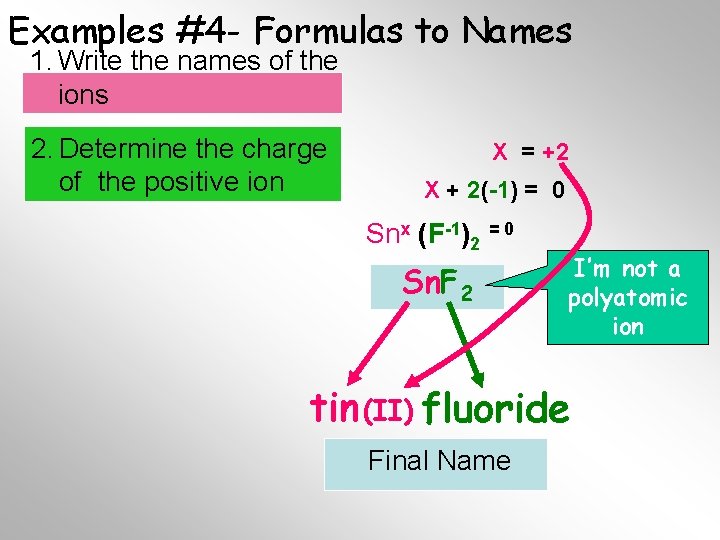
Examples #4 - Formulas to Names 1. Write the names of the ions 2. Determine the charge of the positive ion X = +2 X + 2(-1) = 0 Snx (F-1)2 = 0 Sn. F 2 I’m not a polyatomic ion tin (II) fluoride Final Name
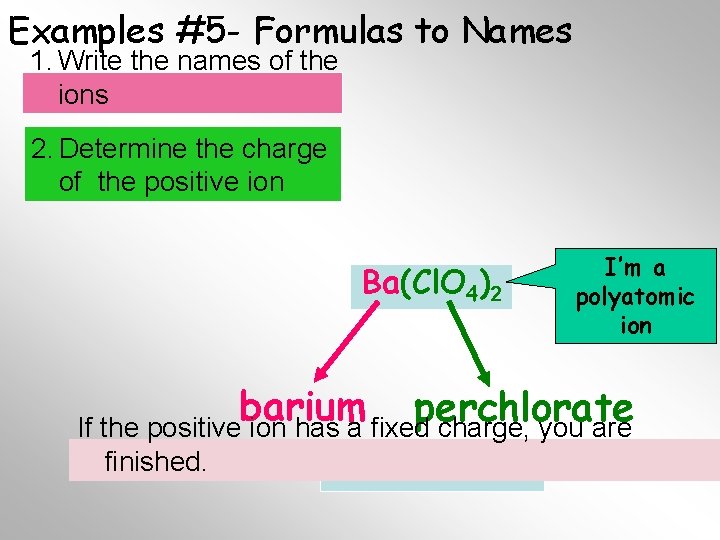
Examples #5 - Formulas to Names 1. Write the names of the ions 2. Determine the charge of the positive ion Ba(Cl. O 4)2 I’m a polyatomic ion barium perchlorate If the positive ion has a fixed charge, you are finished. Final Name
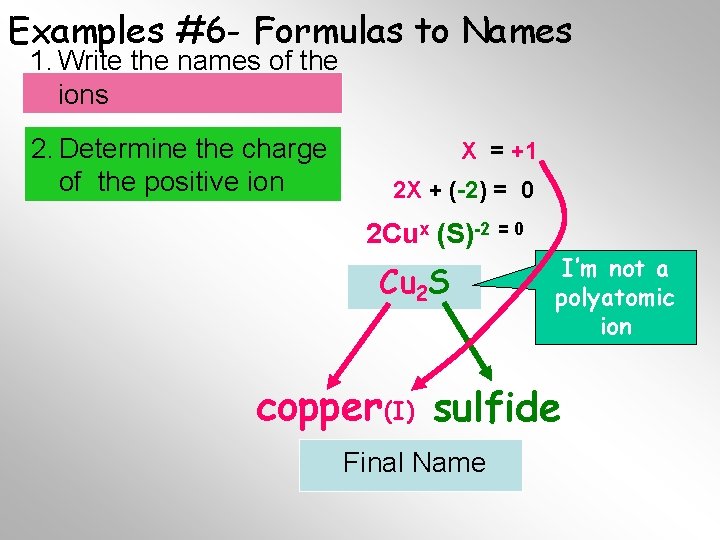
Examples #6 - Formulas to Names 1. Write the names of the ions 2. Determine the charge of the positive ion X = +1 2 X + (-2) = 0 2 Cux (S)-2 = 0 Cu 2 S I’m not a polyatomic ion copper (I) sulfide Final Name
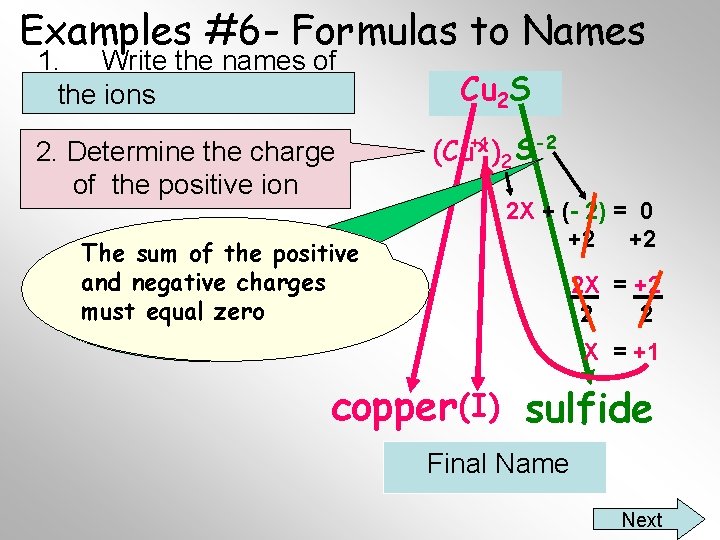
Examples #6 - Formulas to Names 1. Write the names of the ions 2. Determine the charge of the positive ion The the positive You sum mustofknow and negative charges charge on the sulfide must ion isequal -2 zero Cu 2 S (Cu+1 x )2 S -2 2 X + (- 2) = 0 +2 +2 2 X = +2 2 2 X = +1 copper (I) sulfide Final Name Next
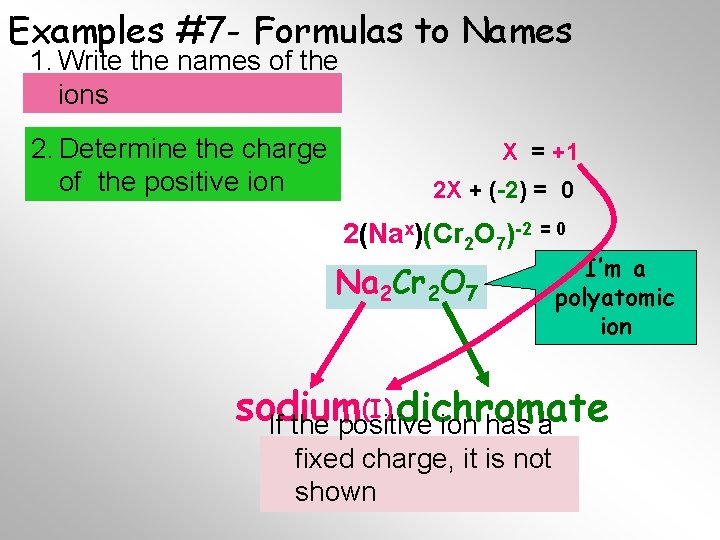
Examples #7 - Formulas to Names 1. Write the names of the ions 2. Determine the charge of the positive ion X = +1 2 X + (-2) = 0 2(Nax)(Cr 2 O 7)-2 = 0 Na 2 Cr 2 O 7 I’m a polyatomic ion (I) dichromate sodium If the positive ion has a fixed. Final charge, it is not Name shown
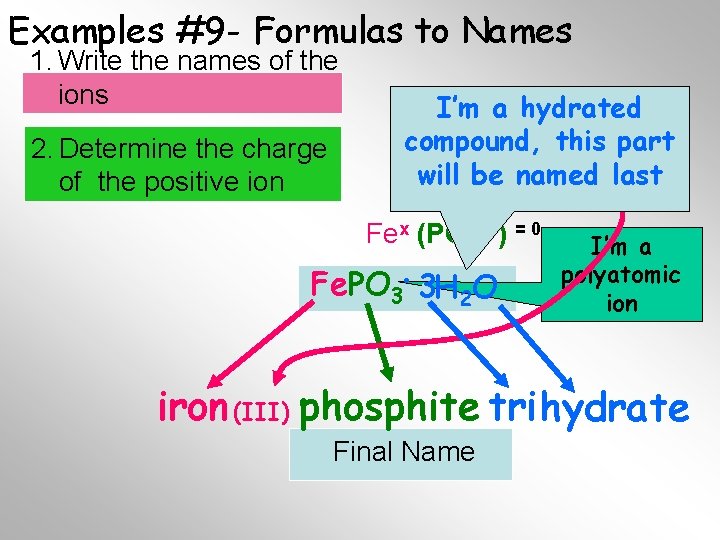
Examples #9 - Formulas to Names 1. Write the names of the ions 2. Determine the charge of the positive ion I’m a hydrated compound, X = +3 this part will be named last X + (-3) = 0 Fex (PO 3 -3) = 0 Fe. PO 3. . 3 H O 33 H 22 O I’m a polyatomic ion iron (III) phosphite tri hydrate Final Name
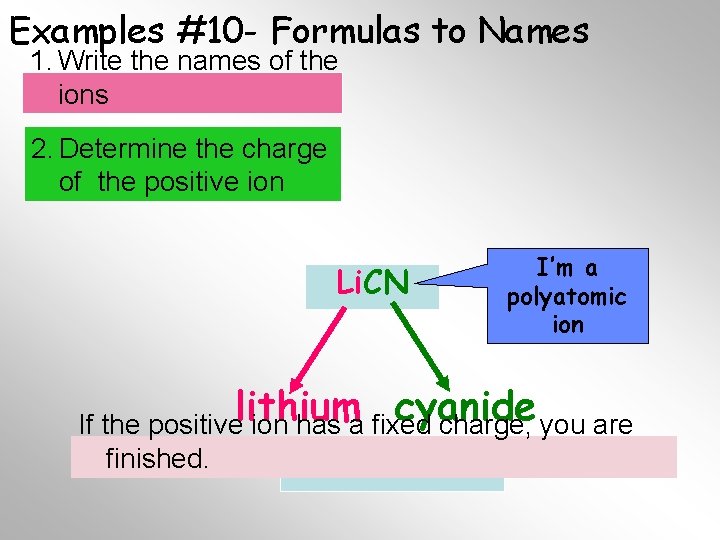
Examples #10 - Formulas to Names 1. Write the names of the ions 2. Determine the charge of the positive ion Li. CN I’m a polyatomic ion lithium cyanide If the positive ion has a fixed charge, you are finished. Final Name
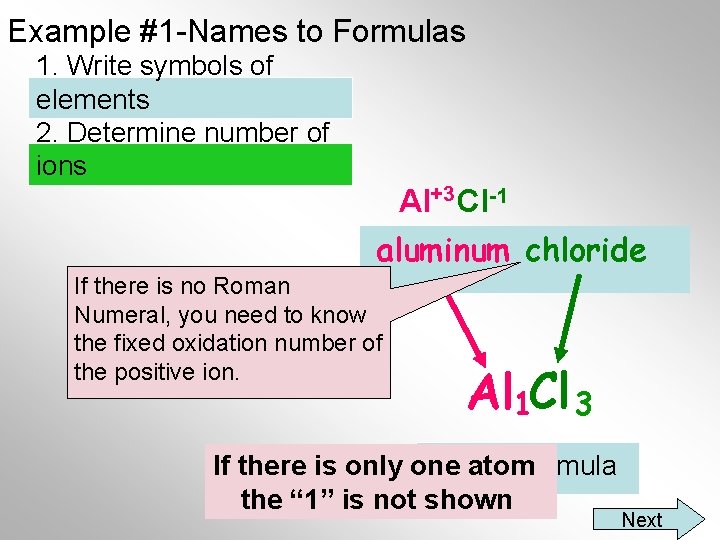
Writing Ionic Formulas • It is easier to write the formula of an ionic compound from its name than the reverse. • The oxidation number of the negative ion must be memorized in all cases. Refer to the table of polyatomic ions.
Example #1 -Names to Formulas 1. Write symbols of elements 2. Determine number of ions Al+3 Cl-1 aluminum chloride If there is no Roman Numeral, you need to know the fixed oxidation number of the positive ion. Al 1 Cl 3 Final Formula If there is only one atom the “ 1” is not shown Next
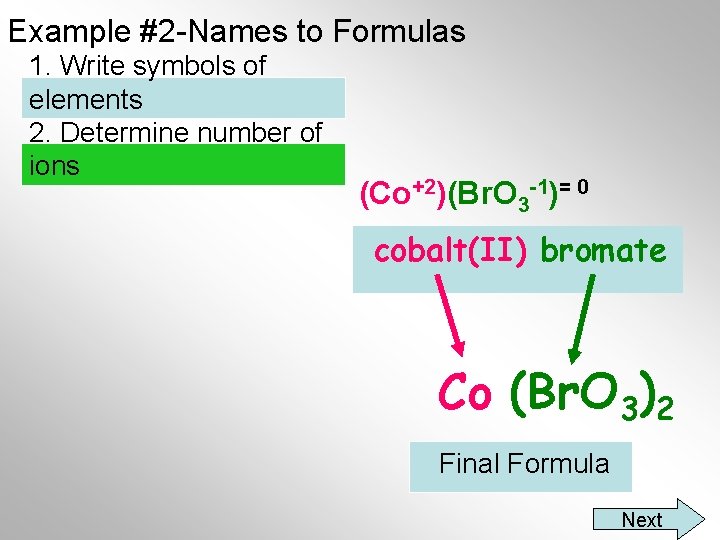
Example #2 -Names to Formulas 1. Write symbols of elements 2. Determine number of ions (Co+2)(Br. O 3 -1)= 0 cobalt(II) bromate Br. O 3)2 Co (Br. O Final Formula Next
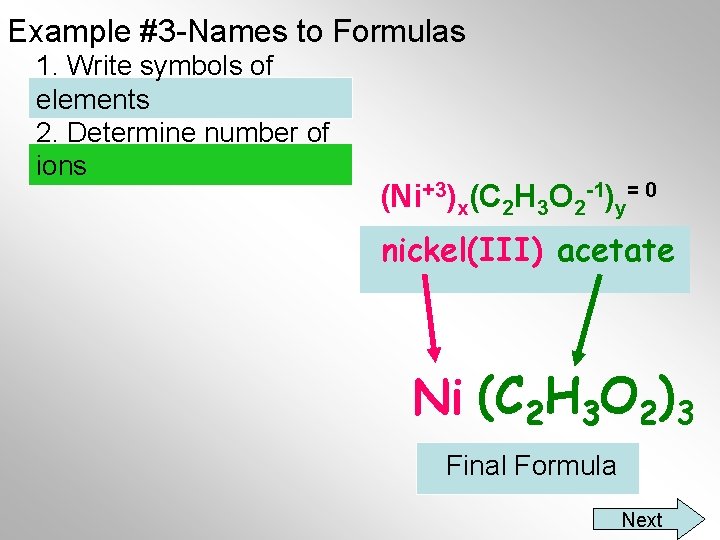
Example #3 -Names to Formulas 1. Write symbols of elements 2. Determine number of ions (Ni+3)x(C 2 H 3 O 2 -1)y= 0 nickel(III) acetate C 2 H 3 O 2)3 Ni (C Final Formula Next
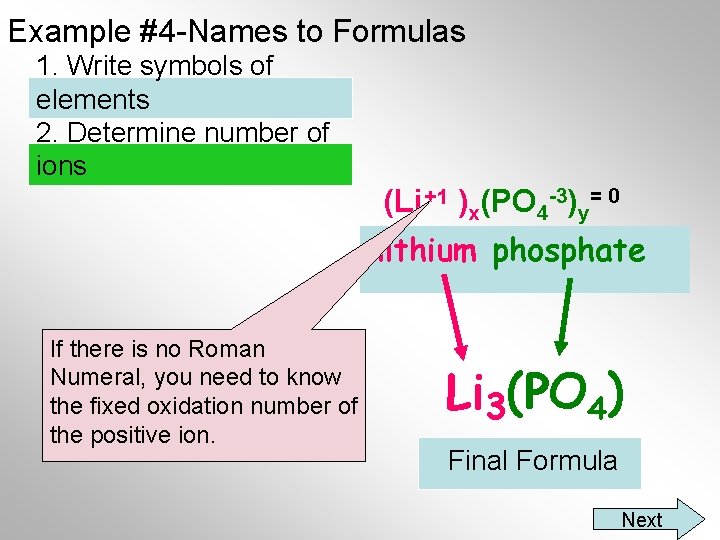
Example #4 -Names to Formulas 1. Write symbols of elements 2. Determine number of ions (Li +1 )x(PO 4 -3)y= 0 lithium phosphate If there is no Roman Numeral, you need to know the fixed oxidation number of the positive ion. PO 4) Li 3(PO Final Formula Next
Practice Problems By now you should have an idea of what is expected when naming covalent binary compounds using prefixes. In order to master this naming system you need to practice until you feel proficient in naming compounds using prefixes.
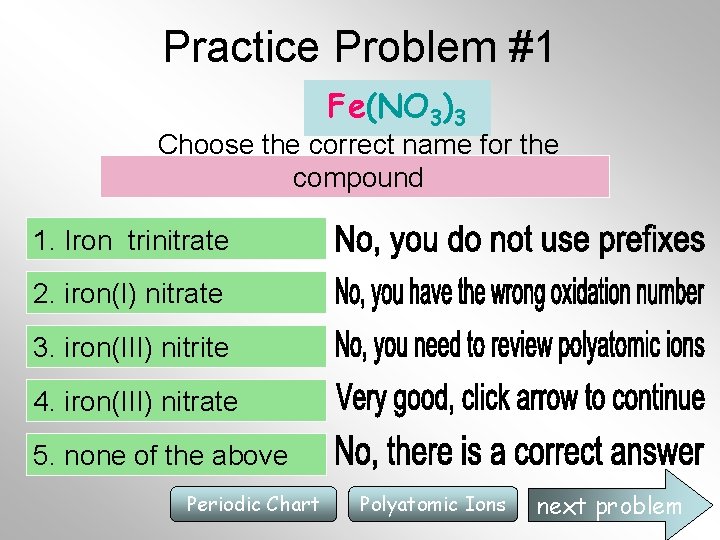
Practice Problem #1 Fe(NO 3)3 Choose the correct name for the compound 1. Iron trinitrate 2. iron(I) nitrate 3. iron(III) nitrite 4. iron(III) nitrate 5. none of the above Periodic Chart Polyatomic Ions next problem
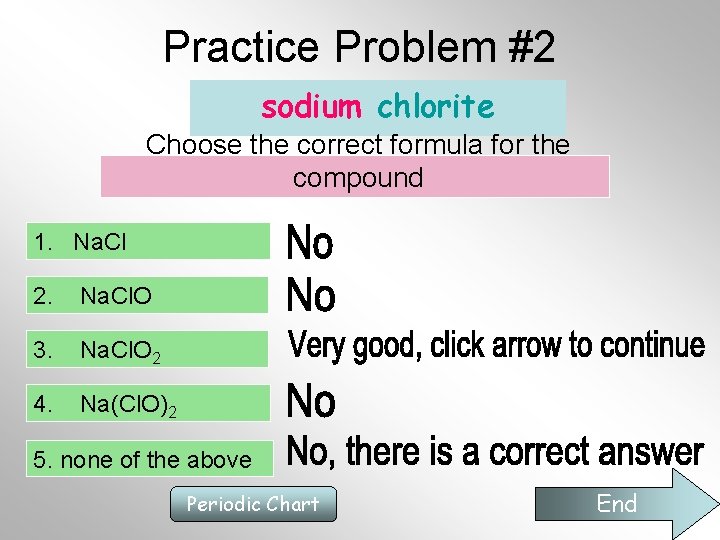
Practice Problem #2 sodium chlorite Choose the correct formula for the compound 1. Na. Cl 2. Na. Cl. O 3. Na. Cl. O 2 4. Na(Cl. O)2 5. none of the above Periodic Chart End
POLYATOMIC IONS Ions with -1 charge perbromate Br. O 4 -1 bromate Br. O 3 -1 bromite Br. O 2 -1 hypobromite Br. O-1 perchlorate Cl. O 4 -1 chlorate Cl. O 3 -1 chlorite Cl. O 2 -1 hypochlorite Cl. O-1 periodate IO 4 -1 iodate IO 3 -1 iodite IO 2 -1 hypoiodite IO-1 nitrate NO 3 -1 nitrite NO 2 -1 hydroxide OH-1 cyanide CN-1 thiocyanate SCN-1 acetate C 2 H 3 O 2 -1 Permanganate Mn. O 4 -1 bicarbonate HCO 3 -1 Ions with a -2 Charge carbonate CO 3 -2 phthalate C 8 H 4 O 4 -2 sulfate SO 4 -2 sulfite chromate dichromate oxalate peroxide SO 3 -2 Cr. O 4 -2 Cr 2 O 7 -2 C 2 O 4 -2 O 2 -2 Ions with a -3 Charge phosphate PO 4 -3 phosphite PO 3 -3 arsenate As. O 4 -3 Ions with +1 charge ammonium ion NH 4+1 return
Oxidation Numbers (most common) -2 -3 -4 +3 +2 +1 -1 0 1 A H 2 A Li +1 +2 Be Click on element to see its oxidation number(s) Na Mg K Ca Sc Ti Rb Sr +2 +3 Y V +2 +4 7 A 3 A 4 A 5 A 6 A 8 A H He B C N O F Ne Al Si P S Cl Ar Cr Mn Fe Co Ni Cu Zn Ga Ge As Se Br Kr Zr Nb Mo Tc Ru Rh Pd Ag Cd In Sn Sb Te Ce Ba La Hf Ta W Re Os Ir Pt Au Hg Tl Pb Bi I Xe Po At Rn Fr Ra Ac Rf Db Sg Rh Hs Mt return Ce Pr Nd Pm Sm Eu Gd Tb Dy Ho Er Tm Yb Lu Th Pa U Np Pu Am Cm Bk Cf Es Fm Md No Lr