
Compounds and Their Bonds Polyatomic Ions Review Covalent
Compounds and Their Bonds Polyatomic Ions Review: Covalent Compounds 1
Covalent Bonds l. Formed between two nonmetals in 4 A, 5 A, 6 A, and 7 A l. Nonmetals have high electronegativity values l. Electrons are shared 2
Learning Check Indicate whether a bond between the following would be 1) Ionic 2) covalent ____ A. sodium and oxygen ____ B. nitrogen and oxygen ____ C. phosphorus and chlorine ____ D. calcium and sulfur ____ E. chlorine and bromine 3
Solution Indicate whether a bond between the following would be 1) Ionic 2) covalent 1 A. sodium and oxygen 2 B. nitrogen and oxygen 2 C. phosphorus and chlorine 1 D. calcium and sulfur 2 E. chlorine and bromine Lecture. PLUS Timberlake 4
Covalent Bonds Two nonmetal atoms form a covalent bond because they have lower energy after they bonded. They are more “Happy” where Happy = Stable 5
Diatomic Molecules Gases that exist as diatomic molecules H 2, F 2, N 2, O 2, Cl 2, Br 2, I 2 octets 6
Binary Compounds Two elements chemically bonded CH 4 CO 2 7
Polyatomic Ions A stable group of nonmetal atoms with an overall charge. NH 4+ ammonium OH- NO 3 - nitrate CO 32 - carbonate hydroxide SO 42 - sulfate 8
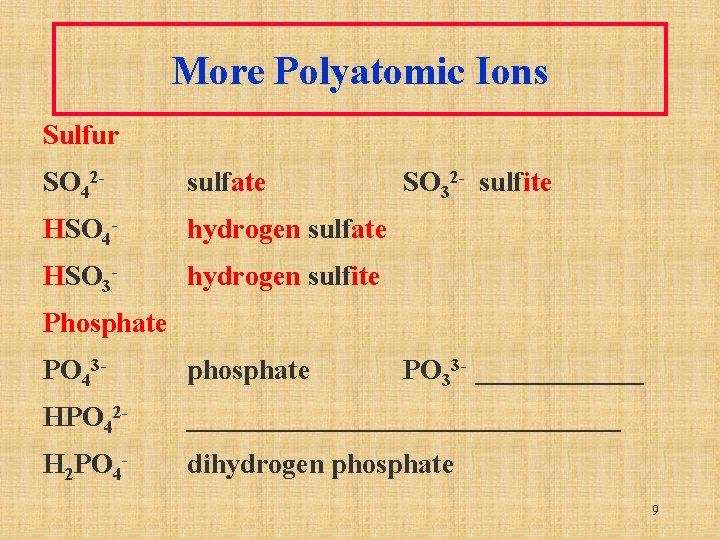
More Polyatomic Ions Sulfur SO 42 - sulfate HSO 4 - hydrogen sulfate HSO 3 - hydrogen sulfite SO 32 - sulfite Phosphate PO 43 - phosphate PO 33 - ______ HPO 42 - ________________ H 2 PO 4 - dihydrogen phosphate 9

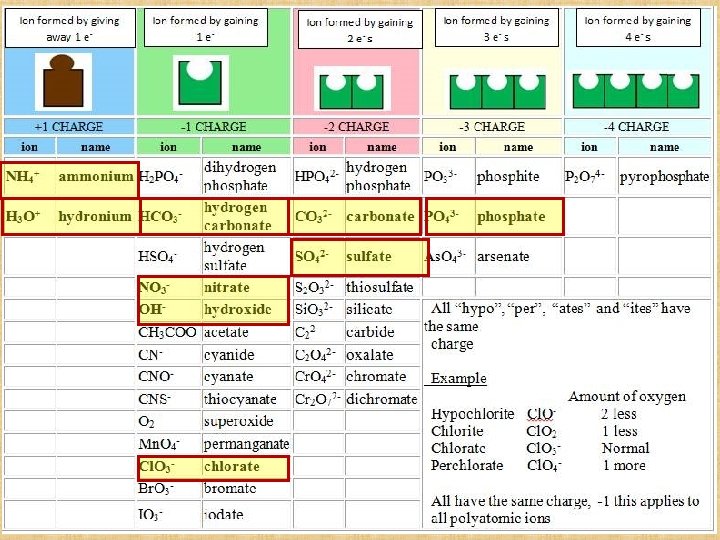
Main Polyatomic Ions 10
- Slides: 11