
Compound nuclear reaction cross sections from surrogate measurements

- Slides: 36
Compound nuclear reaction cross sections from surrogate measurements B. K. Nayak Nuclear Physics Division Bhabha Atomic Research Centre, Mumbai- 400 085
Compound Nuclear cross sections Cross sections for reactions of neutron and light charged particles with target nuclei across the isotopic chart taking place at energies several Ke. V to tens of Me. V is required for : ØNuclear astrophysics Ø National security Ø Nuclear energy
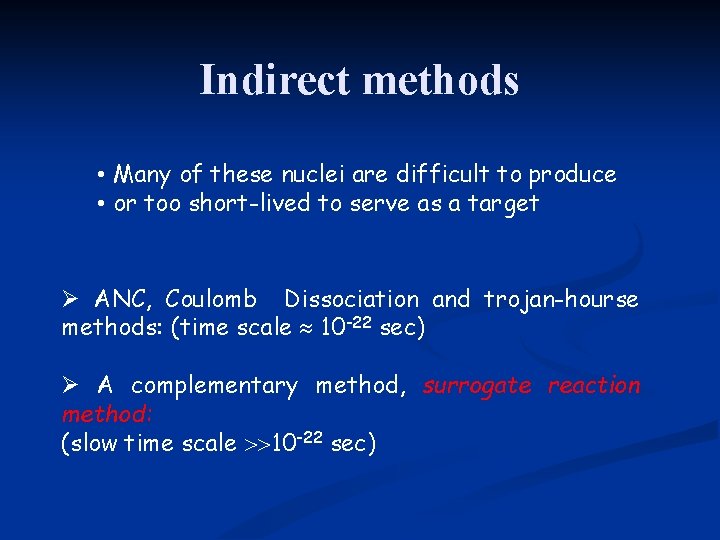
Indirect methods • Many of these nuclei are difficult to produce • or too short-lived to serve as a target Ø ANC, Coulomb Dissociation and trojan-hourse methods: (time scale 10 -22 sec) Ø A complementary method, surrogate reaction method: (slow time scale 10 -22 sec)
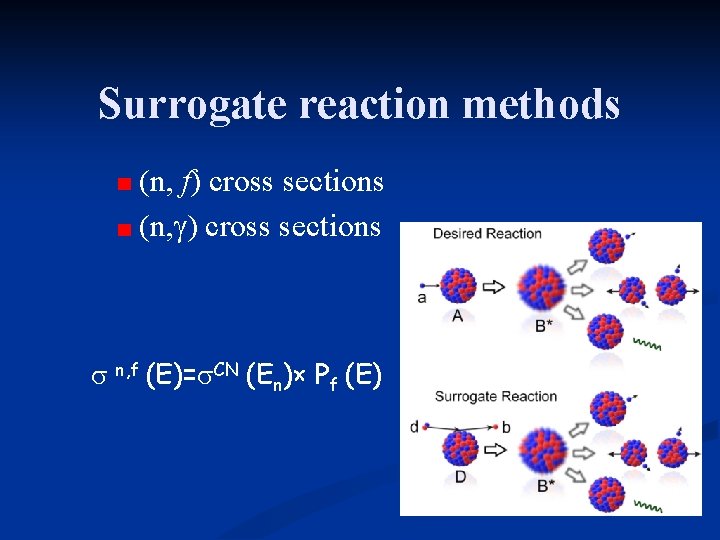
Surrogate reaction methods (n, f) cross sections (n, ) cross sections n, f (E)= CN (En)× Pf (E)
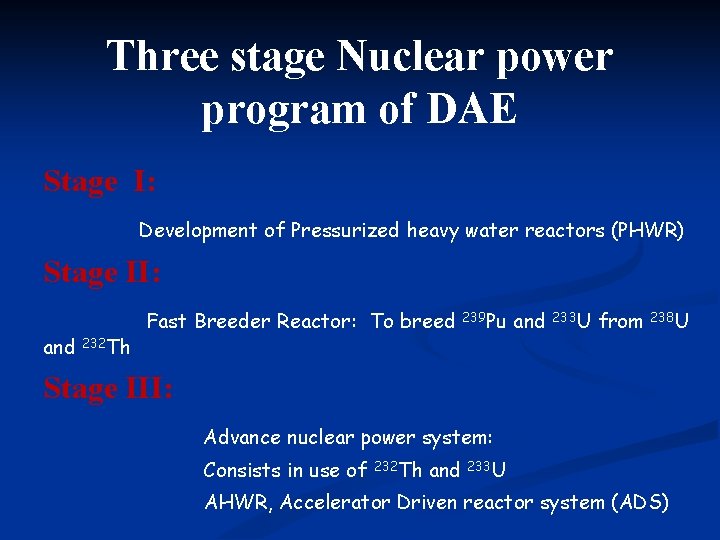
Three stage Nuclear power program of DAE Stage I: Development of Pressurized heavy water reactors (PHWR) Stage II: and 232 Th Fast Breeder Reactor: To breed 239 Pu and 233 U from 238 U Stage III: Advance nuclear power system: Consists in use of 232 Th and 233 U AHWR, Accelerator Driven reactor system (ADS)
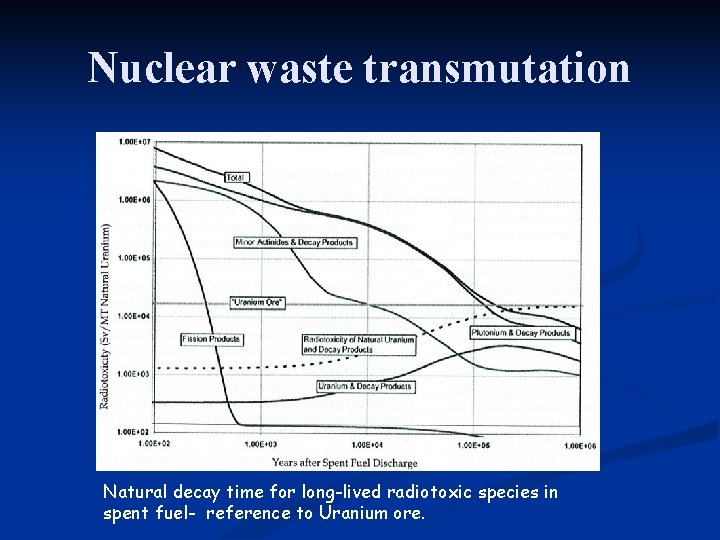
Nuclear waste transmutation Natural decay time for long-lived radiotoxic species in spent fuel- reference to Uranium ore.
Surrogate reaction methods Absolute surrogate method ● Ratio surrogate method ● Hybrid surrogate ratio method ●
Surrogate reaction methods Absolute surrogate method ● Ratio surrogate method ● Hybrid surrogate ratio method ●
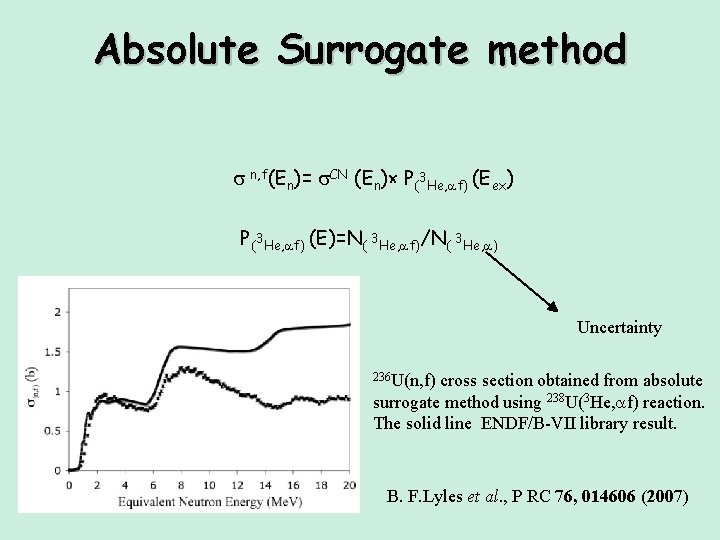
Absolute Surrogate method n, f(En)= CN (En)× P(3 He, f) (Eex) P(3 He, f) (E)=N( 3 He, f)/N( 3 He, ) Uncertainty 236 U(n, f) cross section obtained from absolute surrogate method using 238 U(3 He, f) reaction. The solid line ENDF/B-VII library result. B. F. Lyles et al. , P RC 76, 014606 (2007)
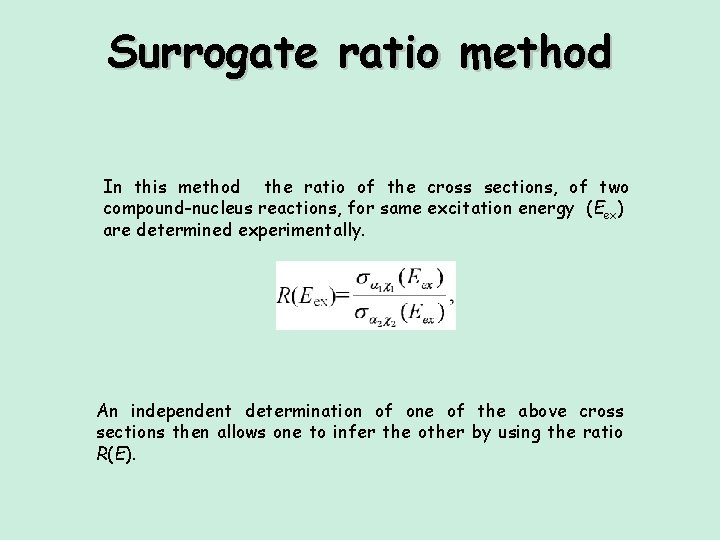
Surrogate ratio method In this method the ratio of the cross sections, of two compound-nucleus reactions, for same excitation energy (Eex) are determined experimentally. An independent determination of one of the above cross sections then allows one to infer the other by using the ratio R(E).
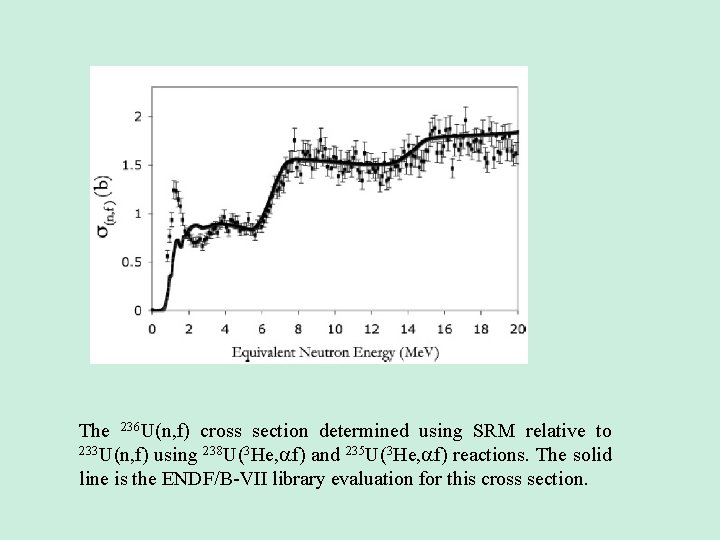
The 236 U(n, f) cross section determined using SRM relative to 233 U(n, f) using 238 U(3 He, f) and 235 U(3 He, f) reactions. The solid line is the ENDF/B-VII library evaluation for this cross section.
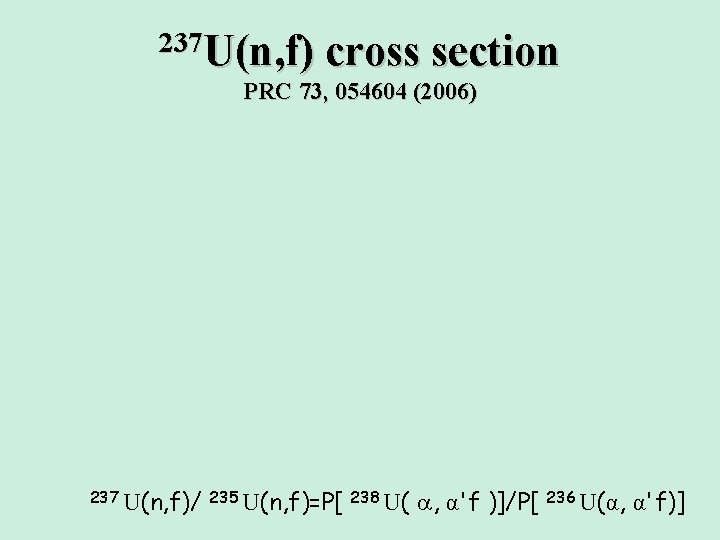
237 U(n, f) cross section PRC 73, 054604 (2006) 237 U(n, f)/ 235 U(n, f)=P[ 238 U( , α'f )]/P[ 236 U(α, α'f)]
Isotopes in the Th-U fuel cycle Schematic view of the thorium fuel cycle.
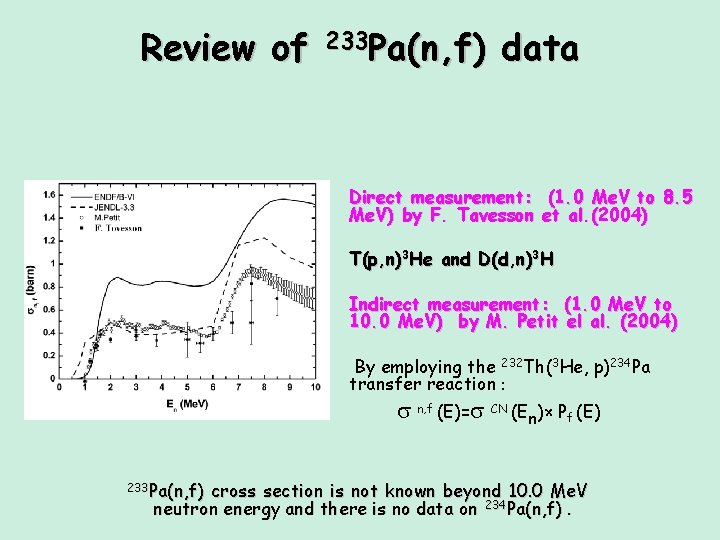
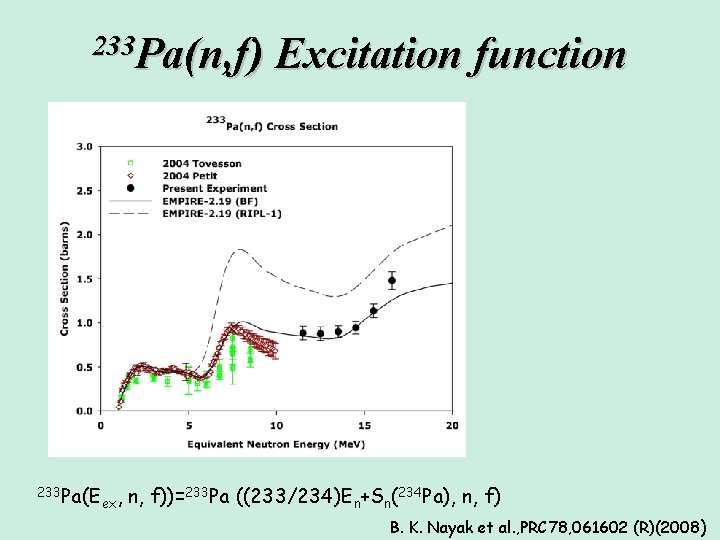
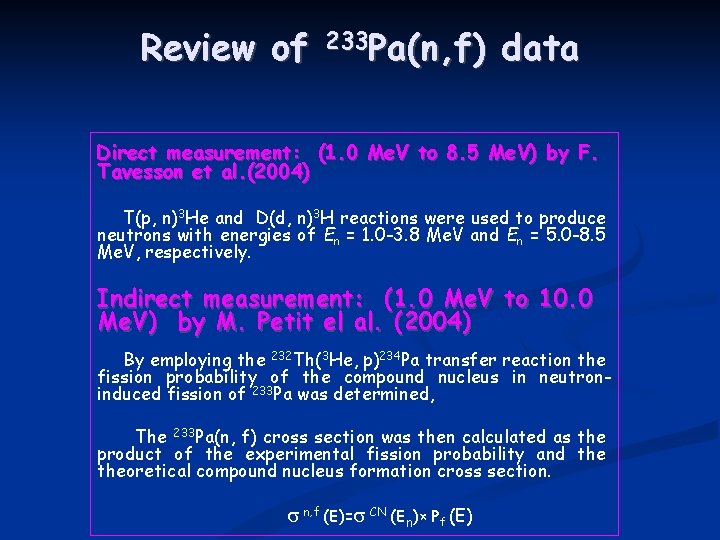
Review of 233 Pa(n, f) data Direct measurement: (1. 0 Me. V to 8. 5 Me. V) by F. Tavesson et al. (2004) T(p, n)3 He and D(d, n)3 H Indirect measurement: (1. 0 Me. V to 10. 0 Me. V) by M. Petit el al. (2004) By employing the 232 Th(3 He, p)234 Pa transfer reaction : n, f (E)= CN (En)× Pf (E) 233 Pa(n, f) cross section is not known beyond 10. 0 Me. V neutron energy and there is no data on 234 Pa(n, f).
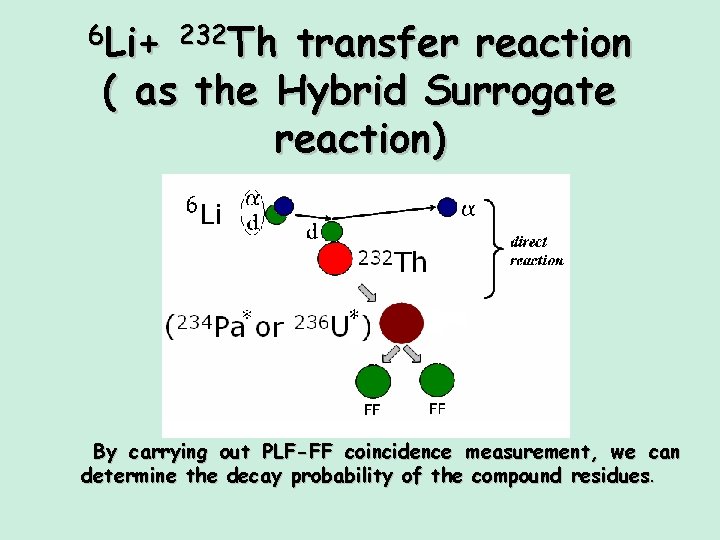
6 Li+ 232 Th transfer reaction ( as the Hybrid Surrogate reaction) CN By carrying out PLF-FF coincidence measurement, we can determine the decay probability of the compound residues.
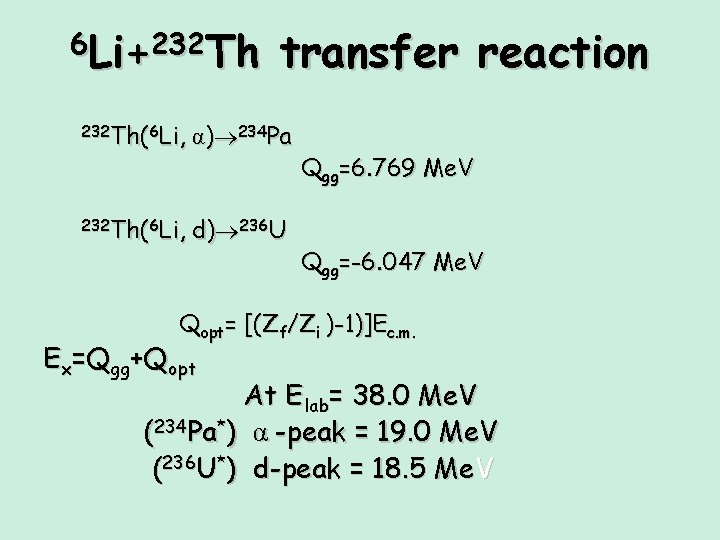
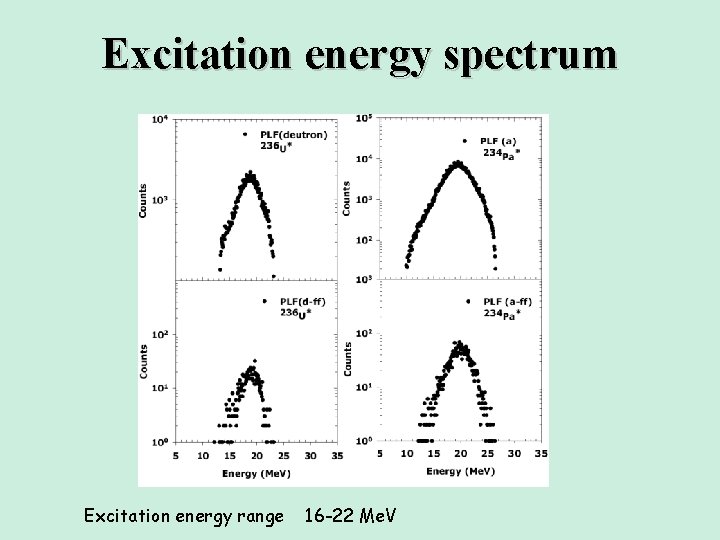
6 Li+232 Th transfer reaction 232 Th(6 Li, α) 234 Pa 232 Th(6 Li, d) 236 U Q gg=6. 769 Me. V Q gg=-6. 047 Me. V Qopt= [(Zf/Zi )-1)]Ec. m. Ex=Qgg+Qopt At Elab= 38. 0 Me. V (234 Pa*) α -peak = 19. 0 Me. V (236 U*) d-peak = 18. 5 Me. V
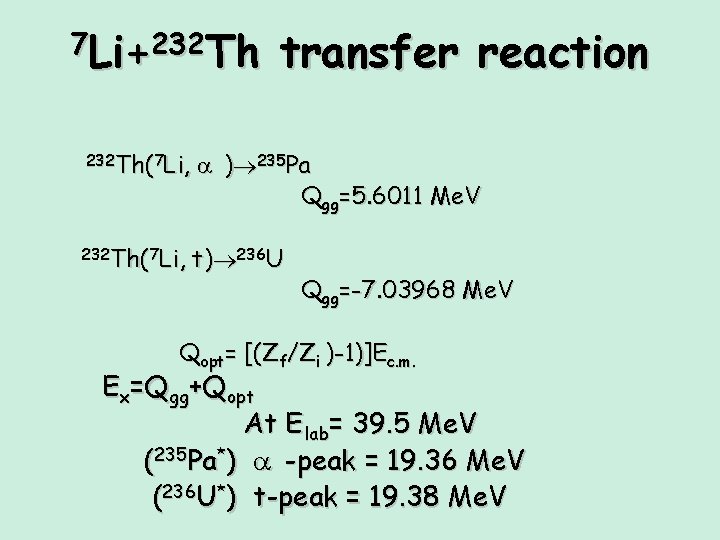
7 Li+232 Th(7 Li, transfer reaction ) 235 Pa Q gg=5. 6011 Me. V t) 236 U Q gg=-7. 03968 Me. V Qopt= [(Zf/Zi )-1)]Ec. m. Ex=Qgg+Qopt At Elab= 39. 5 Me. V (235 Pa*) -peak = 19. 36 Me. V (236 U*) t-peak = 19. 38 Me. V
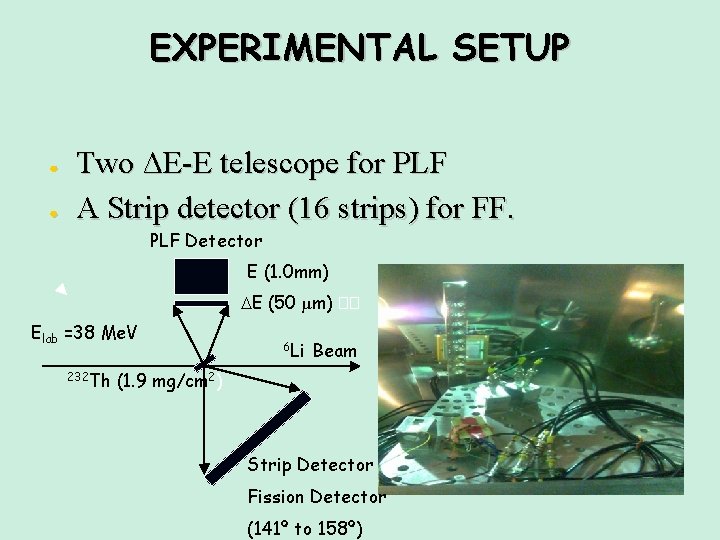
EXPERIMENTAL SETUP ● ● Two ΔE-E telescope for PLF A Strip detector (16 strips) for FF. PLF Detector E (1. 0 mm) E (50 µm) �� Elab =38 Me. V 232 Th 6 Li Beam (1. 9 mg/cm 2) Strip Detector Fission Detector (141º to 158º)
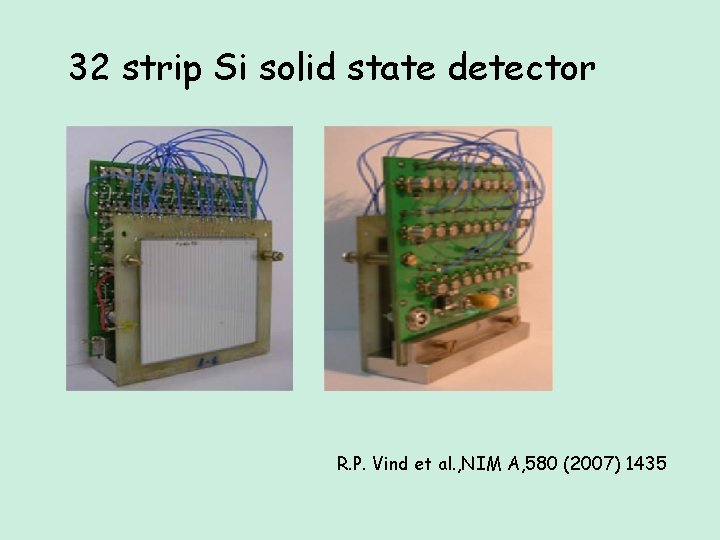
32 strip Si solid state detector R. P. Vind et al. , NIM A, 580 (2007) 1435
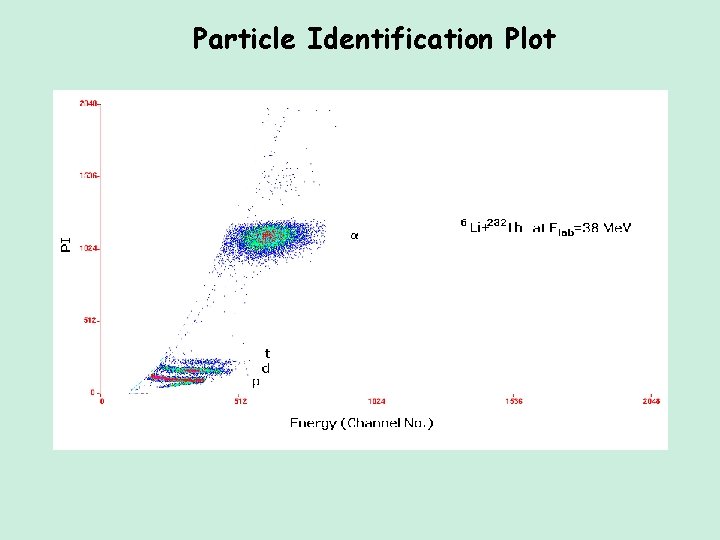
Particle Identification Plot
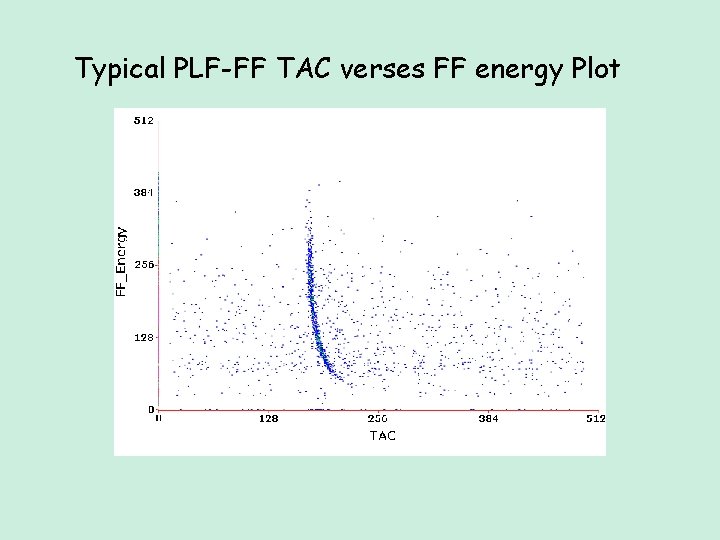
Typical PLF-FF TAC verses FF energy Plot
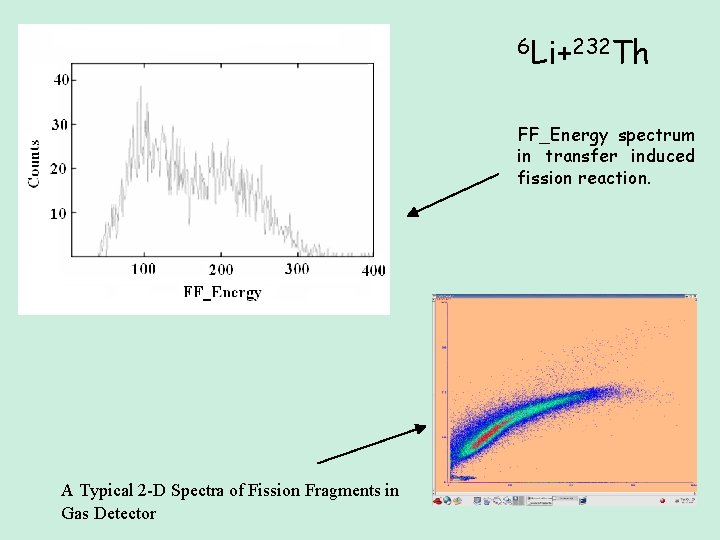
6 Li+232 Th FF_Energy spectrum in transfer induced fission reaction. A Typical 2 -D Spectra of Fission Fragments in Gas Detector
Excitation energy spectrum Excitation energy range 16 -22 Me. V
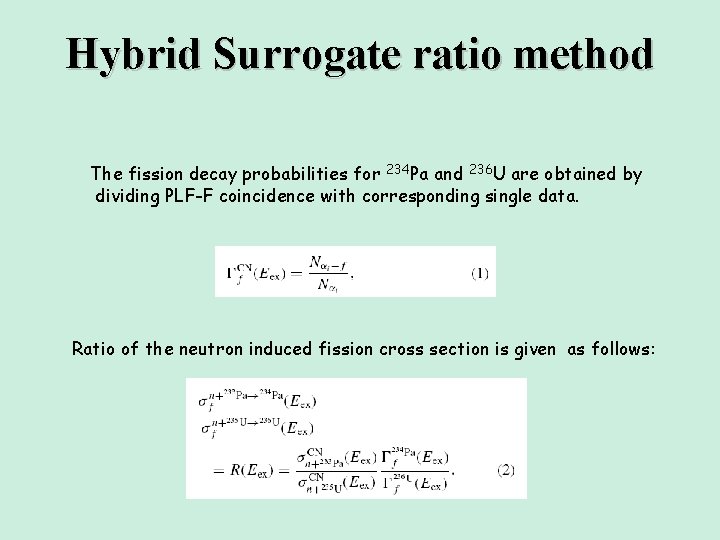
Hybrid Surrogate ratio method The fission decay probabilities for 234 Pa and 236 U are obtained by dividing PLF-F coincidence with corresponding single data. Ratio of the neutron induced fission cross section is given as follows:
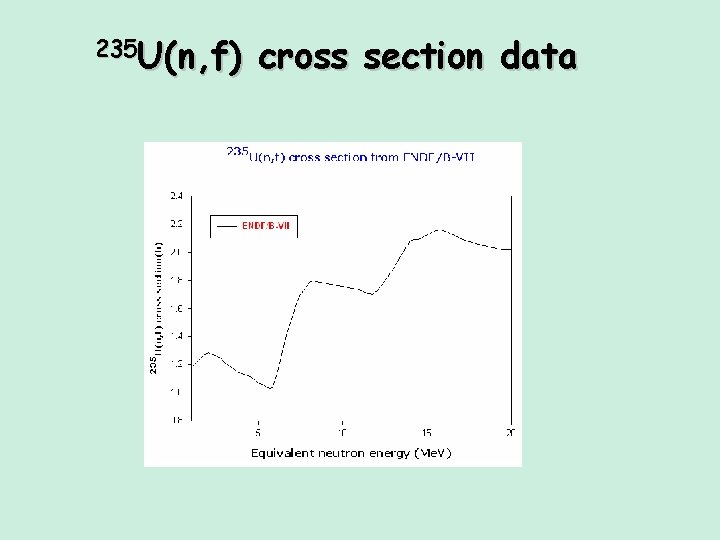
235 U(n, f) cross section data
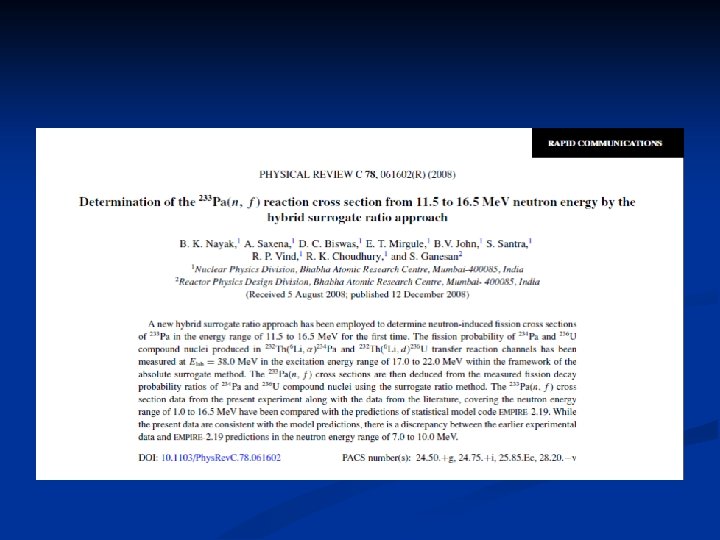
233 Pa(n, f) 233 Pa(E ex, Excitation function n, f))=233 Pa ((233/234)En+Sn(234 Pa), n, f) B. K. Nayak et al. , PRC 78, 061602 (R)(2008)
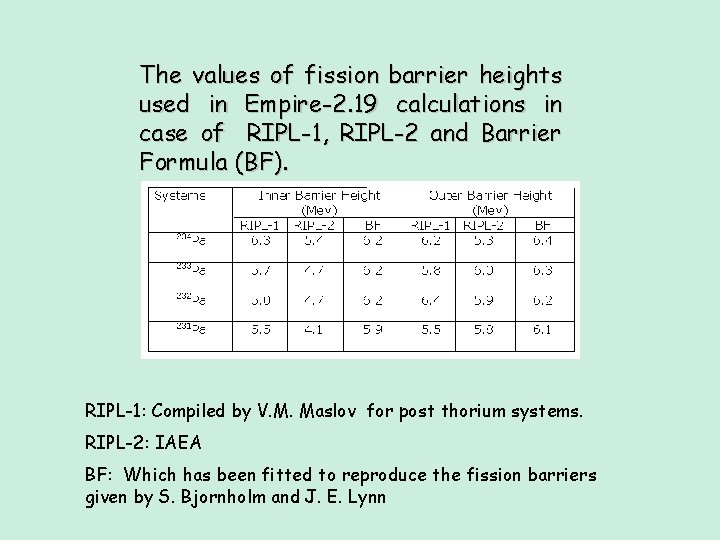
The values of fission barrier heights used in Empire-2. 19 calculations in case of RIPL-1, RIPL-2 and Barrier Formula (BF). RIPL-1: Compiled by V. M. Maslov for post thorium systems. RIPL-2: IAEA BF: Which has been fitted to reproduce the fission barriers given by S. Bjornholm and J. E. Lynn
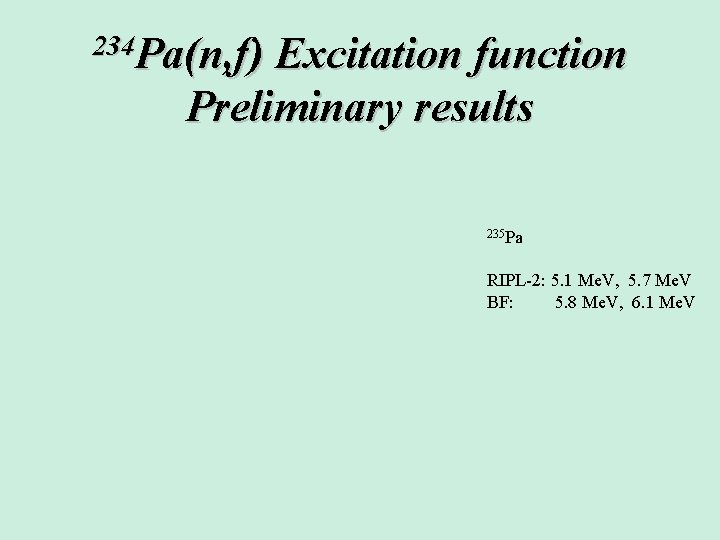
234 Pa(n, f) Excitation function Preliminary results 235 Pa RIPL-2: 5. 1 Me. V, 5. 7 Me. V BF: 5. 8 Me. V, 6. 1 Me. V
Surrogate reaction techniques with RIB ØIsotopes further from stability: Inverse kinematics ØHolifield Radioactive Ion Beam facility (HRIBF) Ø(d, p) reaction looks promising : Helical Orbit Spectrometer (HELIOS) at ANL.
Conclusions The surrogate reaction methods can be used as a tool to determine compound nuclear reaction cross sections for difficult to produce targets. The (n, f) cross sections extracted from surrogate measurement show reasonable agreement with directly measured cross sections for neutron energy above 1 -2 Me. V. Using surrogate reactions a wide-range of cross sections for exotic and short-lived isotopes will be accessible to study at many existing and future high intensity RIB facilities around the world.
Review of 233 Pa(n, f) data Direct measurement: (1. 0 Me. V to 8. 5 Me. V) by F. Tavesson et al. (2004) T(p, n)3 He and D(d, n)3 H reactions were used to produce neutrons with energies of En = 1. 0 -3. 8 Me. V and En = 5. 0 -8. 5 Me. V, respectively. Indirect measurement: (1. 0 Me. V to 10. 0 Me. V) by M. Petit el al. (2004) By employing the 232 Th(3 He, p)234 Pa transfer reaction the fission probability of the compound nucleus in neutroninduced fission of 233 Pa was determined, The 233 Pa(n, f) cross section was then calculated as the product of the experimental fission probability and theoretical compound nucleus formation cross section. n, f (E)= CN (En)× Pf (E)
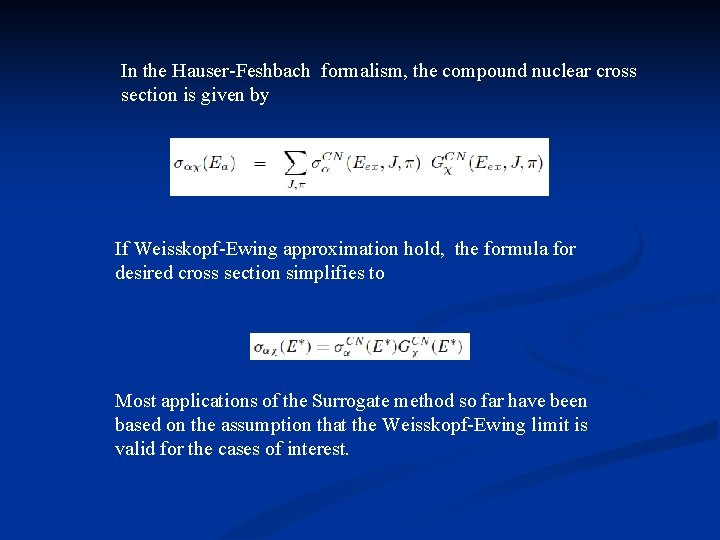
In the Hauser-Feshbach formalism, the compound nuclear cross section is given by If Weisskopf-Ewing approximation hold, the formula for desired cross section simplifies to Most applications of the Surrogate method so far have been based on the assumption that the Weisskopf-Ewing limit is valid for the cases of interest.
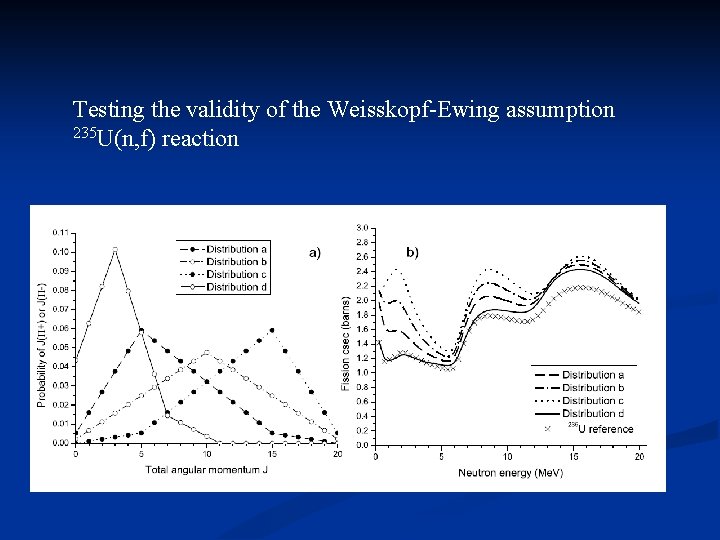
Testing the validity of the Weisskopf-Ewing assumption 235 U(n, f) reaction
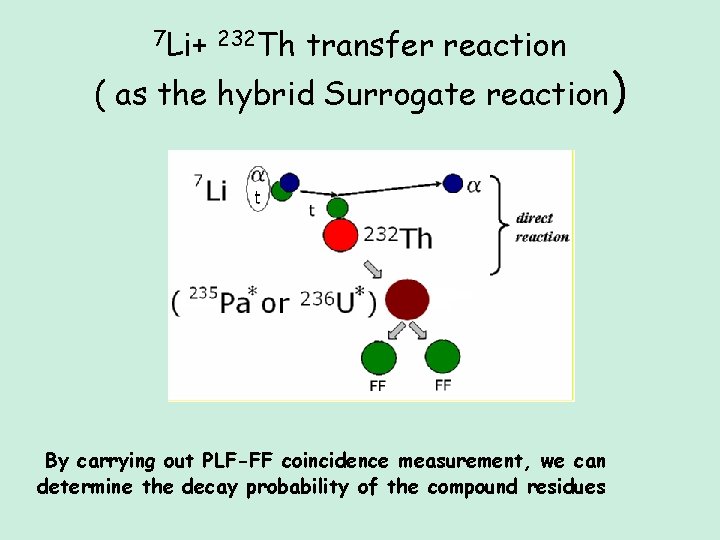
7 Li+ 232 Th transfer reaction ( as the hybrid Surrogate reaction) By carrying out PLF-FF coincidence measurement, we can determine the decay probability of the compound residues