
Compound Data Structures Structural decomposition into other values
![• T[[array [N 1. . . N 2]of T]] = s: let n](https://slidetodoc.com/presentation_image_h2/5b10b3c86a85646600ef561a0164bf5d/image-11.jpg "• T[[array [N 1. . . N 2]of T]] = s: let n")

![Array Indexing S: Subscript Array Environment Store Storable value S[[E]] = a: e: s:](https://slidetodoc.com/presentation_image_h2/5b10b3c86a85646600ef561a0164bf5d/image-15.jpg "Array Indexing S: Subscript Array Environment Store Storable value S[[E]] = a: e: s:")
![Array Assignment C[[I[S] : = E]] = e: s: cases (accessenv [[I]] e) of.](https://slidetodoc.com/presentation_image_h2/5b10b3c86a85646600ef561a0164bf5d/image-16.jpg "Array Assignment C[[I[S] : = E]] = e: s: cases (accessenv [[I]] e) of.")
- Slides: 16
Compound Data Structures • Structural decomposition into other values. • Lists: domain A* – Constructors: NIL, CONS. – Selectors: HEAD, TAIL. • Tuples: domain A x B x C … – Constructor: (…, …, …) – Selector: i • Problem: imperative languages – Variable forms of the objects exist. – Objects subcomponents can be altered. • Several versions of arrays variables.
Arrays • Collection of homogeneous objects indexed by a set of scalar values. • Homogeneity all components have same structure. • Allocation of storage and type checking easy. • Both tasks can be performed by compiler. • Selector operation: indexing. – Scalar index set: primitive domain with relational and arithmetic operations. – Restricted by lower and upper bounds.
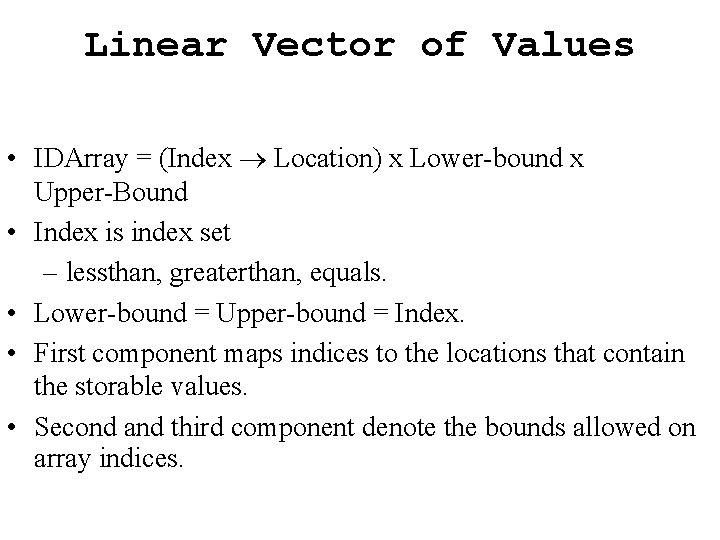
Linear Vector of Values • IDArray = (Index Location) x Lower bound x Upper Bound • Index is index set – lessthan, greaterthan, equals. • Lower bound = Upper bound = Index. • First component maps indices to the locations that contain the storable values. • Second and third component denote the bounds allowed on array indices.
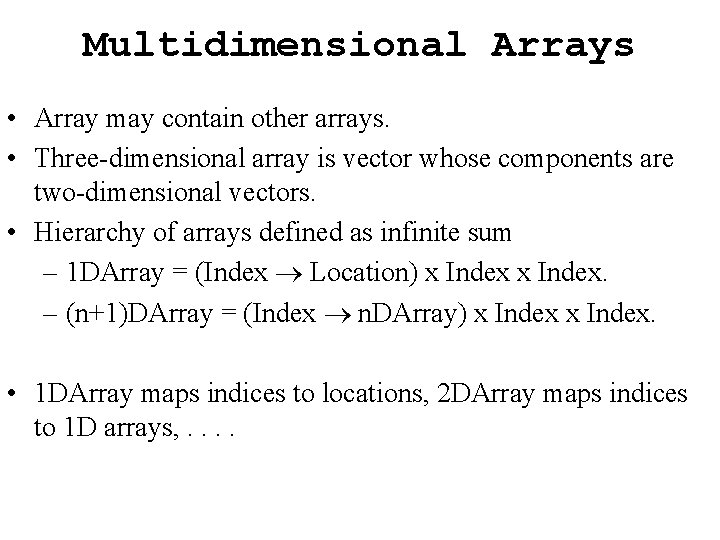
Multidimensional Arrays • Array may contain other arrays. • Three dimensional array is vector whose components are two dimensional vectors. • Hierarchy of arrays defined as infinite sum – 1 DArray = (Index Location) x Index. – (n+1)DArray = (Index n. DArray) x Index. • 1 DArray maps indices to locations, 2 DArray maps indices to 1 D arrays, . .
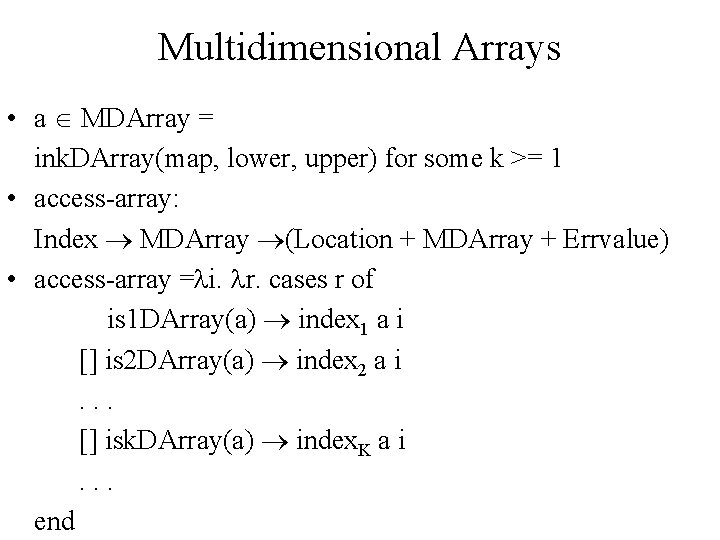
Multidimensional Arrays • a MDArray = ink. DArray(map, lower, upper) for some k >= 1 • access array: Index MDArray (Location + MDArray + Errvalue) • access array = i. r. cases r of is 1 DArray(a) index 1 a i [] is 2 DArray(a) index 2 a i. . . [] isk. DArray(a) index. K a i. . . end
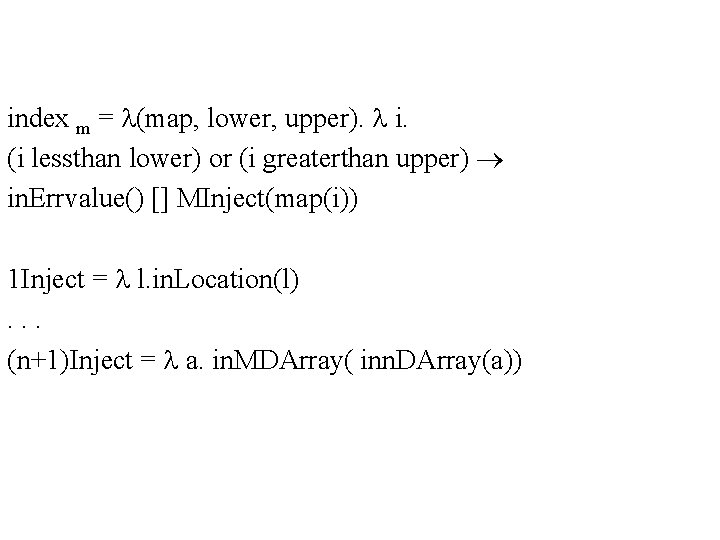
index m = (map, lower, upper). i. (i lessthan lower) or (i greaterthan upper) in. Errvalue() [] MInject(map(i)) 1 Inject = l. in. Location(l). . . (n+1)Inject = a. in. MDArray( inn. DArray(a))
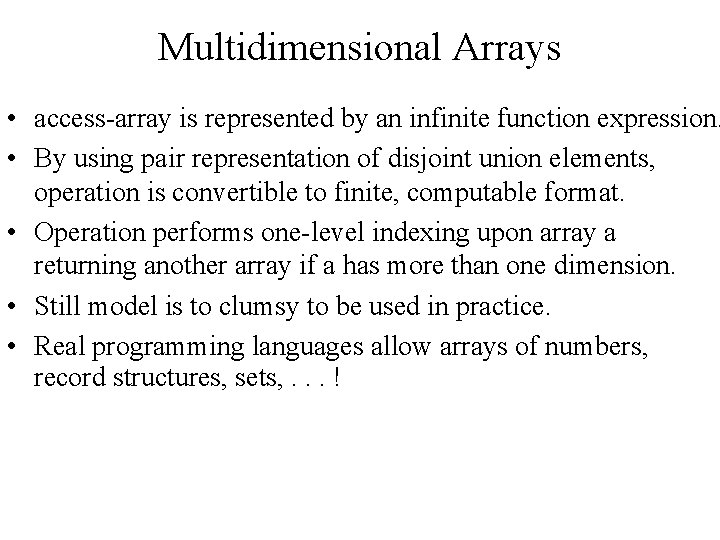
Multidimensional Arrays • access array is represented by an infinite function expression. • By using pair representation of disjoint union elements, operation is convertible to finite, computable format. • Operation performs one level indexing upon array a returning another array if a has more than one dimension. • Still model is to clumsy to be used in practice. • Real programming languages allow arrays of numbers, record structures, sets, . . . !
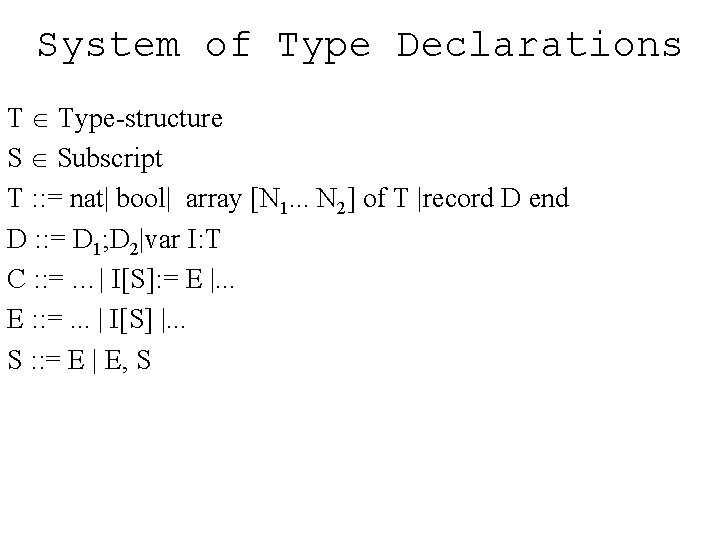
System of Type Declarations T Type structure S Subscript T : : = nat| bool| array [N 1. . . N 2] of T |record D end D : : = D 1; D 2|var I: T C : : = …| I[S]: = E |. . . E : : =. . . | I[S] |. . . S : : = E | E, S
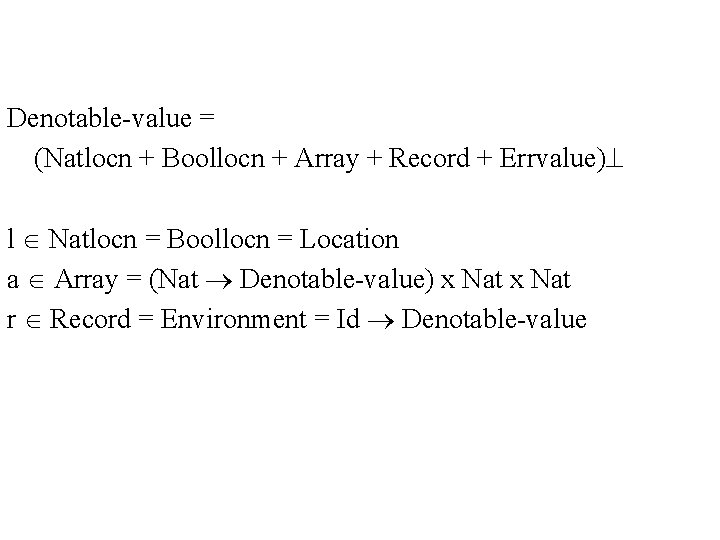
Denotable value = (Natlocn + Boollocn + Array + Record + Errvalue) l Natlocn = Boollocn = Location a Array = (Nat Denotable value) x Nat r Record = Environment = Id Denotable value
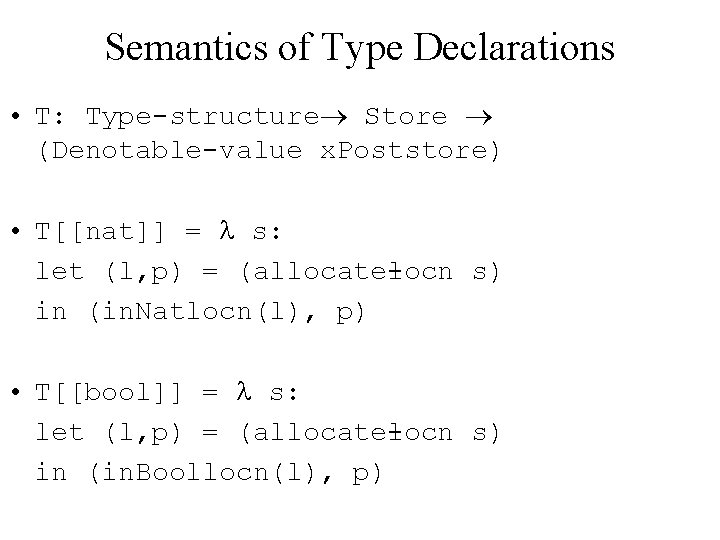
Semantics of Type Declarations • T: Type structure Store (Denotable value x. Poststore) • T[[nat]] = s: let (l, p) = (allocate locn s) in (in. Natlocn(l), p) • T[[bool]] = s: let (l, p) = (allocate locn s) in (in. Boollocn(l), p)
• T[[array [N 1. . . N 2]of T]] = s: let n 1 = N[[N 1]] in let n 2 = N[[N 2]] in n 1 greaterthan n 2 (in. Errvalue(), (signalerr s)) [] get storage n 1 (empty array n 1 n 2 ) s • T[[record D end]] = s: let (e, p) = (D[[D]] emptyenv s) in (in. Record(e), p) Type structure expressions are mapped to storage allocation actions!
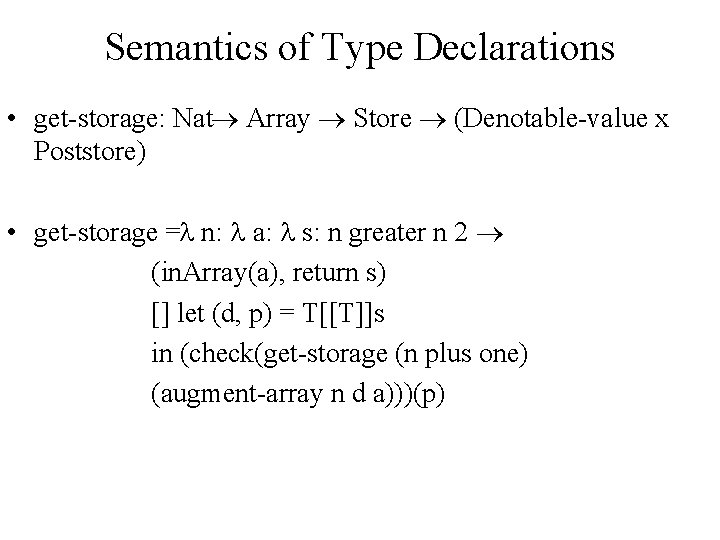
Semantics of Type Declarations • get storage: Nat Array Store (Denotable value x Poststore) • get storage = n: a: s: n greater n 2 (in. Array(a), return s) [] let (d, p) = T[[T]]s in (check(get storage (n plus one) (augment array n d a)))(p)
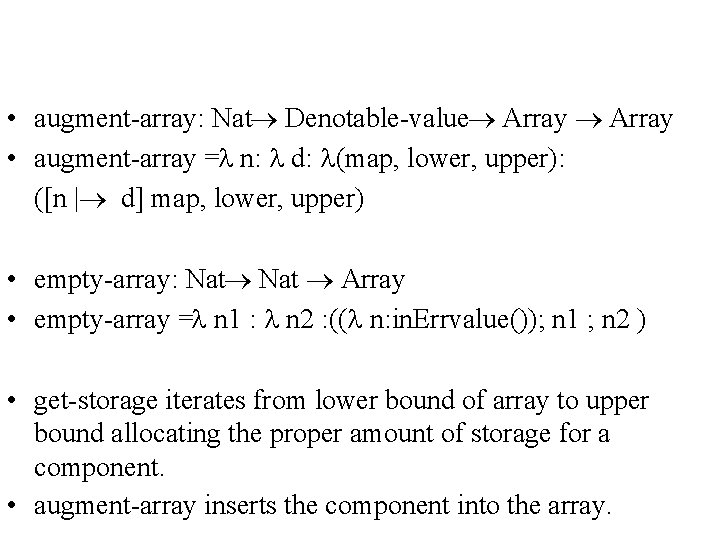
• augment array: Nat Denotable value Array • augment array = n: d: (map, lower, upper): ([n | d] map, lower, upper) • empty array: Nat Array • empty array = n 1 : n 2 : (( n: in. Errvalue()); n 1 ; n 2 ) • get storage iterates from lower bound of array to upper bound allocating the proper amount of storage for a component. • augment array inserts the component into the array.
Declarations • D: Declaration Environment Store (Environment x Poststore) • D[[D 1; D 2 ]] = e: s: let (e’, p’) = (D[[D 1]]e s) in (check (D[[D 2 ]]e’))(p) • D[[var I: T]] = e: s: let (d, p) = T[[T]]s in ((updateenv [[I]] d e), p) • A declaration activates the storage allocation strategy specified by its type structure.
Array Indexing S: Subscript Array Environment Store Storable value S[[E]] = a: e: s: cases (E[[E]]e s) of. . . [] is. Nat(n) access array n a … end S[[E, S]] = a: e: s: cases (E[[E]]e s) of … [] is. Nat(n) (cases (access array n a) of … [] is. Array(a’ ) S[[S]]a’ e s. . . end). . . end
Array Assignment C[[I[S] : = E]] = e: s: cases (accessenv [[I]] e) of. . . [] is. Array(a) (cases (S[[S]]a e s) of. . . is. Natlocn(l) (cases (E[[E]]e s) of. . . [] is. Nat(n) return(update l in. Nat(n) s). . . end). . . end Assignment is first order (location, not an array, is on left hand side).