
Compost tea a brewable food web for disease
Compost tea: a brewable food web for disease control Martha Rosemeyer June 25, 2003 rosemeym@evergreen. edu
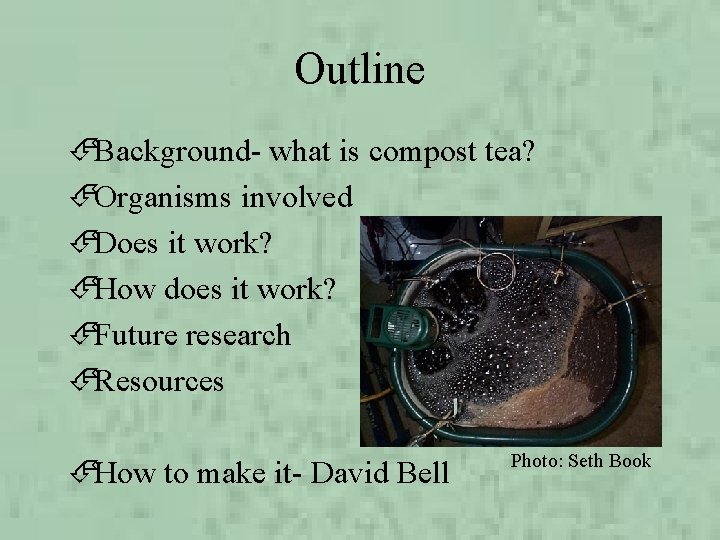
Outline ÉBackground- what is compost tea? ÉOrganisms involved ÉDoes it work? ÉHow does it work? ÉFuture research ÉResources ÉHow to make it- David Bell Photo: Seth Book
What is compost tea? ÉWater extract of compost that is brewed, ie fermented (Ingham, E. 2001) ÉSpecifically the organisms are released from the compost and increase in number ÉNutrients may be added to further increase organisms ÉUsed for disease control, as well as a plant nutrient source
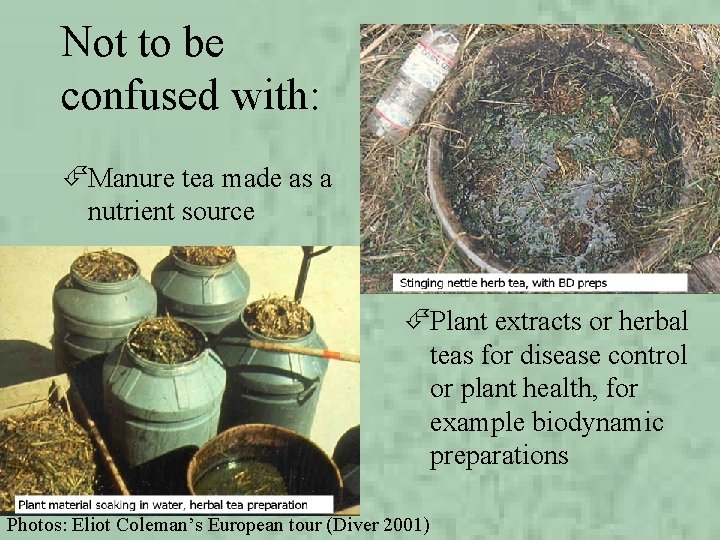
Not to be confused with: ÉManure tea made as a nutrient source ÉPlant extracts or herbal teas for disease control or plant health, for example biodynamic preparations Photos: Eliot Coleman’s European tour (Diver 2001)
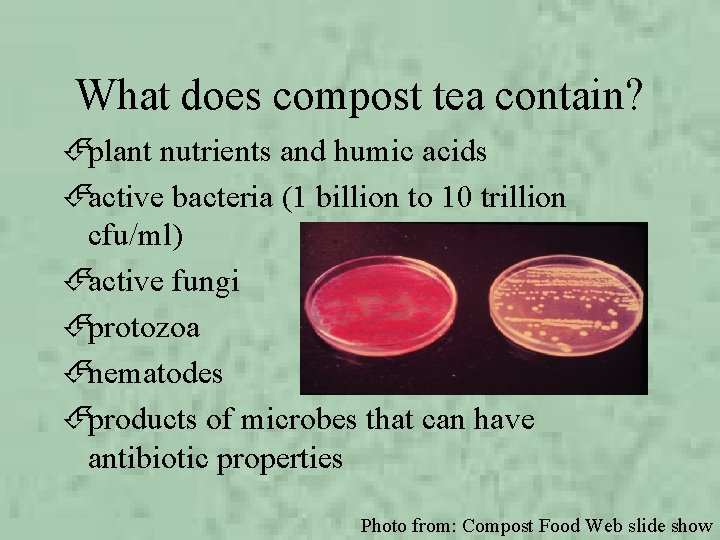
What does compost tea contain? Éplant nutrients and humic acids Éactive bacteria (1 billion to 10 trillion cfu/ml) Éactive fungi Éprotozoa Énematodes Éproducts of microbes that can have antibiotic properties Photo from: Compost Food Web slide show
Why compost tea? Why now? ÉIncreasing societal concern for health and environment and organic production ÉLack of disease control mechanisms for organic farmers and gardeners – Restricting agrochemicals due to recognized toxicity, for example FQPA ÉOrganic farmers need control methods that work within a holistic system
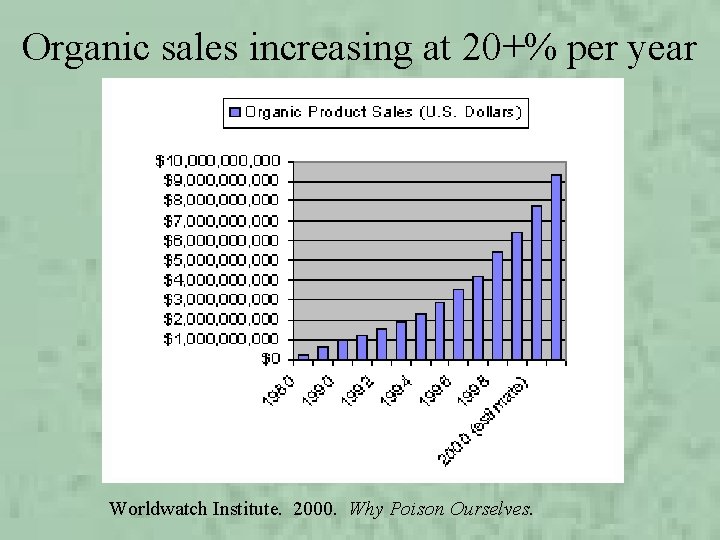
Organic sales increasing at 20+% per year Worldwatch Institute. 2000. Why Poison Ourselves.
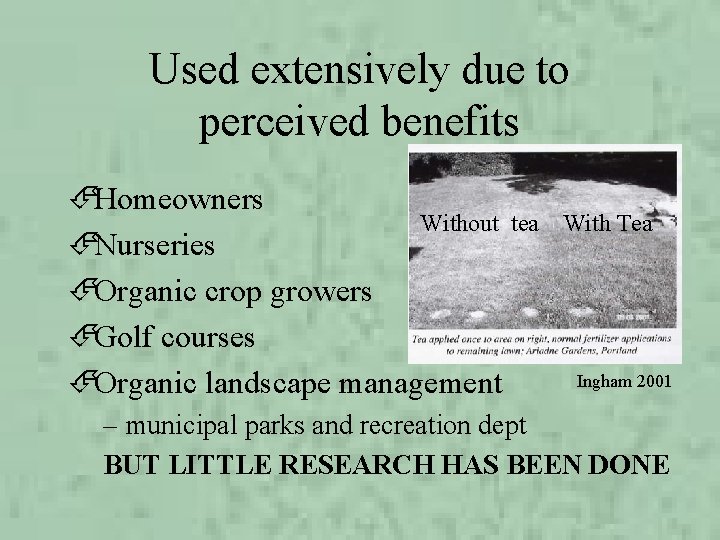
Used extensively due to perceived benefits ÉHomeowners Without tea ÉNurseries ÉOrganic crop growers ÉGolf courses ÉOrganic landscape management With Tea Ingham 2001 – municipal parks and recreation dept BUT LITTLE RESEARCH HAS BEEN DONE
Background ÉSince 1920’s compost water used to soak seeds for nutrients, prevent disease ÉTwo main approaches – compost extracts = watery fermented compost extract= steepages =non-aerated compost tea (Scheuerell and Mahaffee 2002) • • fermented but not aerated, stirred occasionally lower costs, lower energy much research disease control has been documented
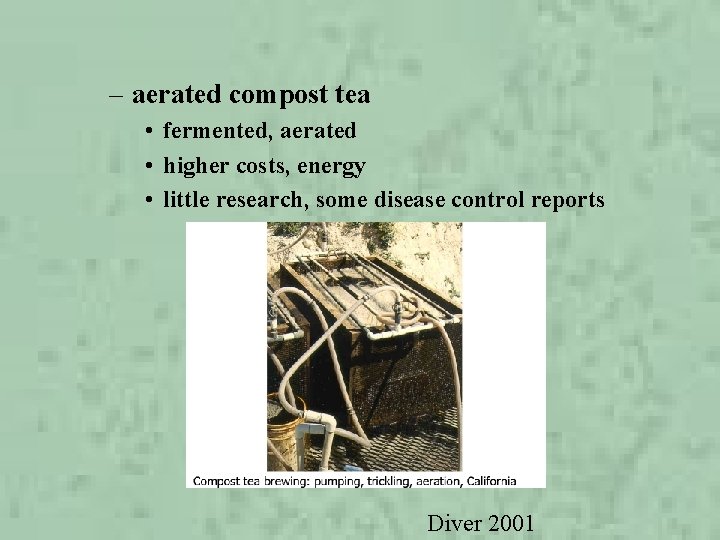
– aerated compost tea • fermented, aerated • higher costs, energy • little research, some disease control reports Diver 2001
Benefits of compost tea ÉNutrient application, lesser ÉDisease control – Foliar disease – Root disease ÉInoculation of functioning soil food web
How to make non-aerobic compost tea ÉMix ratio of compost to water-1: 4 -1: 10 compost to water in an open container, stir occasionally ÉAt least 3 days at 15 -25°C (50 -70 °F)
How to make Aerobic Compost Tea ÉChoose compost- well aged – plant based or worm compost ÉIn water (remove chlorine from water) ÉRatio 1 compost: 10 water to 1: 50 ÉAdd nutrients (optional) like molasses, humic acids, kelp ÉAerate and mix solution for 12 - 24 - 48 hours
Commercial aerobic compost tea brewers ÉSoil Soup: www. soilsoup. com ÉMicrob Brewer: www. microbbrewer. com ÉGrowing Solutions: www. growingsolutions. com ÉEarth Tea Brewer: www. composttea. com ÉXtractor: compara. nl/compost_tea_systems.
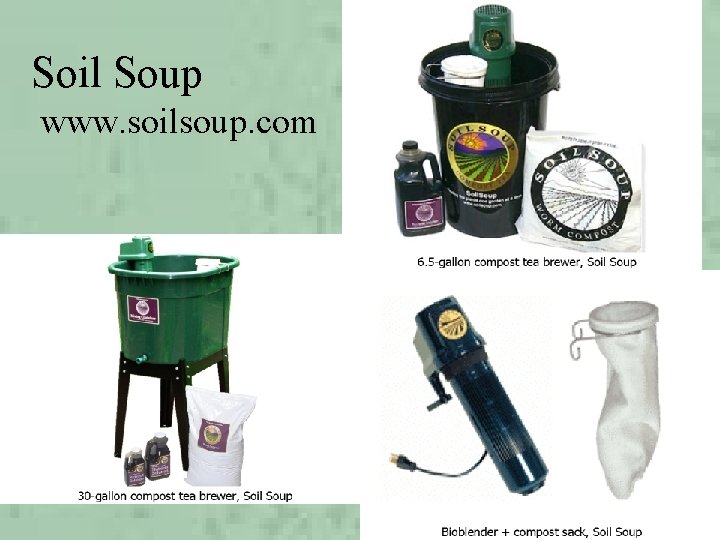
Soil Soup www. soilsoup. com
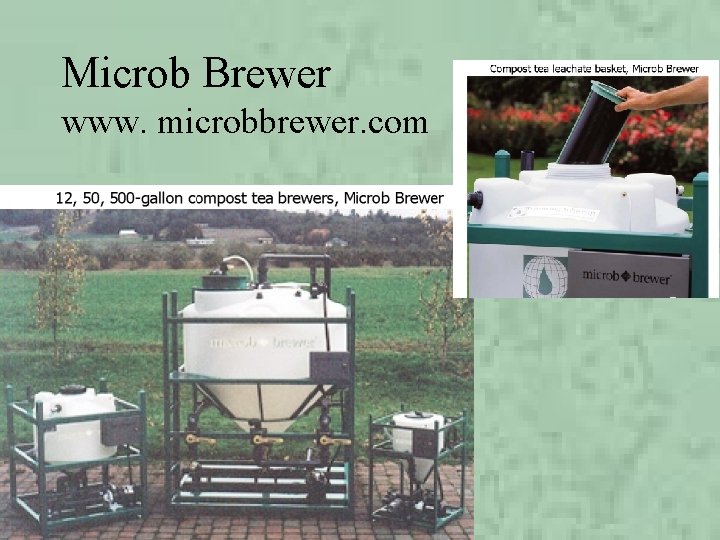
Microb Brewer www. microbbrewer. com
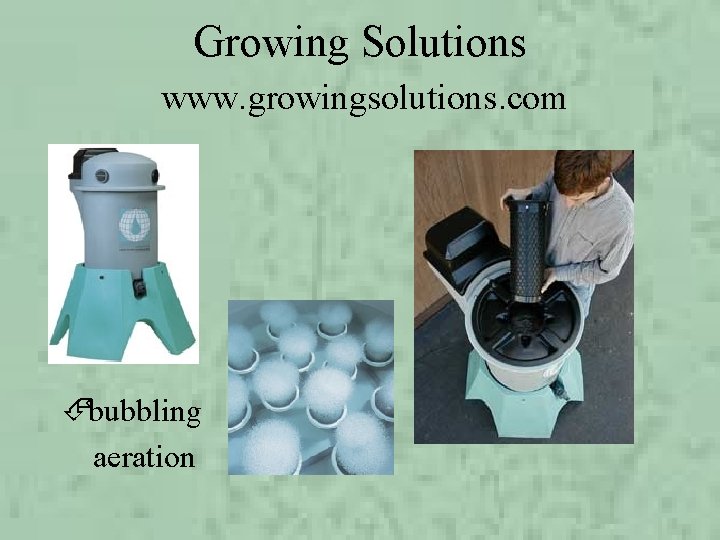
Growing Solutions www. growingsolutions. com Ébubbling aeration

What happens in the compost tea while brewing? ? ?
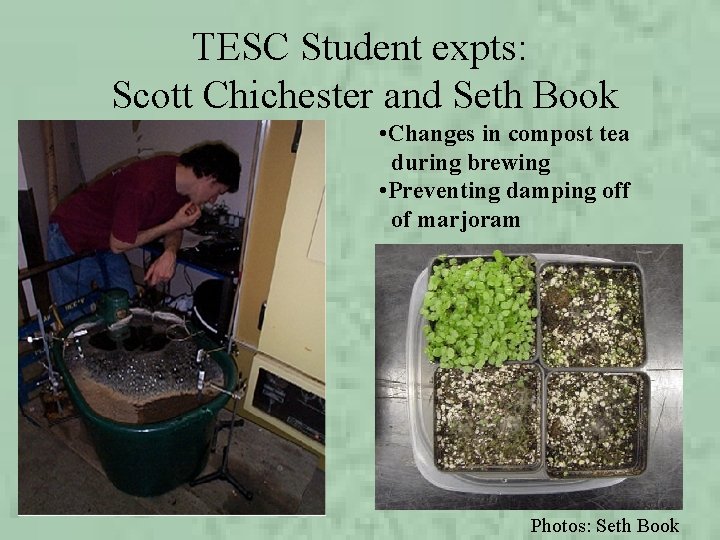
TESC Student expts: Scott Chichester and Seth Book • Changes in compost tea during brewing • Preventing damping off of marjoram Photos: Seth Book
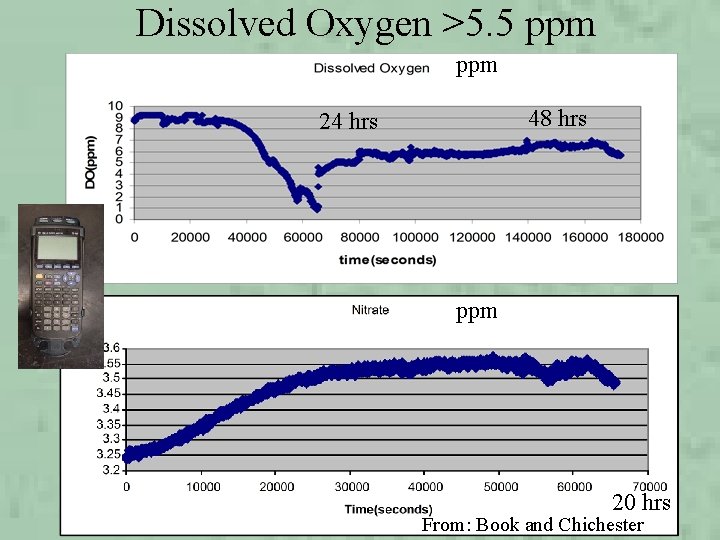
Dissolved Oxygen >5. 5 ppm 48 hrs 24 hrs ppm 20 hrs From: Book and Chichester
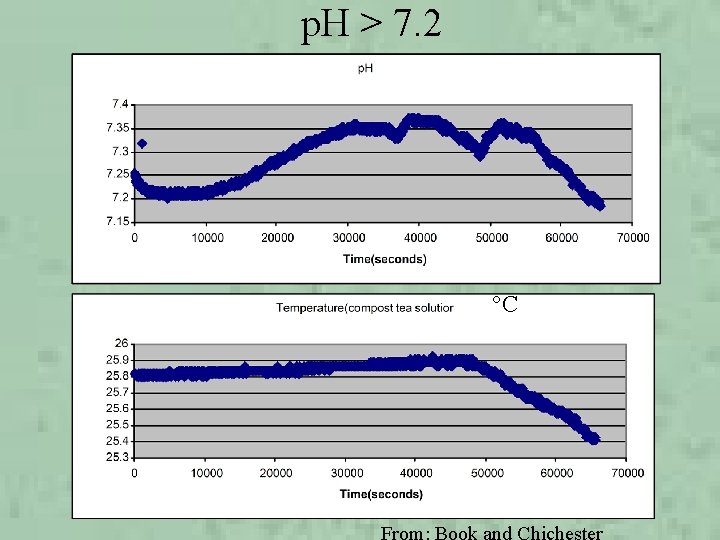
p. H > 7. 2 °C
Food web concept ”Everything eats, everything excretes, and everything is food for something" – Elaine Ingham, 2001 A great resource: SWCS/NRCS, Soil Biology Primer
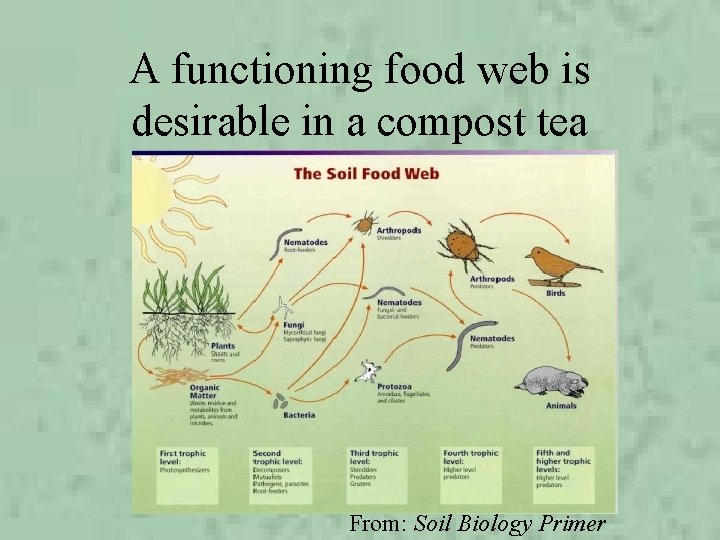
A functioning food web is desirable in a compost tea From: Soil Biology Primer
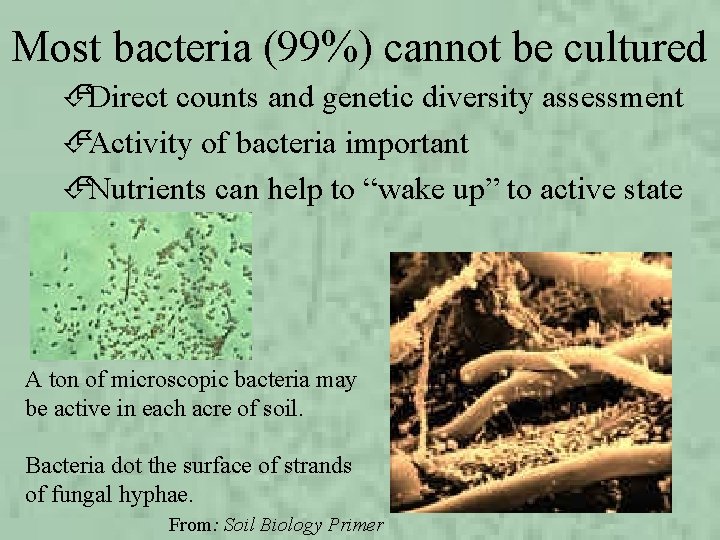
Most bacteria (99%) cannot be cultured ÉDirect counts and genetic diversity assessment ÉActivity of bacteria important ÉNutrients can help to “wake up” to active state A ton of microscopic bacteria may be active in each acre of soil. Bacteria dot the surface of strands of fungal hyphae. From: Soil Biology Primer
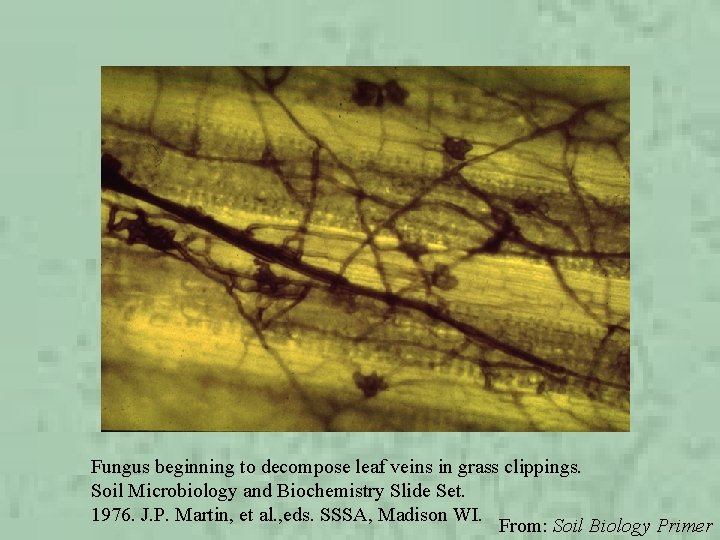
Fungus beginning to decompose leaf veins in grass clippings. Soil Microbiology and Biochemistry Slide Set. 1976. J. P. Martin, et al. , eds. SSSA, Madison WI. From: Soil Biology Primer
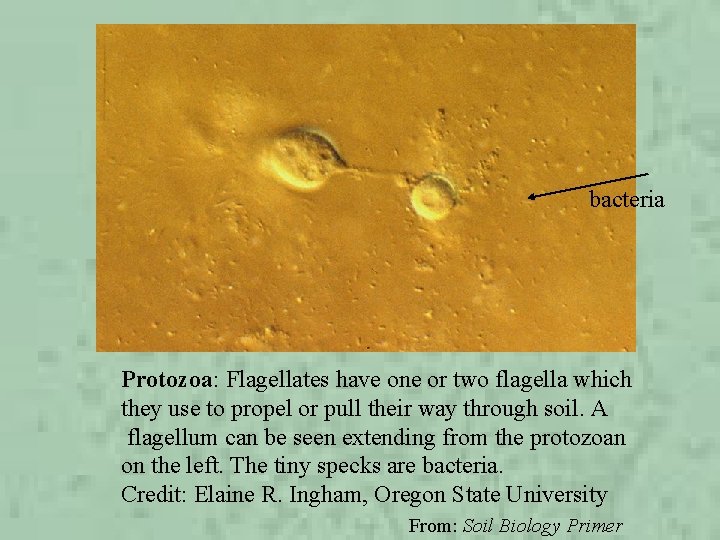
bacteria Protozoa: Flagellates have one or two flagella which they use to propel or pull their way through soil. A flagellum can be seen extending from the protozoan on the left. The tiny specks are bacteria. Credit: Elaine R. Ingham, Oregon State University From: Soil Biology Primer
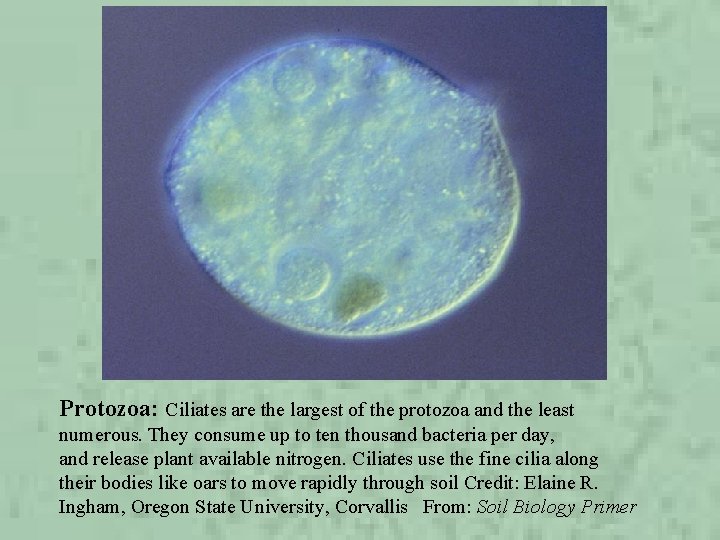
Protozoa: Ciliates are the largest of the protozoa and the least numerous. They consume up to ten thousand bacteria per day, and release plant available nitrogen. Ciliates use the fine cilia along their bodies like oars to move rapidly through soil Credit: Elaine R. Ingham, Oregon State University, Corvallis From: Soil Biology Primer
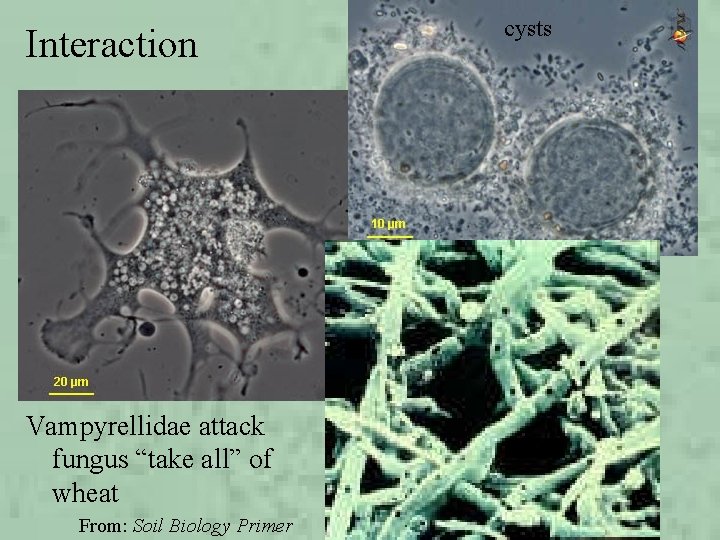
Interaction Vampyrellidae attack fungus “take all” of wheat From: Soil Biology Primer cysts
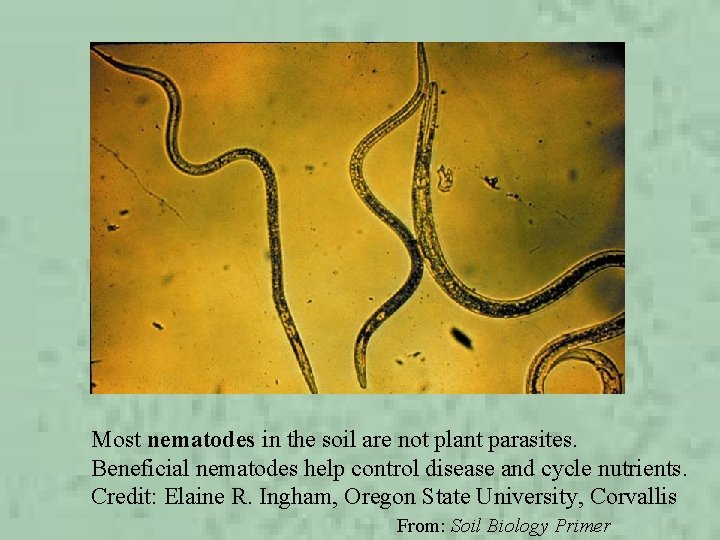
Most nematodes in the soil are not plant parasites. Beneficial nematodes help control disease and cycle nutrients. Credit: Elaine R. Ingham, Oregon State University, Corvallis From: Soil Biology Primer
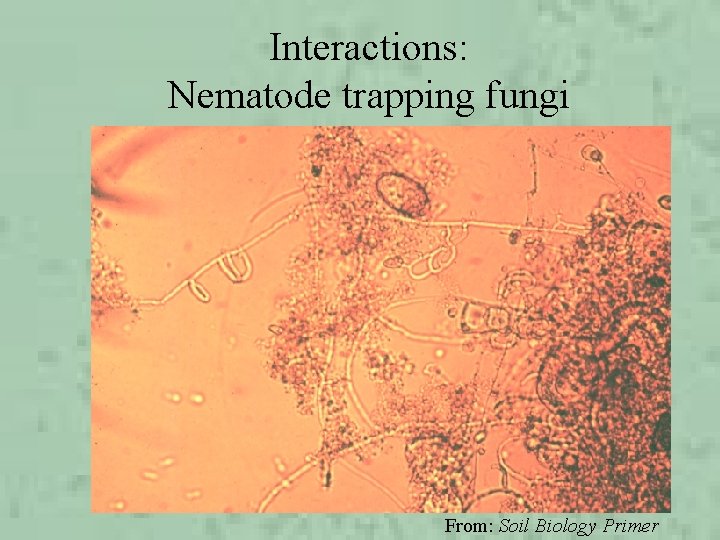
Interactions: Nematode trapping fungi From: Soil Biology Primer
Total population of active microbes ÉBacteria minimum 107 -1010 (Scheurell and Mahaffee) ÉBut may not be associated with disease control, if appropriate agent not present!
Do we know what the diversity or quantity of microbes means with respect to disease? ÉNot entirely ÉMost soil organisms are unknown! ÉDoes microbial diversity increase microbial function? ÉIf we are mainly interested in disease prevention then do we know what mechanism and whether that organism is involved? ÉIn general more diversity means better change that have the appropriate organism
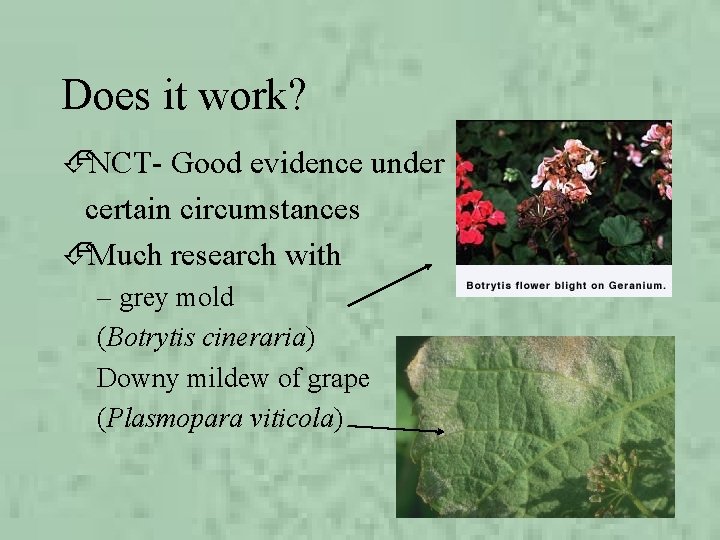
Does it work? ÉNCT- Good evidence under certain circumstances ÉMuch research with – grey mold (Botrytis cineraria) Downy mildew of grape (Plasmopara viticola)
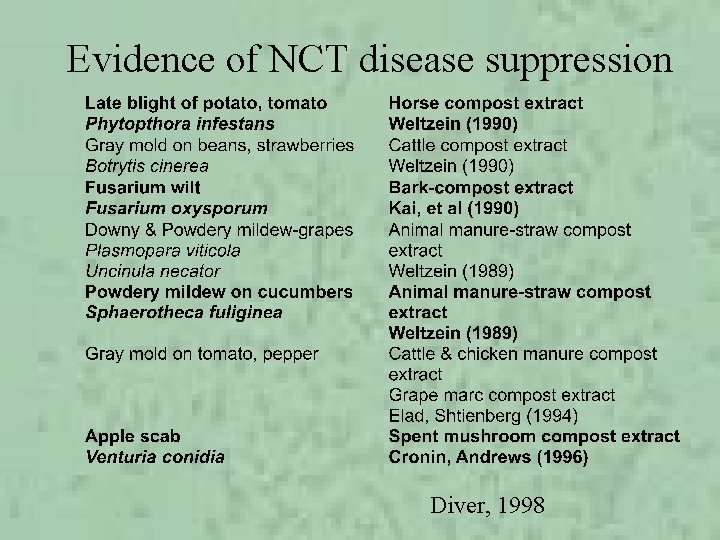
Evidence of NCT disease suppression Diver, 1998
Is ACT better than NCT? ÉBoth ferment well-characterized compost in water for a period of time, with or without nutrients ÉFew studies have actually compared the two ÉNCT has been suggested to cause plant problems and potentially an environment for human pathogen growth (Ingham) ÉAccording to Scheuerell and Mahaffee, there is no evidence that phytotoxic symptoms
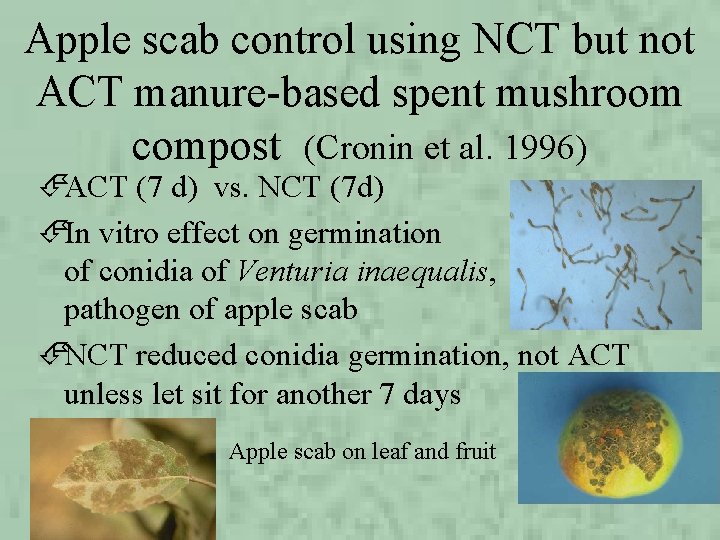
Apple scab control using NCT but not ACT manure-based spent mushroom compost (Cronin et al. 1996) ÉACT (7 d) vs. NCT (7 d) ÉIn vitro effect on germination of conidia of Venturia inaequalis, pathogen of apple scab ÉNCT reduced conidia germination, not ACT unless let sit for another 7 days Apple scab on leaf and fruit
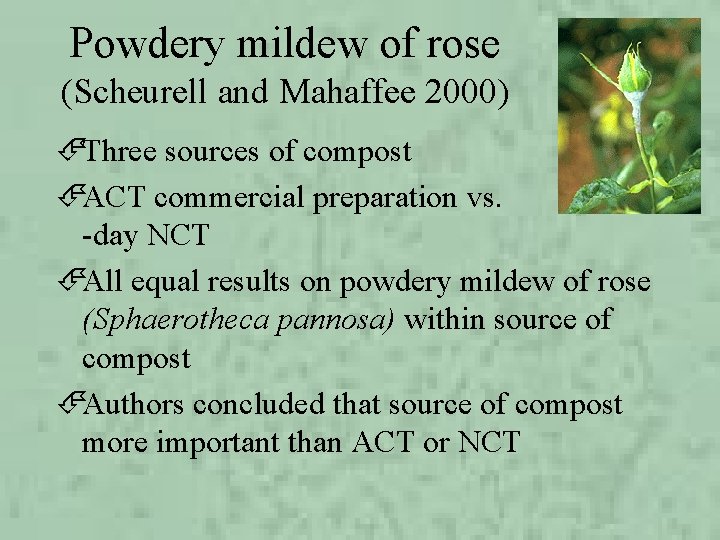
Powdery mildew of rose (Scheurell and Mahaffee 2000) ÉThree sources of compost ÉACT commercial preparation vs. 7 -day NCT ÉAll equal results on powdery mildew of rose (Sphaerotheca pannosa) within source of compost ÉAuthors concluded that source of compost more important than ACT or NCT
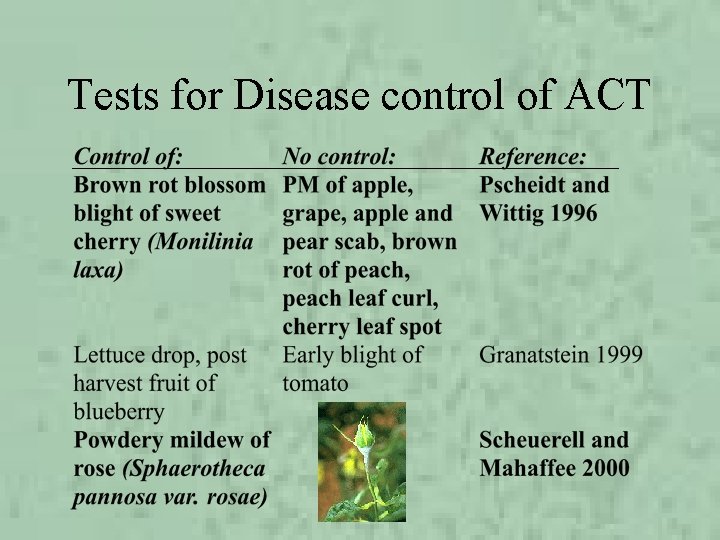
Tests for Disease control of ACT
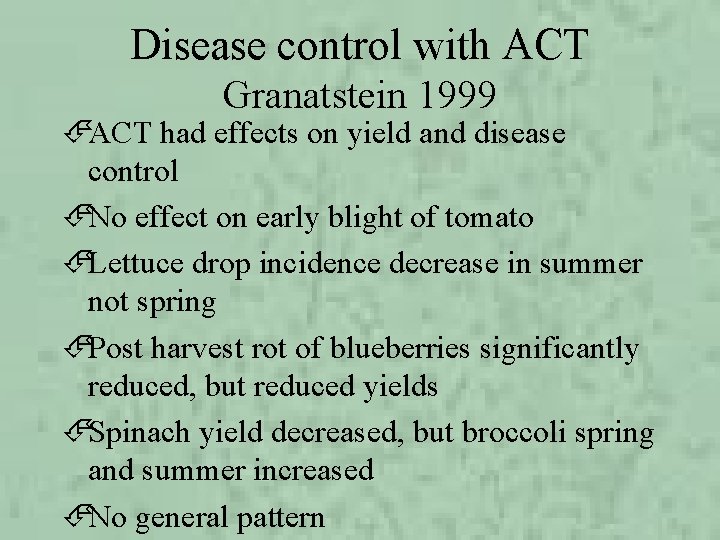
Disease control with ACT Granatstein 1999 ÉACT had effects on yield and disease control ÉNo effect on early blight of tomato ÉLettuce drop incidence decrease in summer not spring ÉPost harvest rot of blueberries significantly reduced, but reduced yields ÉSpinach yield decreased, but broccoli spring and summer increased ÉNo general pattern
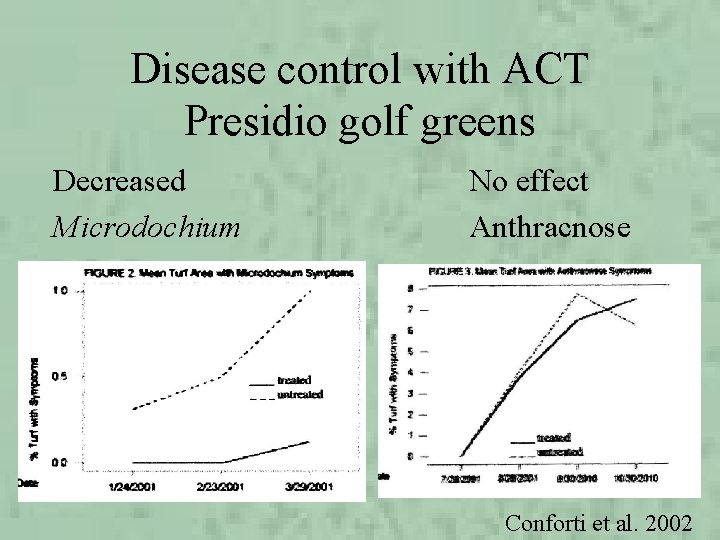
Disease control with ACT Presidio golf greens Decreased Microdochium No effect Anthracnose Conforti et al. 2002
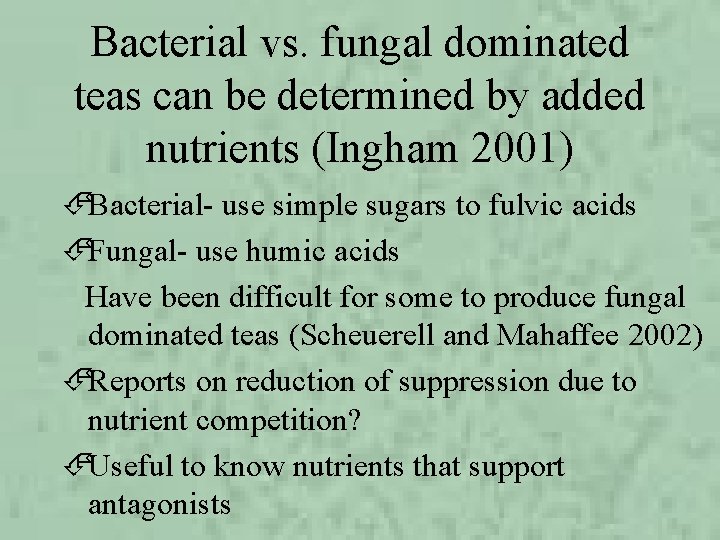
Bacterial vs. fungal dominated teas can be determined by added nutrients (Ingham 2001) ÉBacterial- use simple sugars to fulvic acids ÉFungal- use humic acids Have been difficult for some to produce fungal dominated teas (Scheuerell and Mahaffee 2002) ÉReports on reduction of suppression due to nutrient competition? ÉUseful to know nutrients that support antagonists
How might compost teas work? Mechanisms from NCT ÉPrevention of pathogen colonization – due to competition of space or nutrients – direct destruction of pathogen ÉAntibiosis – Release of antimicrobial compounds ÉInduced resistance
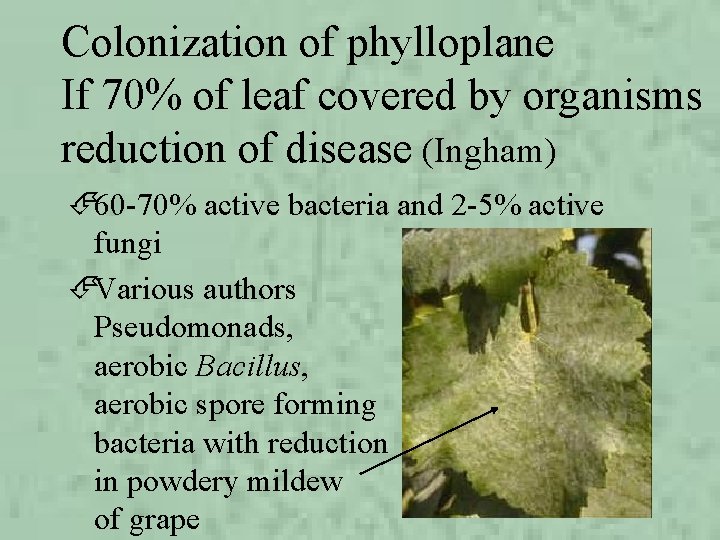
Colonization of phylloplane If 70% of leaf covered by organisms reduction of disease (Ingham) É60 -70% active bacteria and 2 -5% active fungi ÉVarious authors Pseudomonads, aerobic Bacillus, aerobic spore forming bacteria with reduction in powdery mildew of grape
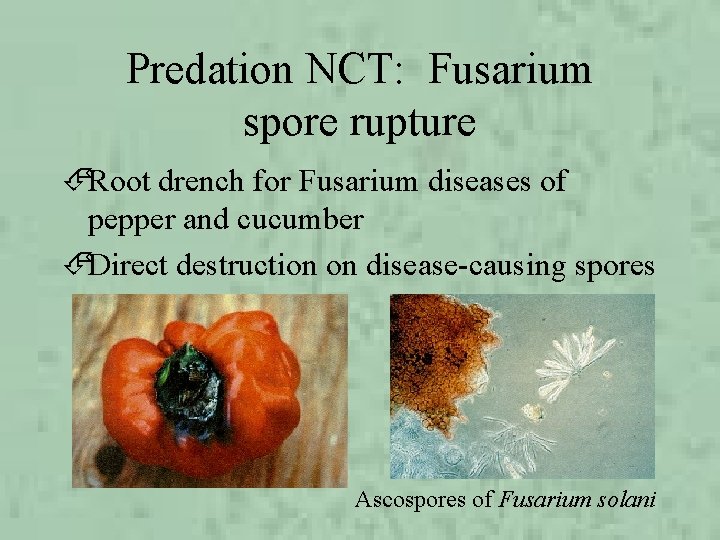
Predation NCT: Fusarium spore rupture ÉRoot drench for Fusarium diseases of pepper and cucumber ÉDirect destruction on disease-causing spores Ascospores of Fusarium solani
Antibiosis: what organisms and metabolites may be involved? ÉBacteria- Bacillus, Pseudomonas, Serrantia ÉYeast- Sporobolomyces, Cryptococcus ÉFungi- Trichoderma, Gliocladium and Penicillium Chemicals involved - phenols, amino acids, low molecular weight non-protein (sometimes produced by fermentation and other times already within compost)
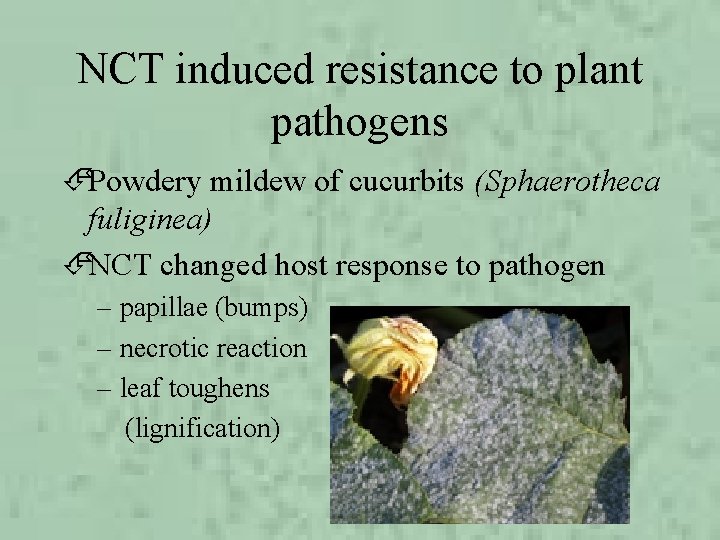
NCT induced resistance to plant pathogens ÉPowdery mildew of cucurbits (Sphaerotheca fuliginea) ÉNCT changed host response to pathogen – papillae (bumps) – necrotic reaction – leaf toughens (lignification)
Standards for compost tea So far only one proposed minimum standards (Ingham 2001) – oxygen concentration remain above 5. 5 ppm or 60% DO [but there is disease suppression in NCT] – in vitro pathogen inhibition [but question as to whether this reflects field conditions]
Minimum standards for compost tea/m. L (Ingham 2001) É10 -150 g active bacteria, 150 -300 g total bacteria É2 -10 g active fungi, 5 -20 total fungi É1000 flagellated protozoa É1000 amoeba-type protozoa É20 -50 ciliates protozoa É2 -10 beneficial nematodes (soil drench)
How to test? ÉSend compost tea to Soil Food Web (direct counts) ÉBBC Labs, Vicki Bess ÉNeed to correlate counts to field performance
Potential to support human pathogens ÉAppears that despite popular conception, ACT can support human pathogens if fermented with sugars (2 papers) ÉIf no sugars, including molasses, are used then neither ACT and NCT appear to be able to maintain human enteric pathogens (Escherichia, Salmonella, Shigella, Yersinia) even if contain low levels of pathogens ÉIf use worm compost as source appears that can avoid pathogens ÉNeeds more research
Summary ÉJury still out on NCT vs ACT, bacterial vs. fungal composts and tea, human pathogen tests ÉGood testimonials but variable results – May be due to variability in the compost tea due to compost quality, fermentation nutrients, fermentation time and specific microbial antagonists ÉVariability may also be due to previous use of pesticides and fertilizers
ÉImportant to understand how compost tea production and application interact with the pathogen’s biology, put your plan into practice and carefully observe results ÉNot a panacea but a great tool!
Future research ÉWe are all experimenters! – If possible send sample in for testing: BBC labs (www. bbclabs. com), Soil Food Web Inc. ÉNeed to understand connection between quantity, specific organisms, food web for disease suppression ÉHow to support the suppressive organisms and mechanisms that suppress disease, add biocontrol agents ÉEffect of cropping system-- organic vs. conventional --Duff Wilson, Fateful Harvest
Resources ÉDiver, S. 1998. 2001. www. attra. org ÉIngham, E. 2001. Compost Tea Brewing Manual. Available through: www. soilfoodweb. com ÉSoil and Water Conservation Society and NRCS. 2001. Soil Biology Primer. www. swcs. org ÉScheurell and Mahaffee. 2002. Literature Review: Compost tea: Principles and Prospects for Disease Control. Compost Science and Utilization 10(4): 313 -338 ÉBrinton, W. F. et al. 1996. Investigations into liquid compost extracts. Biocycle 37: 68 -70
PNW research experiences ÉGranatstein, D. 1999. Foliar disease control using compost teas. Compost Connection for Western Agriculture 8: 1 -4 ÉPscheidt and Wittig. 1996. Fruit and ornamental disease management testing program. Ext. Plant Path. OSU ÉScheuerell, S. 2003. Understanding How Compost Tea Can Control Disease. Biocycle 44: 20 -25
Photo credits not listed above ÉBacteria Credit: Michael T. Holmes, Oregon State University, Corvallis. From: Soil Biology Primer ÉFungus Credit: R. Campbell. In R. Campbell. 1985. Plant Microbiology. Edward Arnold; London. P 149. From: Soil Biology Primer
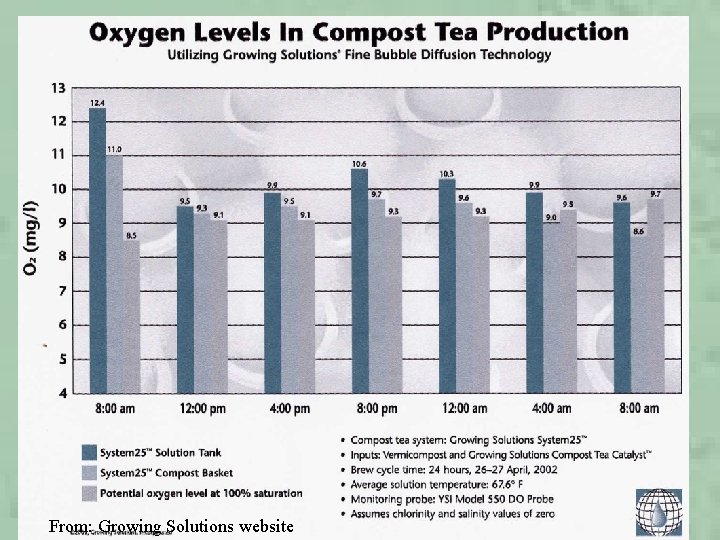
From: Growing Solutions website
- Slides: 57