
CompositionWriting Grammar Terms English 11 Mrs Gillmore Closed
- Slides: 51
Composition/Writing Grammar Terms English 11 Mrs. Gillmore
Closed Syllable A syllable ending with one or more consonants
Commentary Information Student writer’s interpretations and inferences supported with concrete information
Concrete Information Factual material from the text
Content Prose/Text Non-fiction prose selections taken from across the curriculum
Descriptive Writing Provides details about an object, place, or person purposefully to make the experience depicted come alive for the reader
Digraph Two letters that represent one speech sound – ch for /ch/ in chin or ea for /e/ in bread
Discourse Purposeful communication between people
Disinformation Deliberately misleading information announced publicly or leaked by a government or especially by an intelligence agency for the purpose of influencing public opinion or the government in another nation: – “He would be the unconscious channel for a piece of disinformation aimed at another country's intelligence service” (Ken Follett).
Embedding Process of combining sentence in which one clause or phrase is contained inside another
Evaluation Judgment of performance as process or product or change
Expository text/writing One of the four traditional forms of composition in speech and writing (expository, narrative, descriptive, and persuasive), intended to set forth or explain
Fallacies Errors in directions or mistakes in logic
Fluency The clear, rapid, and easy expression of ideas in reading, writing, or speaking: movements that flow smoothly, easily, and readily
Focused Freewriting that is restricted by time or topic
Freewriting Writing that is unrestricted in form, style, content and purpose; a technique designed to aid the student-writer in finding a personal voice through uninhibited expression
Genre A form or style of writing – narrative (a story) – informative (a report) – functional (instructions)
Infographics Information conveyed by graphic elements – including charts, graphs, etc. , often contained in print media
Inversion An interchange of position of adjacent objects in a sequence, especially a change in normal word order, such as the placement of a verb before its subject
Kinds of Sentences Declarative—makes a statement or expresses and opinion and ends with a period; Imperative—makes a request or gives a command ends with either a period or an exclamation point; Exclamatory—expresses strong feeling and ends with an exclamation point; Interrogative—asks a question and ends with a question mark
Logic The study of criteria for the evaluation of arguments Ethos: ethical appeal Pathos: emotional appeal Logos: logical appeal
Mechanics Includes the system of symbols and cuing devices a writer uses to help readers make meaning. – Features are capitalization, punctuation, formatting, and spelling.
Mode of Writing The major types of written discourse: persuasive, expository, narrative; descriptive
Narrative Text in any form (print, oral, or visual) that recounts events or tells a story
Non-Print Text Any text that creates meaning through sounds or images or both – photographs, drawings, collages, films, videos, computer graphics, speeches, oral poems and tales, and songs
Onset The consonants preceding the vowel of a syllable, as /str/ in strip and /c/ in cat
Organizational Structure Compare/contrast analyze cause/effect chronological order Inference evaluation
Personal Voice In writing, the distinctive way in which the writer expresses ideas with respect to style, form, content, purpose, etc; author’s voice
Phoneme The smallest units of sound in a given language The phonemes in the words are not always the same as the letters in a word. In the word dog, there are three phonemes [d-o-g] and three letters. In the word snow, there are three phonemes [s-no] but four letters. )
Phonics A term generally used to refer to the system of sound-letter relationships used in reading and writing. Phonics begins with the understanding that each letter (or grapheme) of the English alphabet stands for one or more sounds (or phonemes).
Portfolio A systematic and purpose collection of a variety of materials related to student learning.
Presentation May be oral, written, graphic, or musical and include art, music, writing
Prewriting Activities List Survey Read Discuss Freewrite (focused/unfocused) Learning and reading log Gather data Conduct experiments, Debate Interview Observe Use visual aids including mapping, webbing, and formal outlining to gather and organize material for writing
Primary Sources Firsthand information, including memoirs, interviews, letters, and public documents
Prose The ordinary language of men in speaking or writing; language not cast in poetical measure or rhythm; distinguished from verse or metrical composition. – I speak in prose, and let him rymes make. --Chaucer.
Rhetorical Devices Use of language mainly by the arrangement of words to achieve special effects
Rhetorical Strategies Plans used in arranging writing tasks or compositions, – Comparison/contrast – Narration – Description – Process analysis
Rubric A scoring guide used to evaluate the quality of a student performance; typically, a rubric lists criteria that describe levels of proficiency on a task
Secondary Sources Works that have been collected, interpreted, or published by someone other than the original source
Sentence Formation Reflects the writer’s ability to form competent, appropriately mature sentences to express thoughts. Features of this writing domain – – – completeness absence of fused sentences expansion through standard coordination and modifiers – embedding through standard subordination and modifiers – standard word order.
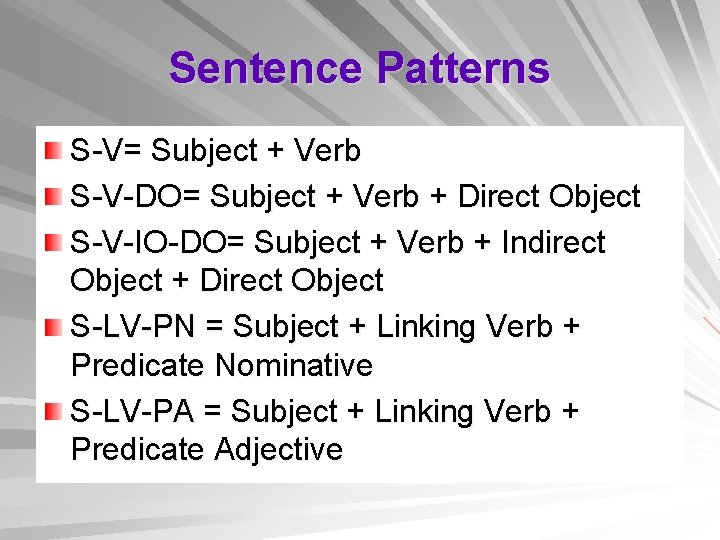
Sentence Patterns S-V= Subject + Verb S-V-DO= Subject + Verb + Direct Object S-V-IO-DO= Subject + Verb + Indirect Object + Direct Object S-LV-PN = Subject + Linking Verb + Predicate Nominative S-LV-PA = Subject + Linking Verb + Predicate Adjective
Socratic Discourse A technique in which a teacher does not give information directly but instead asks a series of questions – with the result that the student comes either to the desired knowledge by answering the questions or to a deeper awareness of the limits of knowledge
Style The characteristics of a work that reflect the author’s distinctive way of writing; an author’s use of language, its effects, and its appropriateness to the author’s intent and theme
Syntax The rules by which words are combined to form grammatically correct sentences (i. e. , plurals, future tense, etc. ); the study of how sentences are formed and the grammatical rules that govern their formation
Text Features Format, italics, headings, sub-headings, graphics, sequence, diagrams, illustrations
Types of Sentences Simple—consists of one independent clause Compound—consists of two or more independent clauses Complex—consists of one independent clause and one or more dependent (subordinate) clauses Compound-complex—consists of tow or more independent clauses and one or more dependent (subordinate) clauses
Usage Comprises the writer’s use of word-level features that cause written language to be acceptable and effective for standard discourse. Features are standard inflections, agreement, word meaning, and conventions.
Verbals Forms of a verb that is used as other parts of speech. Three types of verbals Infinitives Gerunds participles.
Visual Aids Presentational tools that appeal to the sight and are used for illustration and demonstration
Visualization The process or result of mentally picturing objects or events that are normally experienced directly
Writing Process The many aspects of the complex act of producing a written communication Planning Drafting Revising Editing Publishing