
Composition of Substances and Solutions Atomic Mass and
Composition of Substances and Solutions • • Atomic Mass and Formula Mass; The Mole & Molar Mass; Percent Composition of Compounds; Determination of Empirical & Molecular Formulas; • Molarity • Other Units for Solution Concentrations
Atomic Masses • Absolute masses of atoms cannot be obtained – too small to measure the mass directly; • Atomic mass is expressed as relative mass – masses relative to a chosen standard or reference. • Carbon-12: chosen as reference; assigned an atomic mass of 12 u exactly; • Masses of other atoms are relative to that of carbon-12 atom; • Relative atomic masses are determined using mass spectrophotometer;
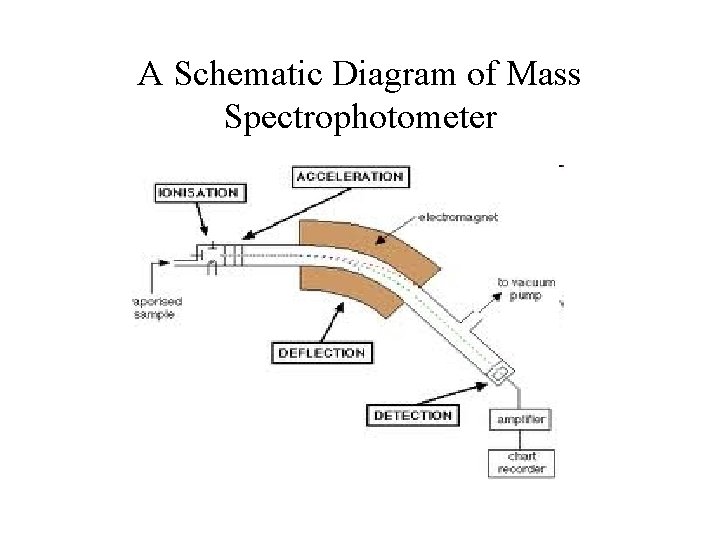
A Schematic Diagram of Mass Spectrophotometer
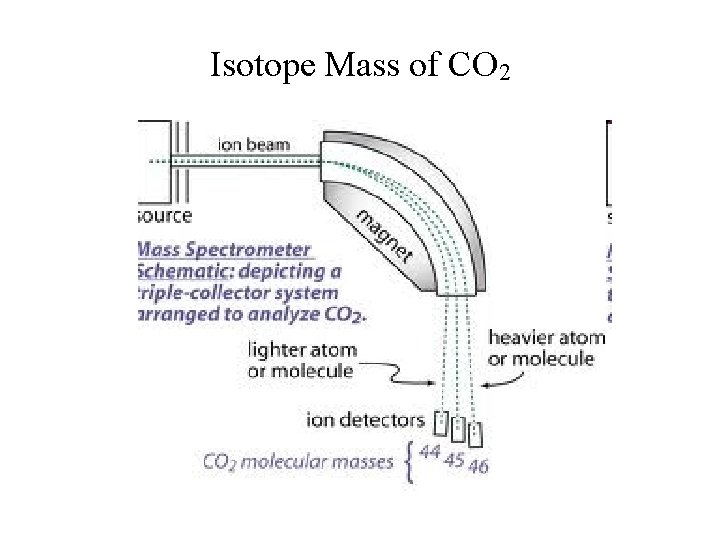
Isotope Mass of CO 2
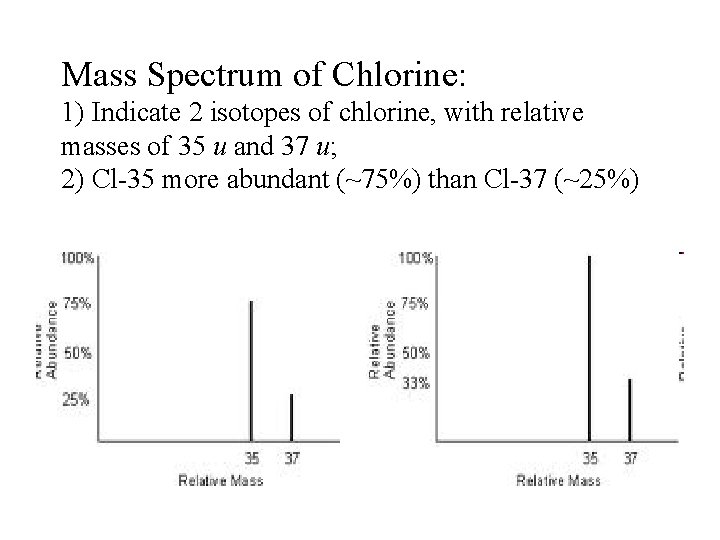
Mass Spectrum of Chlorine: 1) Indicate 2 isotopes of chlorine, with relative masses of 35 u and 37 u; 2) Cl-35 more abundant (~75%) than Cl-37 (~25%)
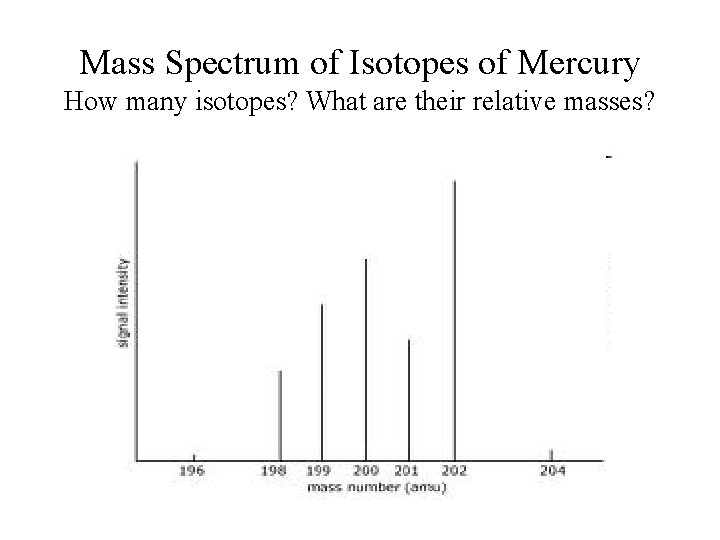
Mass Spectrum of Isotopes of Mercury How many isotopes? What are their relative masses?
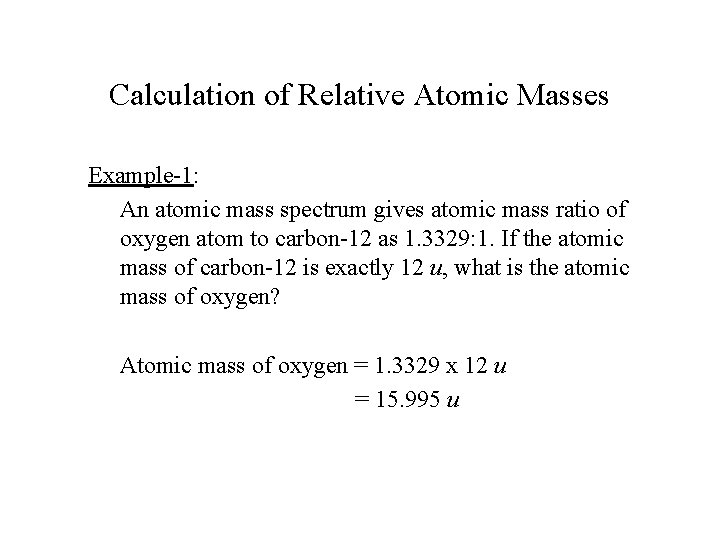
Calculation of Relative Atomic Masses Example-1: An atomic mass spectrum gives atomic mass ratio of oxygen atom to carbon-12 as 1. 3329: 1. If the atomic mass of carbon-12 is exactly 12 u, what is the atomic mass of oxygen? Atomic mass of oxygen = 1. 3329 x 12 u = 15. 995 u
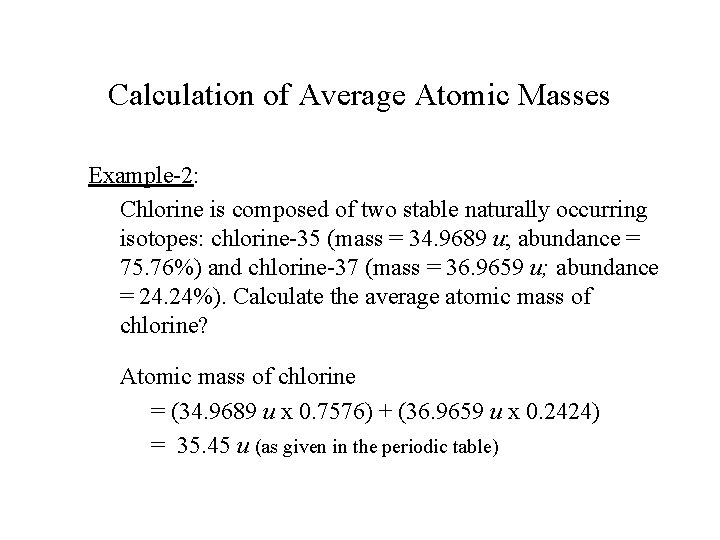
Calculation of Average Atomic Masses Example-2: Chlorine is composed of two stable naturally occurring isotopes: chlorine-35 (mass = 34. 9689 u; abundance = 75. 76%) and chlorine-37 (mass = 36. 9659 u; abundance = 24. 24%). Calculate the average atomic mass of chlorine? Atomic mass of chlorine = (34. 9689 u x 0. 7576) + (36. 9659 u x 0. 2424) = 35. 45 u (as given in the periodic table)
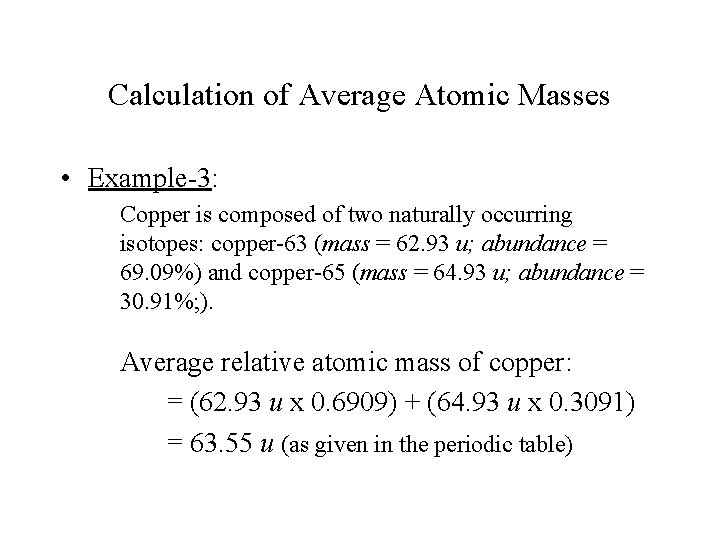
Calculation of Average Atomic Masses • Example-3: Copper is composed of two naturally occurring isotopes: copper-63 (mass = 62. 93 u; abundance = 69. 09%) and copper-65 (mass = 64. 93 u; abundance = 30. 91%; ). Average relative atomic mass of copper: = (62. 93 u x 0. 6909) + (64. 93 u x 0. 3091) = 63. 55 u (as given in the periodic table)
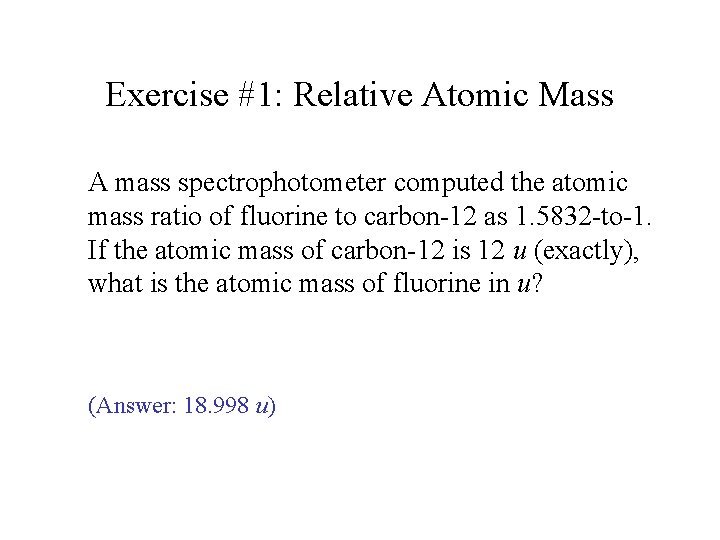
Exercise #1: Relative Atomic Mass A mass spectrophotometer computed the atomic mass ratio of fluorine to carbon-12 as 1. 5832 -to-1. If the atomic mass of carbon-12 is 12 u (exactly), what is the atomic mass of fluorine in u? (Answer: 18. 998 u)
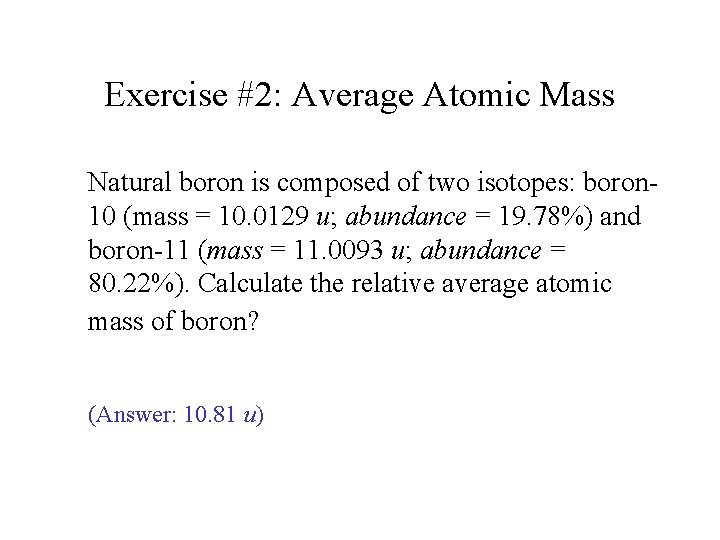
Exercise #2: Average Atomic Mass Natural boron is composed of two isotopes: boron 10 (mass = 10. 0129 u; abundance = 19. 78%) and boron-11 (mass = 11. 0093 u; abundance = 80. 22%). Calculate the relative average atomic mass of boron? (Answer: 10. 81 u)
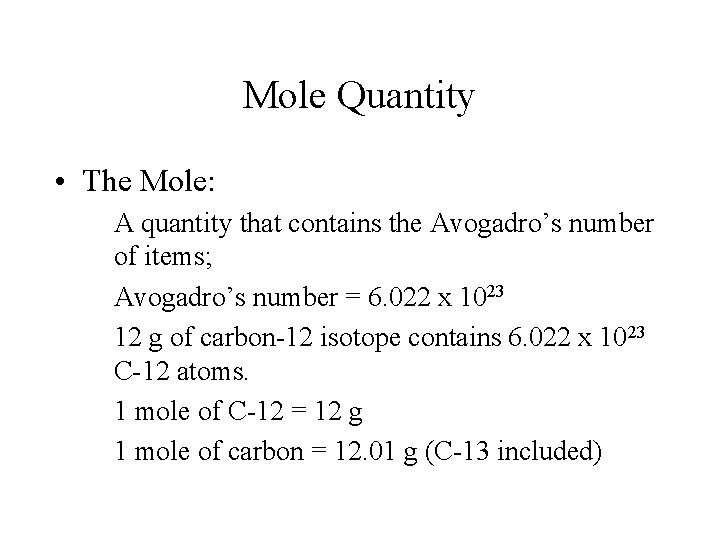
Mole Quantity • The Mole: A quantity that contains the Avogadro’s number of items; Avogadro’s number = 6. 022 x 1023 12 g of carbon-12 isotope contains 6. 022 x 1023 C-12 atoms. 1 mole of C-12 = 12 g 1 mole of carbon = 12. 01 g (C-13 included)
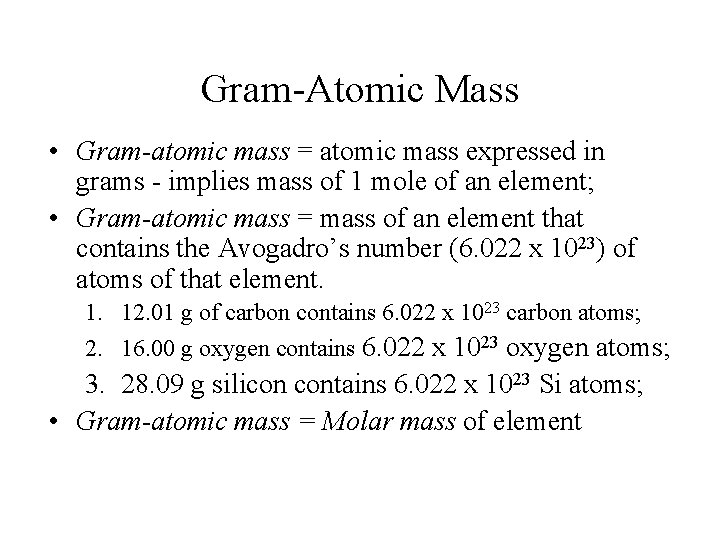
Gram-Atomic Mass • Gram-atomic mass = atomic mass expressed in grams - implies mass of 1 mole of an element; • Gram-atomic mass = mass of an element that contains the Avogadro’s number (6. 022 x 1023) of atoms of that element. 1. 12. 01 g of carbon contains 6. 022 x 1023 carbon atoms; 2. 16. 00 g oxygen contains 6. 022 x 1023 oxygen atoms; 3. 28. 09 g silicon contains 6. 022 x 1023 Si atoms; • Gram-atomic mass = Molar mass of element
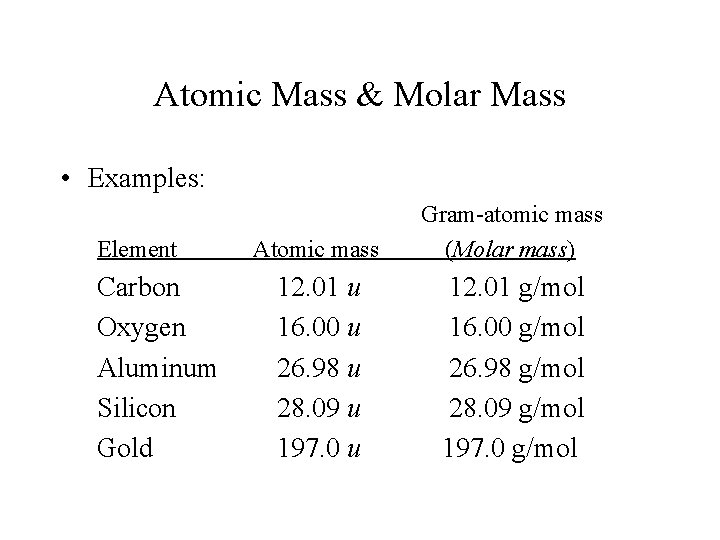
Atomic Mass & Molar Mass • Examples: Element Carbon Oxygen Aluminum Silicon Gold Atomic mass Gram-atomic mass (Molar mass) 12. 01 u 16. 00 u 26. 98 u 28. 09 u 197. 0 u 12. 01 g/mol 16. 00 g/mol 26. 98 g/mol 28. 09 g/mol 197. 0 g/mol
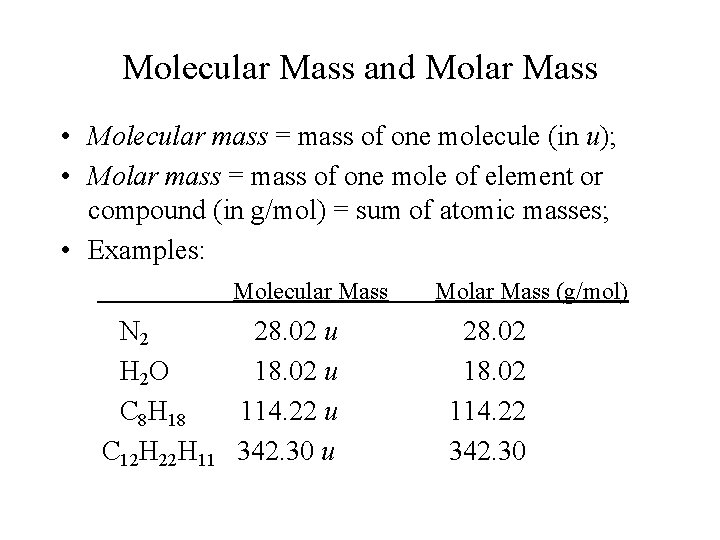
Molecular Mass and Molar Mass • Molecular mass = mass of one molecule (in u); • Molar mass = mass of one mole of element or compound (in g/mol) = sum of atomic masses; • Examples: Molecular Mass N 2 28. 02 u H 2 O 18. 02 u C 8 H 18 114. 22 u C 12 H 22 H 11 342. 30 u Molar Mass (g/mol) 28. 02 114. 22 342. 30
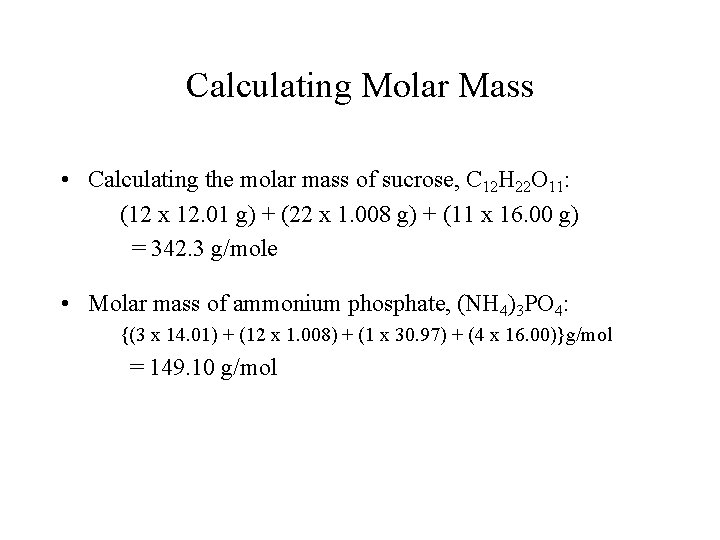
Calculating Molar Mass • Calculating the molar mass of sucrose, C 12 H 22 O 11: (12 x 12. 01 g) + (22 x 1. 008 g) + (11 x 16. 00 g) = 342. 3 g/mole • Molar mass of ammonium phosphate, (NH 4)3 PO 4: {(3 x 14. 01) + (12 x 1. 008) + (1 x 30. 97) + (4 x 16. 00)}g/mol = 149. 10 g/mol
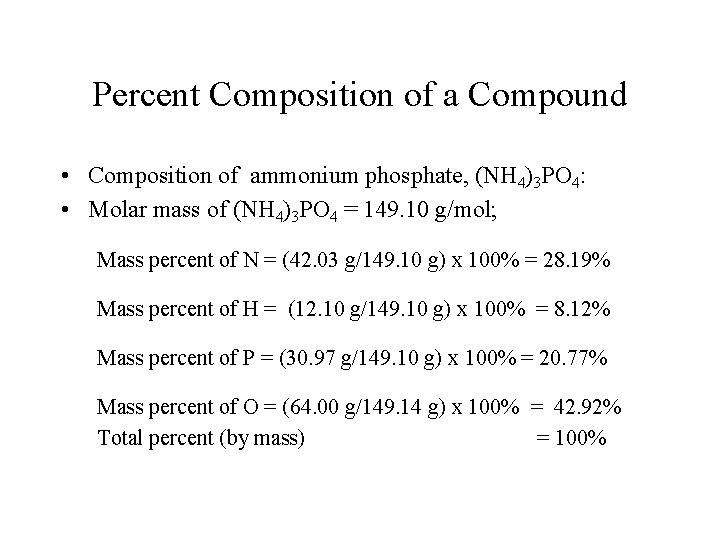
Percent Composition of a Compound • Composition of ammonium phosphate, (NH 4)3 PO 4: • Molar mass of (NH 4)3 PO 4 = 149. 10 g/mol; Mass percent of N = (42. 03 g/149. 10 g) x 100% = 28. 19% Mass percent of H = (12. 10 g/149. 10 g) x 100% = 8. 12% Mass percent of P = (30. 97 g/149. 10 g) x 100% = 20. 77% Mass percent of O = (64. 00 g/149. 14 g) x 100% = 42. 92% Total percent (by mass) = 100%
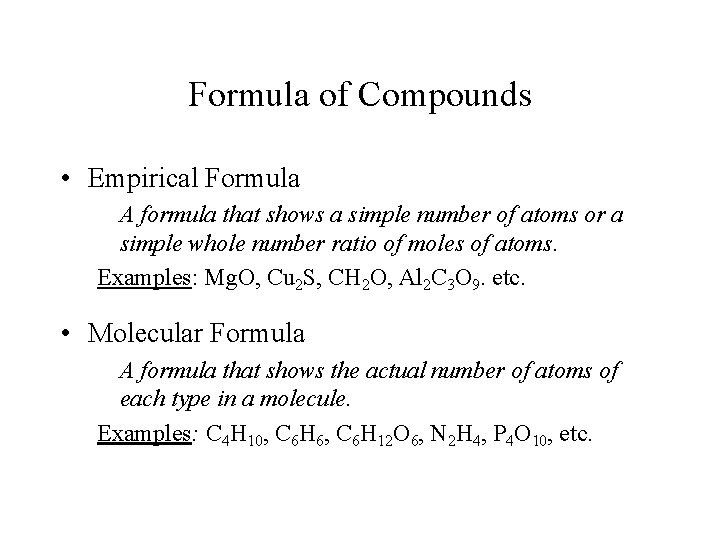
Formula of Compounds • Empirical Formula A formula that shows a simple number of atoms or a simple whole number ratio of moles of atoms. Examples: Mg. O, Cu 2 S, CH 2 O, Al 2 C 3 O 9. etc. • Molecular Formula A formula that shows the actual number of atoms of each type in a molecule. Examples: C 4 H 10, C 6 H 6, C 6 H 12 O 6, N 2 H 4, P 4 O 10, etc.
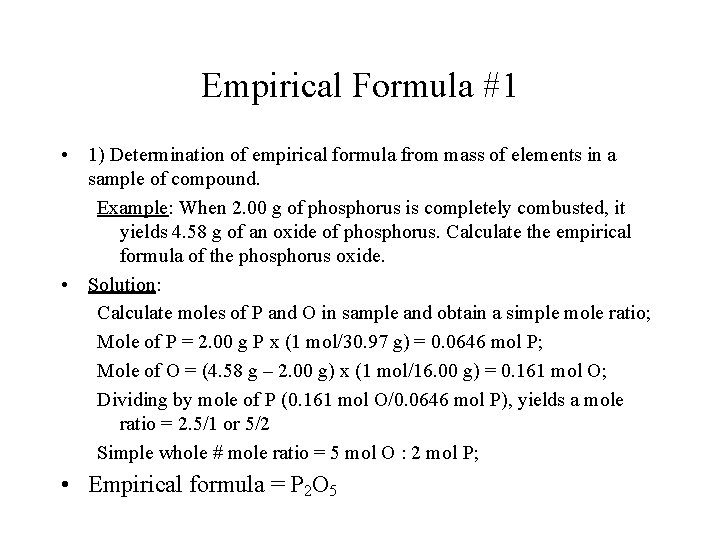
Empirical Formula #1 • 1) Determination of empirical formula from mass of elements in a sample of compound. Example: When 2. 00 g of phosphorus is completely combusted, it yields 4. 58 g of an oxide of phosphorus. Calculate the empirical formula of the phosphorus oxide. • Solution: Calculate moles of P and O in sample and obtain a simple mole ratio; Mole of P = 2. 00 g P x (1 mol/30. 97 g) = 0. 0646 mol P; Mole of O = (4. 58 g – 2. 00 g) x (1 mol/16. 00 g) = 0. 161 mol O; Dividing by mole of P (0. 161 mol O/0. 0646 mol P), yields a mole ratio = 2. 5/1 or 5/2 Simple whole # mole ratio = 5 mol O : 2 mol P; • Empirical formula = P 2 O 5
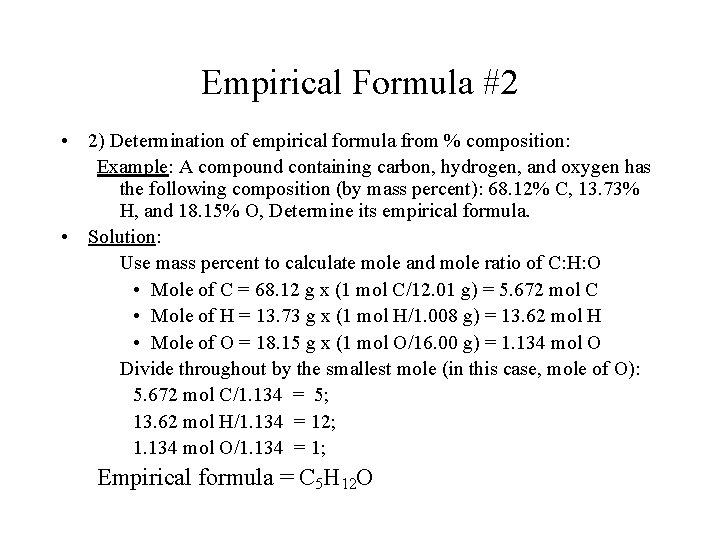
Empirical Formula #2 • 2) Determination of empirical formula from % composition: Example: A compound containing carbon, hydrogen, and oxygen has the following composition (by mass percent): 68. 12% C, 13. 73% H, and 18. 15% O, Determine its empirical formula. • Solution: Use mass percent to calculate mole and mole ratio of C: H: O • Mole of C = 68. 12 g x (1 mol C/12. 01 g) = 5. 672 mol C • Mole of H = 13. 73 g x (1 mol H/1. 008 g) = 13. 62 mol H • Mole of O = 18. 15 g x (1 mol O/16. 00 g) = 1. 134 mol O Divide throughout by the smallest mole (in this case, mole of O): 5. 672 mol C/1. 134 = 5; 13. 62 mol H/1. 134 = 12; 1. 134 mol O/1. 134 = 1; Empirical formula = C 5 H 12 O
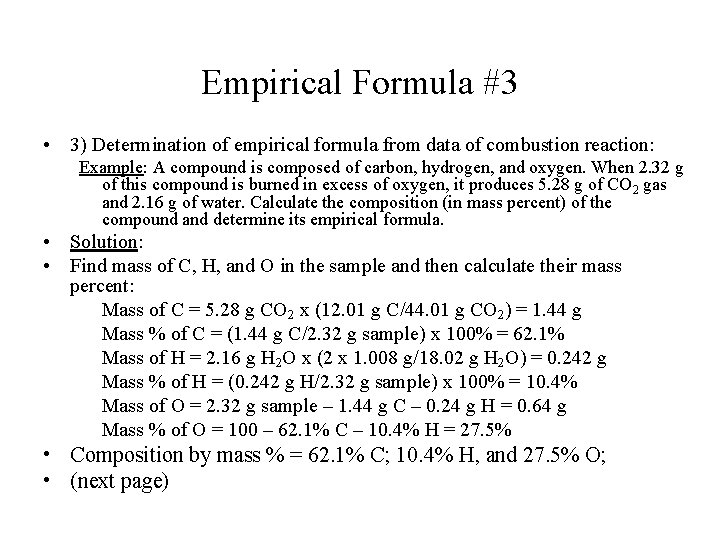
Empirical Formula #3 • 3) Determination of empirical formula from data of combustion reaction: Example: A compound is composed of carbon, hydrogen, and oxygen. When 2. 32 g of this compound is burned in excess of oxygen, it produces 5. 28 g of CO 2 gas and 2. 16 g of water. Calculate the composition (in mass percent) of the compound and determine its empirical formula. • Solution: • Find mass of C, H, and O in the sample and then calculate their mass percent: Mass of C = 5. 28 g CO 2 x (12. 01 g C/44. 01 g CO 2) = 1. 44 g Mass % of C = (1. 44 g C/2. 32 g sample) x 100% = 62. 1% Mass of H = 2. 16 g H 2 O x (2 x 1. 008 g/18. 02 g H 2 O) = 0. 242 g Mass % of H = (0. 242 g H/2. 32 g sample) x 100% = 10. 4% Mass of O = 2. 32 g sample – 1. 44 g C – 0. 24 g H = 0. 64 g Mass % of O = 100 – 62. 1% C – 10. 4% H = 27. 5% • Composition by mass % = 62. 1% C; 10. 4% H, and 27. 5% O; • (next page)
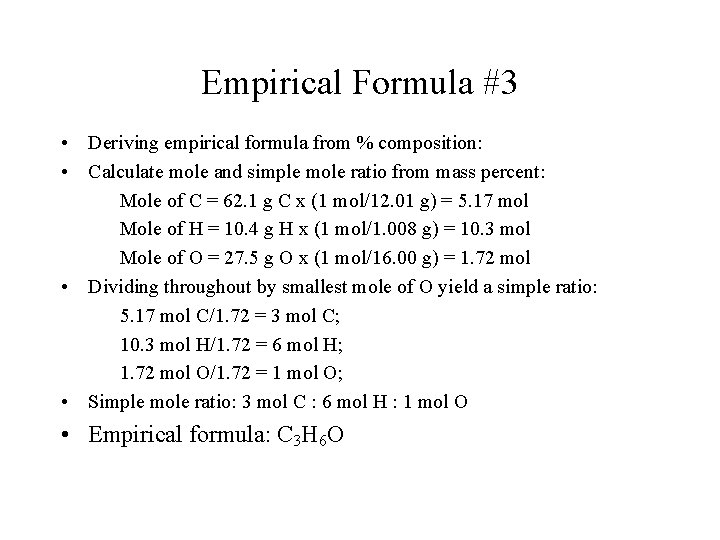
Empirical Formula #3 • Deriving empirical formula from % composition: • Calculate mole and simple mole ratio from mass percent: Mole of C = 62. 1 g C x (1 mol/12. 01 g) = 5. 17 mol Mole of H = 10. 4 g H x (1 mol/1. 008 g) = 10. 3 mol Mole of O = 27. 5 g O x (1 mol/16. 00 g) = 1. 72 mol • Dividing throughout by smallest mole of O yield a simple ratio: 5. 17 mol C/1. 72 = 3 mol C; 10. 3 mol H/1. 72 = 6 mol H; 1. 72 mol O/1. 72 = 1 mol O; • Simple mole ratio: 3 mol C : 6 mol H : 1 mol O • Empirical formula: C 3 H 6 O
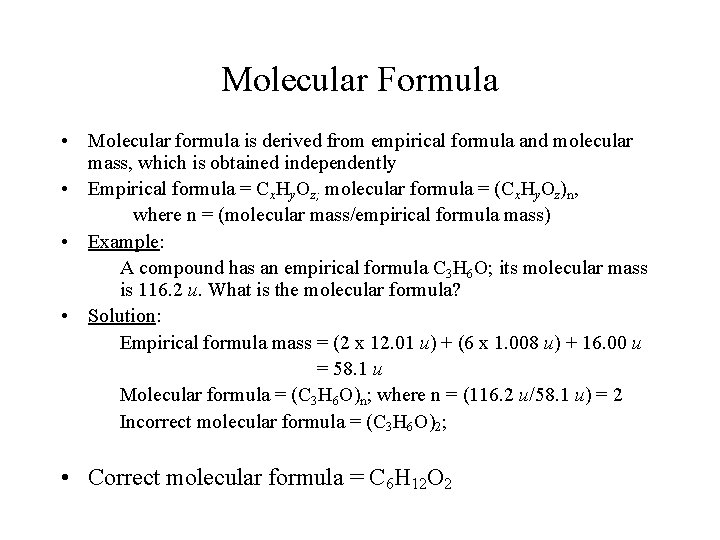
Molecular Formula • Molecular formula is derived from empirical formula and molecular mass, which is obtained independently • Empirical formula = Cx. Hy. Oz; molecular formula = (Cx. Hy. Oz)n, where n = (molecular mass/empirical formula mass) • Example: A compound has an empirical formula C 3 H 6 O; its molecular mass is 116. 2 u. What is the molecular formula? • Solution: Empirical formula mass = (2 x 12. 01 u) + (6 x 1. 008 u) + 16. 00 u = 58. 1 u Molecular formula = (C 3 H 6 O)n; where n = (116. 2 u/58. 1 u) = 2 Incorrect molecular formula = (C 3 H 6 O)2; • Correct molecular formula = C 6 H 12 O 2
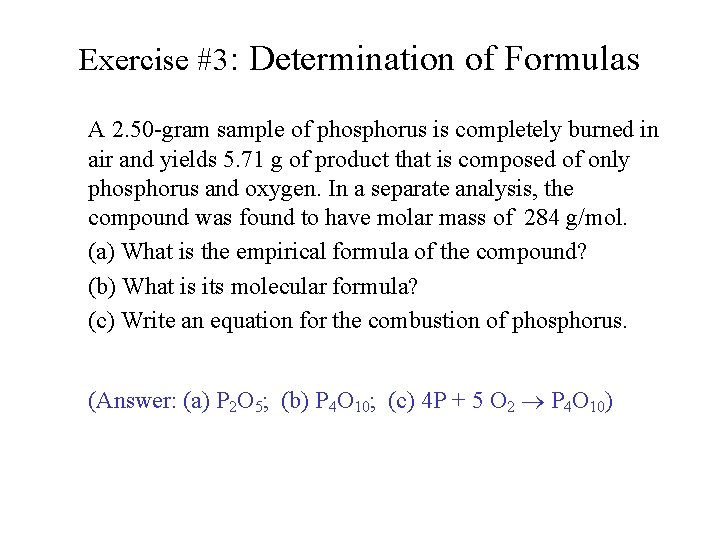
Exercise #3: Determination of Formulas A 2. 50 -gram sample of phosphorus is completely burned in air and yields 5. 71 g of product that is composed of only phosphorus and oxygen. In a separate analysis, the compound was found to have molar mass of 284 g/mol. (a) What is the empirical formula of the compound? (b) What is its molecular formula? (c) Write an equation for the combustion of phosphorus. (Answer: (a) P 2 O 5; (b) P 4 O 10; (c) 4 P + 5 O 2 P 4 O 10)
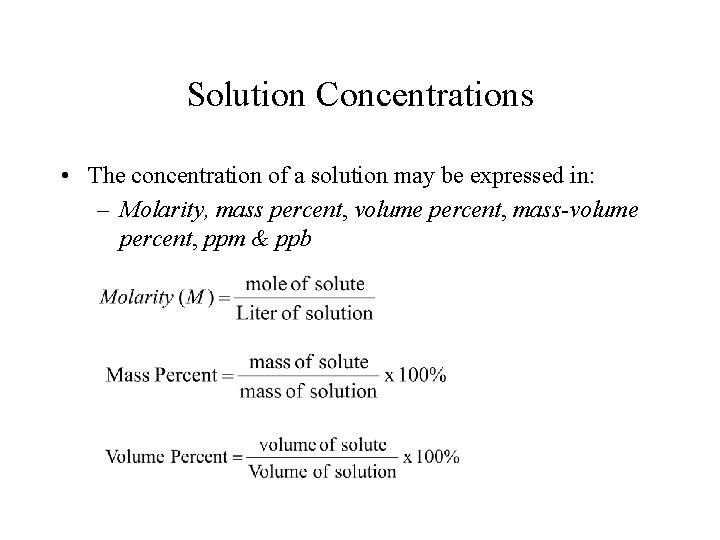
Solution Concentrations • The concentration of a solution may be expressed in: – Molarity, mass percent, volume percent, mass-volume percent, ppm & ppb
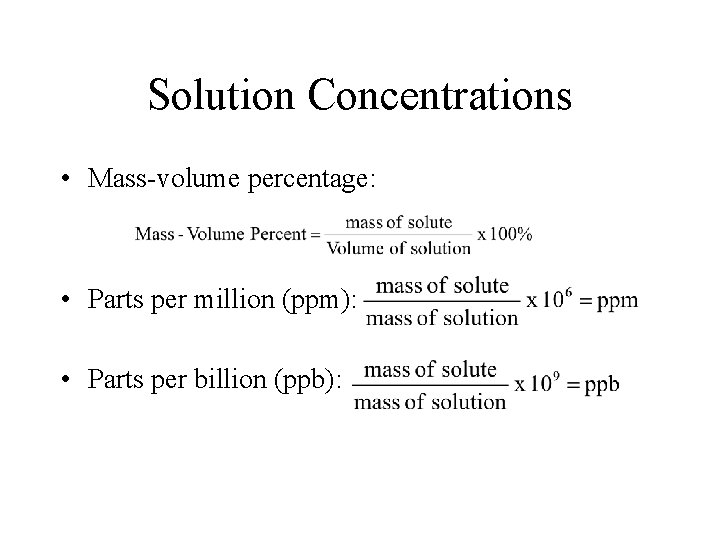
Solution Concentrations • Mass-volume percentage: • Parts per million (ppm): • Parts per billion (ppb):
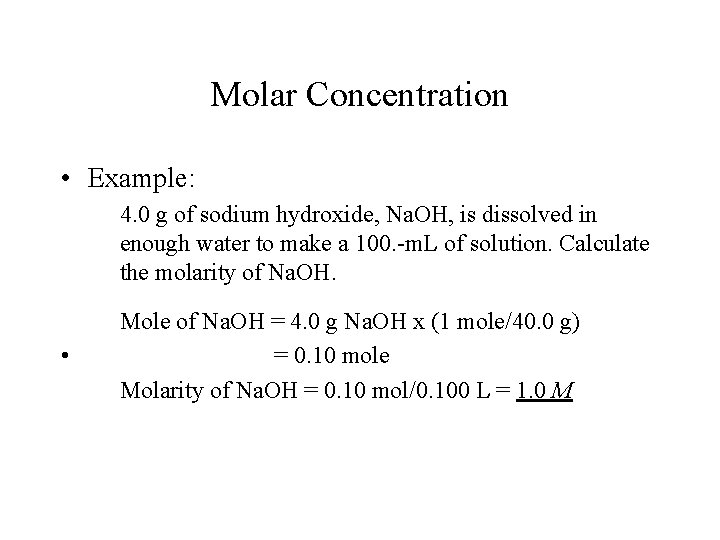
Molar Concentration • Example: 4. 0 g of sodium hydroxide, Na. OH, is dissolved in enough water to make a 100. -m. L of solution. Calculate the molarity of Na. OH. • Mole of Na. OH = 4. 0 g Na. OH x (1 mole/40. 0 g) = 0. 10 mole Molarity of Na. OH = 0. 10 mol/0. 100 L = 1. 0 M
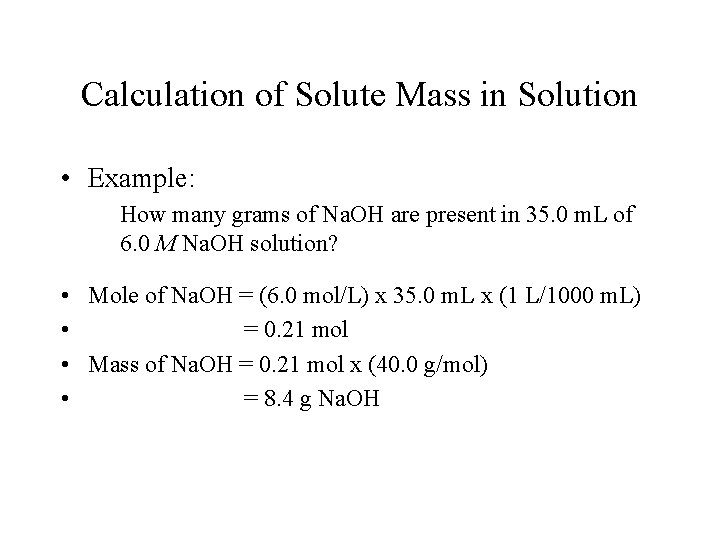
Calculation of Solute Mass in Solution • Example: How many grams of Na. OH are present in 35. 0 m. L of 6. 0 M Na. OH solution? • Mole of Na. OH = (6. 0 mol/L) x 35. 0 m. L x (1 L/1000 m. L) • = 0. 21 mol • Mass of Na. OH = 0. 21 mol x (40. 0 g/mol) • = 8. 4 g Na. OH
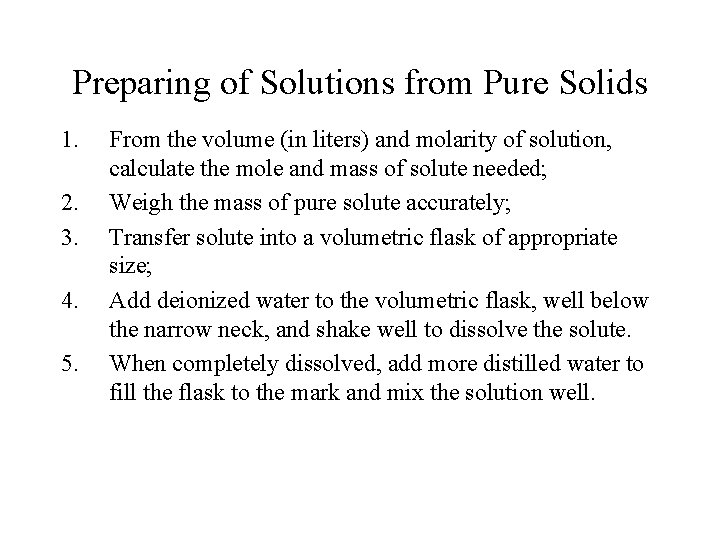
Preparing of Solutions from Pure Solids 1. 2. 3. 4. 5. From the volume (in liters) and molarity of solution, calculate the mole and mass of solute needed; Weigh the mass of pure solute accurately; Transfer solute into a volumetric flask of appropriate size; Add deionized water to the volumetric flask, well below the narrow neck, and shake well to dissolve the solute. When completely dissolved, add more distilled water to fill the flask to the mark and mix the solution well.
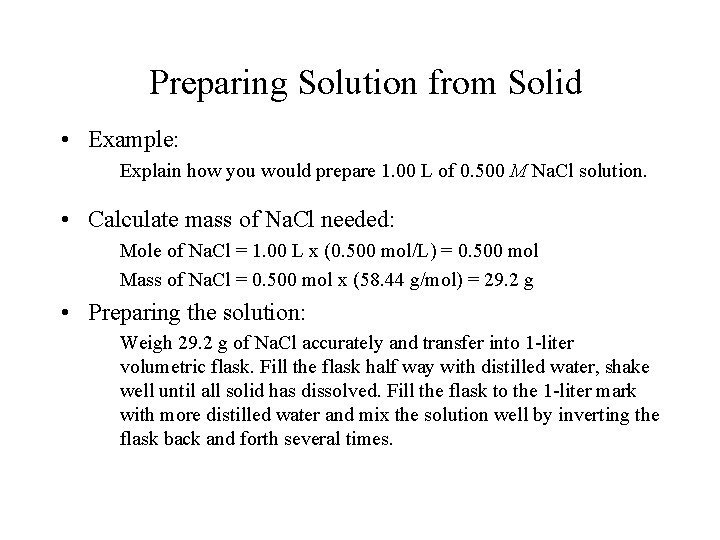
Preparing Solution from Solid • Example: Explain how you would prepare 1. 00 L of 0. 500 M Na. Cl solution. • Calculate mass of Na. Cl needed: Mole of Na. Cl = 1. 00 L x (0. 500 mol/L) = 0. 500 mol Mass of Na. Cl = 0. 500 mol x (58. 44 g/mol) = 29. 2 g • Preparing the solution: Weigh 29. 2 g of Na. Cl accurately and transfer into 1 -liter volumetric flask. Fill the flask half way with distilled water, shake well until all solid has dissolved. Fill the flask to the 1 -liter mark with more distilled water and mix the solution well by inverting the flask back and forth several times.
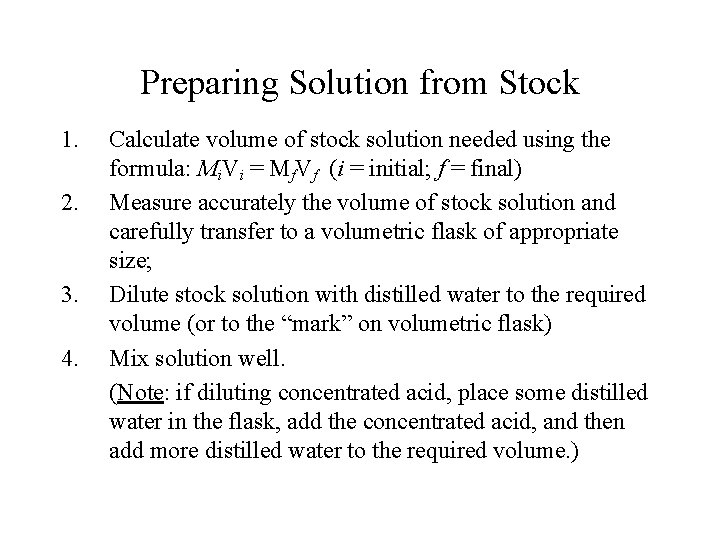
Preparing Solution from Stock 1. 2. 3. 4. Calculate volume of stock solution needed using the formula: Mi. Vi = Mf. Vf (i = initial; f = final) Measure accurately the volume of stock solution and carefully transfer to a volumetric flask of appropriate size; Dilute stock solution with distilled water to the required volume (or to the “mark” on volumetric flask) Mix solution well. (Note: if diluting concentrated acid, place some distilled water in the flask, add the concentrated acid, and then add more distilled water to the required volume. )
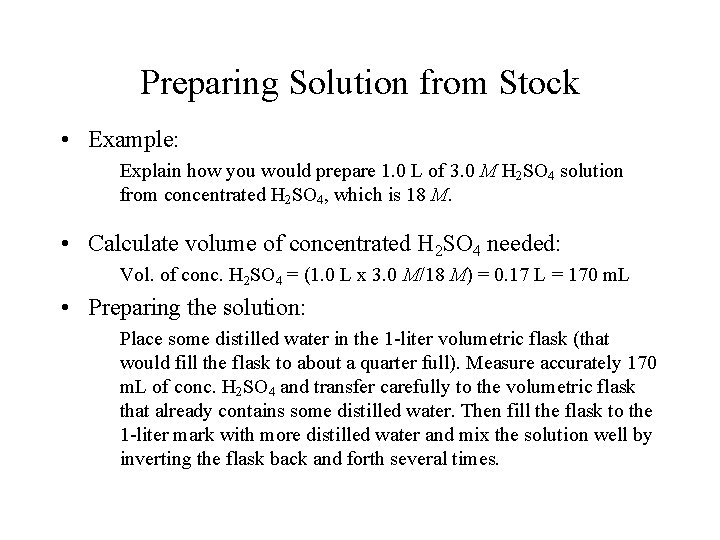
Preparing Solution from Stock • Example: Explain how you would prepare 1. 0 L of 3. 0 M H 2 SO 4 solution from concentrated H 2 SO 4, which is 18 M. • Calculate volume of concentrated H 2 SO 4 needed: Vol. of conc. H 2 SO 4 = (1. 0 L x 3. 0 M/18 M) = 0. 17 L = 170 m. L • Preparing the solution: Place some distilled water in the 1 -liter volumetric flask (that would fill the flask to about a quarter full). Measure accurately 170 m. L of conc. H 2 SO 4 and transfer carefully to the volumetric flask that already contains some distilled water. Then fill the flask to the 1 -liter mark with more distilled water and mix the solution well by inverting the flask back and forth several times.
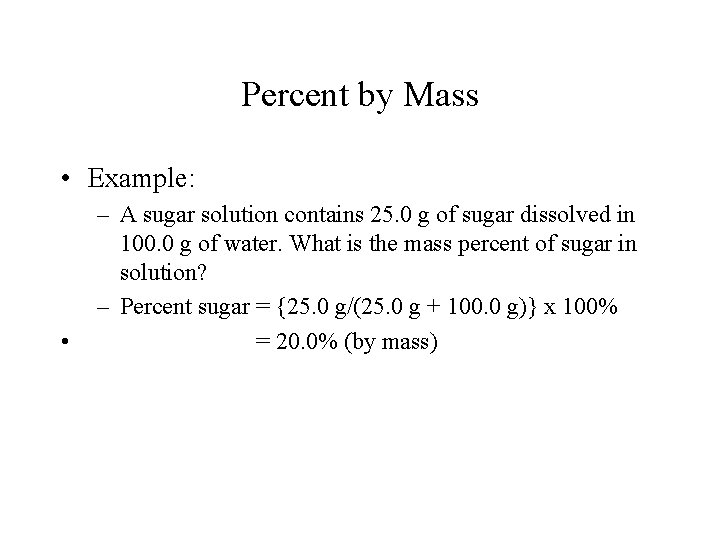
Percent by Mass • Example: • – A sugar solution contains 25. 0 g of sugar dissolved in 100. 0 g of water. What is the mass percent of sugar in solution? – Percent sugar = {25. 0 g/(25. 0 g + 100. 0 g)} x 100% = 20. 0% (by mass)
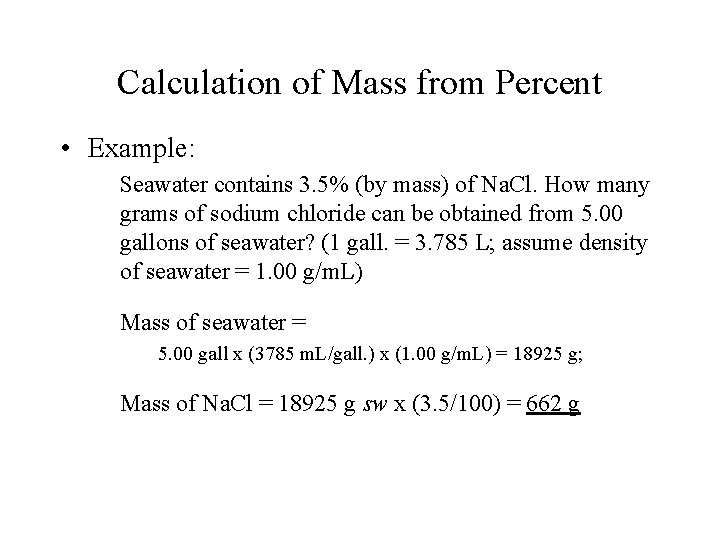
Calculation of Mass from Percent • Example: Seawater contains 3. 5% (by mass) of Na. Cl. How many grams of sodium chloride can be obtained from 5. 00 gallons of seawater? (1 gall. = 3. 785 L; assume density of seawater = 1. 00 g/m. L) Mass of seawater = 5. 00 gall x (3785 m. L/gall. ) x (1. 00 g/m. L) = 18925 g; Mass of Na. Cl = 18925 g sw x (3. 5/100) = 662 g
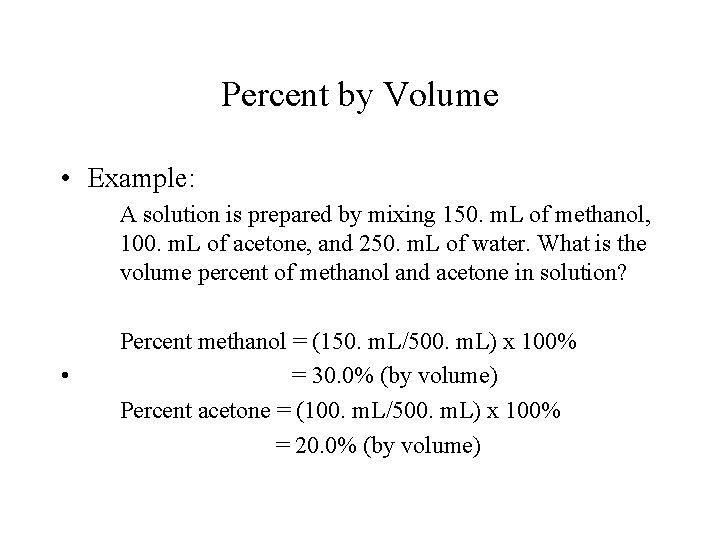
Percent by Volume • Example: A solution is prepared by mixing 150. m. L of methanol, 100. m. L of acetone, and 250. m. L of water. What is the volume percent of methanol and acetone in solution? • Percent methanol = (150. m. L/500. m. L) x 100% = 30. 0% (by volume) Percent acetone = (100. m. L/500. m. L) x 100% = 20. 0% (by volume)

Mass-Volume Percentage • Ratio of mass solute (in g) to volume of solution (in m. L) x 100%; • Examples: (1) 0. 9 g of Na. Cl in 100 m. L of solution = (0. 9 g/100 m. L) x 100% = 0. 9% (w/v) (2) 55 g glucose in 1 L (1000 m. L) of solution = (54 g/1000 m. L) x 100% = 5. 4% (w/v)
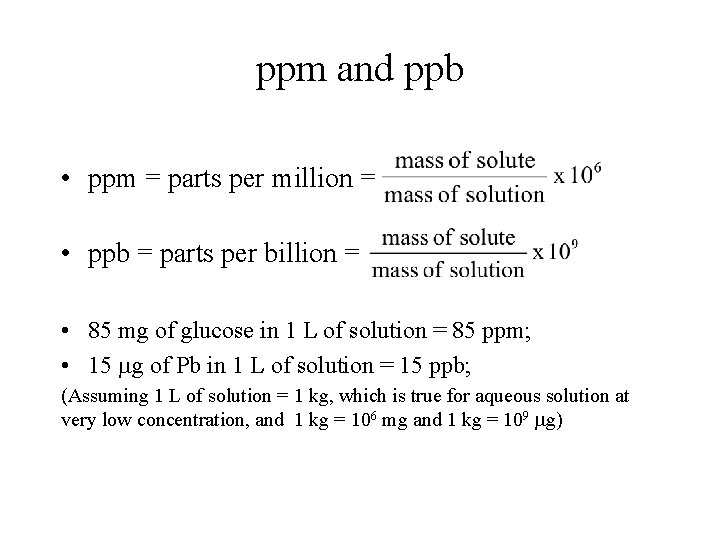
ppm and ppb • ppm = parts per million = • ppb = parts per billion = • 85 mg of glucose in 1 L of solution = 85 ppm; • 15 mg of Pb in 1 L of solution = 15 ppb; (Assuming 1 L of solution = 1 kg, which is true for aqueous solution at very low concentration, and 1 kg = 106 mg and 1 kg = 109 mg)
Blank Page
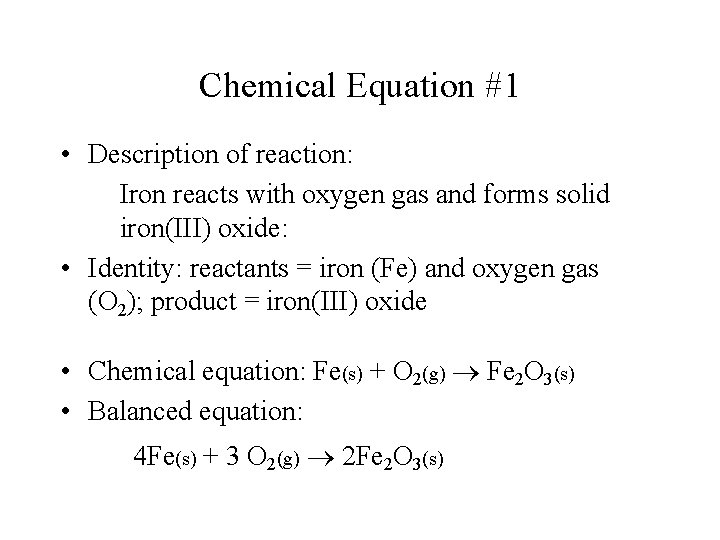
Chemical Equation #1 • Description of reaction: Iron reacts with oxygen gas and forms solid iron(III) oxide: • Identity: reactants = iron (Fe) and oxygen gas (O 2); product = iron(III) oxide • Chemical equation: Fe(s) + O 2(g) Fe 2 O 3(s) • Balanced equation: 4 Fe(s) + 3 O 2(g) 2 Fe 2 O 3(s)
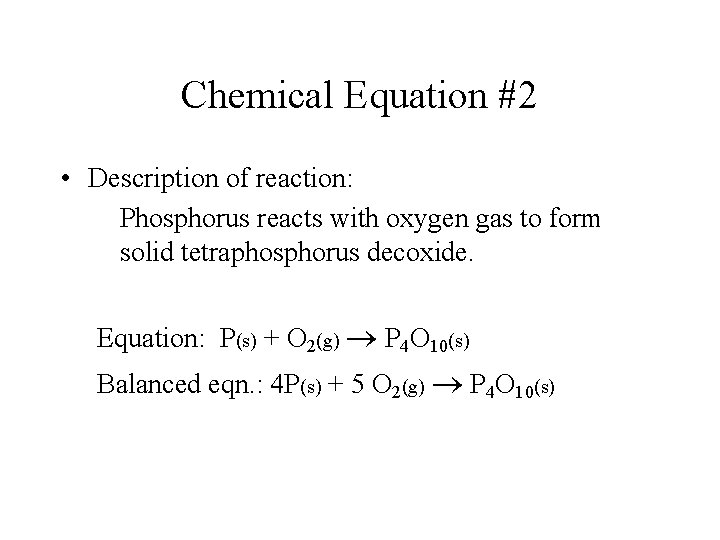
Chemical Equation #2 • Description of reaction: Phosphorus reacts with oxygen gas to form solid tetraphosphorus decoxide. Equation: P(s) + O 2(g) P 4 O 10(s) Balanced eqn. : 4 P(s) + 5 O 2(g) P 4 O 10(s)
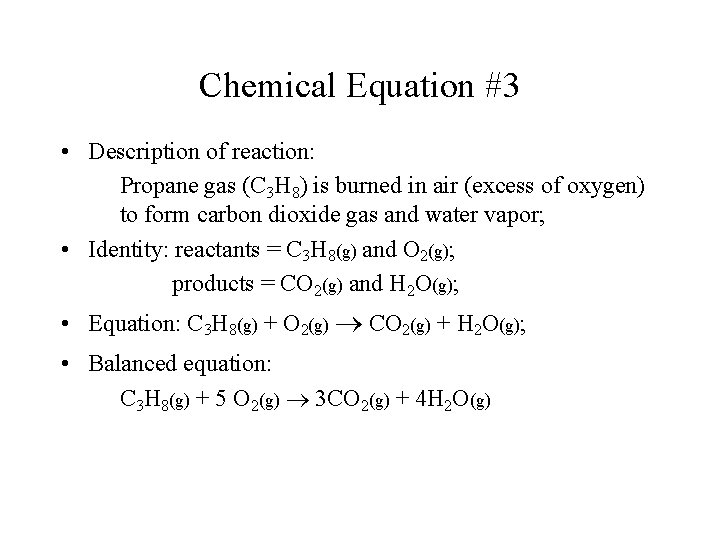
Chemical Equation #3 • Description of reaction: Propane gas (C 3 H 8) is burned in air (excess of oxygen) to form carbon dioxide gas and water vapor; • Identity: reactants = C 3 H 8(g) and O 2(g); products = CO 2(g) and H 2 O(g); • Equation: C 3 H 8(g) + O 2(g) CO 2(g) + H 2 O(g); • Balanced equation: C 3 H 8(g) + 5 O 2(g) 3 CO 2(g) + 4 H 2 O(g)
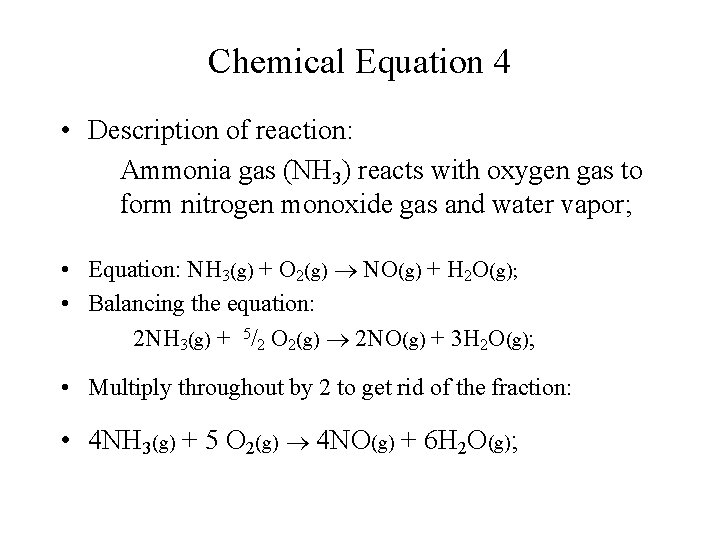
Chemical Equation 4 • Description of reaction: Ammonia gas (NH 3) reacts with oxygen gas to form nitrogen monoxide gas and water vapor; • Equation: NH 3(g) + O 2(g) NO(g) + H 2 O(g); • Balancing the equation: 2 NH 3(g) + 5/2 O 2(g) 2 NO(g) + 3 H 2 O(g); • Multiply throughout by 2 to get rid of the fraction: • 4 NH 3(g) + 5 O 2(g) 4 NO(g) + 6 H 2 O(g);
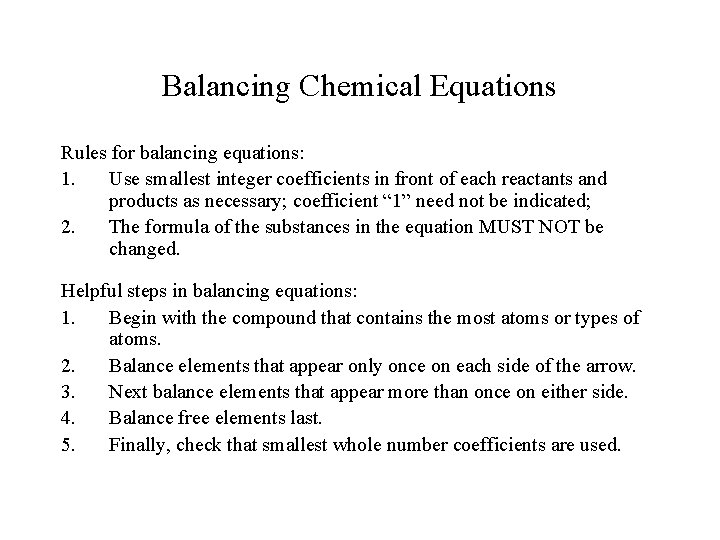
Balancing Chemical Equations Rules for balancing equations: 1. Use smallest integer coefficients in front of each reactants and products as necessary; coefficient “ 1” need not be indicated; 2. The formula of the substances in the equation MUST NOT be changed. Helpful steps in balancing equations: 1. Begin with the compound that contains the most atoms or types of atoms. 2. Balance elements that appear only once on each side of the arrow. 3. Next balance elements that appear more than once on either side. 4. Balance free elements last. 5. Finally, check that smallest whole number coefficients are used.
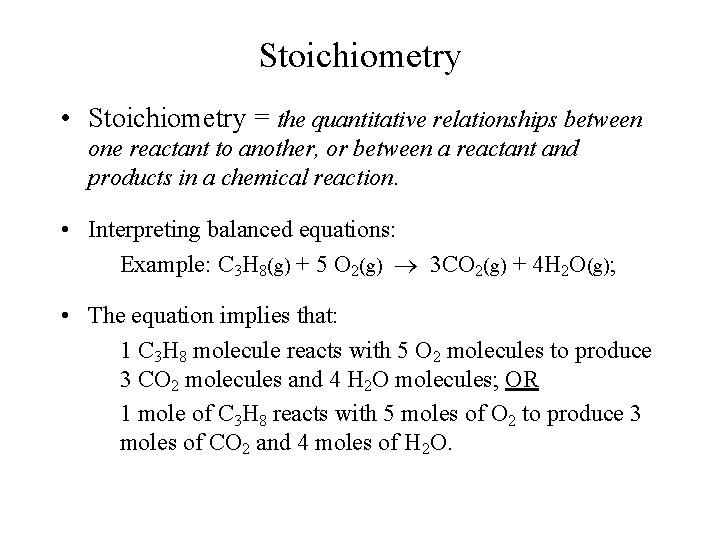
Stoichiometry • Stoichiometry = the quantitative relationships between one reactant to another, or between a reactant and products in a chemical reaction. • Interpreting balanced equations: Example: C 3 H 8(g) + 5 O 2(g) 3 CO 2(g) + 4 H 2 O(g); • The equation implies that: 1 C 3 H 8 molecule reacts with 5 O 2 molecules to produce 3 CO 2 molecules and 4 H 2 O molecules; OR 1 mole of C 3 H 8 reacts with 5 moles of O 2 to produce 3 moles of CO 2 and 4 moles of H 2 O.
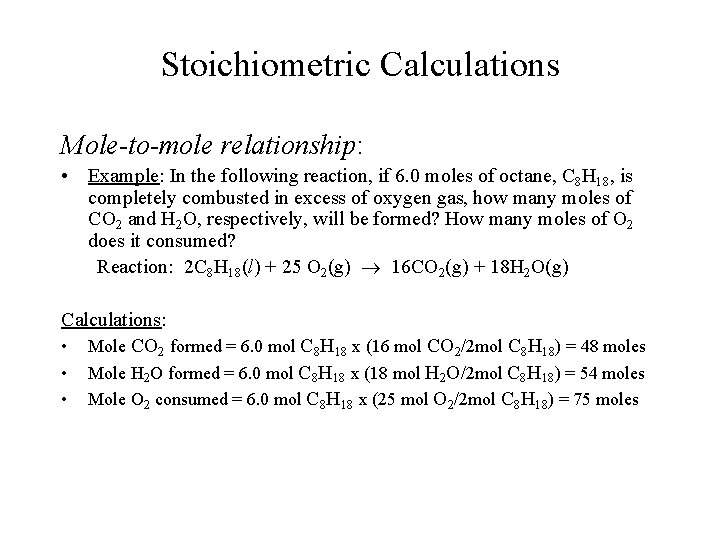
Stoichiometric Calculations Mole-to-mole relationship: • Example: In the following reaction, if 6. 0 moles of octane, C 8 H 18, is completely combusted in excess of oxygen gas, how many moles of CO 2 and H 2 O, respectively, will be formed? How many moles of O 2 does it consumed? Reaction: 2 C 8 H 18(l) + 25 O 2(g) 16 CO 2(g) + 18 H 2 O(g) Calculations: • Mole CO 2 formed = 6. 0 mol C 8 H 18 x (16 mol CO 2/2 mol C 8 H 18) = 48 moles • Mole H 2 O formed = 6. 0 mol C 8 H 18 x (18 mol H 2 O/2 mol C 8 H 18) = 54 moles • Mole O 2 consumed = 6. 0 mol C 8 H 18 x (25 mol O 2/2 mol C 8 H 18) = 75 moles
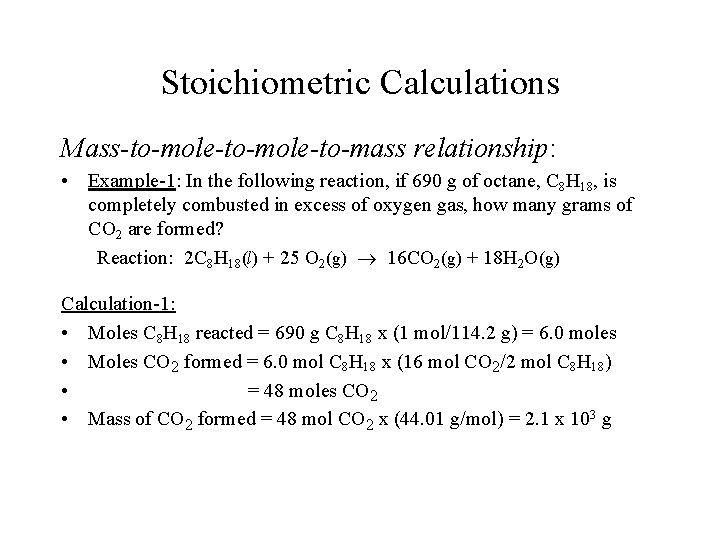
Stoichiometric Calculations Mass-to-mole-to-mass relationship: • Example-1: In the following reaction, if 690 g of octane, C 8 H 18, is completely combusted in excess of oxygen gas, how many grams of CO 2 are formed? Reaction: 2 C 8 H 18(l) + 25 O 2(g) 16 CO 2(g) + 18 H 2 O(g) Calculation-1: • Moles C 8 H 18 reacted = 690 g C 8 H 18 x (1 mol/114. 2 g) = 6. 0 moles • Moles CO 2 formed = 6. 0 mol C 8 H 18 x (16 mol CO 2/2 mol C 8 H 18) • = 48 moles CO 2 • Mass of CO 2 formed = 48 mol CO 2 x (44. 01 g/mol) = 2. 1 x 10³ g
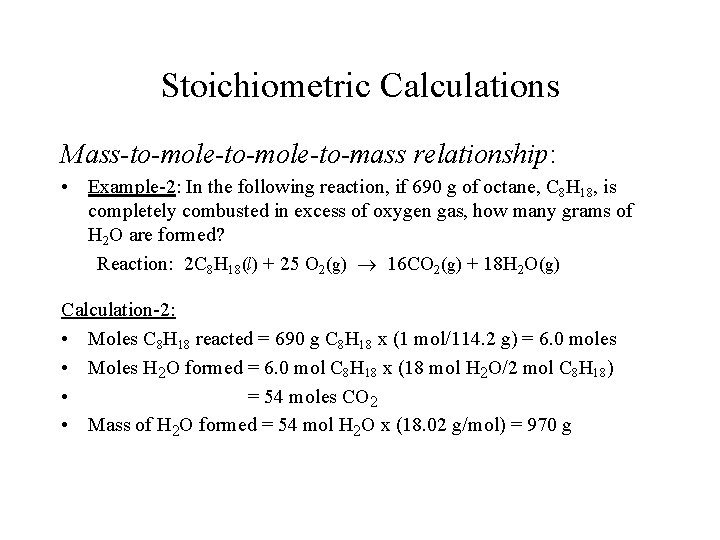
Stoichiometric Calculations Mass-to-mole-to-mass relationship: • Example-2: In the following reaction, if 690 g of octane, C 8 H 18, is completely combusted in excess of oxygen gas, how many grams of H 2 O are formed? Reaction: 2 C 8 H 18(l) + 25 O 2(g) 16 CO 2(g) + 18 H 2 O(g) Calculation-2: • Moles C 8 H 18 reacted = 690 g C 8 H 18 x (1 mol/114. 2 g) = 6. 0 moles • Moles H 2 O formed = 6. 0 mol C 8 H 18 x (18 mol H 2 O/2 mol C 8 H 18) • = 54 moles CO 2 • Mass of H 2 O formed = 54 mol H 2 O x (18. 02 g/mol) = 970 g
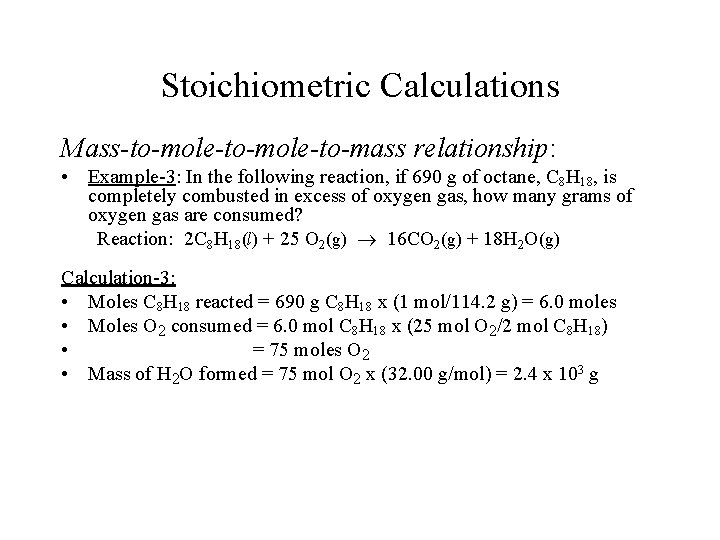
Stoichiometric Calculations Mass-to-mole-to-mass relationship: • Example-3: In the following reaction, if 690 g of octane, C 8 H 18, is completely combusted in excess of oxygen gas, how many grams of oxygen gas are consumed? Reaction: 2 C 8 H 18(l) + 25 O 2(g) 16 CO 2(g) + 18 H 2 O(g) Calculation-3: • Moles C 8 H 18 reacted = 690 g C 8 H 18 x (1 mol/114. 2 g) = 6. 0 moles • Moles O 2 consumed = 6. 0 mol C 8 H 18 x (25 mol O 2/2 mol C 8 H 18) • = 75 moles O 2 • Mass of H 2 O formed = 75 mol O 2 x (32. 00 g/mol) = 2. 4 x 10³ g
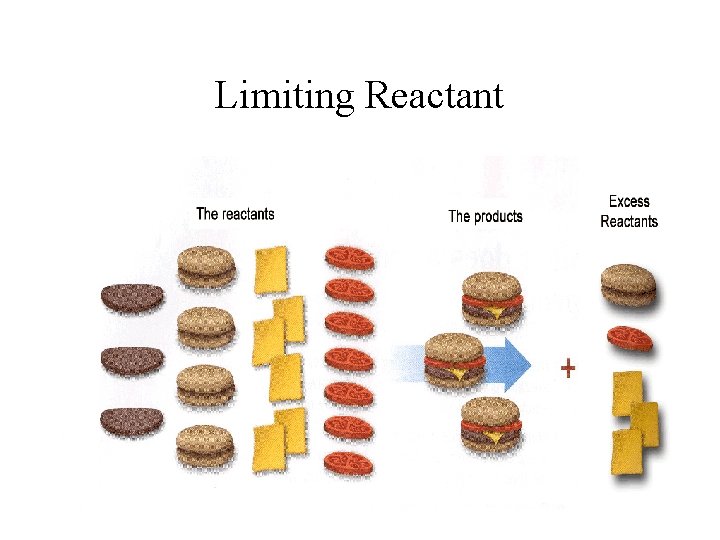
Stoichiometry Involving Limiting Reactant • Limiting reactant one that got completely consumed in a chemical reaction before the other reactants. Product yields depend on the amount of limiting reactant
Limiting Reactant
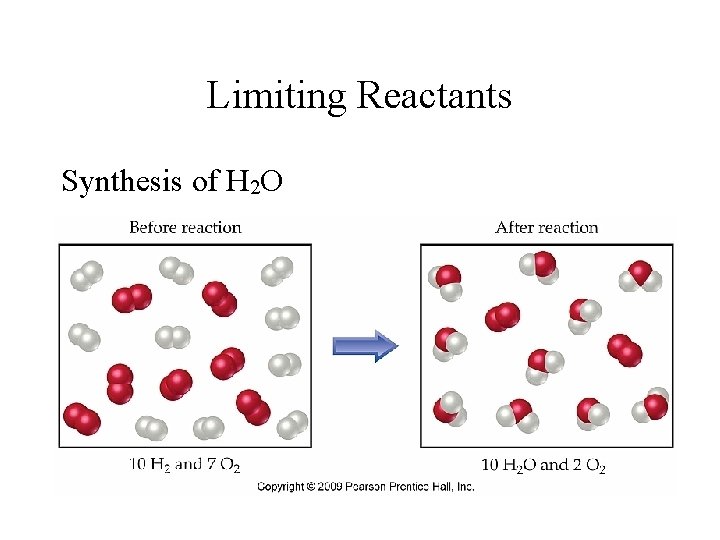
Limiting Reactants Synthesis of H 2 O
A Reaction Stoichiometry For example, in the synthesis reaction to produce water according to the following equation, 2 H 2(g) + O 2(g) 2 H 2 O(l), 2 moles of H 2 are required to react completely with 1 mole of O 2, in which 2 mole of H 2 O are formed. If a reaction is carried out with 1 mole of H 2 and 1 mole of O 2, H 2 will be the limiting reactant and O 2 will be present in excess. Only 1 mole of H 2 O will be produced.
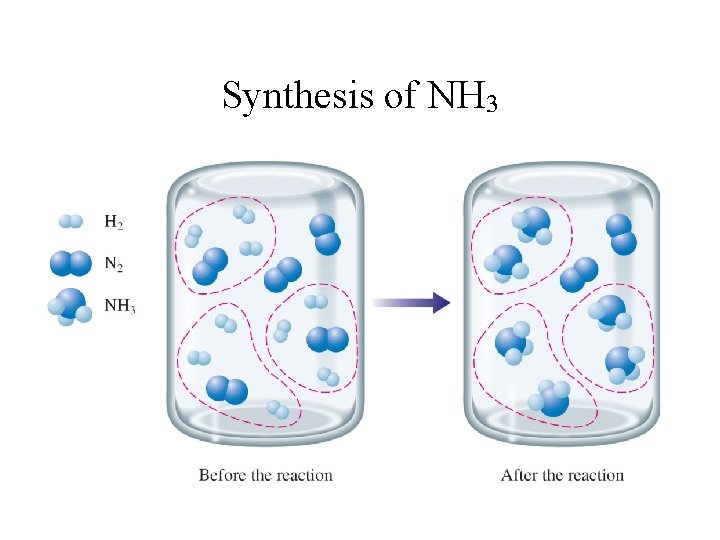
Synthesis of NH 3
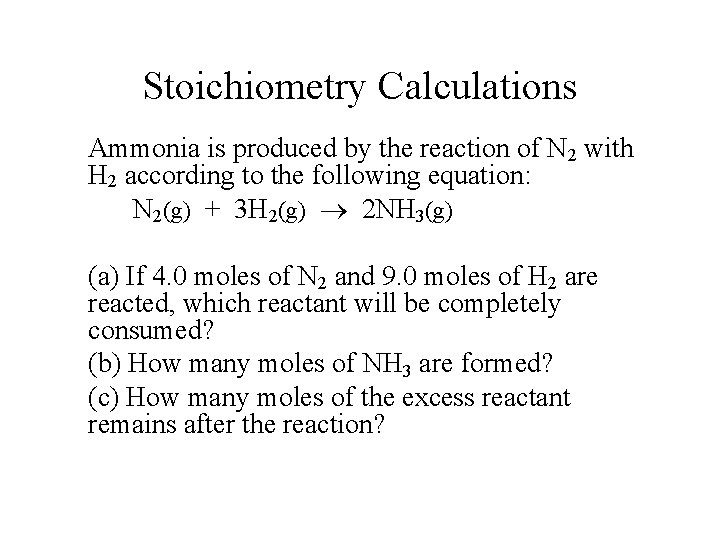
Stoichiometry Calculations Ammonia is produced by the reaction of N 2 with H 2 according to the following equation: N 2(g) + 3 H 2(g) 2 NH 3(g) (a) If 4. 0 moles of N 2 and 9. 0 moles of H 2 are reacted, which reactant will be completely consumed? (b) How many moles of NH 3 are formed? (c) How many moles of the excess reactant remains after the reaction?
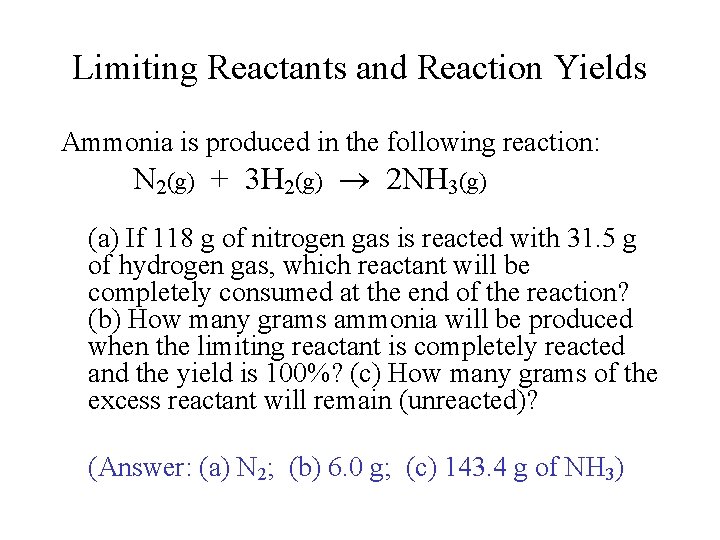
Limiting Reactants and Reaction Yields Ammonia is produced in the following reaction: N 2(g) + 3 H 2(g) 2 NH 3(g) (a) If 118 g of nitrogen gas is reacted with 31. 5 g of hydrogen gas, which reactant will be completely consumed at the end of the reaction? (b) How many grams ammonia will be produced when the limiting reactant is completely reacted and the yield is 100%? (c) How many grams of the excess reactant will remain (unreacted)? (Answer: (a) N 2; (b) 6. 0 g; (c) 143. 4 g of NH 3)
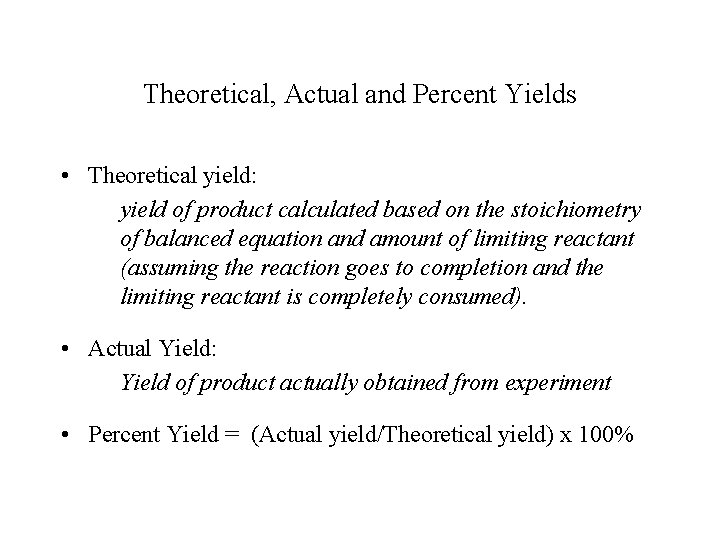
Theoretical, Actual and Percent Yields • Theoretical yield: yield of product calculated based on the stoichiometry of balanced equation and amount of limiting reactant (assuming the reaction goes to completion and the limiting reactant is completely consumed). • Actual Yield: Yield of product actually obtained from experiment • Percent Yield = (Actual yield/Theoretical yield) x 100%
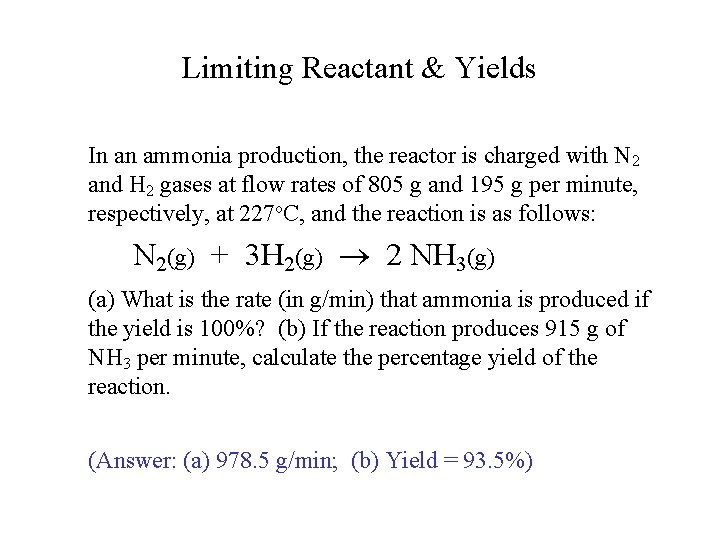
Limiting Reactant & Yields In an ammonia production, the reactor is charged with N 2 and H 2 gases at flow rates of 805 g and 195 g per minute, respectively, at 227 o. C, and the reaction is as follows: N 2(g) + 3 H 2(g) 2 NH 3(g) (a) What is the rate (in g/min) that ammonia is produced if the yield is 100%? (b) If the reaction produces 915 g of NH 3 per minute, calculate the percentage yield of the reaction. (Answer: (a) 978. 5 g/min; (b) Yield = 93. 5%)
- Slides: 58