
Composition of Milk Composition of Milk is the

- Slides: 13
Composition of Milk
Composition of Milk is the basis of all dairy products The Pasteurized Milk Ordinance defines milk as: the lacteal secretion, practically free from colostrum, obtained by the complete milking of one or more cows.
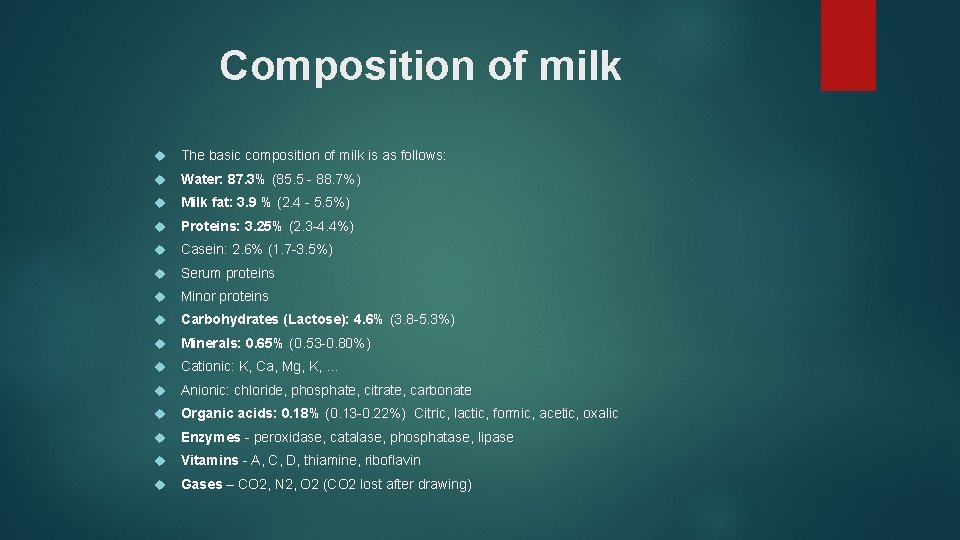
Composition of milk The basic composition of milk is as follows: Water: 87. 3% (85. 5 - 88. 7%) Milk fat: 3. 9 % (2. 4 - 5. 5%) Proteins: 3. 25% (2. 3 -4. 4%) Casein: 2. 6% (1. 7 -3. 5%) Serum proteins Minor proteins Carbohydrates (Lactose): 4. 6% (3. 8 -5. 3%) Minerals: 0. 65% (0. 53 -0. 80%) Cationic: K, Ca, Mg, K, … Anionic: chloride, phosphate, citrate, carbonate Organic acids: 0. 18% (0. 13 -0. 22%) Citric, lactic, formic, acetic, oxalic Enzymes - peroxidase, catalase, phosphatase, lipase Vitamins - A, C, D, thiamine, riboflavin Gases – CO 2, N 2, O 2 (CO 2 lost after drawing)
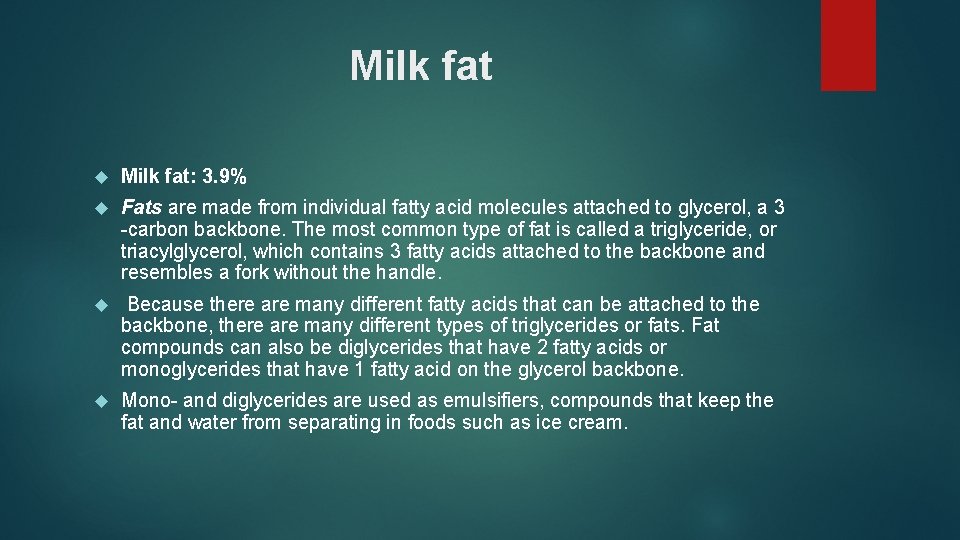
Milk fat Milk fat: 3. 9% Fats are made from individual fatty acid molecules attached to glycerol, a 3 -carbon backbone. The most common type of fat is called a triglyceride, or triacylglycerol, which contains 3 fatty acids attached to the backbone and resembles a fork without the handle. Because there are many different fatty acids that can be attached to the backbone, there are many different types of triglycerides or fats. Fat compounds can also be diglycerides that have 2 fatty acids or monoglycerides that have 1 fatty acid on the glycerol backbone. Mono- and diglycerides are used as emulsifiers, compounds that keep the fat and water from separating in foods such as ice cream.
Milk fat has the most complex fatty acid composition of the edible fats. Over 400 individual fatty acids have been identified in milk fat. However, approximately 15 to 20 fatty acids make up 90% of the milk fat. The major fatty acids in milk fat are straight chain fatty acids that are saturated and have 4 to 18 carbons (4: 0, 6: 0, 8: 0, 10: 0, 12: 0, 14: 0, 16: 0, 18: 0), monounsaturated fatty acids (16: 1, 18: 1), and polyunsaturated fatty acids (18: 2, 18: 3). Some of the fatty acids are found in very small amounts but contribute to the unique and desirable flavor of milk fat and butter. For example, the C 14: 0 and C 16: 0 ß-hydroxy fatty acids spontaneously form lactones upon heating which enhance the flavor of butter.
Milk fat melts over a wide temperature range, from approximately -40°F (40°C) to 104°F (40°C). This is best illustrated by the firmness of butter at refrigerator temperature versus room temperature. At refrigerator temperature butter is approximately 50% solid, but is only about 20% solid at room temperature, which is why it spreads more easily as the temperature increases. The melting properties of milk are a result of the melting points of the individual fatty acids that make up milk fat and their arrangement on the triglyceride molecule.
Milk Proteins are chains of amino acid molecules connected by peptide bonds. Milk contains 3. 9% total protein. Milk proteins contain all 9 essential amino acids required by humans. Milk proteins are synthesized in the mammary gland, but 60% of the amino acids used to build the proteins are obtained from the cow's diet. Total milk protein content and amino acid composition varies with cow breed and individual animal genetics.
Milk Protein There are 2 major categories of milk protein that are broadly defined by their chemical composition and physical properties. The casein family contains phosphorus and will coagulate or precipitate at p. H 4. 6. The serum (whey) proteins do not contain phosphorus, and these proteins remain in solution in milk at p. H 4. 6. The principle of coagulation, or curd formation, at reduced p. H is the basis for cheese curd formation. In cow's milk, approximately 82% of milk protein is casein and the remaining 18% is serum, or whey protein.
Milk Protein The caseins in milk form complexes called micelles that are dispersed in the water phase of milk. The casein micelles consist of subunits of the different caseins (α-s 1, α-s 2 and ß) held together by calcium phosphate bridges on the inside, surrounded by a layer of 6 -casein which helps to stabilize the micelle in solution. Casein micelles are spherical and are 0. 04 to 0. 3 µm in diameter, much smaller than fat globules which are approximately 1 µm in homogenized milk.
Milk Protein The casein micelles are porous structures that allow the water phase to move freely in and out of the micelle. Casein micelles are stable but dynamic structures that do not settle out of solution. They can be heated to boiling or cooled, and they can be dried and reconstituted without adverse effects. ß-casein, along with some calcium phosphate, will migrate in and out of the micelle with changes in temperature, but this does not affect the nutritional properties of the protein and minerals. The whey proteins exist as individual units dissolved in the water phase of milk.
What is denaturing and why does it matter Denaturation is the alteration of a protein shape through some form of external stress (for example, by applying heat, acid or alkali), in such a way that it will no longer be able to carry out its cellular function. Denatured proteins can exhibit a wide range of characteristics, from loss of solubility to communal aggregation. Once this post-translational modification process has been completed, the protein begins to fold (spontaneously, and sometimes with enzymatic assistance), curling up on itself so that hydrophobic elements of the protein are buried deep inside the structure and hydrophilic elements end up on the outside. The final shape of a protein determines how it interacts with its environment. Denaturation of proteins results in change of function and ability to interact with other compounds, including proteins. Denaturation of protein enzymes results in inactivation of activity.
Lactose Milk contains approximately 4. 9% carbohydrate that is predominately lactose with trace amounts of monosaccharides and oligosaccharides. Lactose is a disaccharide of glucose and galactose. Lactose is dissolved in the serum (whey) phase of fluid milk. Lactose dissolved in solution is found in 2 forms, called the α-anomer and ßanomer, that can convert back and forth between each other. The solubility of the 2 anomers is temperature dependent and therefore the equilibrium concentration of the 2 forms will be different at different temperatures. At room temperature (70°F, 20°C) the equilibrium ratio is approximately 37% αand 63% ß-lactose. At temperatures above 200°F (93. 5°C) the ß-anomer is less soluble so there is a higher ratio of α- to ß-lactose. The type of anomer present does not affect the nutritional properties of lactose.
Vitamins/Minerals Milk contains the water soluble vitamins thiamin (vitamin B 1), riboflavin (vitamin B 2), niacin (vitamin B 3), pantothenic acid (vitamin B 5), vitamin B 6 (pyridoxine), vitamin B 12 (cobalamin), vitamin C, and folate. Milk is a good source of thiamin, riboflavin and vitamin B 12. Milk contains small amounts of niacin, pantothenic acid, vitamin B 6, vitamin C, and folate and is not considered a major source of these vitamins in the diet. Milk contains the fat soluble vitamins A, D, E, and K. The content level of fat soluble vitamins in dairy products depends on the fat content of the product. Reduced fat (2% fat), low-fat (1% fat), and skim milk must be fortified with vitamin A to be nutritionally equivalent to whole milk. Fortification of all milk with vitamin D is voluntary. Milk contains small amounts of vitamins E and K and is not considered a major source of these vitamins in the diet.