
Composition of Bone Composed of mineralized calcium phosphate
Composition of Bone • Composed of mineralized calcium phosphate (specifically, the calcium phosphate phase called hydroxyapatite (HAP) Ca 10(PO 4)6(OH)2) within a matrix of collagen fibrils (~1/3 dry weight, 50% of bone by volume, 90% of protein content) and 200 other proteins (e. g. , acidic glycoproteins, proteoglycans & carboxylated proteins comprising the other 10% by weight) • The HAP of bones and teeth is not compositionally pure • it’s composition can actually be better represented as (Ca, Sr, Mg, Na, H 2 O, [])10(PO 4, HPO 4, CO 3 P 2 O 7)6(OH, F, Cl, H 2 O, O, [])2 where [] represent crystal lattice defects • HAP is a ‘living mineral’ that is continually grown, dissolved & remodeled in response to signals of internal (e. g. , pregnancy) and external (e. g. , gravity, exercise) origin
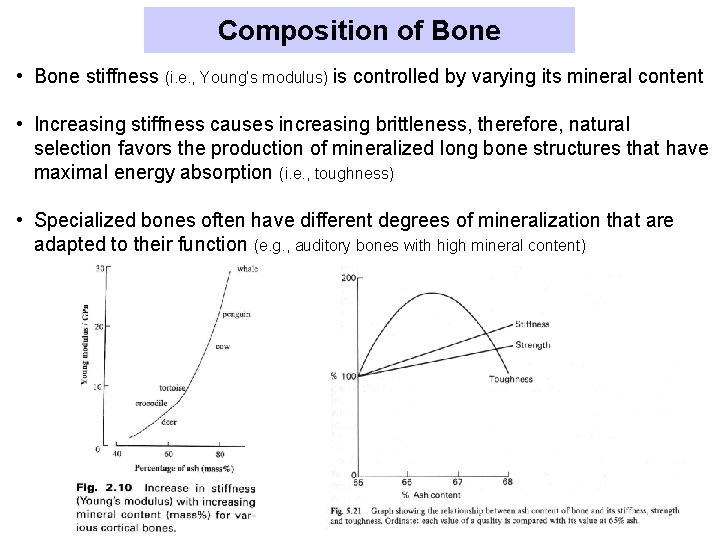
Composition of Bone • Bone stiffness (i. e. , Young’s modulus) is controlled by varying its mineral content • Increasing stiffness causes increasing brittleness, therefore, natural selection favors the production of mineralized long bone structures that have maximal energy absorption (i. e. , toughness) • Specialized bones often have different degrees of mineralization that are adapted to their function (e. g. , auditory bones with high mineral content)
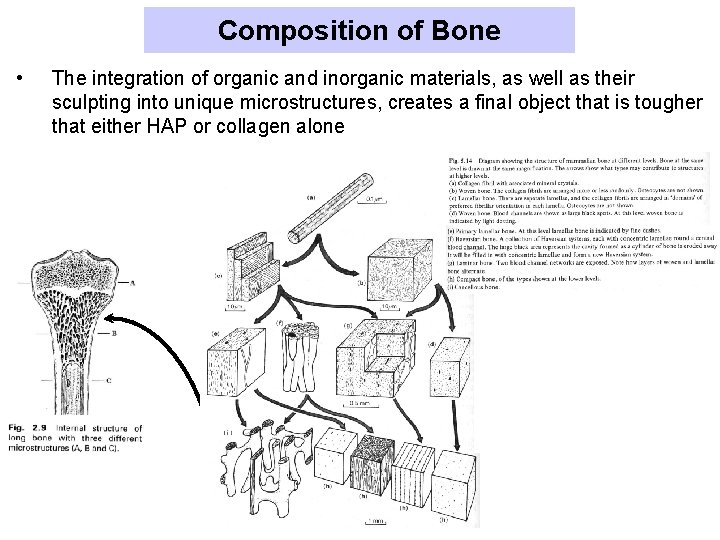
Composition of Bone • The integration of organic and inorganic materials, as well as their sculpting into unique microstructures, creates a final object that is tougher that either HAP or collagen alone
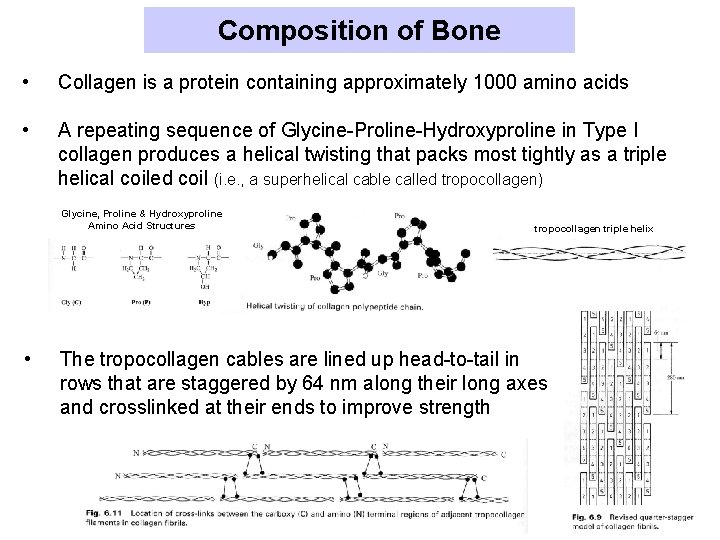
Composition of Bone • Collagen is a protein containing approximately 1000 amino acids • A repeating sequence of Glycine-Proline-Hydroxyproline in Type I collagen produces a helical twisting that packs most tightly as a triple helical coiled coil (i. e. , a superhelical cable called tropocollagen) Glycine, Proline & Hydroxyproline Amino Acid Structures • tropocollagen triple helix The tropocollagen cables are lined up head-to-tail in rows that are staggered by 64 nm along their long axes and crosslinked at their ends to improve strength
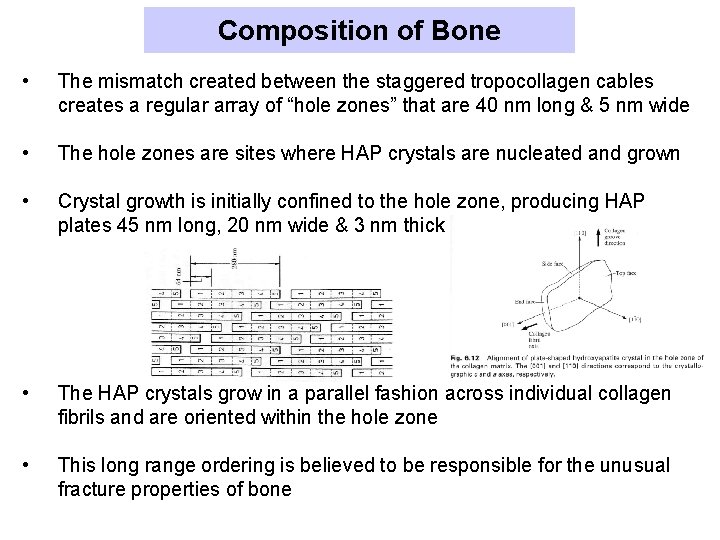
Composition of Bone • The mismatch created between the staggered tropocollagen cables creates a regular array of “hole zones” that are 40 nm long & 5 nm wide • The hole zones are sites where HAP crystals are nucleated and grown • Crystal growth is initially confined to the hole zone, producing HAP plates 45 nm long, 20 nm wide & 3 nm thick • The HAP crystals grow in a parallel fashion across individual collagen fibrils and are oriented within the hole zone • This long range ordering is believed to be responsible for the unusual fracture properties of bone
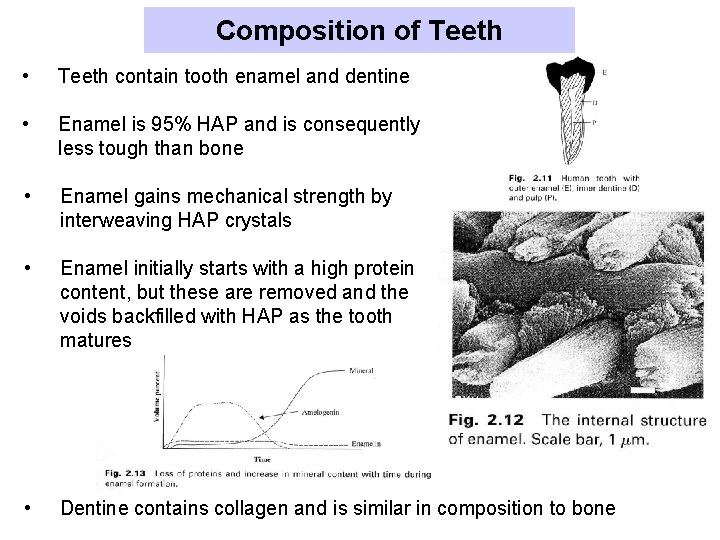
Composition of Teeth • Teeth contain tooth enamel and dentine • Enamel is 95% HAP and is consequently less tough than bone • Enamel gains mechanical strength by interweaving HAP crystals • Enamel initially starts with a high protein content, but these are removed and the voids backfilled with HAP as the tooth matures • Dentine contains collagen and is similar in composition to bone
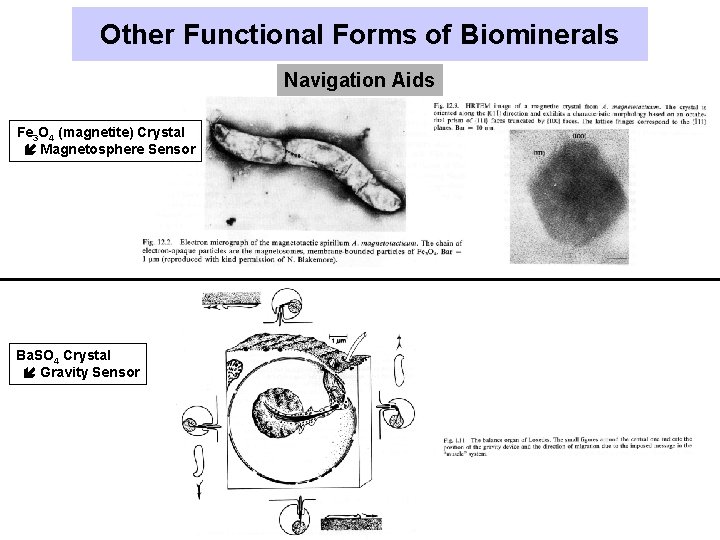
Other Functional Forms of Biominerals Navigation Aids Fe 3 O 4 (magnetite) Crystal Magnetosphere Sensor Ba. SO 4 Crystal Gravity Sensor
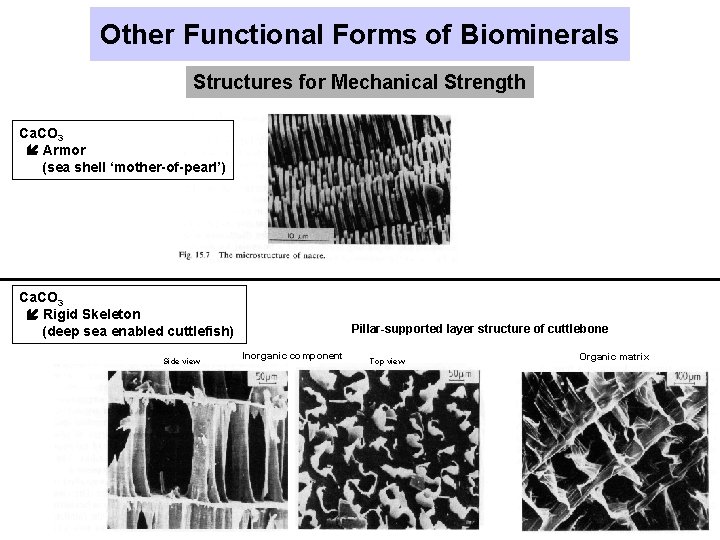
Other Functional Forms of Biominerals Structures for Mechanical Strength Ca. CO 3 Armor (sea shell ‘mother-of-pearl’) Ca. CO 3 Rigid Skeleton (deep sea enabled cuttlefish) Side view Pillar-supported layer structure of cuttlebone Inorganic component Top view Organic matrix
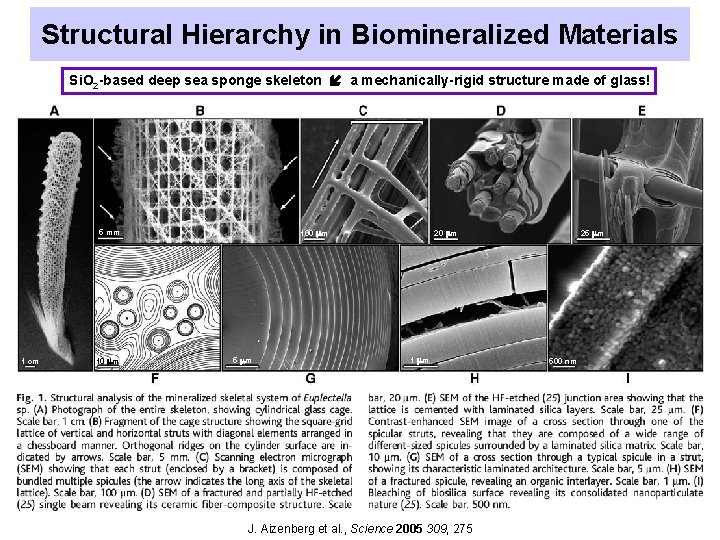
Structural Hierarchy in Biomineralized Materials Si. O 2 -based deep sea sponge skeleton a mechanically-rigid structure made of glass! 100 m 5 mm 1 cm 10 m 5 m 20 m 1 m J. Aizenberg et al. , Science 2005 309, 275 25 m 500 nm
- Slides: 9