
COMPOSITE MATERIAL FIRE FIGHTING Presented to International Aircraft
- Slides: 17
COMPOSITE MATERIAL FIRE FIGHTING Presented to: International Aircraft Materials Fire Test Working Group Pooler, GA, USA Presented by: John C. Hode SRA International Date: March 1 -2, 2011 Federal Aviation Administration
Development of a Fire Test Method Purpose: • Create a repeatable test method to quantitatively assess the amount of fire fighting agent necessary to extinguish aircraft structural materials. First objective: Second objective: • Determine the conditions for self-sustained fire. • Develop a method to apply various fire suppression agents. • Establish the quantity of agent (water & foam)necessary to extinguish a self-sustaining aircraft fire. • Determine the effectiveness of various agents. Airport Technology Research & Development Branch March 1 -2, 2011 Federal Aviation Administration 2
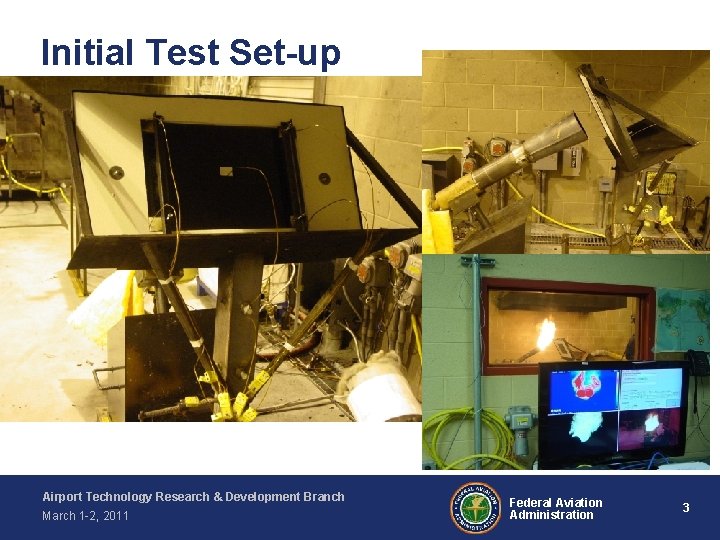
Initial Test Set-up Airport Technology Research & Development Branch March 1 -2, 2011 Federal Aviation Administration 3
Small & Intermediate Scale Testing • Baseline intermediate scale tests conducted to see if results from initial test design are repeatable. • Small scale tests – ASTM E 1354 Cone Calorimeter • Data to support exterior fuselage flame propagation/spread modeling – ASTM E 1321 Lateral Flame Spread Testing (Lateral flame spread) Airport Technology Research & Development Branch March 1 -2, 2011 Federal Aviation Administration 4
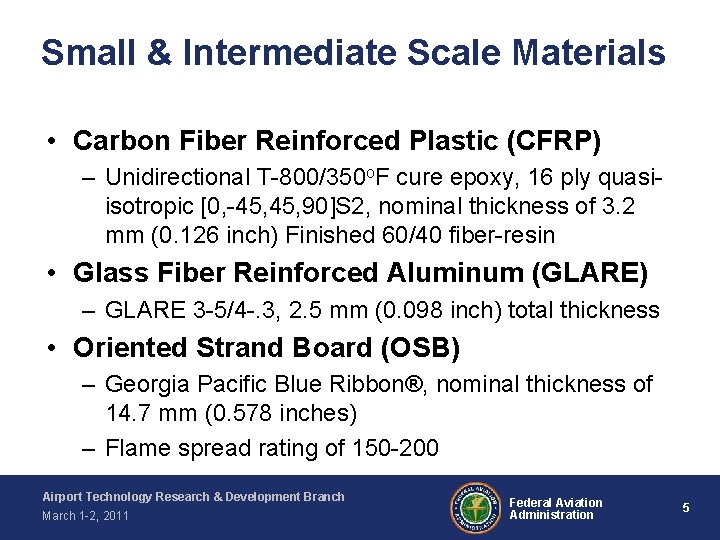
Small & Intermediate Scale Materials • Carbon Fiber Reinforced Plastic (CFRP) – Unidirectional T-800/350 o. F cure epoxy, 16 ply quasiisotropic [0, -45, 90]S 2, nominal thickness of 3. 2 mm (0. 126 inch) Finished 60/40 fiber-resin • Glass Fiber Reinforced Aluminum (GLARE) – GLARE 3 -5/4 -. 3, 2. 5 mm (0. 098 inch) total thickness • Oriented Strand Board (OSB) – Georgia Pacific Blue Ribbon®, nominal thickness of 14. 7 mm (0. 578 inches) – Flame spread rating of 150 -200 Airport Technology Research & Development Branch March 1 -2, 2011 Federal Aviation Administration 5
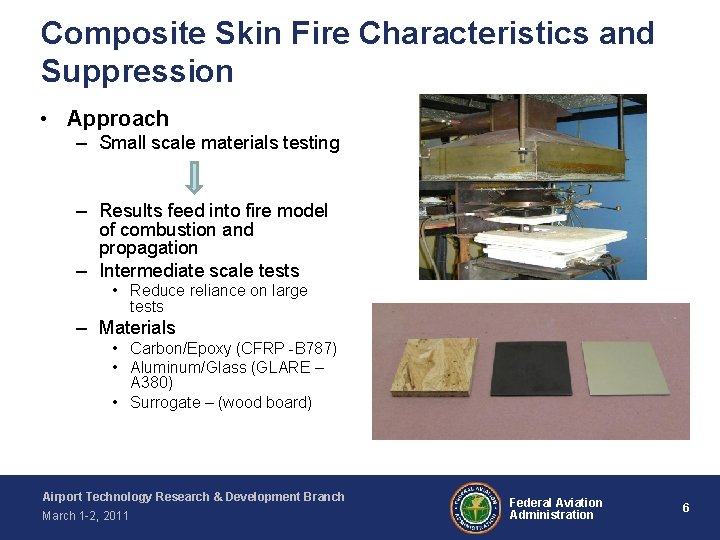
Composite Skin Fire Characteristics and Suppression • Approach – Small scale materials testing – Results feed into fire model of combustion and propagation – Intermediate scale tests • Reduce reliance on large tests – Materials • Carbon/Epoxy (CFRP -B 787) • Aluminum/Glass (GLARE – A 380) • Surrogate – (wood board) Airport Technology Research & Development Branch March 1 -2, 2011 Federal Aviation Administration 6
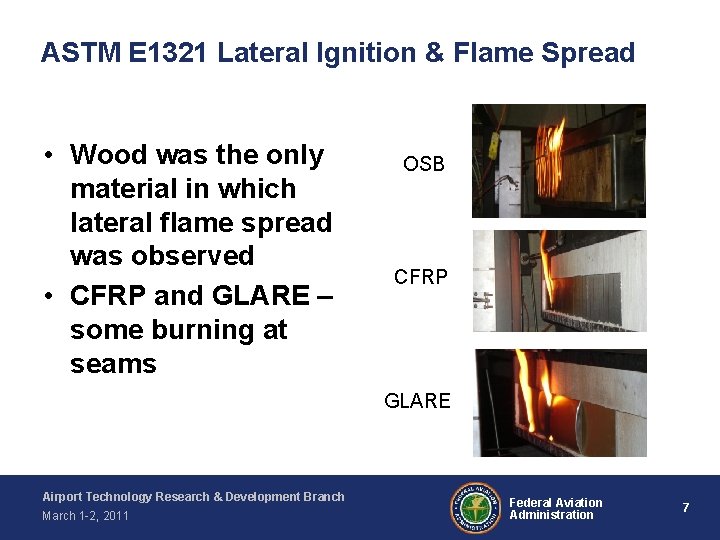
ASTM E 1321 Lateral Ignition & Flame Spread • Wood was the only material in which lateral flame spread was observed • CFRP and GLARE – some burning at seams OSB CFRP GLARE Airport Technology Research & Development Branch March 1 -2, 2011 Federal Aviation Administration 7
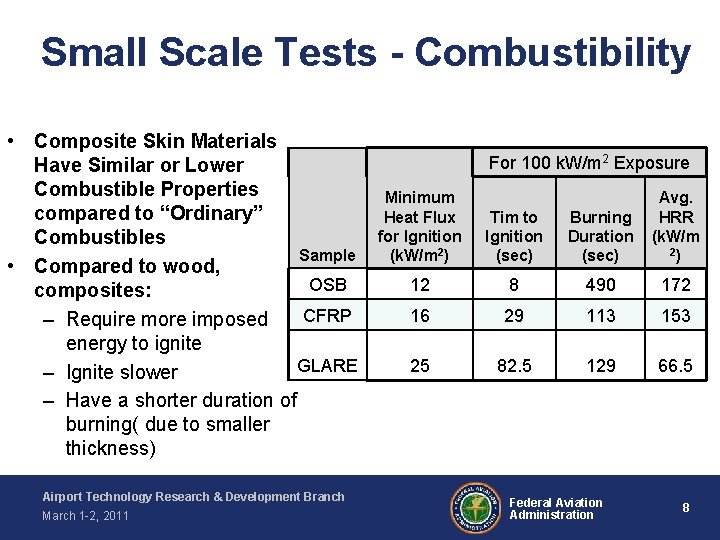
Small Scale Tests - Combustibility • Composite Skin Materials Have Similar or Lower Combustible Properties compared to “Ordinary” Combustibles Sample • Compared to wood, OSB composites: CFRP – Require more imposed energy to ignite GLARE – Ignite slower – Have a shorter duration of burning( due to smaller thickness) Airport Technology Research & Development Branch March 1 -2, 2011 For 100 k. W/m 2 Exposure Minimum Heat Flux for Ignition (k. W/m 2) Tim to Ignition (sec) Burning Duration (sec) Avg. HRR (k. W/m 2) 12 8 490 172 16 29 113 153 25 82. 5 129 66. 5 Federal Aviation Administration 8
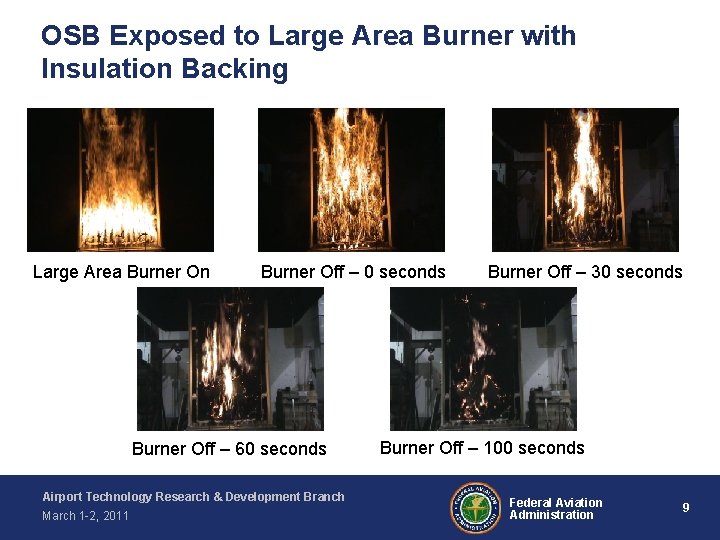
OSB Exposed to Large Area Burner with Insulation Backing Large Area Burner On Burner Off – 0 seconds Burner Off – 60 seconds Airport Technology Research & Development Branch March 1 -2, 2011 Burner Off – 30 seconds Burner Off – 100 seconds Federal Aviation Administration 9
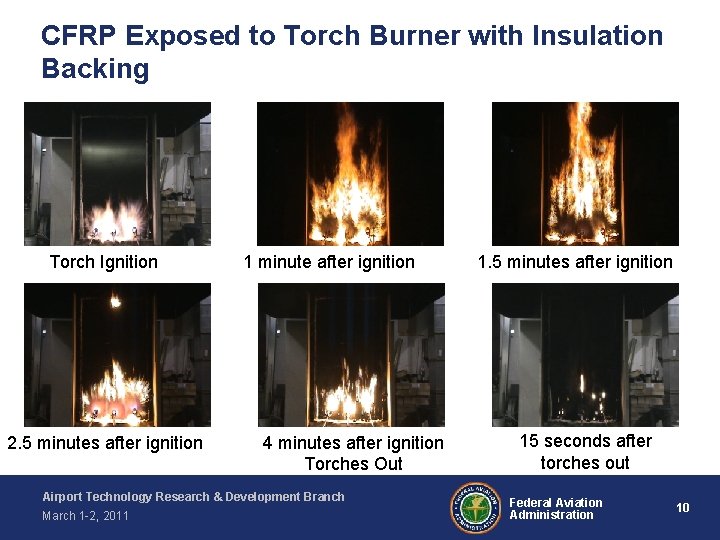
CFRP Exposed to Torch Burner with Insulation Backing Torch Ignition 2. 5 minutes after ignition 1 minute after ignition 4 minutes after ignition Torches Out Airport Technology Research & Development Branch March 1 -2, 2011 1. 5 minutes after ignition 15 seconds after torches out Federal Aviation Administration 10
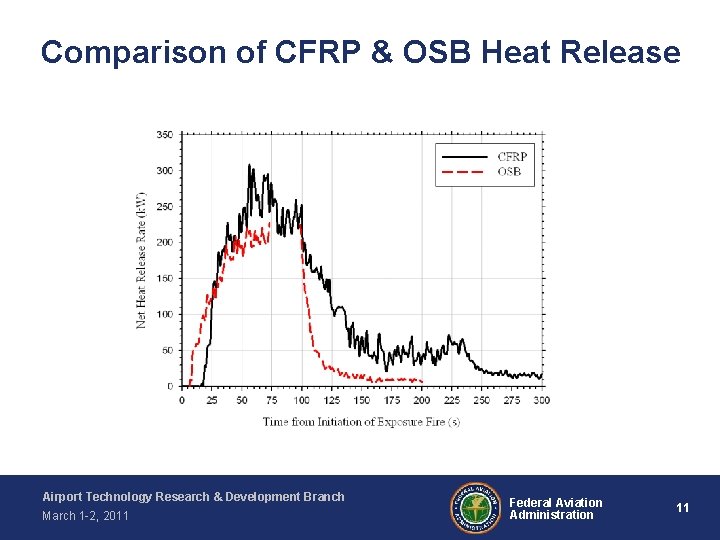
Comparison of CFRP & OSB Heat Release Airport Technology Research & Development Branch March 1 -2, 2011 Federal Aviation Administration 11
CFRP Torch Test • • Exposure 180 k. W/m 2 Duration 250 seconds (4 min 10 sec) Panel Ignition at 16 seconds HRR increased after ignition to peak of 300 k. W over 60 seconds • HRR decayed after 90 seconds to steadystate value of 50 k. W • Post-exposure burning for 37 seconds Airport Technology Research & Development Branch March 1 -2, 2011 Federal Aviation Administration 12
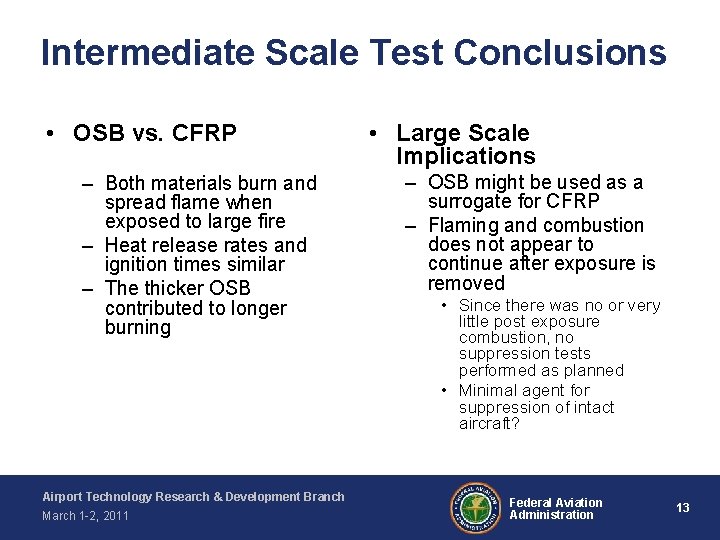
Intermediate Scale Test Conclusions • OSB vs. CFRP – Both materials burn and spread flame when exposed to large fire – Heat release rates and ignition times similar – The thicker OSB contributed to longer burning Airport Technology Research & Development Branch March 1 -2, 2011 • Large Scale Implications – OSB might be used as a surrogate for CFRP – Flaming and combustion does not appear to continue after exposure is removed • Since there was no or very little post exposure combustion, no suppression tests performed as planned • Minimal agent for suppression of intact aircraft? Federal Aviation Administration 13
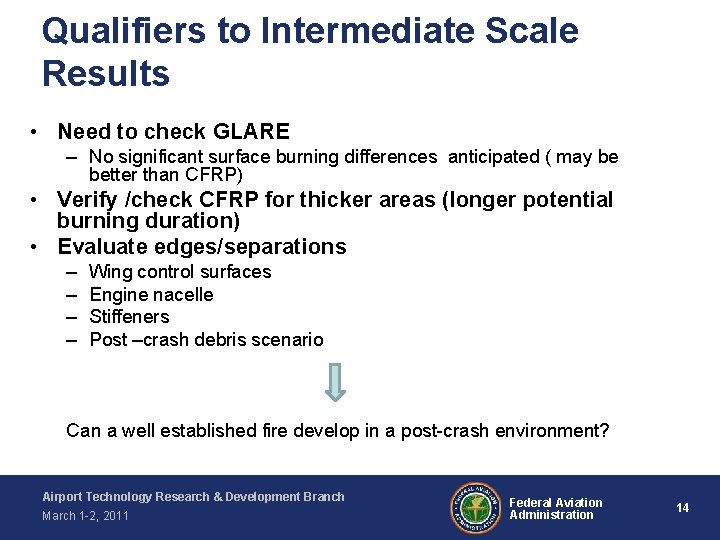
Qualifiers to Intermediate Scale Results • Need to check GLARE – No significant surface burning differences anticipated ( may be better than CFRP) • Verify /check CFRP for thicker areas (longer potential burning duration) • Evaluate edges/separations – – Wing control surfaces Engine nacelle Stiffeners Post –crash debris scenario Can a well established fire develop in a post-crash environment? Airport Technology Research & Development Branch March 1 -2, 2011 Federal Aviation Administration 14
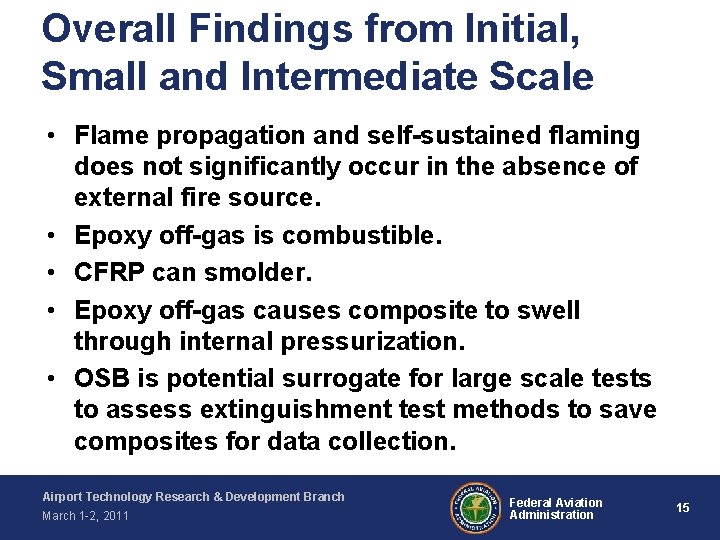
Overall Findings from Initial, Small and Intermediate Scale • Flame propagation and self-sustained flaming does not significantly occur in the absence of external fire source. • Epoxy off-gas is combustible. • CFRP can smolder. • Epoxy off-gas causes composite to swell through internal pressurization. • OSB is potential surrogate for large scale tests to assess extinguishment test methods to save composites for data collection. Airport Technology Research & Development Branch March 1 -2, 2011 Federal Aviation Administration 15
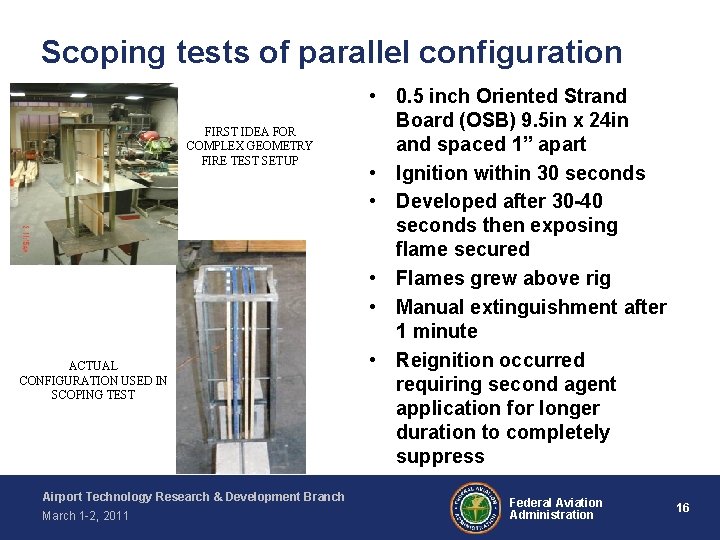
Scoping tests of parallel configuration FIRST IDEA FOR COMPLEX GEOMETRY FIRE TEST SETUP ACTUAL CONFIGURATION USED IN SCOPING TEST Airport Technology Research & Development Branch March 1 -2, 2011 • 0. 5 inch Oriented Strand Board (OSB) 9. 5 in x 24 in and spaced 1” apart • Ignition within 30 seconds • Developed after 30 -40 seconds then exposing flame secured • Flames grew above rig • Manual extinguishment after 1 minute • Reignition occurred requiring second agent application for longer duration to completely suppress Federal Aviation Administration 16
Participation welcome • Soliciting comments and ideas on: – Potential test configurations – Previous testing results and data – Sources for aviation-grade carbon fiber composites and FML – Other helpful ideas Airport Technology Research & Development Branch March 1 -2, 2011 Federal Aviation Administration 17