
Composite Joining Techniques Adhesive Bonding LBNL Composites Workshop
Composite Joining Techniques: Adhesive Bonding LBNL Composites Workshop February 29 -March 3, 2016 1

Adhesive Bonding • Stresses in Bonded Joints • Joint Design • Adhesives • Surface Preparation Neal Hartman, LBNL 2

Adhesive Joints This is the test standard: Don’t BAD Not Great but better… Designing an adhesive joint is NOT about choosing the right glue… It is about designing the proper geometry. Neal Hartman, LBNL 3

Adhesive Joints • Read the papers by Hart-Smith—all texts on adhesive joints refer to them • Excellent source on joint design and improvement methods • Designing an adhesive joint is not just choosing the right glue and overlap Neal Hartman, LBNL 4
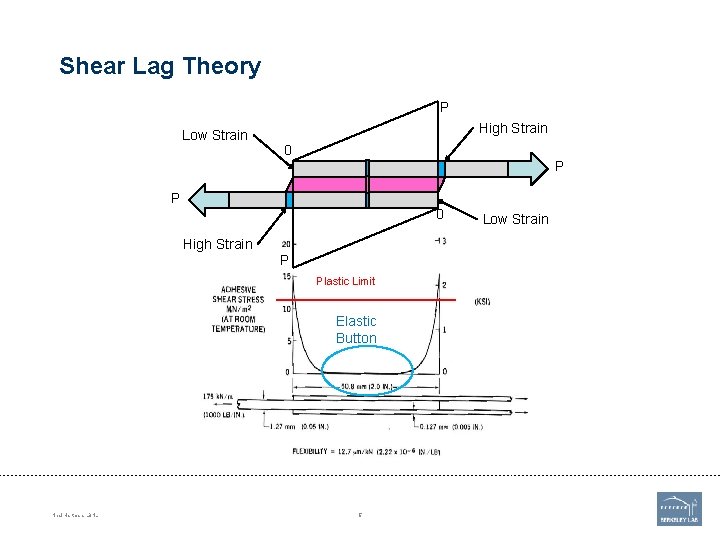
Shear Lag Theory P Low Strain High Strain 0 P P 0 High Strain P Plastic Limit Elastic Button Neal Hartman, LBNL 5 Low Strain
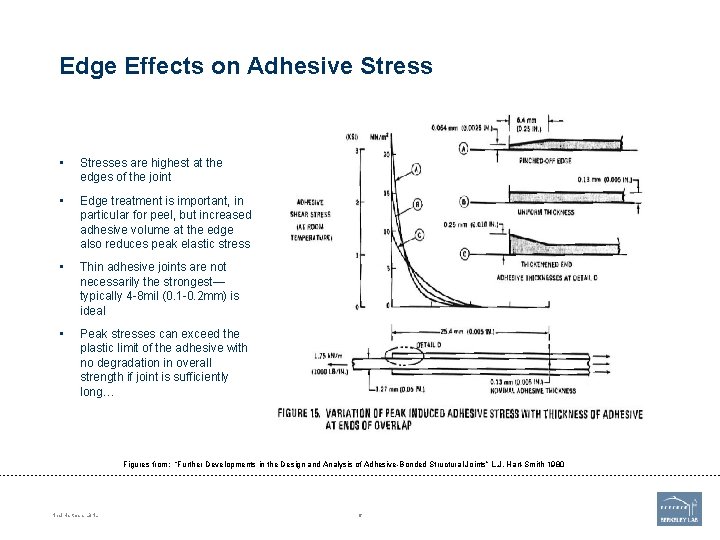
Edge Effects on Adhesive Stress • Stresses are highest at the edges of the joint • Edge treatment is important, in particular for peel, but increased adhesive volume at the edge also reduces peak elastic stress • Thin adhesive joints are not necessarily the strongest— typically 4 -8 mil (0. 1 -0. 2 mm) is ideal • Peak stresses can exceed the plastic limit of the adhesive with no degradation in overall strength if joint is sufficiently long… Figures from: “Further Developments in the Design and Analysis of Adhesive-Bonded Structural Joints” L. J. Hart-Smith 1980 Neal Hartman, LBNL 6
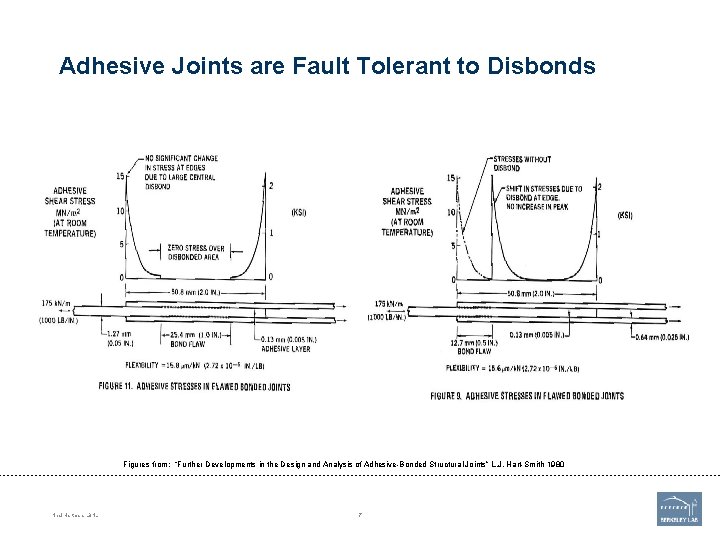
Adhesive Joints are Fault Tolerant to Disbonds Figures from: “Further Developments in the Design and Analysis of Adhesive-Bonded Structural Joints” L. J. Hart-Smith 1980 Neal Hartman, LBNL 7
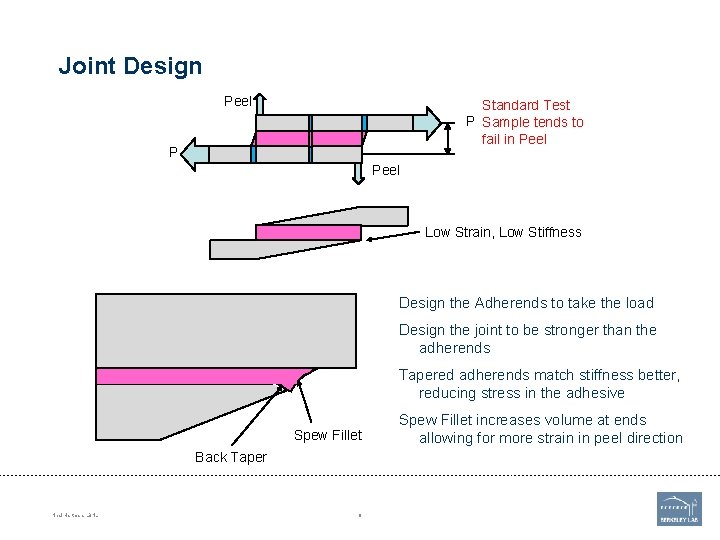
Joint Design Peel Standard Test P Sample tends to fail in Peel P Peel Low Strain, Low Stiffness Design the Adherends to take the load Design the joint to be stronger than the adherends Tapered adherends match stiffness better, reducing stress in the adhesive Spew Fillet Back Taper Neal Hartman, LBNL 8 Spew Fillet increases volume at ends allowing for more strain in peel direction
Adhesive Selection • While not more important than joint geometry, there is substantial variation among adhesives • Strengths vary from 2000 to 5000 psi • Bond line tolerance varies from 100 microns to millimeters • Fillers can substantially alter adhesive viscosity and toughness, and can permit uses such as vertical applications Neal Hartman, LBNL 9
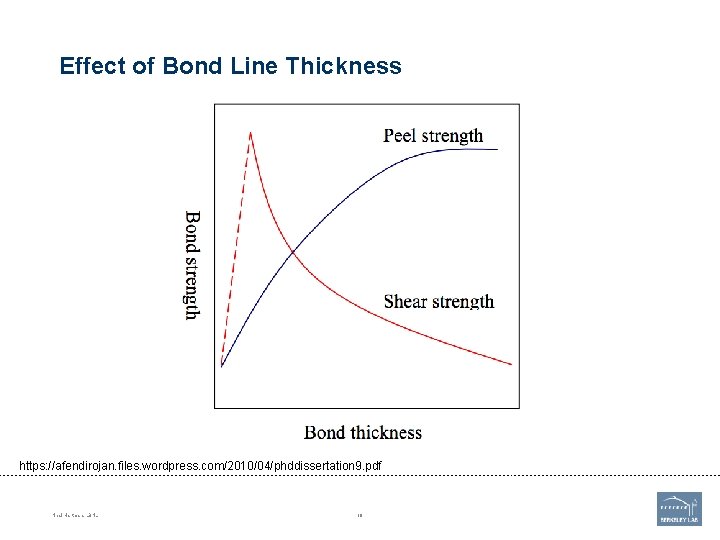
Effect of Bond Line Thickness https: //afendirojan. files. wordpress. com/2010/04/phddissertation 9. pdf Neal Hartman, LBNL 10
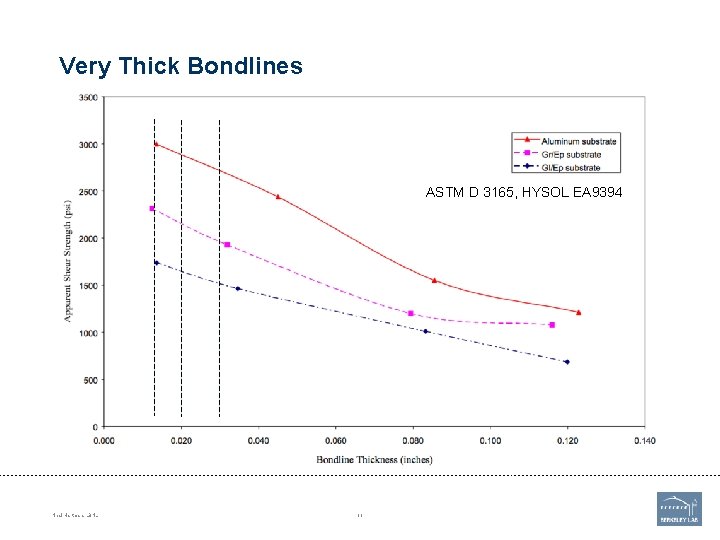
Very Thick Bondlines ASTM D 3165, HYSOL EA 9394 Neal Hartman, LBNL 11
Achieving Bond Line Control • Fillers in the adhesive such as glass beads • Gap control materials – Shims – Monofilament – Wire • – – Building gap into the joint design Ridges or steps in bond region But must be aware of high stress regions 12
Surface Treatment • Abrasion – Increase surface bonding area – Remove surface contaminants – Increase surface energy (expose more energetic chemical structure) – Must reclean after abrasion • – – – Cleaning or etch treatment Remove surface contaminants Form highly adherent, stable surface Bond within short time after treatment to maximise advantage Neal Hartman, LBNL 13
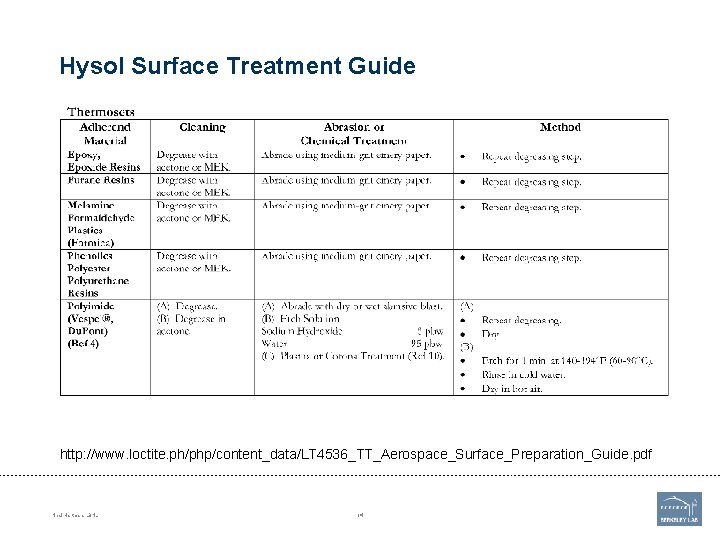
Hysol Surface Treatment Guide http: //www. loctite. ph/php/content_data/LT 4536_TT_Aerospace_Surface_Preparation_Guide. pdf Neal Hartman, LBNL 14
Final Words on Adhesive Bonding • First and foremost, joint geometry should be intelligently designed • Bond line thickness must be well controlled • Surfaces must be properly treated and bond performed within the specified time • Choose the right adhesive (this is the least important element) • A good joint will outperform the adherends – this should be the goal Neal Hartman, LBNL 15
- Slides: 15