
Composite Functions I Composition of Functions f gx
- Slides: 3
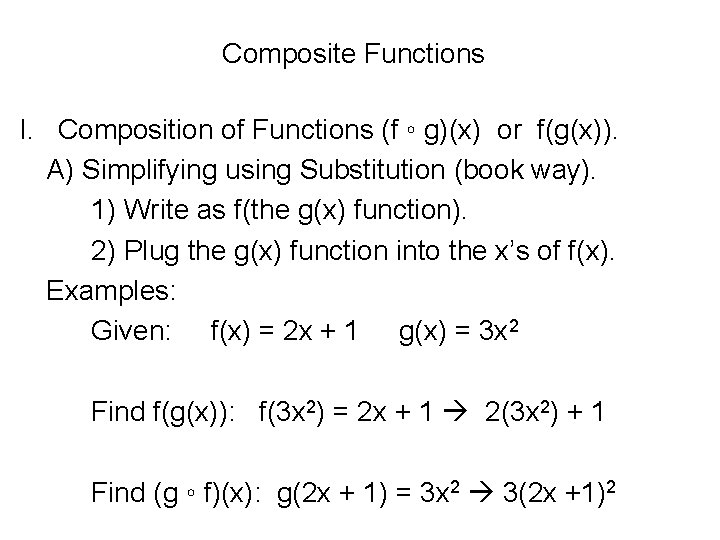
Composite Functions I. Composition of Functions (f ◦ g)(x) or f(g(x)). A) Simplifying using Substitution (book way). 1) Write as f(the g(x) function). 2) Plug the g(x) function into the x’s of f(x). Examples: Given: f(x) = 2 x + 1 g(x) = 3 x 2 Find f(g(x)): f(3 x 2) = 2 x + 1 2(3 x 2) + 1 Find (g ◦ f)(x): g(2 x + 1) = 3 x 2 3(2 x +1)2
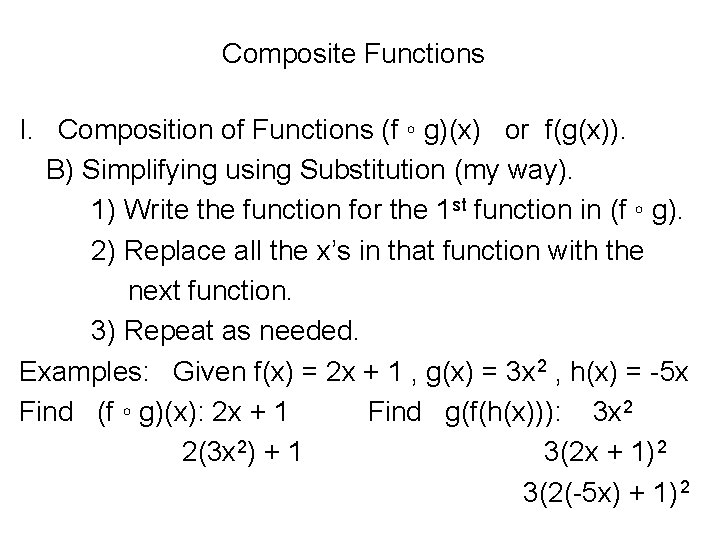
Composite Functions I. Composition of Functions (f ◦ g)(x) or f(g(x)). B) Simplifying using Substitution (my way). 1) Write the function for the 1 st function in (f ◦ g). 2) Replace all the x’s in that function with the next function. 3) Repeat as needed. Examples: Given f(x) = 2 x + 1 , g(x) = 3 x 2 , h(x) = -5 x Find (f ◦ g)(x): 2 x + 1 Find g(f(h(x))): 3 x 2 2(3 x 2) + 1 3(2 x + 1) 2 3(2(-5 x) + 1) 2
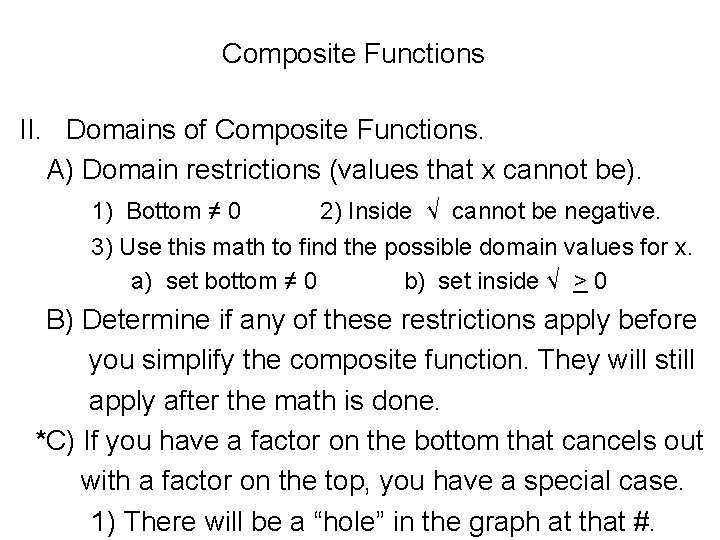
Composite Functions II. Domains of Composite Functions. A) Domain restrictions (values that x cannot be). 1) Bottom ≠ 0 2) Inside √ cannot be negative. 3) Use this math to find the possible domain values for x. a) set bottom ≠ 0 b) set inside √ > 0 B) Determine if any of these restrictions apply before you simplify the composite function. They will still apply after the math is done. *C) If you have a factor on the bottom that cancels out with a factor on the top, you have a special case. 1) There will be a “hole” in the graph at that #.