
Components of the Earth Components of the Earth

- Slides: 26
Components of the Earth
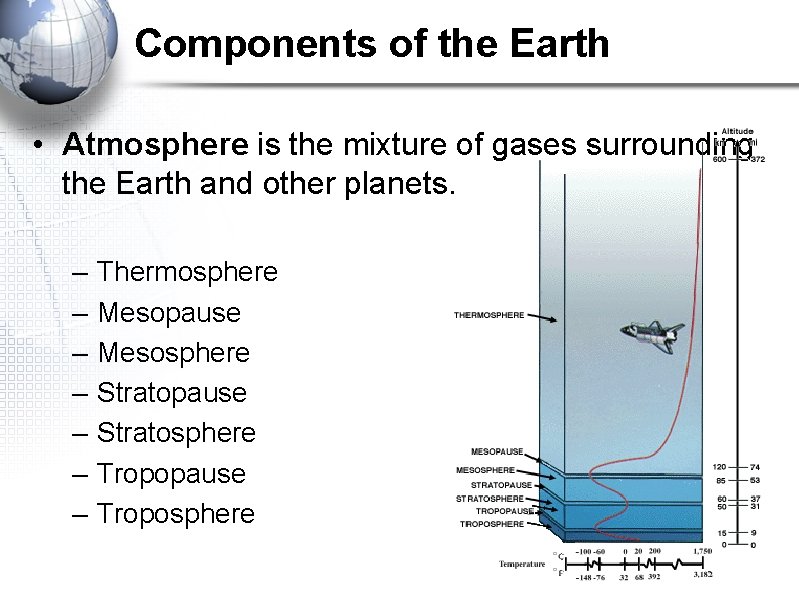
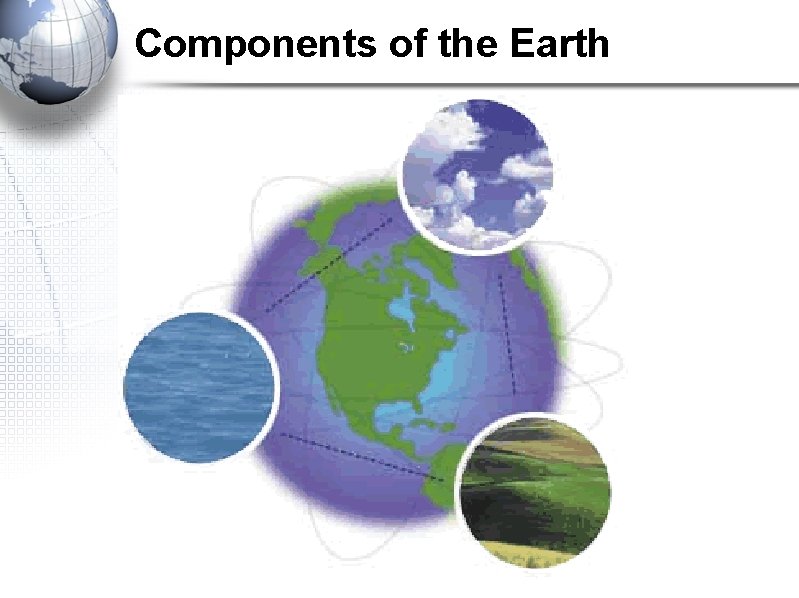
Components of the Earth • Atmosphere is the mixture of gases surrounding the Earth and other planets. – – – – Thermosphere Mesopause Mesosphere Stratopause Stratosphere Tropopause Troposphere
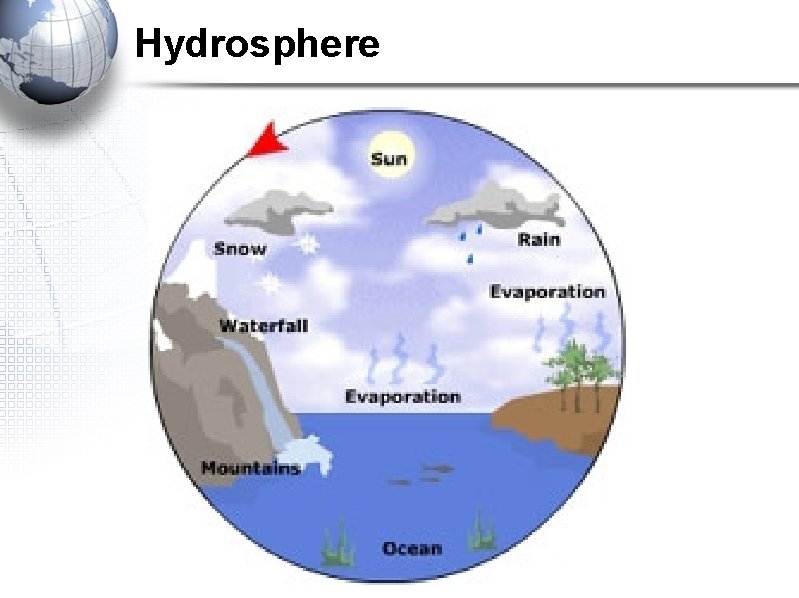
Components of the Earth • Hydrosphere is the part of the Earth composed of water (including clouds, oceans, seas, ice caps, glaciers, lakes, rivers, underground water supplies, and atmospheric water vapour). • Approximately 71% of the Earth is covered by water. – 97% of this water is in the oceans (salt water) – 3% is freshwater • 77% of freshwater is locked in ice • 22% of freshwater is in the ground • <1% of freshwater is in lakes, rivers, and wetlands
Hydrosphere
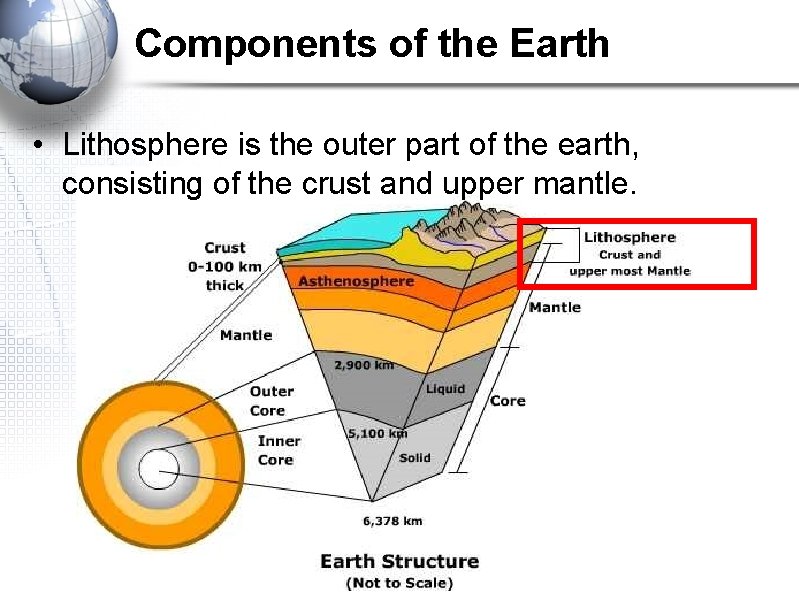
Components of the Earth • Lithosphere is the solid outer crust of the earth, while the mantle and core comprise the interior of the earth. • The lithosphere runs up to 60 miles deep, is divided into the crust and upper mantle. – The upper part of the crust is made of igneous and sedimentary rocks; this makes up the continents. – The lower crust is made of igneous rocks which form the ocean floors. • The inner layers of the earth are the mantle and the core
Components of the Earth • Lithosphere is the outer part of the earth, consisting of the crust and upper mantle.
Components of the Earth • Biosphere is the life zone of the Earth and includes all living organisms, including man, and all organic matter that has not yet decomposed. • The biosphere is structured into a hierarchy known as the food chain whereby all life is dependent upon the first tier (i. e. mainly the primary producers that are capable of photosynthesis). • Energy and mass is transferred from one level of the food chain to the next with an efficiency of about 10%.
Components of the Earth • All organisms are intrinsically linked to their physical environment and the relationship between an organism and its environment is the study of ecology. • The biosphere can be divided into distinct ecosystems that represent the interactions between a group of organisms forming a trophic pyramid and the environment or habitat in which they live.
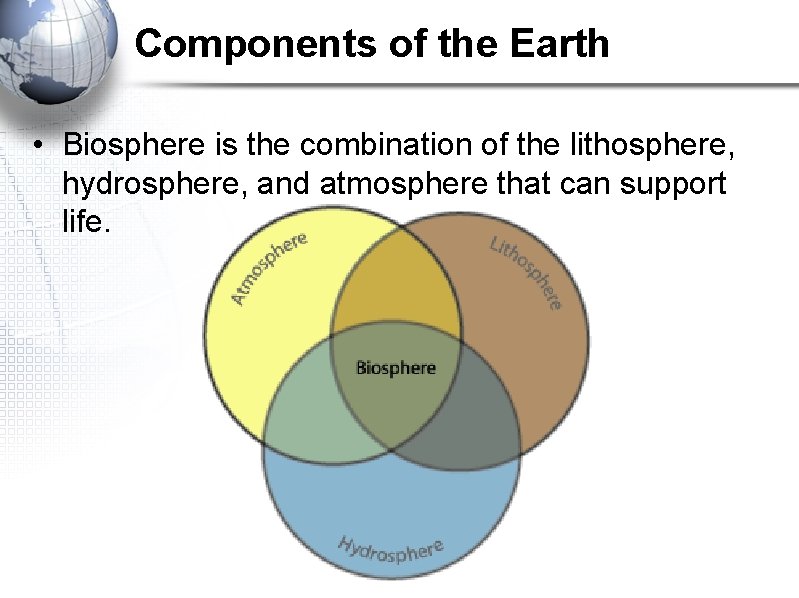
Components of the Earth • Biosphere is the combination of the lithosphere, hydrosphere, and atmosphere that can support life.
Components of the Earth
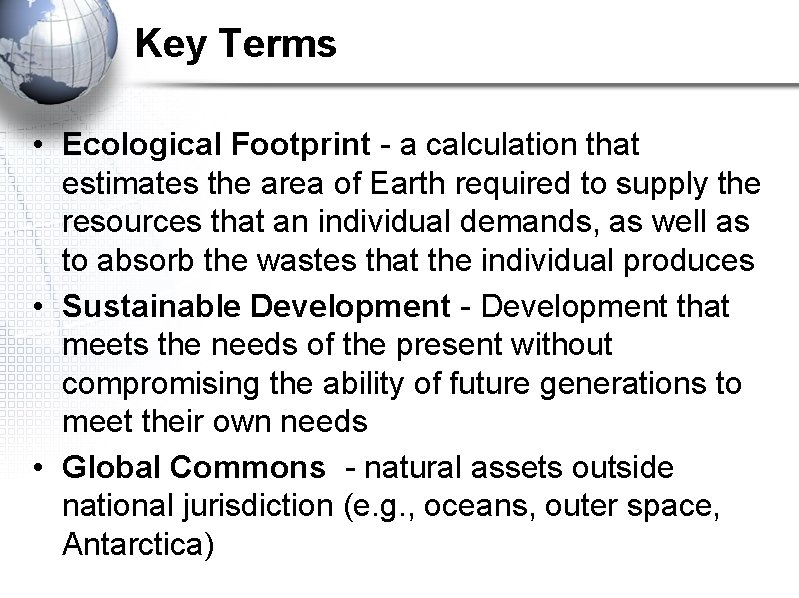
Key Terms • Ecology - the study of how organisms interact with each other and their physical environment • Biodiversity - the variety of life on our planet, (measurable as the variety within species, between species, and the variety of ecosystems) • Carrying Capacity - the maximum number of individuals of a given species that a site can support during the most unfavorable time of year, without causing deterioration of the site
Key Terms • Ecological Footprint - a calculation that estimates the area of Earth required to supply the resources that an individual demands, as well as to absorb the wastes that the individual produces • Sustainable Development - Development that meets the needs of the present without compromising the ability of future generations to meet their own needs • Global Commons - natural assets outside national jurisdiction (e. g. , oceans, outer space, Antarctica)
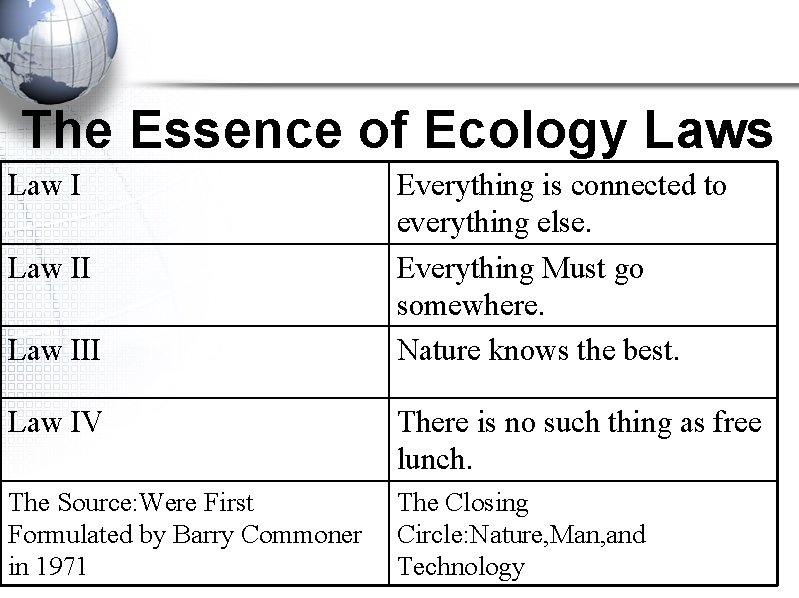
The Essence of Ecology Laws Law III Everything is connected to everything else. Everything Must go somewhere. Nature knows the best. Law IV There is no such thing as free lunch. The Source: Were First Formulated by Barry Commoner in 1971 The Closing Circle: Nature, Man, and Technology
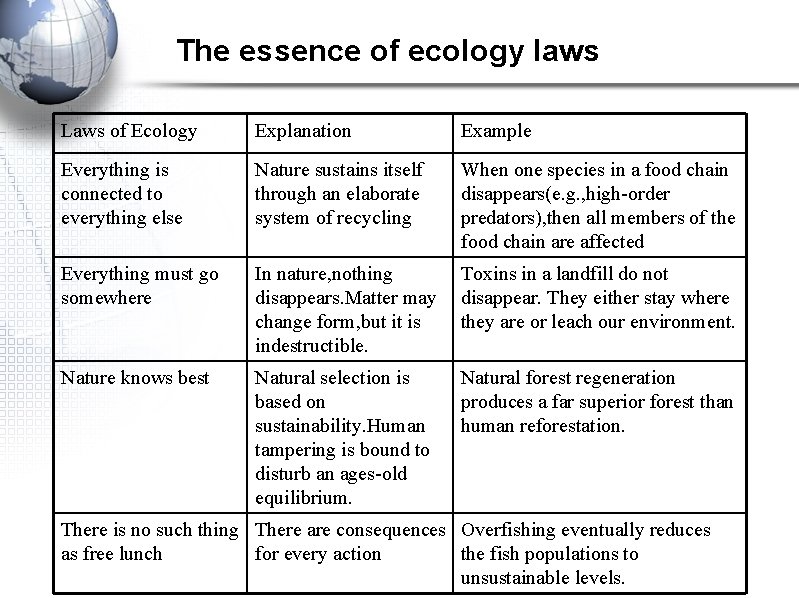
The essence of ecology laws Laws of Ecology Explanation Example Everything is connected to everything else Nature sustains itself through an elaborate system of recycling When one species in a food chain disappears(e. g. , high-order predators), then all members of the food chain are affected Everything must go somewhere In nature, nothing disappears. Matter may change form, but it is indestructible. Toxins in a landfill do not disappear. They either stay where they are or leach our environment. Nature knows best Natural selection is based on sustainability. Human tampering is bound to disturb an ages-old equilibrium. Natural forest regeneration produces a far superior forest than human reforestation. There is no such thing There are consequences Overfishing eventually reduces as free lunch for every action the fish populations to unsustainable levels.
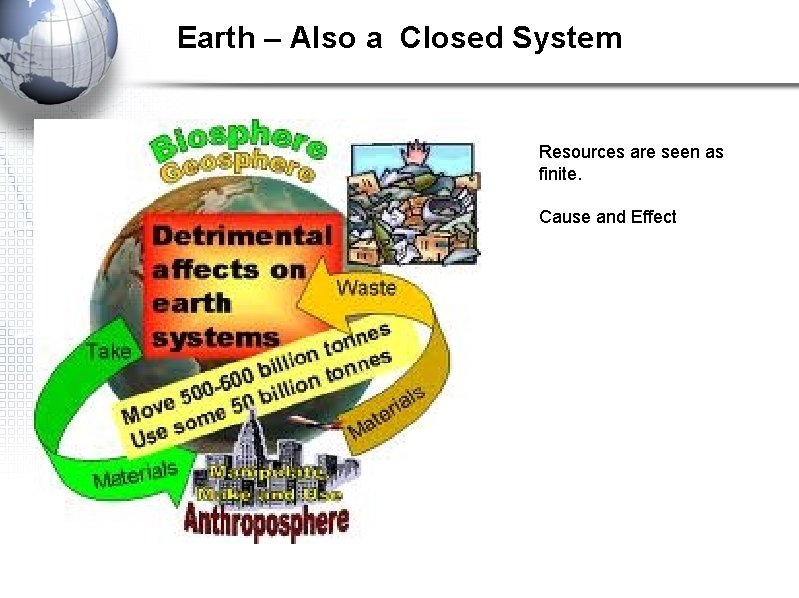
Earth – Also a Closed System Resources are seen as finite. Cause and Effect
Biosphere 2
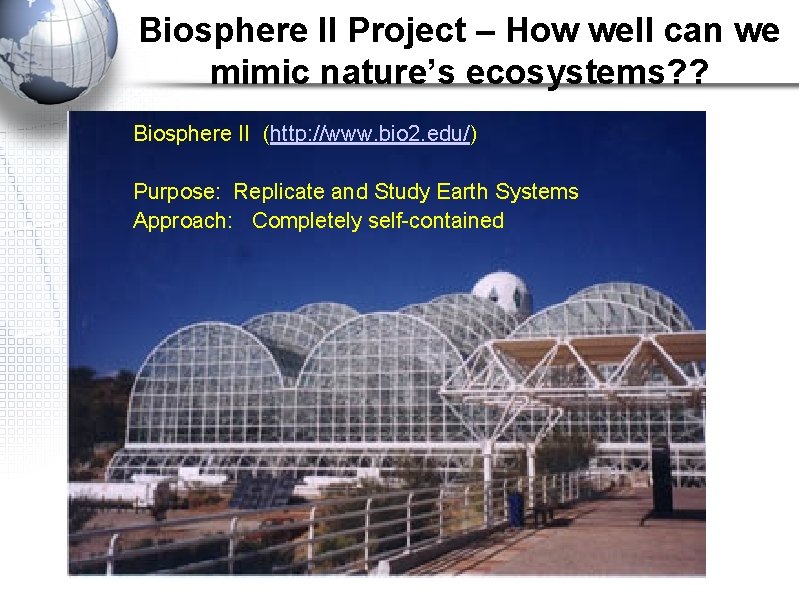
Biosphere II Project – How well can we mimic nature’s ecosystems? ? Biosphere II (http: //www. bio 2. edu/) Purpose: Replicate and Study Earth Systems Approach: Completely self-contained
Re-opened to Public • Biosphere 2 Center was opened to the public in 1990 as a research and learning center to explore how our environment affects our lives and how we affect our environment. • The goal of Biosphere 2 has been to find ways to become responsible stewards of our planet, ensuring a good quality of life for us and for future generations.
System in Words • On January 1, 1996, Columbia University - one of the world's leading research and education institutions - joined Biosphere 2 Center to expand guide its programs • http: //www. youtube. com/watch? v=a 7 B 39 MLVe. Ic& feature=related •
Facts and Numbers • Biosphere 2 was created to better understand Biosphere I -- planet Earth • Biosphere 2 covers 3. 15 acres • It is 91 feet at its highest point • It is sealed off from Earth below by a 500 -ton welded stainless steel liner • A host of instruments constantly monitors the air, soil and water • The 25 -foot ocean contains a million gallons of salt water • Biosphere 2 contains five biomes - a rainforest, desert, savanna, marsh and ocean. (A biome is a self-sustaining community of living organisms. ) • The apparatus houses more than 3, 000 species of living organisms • The Habitat is open for public tours and features many exhibits such as the Climate Change and Life on Earth exhibition.
Biosphere II Project - Needs What do you need? Food Water Lighting Heat Energy to run systems Waste Treatment Proximal Source Constructed Ecosystems Water Food Energy Natural resources Waste Removal Distal Sources? No – wish to be self-contained!!
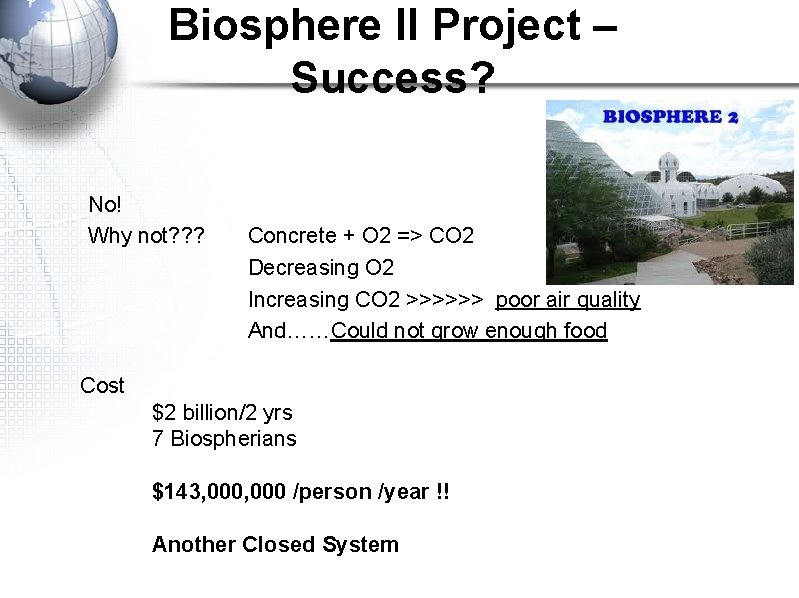
Biosphere II Project – Success? No! Why not? ? ? Concrete + O 2 => CO 2 Decreasing O 2 Increasing CO 2 >>>>>> poor air quality And……Could not grow enough food Cost $2 billion/2 yrs 7 Biospherians $143, 000 /person /year !! Another Closed System
We Live in a Closed System!! • Apollo 13 - No other planet to rescue us if something goes wrong • Biosphere II –expensive to build natural system to keep us going (and we still don’t know how!) – We cannot even build the basics – cannot replace nature Consequences of Living in a Closed System – Lots of Services provided by nature that we cannot easily, or in any way, replace – What are sources of: • Air? • Water? • Soil?
Ecosystem Services: What are ecosystems worth to us? Economic AND Non-Market Values Discussion