
Components of IPM Introduction Insect pests bottlenecks in
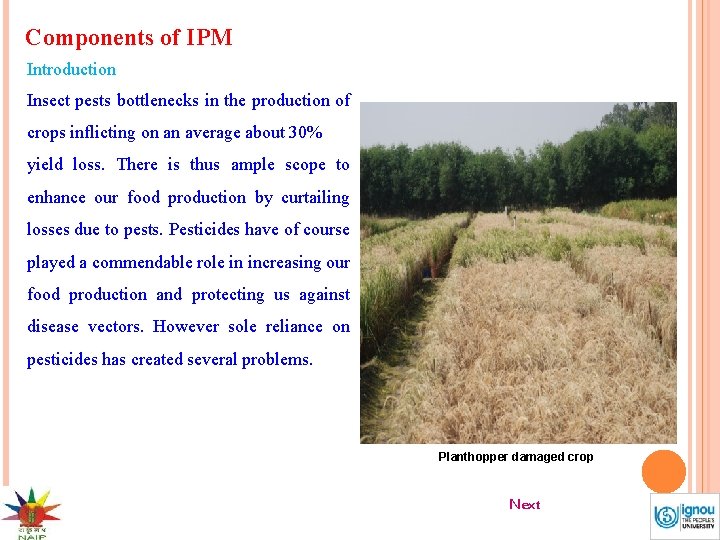
Components of IPM Introduction Insect pests bottlenecks in the production of crops inflicting on an average about 30% yield loss. There is thus ample scope to enhance our food production by curtailing losses due to pests. Pesticides have of course played a commendable role in increasing our food production and protecting us against disease vectors. However sole reliance on pesticides has created several problems. Planthopper damaged crop Next
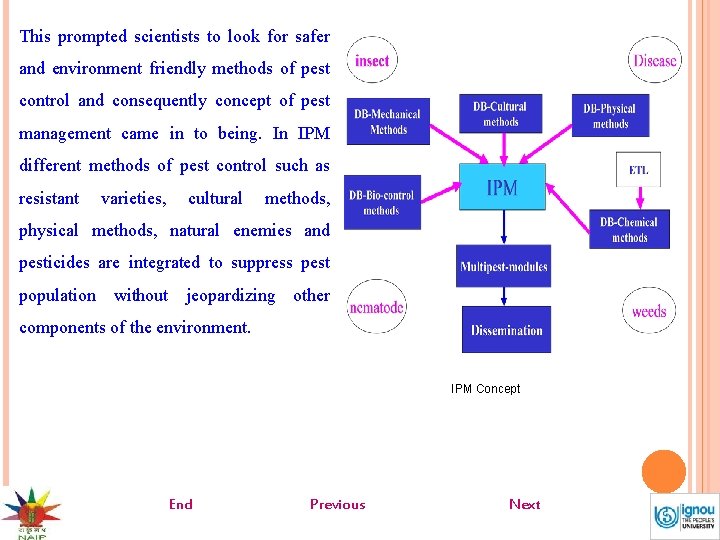
This prompted scientists to look for safer and environment friendly methods of pest control and consequently concept of pest management came in to being. In IPM different methods of pest control such as resistant varieties, cultural methods, physical methods, natural enemies and pesticides are integrated to suppress pest population without jeopardizing other components of the environment. IPM Concept End Previous Next
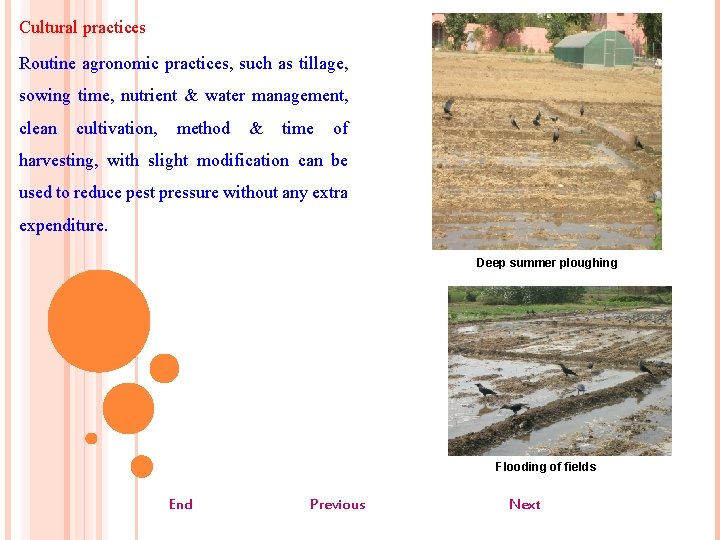
Cultural practices Routine agronomic practices, such as tillage, sowing time, nutrient & water management, clean cultivation, method & time of harvesting, with slight modification can be used to reduce pest pressure without any extra expenditure. Deep summer ploughing Flooding of fields End Previous Next

Clean cultivation Ø Removal of weeds and excess nurseries reduces incidence of borers, grasshoppers, leafhoppers, gall midge, leaf folder. Removal of Echinochloa from field and bunds brings down gundhi bug population. Echinochloa weed End Previous Next
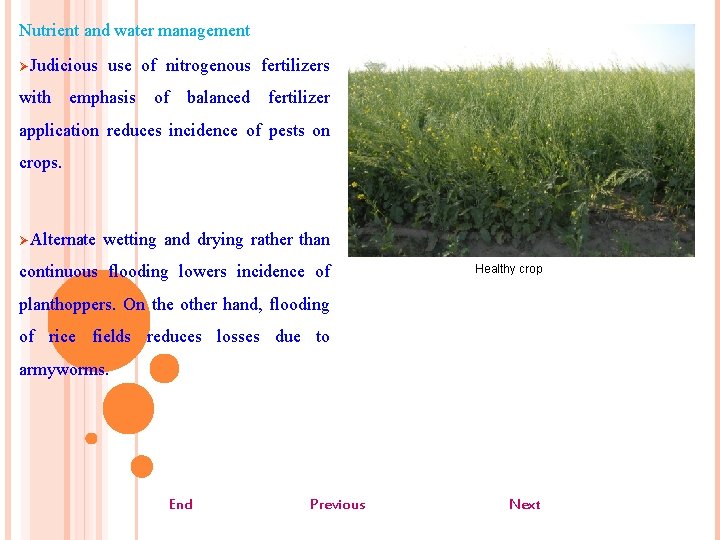
Nutrient and water management ØJudicious use of nitrogenous fertilizers with emphasis of balanced fertilizer application reduces incidence of pests on crops. ØAlternate wetting and drying rather than continuous flooding lowers incidence of Healthy crop planthoppers. On the other hand, flooding of rice fields reduces losses due to armyworms. End Previous Next
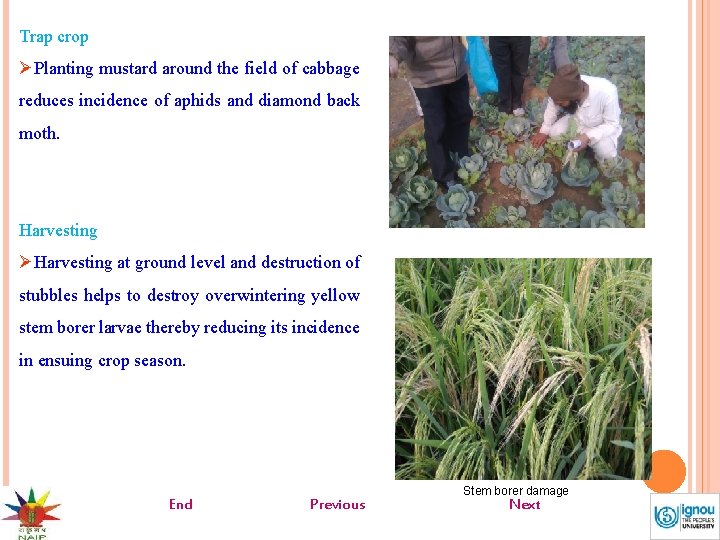
Trap crop ØPlanting mustard around the field of cabbage reduces incidence of aphids and diamond back moth. Harvesting ØHarvesting at ground level and destruction of stubbles helps to destroy overwintering yellow stem borer larvae thereby reducing its incidence in ensuing crop season. End Previous Stem borer damage Next
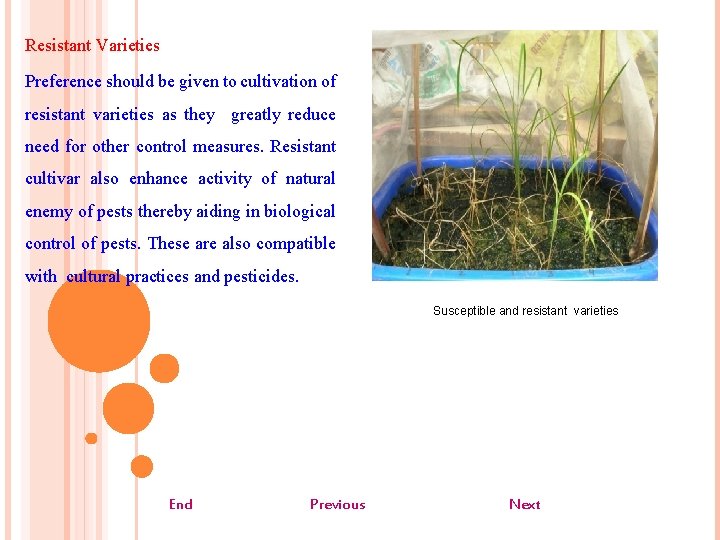
Resistant Varieties Preference should be given to cultivation of resistant varieties as they greatly reduce need for other control measures. Resistant cultivar also enhance activity of natural enemy of pests thereby aiding in biological control of pests. These are also compatible with cultural practices and pesticides. Susceptible and resistant varieties End Previous Next
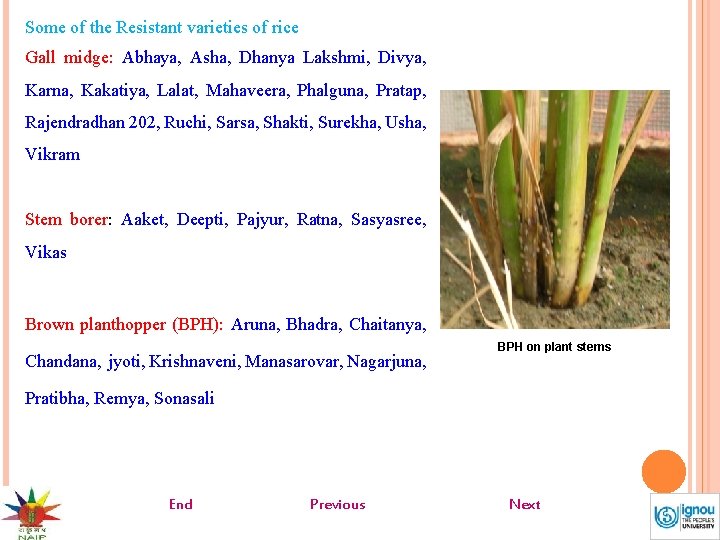
Some of the Resistant varieties of rice Gall midge: Abhaya, Asha, Dhanya Lakshmi, Divya, Karna, Kakatiya, Lalat, Mahaveera, Phalguna, Pratap, Rajendradhan 202, Ruchi, Sarsa, Shakti, Surekha, Usha, Vikram Stem borer: Aaket, Deepti, Pajyur, Ratna, Sasyasree, Vikas Brown planthopper (BPH): Aruna, Bhadra, Chaitanya, Chandana, jyoti, Krishnaveni, Manasarovar, Nagarjuna, BPH on plant stems Pratibha, Remya, Sonasali End Previous Next

Physical methods Use of physical practices refer to manipulation of physical factors of environment such as light, heat, temperature, humidity to reduce incidence of pests, for example light traps are used for mass trapping and destruction of pests by exploiting their behaviour. Likewise, stored-grain pests are controlled through improved storage structures, which are based on principles of air tightness, thermal insulation and Light Trap moisture proofing. End Previous Gram damaged by pulse beetle Next Courtesy: www. jnkvv. nic. in
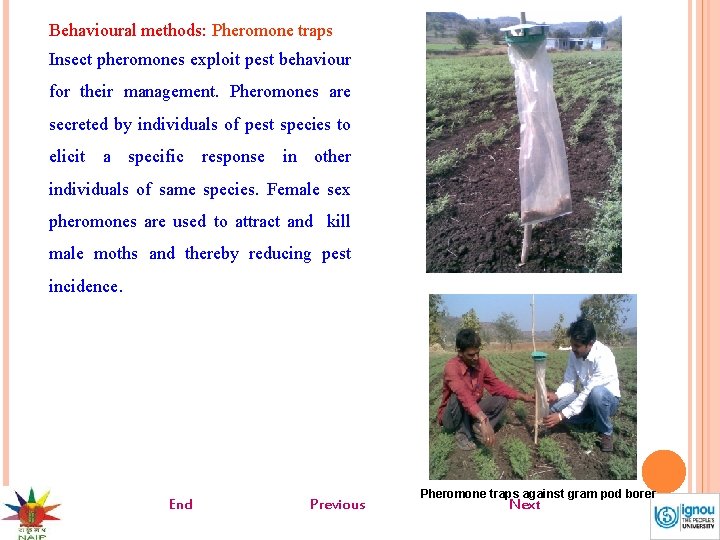
Behavioural methods: Pheromone traps Insect pheromones exploit pest behaviour for their management. Pheromones are secreted by individuals of pest species to elicit a specific response in other individuals of same species. Female sex pheromones are used to attract and kill male moths and thereby reducing pest incidence. End Previous Pheromone traps against gram pod borer Next
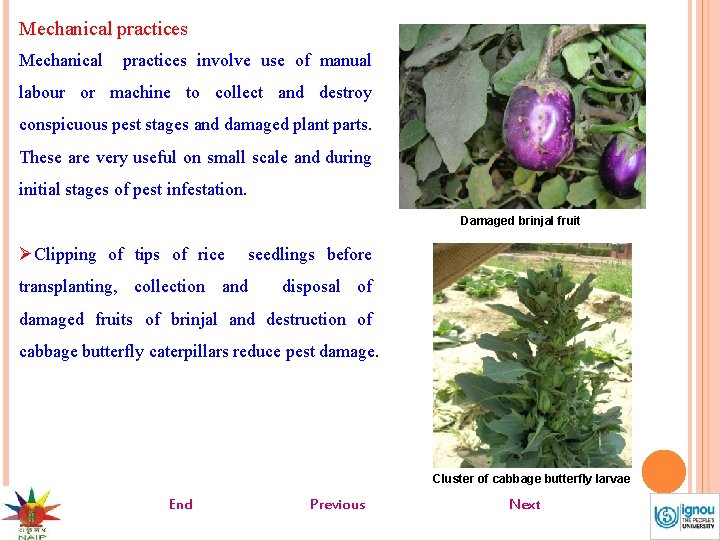
Mechanical practices involve use of manual labour or machine to collect and destroy conspicuous pest stages and damaged plant parts. These are very useful on small scale and during initial stages of pest infestation. Damaged brinjal fruit ØClipping of tips of rice transplanting, collection and seedlings before disposal of damaged fruits of brinjal and destruction of cabbage butterfly caterpillars reduce pest damage. Cluster of cabbage butterfly larvae End Previous Next
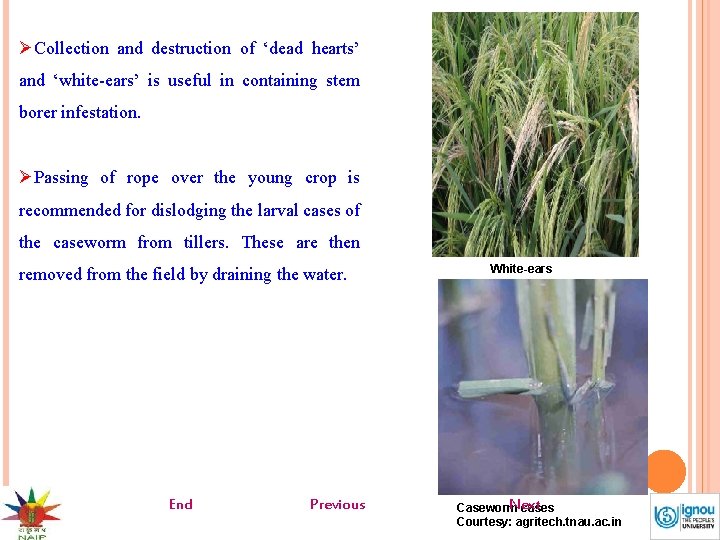
ØCollection and destruction of ‘dead hearts’ and ‘white-ears’ is useful in containing stem borer infestation. ØPassing of rope over the young crop is recommended for dislodging the larval cases of the caseworm from tillers. These are then removed from the field by draining the water. End Previous White-ears Next Caseworm cases Courtesy: agritech. tnau. ac. in
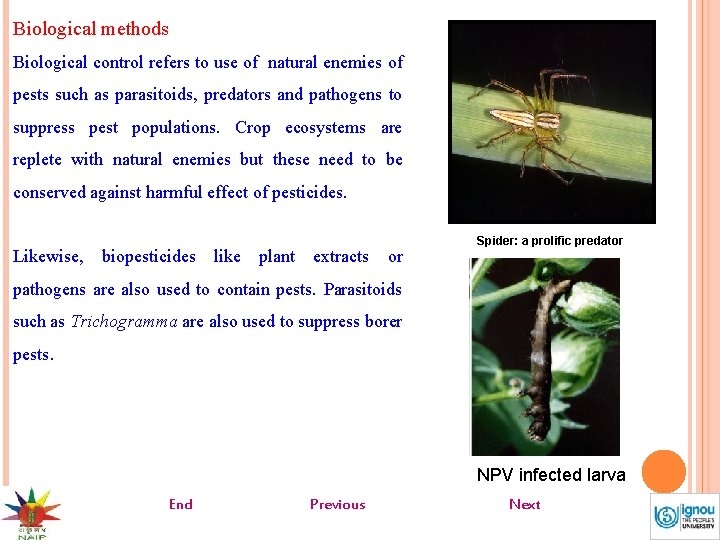
Biological methods Biological control refers to use of natural enemies of pests such as parasitoids, predators and pathogens to suppress pest populations. Crop ecosystems are replete with natural enemies but these need to be conserved against harmful effect of pesticides. Likewise, biopesticides like plant extracts or Spider: a prolific predator pathogens are also used to contain pests. Parasitoids such as Trichogramma are also used to suppress borer pests. NPV infected larva End Previous Next
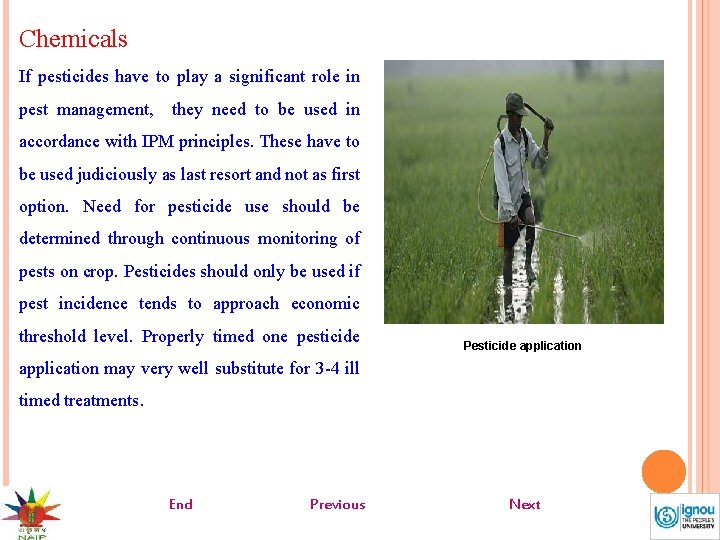
Chemicals If pesticides have to play a significant role in pest management, they need to be used in accordance with IPM principles. These have to be used judiciously as last resort and not as first option. Need for pesticide use should be determined through continuous monitoring of pests on crop. Pesticides should only be used if pest incidence tends to approach economic threshold level. Properly timed one pesticide Pesticide application may very well substitute for 3 -4 ill timed treatments. End Previous Next
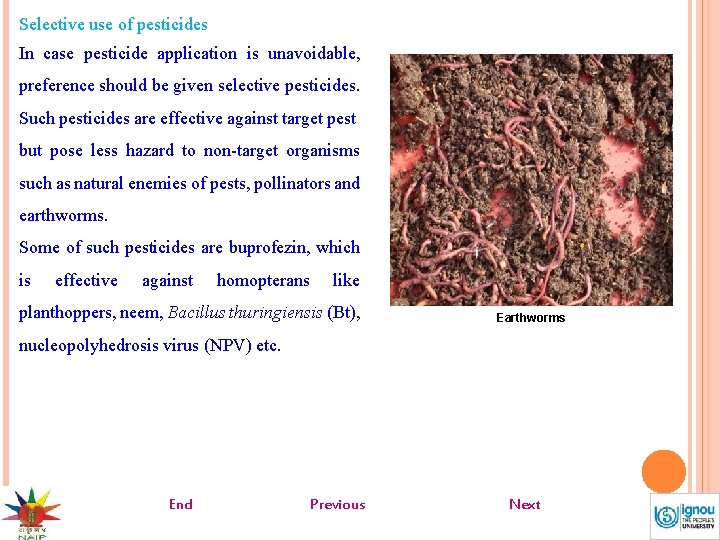
Selective use of pesticides In case pesticide application is unavoidable, preference should be given selective pesticides. Such pesticides are effective against target pest but pose less hazard to non-target organisms such as natural enemies of pests, pollinators and earthworms. Some of such pesticides are buprofezin, which is effective against homopterans like planthoppers, neem, Bacillus thuringiensis (Bt), Earthworms nucleopolyhedrosis virus (NPV) etc. End Previous Next
Let’s Sum up ØCultural, mechanical, physical, behavioural, biological and chemical methods constitute different components of IPM. ØRoutine agronomic practices with slight modification can be used to reduce pest pressure without any extra expenditure. ØResistant varieties greatly reduce need for other control measures. ØFemale sex pheromones are used to attract and kill male moths. Mechanical practices involve collection and destruction of conspicuous pest stages and damaged plant parts. ØIn biological control natural enemies of pests such as parasitoids, predators and pathogens to suppress pest populations. ØPesticides need to be used in accordance with IPM principles. ØIPM components, which are relevant to a pest species should be integrated formulated Ipm modules. End Previous to
- Slides: 16