
COMPONENTS OF INDIAN MONEY MARKET Organized money market


- Slides: 8
COMPONENTS OF INDIAN MONEY MARKET Organized money market : These markets have standardized and systematic rules, regulations and procedures to govern the financial dealings. Organized money market are governed and regulated by Government and Reserve Bank of India. It consists of Reserve Bank of India and other banks, financial institutions, specialized financial institutions, non-banking financial institutions, quasi government bodies and government bodies who supply funds through money market
Unorganized money market: unorganized market consists of indigenous bankers and money lenders. They collect deposits and lend money. A part from there are certain private finance companies or non-banking companies, chit funds etc. Reserve Bank of India has taken a number of steps to regulate such type of institutions and bring them in the organized sector. One of such step is issuing of non-banking Financial Companies Act, 1998. Sub market: it consists of call money market and bill market. Bill market consists of commercial bill market and Treasury bills market, certificates of deposits, and commercial papers.
STRUCTURE OF INDIAN MONEY MARKET Indigenous bankers: the Indian Central Banking Enquiry Committee defined Indigenous banks as “ an individual or private firm receiving deposits and dealing in hundies or lending money”. They accept deposit son current accounts and fixed deposits. They lend money to small farmers and traders. Along with this they deal in hundies. They charge exorbitant rate of interest on loans. Certain communities such as Marwari's, Bengalese, Gujarathies, Chettiars and Kallida Kurichi Brahmins do indigenous banking business in India. The main limitation of indigenous bankers is that they follow conservative practices and are not governed by Reserve Bank of India. Money lenders: money lenders constitutes one of the components of the organized money market of our country. Money lenders are those person who do not accept deposits from public, but merely lend their own funds. They lend money mainly for consumption and other domestic purposes. They are mainly two categories of money lenders. 1) Professional money lenders: they are those persons whose main business is to lend money. It may be of two types. Resident money lenders : Maharaja, Sahukars, Seths or Banias. Itinerant money lenders: Pathans and Kabulis 2) Non-professional money lenders: these are those persons who combine money lending with other activities
ORGANIZED BANKING SECTOR It consists of Reserve Bank of India, the State Bank of India and its seven subsidiaries, 19 nationalized banks, the other joint stock banks including commercial banks, co-operative banks, regional Rural Banks, special institutions like LIC, UTI, IDBI, SFCs, NABARD, Exim bank etc. DFHI, non-banking companies and quasi Government bodies and large companies which supply funds in the money market through banks. Reserve Bank of India (RBI) is the central bank and monitory authority of our country. So RBI is the leader of Indian money market. PARTICIPANTS IN MONEY MARKET 1. Lenders: These are the entities with surplus lendable funds like Banks (commercial, co-operative and Private) Mutual Funds Corporate Entities with bulk lendable resources of minimum of Rs. 3 crores per transaction and Financial Institutions. 2. Borrowers: these are entities with deficit funds and include the ones as above.
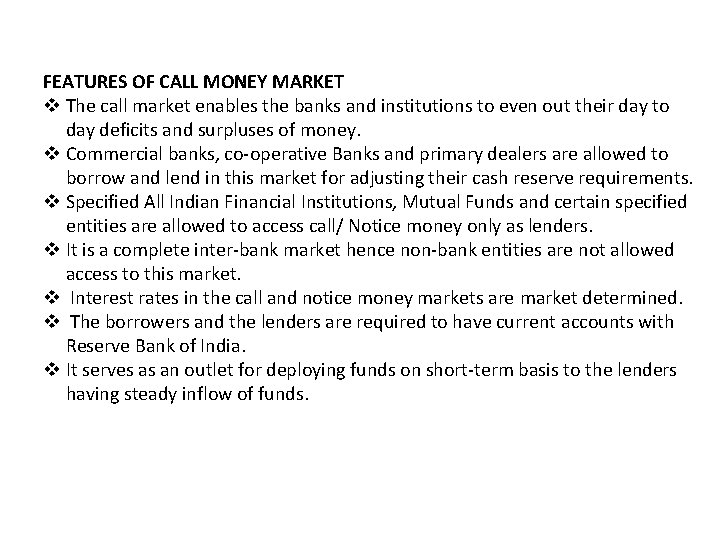
FEATURES OF CALL MONEY MARKET v The call market enables the banks and institutions to even out their day to day deficits and surpluses of money. v Commercial banks, co-operative Banks and primary dealers are allowed to borrow and lend in this market for adjusting their cash reserve requirements. v Specified All Indian Financial Institutions, Mutual Funds and certain specified entities are allowed to access call/ Notice money only as lenders. v It is a complete inter-bank market hence non-bank entities are not allowed access to this market. v Interest rates in the call and notice money markets are market determined. v The borrowers and the lenders are required to have current accounts with Reserve Bank of India. v It serves as an outlet for deploying funds on short-term basis to the lenders having steady inflow of funds.
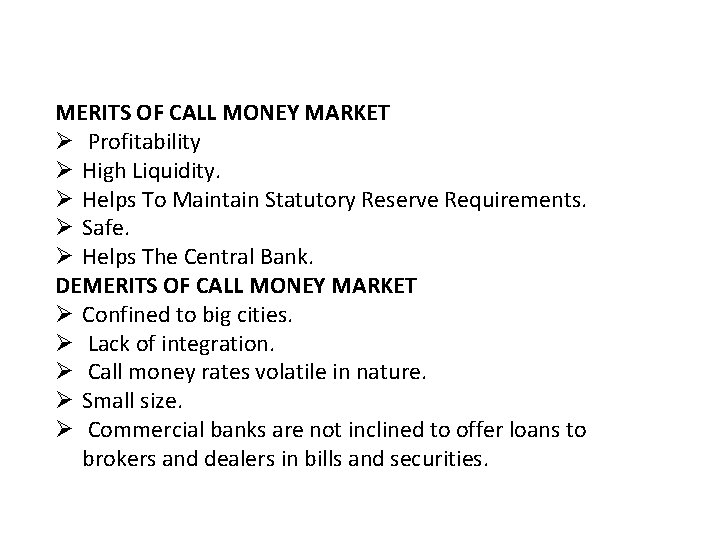
MERITS OF CALL MONEY MARKET Ø Profitability Ø High Liquidity. Ø Helps To Maintain Statutory Reserve Requirements. Ø Safe. Ø Helps The Central Bank. DEMERITS OF CALL MONEY MARKET Ø Confined to big cities. Ø Lack of integration. Ø Call money rates volatile in nature. Ø Small size. Ø Commercial banks are not inclined to offer loans to brokers and dealers in bills and securities.