
Components of Emotion Motivation to act or goals
- Slides: 14
Components of Emotion: • Motivation to act or goals (e. g. , approach or avoidance) • Physiological reactions (e. g. , heart rate, hormone levels) • Thoughts (cognitions) and feelings
Emotional Milestones • Positive emotions – Social smiles: Smiles directed toward people • Typically emerge between 2 -3 months
• Negative emotions – Distress reaction: Present from birth • Occurs in response to multiple stressors (e. g. , hunger, pain, etc. ) – Disagreement about whether young infants experience distinct negative emotions (e. g. , anger, sadness, fear) or if they simply experience distress
• Fear – Little firm evidence of distinct fear reactions in young infants – At around 6 -7 months, fear of strangers (stranger anxiety) often develops – Other fears also present at around 7 months
– Separation Anxiety • Distress due to separation from primary caregiver(s) – Develops around 8 months and continues until about 13 -15 months, then declines
• Other negative emotions (anger, sadness) – Between 4 -8 months, anger expressions become distinct from other negative emotions – Anger and sadness are often elicited by the same situations • Exs: after a painful event; when infants can’t control events in their environment • Anger expressions seem to occur more frequently in infants than sadness expressions
• Self-conscious emotions – Embarrassment, pride, guilt, shame • Emerge between 15 -24 months • Associated with recognition of self (rouge test)
Individual Differences in Emotion • Temperament: Biologically based individual differences in emotional characteristics and other behaviors – Show consistency across situations – Relatively stable over time • But temperament characteristics also often show changes over time
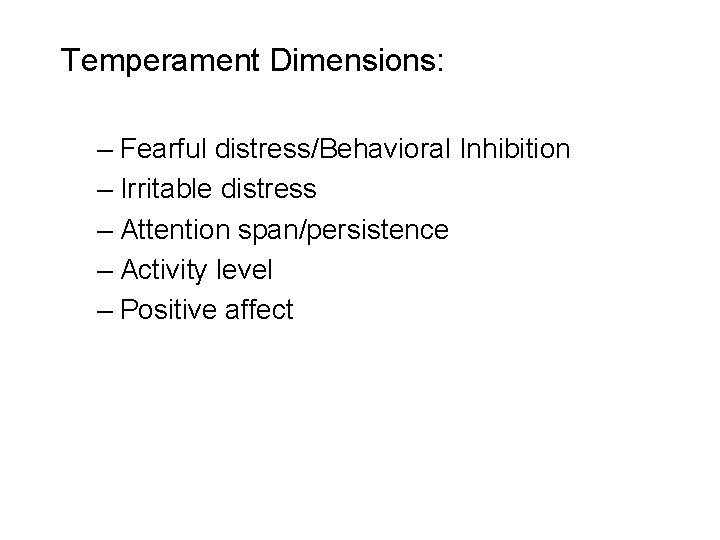
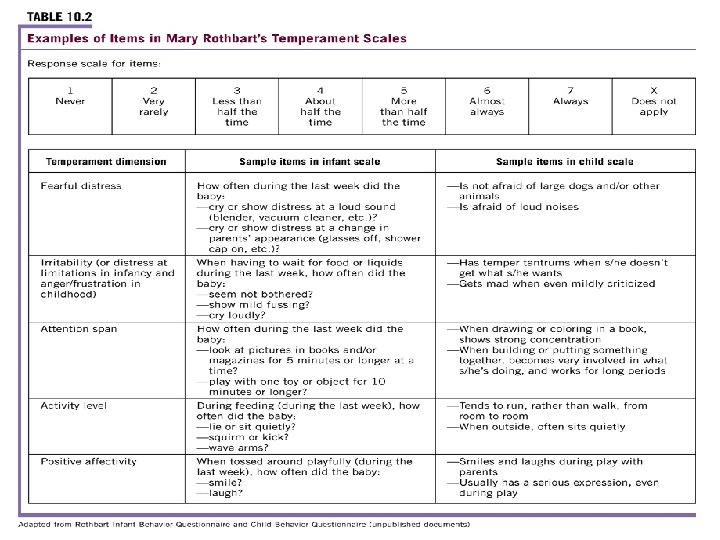
Temperament Dimensions: – Fearful distress/Behavioral Inhibition – Irritable distress – Attention span/persistence – Activity level – Positive affect
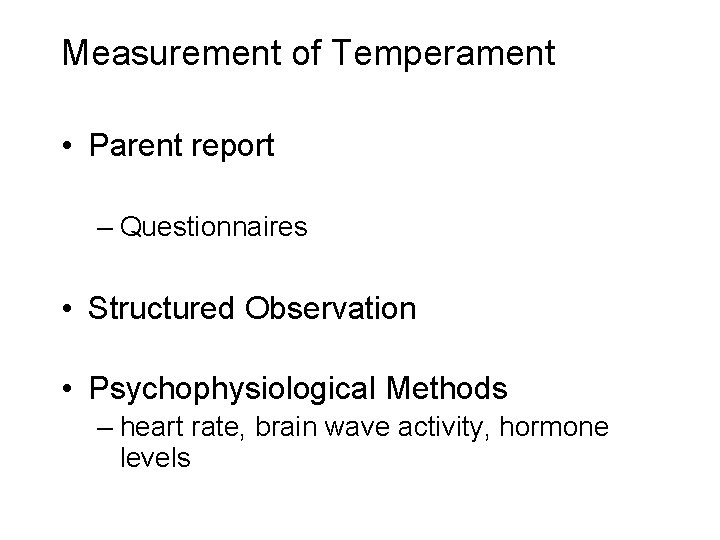
Measurement of Temperament • Parent report – Questionnaires • Structured Observation • Psychophysiological Methods – heart rate, brain wave activity, hormone levels
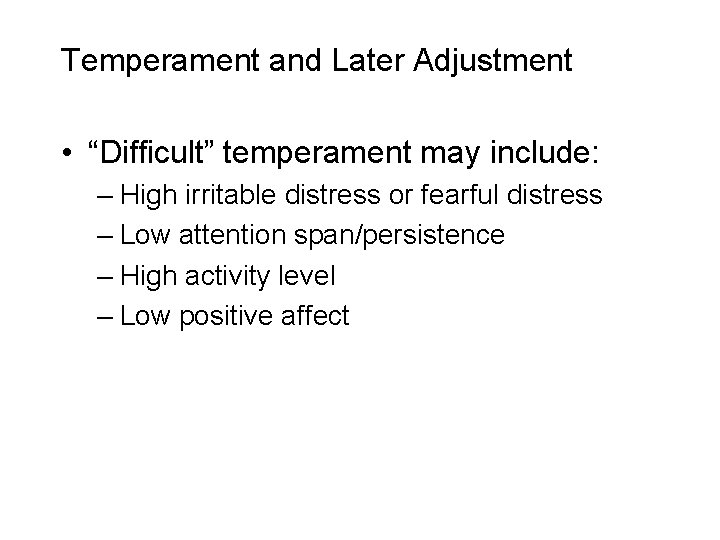
Temperament and Later Adjustment • “Difficult” temperament may include: – High irritable distress or fearful distress – Low attention span/persistence – High activity level – Low positive affect
• Difficult temperament in infancy/preschool period is correlated with adjustment problems later in life (adolescence, adulthood) – But some infants/children with difficult temperament characteristics do not show adjustment problems later in life
• Goodness-of-Fit – Degree to which a child’s temperament is compatible with the expectations of the social environment (including the family environment) • Poor goodness-of-fit likely to result in adjustment problems for children