
COMPONENTS OF CRITICAL THINKING Knowledge Information specific to

- Slides: 4
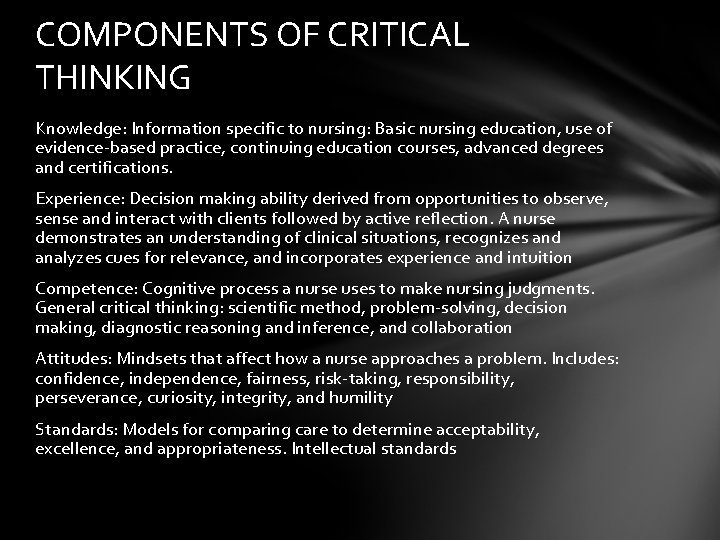
COMPONENTS OF CRITICAL THINKING Knowledge: Information specific to nursing: Basic nursing education, use of evidence-based practice, continuing education courses, advanced degrees and certifications. Experience: Decision making ability derived from opportunities to observe, sense and interact with clients followed by active reflection. A nurse demonstrates an understanding of clinical situations, recognizes and analyzes cues for relevance, and incorporates experience and intuition Competence: Cognitive process a nurse uses to make nursing judgments. General critical thinking: scientific method, problem-solving, decision making, diagnostic reasoning and inference, and collaboration Attitudes: Mindsets that affect how a nurse approaches a problem. Includes: confidence, independence, fairness, risk-taking, responsibility, perseverance, curiosity, integrity, and humility Standards: Models for comparing care to determine acceptability, excellence, and appropriateness. Intellectual standards
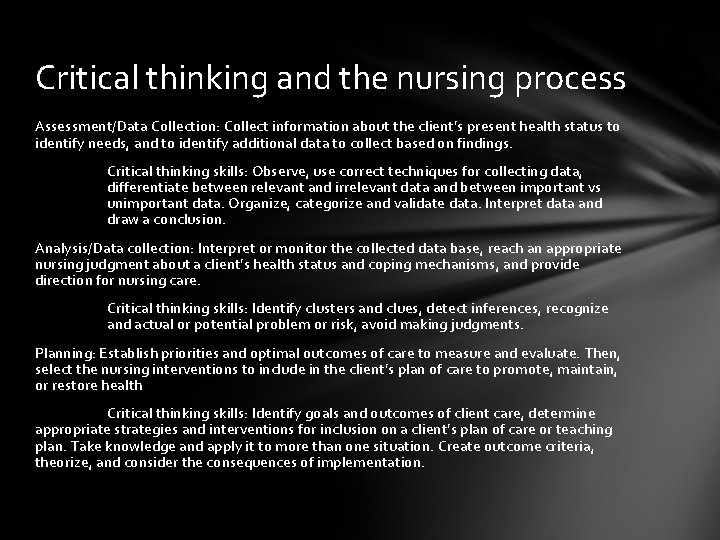
Critical thinking and the nursing process Assessment/Data Collection: Collect information about the client’s present health status to identify needs, and to identify additional data to collect based on findings. Critical thinking skills: Observe, use correct techniques for collecting data, differentiate between relevant and irrelevant data and between important vs unimportant data. Organize, categorize and validate data. Interpret data and draw a conclusion. Analysis/Data collection: Interpret or monitor the collected data base, reach an appropriate nursing judgment about a client’s health status and coping mechanisms, and provide direction for nursing care. Critical thinking skills: Identify clusters and clues, detect inferences, recognize and actual or potential problem or risk, avoid making judgments. Planning: Establish priorities and optimal outcomes of care to measure and evaluate. Then, select the nursing interventions to include in the client’s plan of care to promote, maintain, or restore health Critical thinking skills: Identify goals and outcomes of client care, determine appropriate strategies and interventions for inclusion on a client’s plan of care or teaching plan. Take knowledge and apply it to more than one situation. Create outcome criteria, theorize, and consider the consequences of implementation.
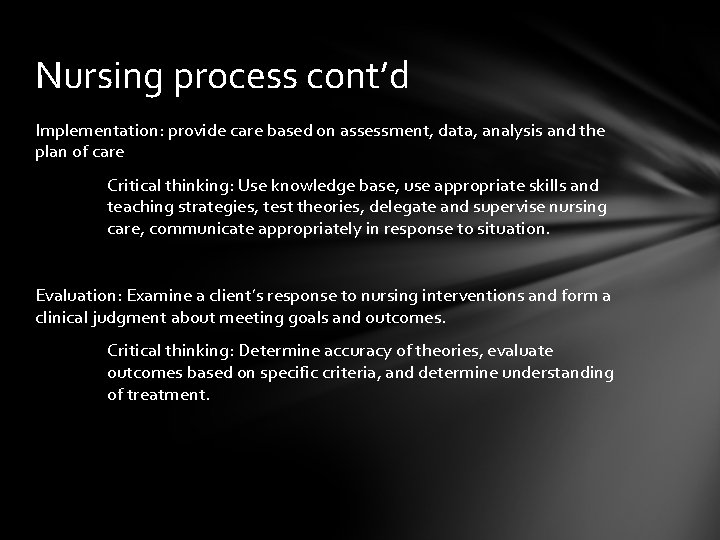
Nursing process cont’d Implementation: provide care based on assessment, data, analysis and the plan of care Critical thinking: Use knowledge base, use appropriate skills and teaching strategies, test theories, delegate and supervise nursing care, communicate appropriately in response to situation. Evaluation: Examine a client’s response to nursing interventions and form a clinical judgment about meeting goals and outcomes. Critical thinking: Determine accuracy of theories, evaluate outcomes based on specific criteria, and determine understanding of treatment.