
Components of building INTRODUCTION TO TYPES OF LOADS
Components of building INTRODUCTION TO TYPES OF LOADS ON BUILDINGS To get safe structures at the same time without ignoring economy of the structure, it is necessary to estimate the various loads acting suitably. Indian standard code IS: 875– 1987 specifies various design loads for buildings and structures. They have grouped various loads as under: 1. Dead loads (DL) 2. Imposed loads or Live Load (LL) 3. Wind loads (WL) 4. Earthquake loads (EQL) Department of Civil Engineering, ACET 1
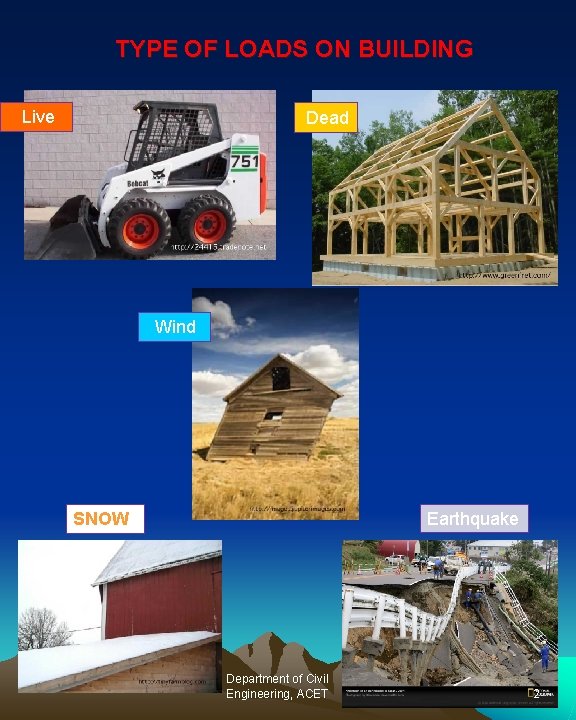
TYPE OF LOADS ON BUILDING Live Dead Wind Earthquake SNOW Department of Civil Engineering, ACET 2
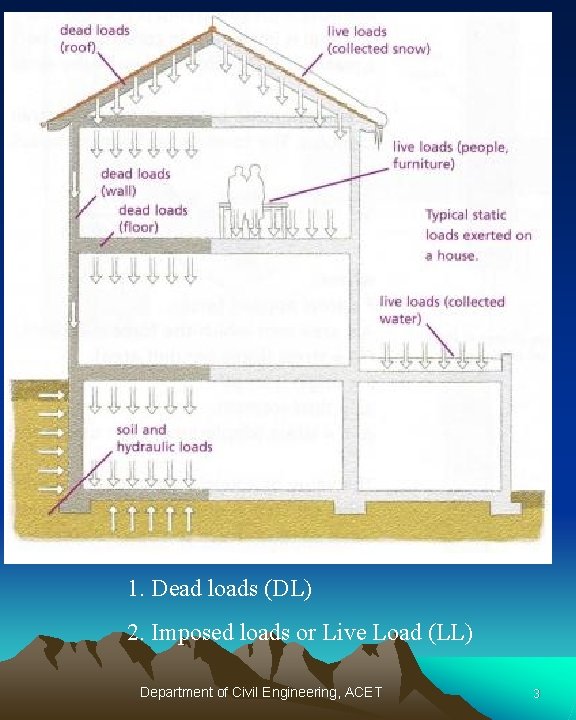
1. Dead loads (DL) 2. Imposed loads or Live Load (LL) Department of Civil Engineering, ACET 3
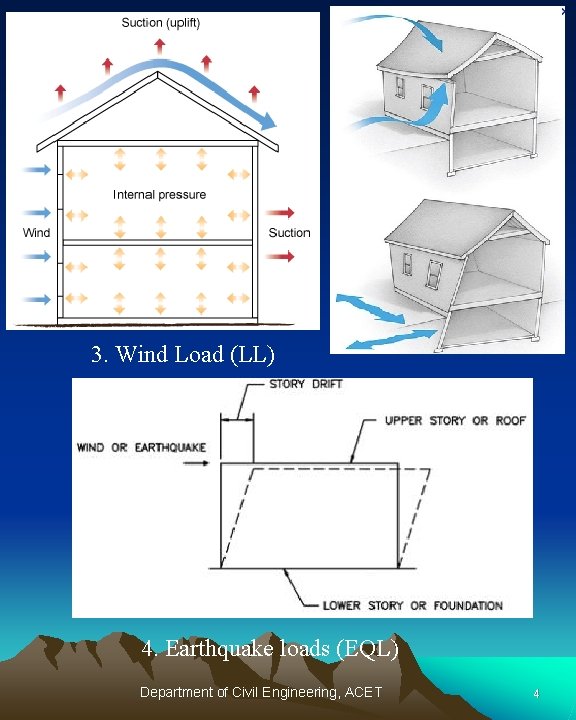
3. Wind Load (LL) 4. Earthquake loads (EQL) Department of Civil Engineering, ACET 4
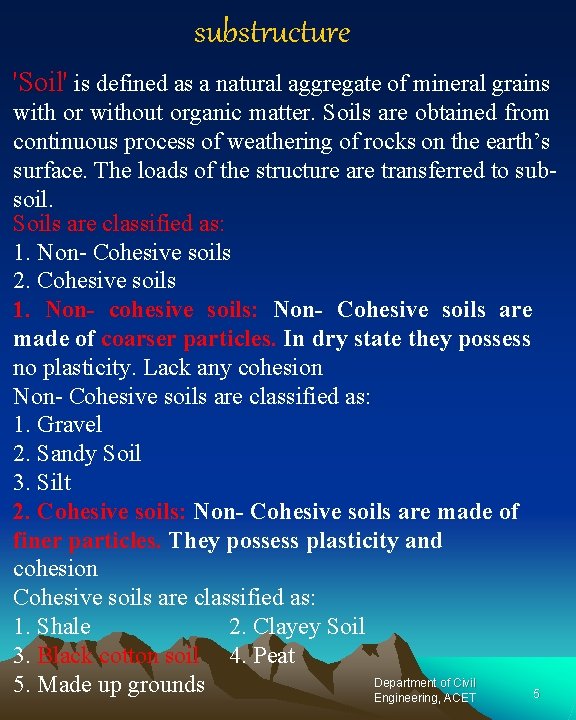
substructure 'Soil' is defined as a natural aggregate of mineral grains with or without organic matter. Soils are obtained from continuous process of weathering of rocks on the earth’s surface. The loads of the structure are transferred to subsoil. Soils are classified as: 1. Non- Cohesive soils 2. Cohesive soils 1. Non- cohesive soils: Non- Cohesive soils are made of coarser particles. In dry state they possess no plasticity. Lack any cohesion Non- Cohesive soils are classified as: 1. Gravel 2. Sandy Soil 3. Silt 2. Cohesive soils: Non- Cohesive soils are made of finer particles. They possess plasticity and cohesion Cohesive soils are classified as: 1. Shale 2. Clayey Soil 3. Black cotton soil 4. Peat Department of Civil 5. Made up grounds 5 Engineering, ACET
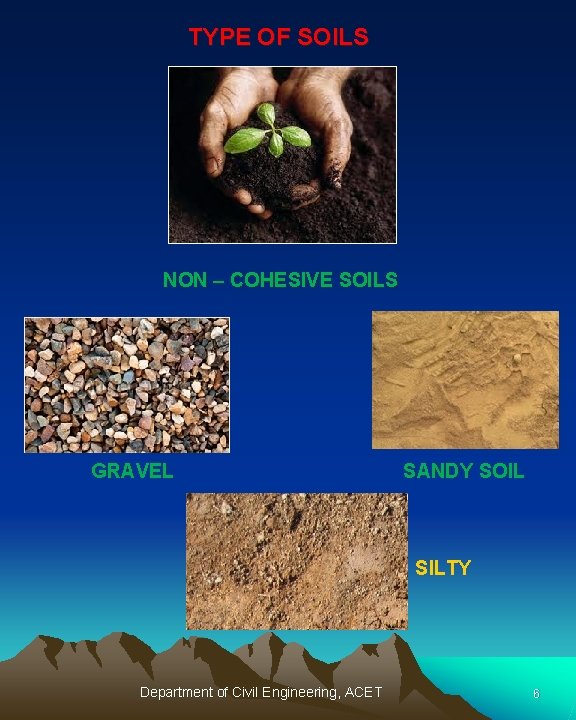
TYPE OF SOILS NON – COHESIVE SOILS GRAVEL SANDY SOIL SILTY Department of Civil Engineering, ACET 6
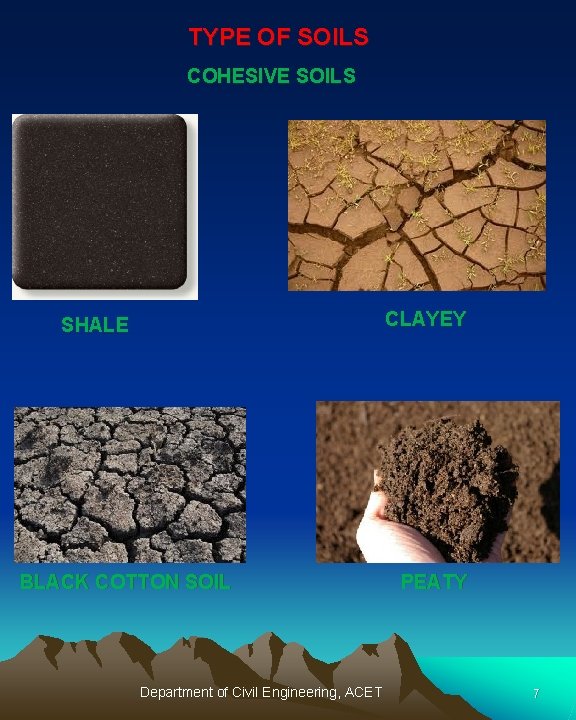
TYPE OF SOILS COHESIVE SOILS CLAYEY SHALE BLACK COTTON SOIL Department of Civil Engineering, ACET PEATY 7
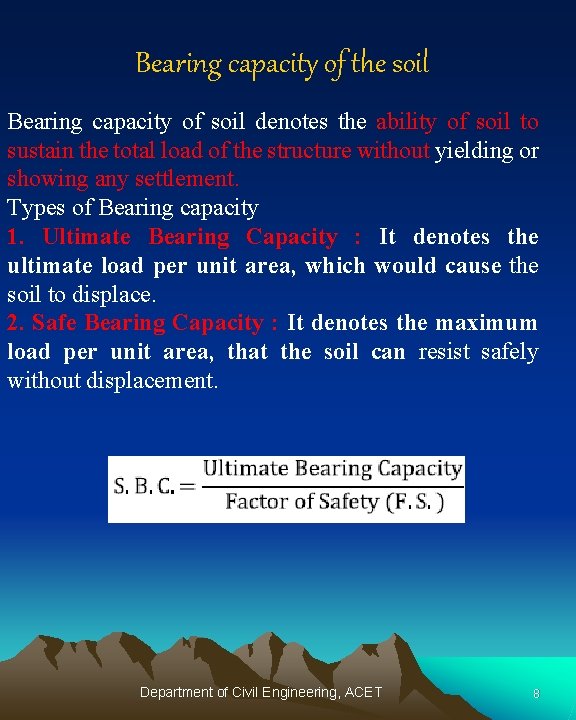
Bearing capacity of the soil Bearing capacity of soil denotes the ability of soil to sustain the total load of the structure without yielding or showing any settlement. Types of Bearing capacity 1. Ultimate Bearing Capacity : It denotes the ultimate load per unit area, which would cause the soil to displace. 2. Safe Bearing Capacity : It denotes the maximum load per unit area, that the soil can resist safely without displacement. Department of Civil Engineering, ACET 8
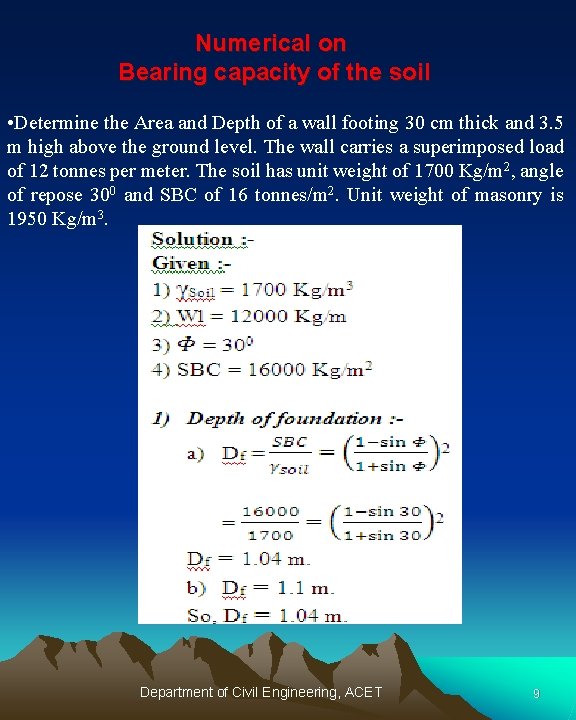
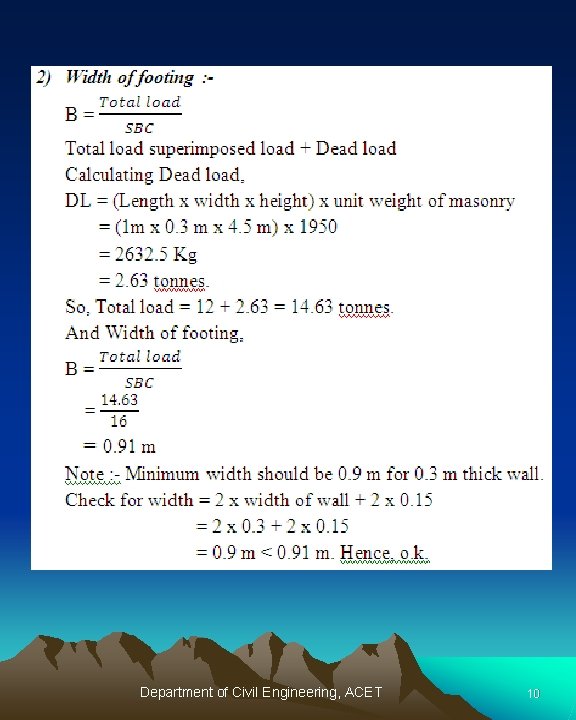
Numerical on Bearing capacity of the soil • Determine the Area and Depth of a wall footing 30 cm thick and 3. 5 m high above the ground level. The wall carries a superimposed load of 12 tonnes per meter. The soil has unit weight of 1700 Kg/m 2, angle of repose 300 and SBC of 16 tonnes/m 2. Unit weight of masonry is 1950 Kg/m 3. Department of Civil Engineering, ACET 9
Department of Civil Engineering, ACET 10
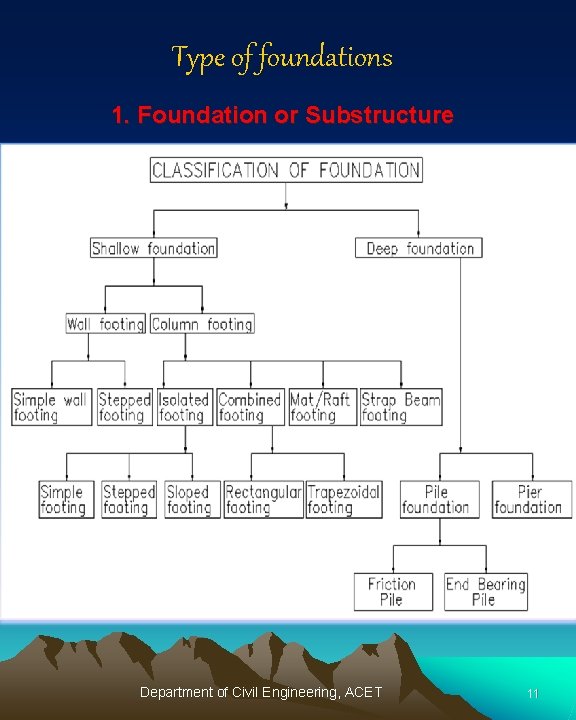
Type of foundations 1. Foundation or Substructure Department of Civil Engineering, ACET 11
Department of Civil Engineering, ACET 12
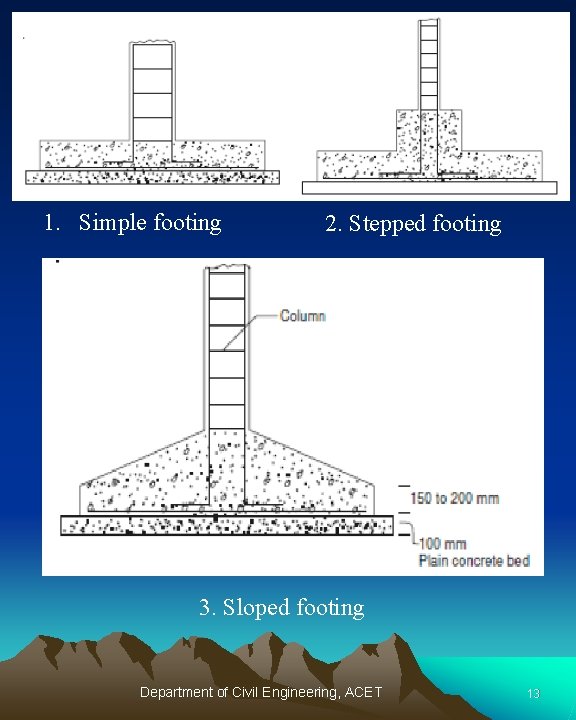
1. Simple footing 2. Stepped footing 3. Sloped footing Department of Civil Engineering, ACET 13
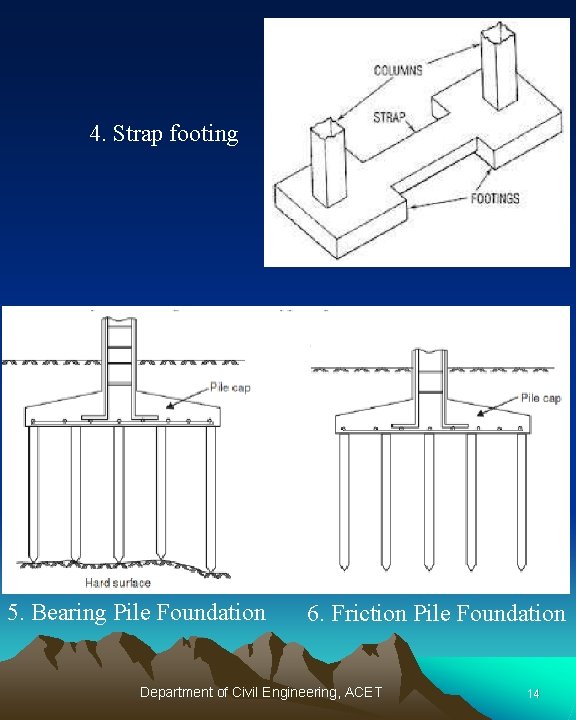
4. Strap footing 5. Bearing Pile Foundation 6. Friction Pile Foundation Department of Civil Engineering, ACET 14
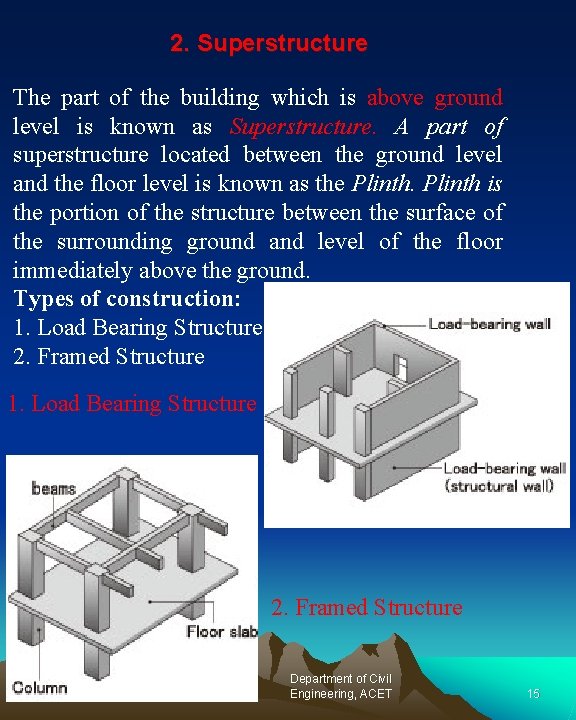
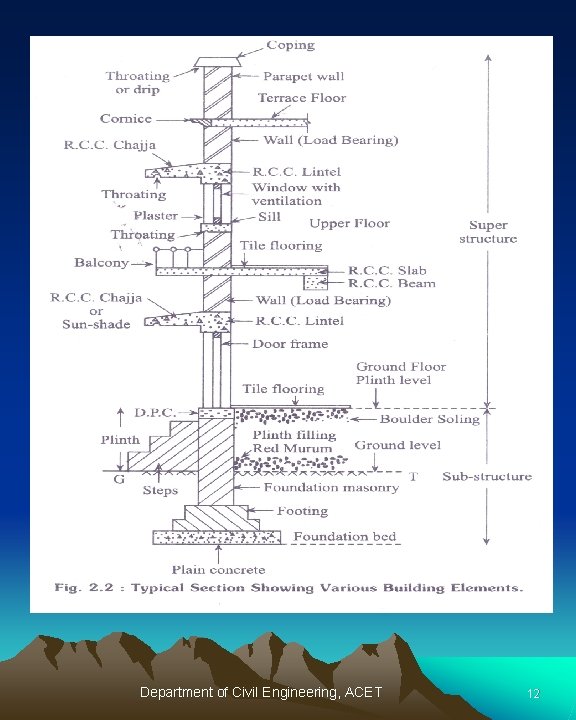
2. Superstructure The part of the building which is above ground level is known as Superstructure. A part of superstructure located between the ground level and the floor level is known as the Plinth is the portion of the structure between the surface of the surrounding ground and level of the floor immediately above the ground. Types of construction: 1. Load Bearing Structure 2. Framed Structure Department of Civil Engineering, ACET 15
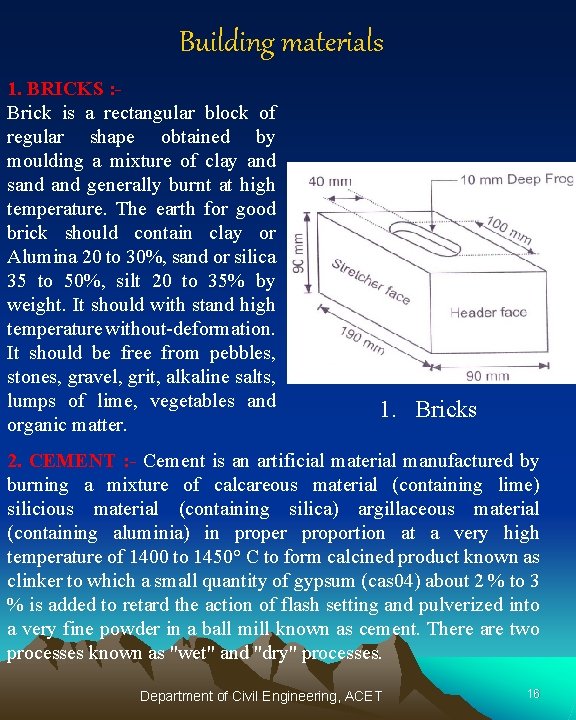
Building materials 1. BRICKS : Brick is a rectangular block of regular shape obtained by moulding a mixture of clay and sand generally burnt at high temperature. The earth for good brick should contain clay or Alumina 20 to 30%, sand or silica 35 to 50%, silt 20 to 35% by weight. It should with stand high temperature without-deformation. It should be free from pebbles, stones, gravel, grit, alkaline salts, lumps of lime, vegetables and organic matter. 1. Bricks 2. CEMENT : - Cement is an artificial material manufactured by burning a mixture of calcareous material (containing lime) silicious material (containing silica) argillaceous material (containing aluminia) in proper proportion at a very high temperature of 1400 to 1450° C to form calcined product known as clinker to which a small quantity of gypsum (cas 04) about 2 % to 3 % is added to retard the action of flash setting and pulverized into a very fine powder in a ball mill known as cement. There are two processes known as "wet" and "dry" processes. Department of Civil Engineering, ACET 16
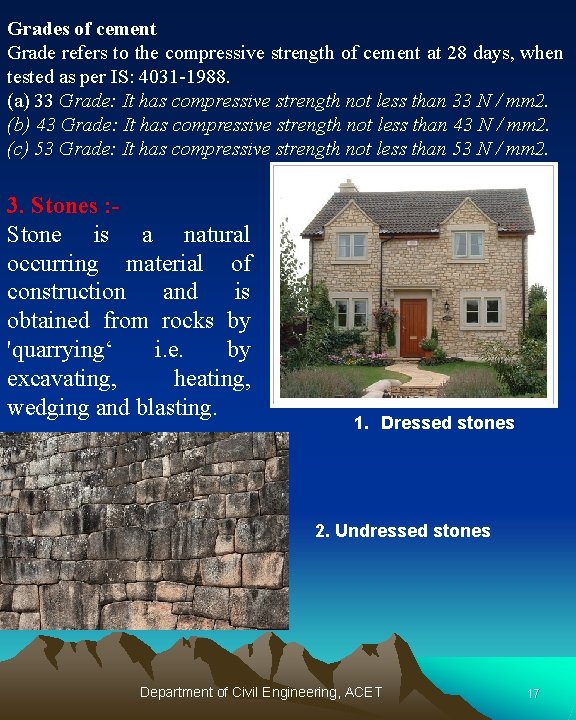
Grades of cement Grade refers to the compressive strength of cement at 28 days, when tested as per IS: 4031 -1988. (a) 33 Grade: It has compressive strength not less than 33 N / mm 2. (b) 43 Grade: It has compressive strength not less than 43 N / mm 2. (c) 53 Grade: It has compressive strength not less than 53 N / mm 2. 3. Stones : Stone is a natural occurring material of construction and is obtained from rocks by 'quarrying‘ i. e. by excavating, heating, wedging and blasting. 1. Dressed stones 2. Undressed stones Department of Civil Engineering, ACET 17
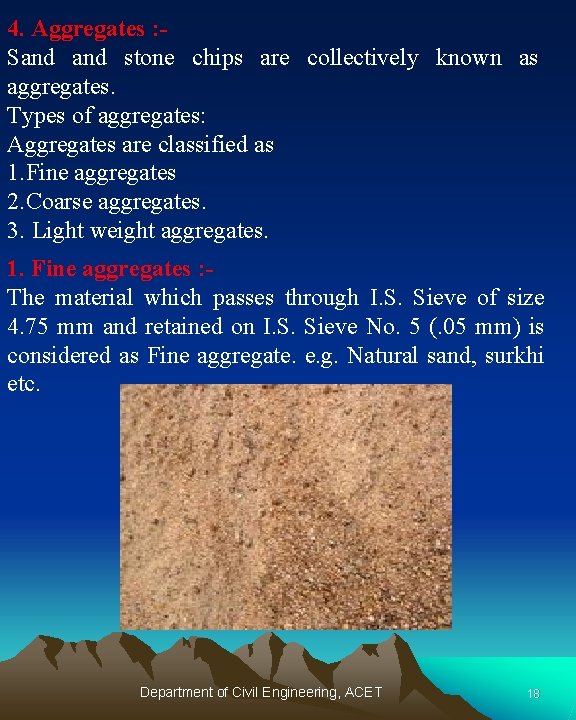
4. Aggregates : Sand stone chips are collectively known as aggregates. Types of aggregates: Aggregates are classified as 1. Fine aggregates 2. Coarse aggregates. 3. Light weight aggregates. 1. Fine aggregates : The material which passes through I. S. Sieve of size 4. 75 mm and retained on I. S. Sieve No. 5 (. 05 mm) is considered as Fine aggregate. e. g. Natural sand, surkhi etc. Department of Civil Engineering, ACET 18
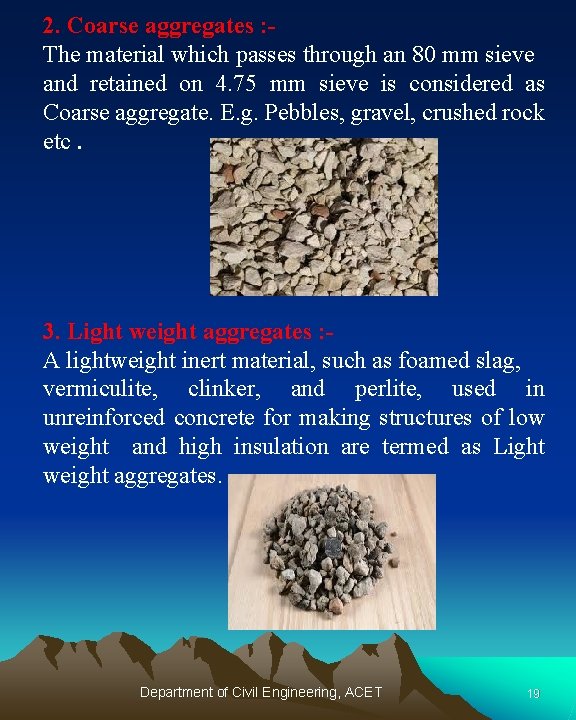
2. Coarse aggregates : The material which passes through an 80 mm sieve and retained on 4. 75 mm sieve is considered as Coarse aggregate. E. g. Pebbles, gravel, crushed rock etc. 3. Light weight aggregates : A lightweight inert material, such as foamed slag, vermiculite, clinker, and perlite, used in unreinforced concrete for making structures of low weight and high insulation are termed as Light weight aggregates. Department of Civil Engineering, ACET 19
5. Reinforcing Steel : 1. Steel is an alloy of ferrous metal with 0. 25 to 1. 5 percent of carbon. Higher the carbon content, harder is the steel. 2. Steel bars of circular cross sections are mainly used as reinforcement to strengthen concrete structures. There are three types of reinforcing steel: 1. Mild steel 2. High Yield Strength Deformed bars (HYSD)/TOR steel. 3. High tensile steel. 1. Mild steel • It contains carbon upto 0. 23 to 0. 25%. • Higher value is permitted for bars of 20 mm and above diameter. • It is available in diameters of 6, 10, 12, 16, 20, 25 and 32 mm. • Its yield strength is 250 N/mm 2 and young’s modulus 2 × 10⁵ N/mm 2. Department of Civil Engineering, ACET 20
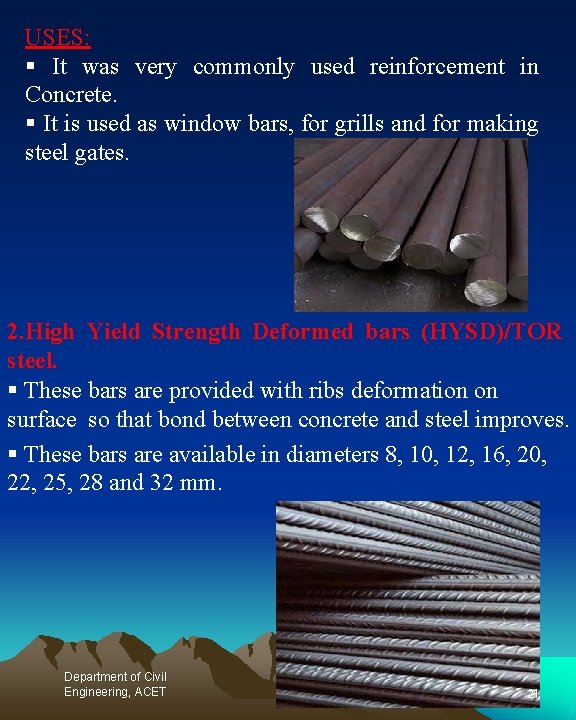
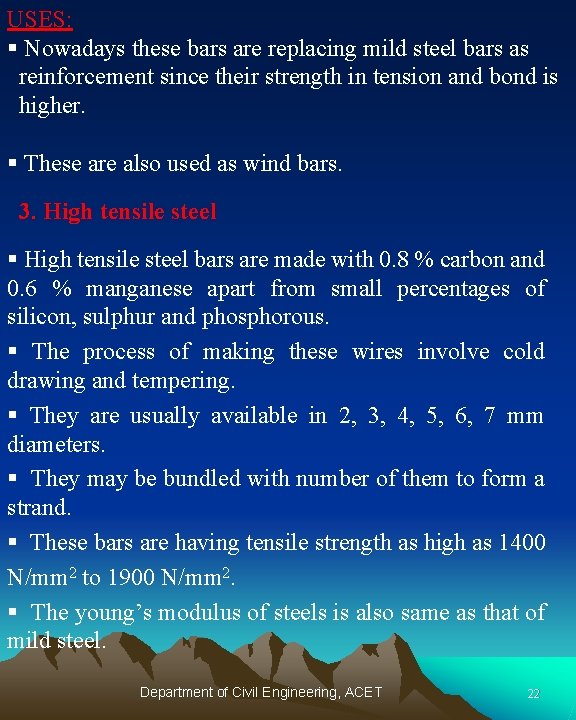
USES: § It was very commonly used reinforcement in Concrete. § It is used as window bars, for grills and for making steel gates. 2. High Yield Strength Deformed bars (HYSD)/TOR steel. § These bars are provided with ribs deformation on surface so that bond between concrete and steel improves. § These bars are available in diameters 8, 10, 12, 16, 20, 22, 25, 28 and 32 mm. Department of Civil Engineering, ACET 21
USES: § Nowadays these bars are replacing mild steel bars as reinforcement since their strength in tension and bond is higher. § These are also used as wind bars. 3. High tensile steel § High tensile steel bars are made with 0. 8 % carbon and 0. 6 % manganese apart from small percentages of silicon, sulphur and phosphorous. § The process of making these wires involve cold drawing and tempering. § They are usually available in 2, 3, 4, 5, 6, 7 mm diameters. § They may be bundled with number of them to form a strand. § These bars are having tensile strength as high as 1400 N/mm 2 to 1900 N/mm 2. § The young’s modulus of steels is also same as that of mild steel. Department of Civil Engineering, ACET 22
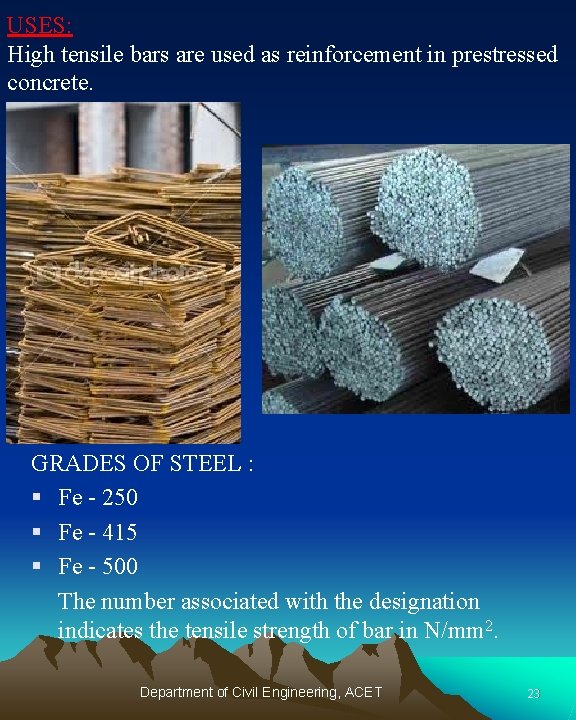
USES: High tensile bars are used as reinforcement in prestressed concrete. GRADES OF STEEL : § Fe - 250 § Fe - 415 § Fe - 500 The number associated with the designation indicates the tensile strength of bar in N/mm 2. Department of Civil Engineering, ACET 23
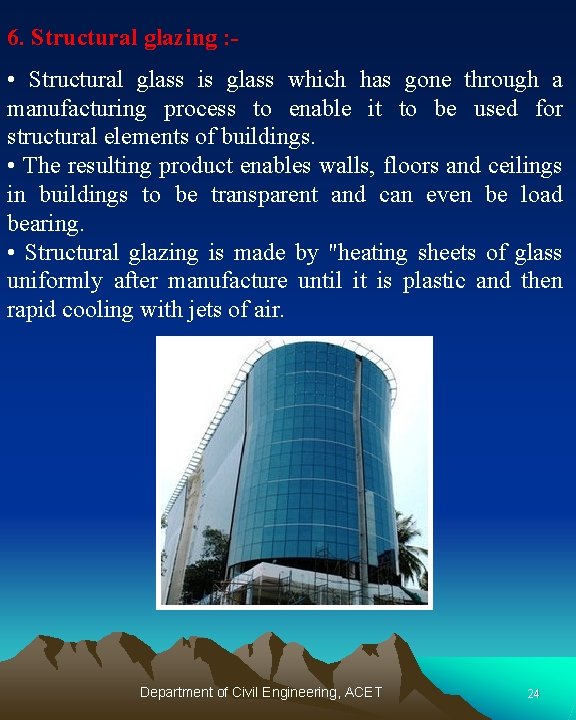
6. Structural glazing : - • Structural glass is glass which has gone through a manufacturing process to enable it to be used for structural elements of buildings. • The resulting product enables walls, floors and ceilings in buildings to be transparent and can even be load bearing. • Structural glazing is made by "heating sheets of glass uniformly after manufacture until it is plastic and then rapid cooling with jets of air. Department of Civil Engineering, ACET 24
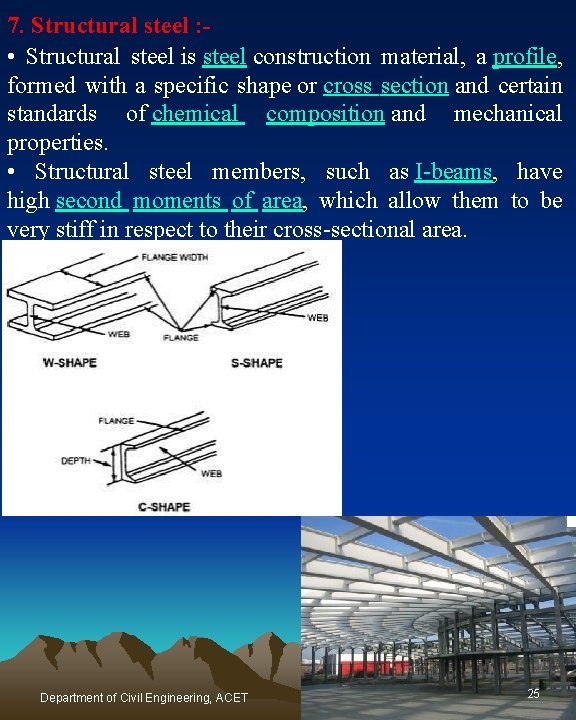
7. Structural steel : • Structural steel is steel construction material, a profile, formed with a specific shape or cross section and certain standards of chemical composition and mechanical properties. • Structural steel members, such as I-beams, have high second moments of area, which allow them to be very stiff in respect to their cross-sectional area. Department of Civil Engineering, ACET 25
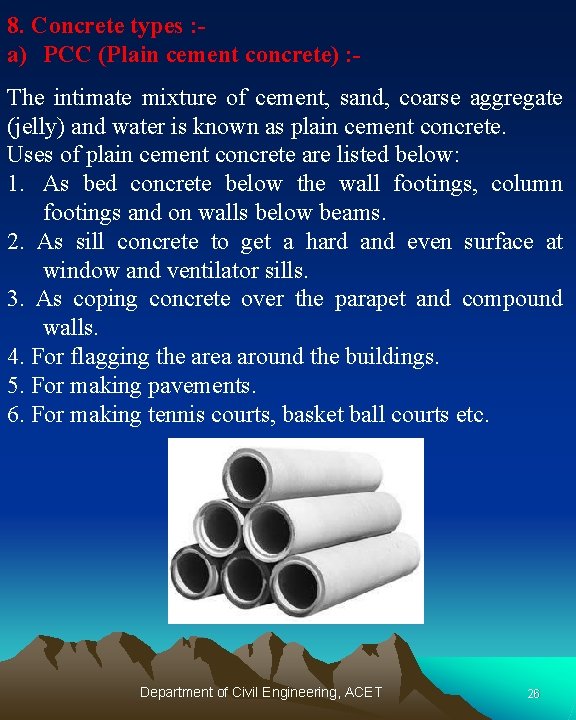
8. Concrete types : a) PCC (Plain cement concrete) : The intimate mixture of cement, sand, coarse aggregate (jelly) and water is known as plain cement concrete. Uses of plain cement concrete are listed below: 1. As bed concrete below the wall footings, column footings and on walls below beams. 2. As sill concrete to get a hard and even surface at window and ventilator sills. 3. As coping concrete over the parapet and compound walls. 4. For flagging the area around the buildings. 5. For making pavements. 6. For making tennis courts, basket ball courts etc. Department of Civil Engineering, ACET 26
b) RCC (Reinforced cement concrete) : Reinforcement is provided in the concrete wherever tensile stress is expected. The best reinforcing material is steel, since its tensile strength is high and bond between steel and concrete is good. The composite material of steel and concrete, now called R. C. C. acts as a structural member and can resist tensile as well as compressive forces efficiently. Uses of R. C. C. 1. R. C. C. is used are: (a) Footing, (b) Columns, (c) Beams, lintels, (d) Chejjas, roof slabs, (e) Stairs. 2. R. C. C. is used for the construction of storage structures like: (a) Water tanks, (b) Dams, (c) Silos, bunkers 3. They are used for the construction of (a) Bridges, (b) Retaining walls, (c) Docks and harbours (d) Under water structures 4. R. C. C. is used for building tall structures like (a) Multistorey buildings, (b) Chimneys, (c) Towers. 5. R. C. C. is used for paving (a) High ways, (b) City roads, (c) Airports. Department of Civil Engineering, ACET 27
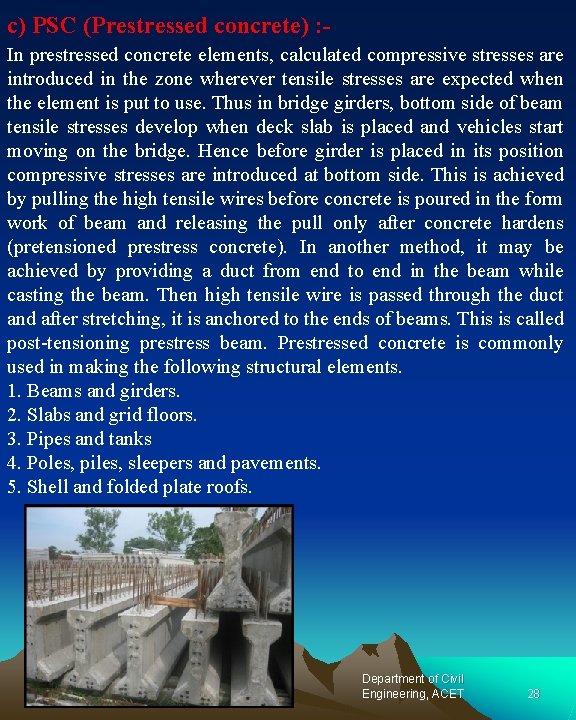
c) PSC (Prestressed concrete) : In prestressed concrete elements, calculated compressive stresses are introduced in the zone wherever tensile stresses are expected when the element is put to use. Thus in bridge girders, bottom side of beam tensile stresses develop when deck slab is placed and vehicles start moving on the bridge. Hence before girder is placed in its position compressive stresses are introduced at bottom side. This is achieved by pulling the high tensile wires before concrete is poured in the form work of beam and releasing the pull only after concrete hardens (pretensioned prestress concrete). In another method, it may be achieved by providing a duct from end to end in the beam while casting the beam. Then high tensile wire is passed through the duct and after stretching, it is anchored to the ends of beams. This is called post-tensioning prestress beam. Prestressed concrete is commonly used in making the following structural elements. 1. Beams and girders. 2. Slabs and grid floors. 3. Pipes and tanks 4. Poles, piles, sleepers and pavements. 5. Shell and folded plate roofs. Department of Civil Engineering, ACET 28
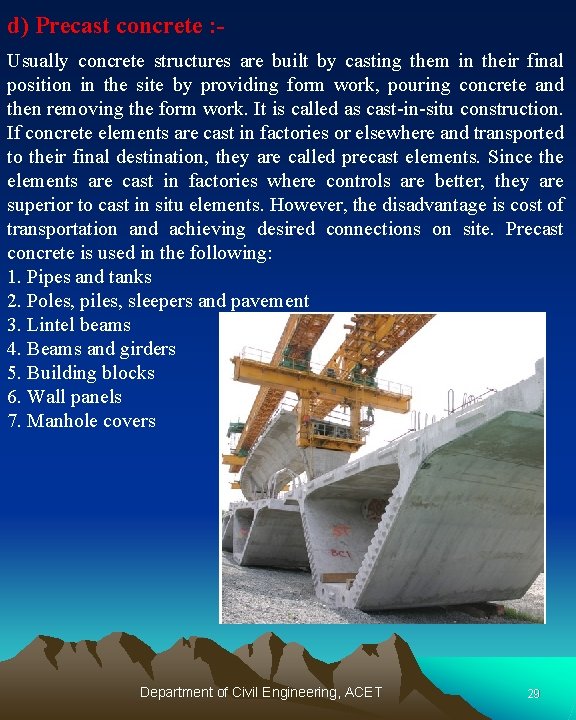
d) Precast concrete : Usually concrete structures are built by casting them in their final position in the site by providing form work, pouring concrete and then removing the form work. It is called as cast-in-situ construction. If concrete elements are cast in factories or elsewhere and transported to their final destination, they are called precast elements. Since the elements are cast in factories where controls are better, they are superior to cast in situ elements. However, the disadvantage is cost of transportation and achieving desired connections on site. Precast concrete is used in the following: 1. Pipes and tanks 2. Poles, piles, sleepers and pavement 3. Lintel beams 4. Beams and girders 5. Building blocks 6. Wall panels 7. Manhole covers Department of Civil Engineering, ACET 29
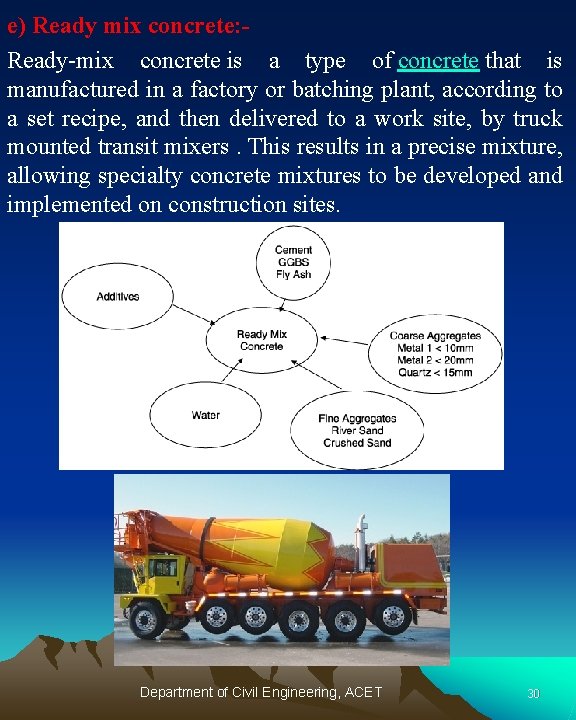
e) Ready mix concrete: Ready-mix concrete is a type of concrete that is manufactured in a factory or batching plant, according to a set recipe, and then delivered to a work site, by truck mounted transit mixers. This results in a precise mixture, allowing specialty concrete mixtures to be developed and implemented on construction sites. Department of Civil Engineering, ACET 30
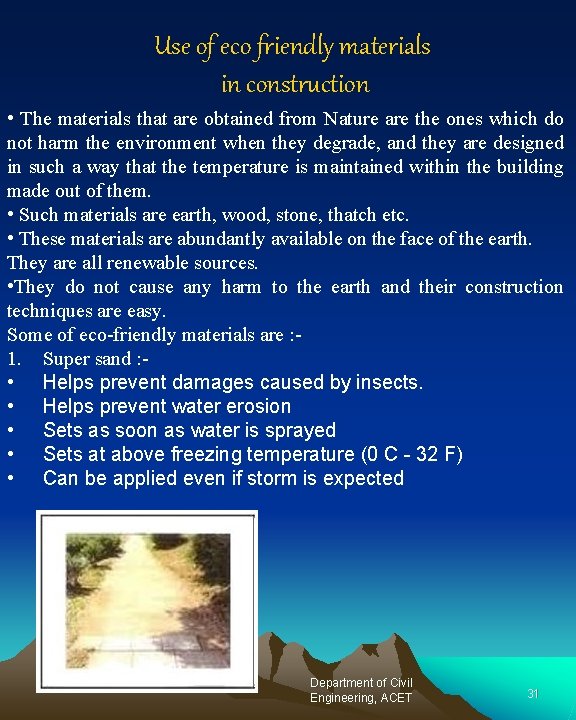
Use of eco friendly materials in construction • The materials that are obtained from Nature are the ones which do not harm the environment when they degrade, and they are designed in such a way that the temperature is maintained within the building made out of them. • Such materials are earth, wood, stone, thatch etc. • These materials are abundantly available on the face of the earth. They are all renewable sources. • They do not cause any harm to the earth and their construction techniques are easy. Some of eco-friendly materials are : 1. Super sand : • Helps prevent damages caused by insects. • Helps prevent water erosion • Sets as soon as water is sprayed • Sets at above freezing temperature (0 C - 32 F) • Can be applied even if storm is expected Department of Civil Engineering, ACET 31
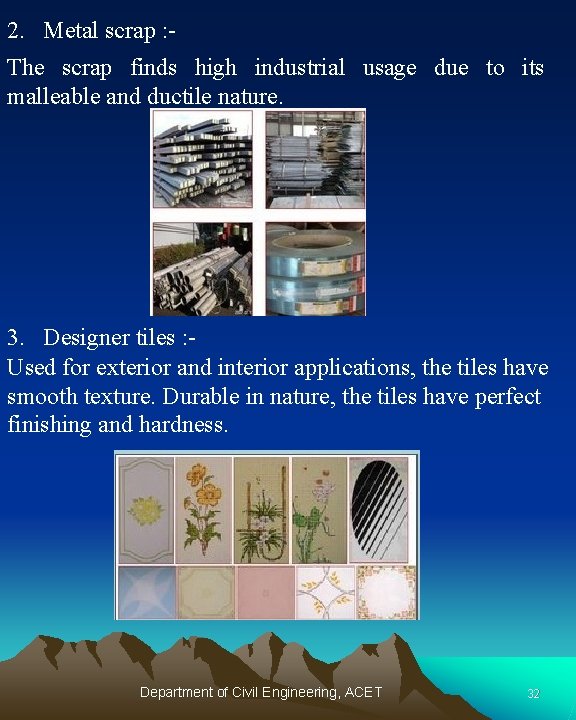
2. Metal scrap : The scrap finds high industrial usage due to its malleable and ductile nature. 3. Designer tiles : Used for exterior and interior applications, the tiles have smooth texture. Durable in nature, the tiles have perfect finishing and hardness. Department of Civil Engineering, ACET 32

Thank you Any questions Department of Civil Engineering, ACET 33
- Slides: 33