
Components of a Strong Family Unit Copyright Texas
- Slides: 35
Components of a Strong Family Unit
Copyright © Texas Education Agency, 2017. These Materials are copyrighted © and trademarked ™ as the property of the Texas Education Agency (TEA) and may not be reproduced without the express written permission of TEA, except under the following conditions: 1) Texas public school districts, charter schools, and Education Service Centers may reproduce and use copies of the Materials and Related Materials for the districts’ and schools’ educational use without obtaining permission from TEA. 2) Residents of the state of Texas may reproduce and use copies of the Materials and Related Materials for individual personal use only, without obtaining written permission of TEA. 3) Any portion reproduced must be reproduced in its entirety and remain unedited, unaltered and unchanged in any way. 4) No monetary charge can be made for the reproduced materials or any document containing them; however, a reasonable charge to cover only the cost of reproduction and distribution may be charged. Private entities or persons located in Texas that are not Texas public school districts, Texas Education Service Centers, or Texas charter schools or any entity, whether public or private, educational or non-educational, located outside the state of Texas MUST obtain written approval from TEA and will be required to enter into a license agreement that may involve the payment of a licensing fee or a royalty. For information contact: Office of Copyrights, Trademarks, License Agreements, and Royalties, Texas Education Agency, 1701 N. Congress Ave. , Austin, TX 78701 -1494; phone 512 -463 -7004; email: copyrights@tea. state. tx. us. Copyright © Texas Education Agency, 2017. All rights reserved. 2
What is the life cycle? Copyright © Texas Education Agency, 2017. All rights reserved. 3
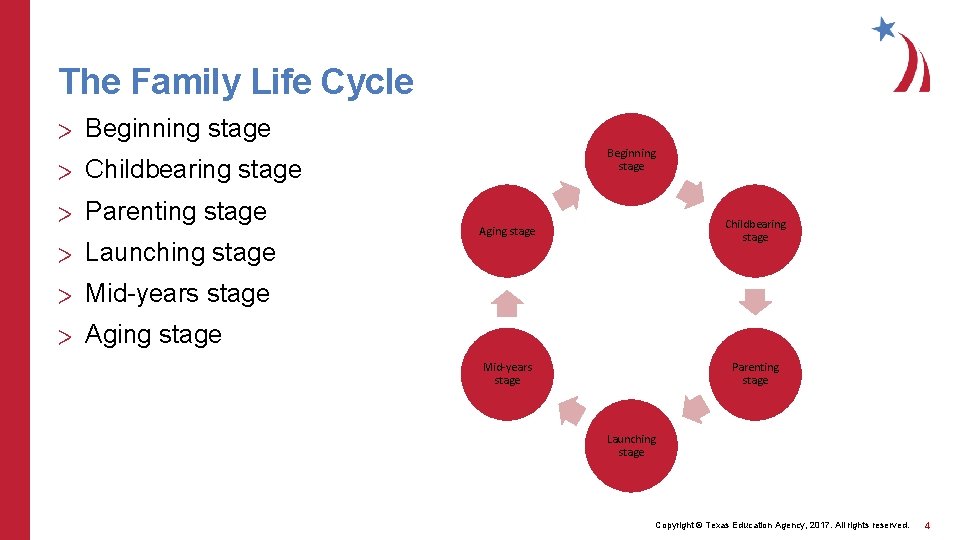
The Family Life Cycle > Beginning stage > Childbearing stage > Parenting stage > Launching stage Aging stage Childbearing stage Mid-years stage Parenting stage > Mid-years stage > Aging stage Launching stage Copyright © Texas Education Agency, 2017. All rights reserved. 4
Family Structures > Adoptive family > Extended kinship > Foster family > Single parent > Step-family > Two-parent Copyright © Texas Education Agency, 2017. All rights reserved. 5
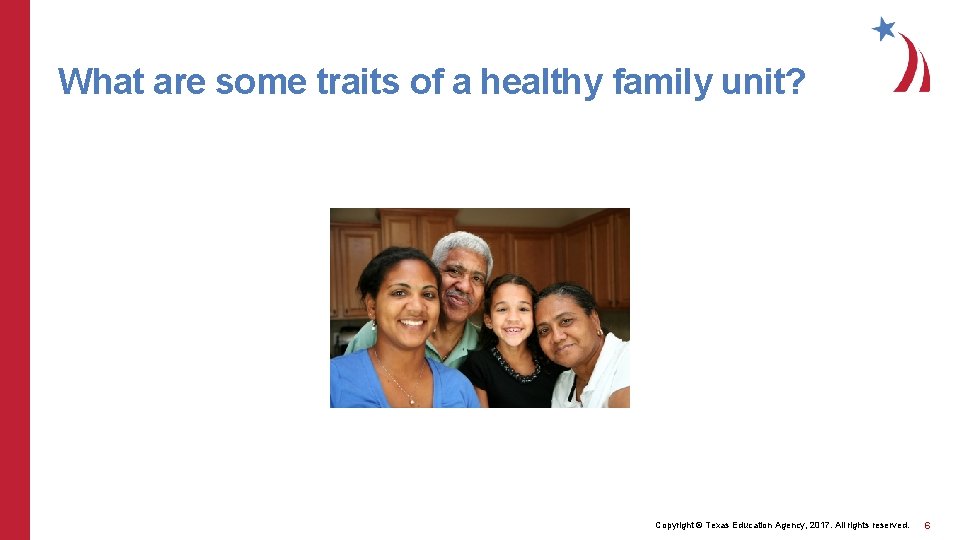
What are some traits of a healthy family unit? Copyright © Texas Education Agency, 2017. All rights reserved. 6
Traits of a Healthy Family > Affirms and supports > Communicates > Listens > Respects > Trusts and forgives Copyright © Texas Education Agency, 2017. All rights reserved. 7
Healthy Families > Admit/seek help for problems > Have a sense of humor > Have family rituals and traditions > Share responsibilities > Teach right from wrong Copyright © Texas Education Agency, 2017. All rights reserved. 8
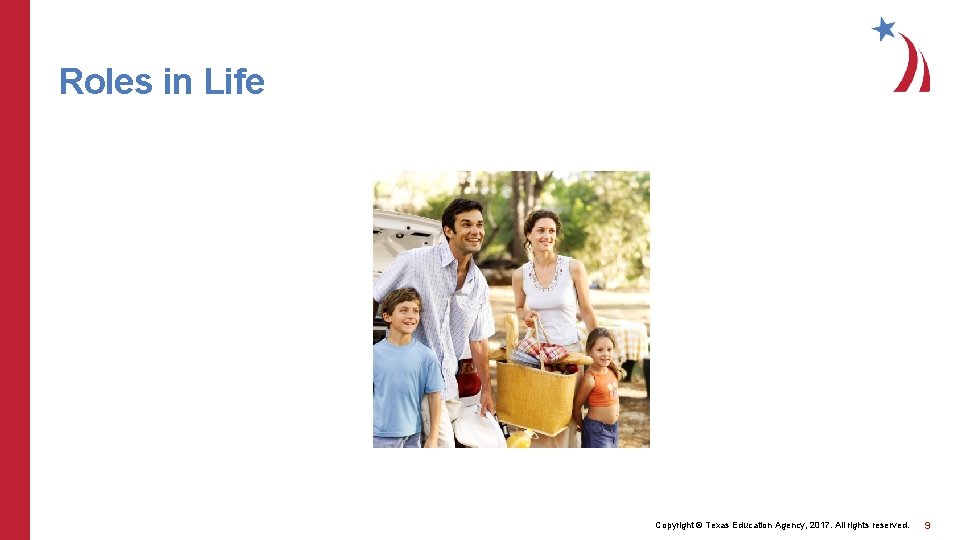
Roles in Life Copyright © Texas Education Agency, 2017. All rights reserved. 9
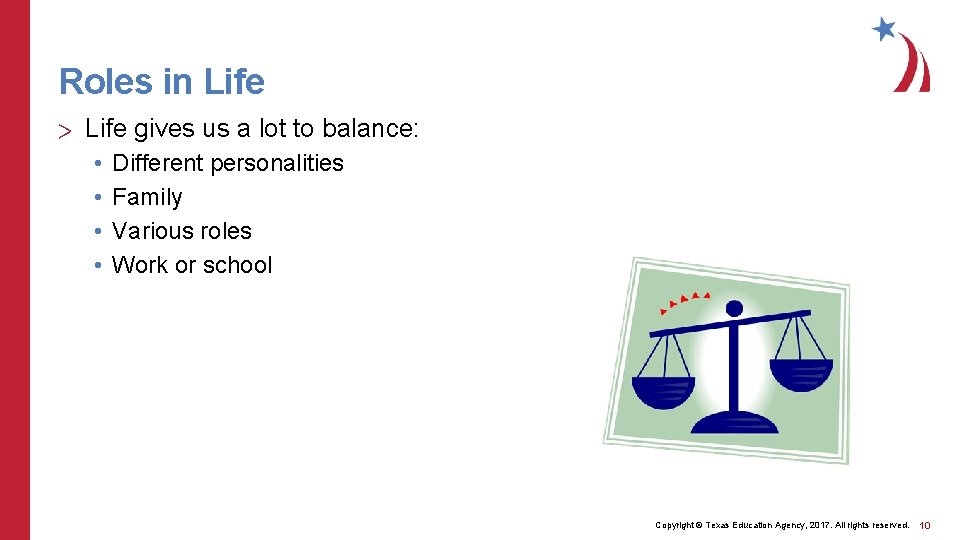
Roles in Life > Life gives us a lot to balance: • • Different personalities Family Various roles Work or school Copyright © Texas Education Agency, 2017. All rights reserved. 10
Roles > The responsibilities we assume and how we portray them individually and in the family • Acquired roles • Character roles • Given roles Copyright © Texas Education Agency, 2017. All rights reserved. 11
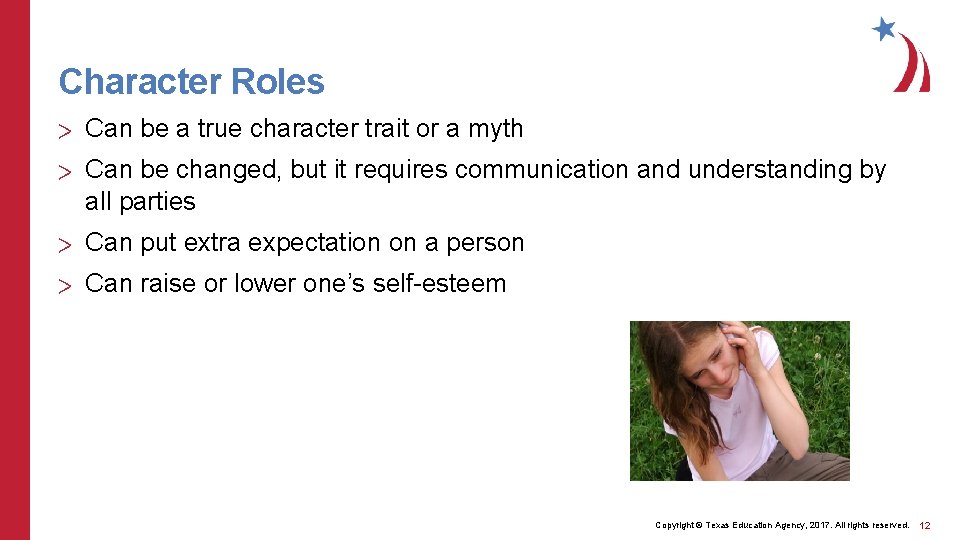
Character Roles > Can be a true character trait or a myth > Can be changed, but it requires communication and understanding by all parties > Can put extra expectation on a person > Can raise or lower one’s self-esteem Copyright © Texas Education Agency, 2017. All rights reserved. 12
Meeting the Needs of the Family Copyright © Texas Education Agency, 2017. All rights reserved. 13
Family Bonds > All families go through difficult and trying times. That’s why it’s so important to love and support each other at all times. Copyright © Texas Education Agency, 2017. All rights reserved. 14
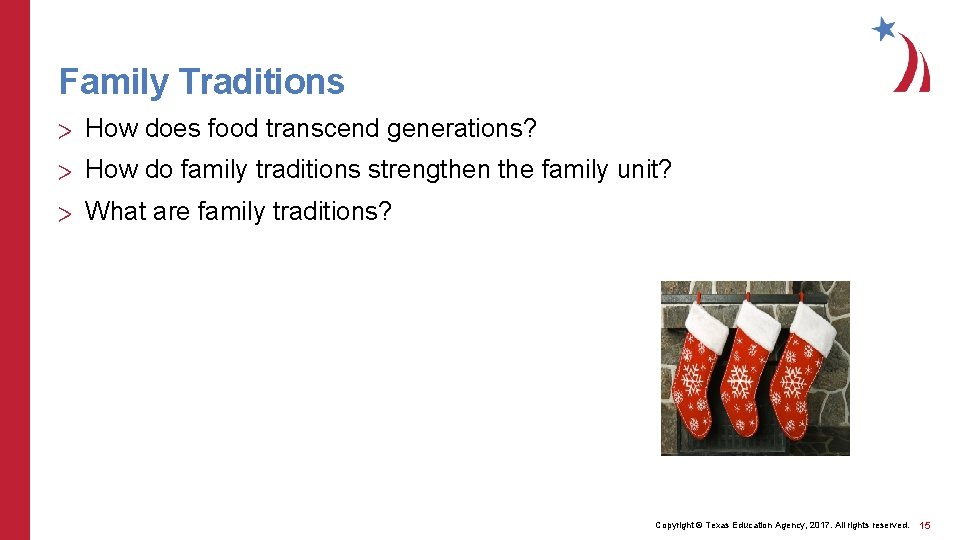
Family Traditions > How does food transcend generations? > How do family traditions strengthen the family unit? > What are family traditions? Copyright © Texas Education Agency, 2017. All rights reserved. 15
Meeting Needs Physically > Financially • Do chores without allowance • Restrain from asking for extra things • Take a part-time job > Other • Picking up the responsibilities wherever needed > Meeting Needs Physically • Chores • Cooking • Helping around the house Copyright © Texas Education Agency, 2017. All rights reserved. 16
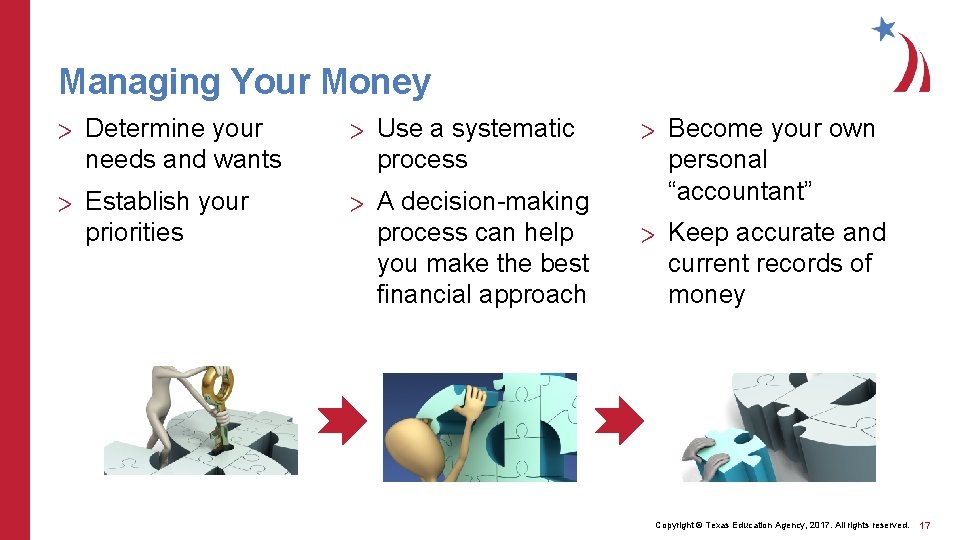
Managing Your Money > Determine your needs and wants > Use a systematic process > Establish your priorities > A decision-making process can help you make the best financial approach > Become your own personal “accountant” > Keep accurate and current records of money Copyright © Texas Education Agency, 2017. All rights reserved. 17
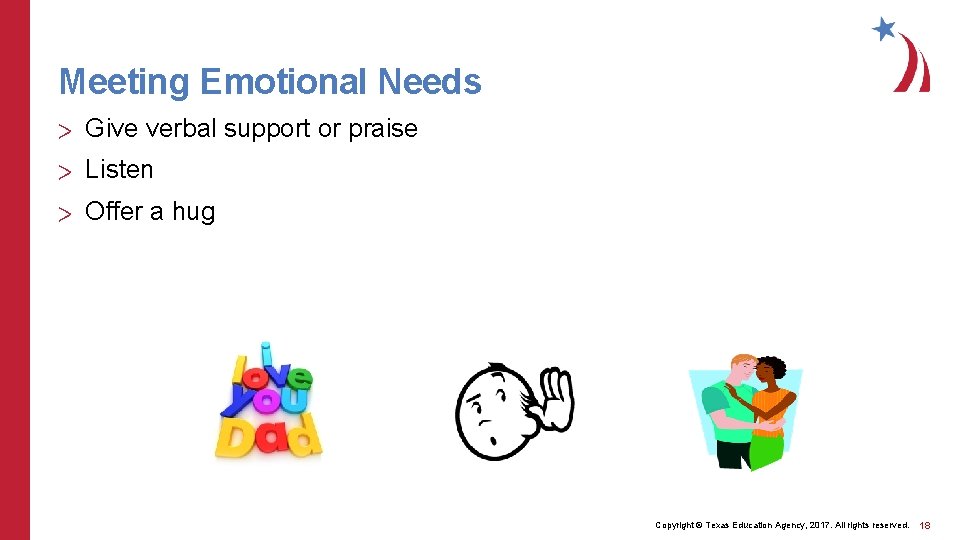
Meeting Emotional Needs > Give verbal support or praise > Listen > Offer a hug Copyright © Texas Education Agency, 2017. All rights reserved. 18
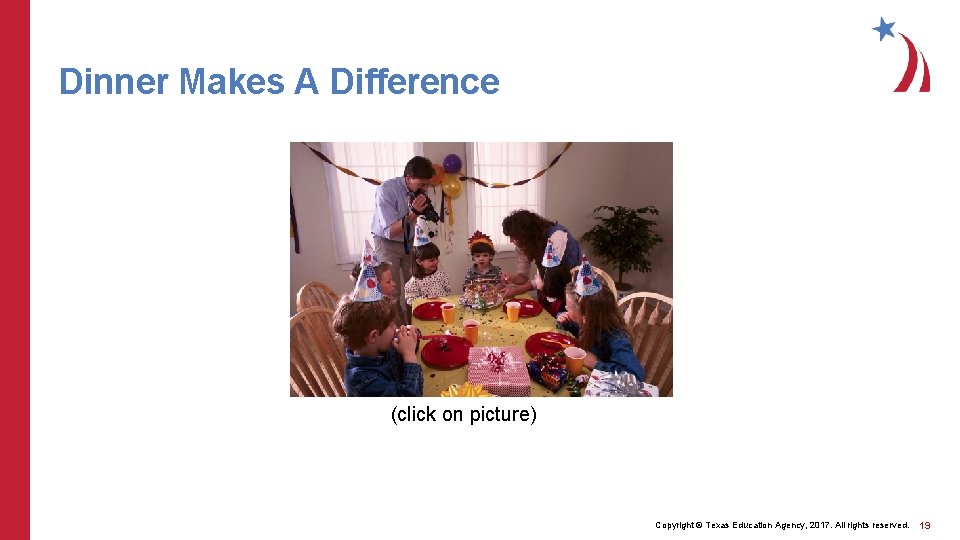
Dinner Makes A Difference (click on picture) Copyright © Texas Education Agency, 2017. All rights reserved. 19
Life Stages > There are various events or situations in life that can greatly affect us. These are a natural and expected part of each person’s life. Copyright © Texas Education Agency, 2017. All rights reserved. 20
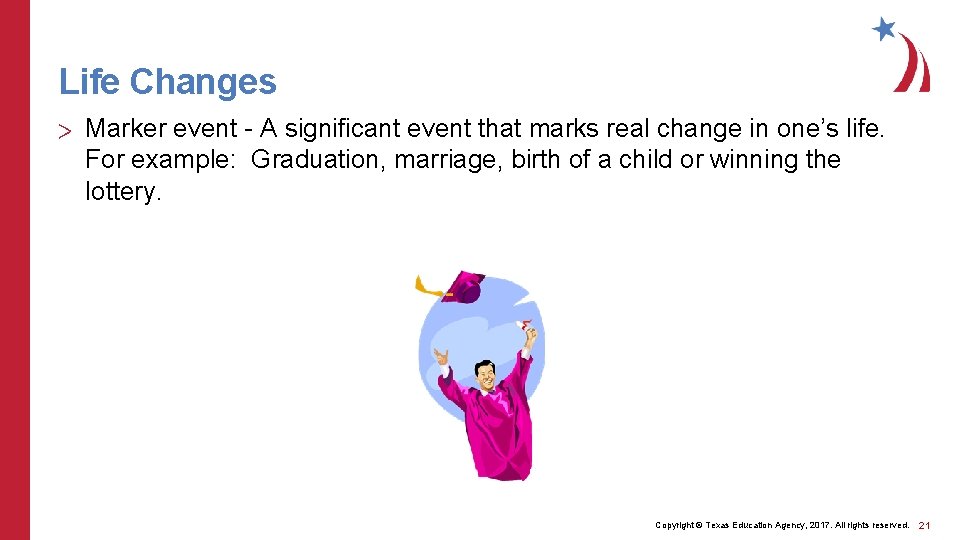
Life Changes > Marker event - A significant event that marks real change in one’s life. For example: Graduation, marriage, birth of a child or winning the lottery. Copyright © Texas Education Agency, 2017. All rights reserved. 21
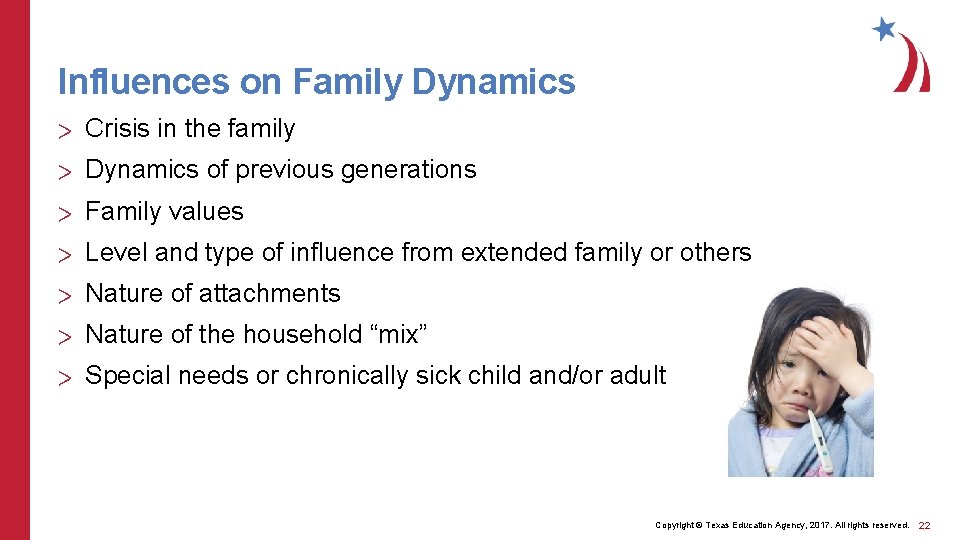
Influences on Family Dynamics > Crisis in the family > Dynamics of previous generations > Family values > Level and type of influence from extended family or others > Nature of attachments > Nature of the household “mix” > Special needs or chronically sick child and/or adult Copyright © Texas Education Agency, 2017. All rights reserved. 22
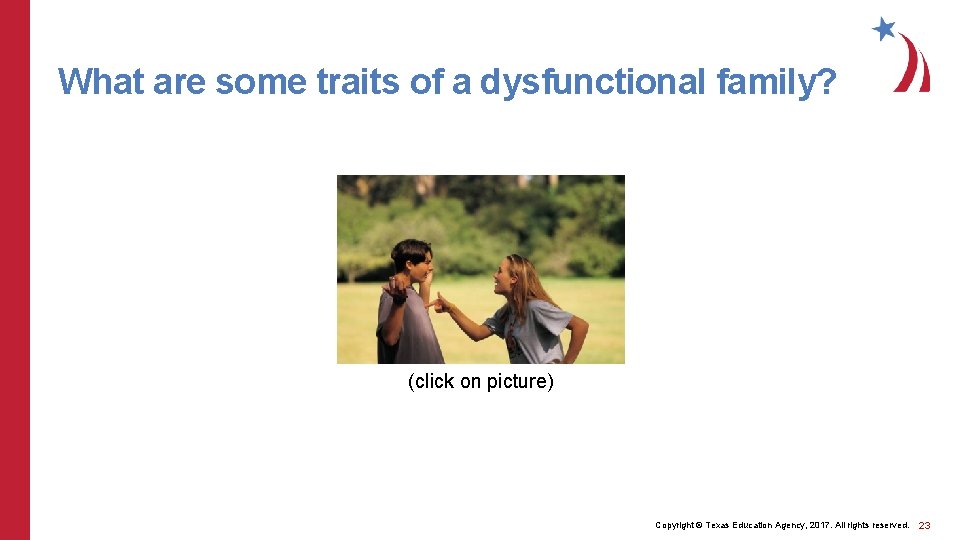
What are some traits of a dysfunctional family? (click on picture) Copyright © Texas Education Agency, 2017. All rights reserved. 23
Traits of a Dysfunctional Family > Communicates indirectly > Doesn’t express feelings openly > Doesn’t laugh or play together > Has unrealistic expectations > Says it’s NOT okay to talk about problems Copyright © Texas Education Agency, 2017. All rights reserved. 24
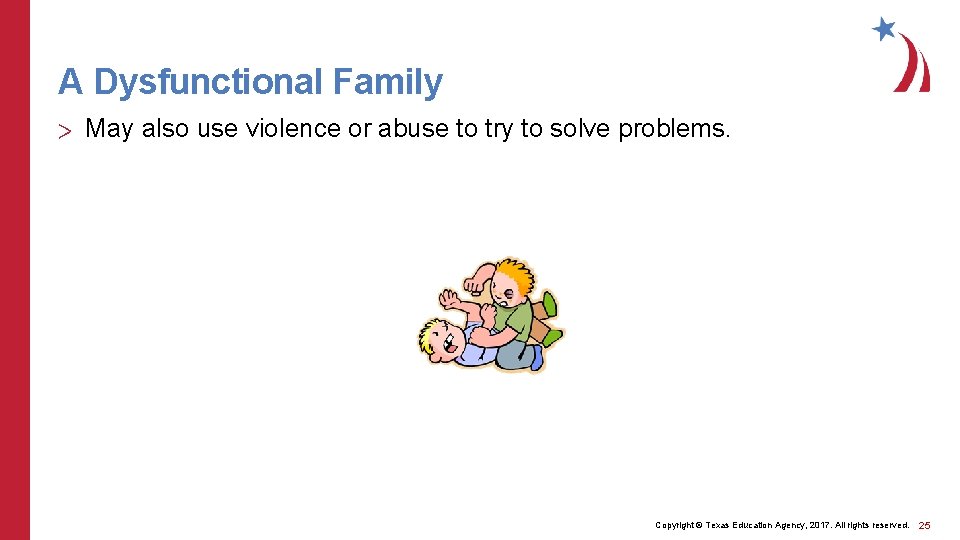
A Dysfunctional Family > May also use violence or abuse to try to solve problems. Copyright © Texas Education Agency, 2017. All rights reserved. 25
Violence and Abuse > Violence and abuse can include: • • Emotional – attacks on self-esteem, extreme pressure and neglect Physical – slapping, beating, torture and withholding food and water Sexual – forcing you to touch or do things with a body that you don’t like Verbal – yelling, cursing, sarcastic put-downs and verbal assaults Copyright © Texas Education Agency, 2017. All rights reserved. 26
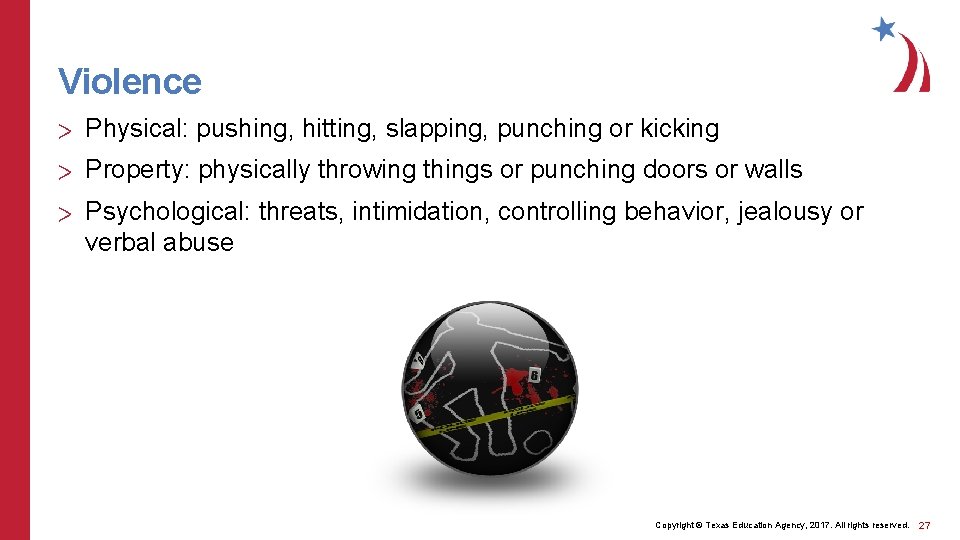
Violence > Physical: pushing, hitting, slapping, punching or kicking > Property: physically throwing things or punching doors or walls > Psychological: threats, intimidation, controlling behavior, jealousy or verbal abuse Copyright © Texas Education Agency, 2017. All rights reserved. 27
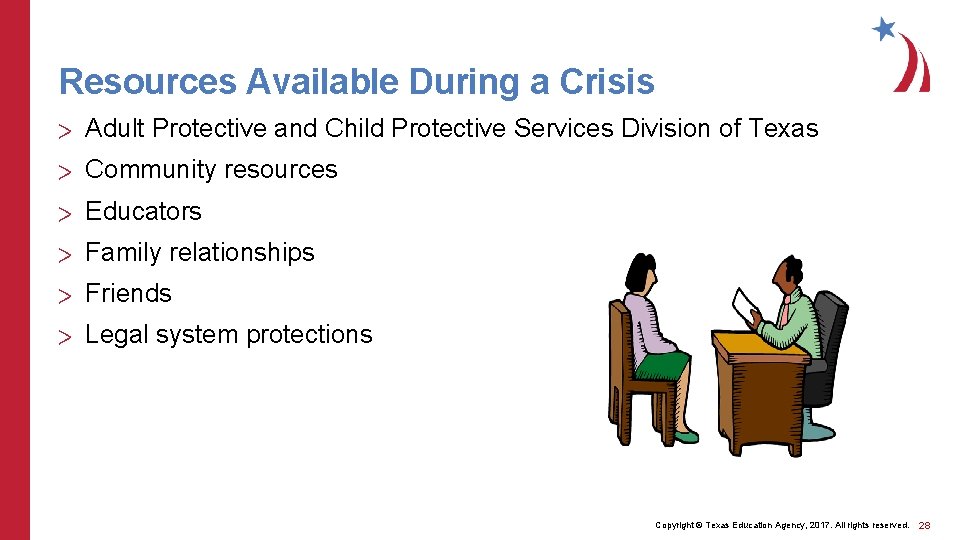
Resources Available During a Crisis > Adult Protective and Child Protective Services Division of Texas > Community resources > Educators > Family relationships > Friends > Legal system protections Copyright © Texas Education Agency, 2017. All rights reserved. 28
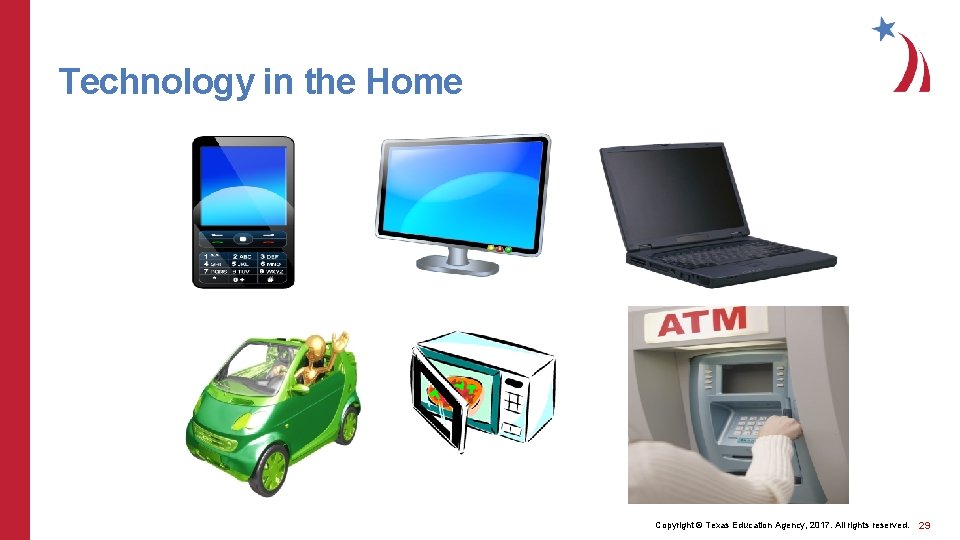
Technology in the Home Copyright © Texas Education Agency, 2017. All rights reserved. 29
Using Technology to Meet Needs > Calling or texting > Keeping the lines of communication open > Sending an e-mail or e-card to let someone know that you are thinking of them > Using the Internet to research sources of assistance Copyright © Texas Education Agency, 2017. All rights reserved. 30
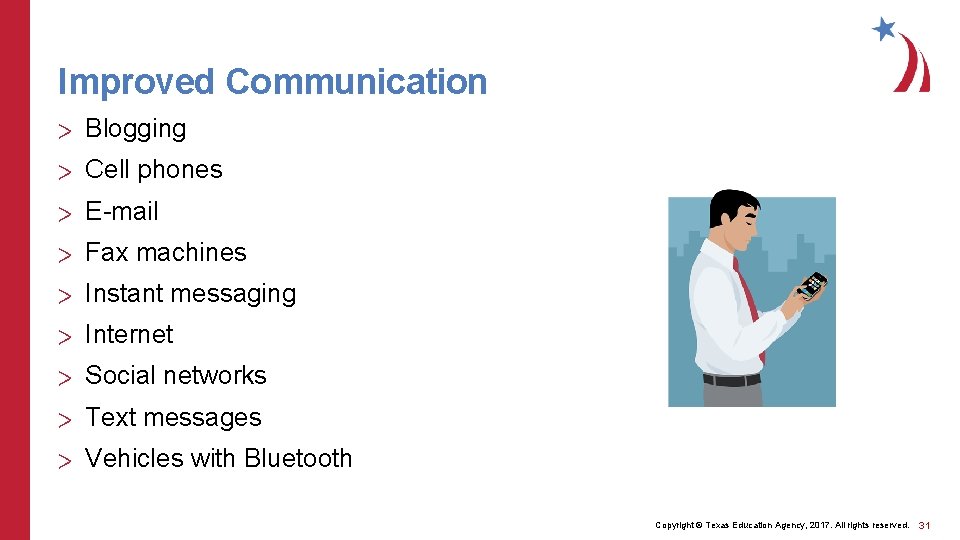
Improved Communication > Blogging > Cell phones > E-mail > Fax machines > Instant messaging > Internet > Social networks > Text messages > Vehicles with Bluetooth Copyright © Texas Education Agency, 2017. All rights reserved. 31
Questions? Copyright © Texas Education Agency, 2017. All rights reserved. 32
References and Resources > Images: • Microsoft Clip Art: Used with permission from Microsoft. > Textbook: • Strengthening Family and Self. The Goodheart-Wilcox Company, Inc. , Copyright 2004 > Websites: • Bureau of Labor Statistics What Effects do Macroeconomic Conditions Have on Families’ Time Together? http: //www. bls. gov/ore/pdf/ec 120030. pdf • Forum on Child and Family Statistics The Federal Interagency Forum on Child and Family Statistics, or the Forum is a working group of federal agencies that collect, analyze, and report data on issues related to children and families. The Forum has partners from 22 federal agencies as well as partners in private research organizations. http: //www. childstats. gov/index. asp Copyright © Texas Education Agency, 2017. All rights reserved. 33
References and Resources > Websites: • Maternal and Child Health The Federal Title V Maternal and Child Health program has provided a foundation for ensuring the health of the nation’s mothers, women, children and youth, including children and youth with special health care needs, and their families. http: //mchb. hrsa. gov/ • Public Broadcasting Service (PBS) Website with links to television, articles and information on various curricular subjects of public interest. http: //www. pbs. org or http: //www. pbs. org/parents/cominghome/article-homecomings. html • Story. Bird is a visual storytelling community and a global hub of readers, writers and artists of all ages. http: //storybird. com/teachers/ Copyright © Texas Education Agency, 2017. All rights reserved. 34
References and Resources > Websites: • Texas State University Dysfunctional Family Patterns http: //www. counseling. txstate. edu/resources/shoverview/bro/dysfunc. html > Video: • Faces of America Episode: Family traditions and customs. Stephen Colbert talks about traditions and customs he’s kept alive in his own family over the generations. http: //video. pbs. org/video/2247082872 Copyright © Texas Education Agency, 2017. All rights reserved. 35