
COMPONENTS OF A SOLUTION SOLUTE substance being dissolved

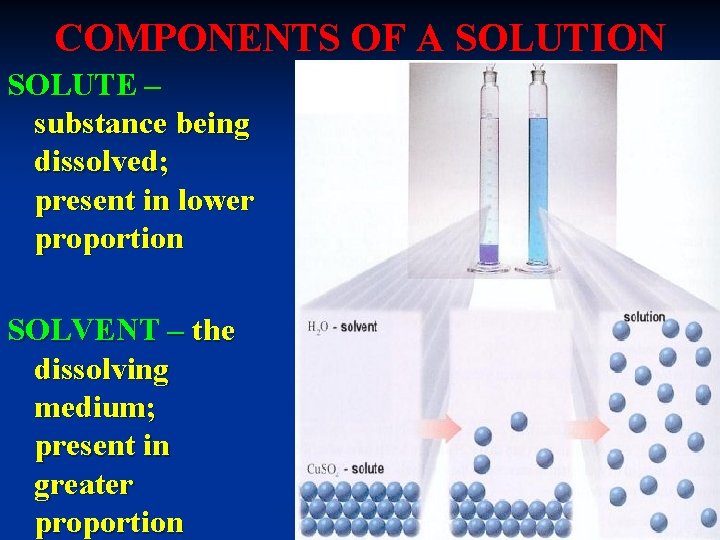
COMPONENTS OF A SOLUTION SOLUTE – substance being dissolved; present in lower proportion SOLVENT – the dissolving medium; present in greater proportion
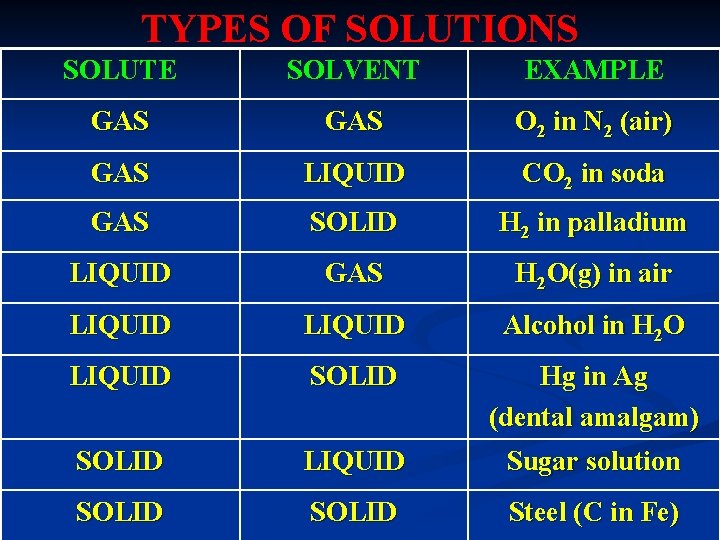
TYPES OF SOLUTIONS SOLUTE SOLVENT EXAMPLE GAS O 2 in N 2 (air) GAS LIQUID CO 2 in soda GAS SOLID H 2 in palladium LIQUID GAS H 2 O(g) in air LIQUID Alcohol in H 2 O LIQUID SOLID Hg in Ag (dental amalgam) SOLID LIQUID Sugar solution SOLID Steel (C in Fe)
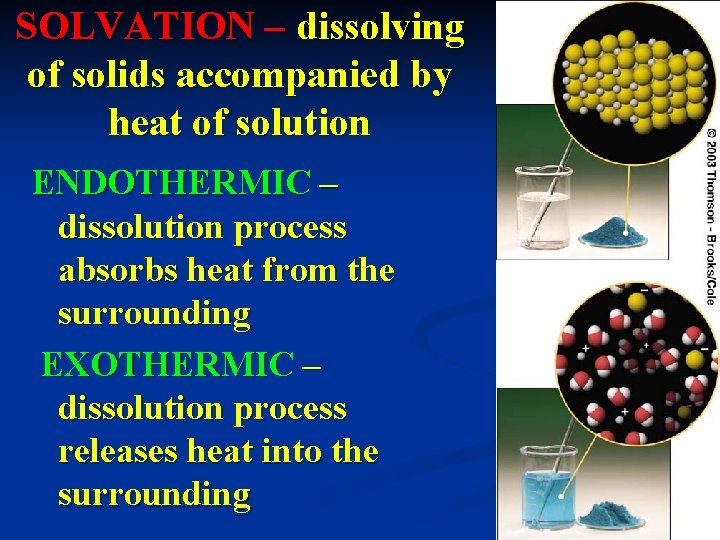
SOLVATION – dissolving of solids accompanied by heat of solution ENDOTHERMIC – dissolution process absorbs heat from the surrounding EXOTHERMIC – dissolution process releases heat into the surrounding
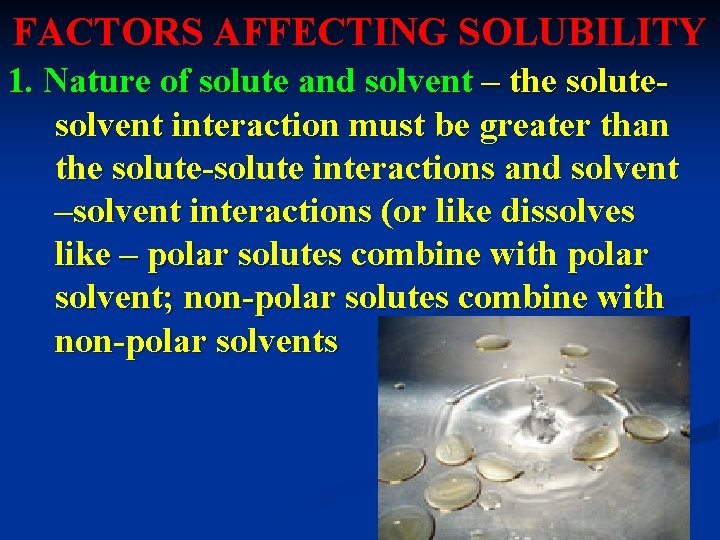
FACTORS AFFECTING SOLUBILITY 1. Nature of solute and solvent – the solutesolvent interaction must be greater than the solute-solute interactions and solvent –solvent interactions (or like dissolves like – polar solutes combine with polar solvent; non-polar solutes combine with non-polar solvents
2. Pressure – The greater the pressure above a liquid, the greater is the solubility of the gas in the liquid. 3. Temperature – The lower the temperature of a liquid, the greater is the solubility of the gas in the liquid.
RELATIVE (or comparative) WAYS OF EXPRESSING CONCENTRATION 1. 2. 3. UNSATURATED or DILUTE – contains a relatively small amount of solute SATURATED – contains the maximum amount of solute in that a given quantity of solvent can dissolve in a given temperature SUPERSATURATED – contains more solute than saturated solutions - prepared by adding more solute to a saturated solution at a higher temperature
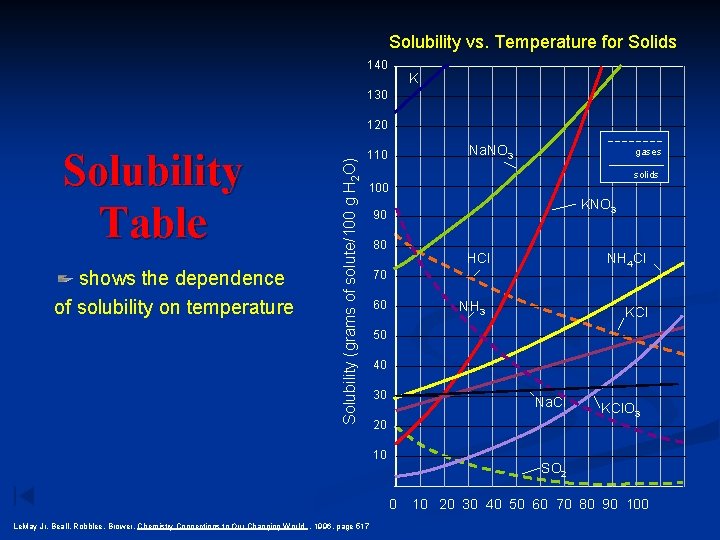
Solubility vs. Temperature for Solids 140 KI 130 Solubility Table shows the dependence of solubility on temperature Solubility (grams of solute/100 g H 2 O) 120 Na. NO 3 110 gases solids 100 KNO 3 90 80 HCl 70 60 NH 3 KCl 50 40 30 Na. Cl 20 10 KCl. O 3 SO 2 0 Le. May Jr, Beall, Robblee, Brower, Chemistry Connections to Our Changing World , 1996, page 517 NH 4 Cl 10 20 30 40 50 60 70 80 90 100
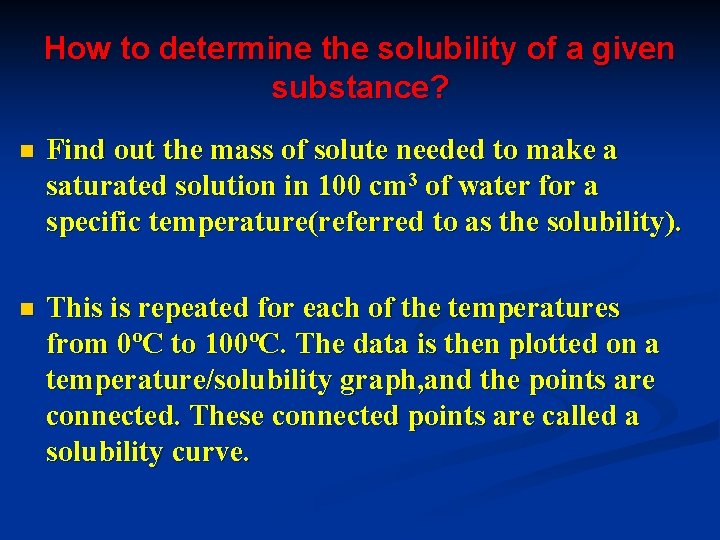
How to determine the solubility of a given substance? n Find out the mass of solute needed to make a saturated solution in 100 cm 3 of water for a specific temperature(referred to as the solubility). n This is repeated for each of the temperatures from 0ºC to 100ºC. The data is then plotted on a temperature/solubility graph, and the points are connected. These connected points are called a solubility curve.
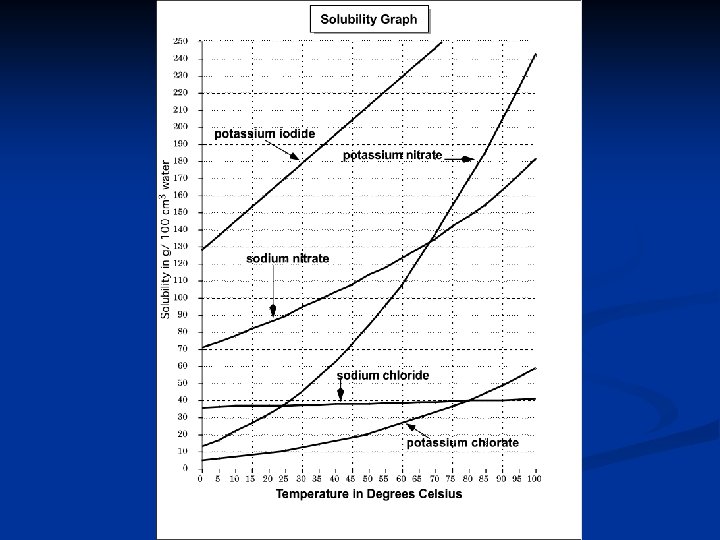
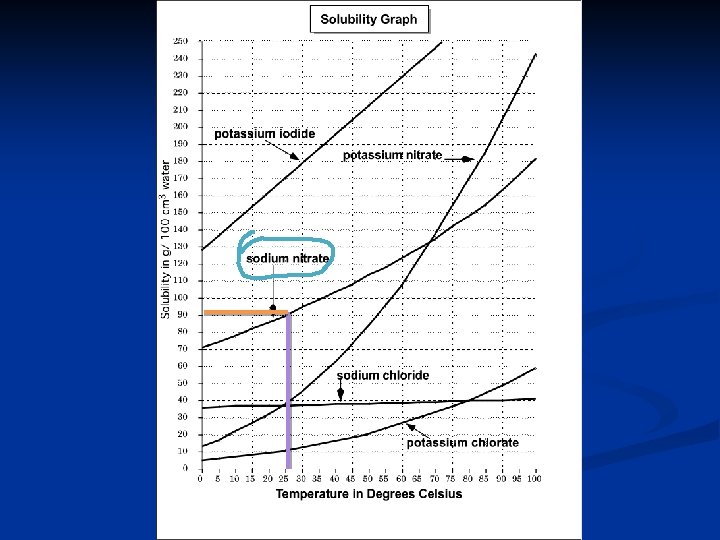
How to use a solubility graph? A. IDENTIFYING A SUBSTANCE ( given the solubility in g/100 cm 3 of water and the temperature) n Look for the intersection of the solubility and temperature.
Example: What substance has a solubility of 90 g/100 3 cm of water at a temperature of 25ºC ?
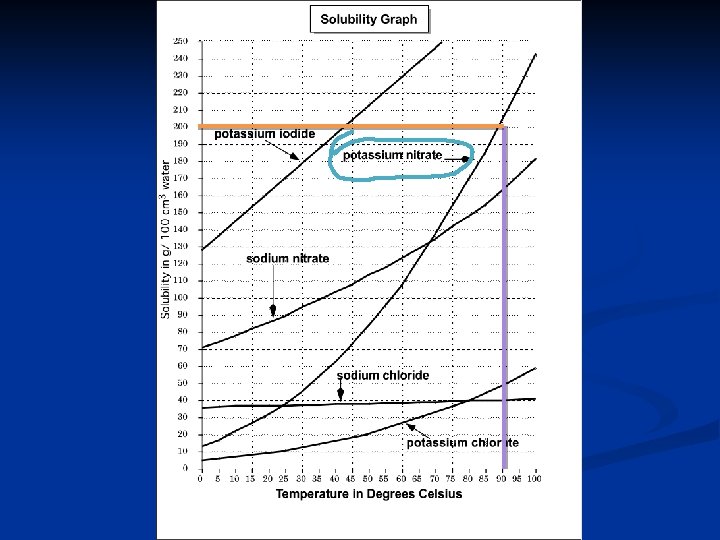
Example: What substance has a 3 solubility of 200 g/100 cm of water at a temperature of 90ºC ?
B. Look for the temperature or solubility • Locate the solubility curve needed and see for a given temperature, which solubility it lines up with and visa versa.
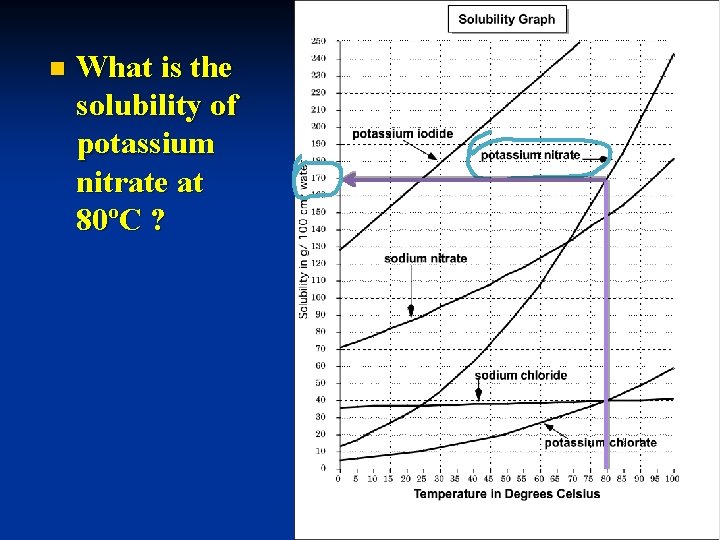
n What is the solubility of potassium nitrate at 80ºC ?
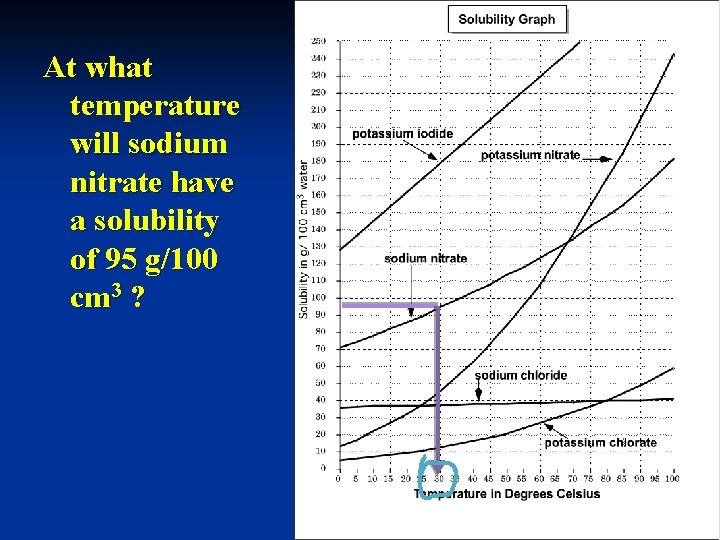
At what temperature will sodium nitrate have a solubility of 95 g/100 cm 3 ?
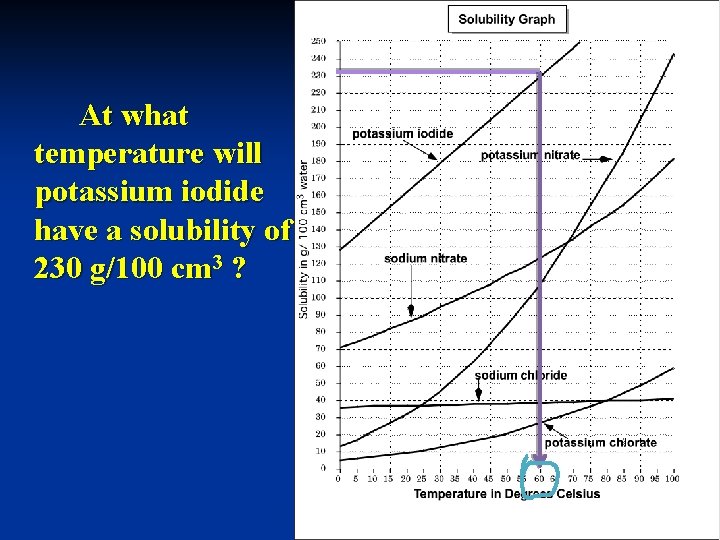
At what temperature will potassium iodide have a solubility of 230 g/100 cm 3 ?
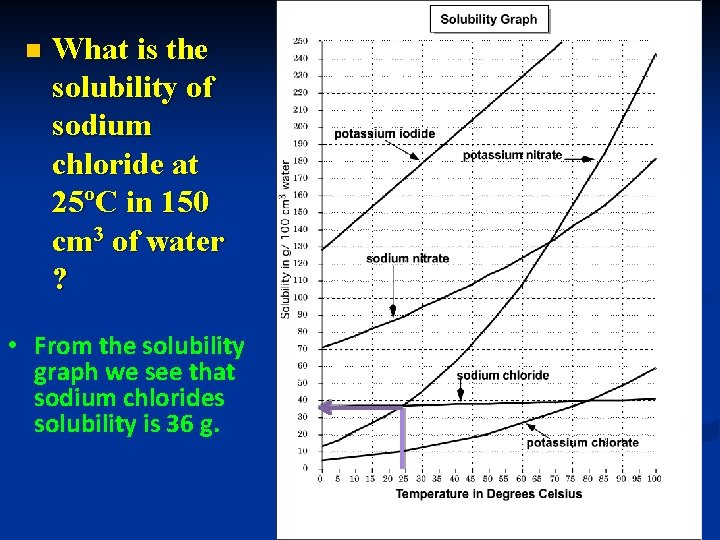
n What is the solubility of sodium chloride at 25ºC in 150 cm 3 of water ? • From the solubility graph we see that sodium chlorides solubility is 36 g.
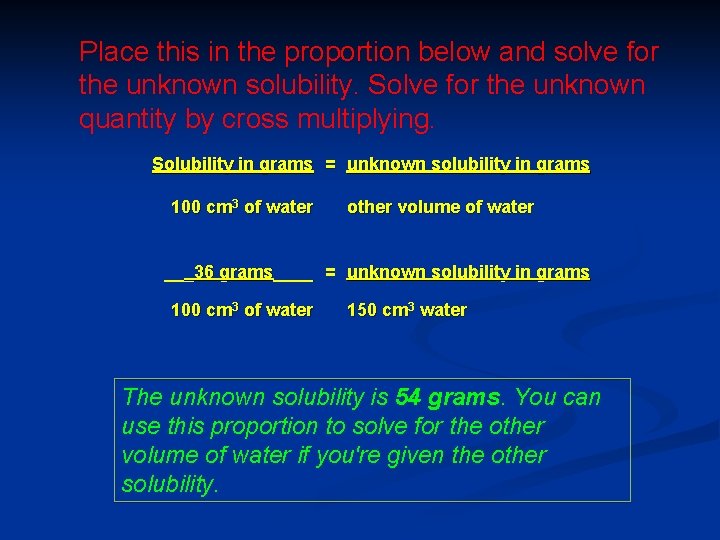
Place this in the proportion below and solve for the unknown solubility. Solve for the unknown quantity by cross multiplying. Solubility in grams = unknown solubility in grams 100 cm 3 of water other volume of water ___36 grams____ = unknown solubility in grams 100 cm 3 of water 150 cm 3 water The unknown solubility is 54 grams. You can use this proportion to solve for the other volume of water if you're given the other solubility.
C. Determine if a solution is saturated, unsaturated, or supersaturated. • If the solubility for a given substance places it anywhere on it's solubility curve it is saturated. • If it lies above the solubility curve, then it's supersaturated, • If it lies below the solubility curve it's an unsaturated solution. Remember though, if the volume of water isn't 100 cm 3 to use a proportion first as shown above.
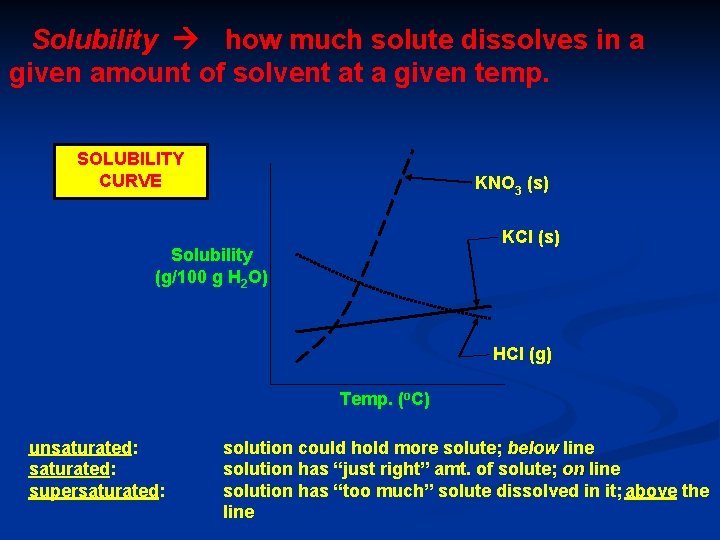
Solubility how much solute dissolves in a given amount of solvent at a given temp. SOLUBILITY CURVE KNO 3 (s) KCl (s) Solubility (g/100 g H 2 O) HCl (g) Temp. (o. C) unsaturated: supersaturated: solution could hold more solute; below line solution has “just right” amt. of solute; on line solution has “too much” solute dissolved in it; above the line
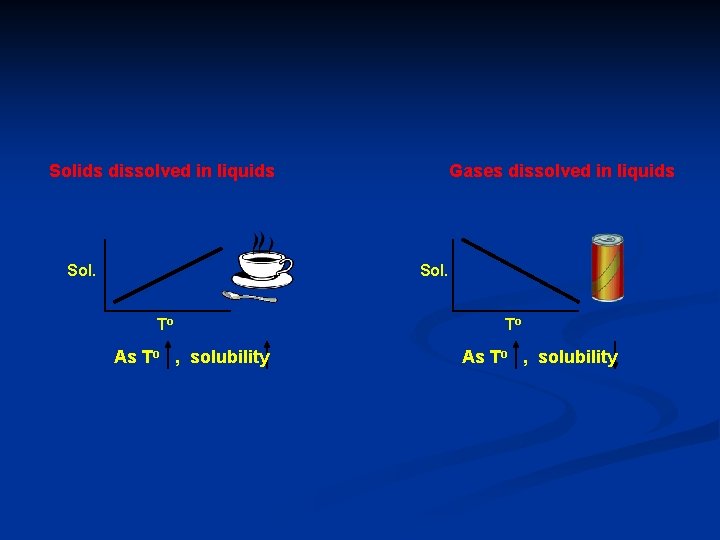
Solids dissolved in liquids Sol. Gases dissolved in liquids Sol. To As To , solubility
Sometimes you'll need to determine how much additional solute needs to be added to a unsaturated solution in order to make it saturated. For example, 30 grams of potassium nitrate has been added to 100 cm 3 of water at a temperature of 50ºC.
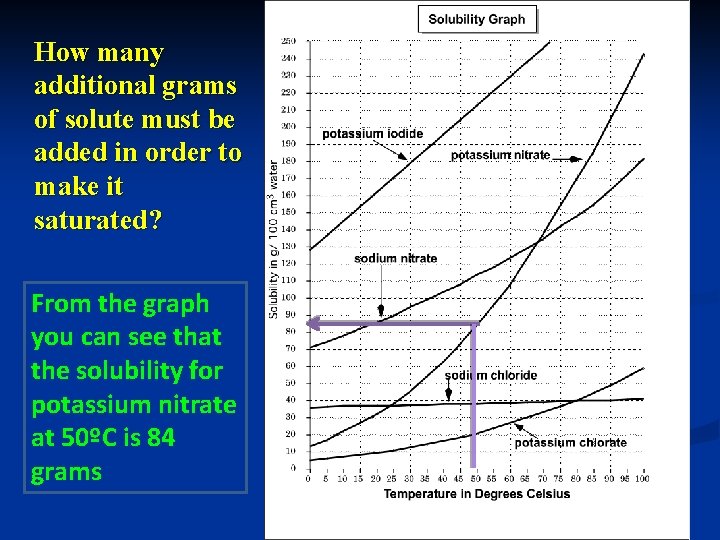
How many additional grams of solute must be added in order to make it saturated? From the graph you can see that the solubility for potassium nitrate at 50ºC is 84 grams
If there already 30 grams of solute in the solution, all you need to get to 84 grams is 54 more grams ( 84 g-30 g ).
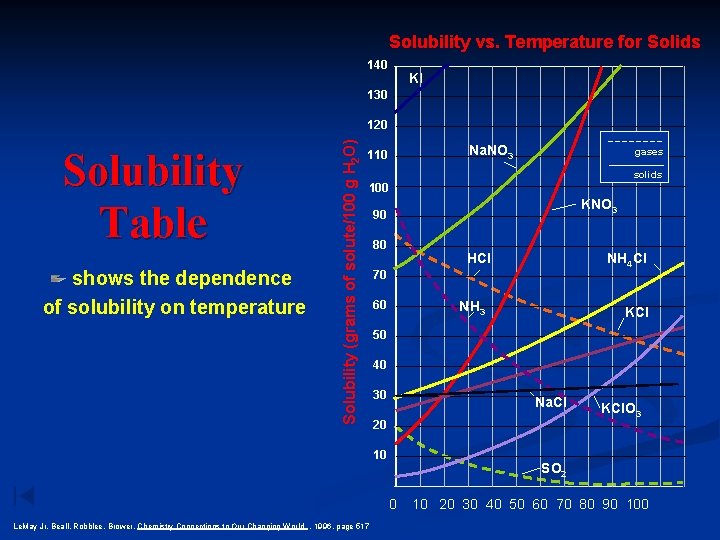
Solubility vs. Temperature for Solids 140 KI 130 Solubility Table shows the dependence of solubility on temperature Solubility (grams of solute/100 g H 2 O) 120 Na. NO 3 110 gases solids 100 KNO 3 90 80 HCl 70 60 NH 3 KCl 50 40 30 Na. Cl 20 10 KCl. O 3 SO 2 0 Le. May Jr, Beall, Robblee, Brower, Chemistry Connections to Our Changing World , 1996, page 517 NH 4 Cl 10 20 30 40 50 60 70 80 90 100
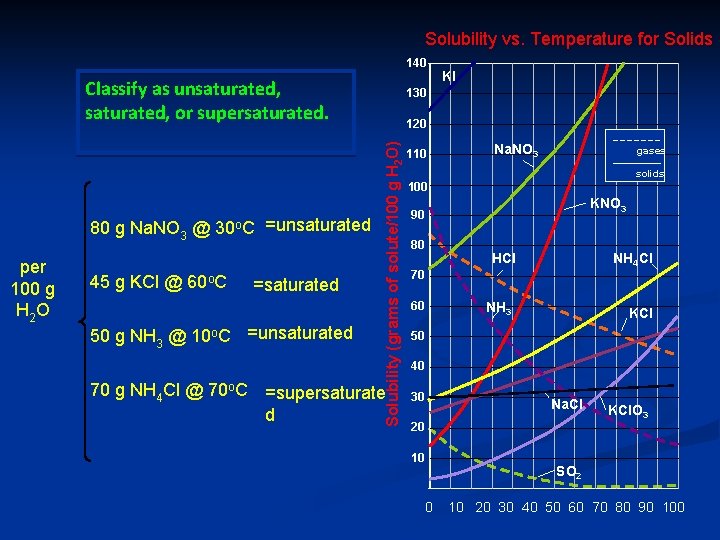
Solubility vs. Temperature for Solids 140 Classify as unsaturated, or supersaturated. per 100 g H 2 O 45 g KCl @ 60 o. C =saturated 50 g NH 3 @ 10 o. C =unsaturated 130 120 Solubility (grams of solute/100 g H 2 O) 80 g Na. NO 3 @ 30 o. C =unsaturated KI 70 g NH 4 Cl @ 70 o. C =supersaturate d 110 Na. NO 3 gases solids 100 KNO 3 90 80 HCl NH 4 Cl 70 60 NH 3 KCl 50 40 30 Na. Cl 20 10 KCl. O 3 SO 2 0 10 20 30 40 50 60 70 80 90 100
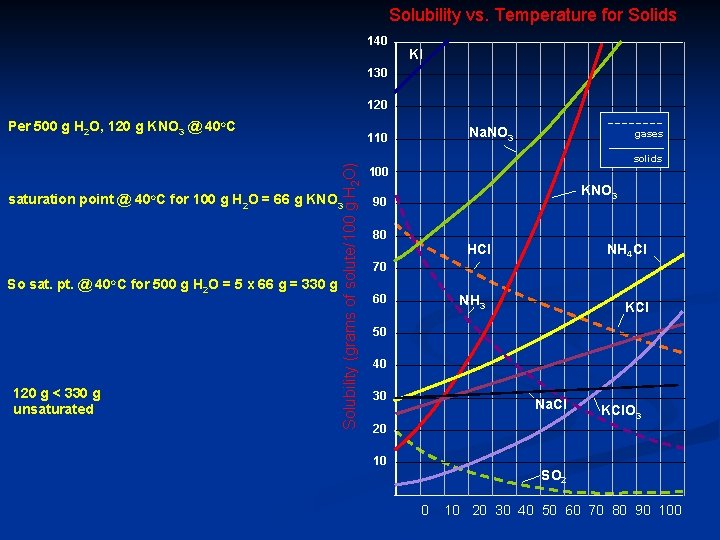
Solubility vs. Temperature for Solids 140 KI 130 120 Per 500 g H 2 O, 120 g KNO 3 @ 40 o. C Solubility (grams of solute/100 g H 2 O) saturation point @ 40 o. C for 100 g H 2 O = 66 g KNO 3 So sat. pt. @ 40 o. C for 500 g H 2 O = 5 x 66 g = 330 g 120 g < 330 g unsaturated Na. NO 3 110 gases solids 100 KNO 3 90 80 HCl NH 4 Cl 70 60 NH 3 KCl 50 40 30 Na. Cl KCl. O 3 20 10 SO 2 0 10 20 30 40 50 60 70 80 90 100
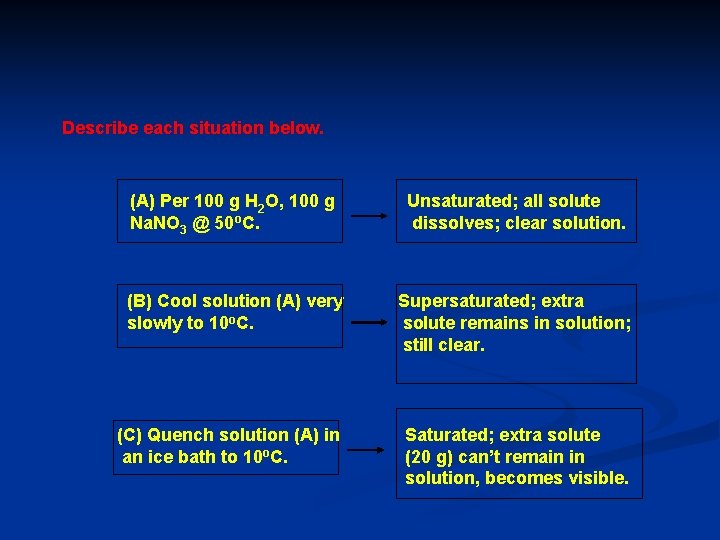
Describe each situation below. (A) Per 100 g H 2 O, 100 g Na. NO 3 @ 50 o. C. Unsaturated; all solute dissolves; clear solution. (B) Cool solution (A) very slowly to 10 o. C. Supersaturated; extra solute remains in solution; still clear. (C) Quench solution (A) in an ice bath to 10 o. C. Saturated; extra solute (20 g) can’t remain in solution, becomes visible.
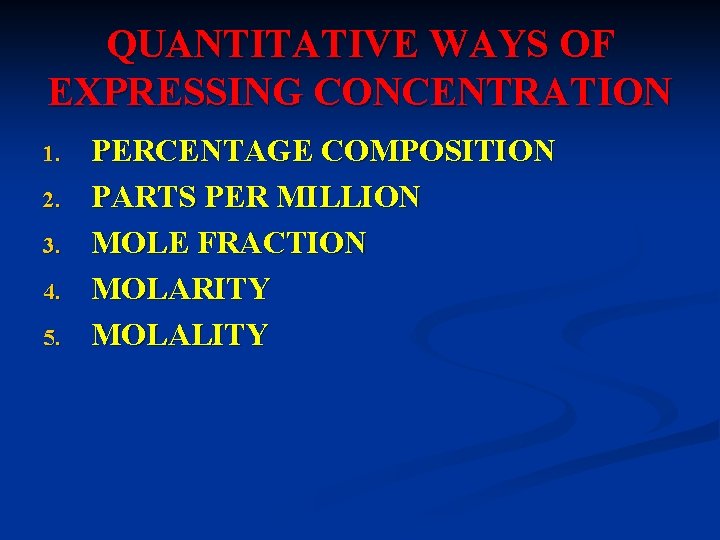
QUANTITATIVE WAYS OF EXPRESSING CONCENTRATION 1. 2. 3. 4. 5. PERCENTAGE COMPOSITION PARTS PER MILLION MOLE FRACTION MOLARITY MOLALITY
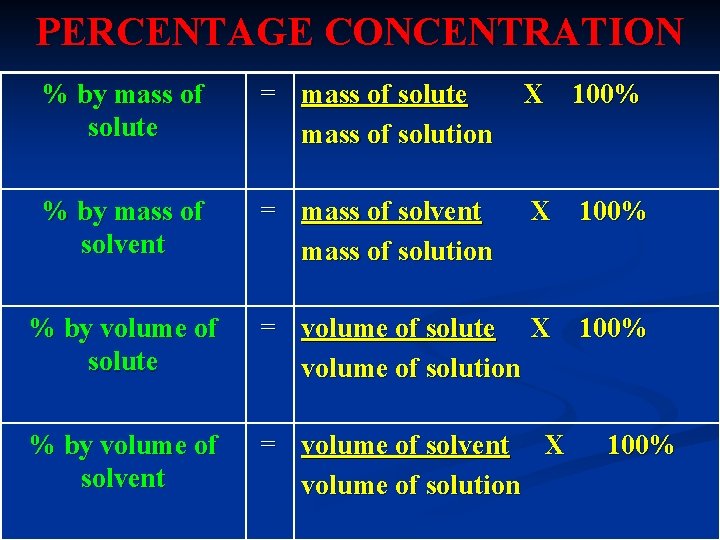
PERCENTAGE CONCENTRATION % by mass of solute = mass of solute mass of solution X 100% % by mass of solvent = mass of solvent mass of solution X 100% % by volume of solute = volume of solute X 100% volume of solution % by volume of solvent = volume of solvent X volume of solution 100%
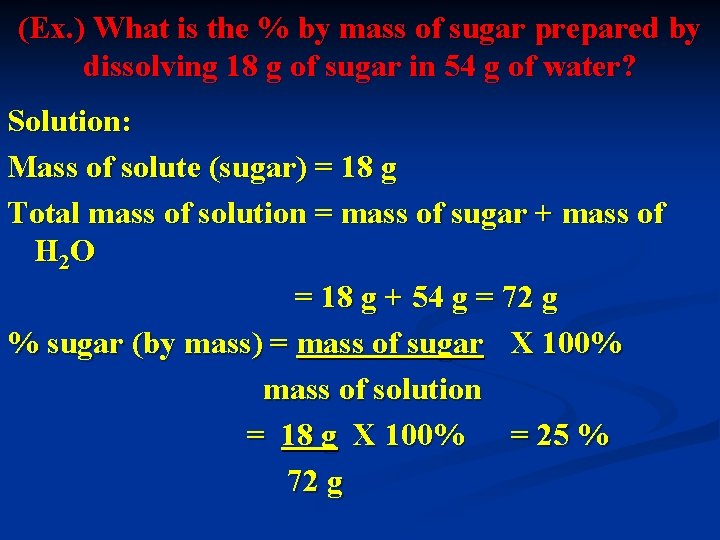
(Ex. ) What is the % by mass of sugar prepared by dissolving 18 g of sugar in 54 g of water? Solution: Mass of solute (sugar) = 18 g Total mass of solution = mass of sugar + mass of H 2 O = 18 g + 54 g = 72 g % sugar (by mass) = mass of sugar X 100% mass of solution = 18 g X 100% = 25 % 72 g
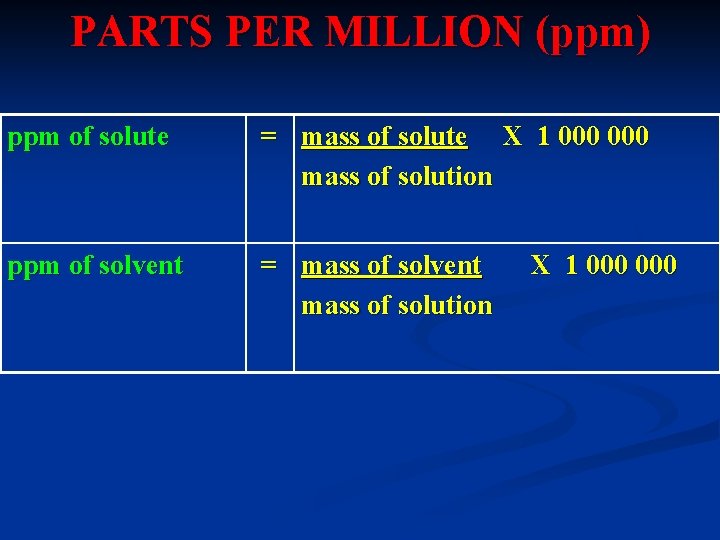
PARTS PER MILLION (ppm) ppm of solute = mass of solute X 1 000 mass of solution ppm of solvent = mass of solvent mass of solution X 1 000
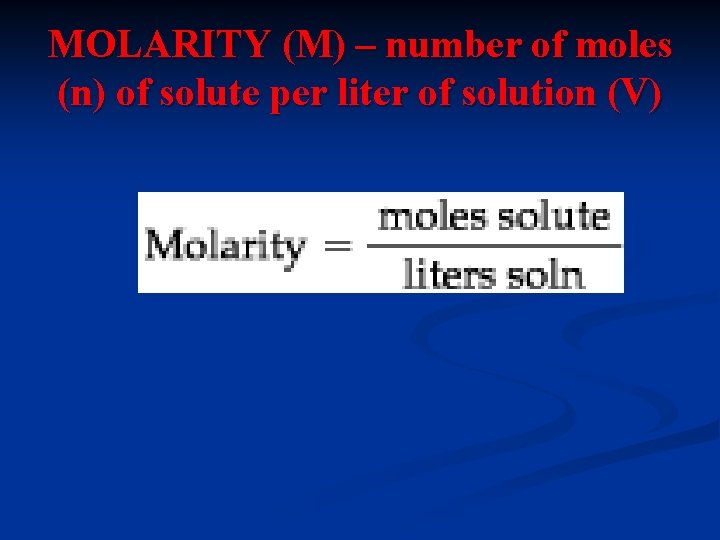
MOLARITY (M) – number of moles (n) of solute per liter of solution (V)
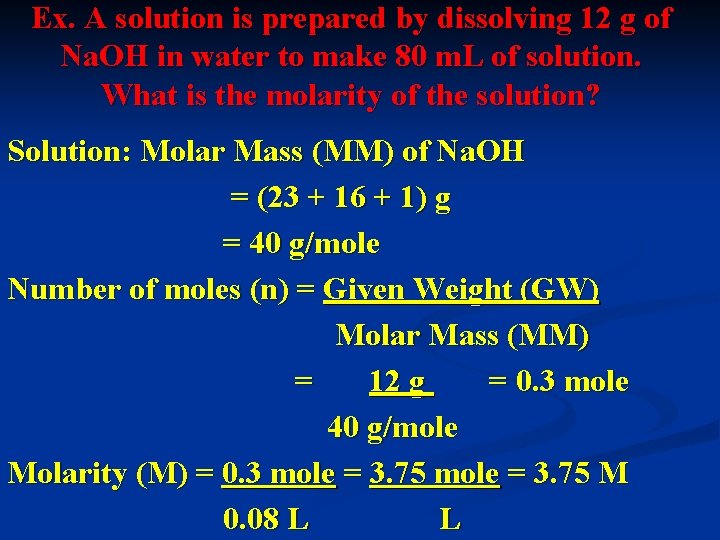
Ex. A solution is prepared by dissolving 12 g of Na. OH in water to make 80 m. L of solution. What is the molarity of the solution? Solution: Molar Mass (MM) of Na. OH = (23 + 16 + 1) g = 40 g/mole Number of moles (n) = Given Weight (GW) Molar Mass (MM) = 12 g = 0. 3 mole 40 g/mole Molarity (M) = 0. 3 mole = 3. 75 M 0. 08 L L
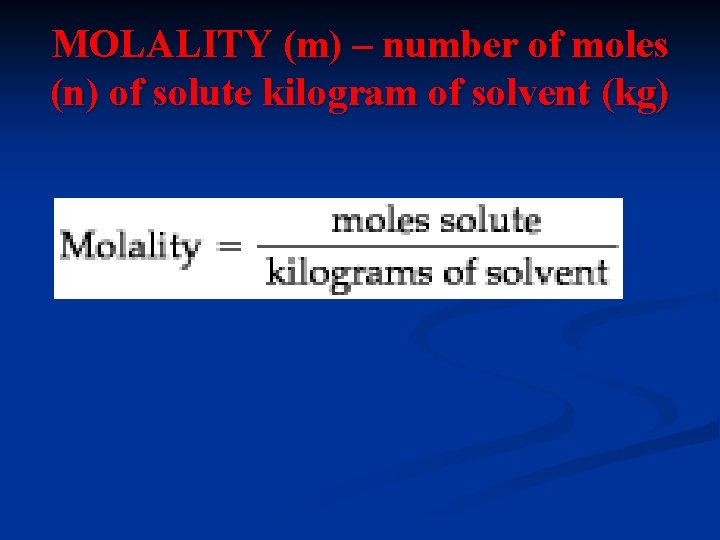
MOLALITY (m) – number of moles (n) of solute kilogram of solvent (kg)
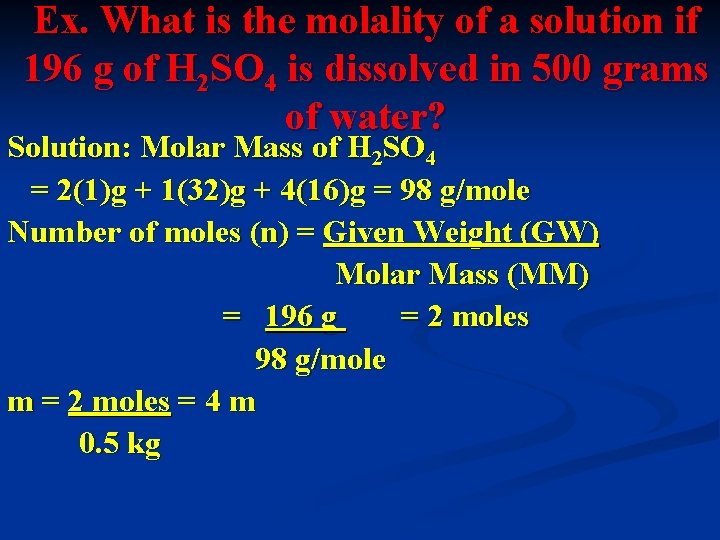
Ex. What is the molality of a solution if 196 g of H 2 SO 4 is dissolved in 500 grams of water? Solution: Molar Mass of H 2 SO 4 = 2(1)g + 1(32)g + 4(16)g = 98 g/mole Number of moles (n) = Given Weight (GW) Molar Mass (MM) = 196 g = 2 moles 98 g/mole m = 2 moles = 4 m 0. 5 kg
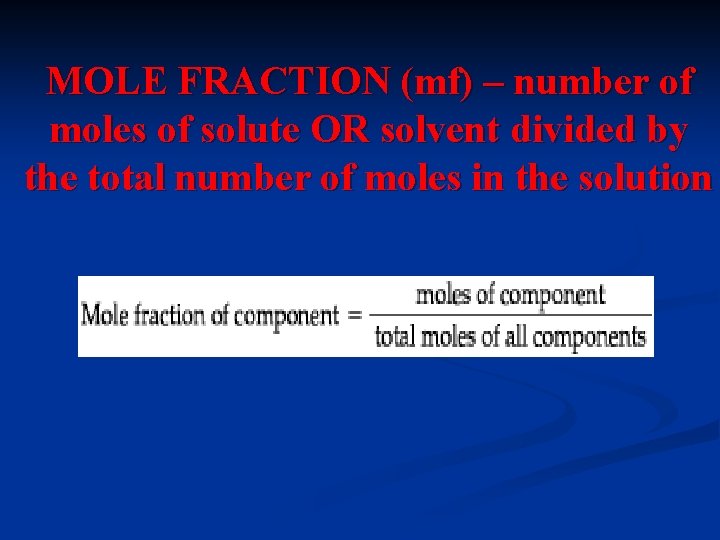
MOLE FRACTION (mf) – number of moles of solute OR solvent divided by the total number of moles in the solution
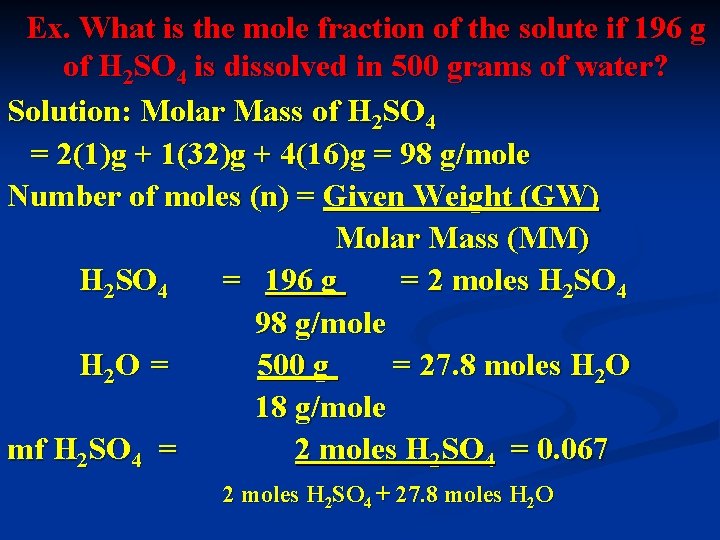
Ex. What is the mole fraction of the solute if 196 g of H 2 SO 4 is dissolved in 500 grams of water? Solution: Molar Mass of H 2 SO 4 = 2(1)g + 1(32)g + 4(16)g = 98 g/mole Number of moles (n) = Given Weight (GW) Molar Mass (MM) H 2 SO 4 = 196 g = 2 moles H 2 SO 4 98 g/mole H 2 O = 500 g = 27. 8 moles H 2 O 18 g/mole mf H 2 SO 4 = 2 moles H 2 SO 4 = 0. 067 2 moles H 2 SO 4 + 27. 8 moles H 2 O
- Slides: 42