
Components of a Solution Solute substance being dissolved
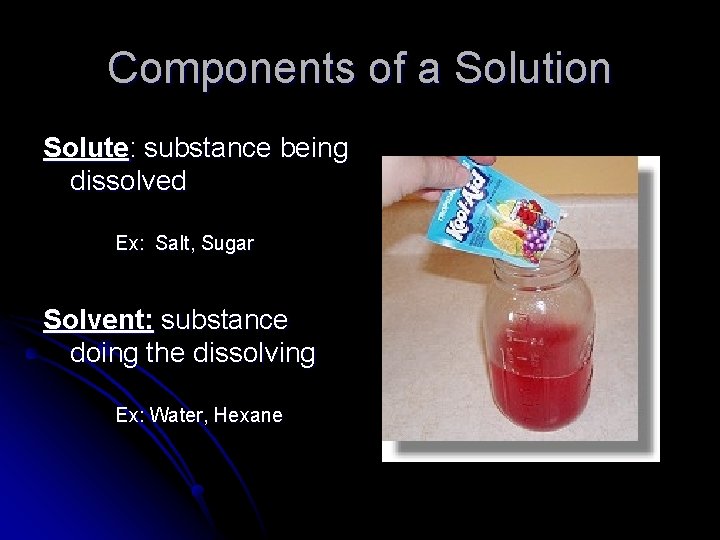
Components of a Solution Solute: substance being dissolved Ex: Salt, Sugar Solvent: substance doing the dissolving Ex: Water, Hexane
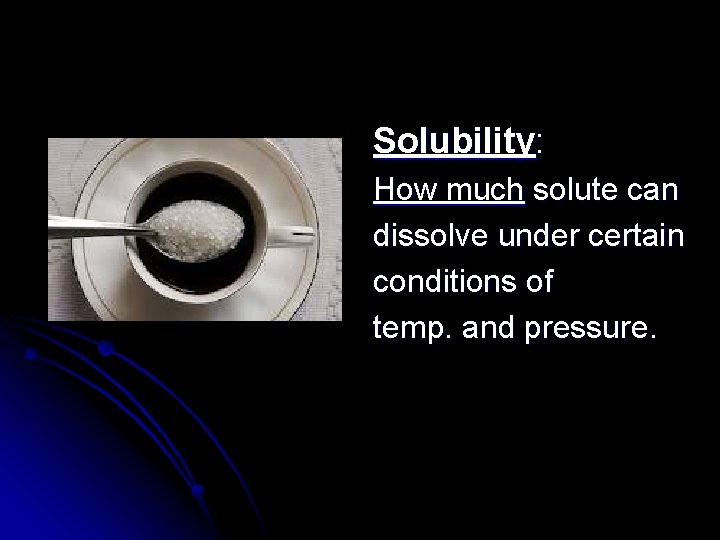
Solubility: How much solute can dissolve under certain conditions of temp. and pressure.
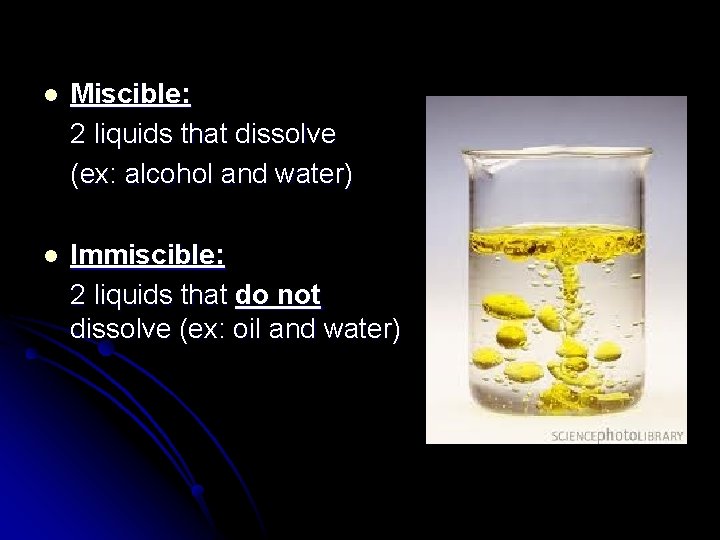
l Miscible: 2 liquids that dissolve (ex: alcohol and water) l Immiscible: 2 liquids that do not dissolve (ex: oil and water)
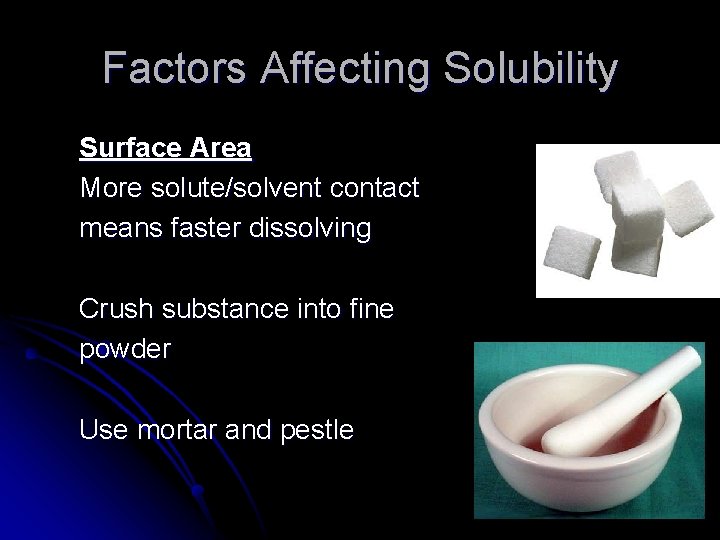
Factors Affecting Solubility Surface Area More solute/solvent contact means faster dissolving Crush substance into fine powder Use mortar and pestle
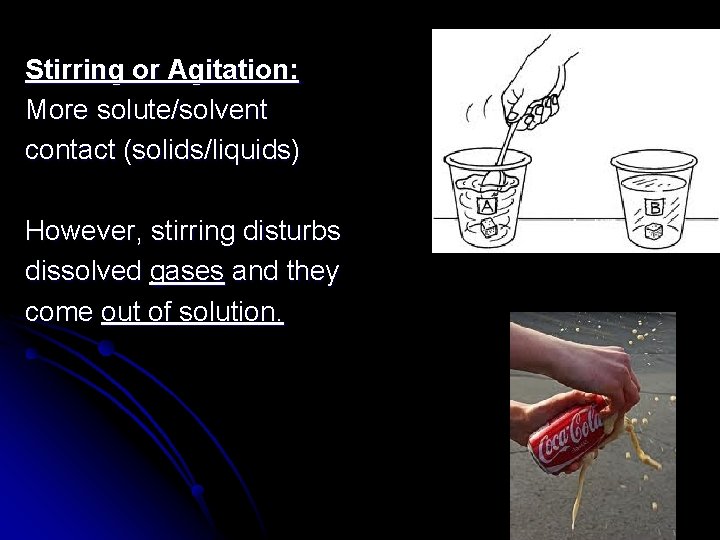
Stirring or Agitation: More solute/solvent contact (solids/liquids) However, stirring disturbs dissolved gases and they come out of solution.
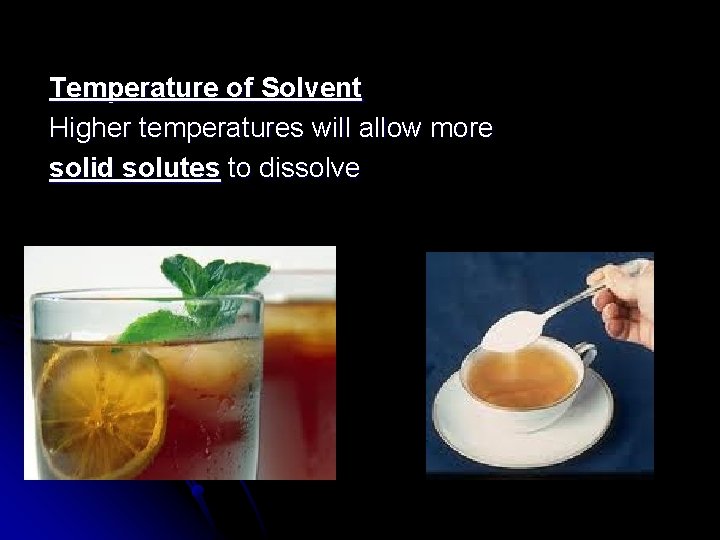
Temperature of Solvent Higher temperatures will allow more solid solutes to dissolve
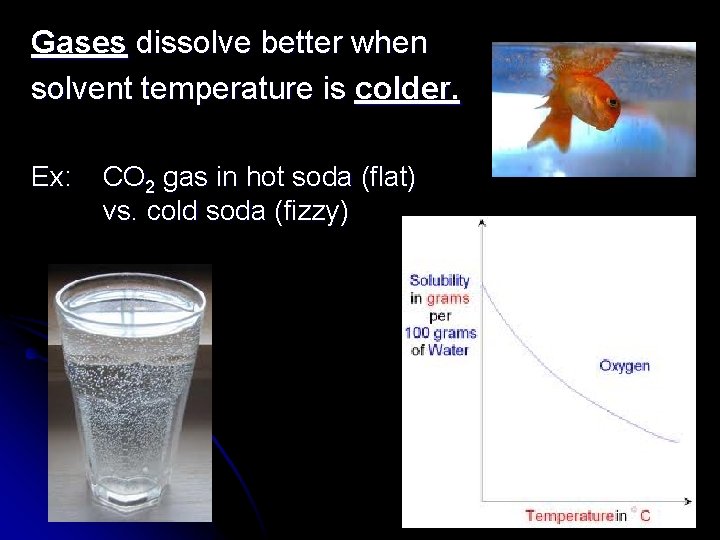
Gases dissolve better when solvent temperature is colder. Ex: CO 2 gas in hot soda (flat) vs. cold soda (fizzy)
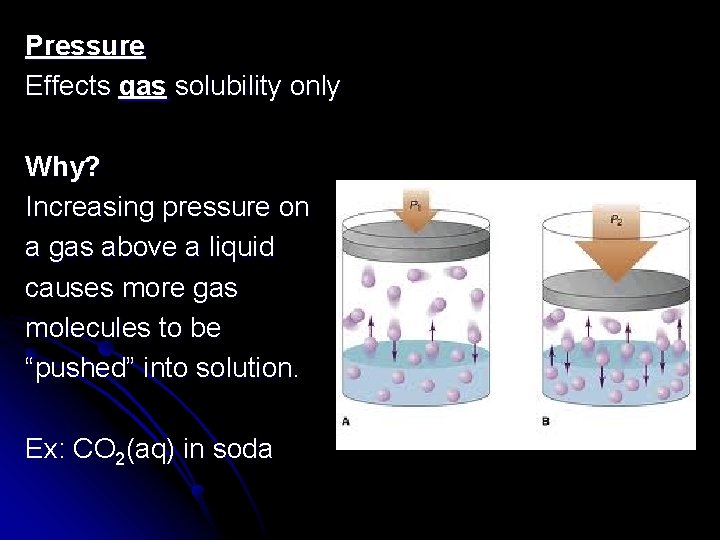
Pressure Effects gas solubility only Why? Increasing pressure on a gas above a liquid causes more gas molecules to be “pushed” into solution. Ex: CO 2(aq) in soda
Nature of Solute and Solvent l Polar solutes dissolve in polar solvents l Nonpolar solutes dissolve in nonpolar solvents l Most ionics (but not all) dissolve in polar solvents (molecule-ion attractions)
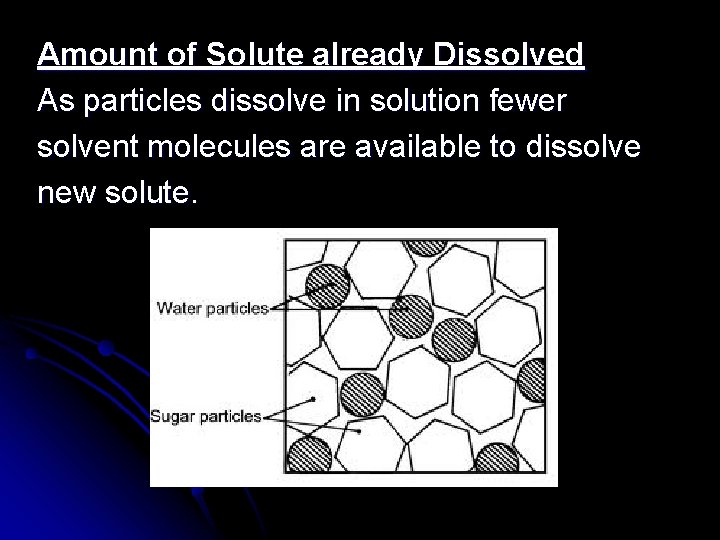
Amount of Solute already Dissolved As particles dissolve in solution fewer solvent molecules are available to dissolve new solute.
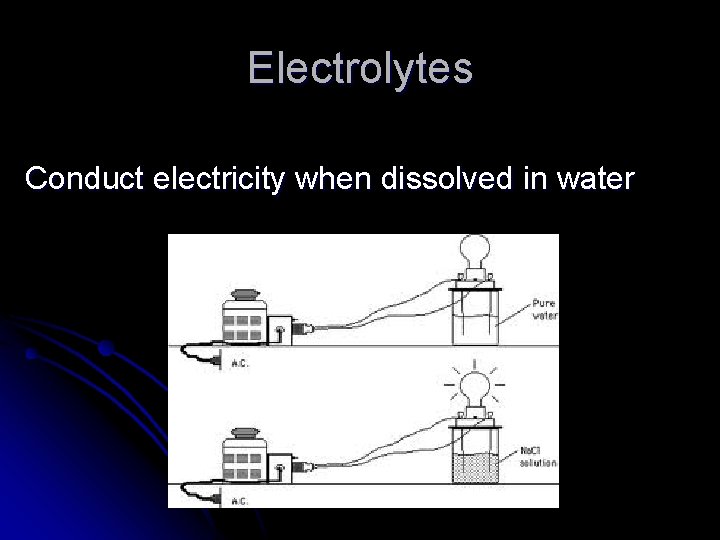
Electrolytes Conduct electricity when dissolved in water
Why do they Conduct? Create mobile ions in solution. l The more concentrated the solution the more it conducts l Includes: l Soluble Ionic Compounds (ex: Na. Cl) l Acids (ex: HCl) l Bases (ex: Na. OH)
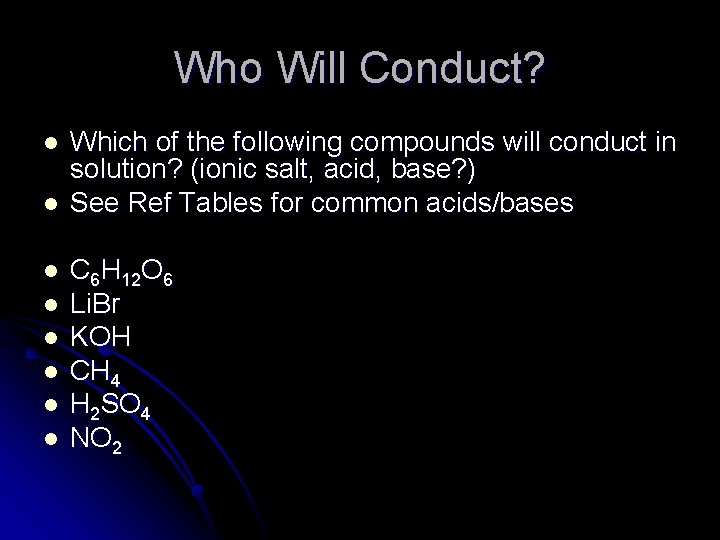
Who Will Conduct? l l l l Which of the following compounds will conduct in solution? (ionic salt, acid, base? ) See Ref Tables for common acids/bases C 6 H 12 O 6 Li. Br KOH CH 4 H 2 SO 4 NO 2
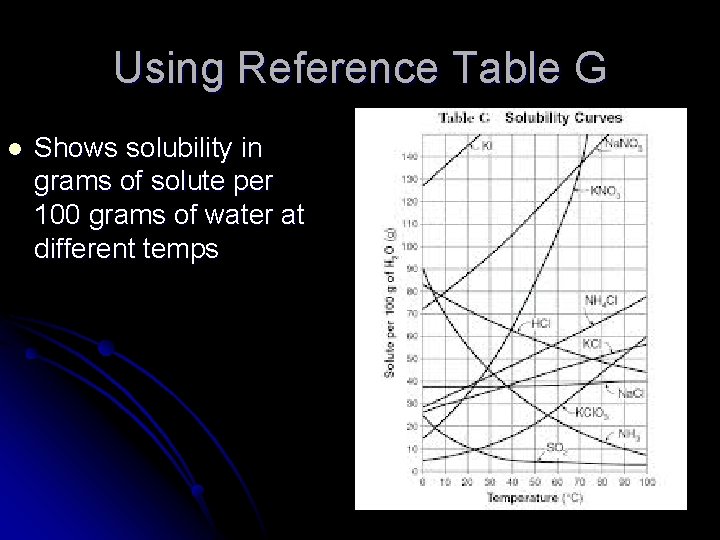
Using Reference Table G l Shows solubility in grams of solute per 100 grams of water at different temps
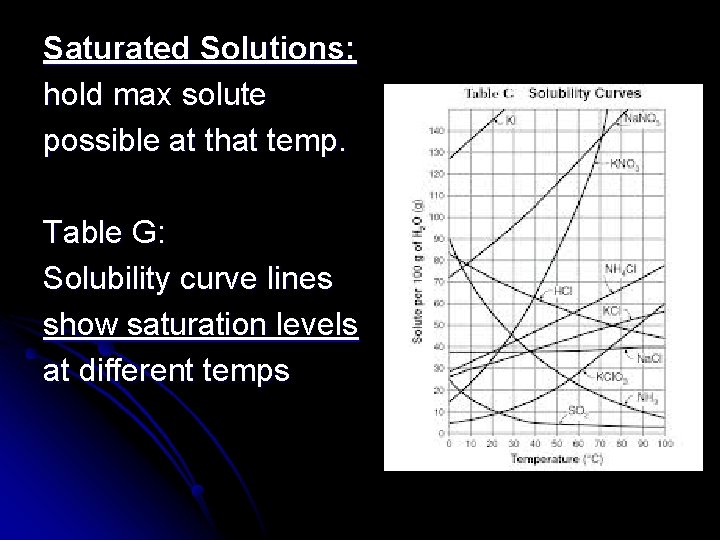
Saturated Solutions: hold max solute possible at that temp. Table G: Solubility curve lines show saturation levels at different temps
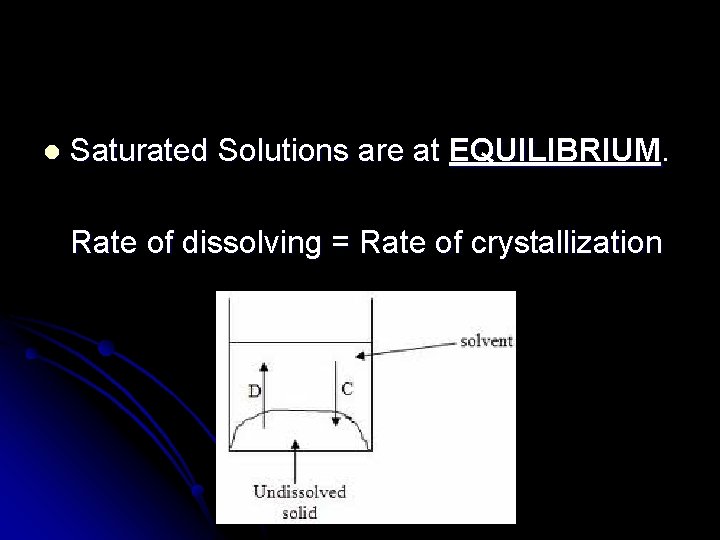
l Saturated Solutions are at EQUILIBRIUM. Rate of dissolving = Rate of crystallization
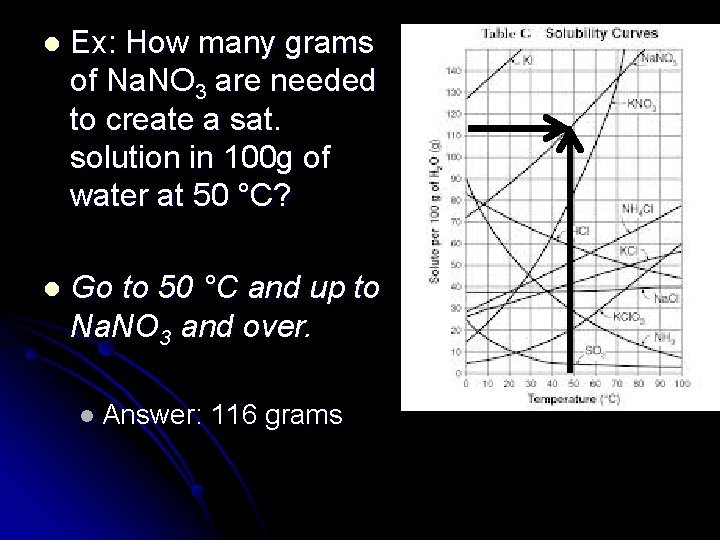
l Ex: How many grams of Na. NO 3 are needed to create a sat. solution in 100 g of water at 50 °C? l Go to 50 °C and up to Na. NO 3 and over. l Answer: 116 grams
Look at The Water!! l Table G is for 100 grams of water. l Amount of water in your problem may be different and you need to adjust your answer.
How many grams of Na. NO 3 are needed to create a sat. solution in 300 g of water at 50 °C? l Answer: 116 grams x 3 l (three l times as much water!) Or you can use a proportion: 116 grams 100 g H 20 = x grams 300 g H 20
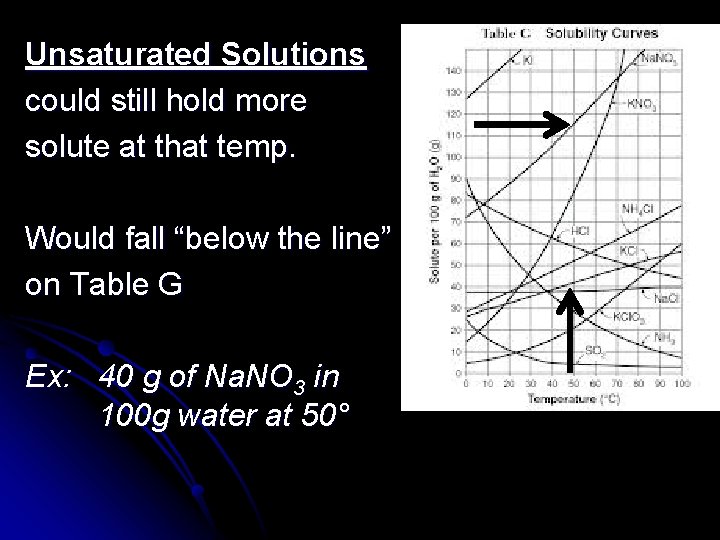
Unsaturated Solutions could still hold more solute at that temp. Would fall “below the line” on Table G Ex: 40 g of Na. NO 3 in 100 g water at 50°
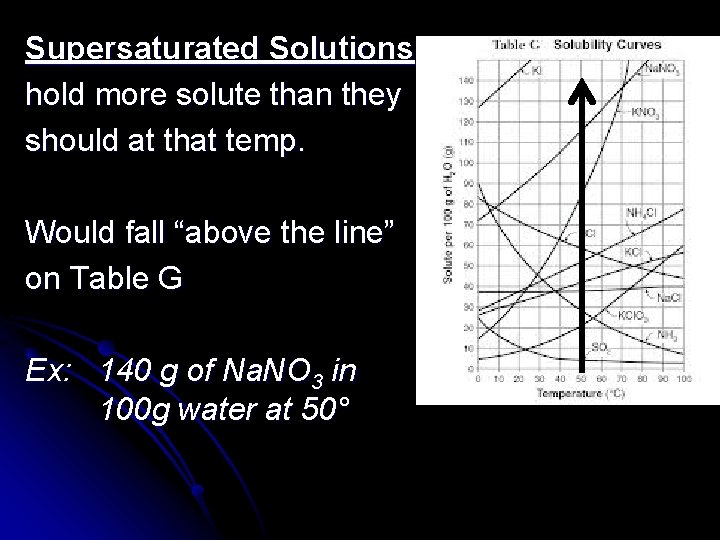
Supersaturated Solutions hold more solute than they should at that temp. Would fall “above the line” on Table G Ex: 140 g of Na. NO 3 in 100 g water at 50°
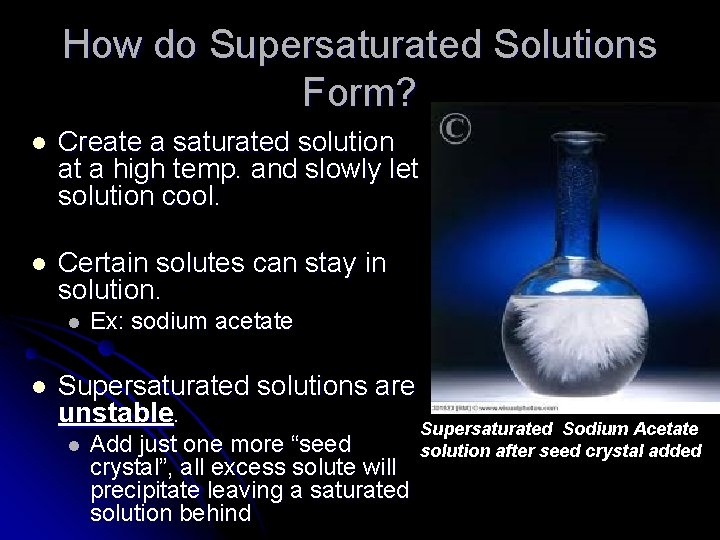
How do Supersaturated Solutions Form? l Create a saturated solution at a high temp. and slowly let solution cool. l Certain solutes can stay in solution. l l Ex: sodium acetate Supersaturated solutions are unstable. Supersaturated l Add just one more “seed crystal”, all excess solute will precipitate leaving a saturated solution behind Sodium Acetate solution after seed crystal added
Describe These Solutions Saturated, Unsaturated or Supersaturated?
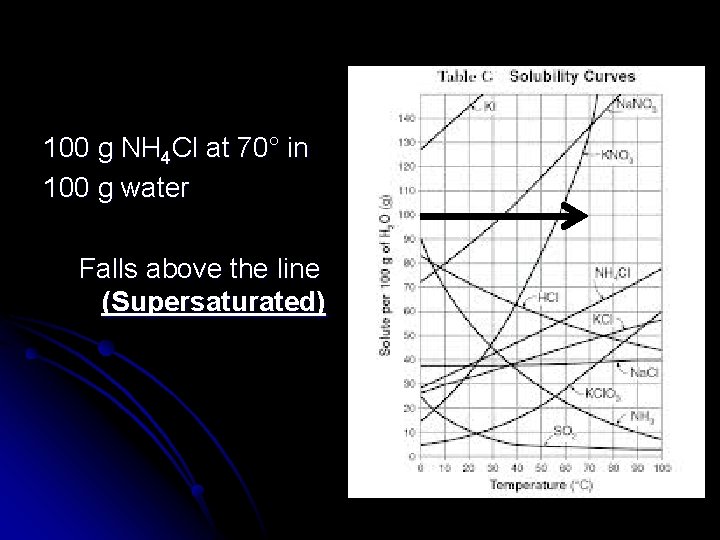
100 g NH 4 Cl at 70° in 100 g water Falls above the line (Supersaturated)
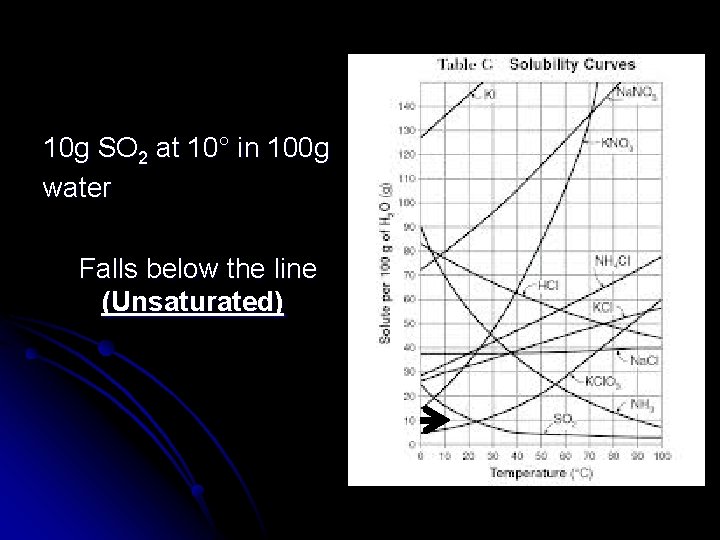
10 g SO 2 at 10° in 100 g water Falls below the line (Unsaturated)
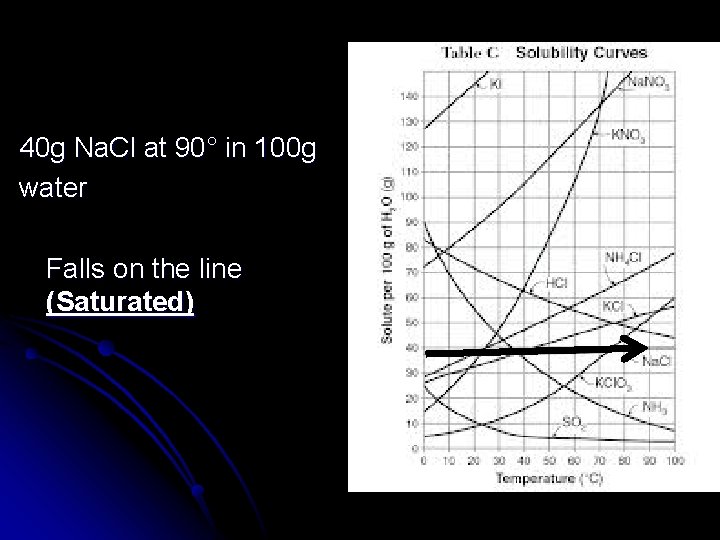
40 g Na. Cl at 90° in 100 g water Falls on the line (Saturated)
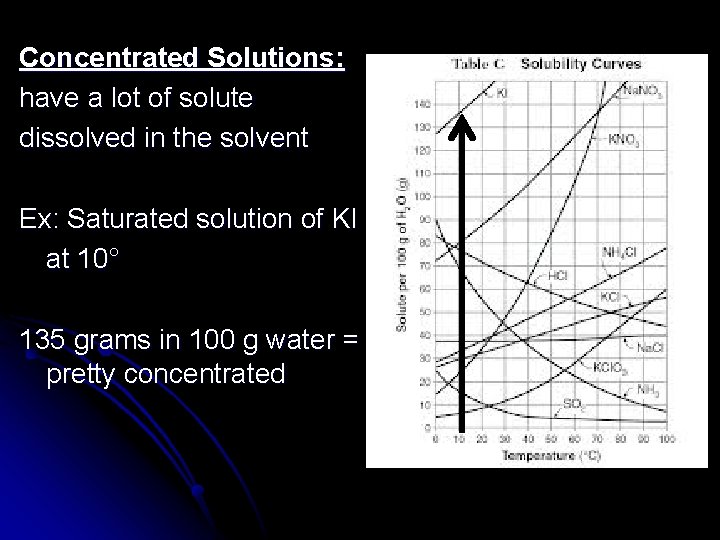
Concentrated Solutions: have a lot of solute dissolved in the solvent Ex: Saturated solution of KI at 10° 135 grams in 100 g water = pretty concentrated
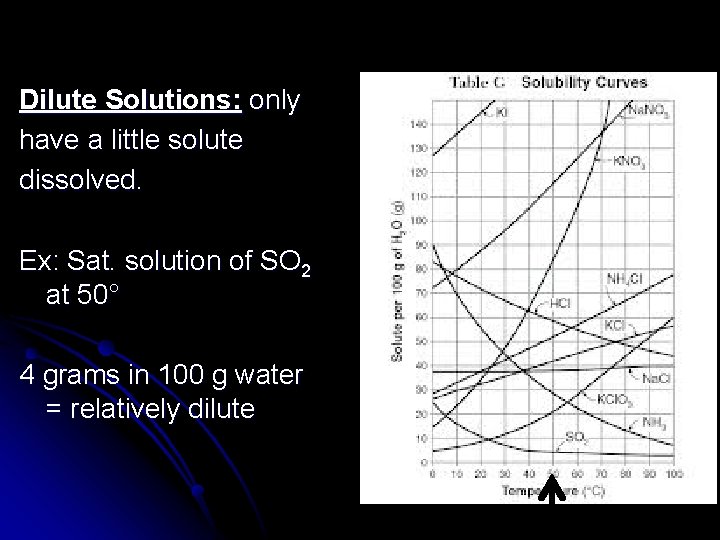
Dilute Solutions: only have a little solute dissolved. Ex: Sat. solution of SO 2 at 50° 4 grams in 100 g water = relatively dilute
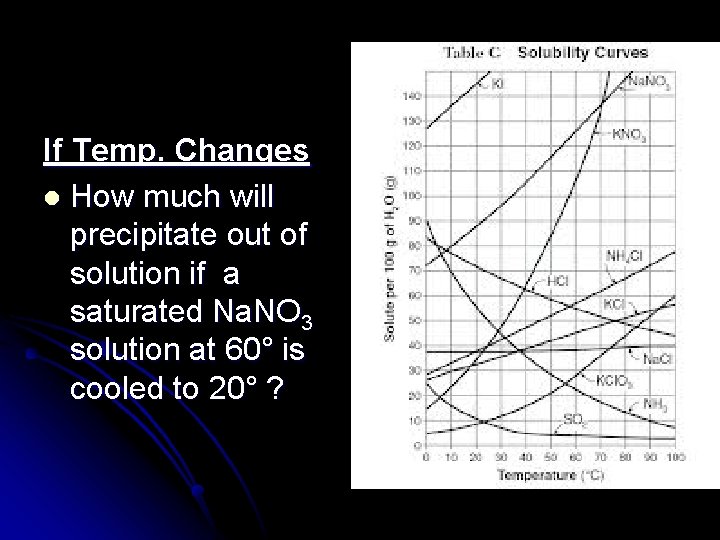
If Temp. Changes l How much will precipitate out of solution if a saturated Na. NO 3 solution at 60° is cooled to 20° ?
Reference Table F l Describes which ionic compounds are soluble or insoluble in water. l Certain combinations of ions hold together so strongly that water cannot dissolve them into solution (insoluble)
l Is this soluble or not? Ca. CO 3 l Carbonate (CO 3 -2) is insoluble and Ca+2 as a partner is not an exception
l Is this soluble or not? Na. NO 3 l Nitrate (NO 3 -1) is always soluble, there are not exceptions
l Is this soluble or not? Li 3 PO 4 l Phosphate (PO 4 -3) is insoluble, however, Li+1 is a Group 1 ion so it is an exception and the compound is soluble.
Soluble or Not? Look out for exceptions! l Ca. SO 4 l Mg. SO 4 l Pb. Cr. O 4 l Li 2 S l NH 4 OH
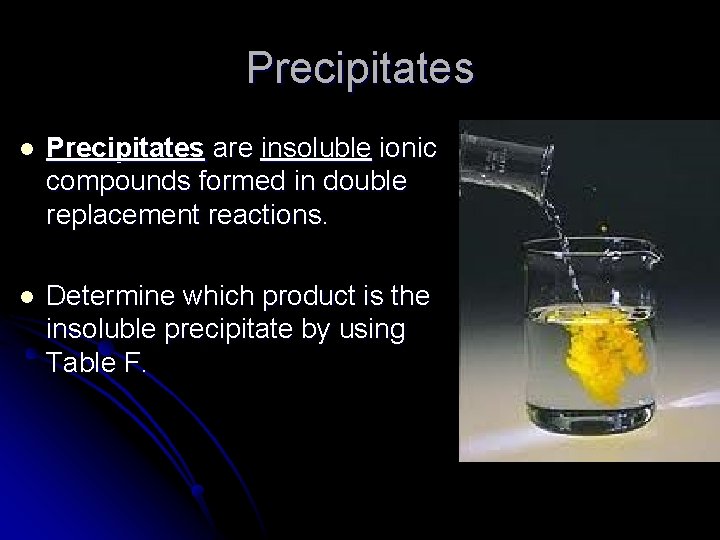
Precipitates l Precipitates are insoluble ionic compounds formed in double replacement reactions. l Determine which product is the insoluble precipitate by using Table F.
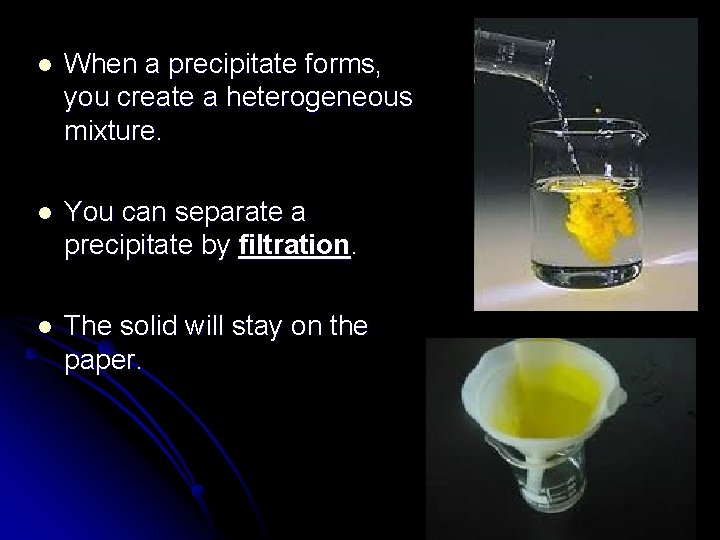
l When a precipitate forms, you create a heterogeneous mixture. l You can separate a precipitate by filtration. l The solid will stay on the paper.
Get Ready! Today’s Agenda l l l Review Prelab Sheet in pairs and as class. Review procedure basics as well as safety issues Divide into groups and get all necessary materials quickly and safely Perform Lab Procedure and Collect Data Clean up Have out: l Prelab Sheet l Solubility of a Salt Lab l Pencil l Calculator
Lesson Frame l What is the solubility of KNO 3 at different temperatures? l How can we construct and interpret a solubility curve? Crystallization of KNO 3 What to look out for: https: //www. youtube. com/watch? v=xr. W 84 ygk. DBg
Lab Groups #1: #2: #3: #4: #5: 1 st person gets goggles 2 nd person gets aprons 3 rd person measures KNO 3 at scale 4 th person gets hot water bath going 5 th person reads procedure out loud to group
- Slides: 39