
COMPONENT RECOVERIES AND PRODUCT PURITIES Separation of components
- Slides: 11
COMPONENT RECOVERIES AND PRODUCT PURITIES Ø Separation of components of a mixture are carried out to effect desired component recovery or product purity. Ø To determine the effectiveness of a separation operation, we need to measure the degree of separation. Ø Separation operations are subject to the conservation of mass. Ø If the separation process is: 1. Steady state. 2. Continuous. 3. No chemical reactions occur. Ch. E 201: Introduction to Chemical Engineering Dr Saad Al-Shahrani
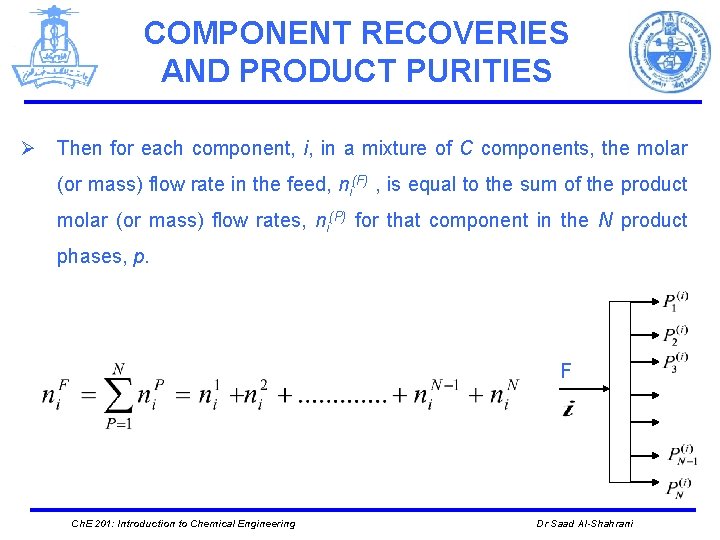
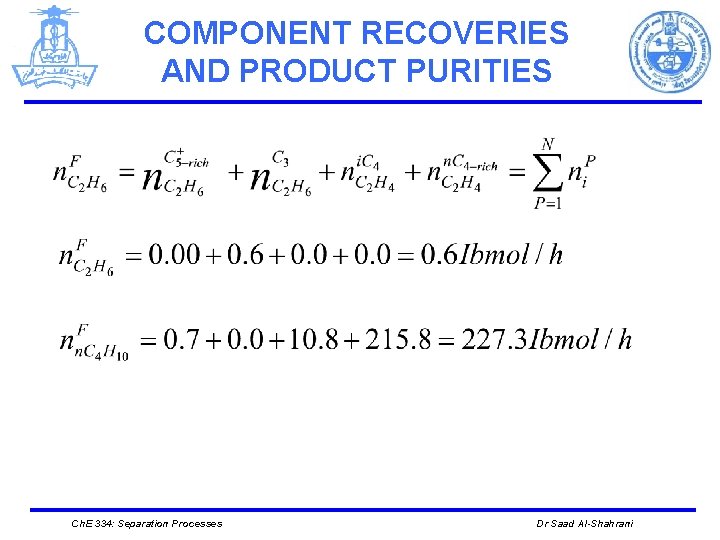
COMPONENT RECOVERIES AND PRODUCT PURITIES Ø Then for each component, i, in a mixture of C components, the molar (or mass) flow rate in the feed, ni(F) , is equal to the sum of the product molar (or mass) flow rates, ni(P) for that component in the N product phases, p. F Ch. E 201: Introduction to Chemical Engineering Dr Saad Al-Shahrani
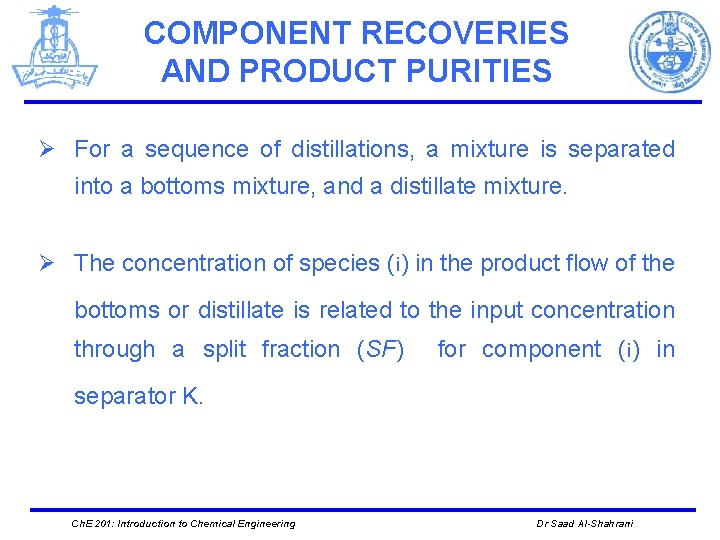
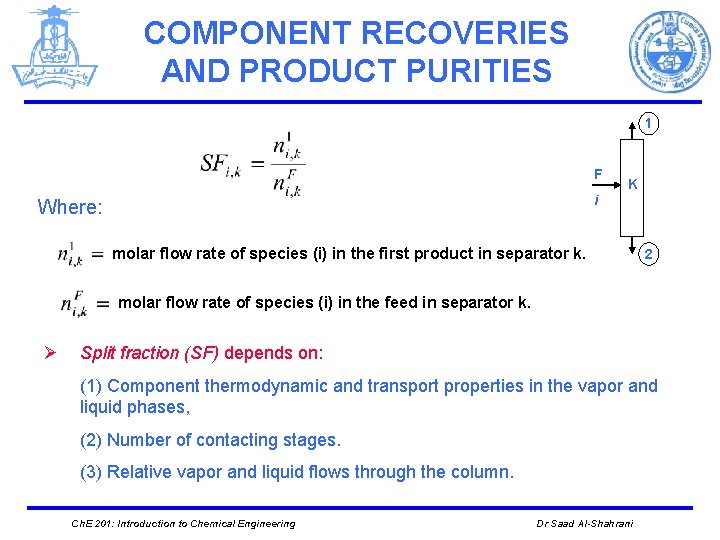
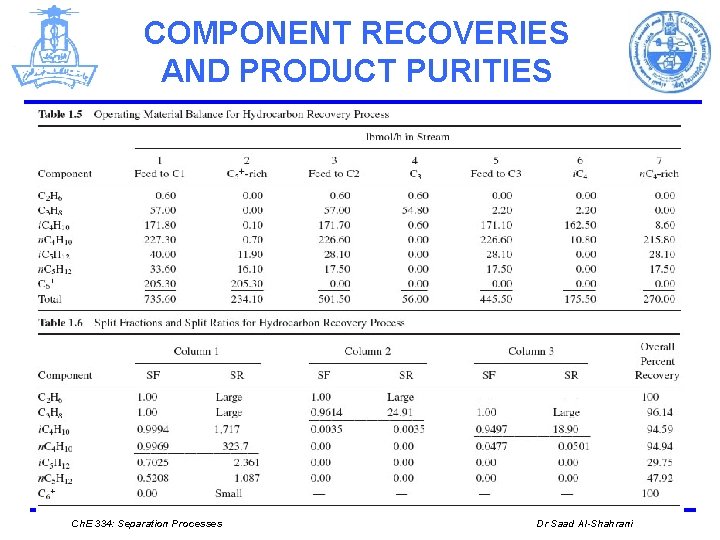
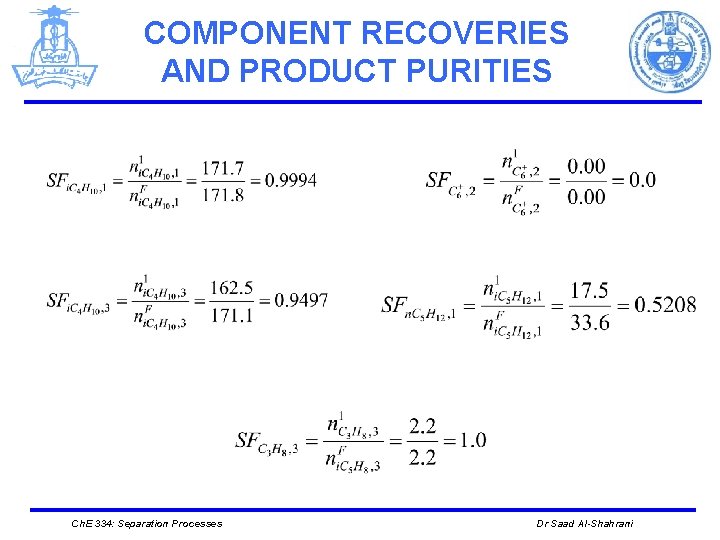
COMPONENT RECOVERIES AND PRODUCT PURITIES Ø For a sequence of distillations, a mixture is separated into a bottoms mixture, and a distillate mixture. Ø The concentration of species (i) in the product flow of the bottoms or distillate is related to the input concentration through a split fraction (SF) for component (i) in separator K. Ch. E 201: Introduction to Chemical Engineering Dr Saad Al-Shahrani
COMPONENT RECOVERIES AND PRODUCT PURITIES 1 F i Where: K molar flow rate of species (i) in the first product in separator k. 2 molar flow rate of species (i) in the feed in separator k. Ø Split fraction (SF) depends on: (1) Component thermodynamic and transport properties in the vapor and liquid phases, (2) Number of contacting stages. (3) Relative vapor and liquid flows through the column. Ch. E 201: Introduction to Chemical Engineering Dr Saad Al-Shahrani
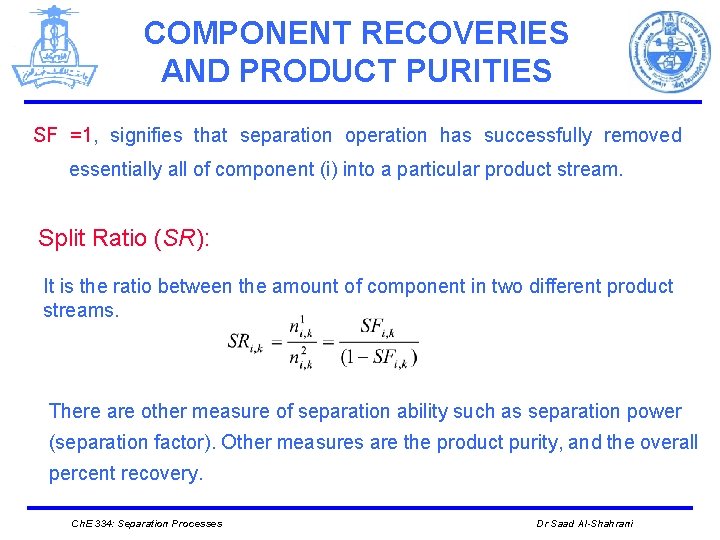
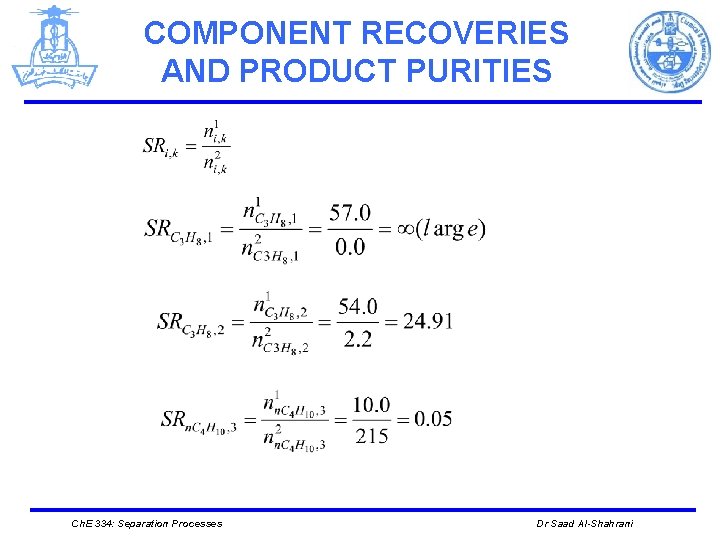
COMPONENT RECOVERIES AND PRODUCT PURITIES SF =1, signifies that separation operation has successfully removed essentially all of component (i) into a particular product stream. Split Ratio (SR): It is the ratio between the amount of component in two different product streams. There are other measure of separation ability such as separation power (separation factor). Other measures are the product purity, and the overall percent recovery. Ch. E 334: Separation Processes Dr Saad Al-Shahrani
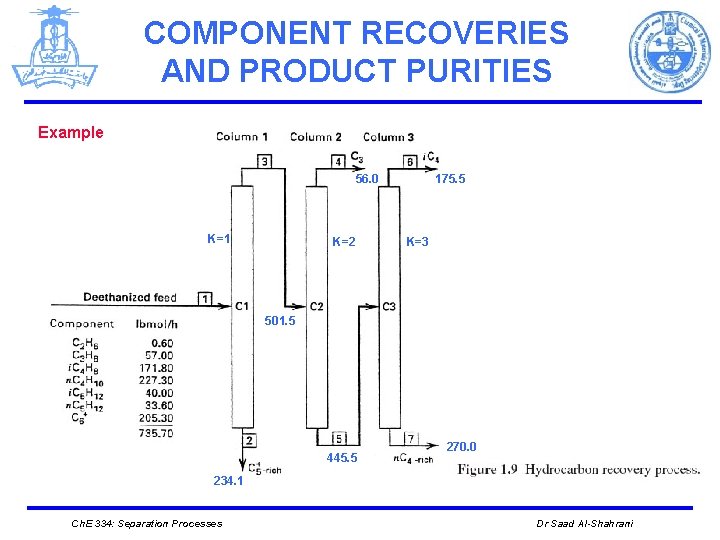
COMPONENT RECOVERIES AND PRODUCT PURITIES Example 56. 0 K=1 K=2 175. 5 K=3 501. 5 445. 5 270. 0 234. 1 Ch. E 334: Separation Processes Dr Saad Al-Shahrani
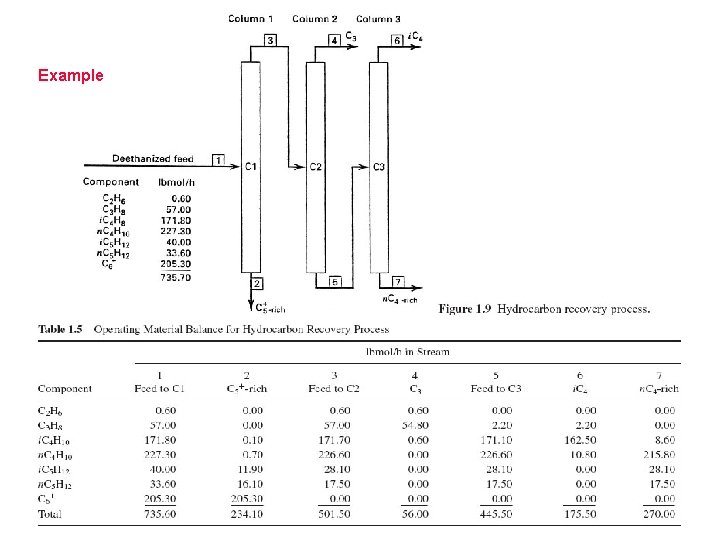
Example
COMPONENT RECOVERIES AND PRODUCT PURITIES Ch. E 334: Separation Processes Dr Saad Al-Shahrani
COMPONENT RECOVERIES AND PRODUCT PURITIES Ch. E 334: Separation Processes Dr Saad Al-Shahrani
COMPONENT RECOVERIES AND PRODUCT PURITIES Ch. E 334: Separation Processes Dr Saad Al-Shahrani
COMPONENT RECOVERIES AND PRODUCT PURITIES Ch. E 334: Separation Processes Dr Saad Al-Shahrani