
Component 8 Core Curriculum Action Plans Core Curriculum
- Slides: 21
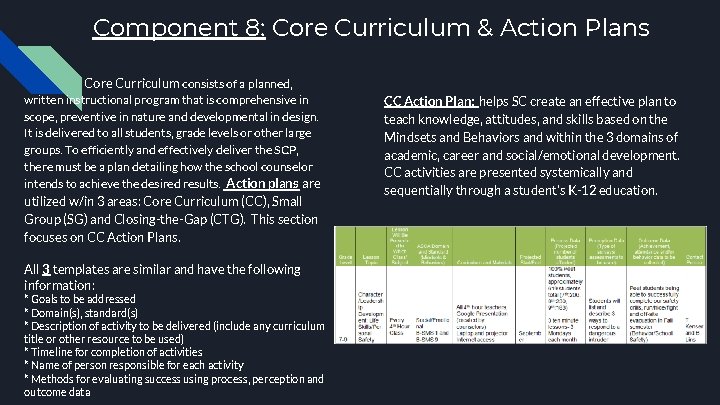
Component 8: Core Curriculum & Action Plans Core Curriculum consists of a planned, written instructional program that is comprehensive in scope, preventive in nature and developmental in design. It is delivered to all students, grade levels or other large groups. To efficiently and effectively deliver the SCP, there must be a plan detailing how the school counselor intends to achieve the desired results. Action plans are utilized w/in 3 areas: Core Curriculum (CC), Small Group (SG) and Closing-the-Gap (CTG). This section focuses on CC Action Plans. All 3 templates are similar and have the following information: * Goals to be addressed * Domain(s), standard(s) * Description of activity to be delivered (include any curriculum title or other resource to be used) * Timeline for completion of activities * Name of person responsible for each activity * Methods for evaluating success using process, perception and outcome data CC Action Plan: helps SC create an effective plan to teach knowledge, attitudes, and skills based on the Mindsets and Behaviors and within the 3 domains of academic, career and social/emotional development. CC activities are presented systemically and sequentially through a student’s K-12 education.
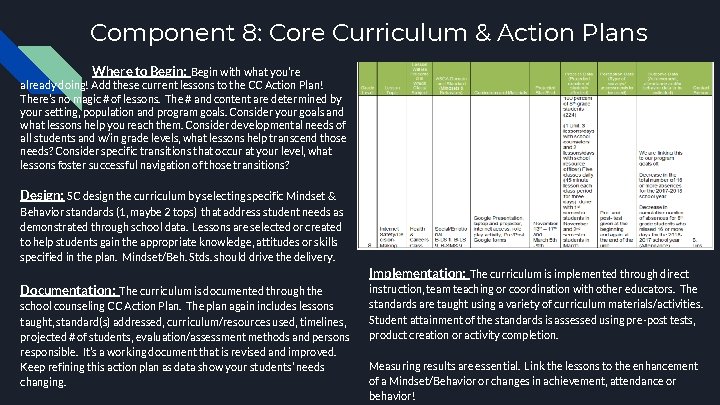
Component 8: Core Curriculum & Action Plans Where to Begin: Begin with what you’re already doing! Add these current lessons to the CC Action Plan! There’s no magic # of lessons. The # and content are determined by your setting, population and program goals. Consider your goals and what lessons help you reach them. Consider developmental needs of all students and w/in grade levels, what lessons help transcend those needs? Consider specific transitions that occur at your level, what lessons foster successful navigation of those transitions? Design: SC design the curriculum by selecting specific Mindset & Behavior standards (1, maybe 2 tops) that address student needs as demonstrated through school data. Lessons are selected or created to help students gain the appropriate knowledge, attitudes or skills specified in the plan. Mindset/Beh. Stds. should drive the delivery. Implementation: The curriculum is implemented through direct Documentation: The curriculum is documented through the school counseling CC Action Plan. The plan again includes lessons taught, standard(s) addressed, curriculum/resources used, timelines, projected # of students, evaluation/assessment methods and persons responsible. It’s a working document that is revised and improved. Keep refining this action plan as data show your students’ needs changing. instruction, team teaching or coordination with other educators. The standards are taught using a variety of curriculum materials/activities. Student attainment of the standards is assessed using pre-post tests, product creation or activity completion. Measuring results are essential. Link the lessons to the enhancement of a Mindset/Behavior or changes in achievement, attendance or behavior!
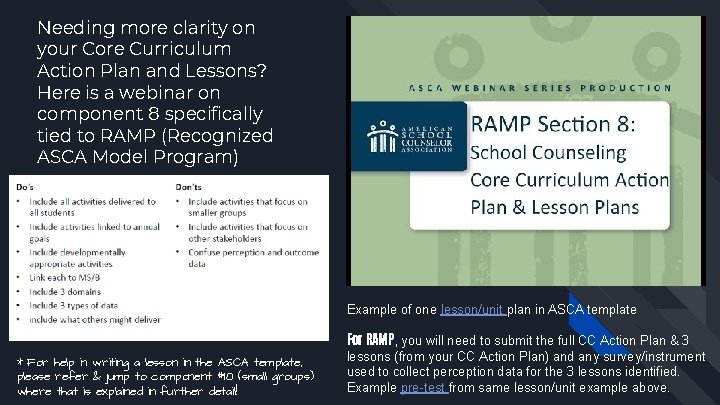
Needing more clarity on your Core Curriculum Action Plan and Lessons? Here is a webinar on component 8 specifically tied to RAMP (Recognized ASCA Model Program) Example of one lesson/unit plan in ASCA template * For help in writing a lesson in the ASCA template, please refer & jump to component #10 (small groups) where that is explained in further detail! For RAMP, you will need to submit the full CC Action Plan & 3 lessons (from your CC Action Plan) and any survey/instrument used to collect perception data for the 3 lessons identified. Example pre-test from same lesson/unit example above.
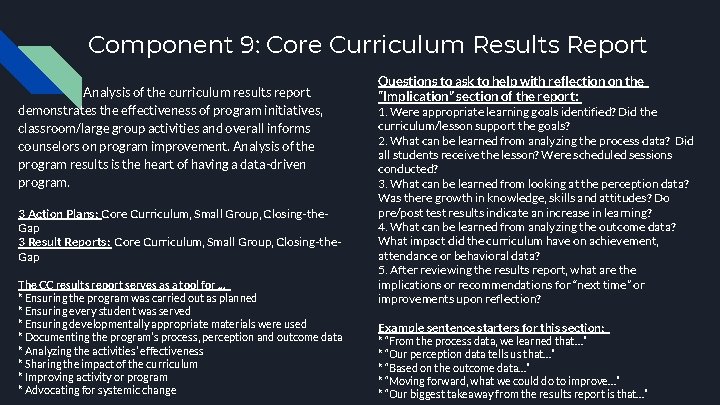
Component 9: Core Curriculum Results Report Analysis of the curriculum results report demonstrates the effectiveness of program initiatives, classroom/large group activities and overall informs counselors on program improvement. Analysis of the program results is the heart of having a data-driven program. 3 Action Plans: Core Curriculum, Small Group, Closing-the. Gap 3 Result Reports: Core Curriculum, Small Group, Closing-the. Gap The CC results report serves as a tool for. . . * Ensuring the program was carried out as planned * Ensuring every student was served * Ensuring developmentally appropriate materials were used * Documenting the program’s process, perception and outcome data * Analyzing the activities’ effectiveness * Sharing the impact of the curriculum * Improving activity or program * Advocating for systemic change Questions to ask to help with reflection on the “Implication” section of the report: 1. Were appropriate learning goals identified? Did the curriculum/lesson support the goals? 2. What can be learned from analyzing the process data? Did all students receive the lesson? Were scheduled sessions conducted? 3. What can be learned from looking at the perception data? Was there growth in knowledge, skills and attitudes? Do pre/post test results indicate an increase in learning? 4. What can be learned from analyzing the outcome data? What impact did the curriculum have on achievement, attendance or behavioral data? 5. After reviewing the results report, what are the implications or recommendations for “next time” or improvements upon reflection? Example sentence starters for this section: * “From the process data, we learned that…” * “Our perception data tells us that…” * “Based on the outcome data…” * “Moving forward, what we could do to improve…” * “Our biggest takeaway from the results report is that…”
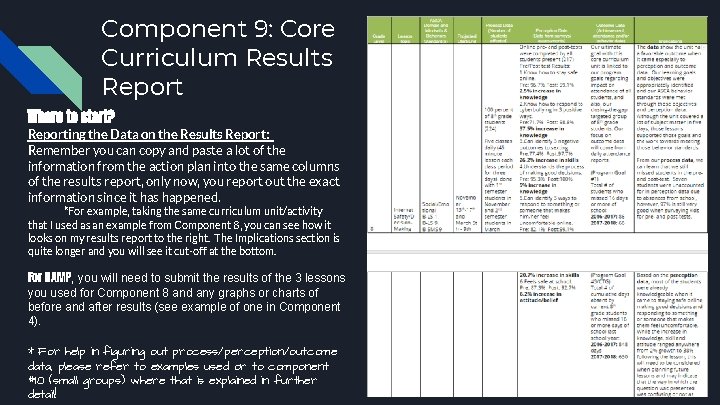
Component 9: Core Curriculum Results Report Where to start? Reporting the Data on the Results Report: Remember you can copy and paste a lot of the information from the action plan into the same columns of the results report, only now, you report out the exact information since it has happened. *For example, taking the same curriculum unit/activity that I used as an example from Component 8, you can see how it looks on my results report to the right. The Implications section is quite longer and you will see it cut-off at the bottom. For RAMP, you will need to submit the results of the 3 lessons you used for Component 8 and any graphs or charts of before and after results (see example of one in Component 4). * For help in figuring out process/perception/outcome data, please refer to examples used or to component #10 (small groups) where that is explained in further detail!
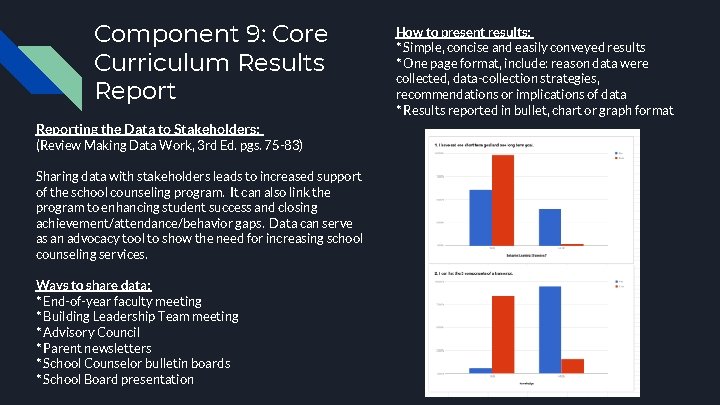
Component 9: Core Curriculum Results Reporting the Data to Stakeholders: (Review Making Data Work, 3 rd Ed. pgs. 75 -83) Sharing data with stakeholders leads to increased support of the school counseling program. It can also link the program to enhancing student success and closing achievement/attendance/behavior gaps. Data can serve as an advocacy tool to show the need for increasing school counseling services. Ways to share data: * End-of-year faculty meeting * Building Leadership Team meeting * Advisory Council * Parent newsletters * School Counselor bulletin boards * School Board presentation How to present results: * Simple, concise and easily conveyed results * One page format, include: reason data were collected, data-collection strategies, recommendations or implications of data * Results reported in bullet, chart or graph format
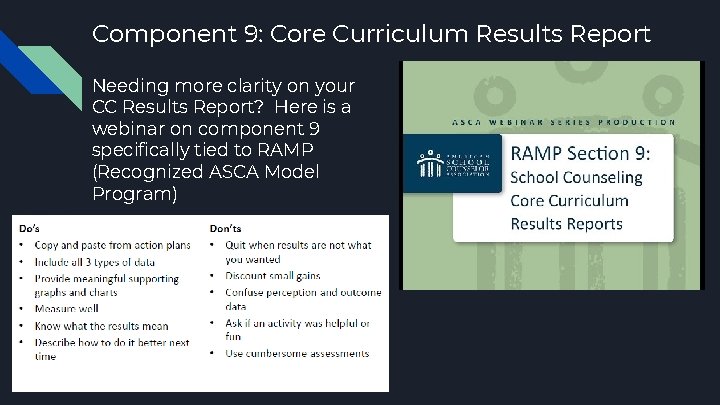
Component 9: Core Curriculum Results Report Needing more clarity on your CC Results Report? Here is a webinar on component 9 specifically tied to RAMP (Recognized ASCA Model Program)
Component 10: Small Groups Small-group counseling is provided as a short-term intervention and typically involves four to eight sessions organized to meet specific prevention or intervention goals. The template assists SC in the design, documentation and implementation of small groups. DESIGN: SC select students for SG based on academic, behavior or attendance needs as reflected in school data. Specific competencies addressing student needs are selected from the ASCA student standards. Lessons or activities are selected or created to help students gain the appropriate knowledge, attitudes or skills. DOCUMENTATION: SG is documented through the SG Action Plan. (not something we need to get into at this time) IMPLEMENTATION: SG implemented using counseling skills and techniques appropriate for the group and a variety of curriculum materials or activities. Student attainment of the competencies is assessed using pre-post tests and success toward reaching the established goals of the group.
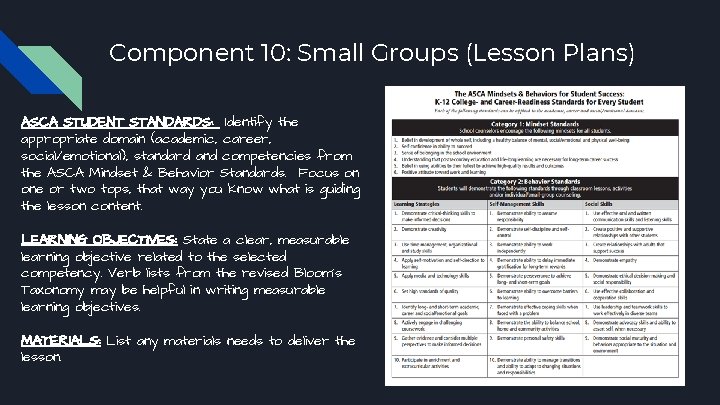
Component 10: Small Groups (Lesson Plans) ASCA STUDENT STANDARDS: Identify the appropriate domain (academic, career, social/emotional), standard and competencies from the ASCA Mindset & Behavior Standards. Focus on one or two tops, that way you know what is guiding the lesson content. LEARNING OBJECTIVES: State a clear, measurable learning objective related to the selected competency. Verb lists from the revised Bloom’s Taxonomy may be helpful in writing measurable learning objectives. MATERIALS: List any materials needs to deliver the lesson.
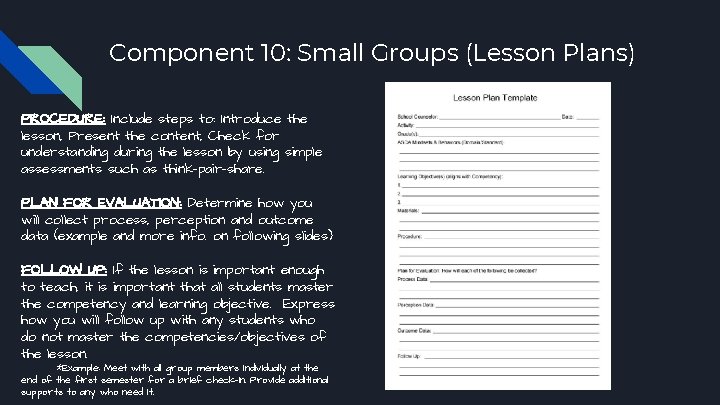
Component 10: Small Groups (Lesson Plans) PROCEDURE: Include steps to: Introduce the lesson, Present the content, Check for understanding during the lesson by using simple assessments such as think-pair-share. PLAN FOR EVALUATION: Determine how you will collect process, perception and outcome data (example and more info. on following slides) FOLLOW UP: If the lesson is important enough to teach, it is important that all students master the competency and learning objective. Express how you will follow up with any students who do not master the competencies/objectives of the lesson. *Example: Meet with all group members individually at the end of the first semester for a brief check-in. Provide additional supports to any who need it.
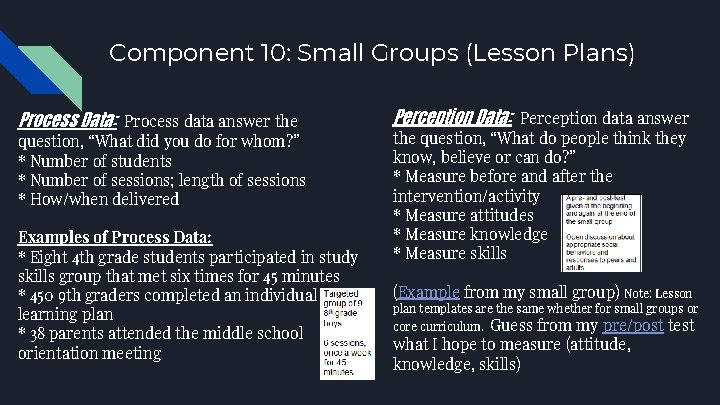
Component 10: Small Groups (Lesson Plans) Process Data: Process data answer the Perception Data: Perception data answer Examples of Process Data: * Eight 4 th grade students participated in study skills group that met six times for 45 minutes * 450 9 th graders completed an individual learning plan * 38 parents attended the middle school orientation meeting (Example from my small group) Note: Lesson question, “What did you do for whom? ” * Number of students * Number of sessions; length of sessions * How/when delivered the question, “What do people think they know, believe or can do? ” * Measure before and after the intervention/activity * Measure attitudes * Measure knowledge * Measure skills plan templates are the same whether for small groups or Guess from my pre/post test what I hope to measure (attitude, knowledge, skills) core curriculum.
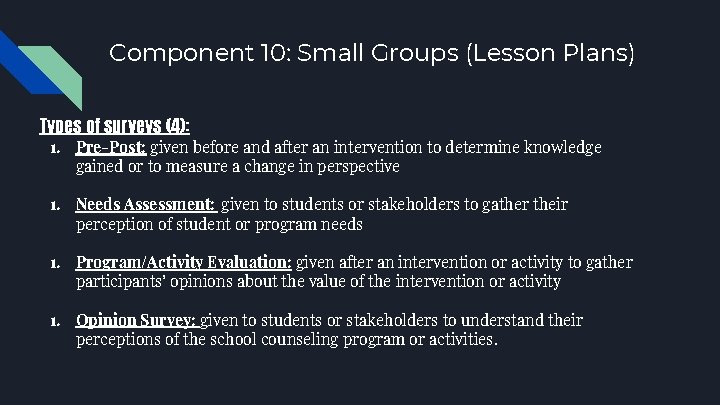
Component 10: Small Groups (Lesson Plans) Types of surveys (4): 1. Pre-Post: given before and after an intervention to determine knowledge gained or to measure a change in perspective 1. Needs Assessment: given to students or stakeholders to gather their perception of student or program needs 1. Program/Activity Evaluation: given after an intervention or activity to gather participants’ opinions about the value of the intervention or activity 1. Opinion Survey: given to students or stakeholders to understand their perceptions of the school counseling program or activities.
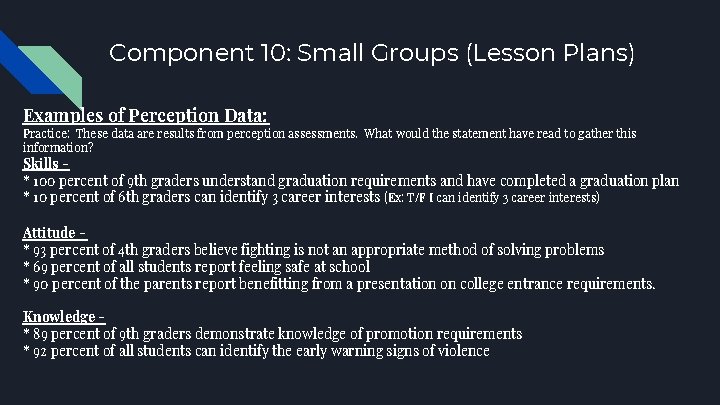
Component 10: Small Groups (Lesson Plans) Examples of Perception Data: Practice: These data are results from perception assessments. What would the statement have read to gather this information? Skills * 100 percent of 9 th graders understand graduation requirements and have completed a graduation plan * 10 percent of 6 th graders can identify 3 career interests (Ex: T/F I can identify 3 career interests) Attitude * 93 percent of 4 th graders believe fighting is not an appropriate method of solving problems * 69 percent of all students report feeling safe at school * 90 percent of the parents report benefitting from a presentation on college entrance requirements. Knowledge * 89 percent of 9 th graders demonstrate knowledge of promotion requirements * 92 percent of all students can identify the early warning signs of violence
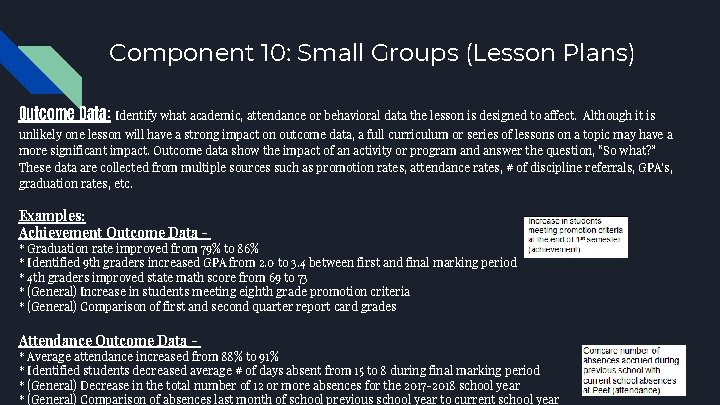
Component 10: Small Groups (Lesson Plans) Outcome Data: Identify what academic, attendance or behavioral data the lesson is designed to affect. Although it is unlikely one lesson will have a strong impact on outcome data, a full curriculum or series of lessons on a topic may have a more significant impact. Outcome data show the impact of an activity or program and answer the question, “So what? ” These data are collected from multiple sources such as promotion rates, attendance rates, # of discipline referrals, GPA’s, graduation rates, etc. Examples: Achievement Outcome Data - * Graduation rate improved from 79% to 86% * Identified 9 th graders increased GPA from 2. 0 to 3. 4 between first and final marking period * 4 th graders improved state math score from 69 to 73 * (General) Increase in students meeting eighth grade promotion criteria * (General) Comparison of first and second quarter report card grades Attendance Outcome Data - * Average attendance increased from 88% to 91% * Identified students decreased average # of days absent from 15 to 8 during final marking period * (General) Decrease in the total number of 12 or more absences for the 2017 -2018 school year * (General) Comparison of absences last month of school previous school year to current school year
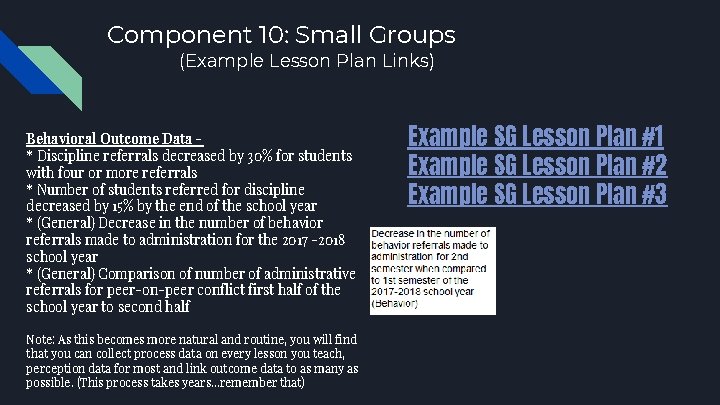
Component 10: Small Groups (Example Lesson Plan Links) Behavioral Outcome Data * Discipline referrals decreased by 30% for students with four or more referrals * Number of students referred for discipline decreased by 15% by the end of the school year * (General) Decrease in the number of behavior referrals made to administration for the 2017 -2018 school year * (General) Comparison of number of administrative referrals for peer-on-peer conflict first half of the school year to second half Note: As this becomes more natural and routine, you will find that you can collect process data on every lesson you teach, perception data for most and link outcome data to as many as possible. (This process takes years. . . remember that) Example SG Lesson Plan #1 Example SG Lesson Plan #2 Example SG Lesson Plan #3
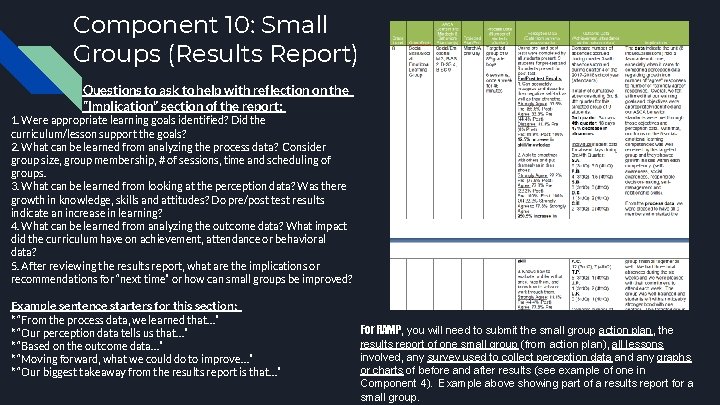
Component 10: Small Groups (Results Report) Questions to ask to help with reflection on the “Implication” section of the report: 1. Were appropriate learning goals identified? Did the curriculum/lesson support the goals? 2. What can be learned from analyzing the process data? Consider group size, group membership, # of sessions, time and scheduling of groups. 3. What can be learned from looking at the perception data? Was there growth in knowledge, skills and attitudes? Do pre/post test results indicate an increase in learning? 4. What can be learned from analyzing the outcome data? What impact did the curriculum have on achievement, attendance or behavioral data? 5. After reviewing the results report, what are the implications or recommendations for “next time” or how can small groups be improved? Example sentence starters for this section: * “From the process data, we learned that…” * “Our perception data tells us that…” * “Based on the outcome data…” * “Moving forward, what we could do to improve…” * “Our biggest takeaway from the results report is that…” For RAMP, you will need to submit the small group action plan, the results report of one small group (from action plan), all lessons involved, any survey used to collect perception data and any graphs or charts of before and after results (see example of one in Component 4). Example above showing part of a results report for a small group.
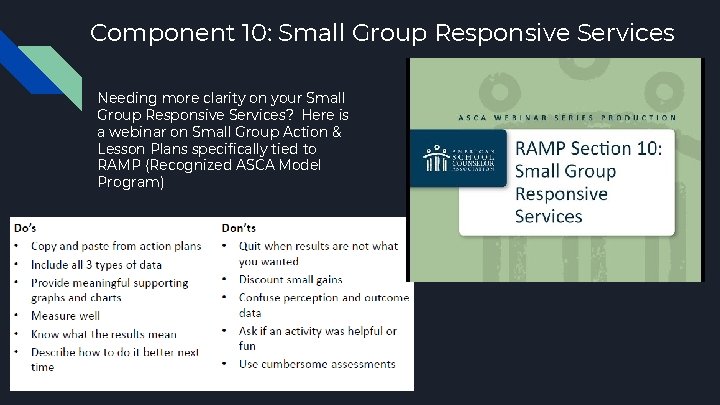
Component 10: Small Group Responsive Services Needing more clarity on your Small Group Responsive Services? Here is a webinar on Small Group Action & Lesson Plans specifically tied to RAMP (Recognized ASCA Model Program)
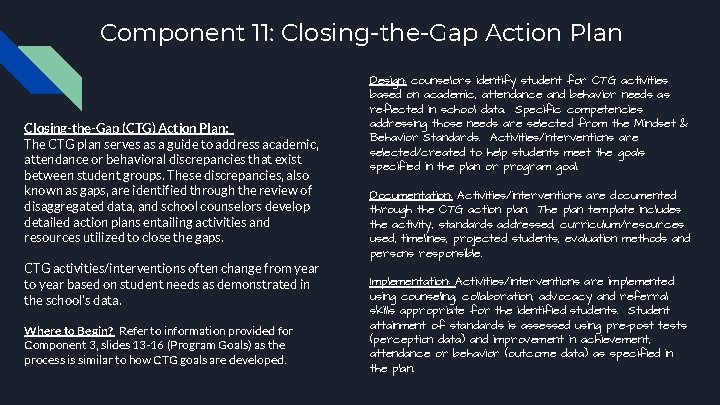
Component 11: Closing-the-Gap Action Plan Closing-the-Gap (CTG) Action Plan: The CTG plan serves as a guide to address academic, attendance or behavioral discrepancies that exist between student groups. These discrepancies, also known as gaps, are identified through the review of disaggregated data, and school counselors develop detailed action plans entailing activities and resources utilized to close the gaps. CTG activities/interventions often change from year to year based on student needs as demonstrated in the school’s data. Where to Begin? Refer to information provided for Component 3, slides 13 -16 (Program Goals) as the process is similar to how CTG goals are developed. Design: counselors identify student for CTG activities based on academic, attendance and behavior needs as reflected in school data. Specific competencies addressing those needs are selected from the Mindset & Behavior Standards. Activities/interventions are selected/created to help students meet the goals specified in the plan or program goal. Documentation: Activities/interventions are documented through the CTG action plan. The plan template includes the activity, standards addressed, curriculum/resources used, timelines, projected students, evaluation methods and persons responsible. Implementation: Activities/interventions are implemented using counseling, collaboration, advocacy and referral skills appropriate for the identified students. Student attainment of standards is assessed using pre-post tests (perception data) and improvement in achievement, attendance or behavior (outcome data) as specified in the plan.
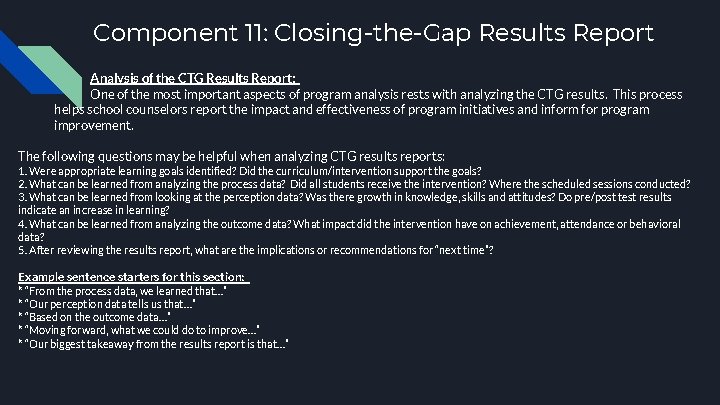
Component 11: Closing-the-Gap Results Report Analysis of the CTG Results Report: One of the most important aspects of program analysis rests with analyzing the CTG results. This process helps school counselors report the impact and effectiveness of program initiatives and inform for program improvement. The following questions may be helpful when analyzing CTG results reports: 1. Were appropriate learning goals identified? Did the curriculum/intervention support the goals? 2. What can be learned from analyzing the process data? Did all students receive the intervention? Where the scheduled sessions conducted? 3. What can be learned from looking at the perception data? Was there growth in knowledge, skills and attitudes? Do pre/post test results indicate an increase in learning? 4. What can be learned from analyzing the outcome data? What impact did the intervention have on achievement, attendance or behavioral data? 5. After reviewing the results report, what are the implications or recommendations for “next time”? Example sentence starters for this section: * “From the process data, we learned that…” * “Our perception data tells us that…” * “Based on the outcome data…” * “Moving forward, what we could do to improve…” * “Our biggest takeaway from the results report is that…”
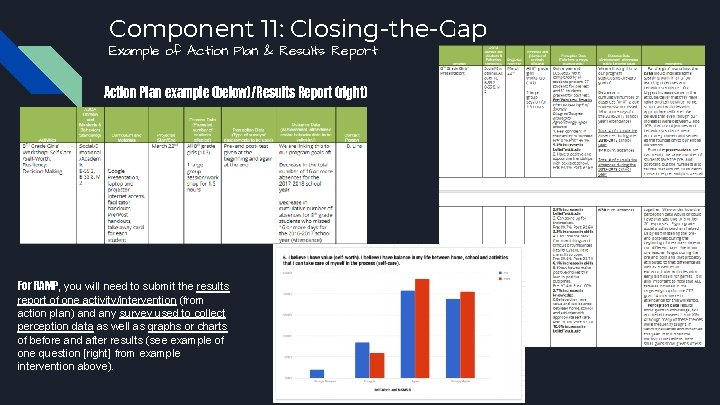
Component 11: Closing-the-Gap Example of Action Plan & Results Report Action Plan example (below)/Results Report (right) For RAMP, you will need to submit the results report of one activity/intervention (from action plan) and any survey used to collect perception data as well as graphs or charts of before and after results (see example of one question [right] from example intervention above).
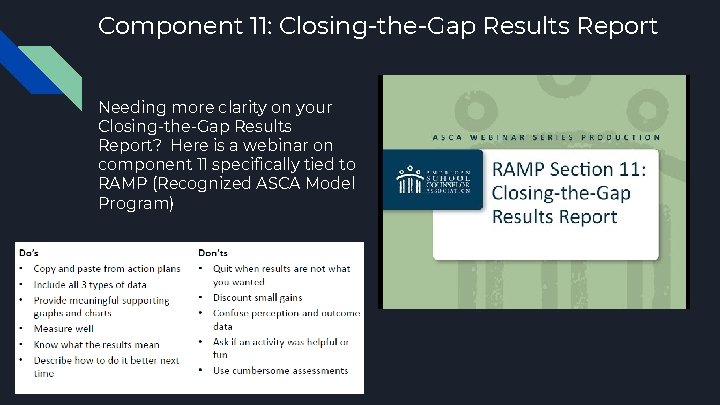
Component 11: Closing-the-Gap Results Report Needing more clarity on your Closing-the-Gap Results Report? Here is a webinar on component 11 specifically tied to RAMP (Recognized ASCA Model Program)