
Component 4 Introduction to Information and Computer Science

- Slides: 25
Component 4: Introduction to Information and Computer Science Unit 6: Databases and SQL Lecture 4 This material was developed by Oregon Health & Science University, funded by the Department of Health and Human Services, Office of the National Coordinator for Health Information Technology under Award Number IU 24 OC 000015.
Topic IV: Design a Simple Relational Database using Data Modeling and Normalization • Description and Information Gathering • Data Model • Normalization, Functional Dependencies and Constraints • Final design, Relationships, Primary keys and Foreign keys Component 4/Unit 6 -4 Health IT Workforce Curriculum Version 2. 0/Spring 2011 2
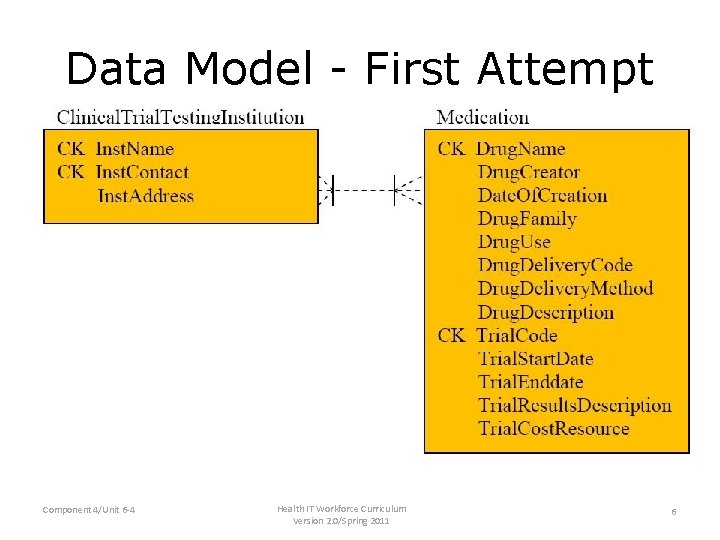
Description of Database • Keep track of new medications that are in trial testing. • Keep track of the medications, the trials for those medications and the clinical institutions doing the testing. Component 4/Unit 6 -4 Health IT Workforce Curriculum Version 2. 0/Spring 2011 3
Information Gathering • Through meetings with users and looking at forms and reports it was determined that certain data about a clinical institution needed to be kept in the data base. – Name of the institution – Address – Contact information Component 4/Unit 6 -4 Health IT Workforce Curriculum Version 2. 0/Spring 2011 4
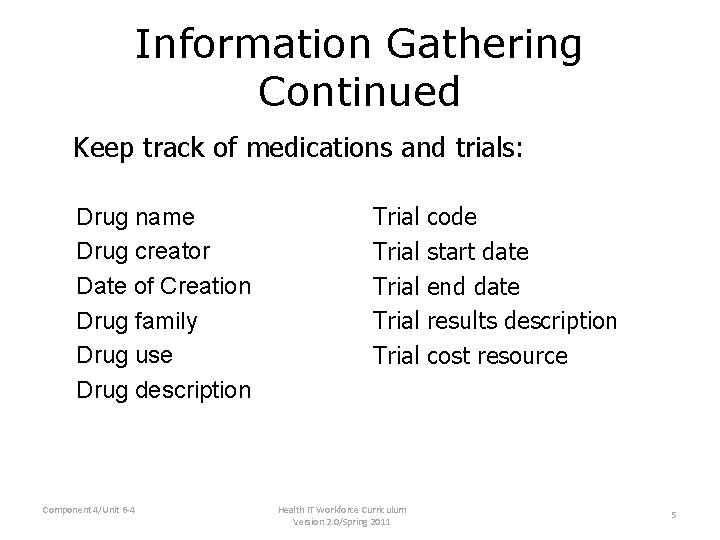
Information Gathering Continued Keep track of medications and trials: Drug name Drug creator Date of Creation Drug family Drug use Drug description Component 4/Unit 6 -4 Trial Trial Health IT Workforce Curriculum Version 2. 0/Spring 2011 code start date end date results description cost resource 5
Data Model - First Attempt Component 4/Unit 6 -4 Health IT Workforce Curriculum Version 2. 0/Spring 2011 6
Normalization • A database is normalized to eliminate data anomalies: Insert, Delete, Update • Functional dependencies • Constraints – Data rules that must be followed • Referential Integrity Constraint Component 4/Unit 6 -4 Health IT Workforce Curriculum Version 2. 0/Spring 2011 7
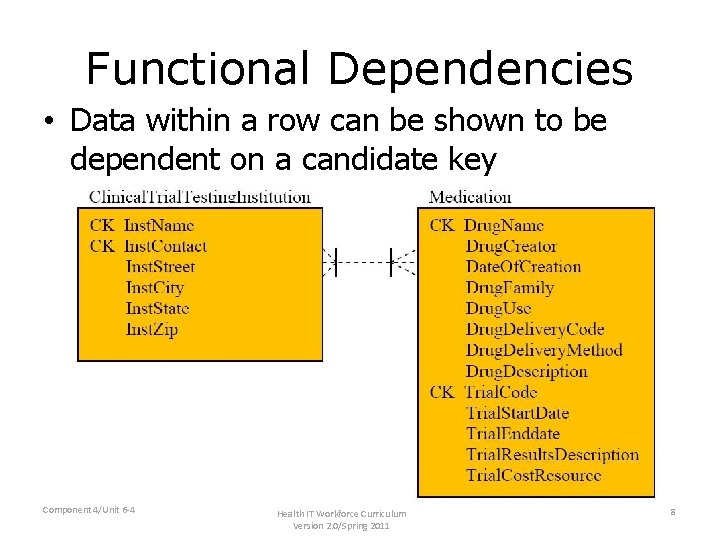
Functional Dependencies • Data within a row can be shown to be dependent on a candidate key Component 4/Unit 6 -4 Health IT Workforce Curriculum Version 2. 0/Spring 2011 8
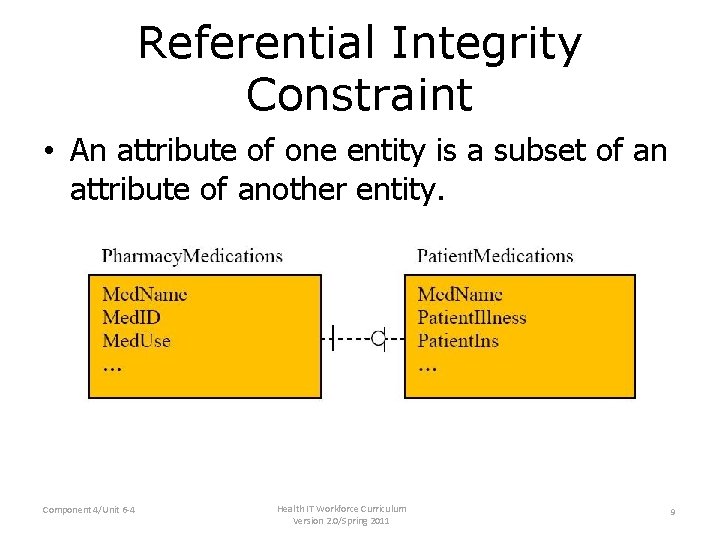
Referential Integrity Constraint • An attribute of one entity is a subset of an attribute of another entity. Component 4/Unit 6 -4 Health IT Workforce Curriculum Version 2. 0/Spring 2011 9
First Normal Form (1 NF) • Definition of a relation – Data rows within an entity must be unique and connected describe an instance of the entity (no data in a relation that is associated with something else). – Columns (attributes) are uniquely named, are of the same data type and will contain only one value. – The order of rows and columns is not important. Component 4/Unit 6 -4 Health IT Workforce Curriculum Version 2. 0/Spring 2011 10
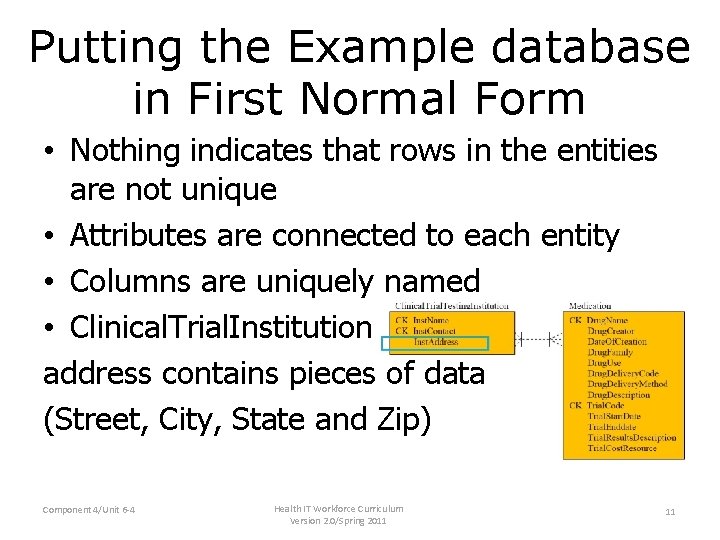
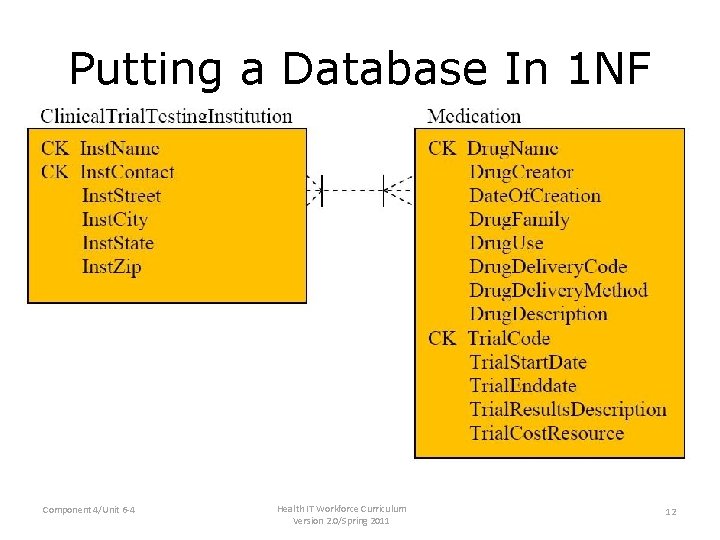
Putting the Example database in First Normal Form • Nothing indicates that rows in the entities are not unique • Attributes are connected to each entity • Columns are uniquely named • Clinical. Trial. Institution address contains pieces of data (Street, City, State and Zip) Component 4/Unit 6 -4 Health IT Workforce Curriculum Version 2. 0/Spring 2011 11
Putting a Database In 1 NF Component 4/Unit 6 -4 Health IT Workforce Curriculum Version 2. 0/Spring 2011 12
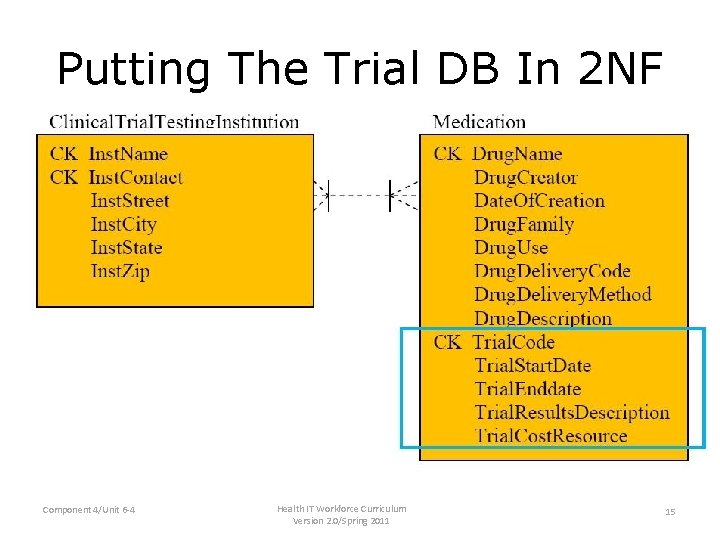
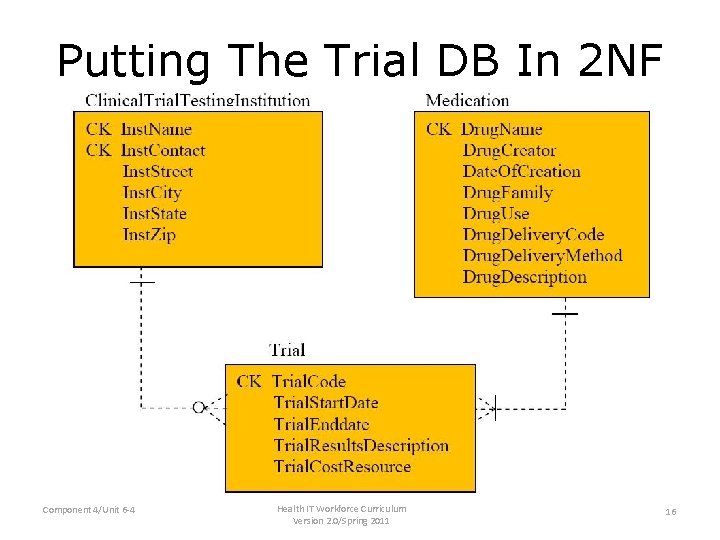
Second Normal Form (2 NF) • 2 NF eliminates deletion and insertion anomalies that are due to having an attribute or attributes dependent on something other than the key. • This is especially true for composite keys. • To be in second normal form attributes must be dependent on the whole key. Component 4/Unit 6 -4 Health IT Workforce Curriculum Version 2. 0/Spring 2011 13
Second Normal Form Continued • A relation is in 2 NF if all its non-key attributes are dependent on the entire key. • A relation in 2 NF must also be in 1 NF. Component 4/Unit 6 -4 Health IT Workforce Curriculum Version 2. 0/Spring 2011 14
Putting The Trial DB In 2 NF Component 4/Unit 6 -4 Health IT Workforce Curriculum Version 2. 0/Spring 2011 15
Putting The Trial DB In 2 NF Component 4/Unit 6 -4 Health IT Workforce Curriculum Version 2. 0/Spring 2011 16
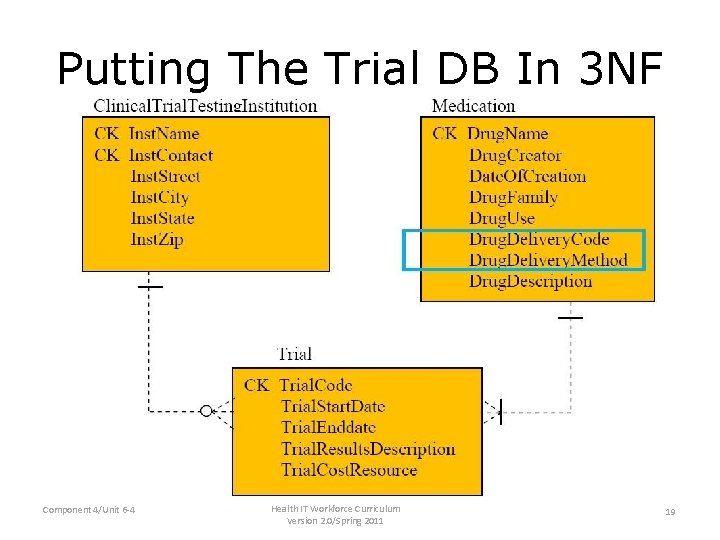
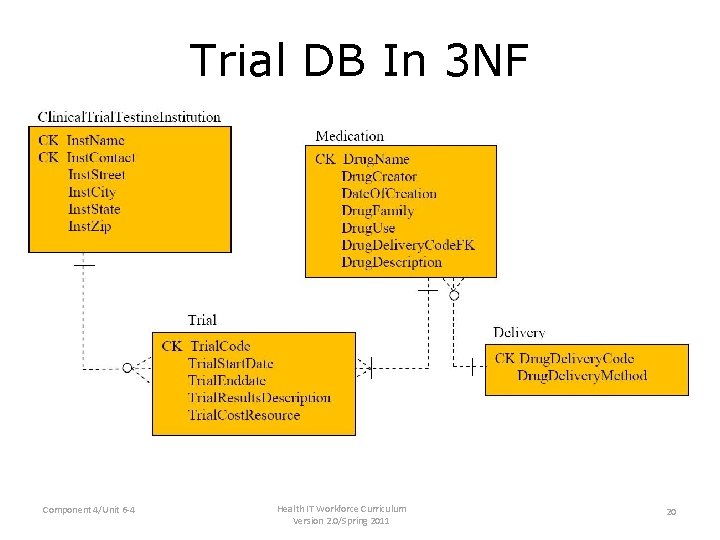
Third Normal Form (3 NF) • 3 NF eliminates deletion and insertion anomalies that are due to having an indirect dependency where an attribute is indirectly dependent on the key • The attribute is directly dependent on an attribute that is dependent on the key • The indirect dependency on the key is called a transitive dependency Component 4/Unit 6 -4 Health IT Workforce Curriculum Version 2. 0/Spring 2011 17
Third Normal Form Continued • A database is said to be 3 NF if there are no transitive dependencies • A database in 3 NF must also be in 2 NF and 1 NF • Many Database Administrators (DBAs) consider 3 NF to be sufficient for most business and health care databases. • Putting the database in a higher level of normalization may make the database less efficient. Component 4/Unit 6 -4 Health IT Workforce Curriculum Version 2. 0/Spring 2011 18
Putting The Trial DB In 3 NF Component 4/Unit 6 -4 Health IT Workforce Curriculum Version 2. 0/Spring 2011 19
Trial DB In 3 NF Component 4/Unit 6 -4 Health IT Workforce Curriculum Version 2. 0/Spring 2011 20
Other Normal Forms • DBAs troubleshoot problems and on occasion will use normal forms beyond 3 NF. • A database can be de-normalized to solve some slow response problems. • Boyce-Codd Normal Form (BCNF) – A determinant is an attribute that determines another attribute – A database is in Boyce-Codd form if every determinant is a candidate key Component 4/Unit 6 -4 Health IT Workforce Curriculum Version 2. 0/Spring 2011 21
Other Normal Forms • Fourth Normal Form (4 NF) – This situation is rare – A multi-value dependency exists when there a minimum of three attributes, two of the attributes are multi-valued and the values of the two multi-value attributes depend only on a 3 rd attribute. – 4 NF fixes an update anomaly that involves a multi-value dependency – A database is in 4 NF when there are no multivalue dependencies Component 4/Unit 6 -4 Health IT Workforce Curriculum Version 2. 0/Spring 2011 22
Other Normal Forms • Fifth Normal Form (5 NF) or Project-Join Normal Form (PJNF) – Extremely rare – Generalization of multi-valued dependencies – Difficult to deal with • Domain Key Normal Form (DKNF) – Generalization of other non-time constraints – Difficult to deal with Component 4/Unit 6 -4 Health IT Workforce Curriculum Version 2. 0/Spring 2011 23
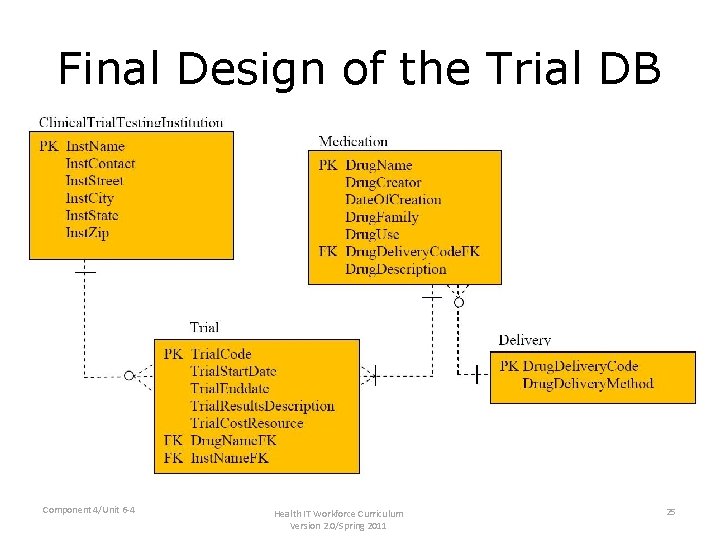
Evolution of the Data Model • Data model progresses from being volatile with many changes to a database design with little change or surprises • In the final design, entities become tables, relationships show minimum and maximum cardinality and primary/foreign keys are chosen Component 4/Unit 6 -4 Health IT Workforce Curriculum Version 2. 0/Spring 2011 24
Final Design of the Trial DB Component 4/Unit 6 -4 Health IT Workforce Curriculum Version 2. 0/Spring 2011 25