
Component 4 Introduction to Information and Computer Science
- Slides: 25
Component 4: Introduction to Information and Computer Science Unit 6: Databases and SQL Lecture 2 This material was developed by Oregon Health & Science University, funded by the Department of Health and Human Services, Office of the National Coordinator for Health Information Technology under Award Number IU 24 OC 000015.
Topic II Relational Databases • • • Keys and relationships Data modeling Database acquisition Database Management System (DBMS) Database development Component 4/Unit 6 -2 Health IT Workforce Curriculum Version 2. 0/Spring 2011 2
Connecting Data • Relationships • Candidate keys • Primary keys – Natural keys – Surrogate keys • Foreign keys Component 4/Unit 6 -2 Health IT Workforce Curriculum Version 2. 0/Spring 2011 3
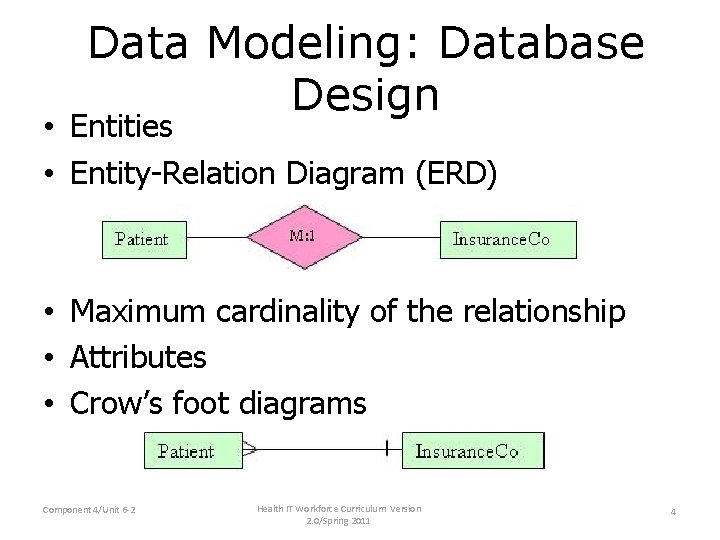
Data Modeling: Database Design • Entities • Entity-Relation Diagram (ERD) • Maximum cardinality of the relationship • Attributes • Crow’s foot diagrams Component 4/Unit 6 -2 Health IT Workforce Curriculum Version 2. 0/Spring 2011 4
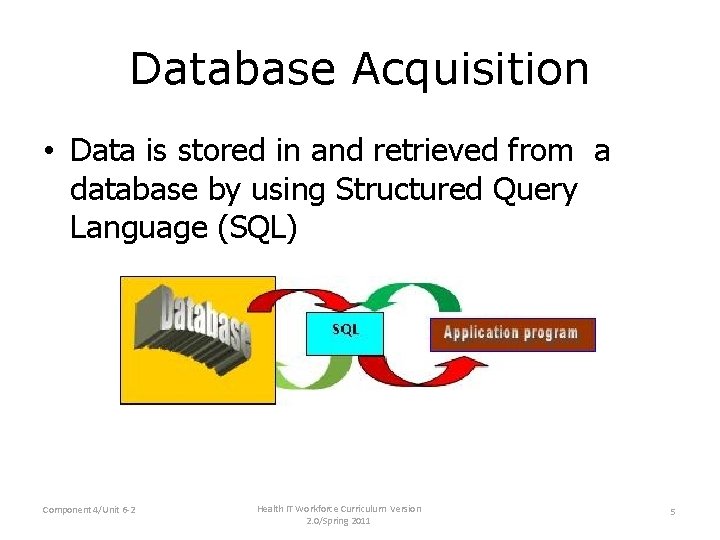
Database Acquisition • Data is stored in and retrieved from a database by using Structured Query Language (SQL) Component 4/Unit 6 -2 Health IT Workforce Curriculum Version 2. 0/Spring 2011 5
The Database Management System (DBMS) • • Metadata Administration of the database Carries out SQL statements and procedures Stored procedures Triggers Security (permissions) Handles processing problems Carries out backup & restore/recovery Component 4/Unit 6 -2 Health IT Workforce Curriculum Version 2. 0/Spring 2011 6
Database Development • From scratch – Existing data – Data model eventually becomes DB design – Merge existing databases • Modification of existing database – Most databases have already been developed Component 4/Unit 6 -2 Health IT Workforce Curriculum Version 2. 0/Spring 2011 7
Phases of Database Development 1. Gathering specifications 2. Design – Data modeling to database design 3. 4. 5. 6. Testing Implementation Maintenance Modification (starts process all over again) Component 4/Unit 6 -2 Health IT Workforce Curriculum Version 2. 0/Spring 2011 8
Gathering Specifications • Attribute domains – Data type, length, legitimate values • • • Business rules Input from users Forms and reports Existing files Outcome of this phase is a beginning data model Component 4/Unit 6 -2 Health IT Workforce Curriculum Version 2. 0/Spring 2011 9
Design • More definitive specifications are gathered • The data model is perfected toward the database design • Entities become tables • Attributes are added subtracted as needed • Candidate keys are identified and finally primary keys are chosen • Relationships are indicated with the addition of foreign keys Component 4/Unit 6 -2 Health IT Workforce Curriculum Version 2. 0/Spring 2011 10
Multiple Views of the Database • Each user will have a different need/view of the database • Forms, files and reports will all be of different views of the database • All views of the database need to be resolved into the data model. The data model will not look like any one of the views. Component 4/Unit 6 -2 Health IT Workforce Curriculum Version 2. 0/Spring 2011 11
Testing • First evaluate design • Confirm that data model contains all the information that users will need – Converse with users – Show them data model – Express “known” facts to users • Users can make objections Component 4/Unit 6 -2 Health IT Workforce Curriculum Version 2. 0/Spring 2011 12
Implementation • Database is created • Tables are created with attributes, primary and foreign keys • Business rules are carried out – Stored procedures – Triggers – Built-in DBMS features Component 4/Unit 6 -2 Health IT Workforce Curriculum Version 2. 0/Spring 2011 13
DBMS Restrictions • The database design may have to be adjusted to meet with any DBMS or computer system restrictions. Component 4/Unit 6 -2 Health IT Workforce Curriculum Version 2. 0/Spring 2011 14
Testing Again • The database is populated with real and/or test data • SQL is written that accommodates what the users have requested and the SQL is run against the database • Bad results means that the database must be changed. This can mean going all the way back to the design phase or it could be something more elementary. Component 4/Unit 6 -2 Health IT Workforce Curriculum Version 2. 0/Spring 2011 15
Entity-Relationship Model • ER model (Peter Chen, 1976) • Extended ER model • Information Engineering (IE)(James Martin, 1990) or Crow’s foot version of ER Model • Integrated Definition 1, Extended Version (IDEF 1 X) – government standard • National Institute of STDs and Technology (NIST) 1993 • Unified Modeling Language (UML) Component 4/Unit 6 -2 Health IT Workforce Curriculum Version 2. 0/Spring 2011 16
Entities • Potential table • Things that the user needs to keep track of – People, places, things, activities, documents • Object Classes (idea) – An occurrence or individual is an instance of an entity class Component 4/Unit 6 -2 Health IT Workforce Curriculum Version 2. 0/Spring 2011 17
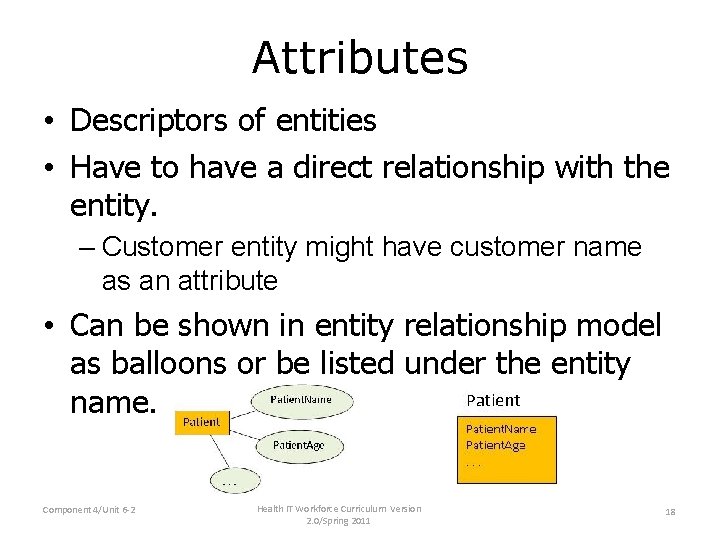
Attributes • Descriptors of entities • Have to have a direct relationship with the entity. – Customer entity might have customer name as an attribute • Can be shown in entity relationship model as balloons or be listed under the entity name. Component 4/Unit 6 -2 Health IT Workforce Curriculum Version 2. 0/Spring 2011 18
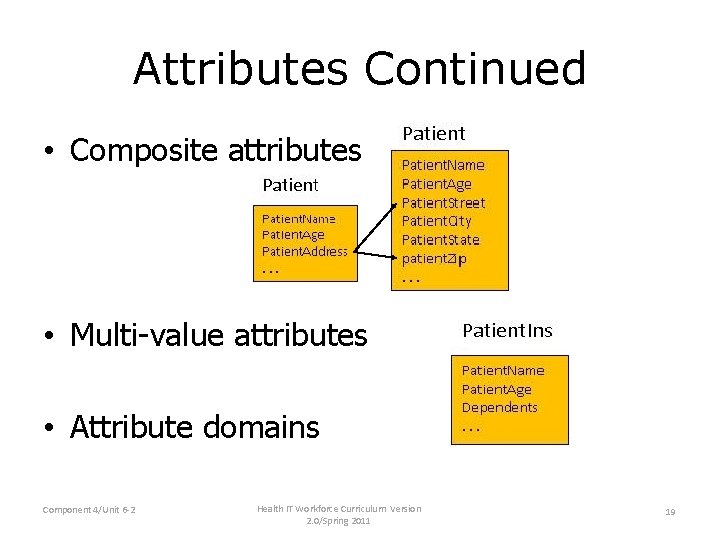
Attributes Continued • Composite attributes • Multi-value attributes • Attribute domains Component 4/Unit 6 -2 Health IT Workforce Curriculum Version 2. 0/Spring 2011 19
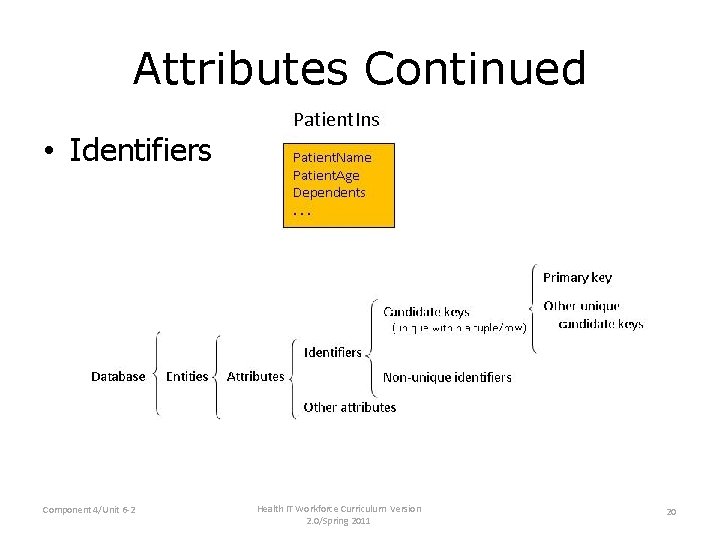
Attributes Continued • Identifiers Component 4/Unit 6 -2 Health IT Workforce Curriculum Version 2. 0/Spring 2011 20
Primary Keys • Primary key uniquely defines a record: – It must be unique within the table column – Composite keys consist of two or more columns – It’s more efficient if it’s short and numeric – Value should never change • Natural vs. surrogate primary keys – A natural primary key is something that the user is familiar with and/or is readily available. Component 4/Unit 6 -2 Health IT Workforce Curriculum Version 2. 0/Spring 2011 21
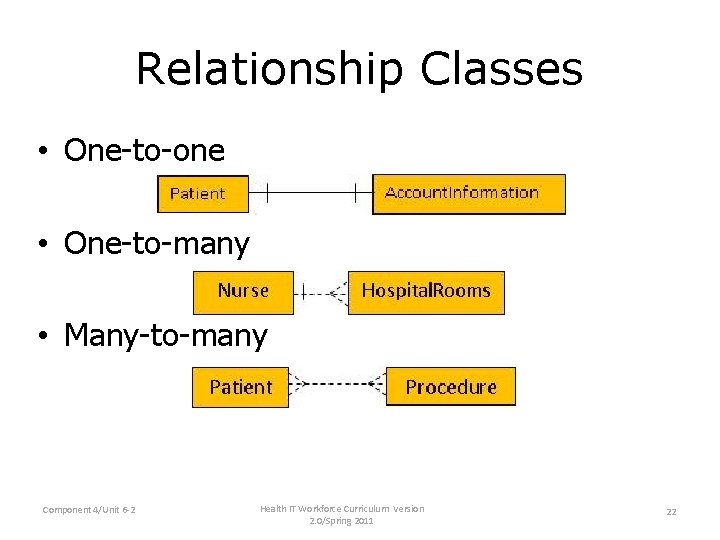
Relationship Classes • One-to-one • One-to-many • Many-to-many Component 4/Unit 6 -2 Health IT Workforce Curriculum Version 2. 0/Spring 2011 22
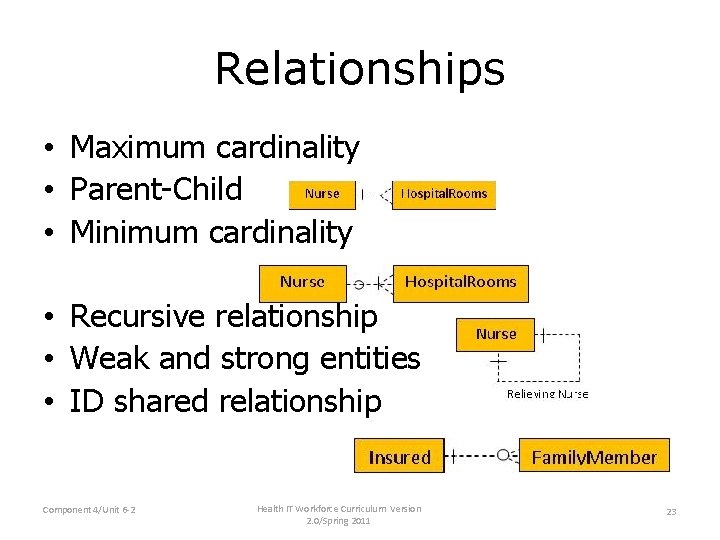
Relationships • Maximum cardinality • Parent-Child • Minimum cardinality • Recursive relationship • Weak and strong entities • ID shared relationship Component 4/Unit 6 -2 Health IT Workforce Curriculum Version 2. 0/Spring 2011 23
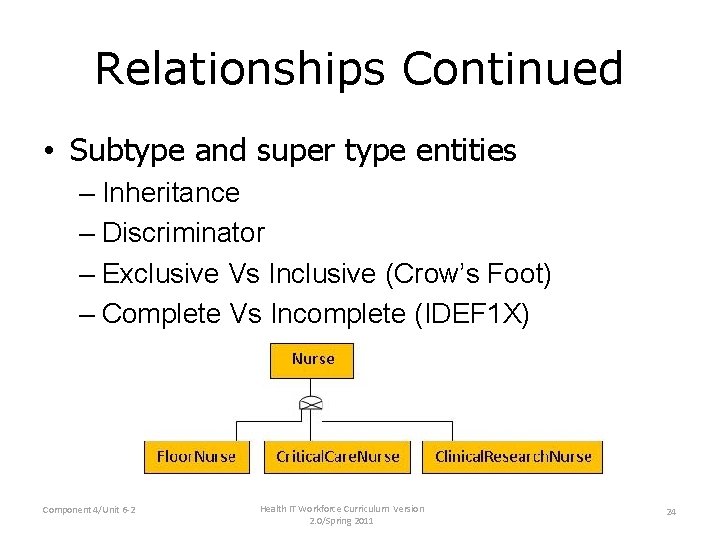
Relationships Continued • Subtype and super type entities – Inheritance – Discriminator – Exclusive Vs Inclusive (Crow’s Foot) – Complete Vs Incomplete (IDEF 1 X) Component 4/Unit 6 -2 Health IT Workforce Curriculum Version 2. 0/Spring 2011 24
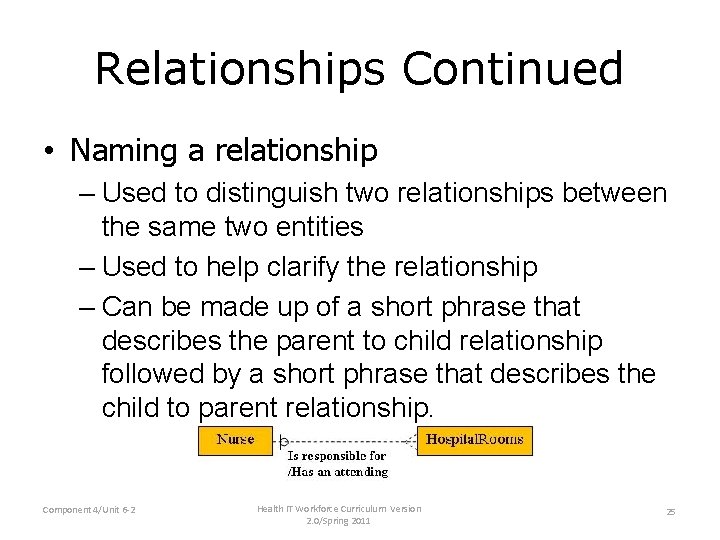
Relationships Continued • Naming a relationship – Used to distinguish two relationships between the same two entities – Used to help clarify the relationship – Can be made up of a short phrase that describes the parent to child relationship followed by a short phrase that describes the child to parent relationship. Component 4/Unit 6 -2 Health IT Workforce Curriculum Version 2. 0/Spring 2011 25