
Component 1 Devising Theatre HOW DO I PRODUCE
- Slides: 17
Component 1: Devising Theatre HOW DO I PRODUCE A PORTFOLIO OF SUPPORTING EVIDENCE?
THE PORTFOLIO �You must produce a portfolio of supporting evidence which demonstrates the research, creation and development of ideas. �This is a working record and therefore should be compiled during the process. �The evidence should focus on three stages which are significant to the development of the devised piece of theatre.
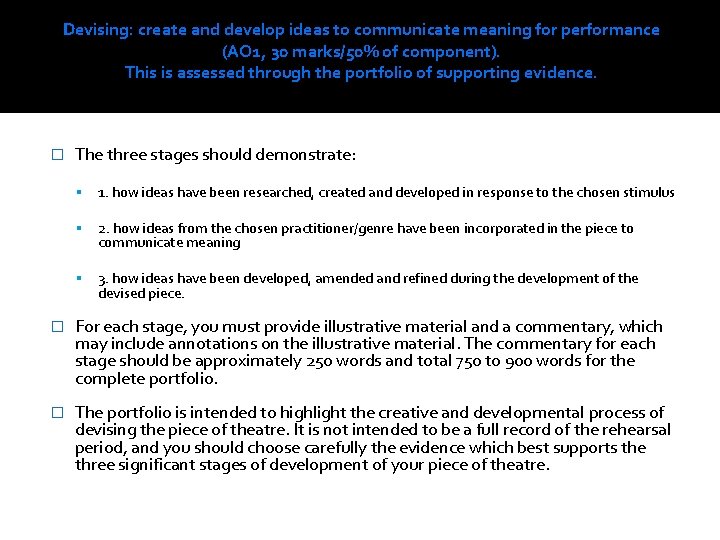
Devising: create and develop ideas to communicate meaning for performance (AO 1, 30 marks/50% of component). This is assessed through the portfolio of supporting evidence. � The three stages should demonstrate: 1. how ideas have been researched, created and developed in response to the chosen stimulus 2. how ideas from the chosen practitioner/genre have been incorporated in the piece to communicate meaning 3. how ideas have been developed, amended and refined during the development of the devised piece. � For each stage, you must provide illustrative material and a commentary, which may include annotations on the illustrative material. The commentary for each stage should be approximately 250 words and total 750 to 900 words for the complete portfolio. � The portfolio is intended to highlight the creative and developmental process of devising the piece of theatre. It is not intended to be a full record of the rehearsal period, and you should choose carefully the evidence which best supports the three significant stages of development of your piece of theatre.
PORTFOLIO OF SUPPORTING EVIDENCE �What is meant by supporting evidence? Well, evidence to demonstrate the research, creation and development of ideas during the process of devising your scene. �Although it is not a diary, it is a working record and should be written during the process and then edited to ensure an appropriate focus. �It is essential that the evidence should focus on three stages which are significant to the development of the devised piece of theatre.
WORD COUNT � The commentary for each stage should be approximately 250 words with a total of 900 words for the complete portfolio. � You could produce your portfolio as a suitably edited blog (again between 750 -900 words) � Or you could produce an audio and audio visual portfolio which should be between six and nine minutes. � It is important that you keep to these word and time limits, as one mark will be deducted for each 100 words/1 minute that exceed the limit: either if your portfolio is too long or too short!
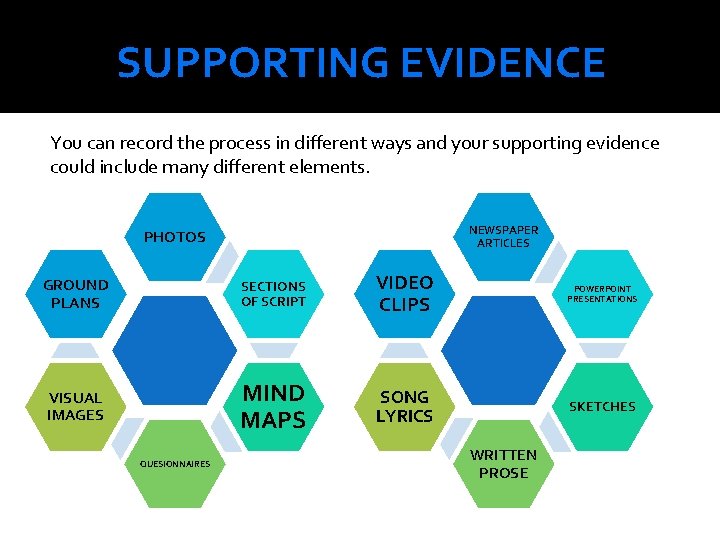
SUPPORTING EVIDENCE You can record the process in different ways and your supporting evidence could include many different elements. NEWSPAPER ARTICLES PHOTOS GROUND PLANS SECTIONS OF SCRIPT VIDEO CLIPS POWERPOINT PRESENTATIONS VISUAL IMAGES MIND MAPS SONG LYRICS SKETCHES QUESIONNAIRES WRITTEN PROSE
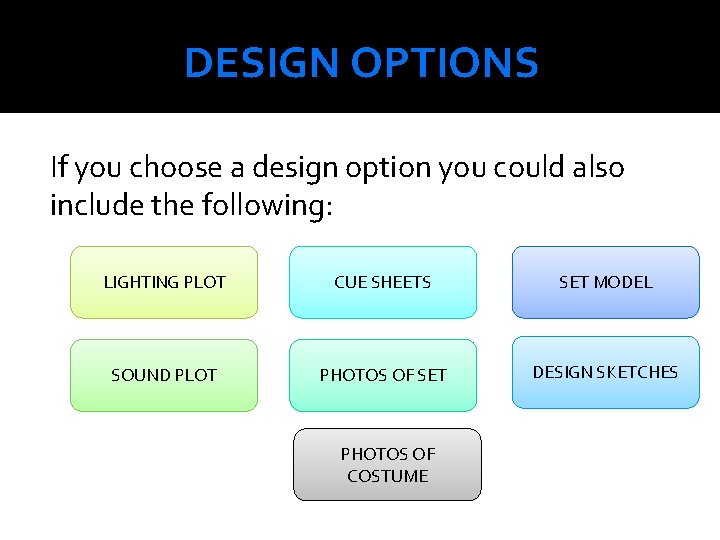
DESIGN OPTIONS If you choose a design option you could also include the following: LIGHTING PLOT CUE SHEETS SET MODEL SOUND PLOT PHOTOS OF SET DESIGN SKETCHES PHOTOS OF COSTUME
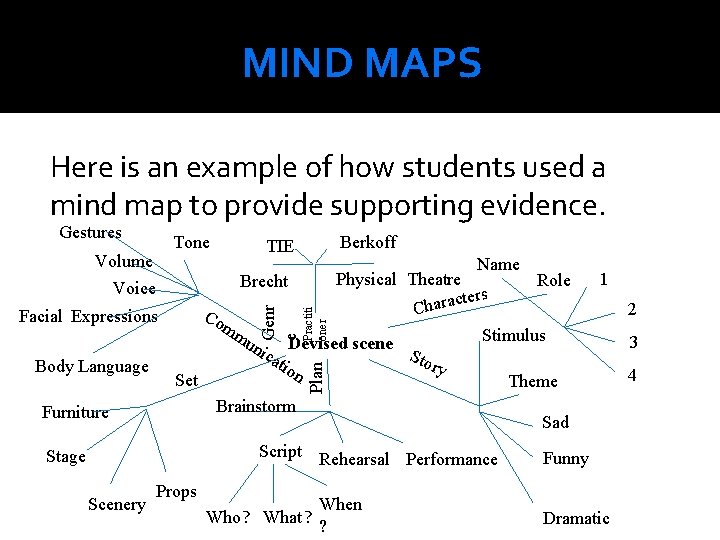
MIND MAPS Here is an example of how students used a mind map to provide supporting evidence. Gestures Tone Volume Voice Name mm un Physical Theatre cters a r a h C ica Devised scene St ory tio n Brainstorm Furniture Script Rehearsal Performance Stage Scenery Props When Who ? What ? ? Role 1 2 Stimulus Plan Set Practiti oner Co Genr e Brecht Facial Expressions Body Language Berkoff TIE Theme Sad Funny Dramatic 3 4
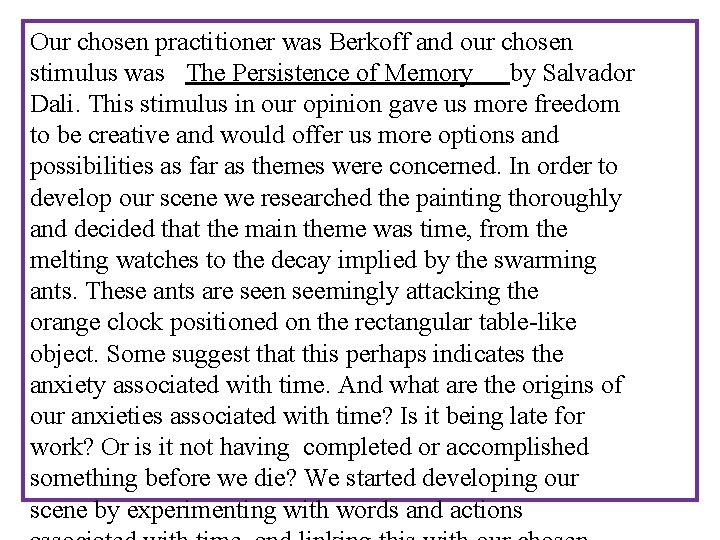
Our chosen practitioner was Berkoff and our chosen stimulus was The Persistence of Memory by Salvador Dali. This stimulus in our opinion gave us more freedom to be creative and would offer us more options and possibilities as far as themes were concerned. In order to develop our scene we researched the painting thoroughly and decided that the main theme was time, from the melting watches to the decay implied by the swarming ants. These ants are seen seemingly attacking the orange clock positioned on the rectangular table-like object. Some suggest that this perhaps indicates the anxiety associated with time. And what are the origins of our anxieties associated with time? Is it being late for work? Or is it not having completed or accomplished something before we die? We started developing our scene by experimenting with words and actions
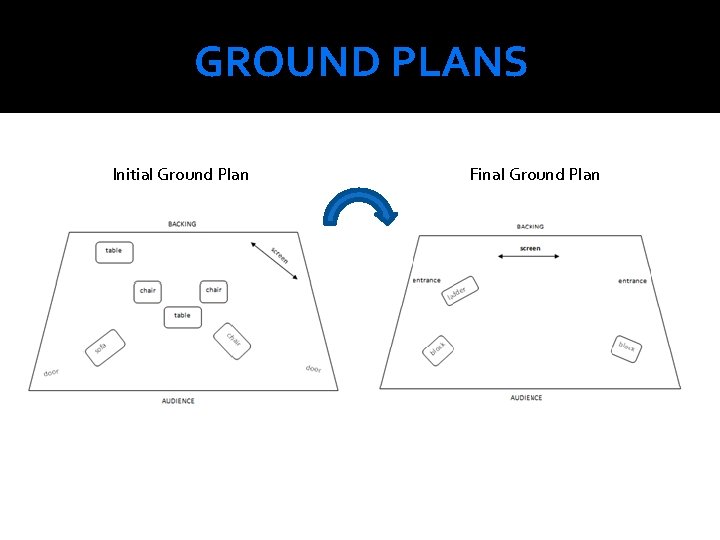
GROUND PLANS Initial Ground Plan Final Ground Plan
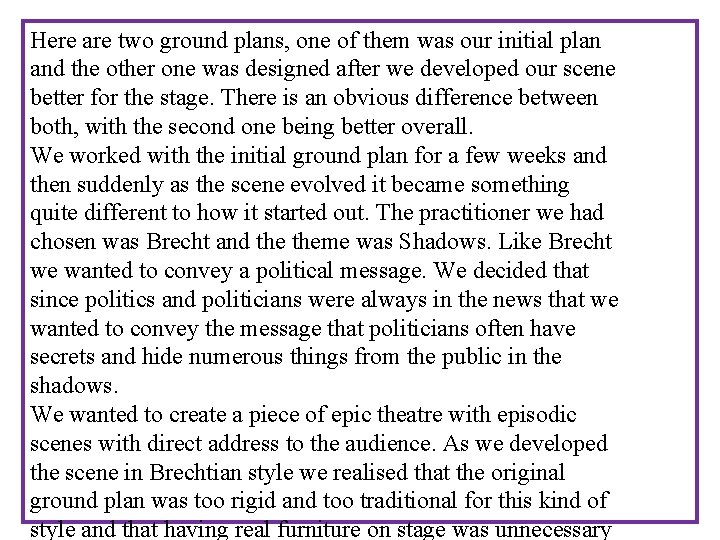
Here are two ground plans, one of them was our initial plan and the other one was designed after we developed our scene better for the stage. There is an obvious difference between both, with the second one being better overall. We worked with the initial ground plan for a few weeks and then suddenly as the scene evolved it became something quite different to how it started out. The practitioner we had chosen was Brecht and theme was Shadows. Like Brecht we wanted to convey a political message. We decided that since politics and politicians were always in the news that we wanted to convey the message that politicians often have secrets and hide numerous things from the public in the shadows. We wanted to create a piece of epic theatre with episodic scenes with direct address to the audience. As we developed the scene in Brechtian style we realised that the original ground plan was too rigid and too traditional for this kind of style and that having real furniture on stage was unnecessary
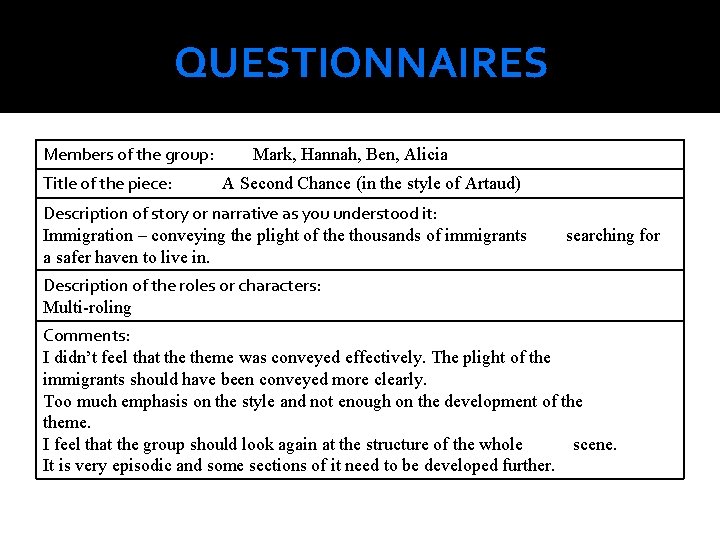
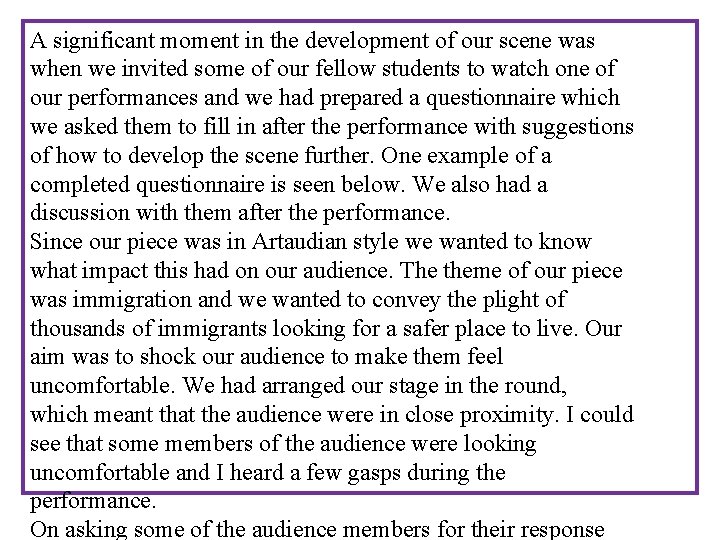
QUESTIONNAIRES Members of the group: Title of the piece: Mark, Hannah, Ben, Alicia A Second Chance (in the style of Artaud) Description of story or narrative as you understood it: Immigration – conveying the plight of the thousands of immigrants a safer haven to live in. searching for Description of the roles or characters: Multi-roling Comments: I didn’t feel that theme was conveyed effectively. The plight of the immigrants should have been conveyed more clearly. Too much emphasis on the style and not enough on the development of theme. I feel that the group should look again at the structure of the whole scene. It is very episodic and some sections of it need to be developed further.
A significant moment in the development of our scene was when we invited some of our fellow students to watch one of our performances and we had prepared a questionnaire which we asked them to fill in after the performance with suggestions of how to develop the scene further. One example of a completed questionnaire is seen below. We also had a discussion with them after the performance. Since our piece was in Artaudian style we wanted to know what impact this had on our audience. The theme of our piece was immigration and we wanted to convey the plight of thousands of immigrants looking for a safer place to live. Our aim was to shock our audience to make them feel uncomfortable. We had arranged our stage in the round, which meant that the audience were in close proximity. I could see that some members of the audience were looking uncomfortable and I heard a few gasps during the performance. On asking some of the audience members for their response
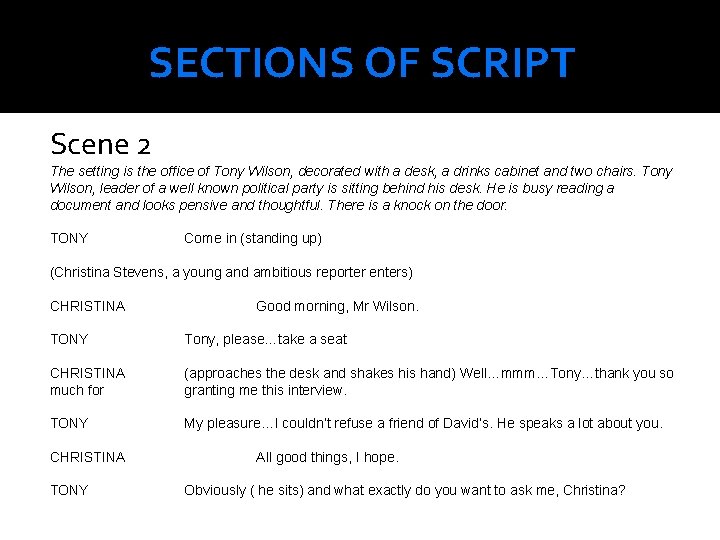
SECTIONS OF SCRIPT Scene 2 The setting is the office of Tony Wilson, decorated with a desk, a drinks cabinet and two chairs. Tony Wilson, leader of a well known political party is sitting behind his desk. He is busy reading a document and looks pensive and thoughtful. There is a knock on the door. TONY Come in (standing up) (Christina Stevens, a young and ambitious reporter enters) CHRISTINA Good morning, Mr Wilson. TONY Tony, please…take a seat CHRISTINA much for (approaches the desk and shakes his hand) Well…mmm…Tony…thank you so granting me this interview. TONY My pleasure…I couldn’t refuse a friend of David’s. He speaks a lot about you. CHRISTINA TONY All good things, I hope. Obviously ( he sits) and what exactly do you want to ask me, Christina?
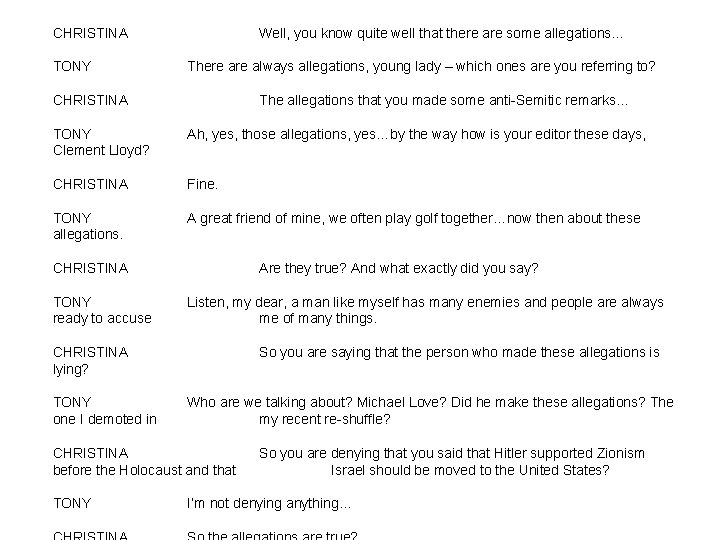
CHRISTINA TONY Well, you know quite well that there are some allegations… There always allegations, young lady – which ones are you referring to? CHRISTINA The allegations that you made some anti-Semitic remarks. . . TONY Clement Lloyd? Ah, yes, those allegations, yes…by the way how is your editor these days, CHRISTINA Fine. TONY allegations. A great friend of mine, we often play golf together…now then about these CHRISTINA TONY ready to accuse Are they true? And what exactly did you say? Listen, my dear, a man like myself has many enemies and people are always me of many things. CHRISTINA lying? TONY one I demoted in So you are saying that the person who made these allegations is Who are we talking about? Michael Love? Did he make these allegations? The my recent re-shuffle? CHRISTINA before the Holocaust and that TONY So you are denying that you said that Hitler supported Zionism Israel should be moved to the United States? I’m not denying anything…
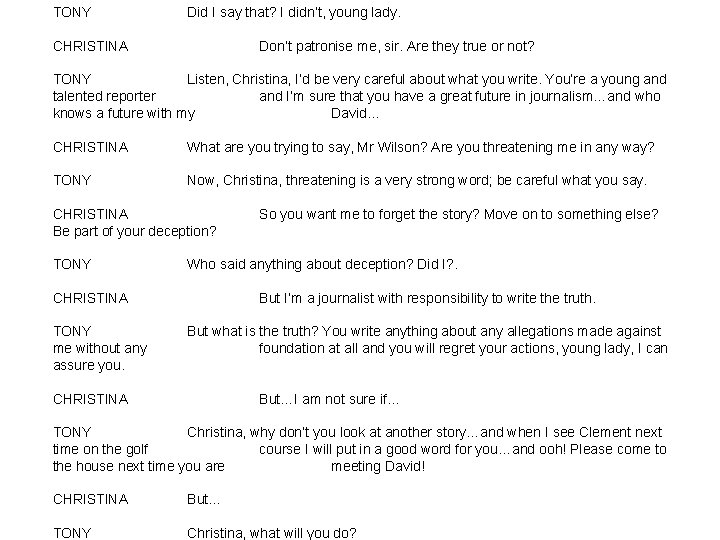
TONY Did I say that? I didn’t, young lady. CHRISTINA Don’t patronise me, sir. Are they true or not? TONY Listen, Christina, I’d be very careful about what you write. You’re a young and talented reporter and I’m sure that you have a great future in journalism…and who knows a future with my David… CHRISTINA What are you trying to say, Mr Wilson? Are you threatening me in any way? TONY Now, Christina, threatening is a very strong word; be careful what you say. CHRISTINA Be part of your deception? TONY Who said anything about deception? Did I? . CHRISTINA TONY me without any assure you. So you want me to forget the story? Move on to something else? But I’m a journalist with responsibility to write the truth. But what is the truth? You write anything about any allegations made against foundation at all and you will regret your actions, young lady, I can CHRISTINA But…I am not sure if… TONY Christina, why don’t you look at another story…and when I see Clement next time on the golf course I will put in a good word for you…and ooh! Please come to the house next time you are meeting David! CHRISTINA But… TONY Christina, what will you do?
The chosen stimulus for our play was Shadows. The piece of illustrative material that I have provided to show our understanding and interpretation of the title is a section of the script. There are two characters in the scene – Tony Wilson, leader of a political party and Christina Stevens, a young and ambitious reporter who has come to interview him about allegations made against him; she is also friendly with Tony’s son, David. We wanted the title to be interpreted in more than one way through our scene. Tony refuses to deny the allegations or admit that they are true. This can be seen as the allegations throwing a shadow over the honesty of Tony as a party leader and in the same way there is a shadow thrown over Christina as she is faced with a dilemma whether to write her report or not. As the scene develops we can see how both characters show their true colours under their shadows. The title can be interpreted in another way as well. We could describe both of them as being shadows since both are willing to deceive or lie in different ways. We see that both of them