
Component 1 1 3 a Biomechanical principles levers
Component 1 – 1. 3. a. Biomechanical principles, levers and the use of technology © OCR 2020 Version 2
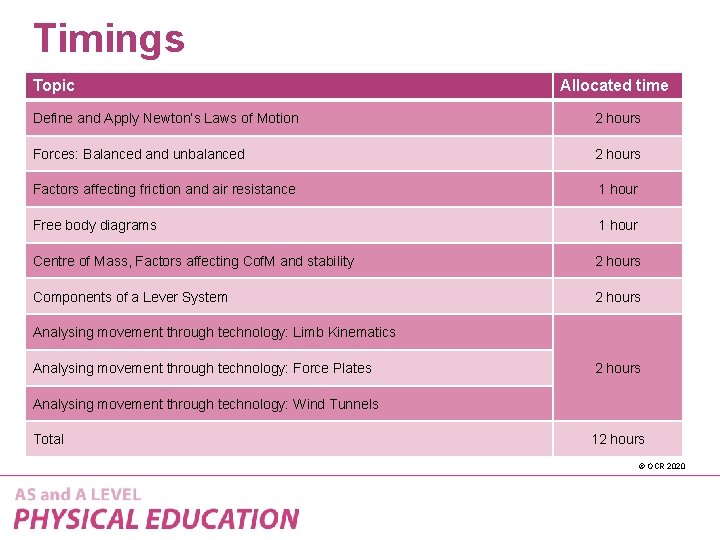
Timings Topic Allocated time Define and Apply Newton’s Laws of Motion 2 hours Forces: Balanced and unbalanced 2 hours Factors affecting friction and air resistance 1 hour Free body diagrams 1 hour Centre of Mass, Factors affecting Cof. M and stability 2 hours Components of a Lever System 2 hours Analysing movement through technology: Limb Kinematics Analysing movement through technology: Force Plates 2 hours Analysing movement through technology: Wind Tunnels Total 12 hours © OCR 2020
Biomechanical principles, levers and the use of technology Biomechanics is the study of human movement and the effect of force and motion on performance. Using the laws and principles of physics it enables us to: • • analyse performance maximise efficiency of movement reduce overuse or acute injuries design protective, comfortable and effective equipment. © OCR 2020
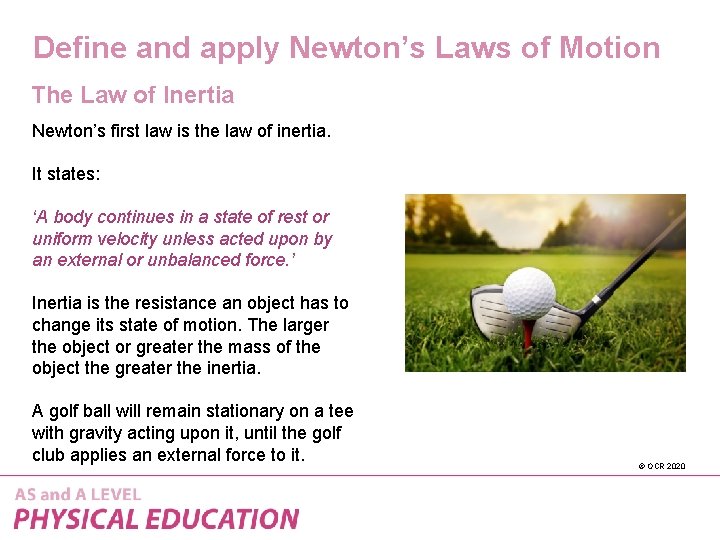
Define and apply Newton’s Laws of Motion The Law of Inertia Newton’s first law is the law of inertia. It states: ‘A body continues in a state of rest or uniform velocity unless acted upon by an external or unbalanced force. ’ Inertia is the resistance an object has to change its state of motion. The larger the object or greater the mass of the object the greater the inertia. A golf ball will remain stationary on a tee with gravity acting upon it, until the golf club applies an external force to it. © OCR 2020
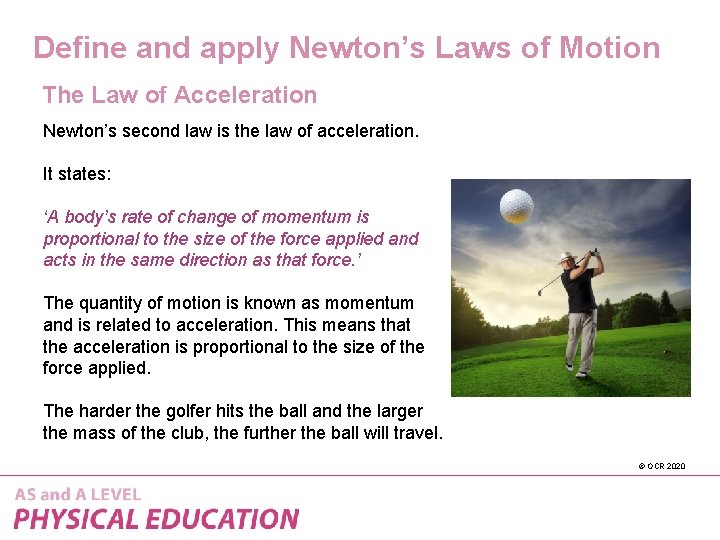
Define and apply Newton’s Laws of Motion The Law of Acceleration Newton’s second law is the law of acceleration. It states: ‘A body’s rate of change of momentum is proportional to the size of the force applied and acts in the same direction as that force. ’ The quantity of motion is known as momentum and is related to acceleration. This means that the acceleration is proportional to the size of the force applied. The harder the golfer hits the ball and the larger the mass of the club, the further the ball will travel. © OCR 2020
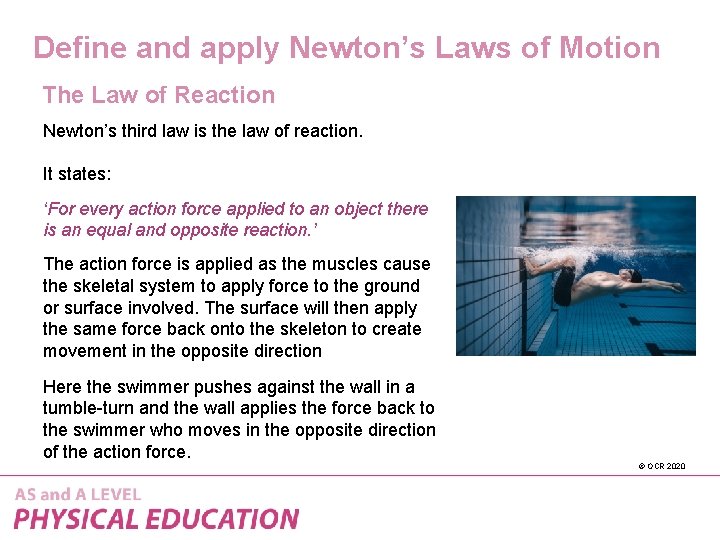
Define and apply Newton’s Laws of Motion The Law of Reaction Newton’s third law is the law of reaction. It states: ‘For every action force applied to an object there is an equal and opposite reaction. ’ The action force is applied as the muscles cause the skeletal system to apply force to the ground or surface involved. The surface will then apply the same force back onto the skeleton to create movement in the opposite direction Here the swimmer pushes against the wall in a tumble-turn and the wall applies the force back to the swimmer who moves in the opposite direction of the action force. © OCR 2020
Define and apply Newton’s Laws of Motion Within Newton’s Laws there are 4 key concepts which can be calculated to ascertain the quantities of force and movement achieved : 1. 2. 3. 4. Velocity Momentum Acceleration Force © OCR 2020
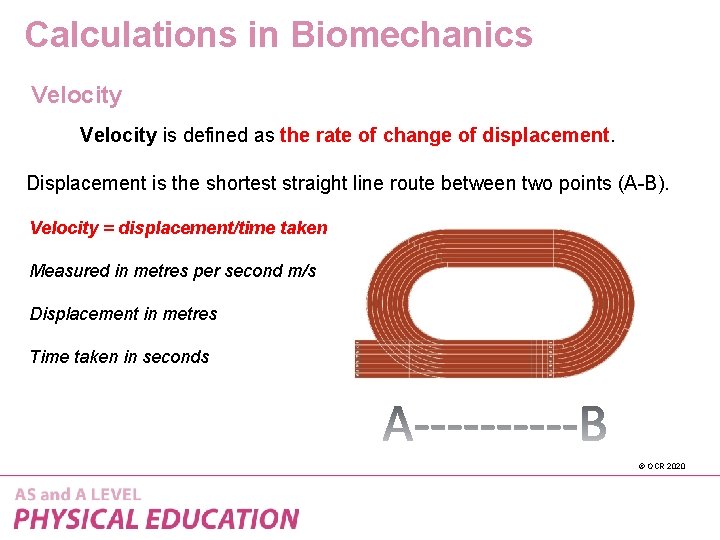
Calculations in Biomechanics Velocity is defined as the rate of change of displacement. Displacement is the shortest straight line route between two points (A-B). Velocity = displacement/time taken Measured in metres per second m/s Displacement in metres Time taken in seconds © OCR 2020
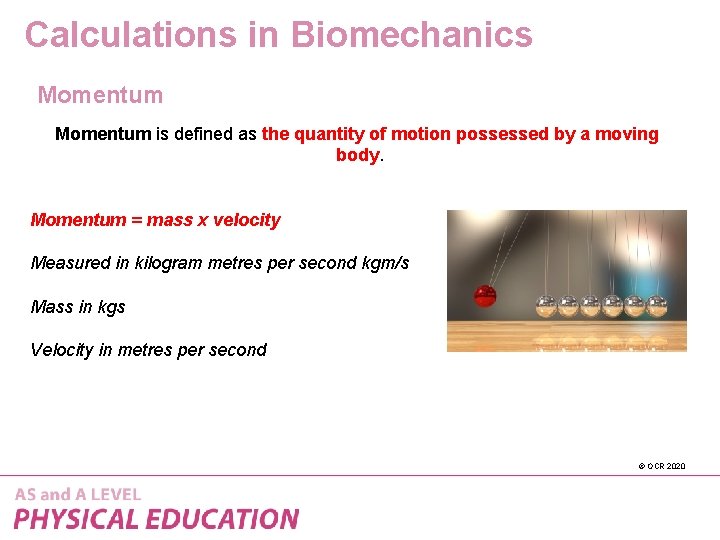
Calculations in Biomechanics Momentum is defined as the quantity of motion possessed by a moving body. Momentum = mass x velocity Measured in kilogram metres per second kgm/s Mass in kgs Velocity in metres per second © OCR 2020
Calculations in Biomechanics Acceleration is defined as the rate of change in velocity Acceleration = (final velocity – initial velocity ) / time taken Measured in metres per second (m/s/s) Velocity in metres per second Time taken in seconds © OCR 2020
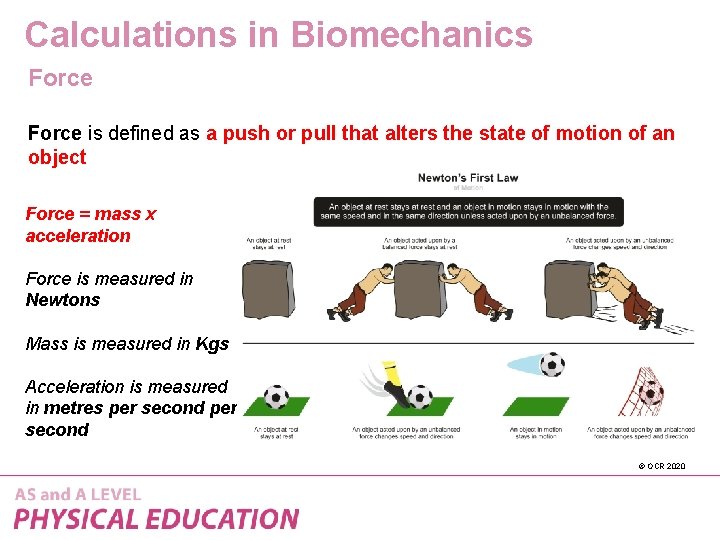
Calculations in Biomechanics Force is defined as a push or pull that alters the state of motion of an object Force = mass x acceleration Force is measured in Newtons Mass is measured in Kgs Acceleration is measured in metres per second © OCR 2020
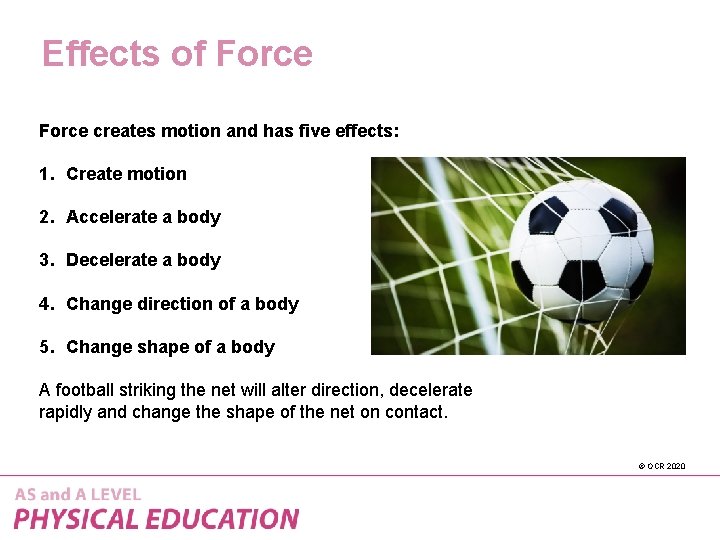
Effects of Force creates motion and has five effects: 1. Create motion 2. Accelerate a body 3. Decelerate a body 4. Change direction of a body 5. Change shape of a body A football striking the net will alter direction, decelerate rapidly and change the shape of the net on contact. © OCR 2020
Forces: Balanced and unbalanced Net Forces Internal forces are those which are created by muscular contractions acting on the skeleton. Net force is the sum of all forces acting on the body. External forces come from outside the body and include: 1. 2. 3. 4. Weight Reaction Friction Air Resistance © OCR 2020
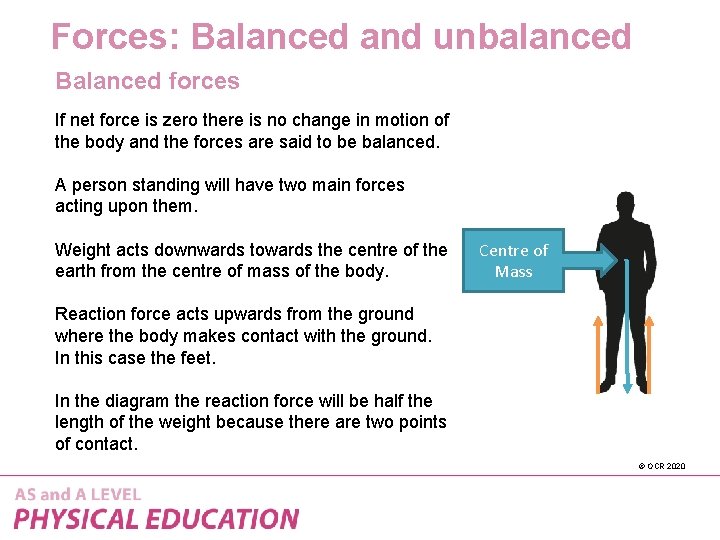
Forces: Balanced and unbalanced Balanced forces If net force is zero there is no change in motion of the body and the forces are said to be balanced. A person standing will have two main forces acting upon them. Weight acts downwards towards the centre of the earth from the centre of mass of the body. Centre of Mass Reaction force acts upwards from the ground where the body makes contact with the ground. In this case the feet. In the diagram the reaction force will be half the length of the weight because there are two points of contact. © OCR 2020
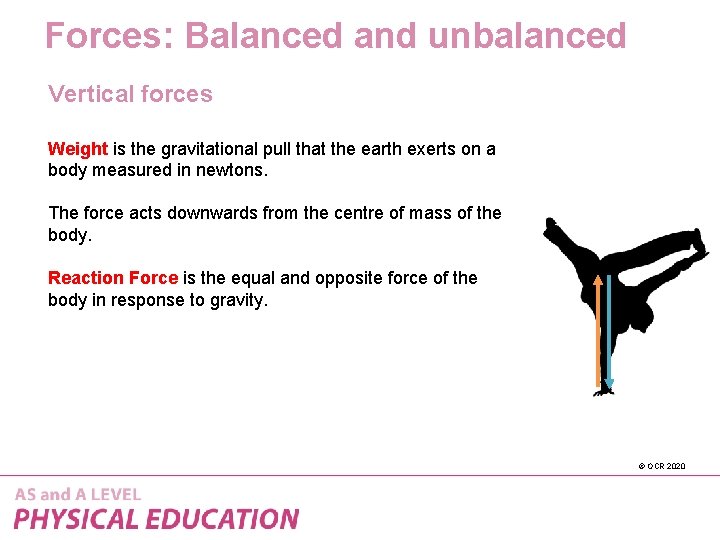
Forces: Balanced and unbalanced Vertical forces Weight is the gravitational pull that the earth exerts on a body measured in newtons. The force acts downwards from the centre of mass of the body. Reaction Force is the equal and opposite force of the body in response to gravity. © OCR 2020
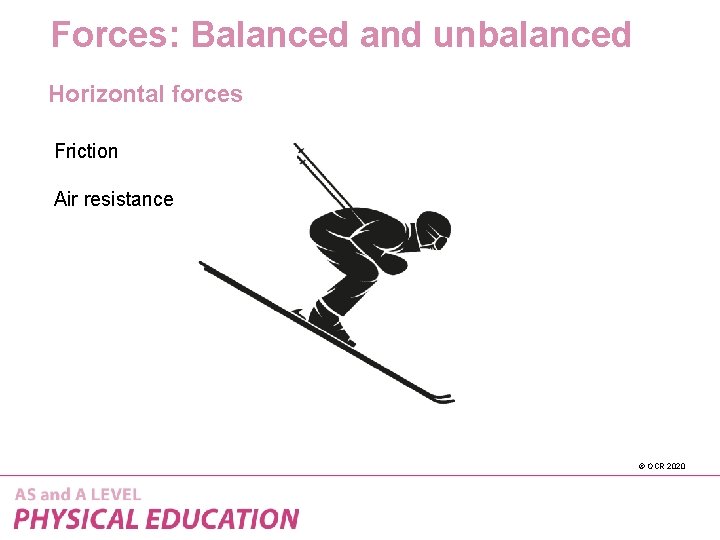
Forces: Balanced and unbalanced Horizontal forces Friction Air resistance © OCR 2020
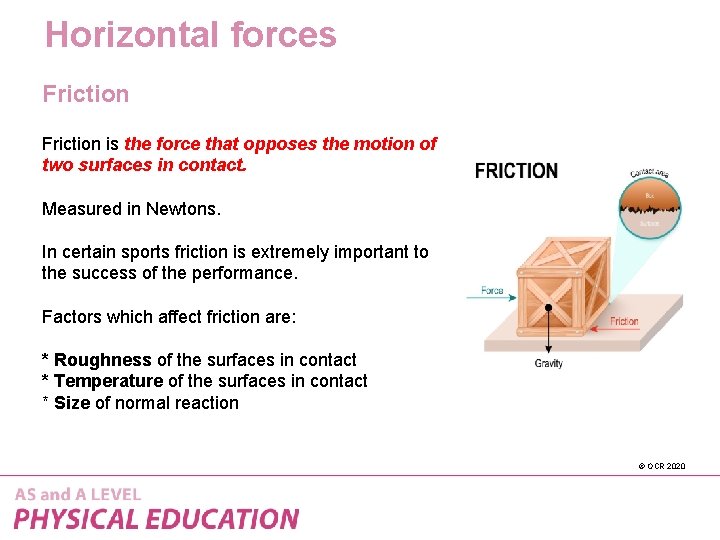
Horizontal forces Friction is the force that opposes the motion of two surfaces in contact. Measured in Newtons. In certain sports friction is extremely important to the success of the performance. Factors which affect friction are: * Roughness of the surfaces in contact * Temperature of the surfaces in contact * Size of normal reaction © OCR 2020
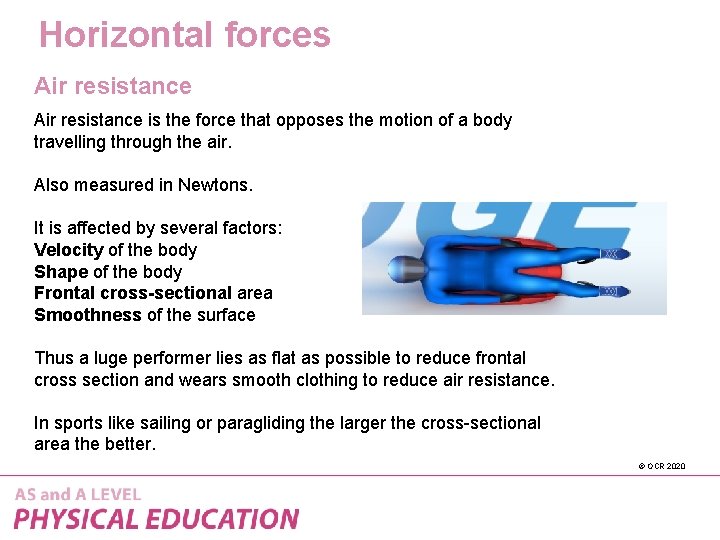
Horizontal forces Air resistance is the force that opposes the motion of a body travelling through the air. Also measured in Newtons. It is affected by several factors: Velocity of the body Shape of the body Frontal cross-sectional area Smoothness of the surface Thus a luge performer lies as flat as possible to reduce frontal cross section and wears smooth clothing to reduce air resistance. In sports like sailing or paragliding the larger the cross-sectional area the better. © OCR 2020
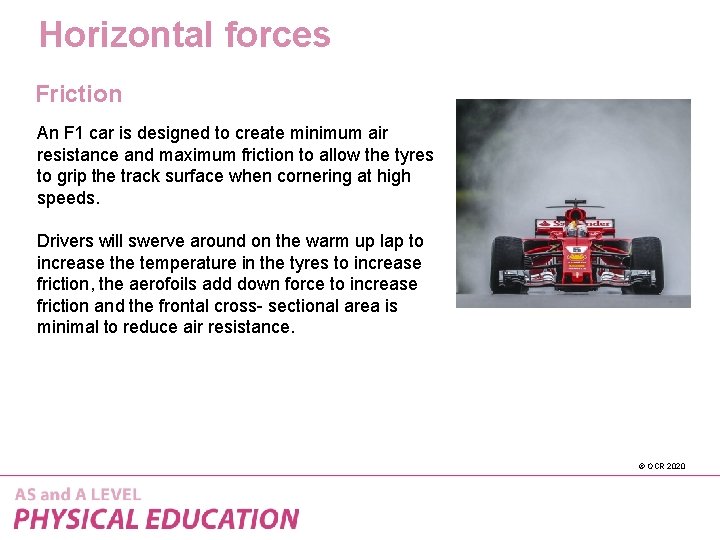
Horizontal forces Friction An F 1 car is designed to create minimum air resistance and maximum friction to allow the tyres to grip the track surface when cornering at high speeds. Drivers will swerve around on the warm up lap to increase the temperature in the tyres to increase friction, the aerofoils add down force to increase friction and the frontal cross- sectional area is minimal to reduce air resistance. © OCR 2020
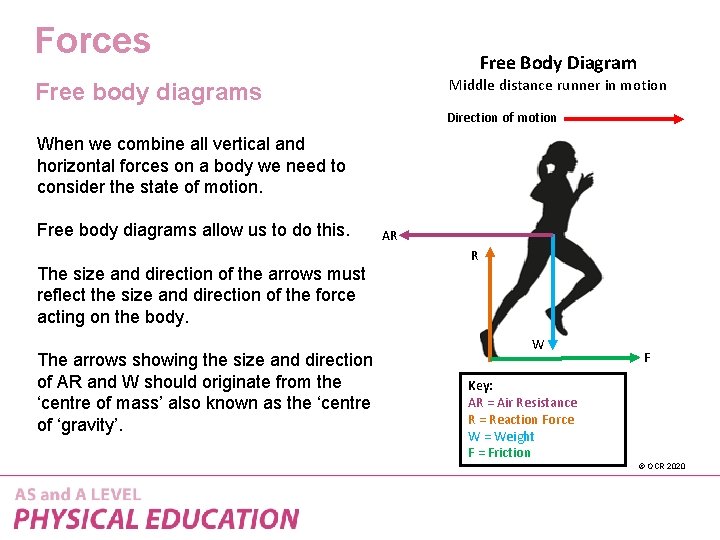
Forces Free Body Diagram Middle distance runner in motion Free body diagrams Direction of motion When we combine all vertical and horizontal forces on a body we need to consider the state of motion. Free body diagrams allow us to do this. The size and direction of the arrows must reflect the size and direction of the force acting on the body. The arrows showing the size and direction of AR and W should originate from the ‘centre of mass’ also known as the ‘centre of ‘gravity’. AR R W F Key: AR = Air Resistance R = Reaction Force W = Weight F = Friction © OCR 2020
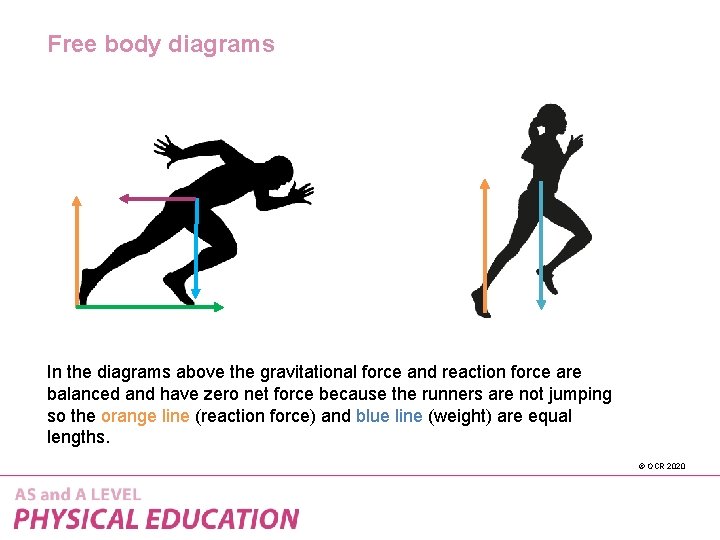
Free body diagrams In the diagrams above the gravitational force and reaction force are balanced and have zero net force because the runners are not jumping so the orange line (reaction force) and blue line (weight) are equal lengths. © OCR 2020
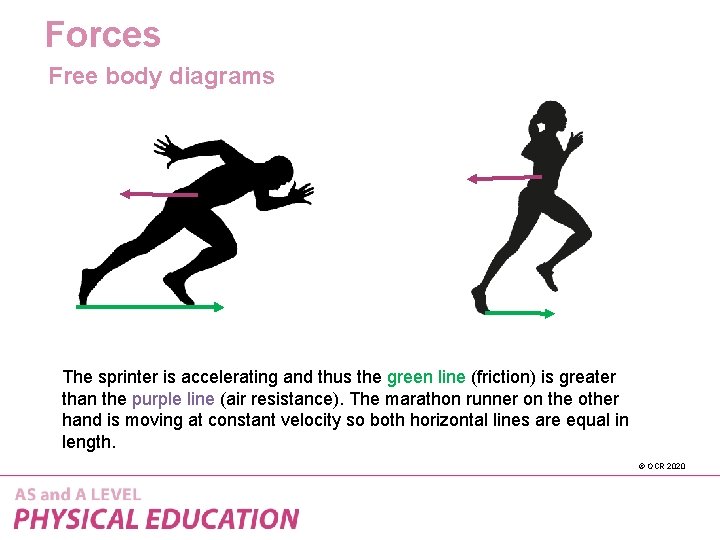
Forces Free body diagrams The sprinter is accelerating and thus the green line (friction) is greater than the purple line (air resistance). The marathon runner on the other hand is moving at constant velocity so both horizontal lines are equal in length. © OCR 2020
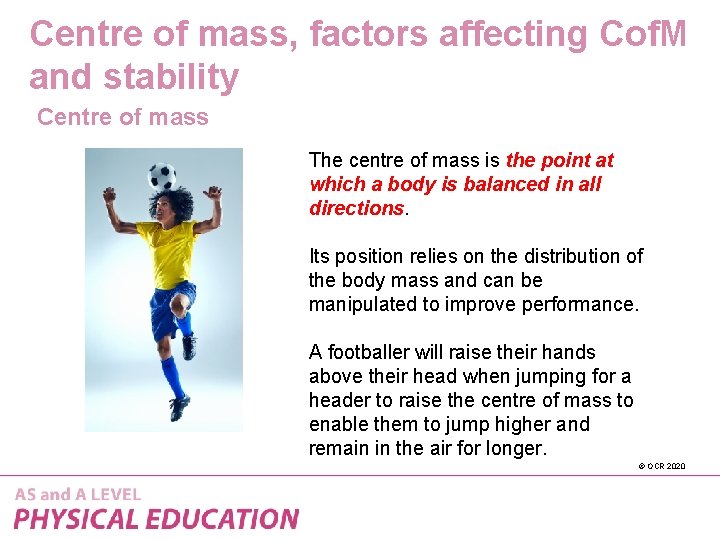
Centre of mass, factors affecting Cof. M and stability Centre of mass The centre of mass is the point at which a body is balanced in all directions. Its position relies on the distribution of the body mass and can be manipulated to improve performance. A footballer will raise their hands above their head when jumping for a header to raise the centre of mass to enable them to jump higher and remain in the air for longer. © OCR 2020
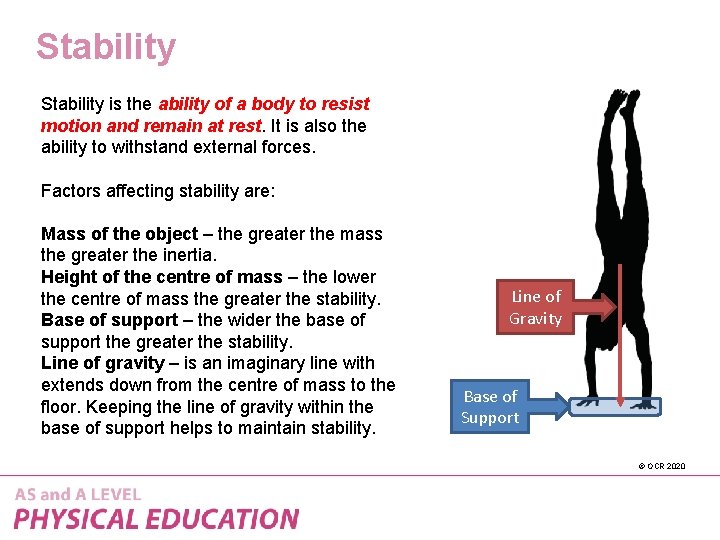
Stability is the ability of a body to resist motion and remain at rest. It is also the ability to withstand external forces. Factors affecting stability are: Mass of the object – the greater the mass the greater the inertia. Height of the centre of mass – the lower the centre of mass the greater the stability. Base of support – the wider the base of support the greater the stability. Line of gravity – is an imaginary line with extends down from the centre of mass to the floor. Keeping the line of gravity within the base of support helps to maintain stability. Line of Gravity Base of Support © OCR 2020
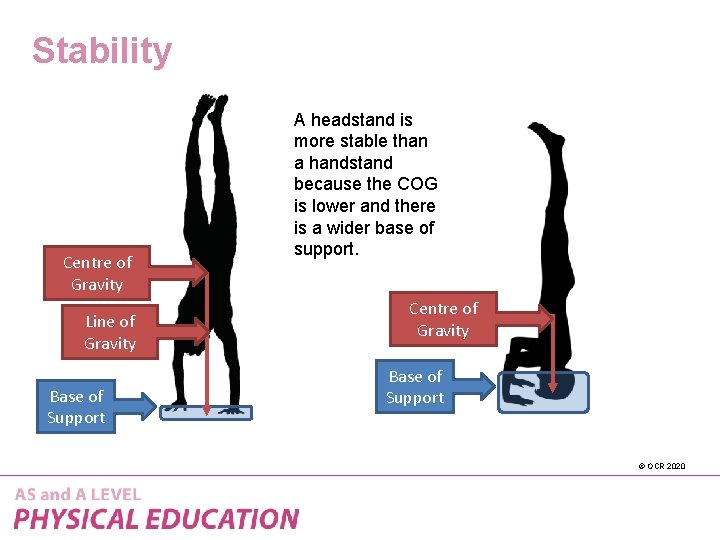
Stability Centre of Gravity Line of Gravity Base of Support A headstand is more stable than a handstand because the COG is lower and there is a wider base of support. Centre of Gravity Base of Support © OCR 2020
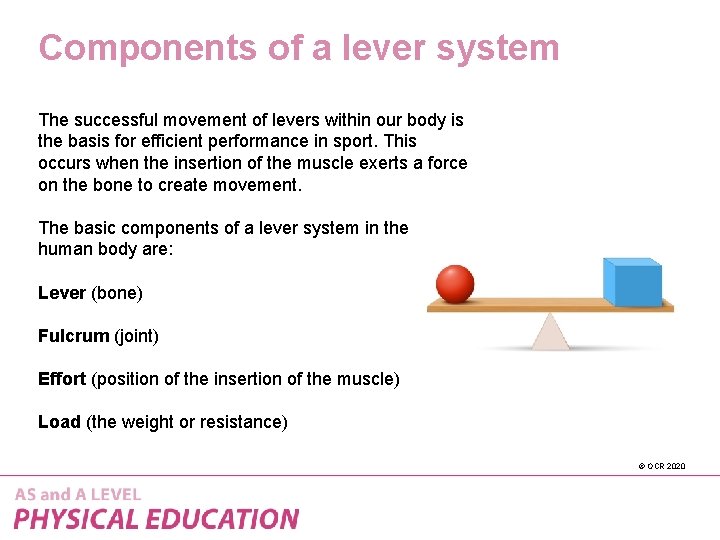
Components of a lever system The successful movement of levers within our body is the basis for efficient performance in sport. This occurs when the insertion of the muscle exerts a force on the bone to create movement. The basic components of a lever system in the human body are: Lever (bone) Fulcrum (joint) Effort (position of the insertion of the muscle) Load (the weight or resistance) © OCR 2020

Classification of levers The easiest way to remember the 3 classes of lever is to memorise the middle component of each class of lever. First Class = Fulcrum Second Class = Load Third Class = Effort. FLE © OCR 2020
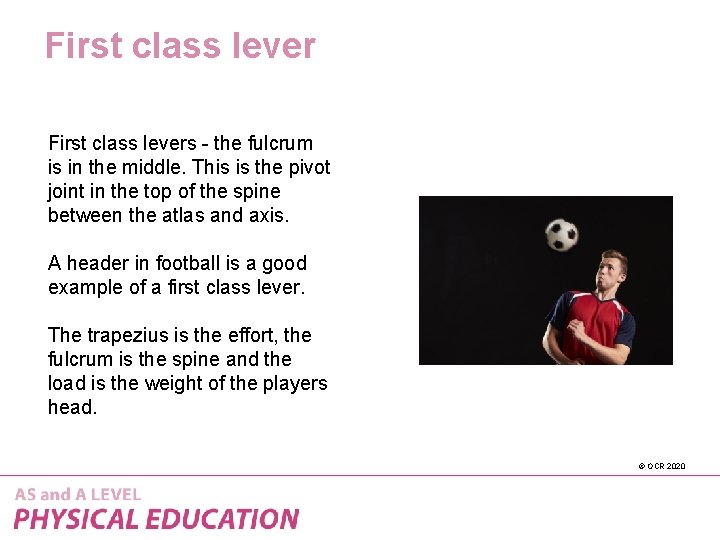
First class levers - the fulcrum is in the middle. This is the pivot joint in the top of the spine between the atlas and axis. A header in football is a good example of a first class lever. The trapezius is the effort, the fulcrum is the spine and the load is the weight of the players head. © OCR 2020

Components of a lever system Second class levers - the load is in the middle. This is weight of a dancer acting through the tibia towards the floor. A dancer on tip toe is a good example The gastrocnemius and soleus are the effort, the fulcrum is the toe and the load is the weight of the dancer. © OCR 2020
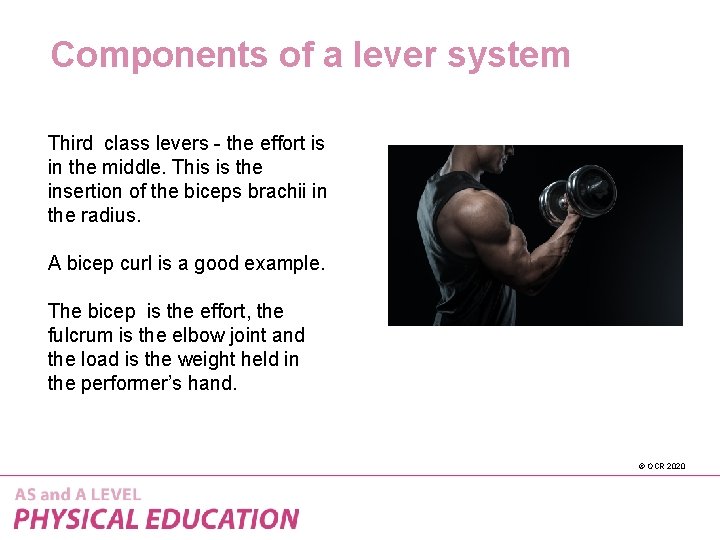
Components of a lever system Third class levers - the effort is in the middle. This is the insertion of the biceps brachii in the radius. A bicep curl is a good example. The bicep is the effort, the fulcrum is the elbow joint and the load is the weight held in the performer’s hand. © OCR 2020
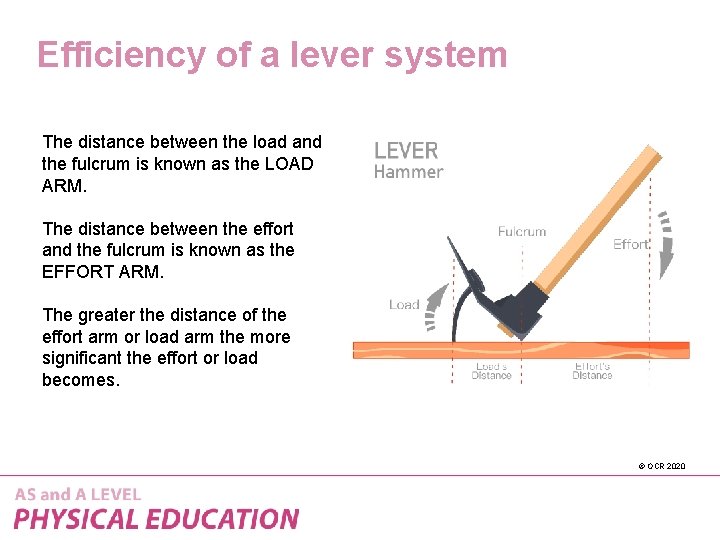
Efficiency of a lever system The distance between the load and the fulcrum is known as the LOAD ARM. The distance between the effort and the fulcrum is known as the EFFORT ARM. The greater the distance of the effort arm or load arm the more significant the effort or load becomes. © OCR 2020
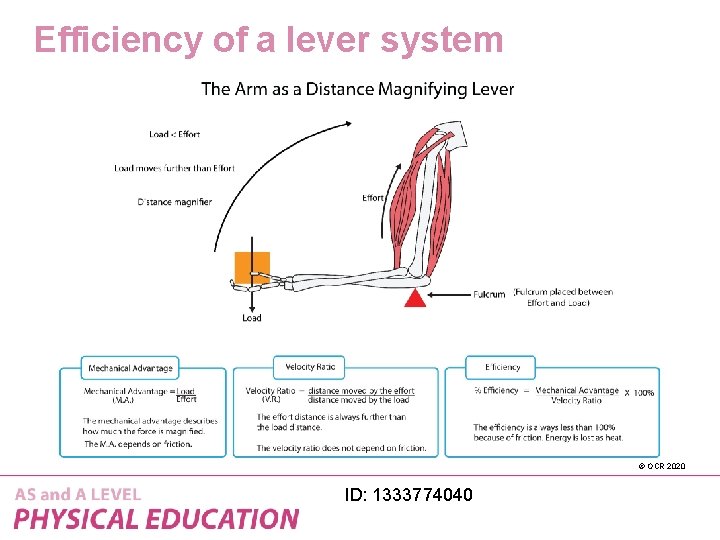
Efficiency of a lever system © OCR 2020 ID: 1333774040
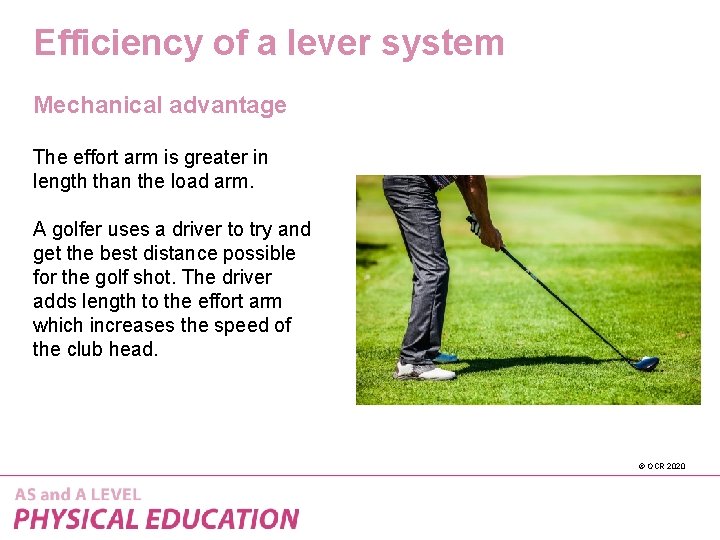
Efficiency of a lever system Mechanical advantage The effort arm is greater in length than the load arm. A golfer uses a driver to try and get the best distance possible for the golf shot. The driver adds length to the effort arm which increases the speed of the club head. © OCR 2020
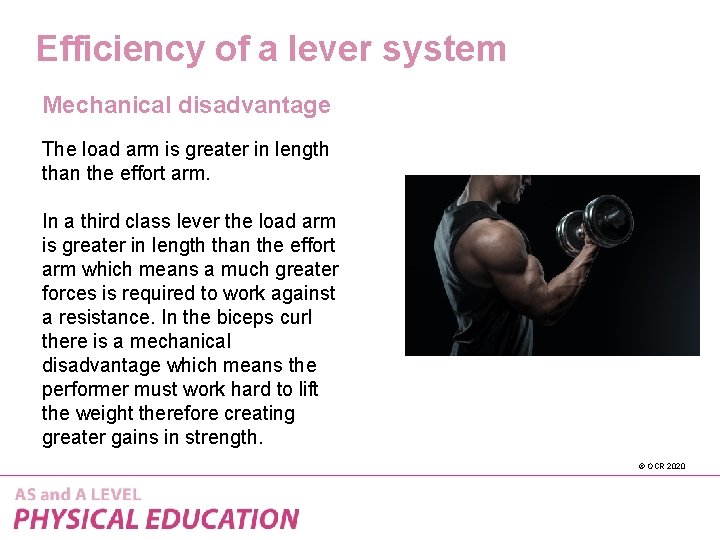
Efficiency of a lever system Mechanical disadvantage The load arm is greater in length than the effort arm. In a third class lever the load arm is greater in length than the effort arm which means a much greater forces is required to work against a resistance. In the biceps curl there is a mechanical disadvantage which means the performer must work hard to lift the weight therefore creating greater gains in strength. © OCR 2020
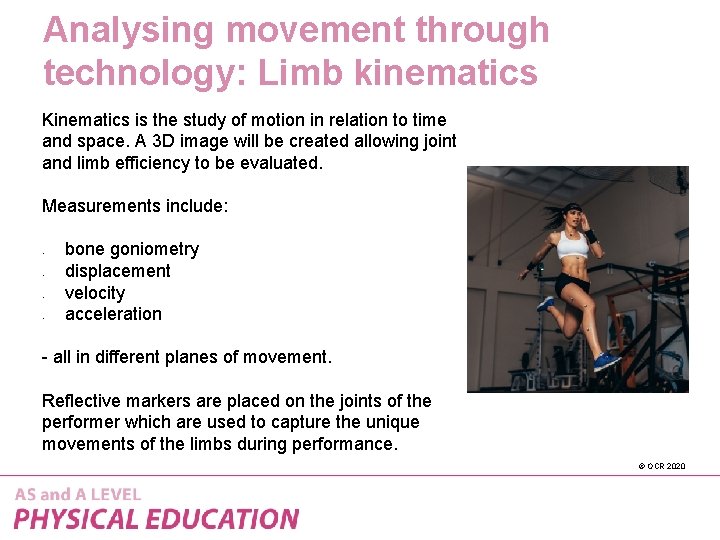
Analysing movement through technology: Limb kinematics Kinematics is the study of motion in relation to time and space. A 3 D image will be created allowing joint and limb efficiency to be evaluated. Measurements include: • • bone goniometry displacement velocity acceleration - all in different planes of movement. Reflective markers are placed on the joints of the performer which are used to capture the unique movements of the limbs during performance. © OCR 2020
Analysing movement through technology: Force plates Ground reaction forces can be measured in lab conditions using force plates. Data can be collected from an athlete placing their foot on the place (or hand on a wall mounted plate) to analyse the pressure created on the plate. Walking, running or jumping analysis can be carried out. Force plates are most commonly used for: • • • gait analysis balance rehab and physical therapy. Force transducers are included in the plate which is embedded in the ground - an electrical output is displayed in graphical form on computer. © OCR 2020
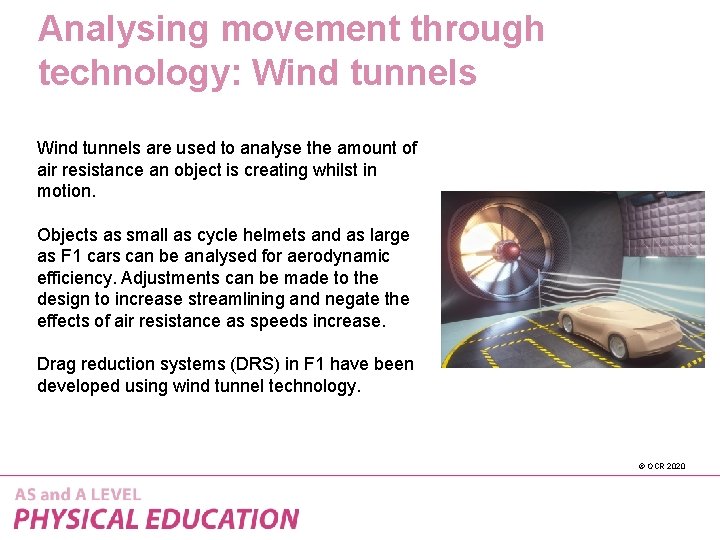
Analysing movement through technology: Wind tunnels are used to analyse the amount of air resistance an object is creating whilst in motion. Objects as small as cycle helmets and as large as F 1 cars can be analysed for aerodynamic efficiency. Adjustments can be made to the design to increase streamlining and negate the effects of air resistance as speeds increase. Drag reduction systems (DRS) in F 1 have been developed using wind tunnel technology. © OCR 2020
OCR Resources: the small print OCR’s resources are provided to support the delivery of OCR qualifications, but in no way constitute an endorsed teaching method that is required by the Board, and the decision to use them lies with the individual teacher. Whilst every effort is made to ensure the accuracy of the content, OCR cannot be held responsible for any errors or omissions within these resources. Our documents are updated over time. Whilst every effort is made to check all documents, there may be contradictions between published support and the specification, therefore please use the information on the latest specification at all times. Where changes are made to specifications these will be indicated within the document, there will be a new version number indicated, and a summary of the changes. If you do notice a discrepancy between the specification and a resource please contact us at: resources. feedback@ocr. org. uk. © OCR 2020 - This resource may be freely copied and distributed, as long as the OCR logo and this message remain intact and OCR is acknowledged as the originator of this work. OCR acknowledges the use of the following content: Slide 4: Playing golf, Miakael Damkier/Shutterstock. com, Slide 5: Playing golf, Ollyy/Shutterstock. com, Slide 6: Swimming, Jacob Lund/Shuttestock. com, Slide 8, Running track, Yulien Velchev/Shutterstock. com, Slide 9: Newtons Cradle, Nathapol Kongseang/Shutterstock. com, Slide 10: Drag racing, Phillip Rubino/Shutterstock. com, Slide 11: Newtown’s First La, udaix/Shutterstock. com, Slide 12: Football in net, Pasko Maksim/Shutterstock. com, Slide 14: Man standing, Michal Sanca/Shutterstock. com, Slide 15: Dancing, Svitlana Holovei/Shutterstock. com, Slide 16: Skiing, Syz. SV/Shutterstock. com, Slide 17: Friction diagram, Designua/Shutterstock. com, Slide 18: Luge, Vitamin. Co/Shutttsock. com, Slide 19: Racing car, Hatiz Johari/Shutterstock. com, Diagram of car, Fouad A. Saad/Shutterstock. com, Slides 21 & 22: Runner, udaix/Shutterstock. com, Runner, sportpoint/Shutterstock. com, Slide 23: Heading a football, Michal Sanca/Shutterstock. com, Slide 24 & 25: Handstand, Dexiao Productions/Shutterstock. com, Slide 25: Headstand, Korioles/Shutterstock. com, Slide 26: Lever system, Designua/Shutterstock. com, Slide 27: Classification of levers, udaix/Shutterstock. com, Slide 28: Boy heading football, Monkey Business Images/Shutterstock. com, Slide 29: Dancing on tip toes, mimagephotography/Shutterstock. com, Slide 30 & 34, Bicep curl, Improvisor/Shutterstock. com, Slide 31: Lever system Hammer, grayjay/Shutterstock. com, Slide 32: Lever system, Steve Cymro/Shutterstock. com, Slide 33: Golfer, Benoit Daost/ Shutterstock. com, Slide 35: Woman junping, Jacob Lund/Shutterstock. com, Slide 37: Wind tunnel, ktsdesign/Shutterstock. com Please get in touch if you want to discuss the accessibility of resources we offer to support delivery of our qualifications: resources. feedback@ocr. org. uk © OCR 2020
- Slides: 38