
Component 1 1 2 b Preparation and training
Component 1 ‒ 1. 2. b. Preparation and training methods in relation to improving and maintaining physical activity and performance © OCR 2020

Timings Topic Principles of Training Allocated time 2 hours Aerobic Capacity and Maximal Oxygen Uptake Methods of evaluating aerobic capacity Intensity and duration of training to develop aerobic capacity 4 hours Physiological Adaptations to aerobic training Types of Strength and factors affecting strength Methods of evaluating each type of strength Training to develop strength 3 hours Physiological Adaptations to strength training Types of Flexibility and factors affecting flexibility Methods of evaluating flexibility Training to develop flexibility 2 hours Physiological Adaptations to flexibility training The effect of training on lifestyle diseases 1 hour © OCR 2020
Principles of training Background For elite sports performers and those who take their sports seriously reaching and maintaining a level of fitness which allows them to perform at the peak of their ability is imperative. To maximise the efficiency of the training process there a number of principles which should be applied. Athletes need to design a fitness training programme which allows for maximum gains whilst also avoiding over-training and injury. Through many months of training they need to maintain motivation and have clear goals for the long, medium and short terms in their training. Without a meticulous plan many an athlete with great potential may fall by the wayside. © OCR 2020

Principles of training Principle Description MODERATION Gradual increase in workload will ensure injury avoided. REVERSIBILITY If training levels are not maintained the benefits gained will regress. SPECIFICITY Training should best replicate the type of activity and energy systems used in performance. VARIANCE Varying the type of activity undertaken can help to increase training effects and reduce boredom. OVERLOAD The system must be overloaded in order for adaptations to take place. PROGRESSION Overload needs to be applied gradually to ensure best adaptation and avoid injury PERIODISATION The organised division of training into a number of specific blocks or phases. © OCR 2020

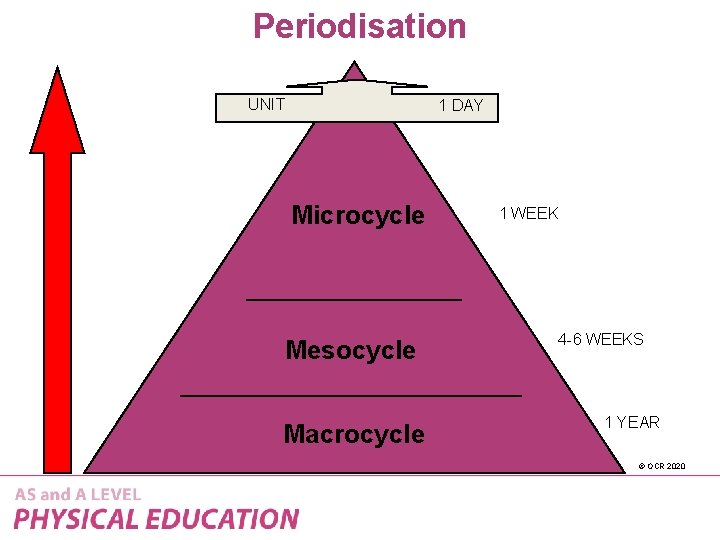
Periodisation Cycles In order to simplify the training process the overall training programme is split into segments. These segments are categorised by the length of time the training will take place. In that way the coach and performer can organise their programme more specifically and target areas they wish to concentrate on. The timeframes are as follows: Macrocycle – the whole programme – long term training programme Mesocycle – the ‘mid-term’ training programme – usually between 4 -6 weeks. Microcycle – the ‘short-term’ training programme – usually between 1 -3 weeks © OCR 2020
Periodisation UNIT 1 DAY Microcycle Mesocycle Macrocycle 1 WEEK 4 -6 WEEKS 1 YEAR © OCR 2020
Periodisation Phases To further organise the training phases are used to once again target specific goals within the programme. The emphasis will vary depending on the phase the performer is in: The phases are as follows: Preparatory – ‘off season or pre-season’. Usually split into two distinct phases. Competitive – ‘includes the competitive season’. Also split into two phases. Transition – time for ‘active rest’ and ‘recuperation’. © OCR 2020
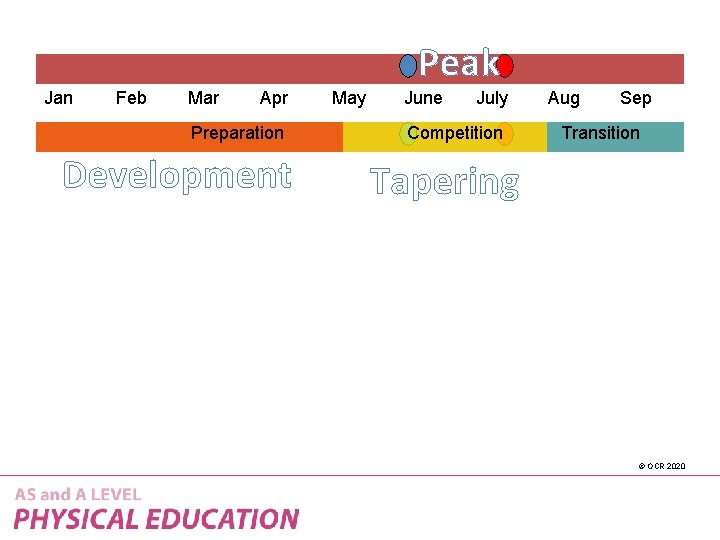
Peak Jan Feb Mar Apr Preparation Development May June July Competition Aug Sep Transition Tapering © OCR 2020
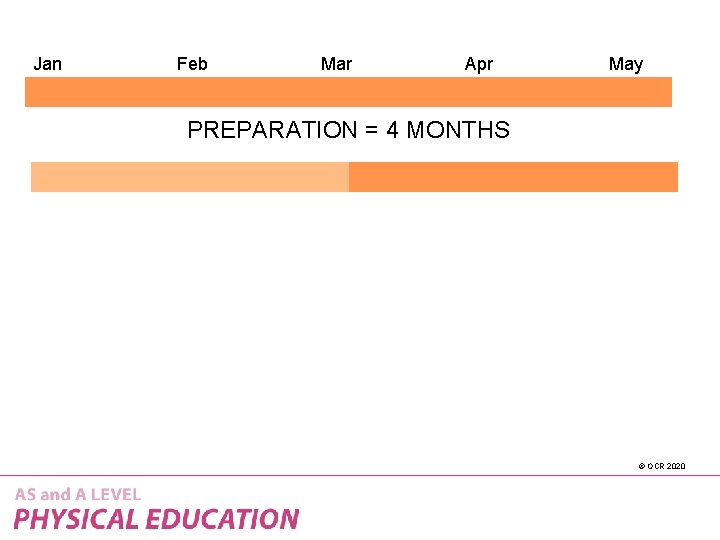
Jan Feb Mar Apr May PREPARATION = 4 MONTHS © OCR 2020
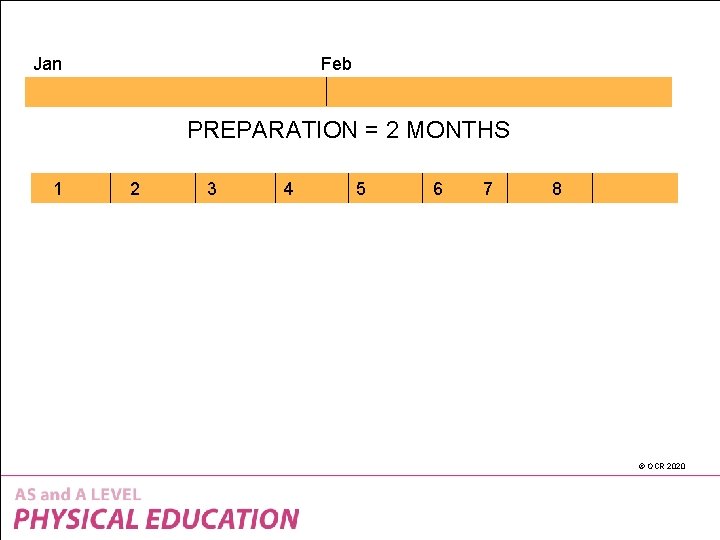
Jan Feb PREPARATION = 2 MONTHS 1 2 3 4 5 6 7 8 © OCR 2020
MON TUES WEDS THURS FRI SAT SUN © OCR 2020

Preparatory phase Phase 1 Off-season – general conditioning developing a foundation to build on in the second phase. This consists of: • Aerobic training • Core development • Mobility • Strength and conditioning Phase 2 Pre-season – progressive overload is the main focus of this phase where the majority of fitness development is targeted. Intensity of training is gradually increased. Initially training volume is high however as competition looms this will be decreased and competition specific training will take place. © OCR 2020

Competition phase Phase 3 Training load reduces and rest days become important. Maintenance of fitness is imperative whilst also paying attention to avoid injury. In certain sports tactics and strategies will be developed however endurance performers may continue high intensity training to be prepared well for Phase 4 Tapering – 2 -3 weeks prior to main competition training load is gradually decreased and recovery is increased to ensure the performer is in peak condition to perform effectively. Training intensity is maintained but the volume and frequency is reduced. © OCR 2020
Transition phase The focus is for active rest and recuperation. Often the performer will take part in activities which add variation to their training whilst trying to maintain a level of aerobic fitness with low-intensity exercise. Activities which offer similar movements and energy systems are undertaken to add some respite from the main training season, helping to maintain motivation. Longer term treatment for injuries will be administered. © OCR 2020
Aerobic capacity The ability to take in, transport and use O 2 for prolonged periods of submaximal work. © OCR 2020
VO 2 Max The HIGHEST RATE of Oxygen consumption attainable during maximal work. © OCR 2020
Factors affecting VO 2 Max 1. 2. 3. 4. 5. 6. 7. 8. Efficiency of the respiratory system Capacity and strength of heart (SV / HR) Vascular System transporting O 2 Percentage slow twitch and FOG muscle fibres Genetics Training Age – decreases from around 25 Gender – females generally 20 -25% lower © OCR 2020
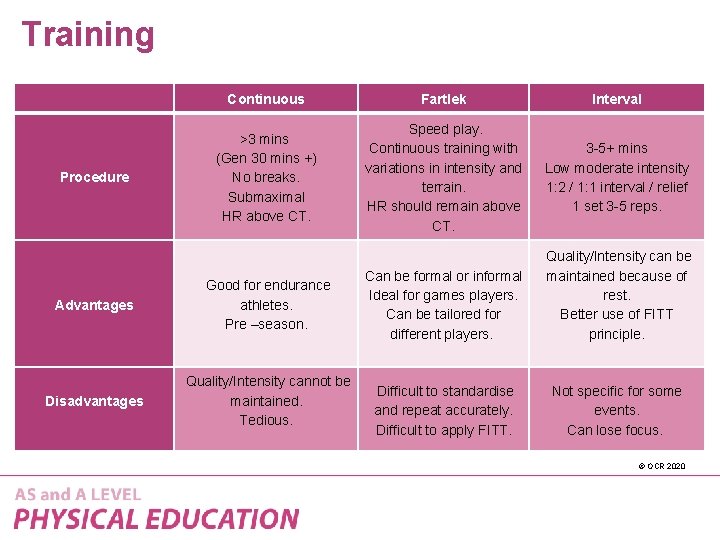
Training Procedure Continuous Fartlek Interval >3 mins (Gen 30 mins +) No breaks. Submaximal HR above CT. Speed play. Continuous training with variations in intensity and terrain. HR should remain above CT. 3 -5+ mins Low moderate intensity 1: 2 / 1: 1 interval / relief 1 set 3 -5 reps. Advantages Good for endurance athletes. Pre –season. Disadvantages Quality/Intensity cannot be maintained. Tedious. Can be formal or informal Ideal for games players. Can be tailored for different players. Quality/Intensity can be maintained because of rest. Better use of FITT principle. Difficult to standardise and repeat accurately. Difficult to apply FITT. Not specific for some events. Can lose focus. © OCR 2020
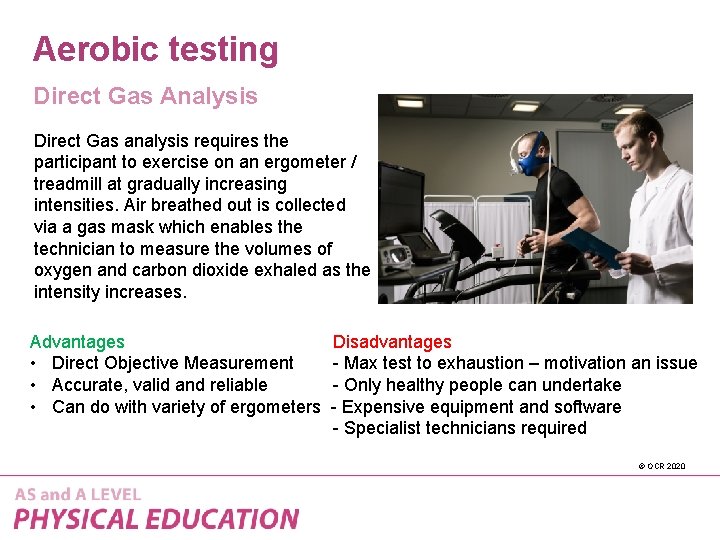
Aerobic testing Direct Gas Analysis Direct Gas analysis requires the participant to exercise on an ergometer / treadmill at gradually increasing intensities. Air breathed out is collected via a gas mask which enables the technician to measure the volumes of oxygen and carbon dioxide exhaled as the intensity increases. Advantages • Direct Objective Measurement • Accurate, valid and reliable • Can do with variety of ergometers Disadvantages - Max test to exhaustion – motivation an issue - Only healthy people can undertake - Expensive equipment and software - Specialist technicians required © OCR 2020
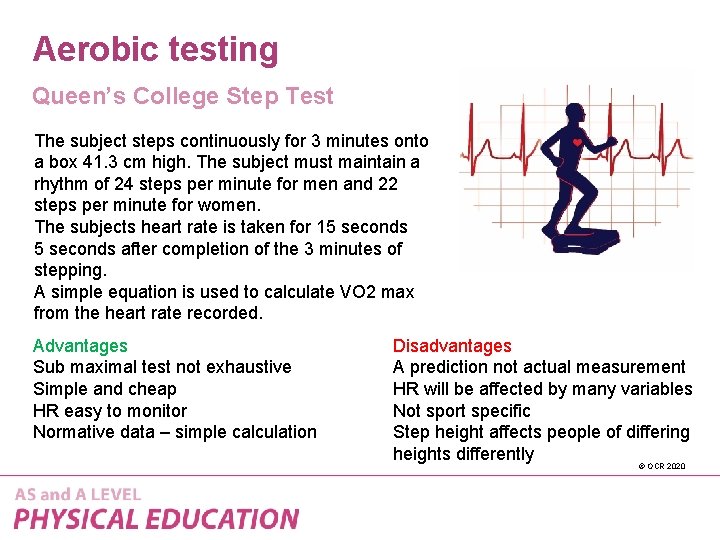
Aerobic testing Queen’s College Step Test The subject steps continuously for 3 minutes onto a box 41. 3 cm high. The subject must maintain a rhythm of 24 steps per minute for men and 22 steps per minute for women. The subjects heart rate is taken for 15 seconds after completion of the 3 minutes of stepping. A simple equation is used to calculate VO 2 max from the heart rate recorded. Advantages Sub maximal test not exhaustive Simple and cheap HR easy to monitor Normative data – simple calculation Disadvantages A prediction not actual measurement HR will be affected by many variables Not sport specific Step height affects people of differing heights differently © OCR 2020
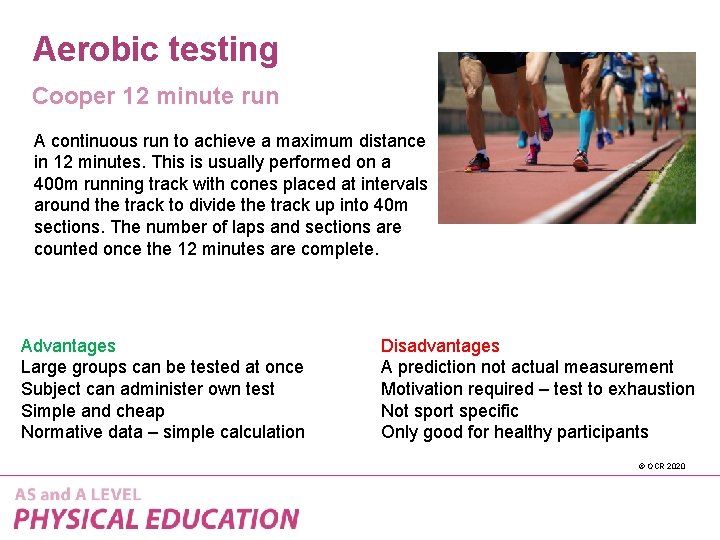
Aerobic testing Cooper 12 minute run A continuous run to achieve a maximum distance in 12 minutes. This is usually performed on a 400 m running track with cones placed at intervals around the track to divide the track up into 40 m sections. The number of laps and sections are counted once the 12 minutes are complete. Advantages Large groups can be tested at once Subject can administer own test Simple and cheap Normative data – simple calculation Disadvantages A prediction not actual measurement Motivation required – test to exhaustion Not sport specific Only good for healthy participants © OCR 2020
Aerobic testing Multi-stage fitness test Subject completes a continuous 20 m shuttle run at progressive intensities to exhaustion. Each shuttle is timed to an audio cue. When the subject can no longer reach the 20 m line on the bleep the test is over. The level and the shuttle completed are compared to a standardised table which will equate to a VO 2 max score. Advantages Large groups can be tested at once Simple and cheap Published tables of VO 2 max Disadvantages A prediction not actual measurement Motivation required – test to exhaustion Not sport specific Only good for healthy participants © OCR 2020

Strength © OCR 2020
Maximum strength The maximum force the neuromuscular system can exert in a singular voluntary contraction. Leg / Grip Dynamometer Multi M -gym R 1 Free Weights © OCR 2020
Static strength The force the neuromuscular system can exert while the muscle length remains constant. Isometric contraction © OCR 2020
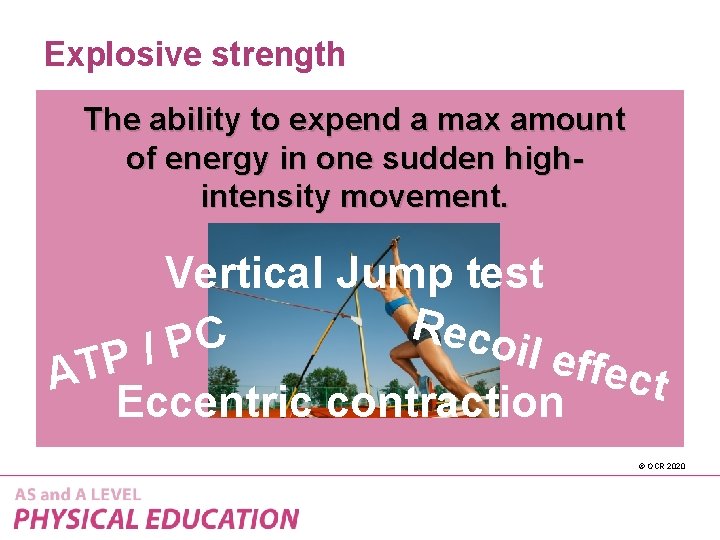
Explosive strength The ability to expend a max amount of energy in one sudden highintensity movement. Vertical Jump test R e c C o P i / l e P ffect T A Eccentric contraction © OCR 2020
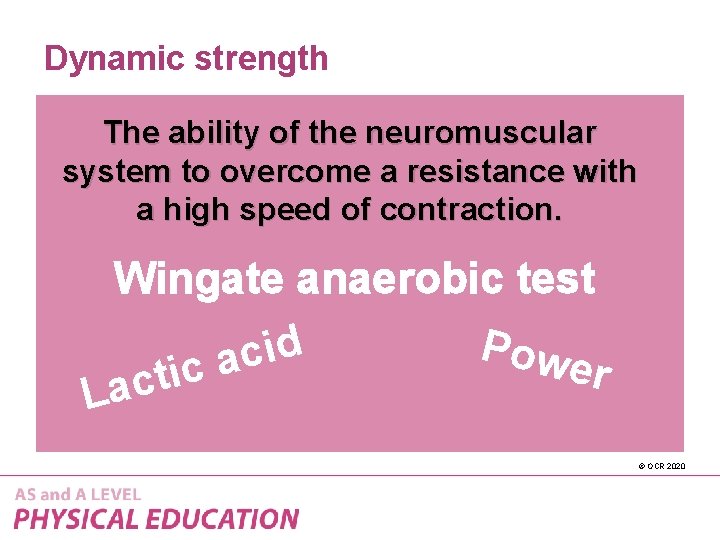
Dynamic strength The ability of the neuromuscular system to overcome a resistance with a high speed of contraction. Wingate anaerobic test P d i o c w a e c r i t c La © OCR 2020

Strength endurance The ability of a muscle to sustain repeated muscle contractions or a single static action. Abdominal sit up test ? y t i c a p M a u c l t c i i g b y o m r e A Circuit training © OCR 2020 D: 78298462
Factors affecting strength 1. 2. 3. 4. 5. 6. Muscle composition Strength training Physical inactivity Genetics Age – decreases from around 18 -30/16 -25 Gender – females less muscle mass and testosterone 7. The weakest point in the range of motion © OCR 2020
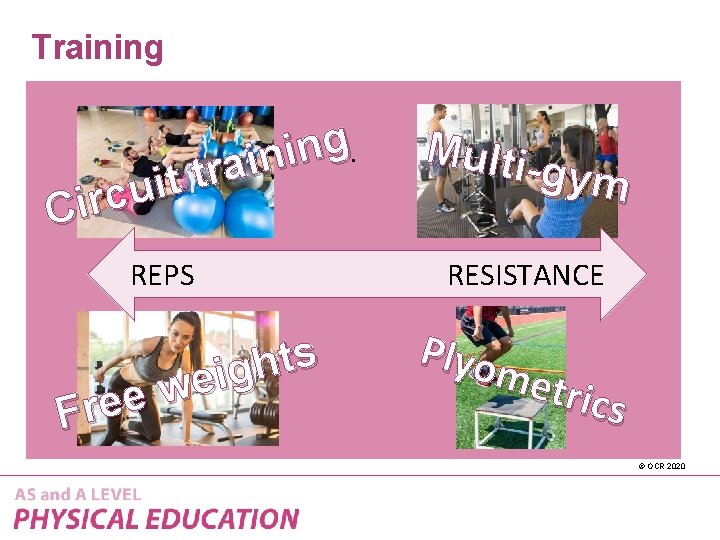
Training g. n i a r t t i u c Cir REPS s t h g i e w e Fre Multigym RESISTANCE Plyo metr ics © OCR 2020
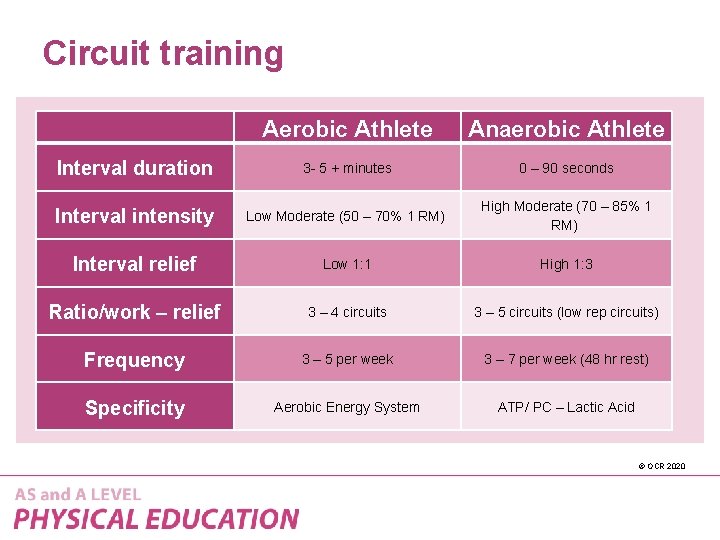
Circuit training Aerobic Athlete . Anaerobic Athlete Interval duration 3 - 5 + minutes 0 – 90 seconds Interval intensity Low Moderate (50 – 70% 1 RM) High Moderate (70 – 85% 1 RM) Interval relief Low 1: 1 High 1: 3 Ratio/work – relief 3 – 4 circuits 3 – 5 circuits (low rep circuits) Frequency 3 – 5 per week 3 – 7 per week (48 hr rest) Specificity Aerobic Energy System ATP/ PC – Lactic Acid © OCR 2020
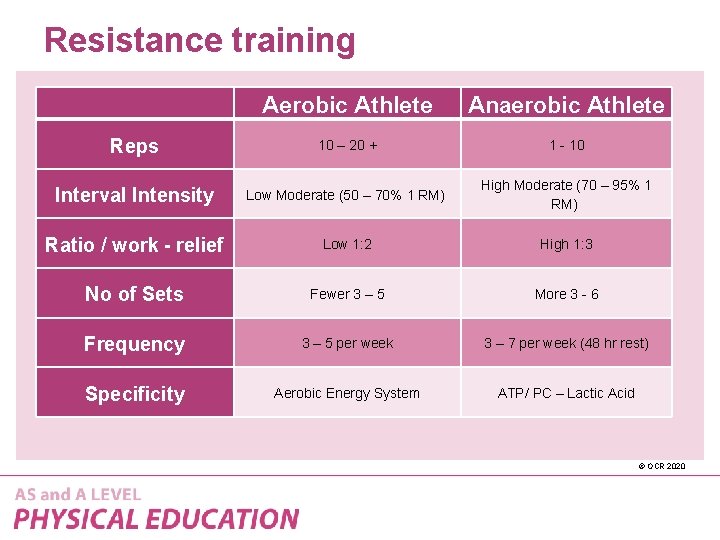
Resistance training Aerobic Athlete . Anaerobic Athlete Reps 10 – 20 + 1 - 10 Interval Intensity Low Moderate (50 – 70% 1 RM) High Moderate (70 – 95% 1 RM) Ratio / work - relief Low 1: 2 High 1: 3 No of Sets Fewer 3 – 5 More 3 - 6 Frequency 3 – 5 per week 3 – 7 per week (48 hr rest) Specificity Aerobic Energy System ATP/ PC – Lactic Acid © OCR 2020
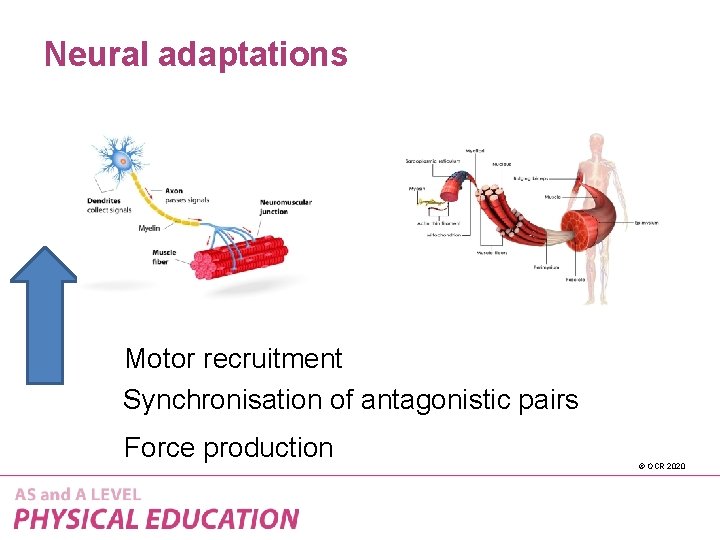
Neural adaptations Motor recruitment Synchronisation of antagonistic pairs Force production © OCR 2020
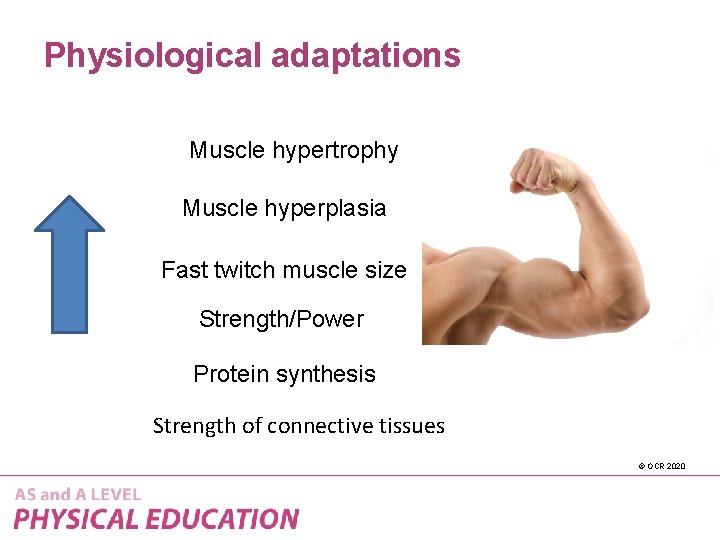
Physiological adaptations Muscle hypertrophy Muscle hyperplasia Fast twitch muscle size Strength/Power Protein synthesis Strength of connective tissues © OCR 2020
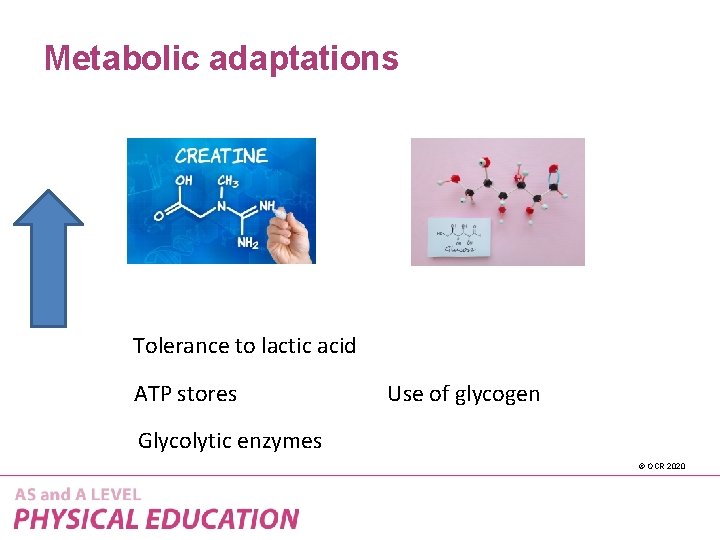
Metabolic adaptations Tolerance to lactic acid ATP stores Use of glycogen Glycolytic enzymes © OCR 2020

Strength training and health What is a good balance? What is healthy? © OCR 2020
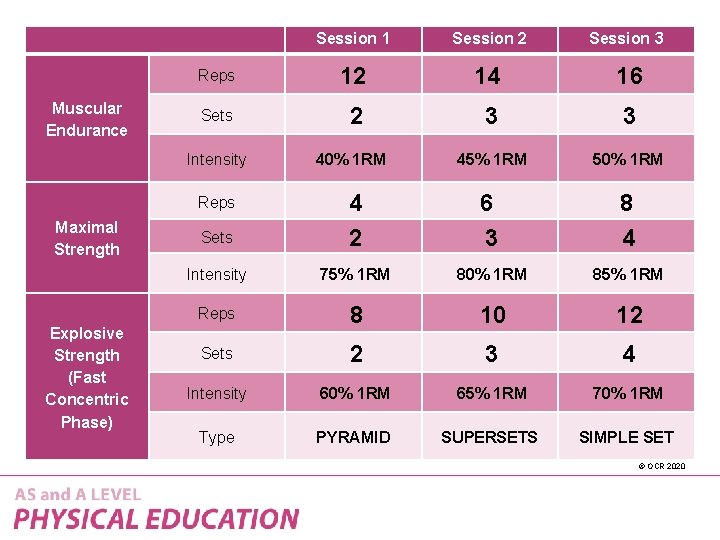
Muscular Endurance Session 1 Session 2 Session 3 Reps 12 14 16 Sets 2 3 3 45% 1 RM 50% 1 RM Sets 4 2 6 3 8 4 Intensity 75% 1 RM 80% 1 RM 85% 1 RM Reps 8 10 12 Sets 2 3 4 Intensity 60% 1 RM 65% 1 RM 70% 1 RM Type PYRAMID SUPERSETS SIMPLE SET Intensity Reps Maximal Strength Explosive Strength (Fast Concentric Phase) 40% 1 RM © OCR 2020

Static flexibility Range of motion about the joint without taking movement into account. © OCR 2020

Dynamic flexibility Range of movement about the joint considering movement. © OCR 2020
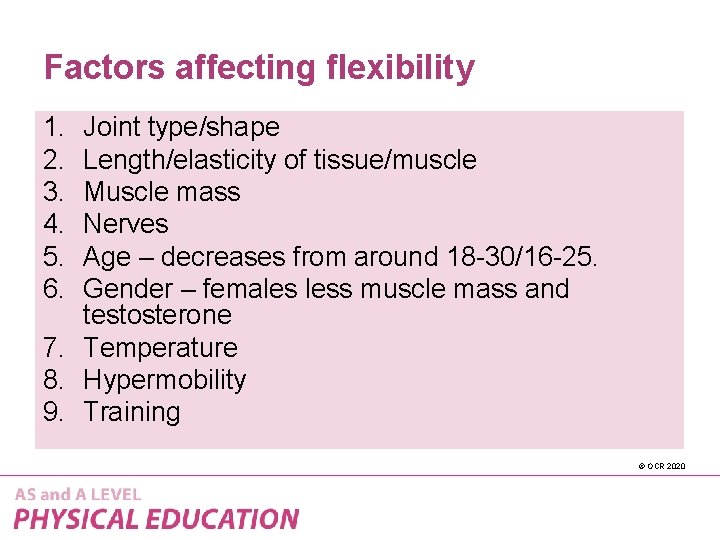
Factors affecting flexibility 1. 2. 3. 4. 5. 6. Joint type/shape Length/elasticity of tissue/muscle Muscle mass Nerves Age – decreases from around 18 -30/16 -25. Gender – females less muscle mass and testosterone 7. Temperature 8. Hypermobility 9. Training © OCR 2020
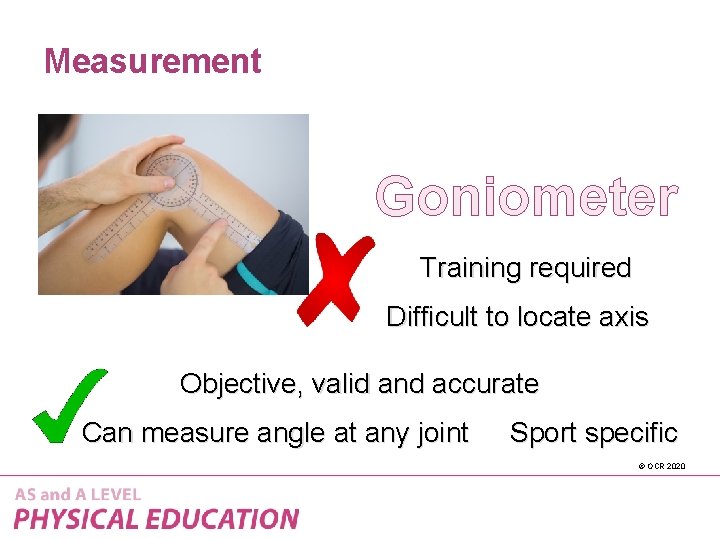
Measurement Goniometer Training required Difficult to locate axis Objective, valid and accurate Can measure angle at any joint Sport specific © OCR 2020
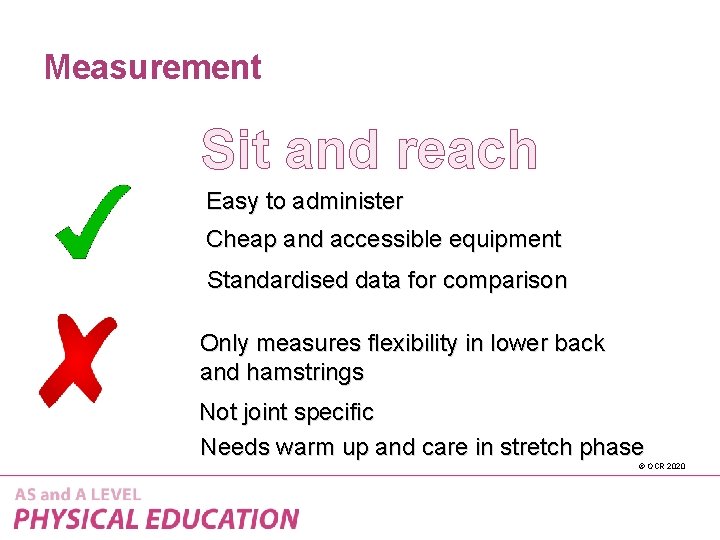
Measurement Sit and reach Easy to administer Cheap and accessible equipment Standardised data for comparison Only measures flexibility in lower back and hamstrings Not joint specific Needs warm up and care in stretch phase © OCR 2020

Training c i t a St g n i h c t stre c i t s i l l a B g n i h c t e r t s Dynam ic stretch PNF © OCR 2020
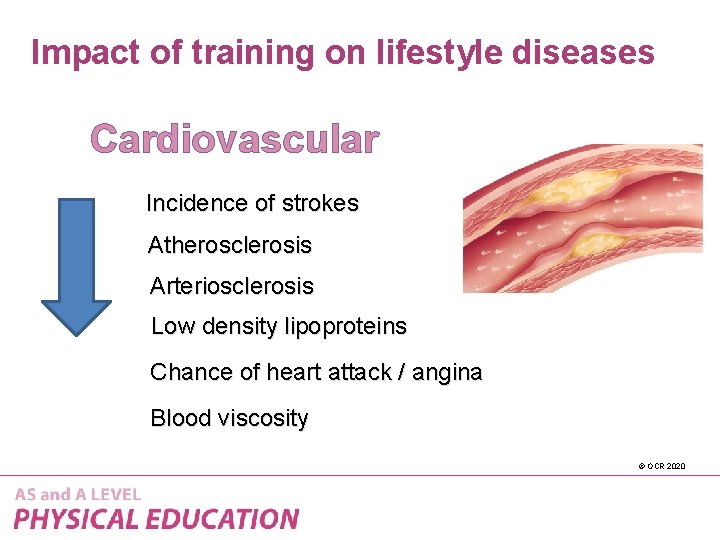
Impact of training on lifestyle diseases Cardiovascular Incidence of strokes Atherosclerosis Arteriosclerosis Low density lipoproteins Chance of heart attack / angina Blood viscosity © OCR 2020
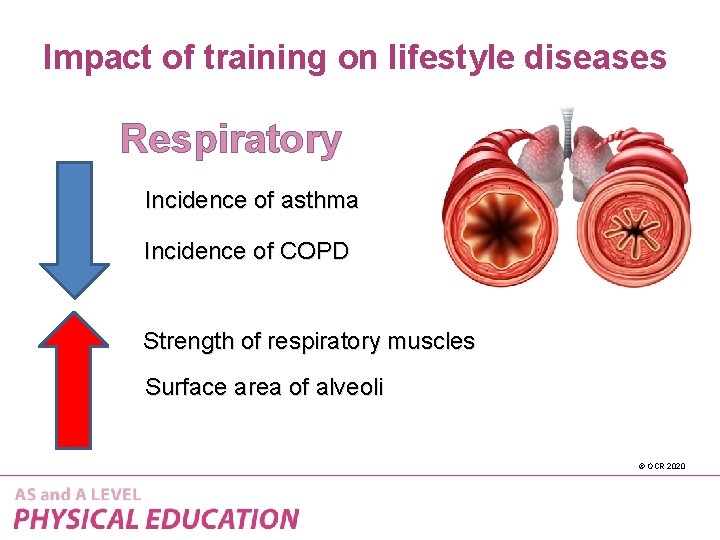
Impact of training on lifestyle diseases Respiratory Incidence of asthma Incidence of COPD Strength of respiratory muscles Surface area of alveoli © OCR 2020

OCR Resources: the small print OCR’s resources are provided to support the delivery of OCR qualifications, but in no way constitute an endorsed teaching method that is required by the Board, and the decision to use them lies with the individual teacher. Whilst every effort is made to ensure the accuracy of the content, OCR cannot be held responsible for any errors or omissions within these resources. Our documents are updated over time. Whilst every effort is made to check all documents, there may be contradictions between published support and the specification, therefore please use the information on the latest specification at all times. Where changes are made to specifications these will be indicated within the document, there will be a new version number indicated, and a summary of the changes. If you do notice a discrepancy between the specification and a resource please contact us at: resources. feedback@ocr. org. uk. © OCR 2020 - This resource may be freely copied and distributed, as long as the OCR logo and this message remain intact and OCR is acknowledged as the originator of this work. OCR acknowledges the use of the following content: Slide 19: Direct gas analysis – Photographee. eu/Shutterstock. com, Slide 20: Heart rate image – Athanasia Nomikou/Shutterstock. com, Slide 21: Running on a track – Pavel 1964/Shutterstock. com, Slide 23: Using weights in a gym – Dean Drobot/Shutterstock. com, Slide 24: Man lifting weights – takoburito/Shutterstock. com, Slide 26: High jumper – Master 1305/Shutterstock. com, Slide 28: Rowers on a lake – Diego Barbieri/Shutterstock. com, Slide 30: Circuit training – lunamarina/Shutterstock. com, Using a multi-gym – Monkey Business Images/Shutterstock. com, Women using weights – Bojan Milinkov/Shutterstock. com, Plyometrics – Woodys. Photos/Shutterstock. com, Slide 33: Neural pathways Designua/Shutterstock. com, Muscle anatomy – sciencepics/Shutterstock. com, Slide 34: Biceps, lulian Valentin/Shutterstock. com, Slide 35: Formula for Creatin – Zerbor/Shutterstock. com, Glucose – Danijela Maksimovic/Shutterstock. com, Slide 36: Muscular man with weights – Nikolas_jkd/Shutterstock. com, Measuring bicep – Paradise studio/Shutterstock. com, Slide 38: Woman stretching – Romariolen/Shutterstock. com, Slide 39: Gymnast – Artur Didyk/Shutterstock. com, Slide 41: Goniometer – ESB Professional/Shutterstock. com, Slide 43: Static stretching, Synda Productions/Shutterstock. com, Dynamic stretch – Maridav. Shutterstock. com, Ballistic stretch – yurakrasil/Shutterstock. com, Physio helping woman stretch – Photographee. eu/Shutterstock. com, Slide 44: Vascular atherosclerosis cutaway view – Medical Art Inc/Shutterstock. com, Slide 45: Asthma diagram – Lightspring/Shutterstock. com Please get in touch if you want to discuss the accessibility of resources we offer to support delivery of our qualifications: resources. feedback@ocr. org. uk © OCR 2020
- Slides: 46