
Compliant Mechanisms Presented By Ravi Agrawal Binoy Shah

Compliant Mechanisms Presented By: Ravi Agrawal, Binoy Shah, and Eric Zimney Northwestern University Compliant Mechanisms ME 381 – Fall 2004
Outline • • Working Principal Advantages and Disadvantages Compliance in MEMS devices Design and Optimization Analysis: Static and Dynamic Example Devices Conclusion Northwestern University Compliant Mechanisms ME 381 – Fall 2004
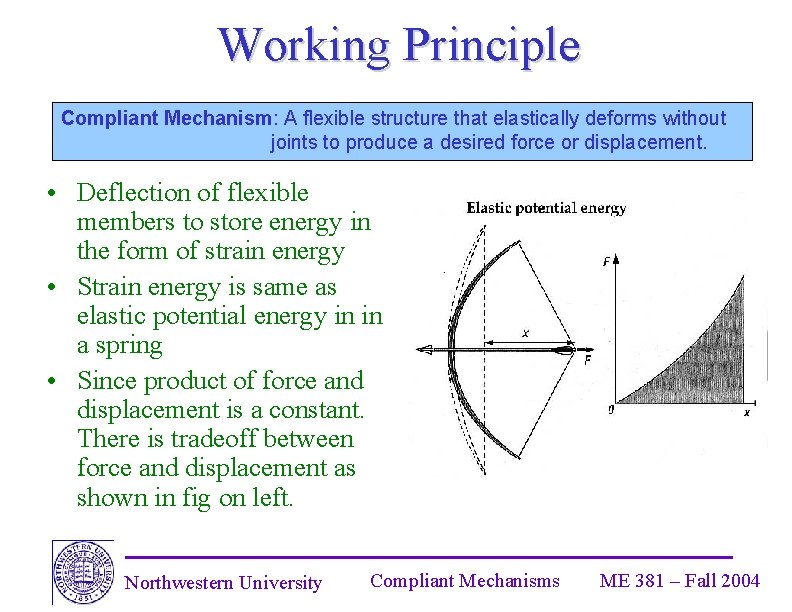
Working Principle Compliant Mechanism: A flexible structure that elastically deforms without joints to produce a desired force or displacement. • Deflection of flexible members to store energy in the form of strain energy • Strain energy is same as elastic potential energy in in a spring • Since product of force and displacement is a constant. There is tradeoff between force and displacement as shown in fig on left. Northwestern University Compliant Mechanisms ME 381 – Fall 2004
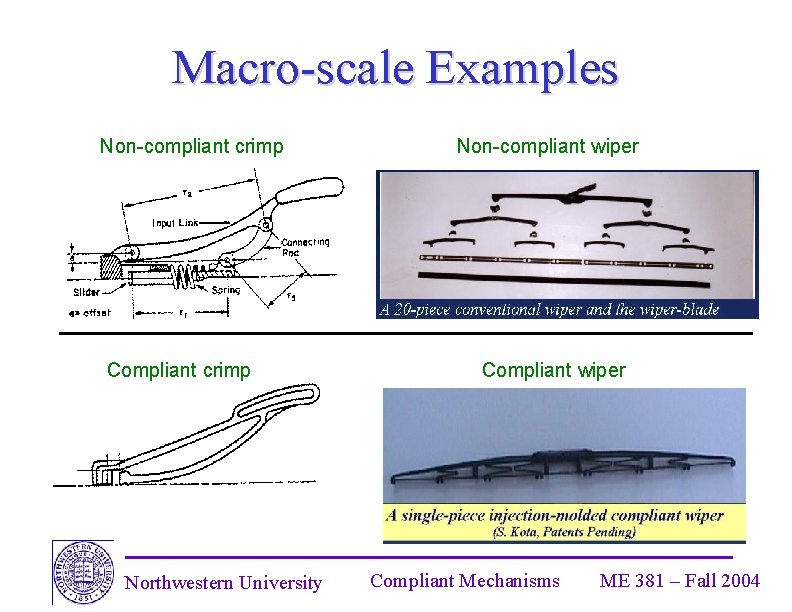
Macro-scale Examples Non-compliant crimp Compliant crimp Northwestern University Non-compliant wiper Compliant Mechanisms ME 381 – Fall 2004
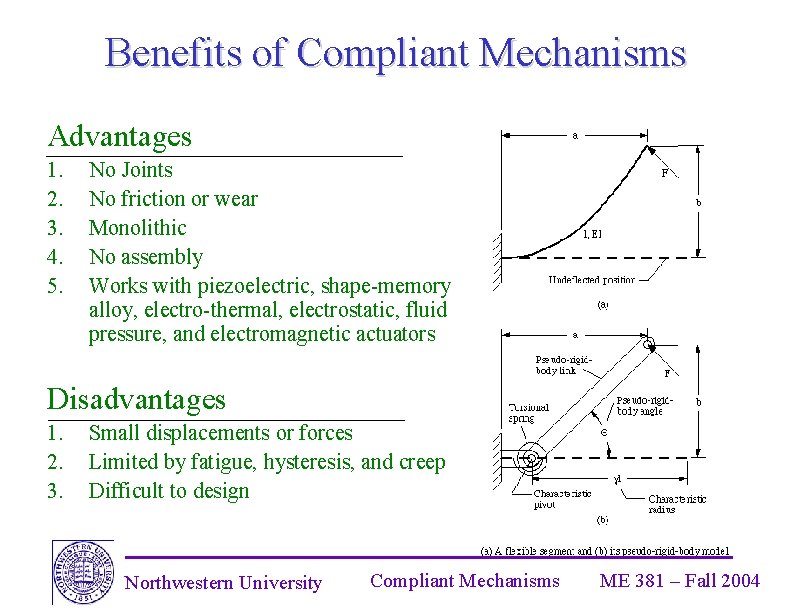
Benefits of Compliant Mechanisms Advantages 1. 2. 3. 4. 5. No Joints No friction or wear Monolithic No assembly Works with piezoelectric, shape-memory alloy, electro-thermal, electrostatic, fluid pressure, and electromagnetic actuators Disadvantages 1. 2. 3. Small displacements or forces Limited by fatigue, hysteresis, and creep Difficult to design Northwestern University Compliant Mechanisms ME 381 – Fall 2004
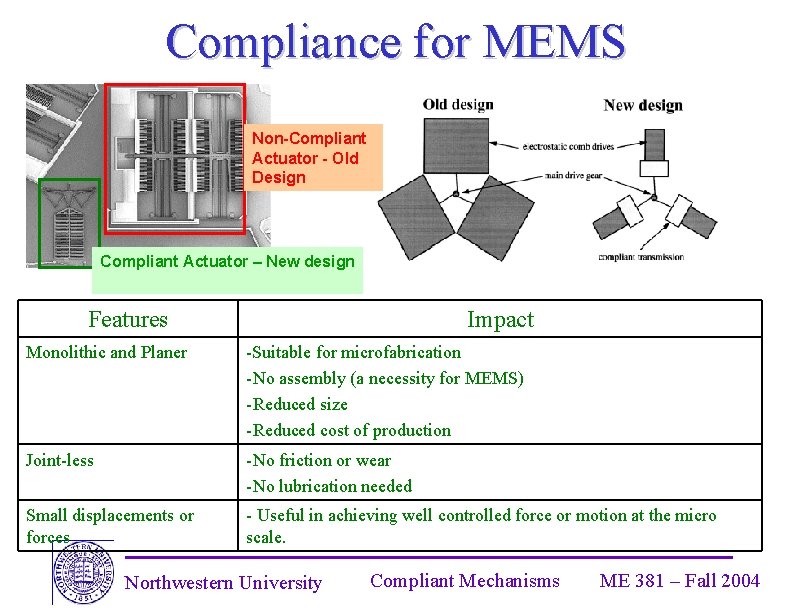
Compliance for MEMS Non-Compliant Actuator - Old Design Compliant Actuator – New design Features Impact Monolithic and Planer -Suitable for microfabrication -No assembly (a necessity for MEMS) -Reduced size -Reduced cost of production Joint-less -No friction or wear -No lubrication needed Small displacements or forces - Useful in achieving well controlled force or motion at the micro scale. Northwestern University Compliant Mechanisms ME 381 – Fall 2004
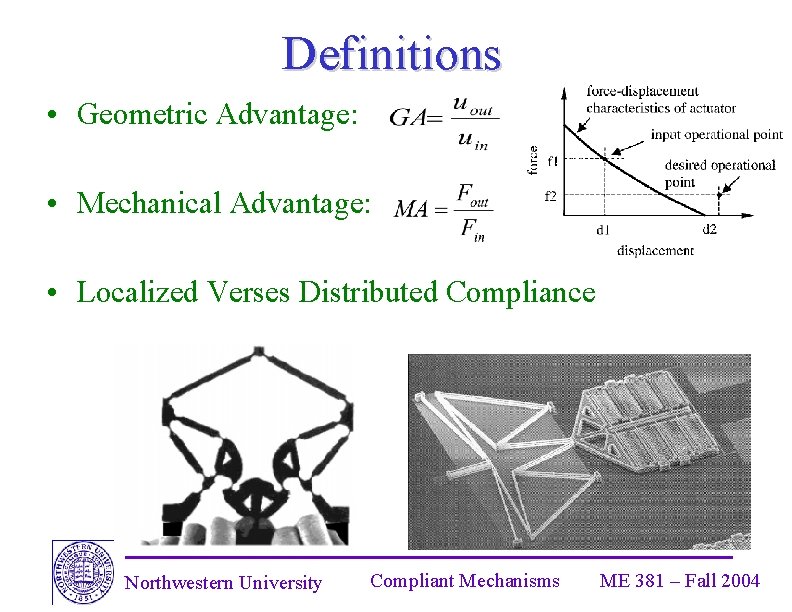
Definitions • Geometric Advantage: • Mechanical Advantage: • Localized Verses Distributed Compliance Northwestern University Compliant Mechanisms ME 381 – Fall 2004
Design of Distributed Compliant Mechanisms • Topology Synthesis – Develop kinematic design to meet input/output constraints. – Optimization routine incompatible with stress analysis. • Size and Shape Optimization – Enforce Performance Requirements to determine optimum dimensions. Northwestern University Compliant Mechanisms ME 381 – Fall 2004
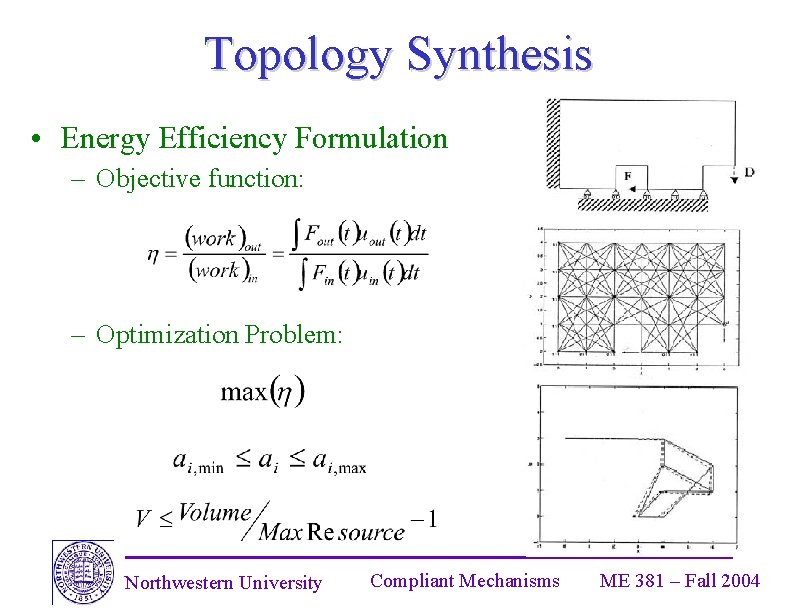
Topology Synthesis • Energy Efficiency Formulation – Objective function: – Optimization Problem: Northwestern University Compliant Mechanisms ME 381 – Fall 2004
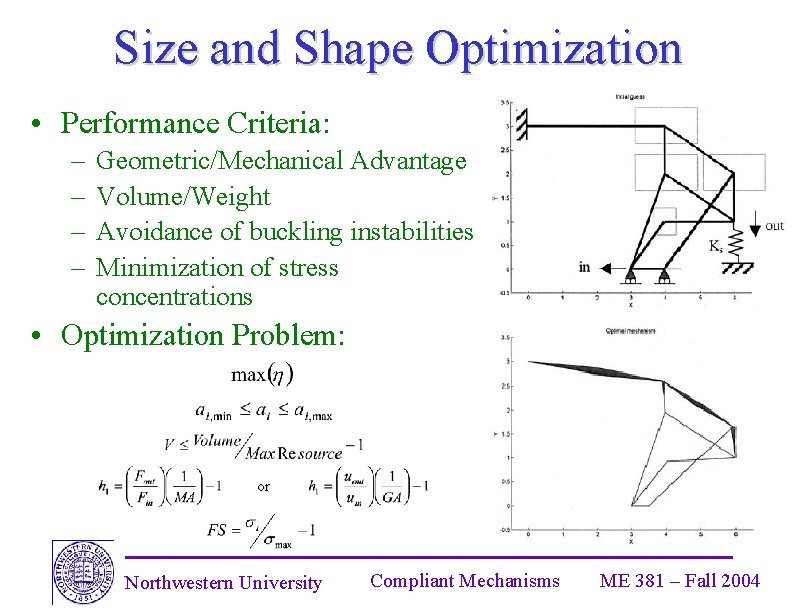
Size and Shape Optimization • Performance Criteria: – – Geometric/Mechanical Advantage Volume/Weight Avoidance of buckling instabilities Minimization of stress concentrations • Optimization Problem: or Northwestern University Compliant Mechanisms ME 381 – Fall 2004
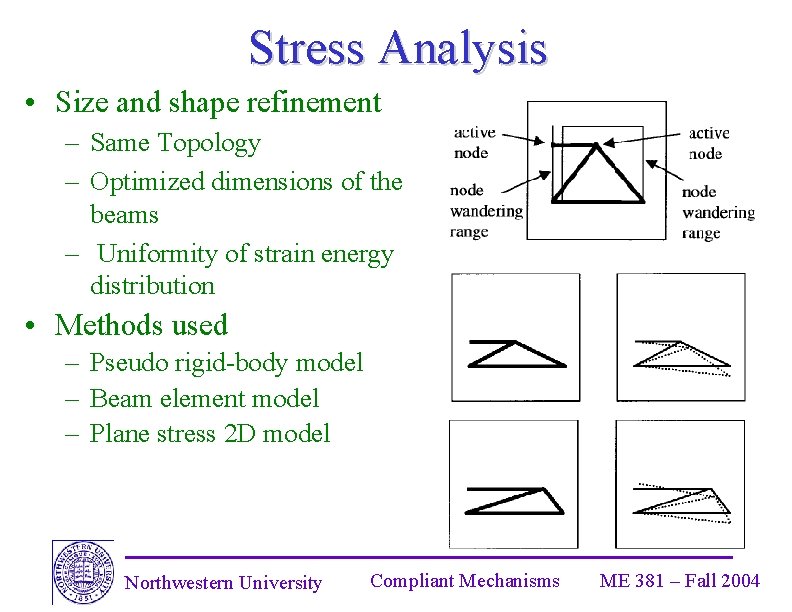
Stress Analysis • Size and shape refinement – Same Topology – Optimized dimensions of the beams – Uniformity of strain energy distribution • Methods used – Pseudo rigid-body model – Beam element model – Plane stress 2 D model Northwestern University Compliant Mechanisms ME 381 – Fall 2004
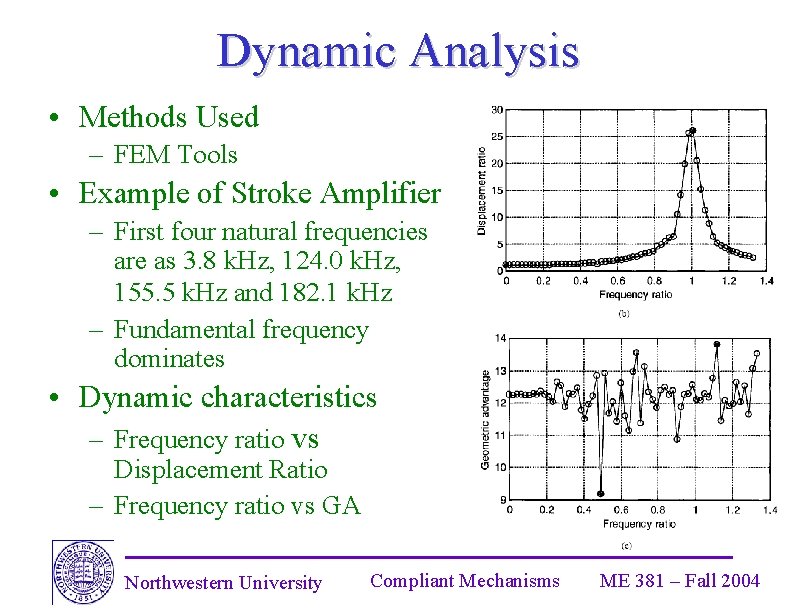
Dynamic Analysis • Methods Used – FEM Tools • Example of Stroke Amplifier – First four natural frequencies are as 3. 8 k. Hz, 124. 0 k. Hz, 155. 5 k. Hz and 182. 1 k. Hz – Fundamental frequency dominates • Dynamic characteristics – Frequency ratio vs Displacement Ratio – Frequency ratio vs GA Northwestern University Compliant Mechanisms ME 381 – Fall 2004
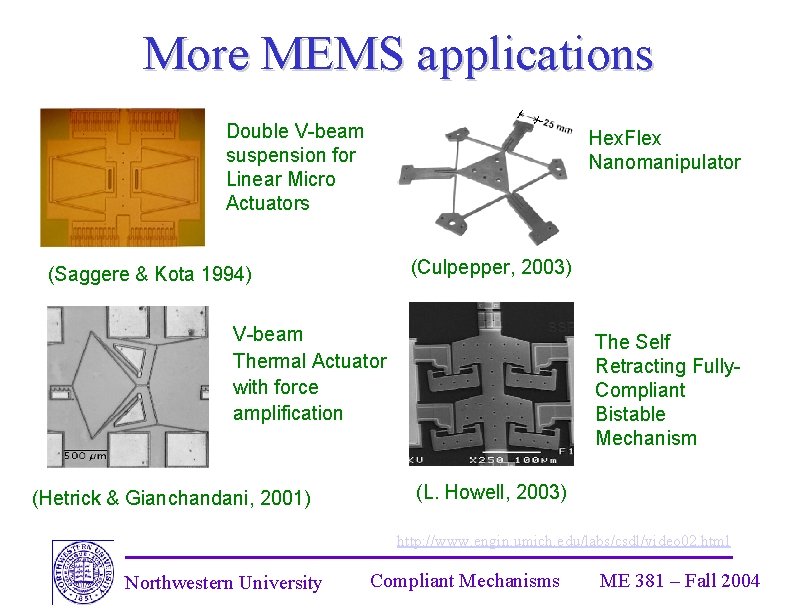
More MEMS applications Double V-beam suspension for Linear Micro Actuators Hex. Flex Nanomanipulator (Culpepper, 2003) (Saggere & Kota 1994) V-beam Thermal Actuator with force amplification (Hetrick & Gianchandani, 2001) The Self Retracting Fully. Compliant Bistable Mechanism (L. Howell, 2003) http: //www. engin. umich. edu/labs/csdl/video 02. html Northwestern University Compliant Mechanisms ME 381 – Fall 2004
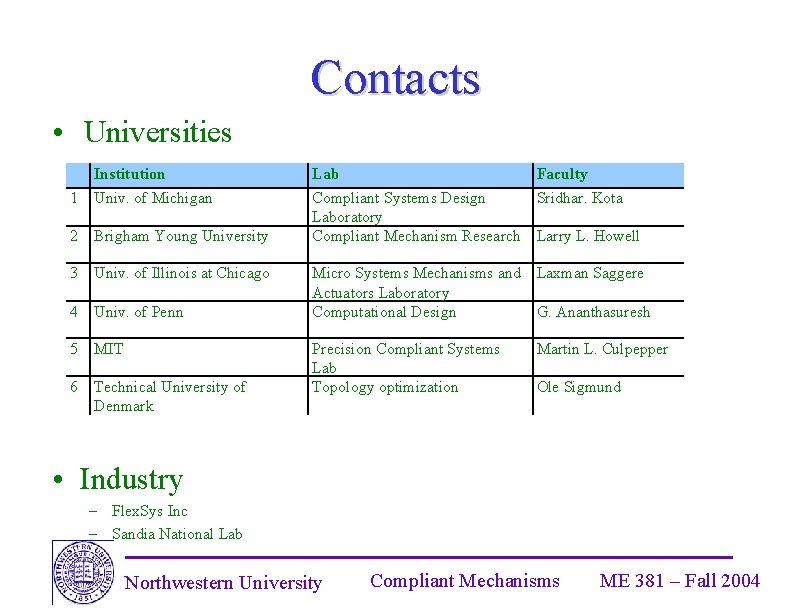
Contacts • Universities Institution Lab Faculty 1 Univ. of Michigan 2 Brigham Young University Compliant Systems Design Sridhar. Kota Laboratory Compliant Mechanism Research Larry L. Howell 3 Univ. of Illinois at Chicago 4 Univ. of Penn 5 MIT 6 Technical University of Denmark Micro Systems Mechanisms and Laxman Saggere Actuators Laboratory Computational Design G. Ananthasuresh Precision Compliant Systems Lab Topology optimization Martin L. Culpepper Ole Sigmund • Industry – Flex. Sys Inc – Sandia National Lab Northwestern University Compliant Mechanisms ME 381 – Fall 2004
Conclusion • Stores potential energy and outputs displacement or force • Monolithic – no joints, no assembly, no friction • Small but controlled forces or displacements • Can tailor design to performance characteristics. • Performance dependent on output • Difficult to design • Examples: Hex. Flex Nanomanipulator, Micro. Engine, Force Amplifier Northwestern University Compliant Mechanisms ME 381 – Fall 2004
- Slides: 15